“Man is a feeling creature, and because of it, the greatest in the universe….”
Hell yeah! You tell ’em, Peter Graves!
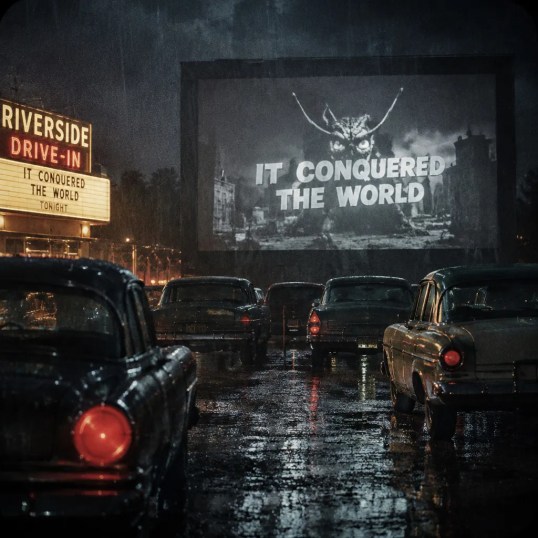
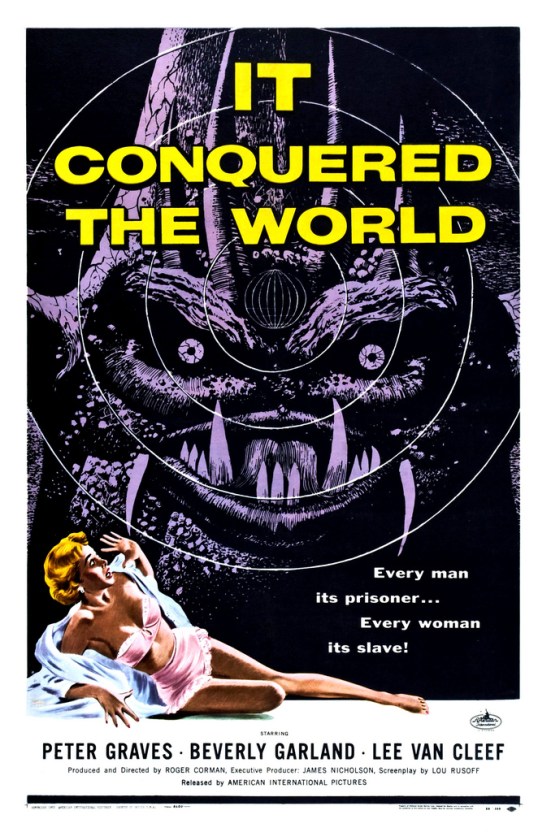
In 1956’s It Conquered The World. Graves plays a scientist who watches in horror as his small town and all of the people who he loves and works with are taken over by an alien. Rival scientist Lee Van Cleef thinks that the alien is going to make the world a better place but Graves understands that a world without individual freedom isn’t one that’s worth living in.
This is one of Corman’s most entertaining films, featuring not only Graves and Van Cleef but also the great Beverly Garland. Like many horror and science fiction films of the 50s, it’s subtext is one of anti-collectivism. Depending on your politics, you could view the film as either a criticism of communism or McCarthyism. Watching the film today, with its scenes of the police and the other towns people hunting anyone who fails to conform or follow orders, it’s hard not to see the excesses of the COVID era.
Of course, there’s also a very persuasive argument to be made that maybe we shouldn’t worry too much about subtext and we should just enjoy the film as a 50s B-movie that was directed with the Corman touch.
Regardless of how interpret the film, I defy anyone not to smile at the sight of ultra-serious Peter Graves riding his bicycle from one location to another.
Here, for your viewing pleasure, is It Conquered The World!
“You see, in this world there’s two kinds of people, my friend: those with loaded guns and those who dig. You dig.” — Blondie
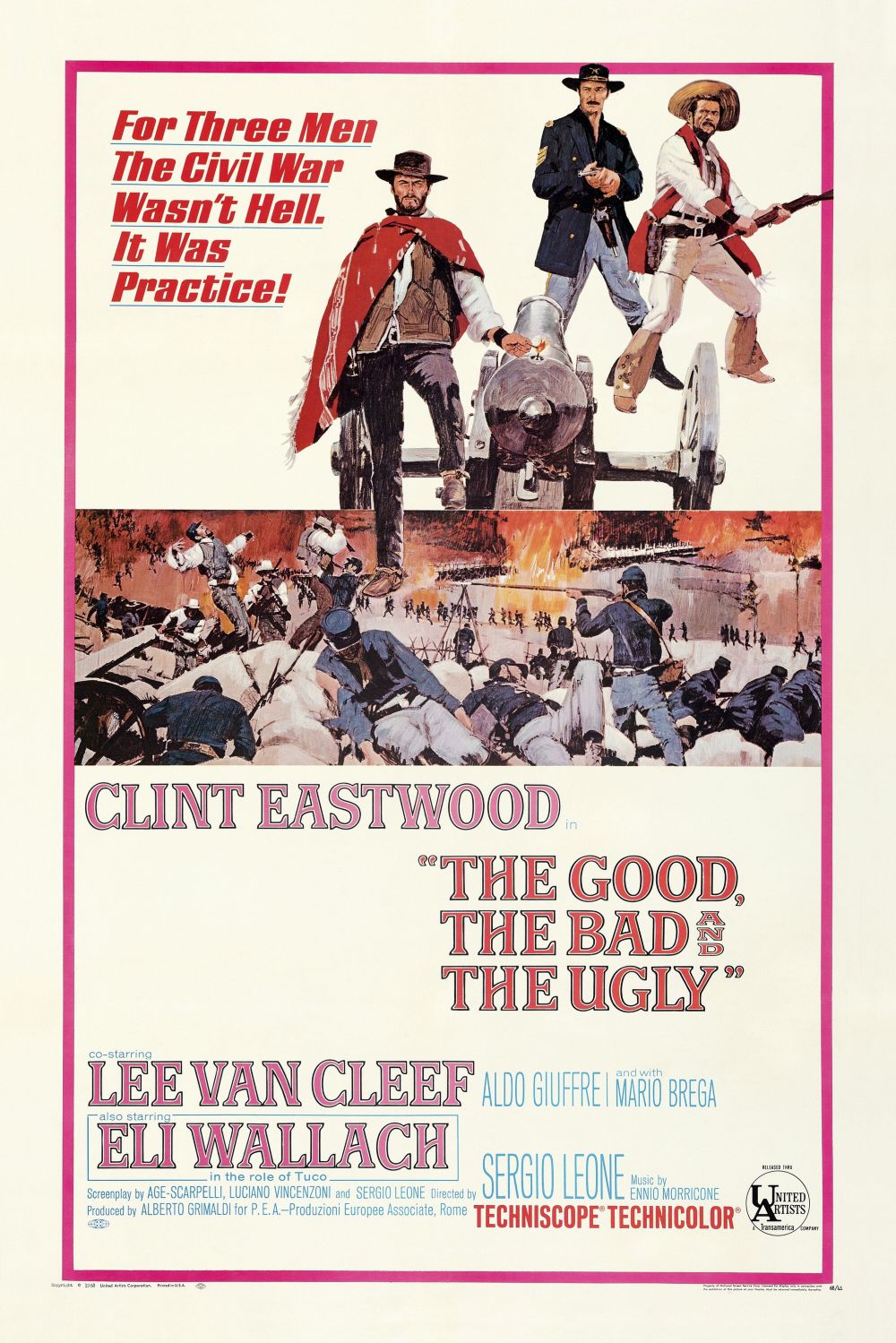
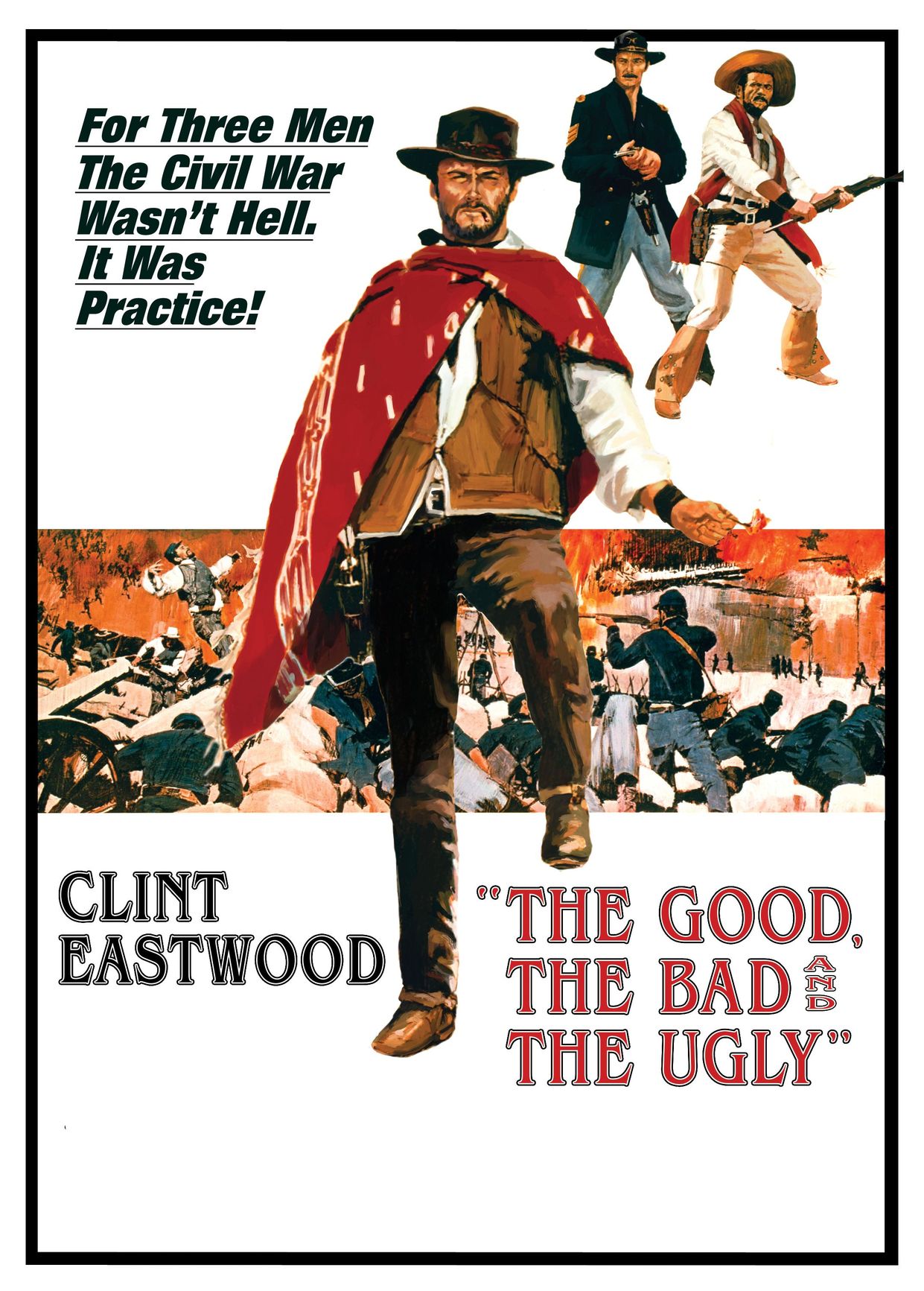
Sergio Leone’s The Good, the Bad and the Ugly is the kind of movie that feels so foundational that it can be easy to forget how strange, bold, funny, and downright operatic it still is. Released in 1966, it was the third and final leg of Leone’s “Dollar’s Trilogy,” following A Fistful of Dollars and For a Few Dollars More, and it takes the stripped-down antihero Western formula of those earlier films to its most grandiose extreme. It is bigger in scale, longer in runtime, more openly concerned with the Civil War, and more confident about lingering on faces, landscapes, corpses, explosions, and silences until they become almost mythic. It is also just an enormously entertaining movie: violent, cynical, hilarious, tense, and powered by one of the greatest scores ever written for film.
The title is simple, but the movie’s moral categories are deliberately slippery. Clint Eastwood plays Blondie, the “Good,” though he is not good in any conventional heroic sense. He is a mercenary drifter with a cool head, a quick draw, and a willingness to exploit the desperate when there is money involved. Lee Van Cleef is Angel Eyes, the “Bad,” a cold professional killer whose cruelty is more orderly and methodical than emotional. Eli Wallach, meanwhile, plays Tuco, the “Ugly,” a bandit, liar, survivor, and chaos agent who is arguably the most human person in the whole film. Leone uses those labels less as literal definitions than as a rough guide to the way each man moves through the world. Blondie may possess the closest thing the story has to a moral code, Angel Eyes is openly monstrous, and Tuco is shamelessly selfish, but all three are driven by greed and survival.
The plot begins with Blondie and Tuco running a scam across the frontier. Blondie collects bounties by turning Tuco in to authorities, then rescues him at the last possible moment before a hanging, allowing the two men to repeat the process elsewhere. Their partnership is profitable but unstable, especially because Blondie holds all the power. When he finally abandons Tuco in the desert after an argument, it sets the tone for the film’s shifting alliances and personal grudges. From there, the story expands into a hunt for buried Confederate gold, with Angel Eyes learning of the treasure independently and pursuing it with ruthless efficiency. The treasure hunt is the basic engine of the story, but the movie keeps finding detours that make it richer: prison camps, mistaken identities, Confederate soldiers, battlefield carnage, a destroyed bridge, family resentments, and a final trip to a cemetery that has become one of the most famous endings in cinema.
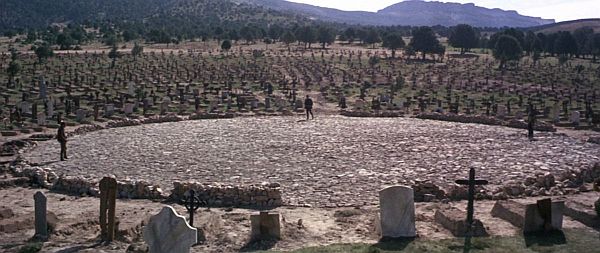
Leone’s great gift is making time itself feel dramatic. The movie is long, but it rarely feels aimless because the director understands how to stretch anticipation. He can hold a close-up for what seems like an eternity, cut between eyes and hands, let a character slowly realize they are trapped, and then release all that pressure in a flash of violence or a perfectly timed joke. The famous three-way standoff at Sad Hill Cemetery is the clearest example. It is not simply a gunfight. It is a miniature psychological war in which every glance matters, every hand movement becomes a potential death sentence, and Ennio Morricone’s music turns the scene into a kind of ritual. The sequence is so iconic because Leone earns it through buildup. He has spent nearly three hours teaching the audience that in this world, watching someone’s eyes can be more important than hearing what they say.
The direction is often described as stylized, but that undersells how carefully Leone balances visual exaggeration with emotional clarity. His close-ups are huge and intimate, showing cracked skin, sweat, stubble, narrowed eyes, and crooked grins in almost absurd detail. Then he will cut to an enormous wide shot in which a lone person barely registers against a desert, battlefield, or cemetery. That contrast makes the characters feel both larger than life and insignificant before the violence surrounding them. Leone’s West is not the clean, heroic frontier found in many older Hollywood Westerns. It is dusty, harsh, crowded with hungry people, and full of soldiers dying for causes that seem distant from their actual suffering. Even when the movie is funny, its world feels unforgiving.
The Civil War setting gives The Good, the Bad and the Ugly a weight that the earlier films in the trilogy do not have in quite the same way. Leone does not transform the picture into a historical drama, and the central story remains about three men chasing money, but he keeps placing their selfish adventure against the machinery of mass death. Blondie and Tuco witness prisoners being beaten, soldiers dying pointlessly, and whole military operations built around the destruction of a bridge. One of the film’s most memorable passages involves a Union captain who has become numb to the casualties under his command. His view of war is not glorious or triumphant; it is weary and sickened. That attitude makes Leone’s spectacle more complicated. The explosions are impressive, and the battle scenes are visually massive, but the movie never suggests that war is noble simply because it looks grand on screen.
Clint Eastwood’s performance is a major reason Blondie remains one of cinema’s defining gunslingers. Eastwood had already established the character type in the previous Leone films, but here he seems fully at ease with the role’s economy. He does not need much dialogue because his posture, timing, and faintly amused stare communicate almost everything. Blondie is always calculating. Even when he appears relaxed, he is noticing the exit, the weapon, the weakness in the other person’s plan. Eastwood makes him cool without making him hollow, and he wisely avoids trying to turn Blondie into a conventional saint. The character can be compassionate, especially compared with Angel Eyes, but he also enjoys having leverage over Tuco. Their relationship is not friendship in any easy sense. It is an ugly, funny bond forged out of mutual usefulness.
Lee Van Cleef is equally effective, though in a very different register. Angel Eyes is terrifying because he never seems hurried or uncertain. He treats murder as a job, and his calm politeness only makes him worse. There is a scene early in the movie where he murders a man after receiving information from him, and the point is immediately clear: Angel Eyes does not make promises he considers inconvenient, and he does not feel guilty about it. Van Cleef’s sharp features and measured delivery make him seem almost supernatural, like death walking around in a black hat. Yet he is not a cartoon. He is a predator with discipline, and the movie understands that competence can be frightening on its own.
Still, Eli Wallach is arguably the film’s secret weapon. Tuco is the character who gives the movie much of its energy, humor, and emotional unpredictability. He is loud where Eastwood is quiet, messy where Van Cleef is controlled, and constantly talking because silence would probably drive him crazy. Wallach gives a performance that could have become exhausting in lesser hands, but he makes Tuco vivid rather than merely obnoxious. You can see the intelligence beneath his impulsiveness. Tuco survives because he can adapt, plead, threaten, deceive, and explode into violence depending on what the moment requires. He also has flashes of pain that make him more than comic relief, particularly when the story briefly brings him face to face with his brother and the life he might have had. That scene gives the movie an unexpected emotional wrinkle without forcing Tuco into a redemption arc he does not deserve.
Morricone’s score deserves its legendary reputation because it does much more than decorate the action. The music creates the film’s atmosphere from the first seconds, with its coyote-like call, whistles, percussion, voices, and electric-guitar edge. It sounds ancient and modern at the same time, perfectly suited to Leone’s version of the West, which is less historical recreation than fever dream. Themes such as “The Ecstasy of Gold” and “The Trio” have become inseparable from the film, but they retain their power even outside their famous scenes. “The Ecstasy of Gold,” accompanying Tuco’s frantic run through the cemetery, is especially remarkable. The music turns what could have been a simple moment of greed into a spiritual experience. Tuco is not merely looking for a grave; he is racing through a landscape of death toward the possibility of salvation, wealth, and survival.
What makes the movie endure is that it never asks the audience to choose between pleasure and substance. It is a masterpiece of style, full of unforgettable faces, brilliant editing, enormous landscapes, and some of the sharpest visual storytelling in the genre. At the same time, it is funny in a dark, mean-spirited way, and it is skeptical about every institution around its characters. Governments send men to die. Criminals betray one another. Families fail to heal old wounds. Religion offers comfort but not necessarily rescue. Money remains the closest thing to a shared religion, and even that cannot guarantee anyone’s safety.
As the final installment of Leone’s “Dollar’s Trilogy,” The Good, the Bad and the Ugly feels like a culmination rather than just a sequel. It takes the mysterious Eastwood gunslinger, the tension between rival bounty hunters and criminals, and the morally barren frontier of the first two films, then expands them into something almost epic. The movie’s scale can make it feel less intimate than For a Few Dollars More, but that is part of its appeal. Leone is not trying to make a neat ending to a continuous story. He is making the biggest, loudest, most definitive statement he can with the ideas the trilogy has been building toward.
Even now, the film’s influence is everywhere: in action movies that use silence as suspense, in antiheroes whose morality is relative rather than pure, in directors who treat a showdown as choreography, and in scores that become characters in their own right. But influence is not the same as replacement. Plenty of movies have copied Leone’s close-ups, pacing, gunfighters, and musical bravado. Very few have matched the strange balance that makes The Good, the Bad and the Ugly feel so alive. It is simultaneously a Western adventure, a black comedy, a war movie, a fable about greed, and a giant cinematic performance piece. By the time the final duel arrives, the film has become exactly what the title promises: a collision between the good, the bad, and the ugly parts of human nature, staged with enough style to make it unforgettable.
My wife is due a good, relaxing vacation at the beach. Back in June, we took off from central Arkansas in our Toyota Camry, eventually making our way to the Canadian border and back home over the course of about 9 days. We drove around 3,500 miles with stops in Nashville, Pittsburgh, Philadelphia, White River Junction (VT), Niagara Falls, Louisville, and Memphis. We had a blast, and it was a special trip, but we were worn out when we got home. Well next week I’m taking her to the beautiful white sands of Perdido Key, FL. She told me that she may not want to leave the condo all week! While I suspect that may not be completely true, I do understand her desire to relax with a beautiful view, a brisk gulf breeze, and a few opportunities to dig her toes into the sand. We can’t wait!
I’m also looking forward to settling in with a few of the entertainment related books on my shelf. I’m definitely taking these three:
“Boxed In – Trapped in 80’s Television,” by Fanacek: I’ve read the first 100 pages of this exhaustively researched book on 80’s TV. It’s a very funny read, and it’s full of so much good info, especially for someone like me who went from 7 to 17 during that decade. I literally grew up on the shows he discusses. And just in case you’re worried I’ll finish it too early in the week, rest easy because it’s about 750 pages long. I may not get to anything else!!
“Marlon Brando – Hollywood Rebel,” by Burt Kearns: I must confess that I don’t know as much about Marlon Brando as I should, especially if I want to call myself a serious film buff. Burt has been a guest on the This Week in Charles Bronson podcast a couple of times, and I enjoyed his book on troubled Hollywood tough guy Lawrence Tierney. I think he’ll be the perfect guide as I enter the world of Brando.
“Winner Takes All – a life of sorts,” by Michael Winner: I really need to read this one. Michael Winner directed the first three DEATH WISH films, and a total of six Charles Bronson films, so I know there will be a lot of good information on my movie hero. Winner also directed a lot of other good movies and even spent time as a restaurant/ food critic in his later years. It’s well past time for me to cross this one off the list.
There are others that I’ll probably take as well, such as Dwayne Epstein’s “Killin’ Generals: The Making of the Dirty Dozen” and “Lee Van Cleef” by Mike Malloy. I can definitely see some Brad’s Book Reviews in the near future! I’m just excited to have some time to slow down, relax and read about the people who interest me.
“When two hunters go after the same prey, they usually end up shooting each other in the back. And we don’t want to shoot each other in the back.” — Col. Douglas Mortimer
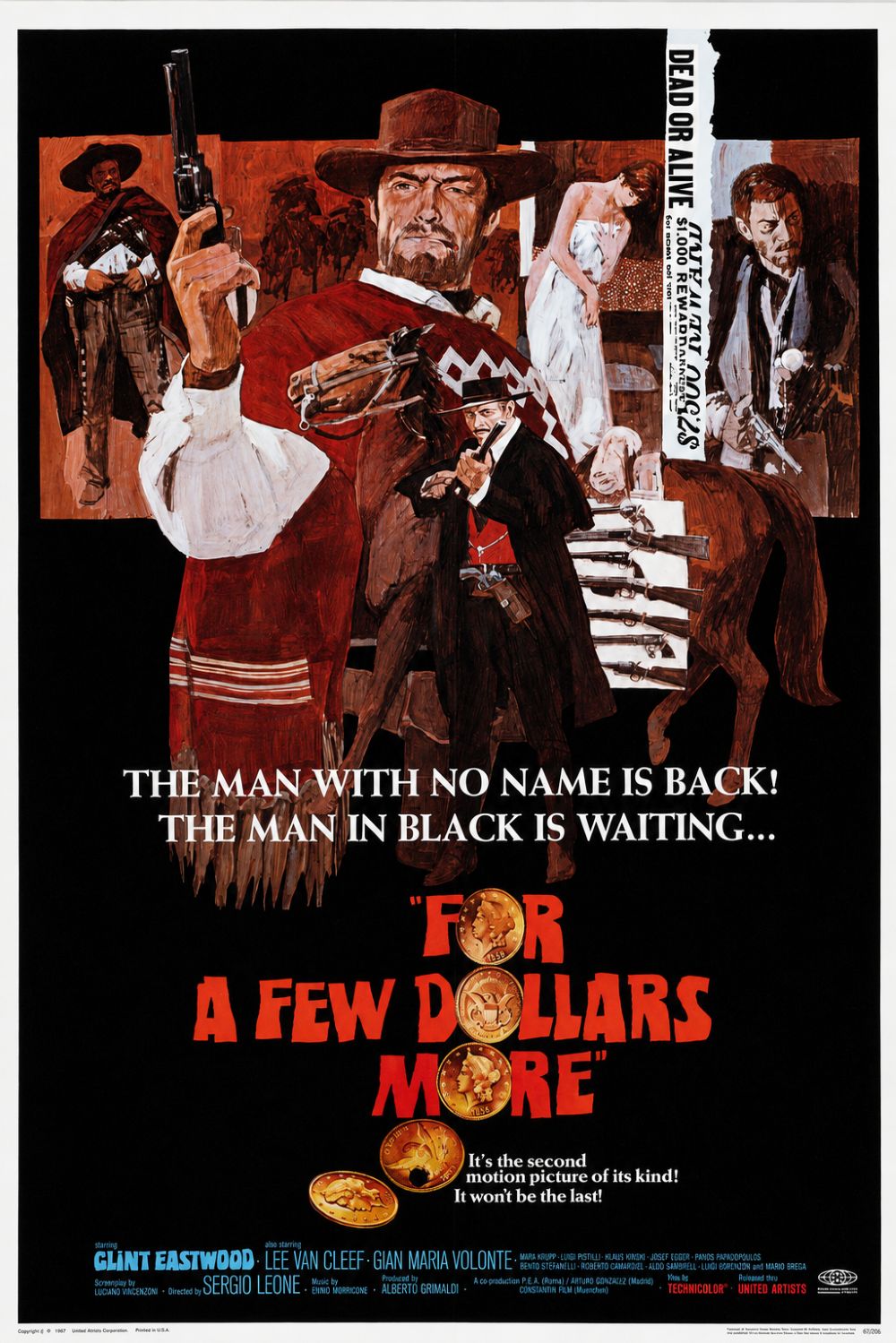
For a Few Dollars More is the moment Sergio Leone’s western style starts to feel fully formed: larger, stranger, more emotionally bruised, and far more confident in its ability to turn silence into suspense. Released in 1965, it serves as the second leg of Leone’s “Dollar’s Trilogy,” following A Fistful of Dollars and preceding The Good, the Bad and the Ugly. It shares the earlier film’s basic ingredients—dusty towns, morally compromised gunmen, crooked institutions, and Ennio Morricone’s unforgettable music—but it is not simply a bigger repeat. Leone takes the stripped-down revenge-and-gold framework of the first movie and gives it a darker emotional center. This is a western about obsession, damaged masculinity, and a world in which violence does not restore order so much as expose how little order existed in the first place.
Clint Eastwood returns as the Man with No Name, although he is called Manco here, and he is still the same lean, poncho-wearing opportunist viewers met in A Fistful of Dollars. He moves through the film with that familiar mixture of cocky calm and barely concealed menace. Manco is a bounty hunter, collecting rewards for dead criminals with an efficiency that makes his work feel almost casual. There is comedy in his early scenes, especially in the way he manages an absurdly large number of wanted men, but the humor has a sharp edge. Manco is not a conventional hero. He is charming because he is capable, because he has style, and because Eastwood knows exactly how little effort the role needs. A squint, a pause, or a hand resting near a gun does more than most full pages of dialogue.
The major difference is that this time Eastwood is not alone at the center of the story. Lee Van Cleef enters as Colonel Douglas Mortimer, another bounty hunter, and his presence gives the film its real dramatic charge. Mortimer is older, more formal, and more openly haunted than Manco. Where Manco seems motivated largely by money and survival, Mortimer carries himself like a man pursuing something much more personal. Their relationship begins as a rivalry, with both men circling the same targets and testing one another’s abilities. Leone gets a lot of mileage out of the contrast: Eastwood is loose and youthful, Van Cleef is rigid and calculating; one looks like he has wandered in from the wilderness, while the other has the manner of a retired officer who never truly left the battlefield.
Their eventual partnership is what makes For a Few Dollars More so satisfying. It is a buddy movie in the least sentimental sense possible. Neither man becomes especially warm or expressive, and their bond is built less on trust than on mutual respect for professional competence. They know the other is dangerous. They also know that the other may be necessary. Leone stages their alliance with a kind of deadpan amusement, particularly when Manco and Mortimer try to outdo each other with increasingly elaborate shooting demonstrations. Those sequences are entertaining because they are absurdly masculine, but the film never lets the spectacle become completely weightless. In this world, skill with a gun is not a sport; it is a qualification for survival.
The villain, Gian Maria Volonté’s El Indio, pushes the film decisively into darker territory than A Fistful of Dollars. Volonté had already played a memorable antagonist in Leone’s previous film, but El Indio is far more unsettling than Ramón Rojo. He is not merely greedy or power-hungry. He is psychologically ruined, driven by trauma and by a sadistic need to revisit it. His recurring pocket-watch motif, paired with Morricone’s chiming melody, becomes one of the film’s great inventions. The tune begins almost innocently, but Leone gradually turns it into a signal of dread. Every time El Indio opens the watch, it feels as though time itself has stopped and everyone nearby has been sentenced to wait for death.
The backstory tied to El Indio is where the movie reveals just how much more disturbing its narrative ambitions are. Leone and his screenwriters introduce subjects that are much uglier than the genre’s usual tales of outlaws and frontier justice: rape, suicide, and the lingering horror of sexual violence. The film does not handle these ideas with contemporary sensitivity, and it is not interested in exploring their victims with the depth they deserve. Still, their presence changes the atmosphere. El Indio’s trauma is not abstract; it is tied to a violent violation and the suicide that follows it. That history does not humanize him in any easy way, nor does it excuse him. Instead, it explains the repetitive, self-destructive pattern of his cruelty. He is obsessed with an event he cannot undo, and he converts that obsession into violence against everyone around him.
That theme of obsession runs through nearly every important character. Mortimer’s pursuit of El Indio turns out to be rooted in a personal wound that has shaped his entire life. His bounty-hunting career, disciplined exterior, and almost mechanical precision are revealed as part of a long-delayed act of vengeance. Manco, meanwhile, is obsessed in a different and less tragic way: with winning, with money, and with proving that he cannot be manipulated. Even the gang’s massive bank robbery has an obsessive quality. It is overcomplicated, theatrical, and clearly more about El Indio demonstrating power over his men than about securing wealth. Leone’s characters do not simply want things. They become imprisoned by them.
The plot itself is fairly direct, though Leone fills it with enough betrayal and shifting alliances to keep it lively. El Indio and his gang target the bank in El Paso, using a jailbreak as part of a larger scheme. Manco and Mortimer separately infiltrate the group, both pursuing the reward on El Indio’s head while working toward their own goals. From there, the film becomes a tense contest of patience. Leone is never in a rush to deliver a payoff. He lets scenes breathe, often lingering on faces, boots, hands, doorways, and empty spaces. In another director’s hands, this could feel slow. Here, it feels like the movie is daring the audience to notice every tiny movement before the gunfire begins.
That visual patience is one of Leone’s greatest strengths. For a Few Dollars More is full of faces that feel weathered by the landscape around them. The film’s close-ups are almost confrontational, catching sweat, stubble, suspicious glances, and flashes of fear. Leone makes the human face as important as the wide-open Spanish locations standing in for the American West. He also understands that scale works best through contrast. A showdown can begin with an extreme close-up of a man’s eyes, then pull back to reveal two tiny figures facing each other in a vast, empty space. The result is both operatic and intimate.
Morricone’s score deserves equal credit for making the movie feel larger than life. The music is less a background element than another character in the story. Whistles, bells, guitar, percussion, and that eerie watch melody give the film a sound unlike the traditional Hollywood western. It is playful in some moments and nightmarish in others. Most importantly, it makes the climactic duel feel like the culmination of everything the film has been building toward. The final confrontation is not just about who draws first. It is about memory, guilt, revenge, and whether a person can ever truly escape the worst moment of their life.
If A Fistful of Dollars was Leone proving that he could reinvent the western with attitude, For a Few Dollars More is him demonstrating that the formula could carry genuine darkness. It is still stylish, funny, and gleefully exaggerated. It still has impossible gunplay, swaggering antiheroes, and scenes designed purely to make the audience grin. But beneath all that is a colder film. Its violence is tied to trauma. Its men are defined by grudges they cannot release. Its most memorable villain is terrifying not because he is invincible, but because he is already spiritually broken.
Eastwood remains iconic, but Van Cleef is arguably the film’s emotional anchor. His performance gives the story weight without ever becoming melodramatic. Volonté, meanwhile, creates one of the great spaghetti-western villains: volatile, wounded, cruel, and unforgettable whenever that pocket watch begins to play. Leone would go even bigger and more ambitious with The Good, the Bad and the Ugly, but For a Few Dollars More may be the trilogy’s most focused character piece. It takes the sparse coolness of its predecessor and adds scars, grief, and a genuinely haunted sense of purpose.
I was a bit shocked to realize that I hadn’t reviewed Escape from New York for this site. Leonard’s reviewed it.Jeff’s reviewed it. I’ve reviewed quite a few Italian films that were inspired by Escape from New York. Last year, I devoted an entire day to how much I love Kurt Russell. I’ve shared John Carpenter’s theme music, more than once. I’ve reacted to Mamdani’s election by telling my friends that it’s time to escape from New York. I’ve lost track of the number of times that I’ve told Leonard that it is “Time to leave the Bronx,” even though he doesn’t live in the Bronx. (What do I know? I live in Texas.) But I’ve never actually reviewed Escape From New York.
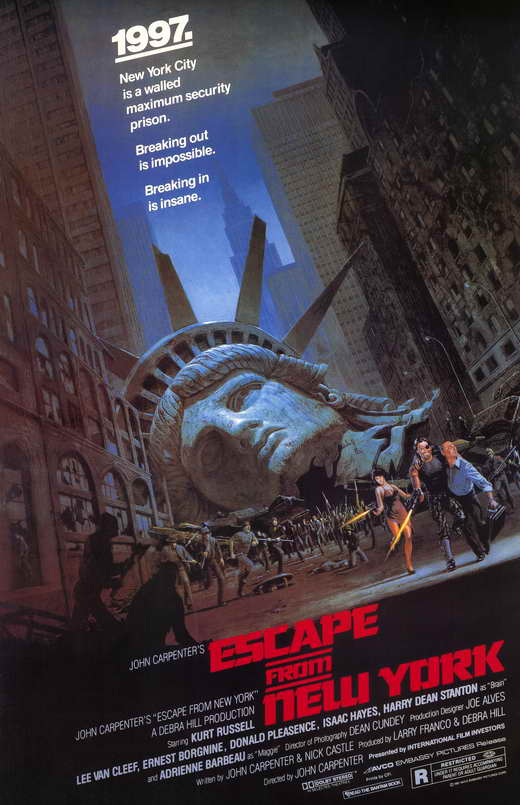
I love Escape from New York but I have to say that the film itself can’t live up the brilliant poster art. The first time I watched Escape from New York, I was really disappointed that the Statue of Liberty’s head never appeared in the middle of a street in Manhattan. If the film were made today, one imagines that the filmmakers would be able to do all sorts of things with the Statue of Liberty. But Escape from New York was made in 1981, in the days before rampant CGI. Escape from New York was made at a time when directors had to be somewhat clever and that definitely works to the film’s advantage. The lack of big time special effects meant that Carpenter had to emphasize character and atmosphere. Escape From New York might not feature the Statue of Liberty’s head but it does feature an amazing cast and a host of unforgettable characters. When you manage to get Kurt Russell, Ernest Borgnine, Donald Pleasence, Harry Dean Stanton, Adrienne Barbeau, Lee Van Cleef, and Isaac Hayes all in the same film, there’s no way it isn’t going to be memorable.
We all know the plot. Kurt Russell plays career criminal Snake Plissken. (Everyone thought Snake was dead.) When the President (Donald Pleasence) finds himself trapped on the prison island of Manhattan, Snake is the man who is sent to rescue him. The fate of the world depends on rescuing the President. If the President isn’t rescued, it could lead to nuclear war. Snake doesn’t really care about the fate of the world. He does care about the fate of himself, however. He’s been injected with a poison that will kill him unless he receives the antidote in 24 hours.
(The doctor who gives Snake the poison is named Dr. Cronenberg. Meanwhile, Frank Doubleday appears as a thug named Romero. Lee Van Cleef’s police commissioner is named Hauk, as in Howard Hawks. Tom Atkins plays Captain Rehme, as in producer Bob Rehme. The film may be about the collapse and possible end of the world but John Carpenter’s having fun. And, of course, so are we.)
The President has been captured by the Duke of New York (Isaac Hayes). It doesn’t take Snake long to track down the Duke. But rescuing the President and making it back to safety turns out to be far more difficult and violent than anyone was anticipating. Snake gets some help, from characters like Cabbie (Ernest Borgnine), Brain (Harry Dean Stanton), and Maggie (Adrienne Barbeau). Of course, that help is largely due to everyone’s self-interest. The recurring theme is that no one really cares that much about whether or not the President or even Snake lives or dies. Maggie loves Brain but, otherwise, there’s not much individual loyalty to be found in this film. Instead, everyone just cares about getting the Hell out of New York. In the end, even the President turns out to be a bit of a jerk.
(I do have to say that I absolutely love Donald Pleasence’s performance in Escape from New York. The “You’re the Duke! You’re the Duke! A Number One!” scene? That was Pleasence at his most brilliant.)
It’s a wonderfully acted and directed film, one that is often darkly humorous. (While Kurt Russell delivers his lines with a endearing self-awareness, Carpenter has a lot of fun imagining the type of criminal society that would emerge on an isolated Manhattan.) It’s also a film that understands the power of New York City. Depending on who you ask, New York either represents the worst or the best of America. That’s true today and, watching Escape from New York, it’s easy to guess that was probably true in 1981 as well. There’s a power to the “New York” name and it’s why this film wouldn’t have worked if it had been called Escape From Houston or Escape From Spokane. (One reason why Escape From LA failed was because the cartoonishness of Los Angeles couldn’t compete with the grit of New York.) We all know the saying — “New York, New York: If you can make it there, you can make it anywhere.” This film reminds us that it’s also true that if you can escape from there, you can escape from anywhere. Escape from New York brilliantly captures the way that most of the rest of country view New York but, by limiting the action to Manhattan, it also presents a story that can be enjoyed by people in Brooklyn, the Bronx, Queens, and Staten Island. I imagine the film is especially popular on Staten Island.
Escape From New York is a brilliant work of the pulp imagination. It’s a film that will probably outlive the city.
Today would have been Lee Van Cleef’s 101st birthday.
Today’s scene that I love features Van Cleef as the title character in 1969’s Sabata. In this scene, he faces off in a duel with William Berger’s Banjo. Even when he’s playing the good guy, like in this film, Lee Van Cleef leaves no doubt that he’s not someone you want to mess with.
“Man is a feeling creature, and because of it, the greatest in the universe….”
Hell yeah! You tell ’em, Peter Graves!
Today’s Horror on the Lens is 1956’s It Conquered The World. Graves plays a scientist who watches in horror as his small town and all of the people who he loves and works with are taken over by an alien. Rival scientist Lee Van Cleef thinks that the alien is going to make the world a better place but Graves understands that a world without individual freedom isn’t one that’s worth living in.
This is one of Corman’s most entertaining films, featuring not only Graves and Van Cleef but also the great Beverly Garland. Like many horror and science fiction films of the 50s, it’s subtext is one of anti-collectivism. Depending on your politics, you could view the film as either a criticism of communism or McCarthyism. Watching the film today, with its scenes of the police and the other towns people hunting anyone who fails to conform or follow orders, it’s hard not to see the excesses of the COVID era.
Of course, there’s also a very persuasive argument to be made that maybe we shouldn’t worry too much about subtext and we should just enjoy the film as a 50s B-movie that was directed with the Corman touch.
Regardless of how interpret the film, I defy anyone not to smile at the sight of ultra-serious Peter Graves riding his bicycle from one location to another.
Here, for your viewing pleasure, is It Conquered The World!
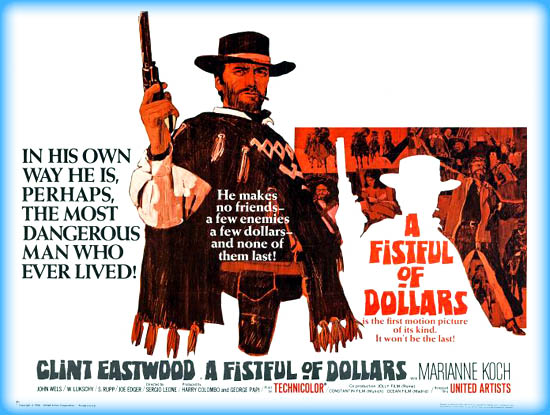
Originally, Sergio Leone envisioned none other than Henry Fond as The Man With No Name.
The year was 1964 and Sergio Leone was searching for the right actor to star in the movie that would become A Fistful Of Dollars. The film, which reimagined Akira Kurosawas’s Yojimbo as a western, centered around a mysterious, amoral gunslinger whose name was unknown. Leone needed an American or a British name to star in the film so that it could get distribution outside of Italy. Leone had grown up watching Henry Fonda movies, all dubbed into Italian. He later said he wanted to cast Fonda because he always wondered what Fonda’s voice actually sounded like.
After realizing that a major Hollywood star would never agree to star in a low-budget Italian western, Leone then offered the role to Charles Bronson. Bronson read the script and said it didn’t make sense to him. Leone went on to offer the role to Henry Silva, Rory Calhoun, Tony Russel, Steve Reeves, Ty Hardin, and James Coburn. Everyone was either too expensive or just not interested. Finally, it was actor Richard Harrison who, after tuning down the part himself, suggested that Leone offer the role to Clint Eastwood. Eastwood, then starring on the American western Rawhide, could play a convincing cowboy. Leone followed Harrison’s advice and Eastwood, eager to break free of his nice guy typecasting and hoping to restart his film career, accepted. The rest is history.
Eastwood would only play The Man With No Name in three films but, in doing so, he changed the movies and the popular conception of the action hero forever.
All three of the Man With No Name movies have been reviewed on this site. But, since today is Clint’s birthday, I thought I’d take a look at how these classic films are holding up, over 60 years since the Man With No Name made his first appearance.
A Fistful Of Dollars (1964)
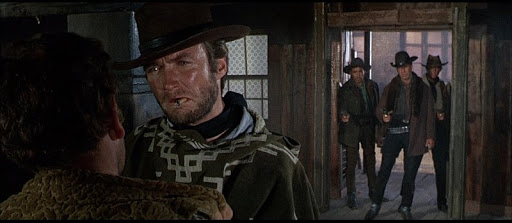
Having now seen both this film and Yojimbo, it’s remarkable how closely A Fistful of Dollars sticks to Kurosawa’s original film. Interestingly, it’s clear that Eastwood patterned his performance of Toshiro Mifune’s in Yojimbo and yet, at the same time, he still managed to make the role his own. The Man With No Name rides into a western town, discovers that there are two groups fighting for control of the area, and he coolly plays everyone against each other. Whether it’s planting the seeds of distrust, exploiting an enemy’s greed, or being the quickest on the draw, the Man With No Name instinctively knows everything that he has to do. Even when he’s getting beaten up by the bad guys, The Man With No Name always seems to be one step ahead. Today, a western in which everyone is greedy and looking out for themselves isn’t going to take anyone by surprise. But if you’ve watched enough westerns from the 40s and 50s, you’ll understand how unique of a viewpoint Leone brought to the genre. Eastwood’s amoral gunslinger was such a surprise that, when the film aired on television, a scene was shot by the network in which Harry Dean Stanton played a prison warden who released The Man With No Name (seen only from behind) on the condition that he clean up the town.
For A Few Dollars More (1965)
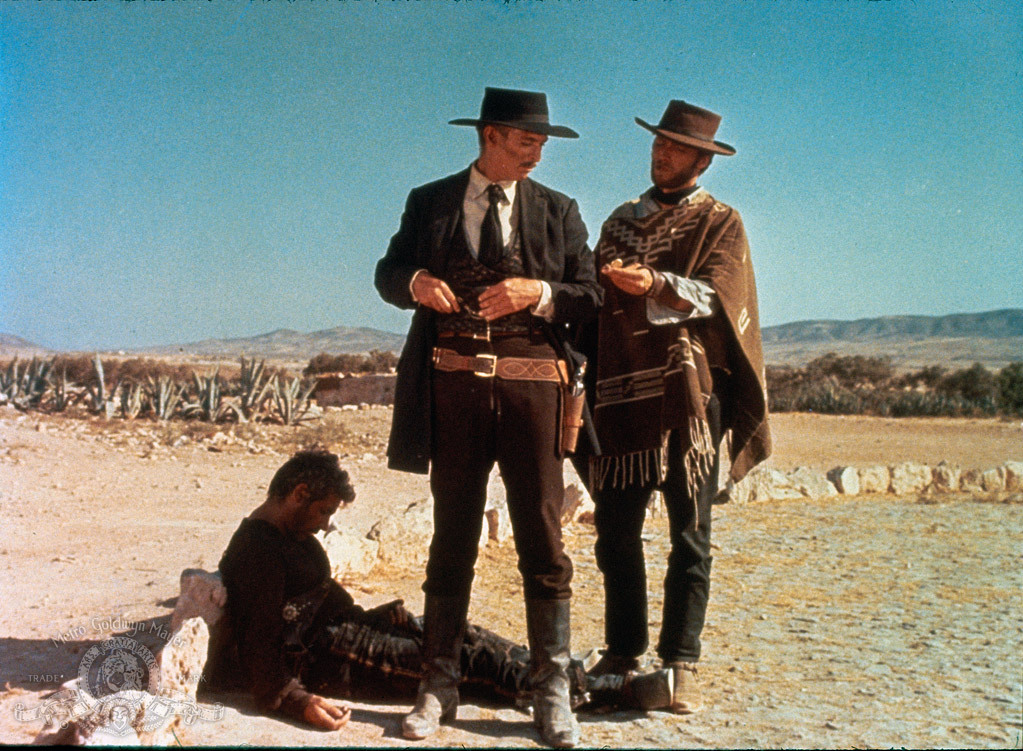
For A Few DollarsMore finds The Man With No Name working as a bounty hunter and teaming up with Colonel Mortimer (Lee Van Cleef) to take down El Indio (Gian Maria Volonte) and his gang (including Klaus Kinski as a hunchback.) This is my least favorite of the trilogy but that doesn’t mean that For A Few DollarsMore is a bad film. Being the least of three masterpieces is nothing to be ashamed of. Eastwood and Van Cleef were two of the best and it’s interesting to see them working together. El Indo is a truly loathsome villain and the members of his gang are all memorably horrid. If it’s my least favorite, it’s just because I prefer the wit of A Fistful of Dollars and the epic storytelling of The Good, The Bad, and The Ugly. Speaking of which…
The Good, The Bad, and The Ugly (1966)
This is it. The greatest western ever made, an epic film that features Leone’s best direction, Ennio Morricone’s greatest score, and brilliant performances from Eastwood, Van Cleef, and especially Eli Wallach. It’s hard to know where to start when it comes to praising The Good, The Bad, and The Ugly. It’s a nearly three-hour film that doesn’t have a single slow spot and it has some of the most iconic gunfights ever filmed. Leone truly found his aesthetic voice in this film and that it still works, after countless parodies, is evidence of how great it is. I appreciate that this film added a historical context to the adventures of The Man With No Name. (Personally, I think this film is meant to be a prequel to A Fistful of Dollars, just because The Man With No Name is considerably kinder in this film than he was in the first two movies. The Man With No Name that we meet in AFistfulofDollars would never have gotten Tuco off that tombstone.) The Good, The Bad, and The Ugly takes place during the Civil War and, along with everything else, it’s an epic war film. While America fights to determine its future, three men search for gold. The cemetery scene will never be topped.
American critics did not initially appreciate these films but audiences did. Clint Eastwood may have been a television actor when he left for Italy but he returned as an international star. And, to think, it all started with Sergio Leone not being able to afford Henry Fonda.
In 1925, on this very date, Lee Van Cleef was born in Somervillve, New Jersey. In honor of what would have been Lee Van Cleef’s 100th birthday, here he is with Klaus Kinski and Clint Eastwood in For A Few Dollars More.
There’s not a lot of dialogue in this scene but when you had actors like Eastwood, Kinski, and Lee Van Cleef, you didn’t need a lot of dialogue to make an impression.
“Man is a feeling creature, and because of it, the greatest in the universe….”
So says scientist Paul Nelson (Peter Graves) towards the end of 1956’s It Conquered The Universe. Paul may be a scientist but he understands the importance of emotion and imagination and individuality. He knows that it’ll take more than just cold logic to save humanity from destruction.
Unfortunately, Paul’s best friend, Tom Anderson (Lee Van Cleef), disagrees. Tom worked at Los Alamos. Tom helped to develop the atomic bomb. Tom is convinced that humanity will destroy itself unless a greater power takes over. Tom feels that he has discovered that greater power. Tom has recently contacted a Venusian and invited it to come to Earth. Upon arriving, the Venusian promptly disrupts all electrical power on Earth. It sends out bat-like creatures that inject humans with a drug that takes control of their minds and turns them into a compliant slaves. Paul tells Tom that robbing people of their free will is not going to save the Earth but Tom remains committed to the Venusian, even as it becomes obvious that the Venusian’s main concern is with its own survival.
It Conquered The World is very much a film of the 1950s. Along with tapping into the era’s paranoia about nuclear war and UFOs, it also features Peter Graves delivering monologues about freedom and the inherent superiority of the human race. When Paul confronts Tom, he not only accuses Tom of selling out the Earth but he also attacks Tom’s patriotism. When Tom’s wife, Claire (Beverly Garland), confronts the alien and orders it to leave her plant along, she does it while wearing high heels and a tight sweater and holding a rifle. The one female scientist (played by Karen Kadler) spends most of her screentime being menaced while wearing a white slip and there’s a platoon of bumbling but unbrainwashed soldiers hanging out in the woods. If one looked up 1956 in the dictionary, there’s a very good chance this film would be the definition.
At the same time, the film’s story feels like a metaphor for modern times. When the Venusian-controlled police turn authoritarian and start threatening to punish anyone who questions their orders, we’re reminded of the excesses of the COVID lockdowns. When the editor of the town’s newspaper is shot by a policeman who says that words are no longer necessary in the new world, it’s hard not to think of all the writers, commentators, artists, and ordinary citizens who have run afoul the online cancellation brigade. When Paul is reduced to riding a bicycle from place to place, it’s hard not to think of the environmental Luddites, with their hatred of anything that makes life more convenient. When Tom rationalizes his activities by saying that humanity must be saved from itself, he’s expressing an opinion that is very popular among several people today. Tom’s embrace of cold logic feels very familiar. Of course, today, people don’t need a Venusian to order them to accept authoritarianism. Instead, they’re more than happy to do on their own.
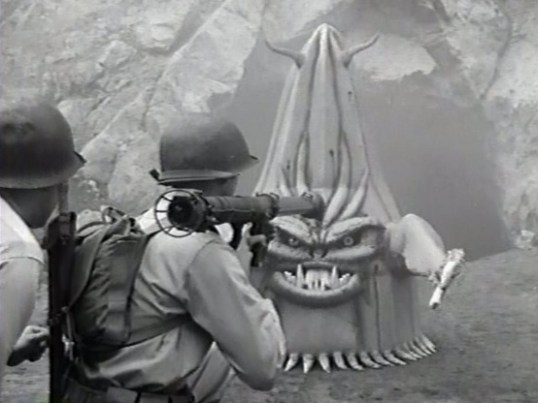
It Conquered The World was directed by Roger Corman. It was his eighth film as a director and it remains one of his most entertaining. As one might expect from a low-budget sci-fi film, It Conquered The World produces it’s share of laughs. It’s hard not to smile at the sight of the extremely serious Peter Graves peddling his bicycle from location to location. (It doesn’t help that Graves never takes off his suit or loosens his tie.) And the Venusian simply has to be seen to be believed:
At the same time, It Conquered The World holds up well. Lee Van Cleef and Beverly Garland both give performances that transcend the material, with Van Cleef especially doing a good job of paying a man struggling to rationalize his bad decisions. It Conquered The World holds up today, as both a portrait of the 50s and 2024.