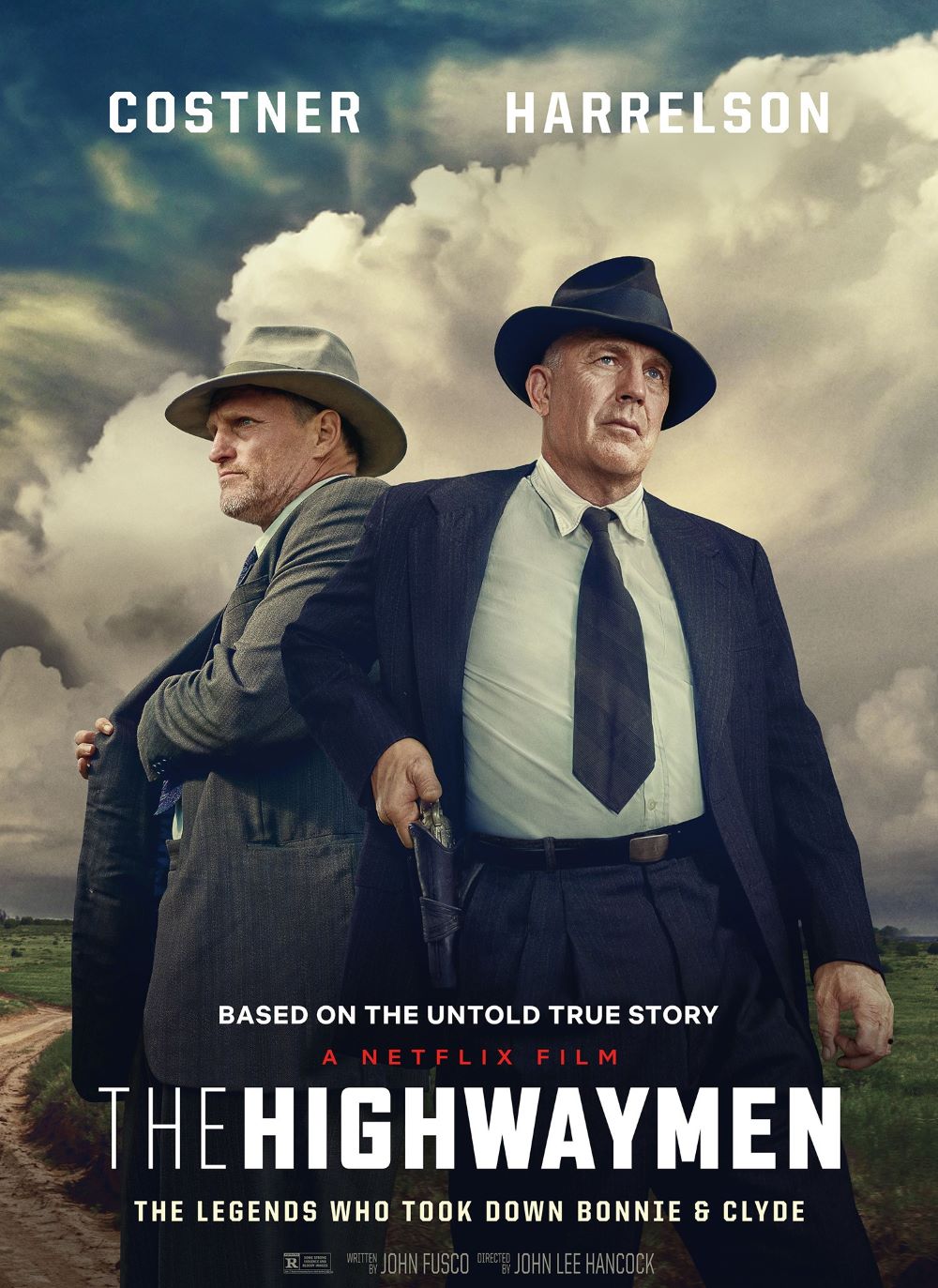
“People don’t always know who they are… ’til it’s too late.” — Frank Hamer
The Highwaymen, as directed by John Lee Hancock, delivers a character-driven, period crime drama that refreshes a story so often mythologized in American pop culture. Instead of glamorizing Bonnie and Clyde, the film spotlights the two former Texas Rangers tasked with ending their crime spree: Frank Hamer (played by Kevin Costner) and Maney Gault (played by Woody Harrelson). Set against the bleak dustbowl landscape of 1934, the film opens with the criminal duo breaking their associates out of Eastham Prison, setting the state of Texas into a panic. In desperation, Governor “Ma” Ferguson authorizes the return of Hamer, a seasoned lawman whose old-school methods have largely been left behind in modern policing.
From the start, The Highwaymen takes its time, inviting viewers into a slower, more contemplative chase rather than the kinetic action often associated with outlaw stories. Hamer, long retired and resistant to rejoining the fight, is persuaded both by the severity of Bonnie and Clyde’s violence and the humiliation his state faces in failing to catch them. Gault, for his part, is recruited despite his own personal struggles, adding a layer of regret and weariness to their partnership. Their pursuit is marked by straightforward detective work—staking out small towns, following trails, and confronting a public that is strangely captivated by the criminals they hunt. The film repeatedly draws attention to the way crowds and the press elevate Bonnie and Clyde, reflecting on an early version of true crime celebrity culture.
The dynamic between Hamer and Gault forms the emotional core of the movie. Their bond is shaped by years of experience, mistakes, and a real sense of being out of place in a society that now doubts their relevance. There’s plenty of banter and friction, but also reflective moments that dig into the costs of life spent in pursuit of justice. Throughout the investigation, the film uses the Texas and Louisiana landscape as a powerful backdrop—the vast, windswept highways underscore the isolation and existential gravity faced by these lawmen. The cinematography favors wide shots and muted colors, giving the chase a feeling of endlessness and melancholy.
Instead of showcasing Bonnie and Clyde as glamorous anti-heroes, the film keeps them at a distance, rarely granting much screen time or dialogue. Violence is handled abruptly and unsentimentally. When it finally arrives, most notably in the climactic ambush, it is portrayed as brutal and inevitable, reminding the viewer that myths are built on blood and public spectacle. The lawmen’s final confrontation results in the infamous shootout, depicted with documentary-like restraint. The aftermath involves a bullet-riddled car towed through throngs of onlookers—an eerie scene that highlights how tragedy becomes spectacle.
One of the film’s greatest strengths is in its portrayal of moral ambiguity. Both Hamer and Gault operate by principles shaped in a different era. Their methods can be rough and unorthodox; they clash with younger law enforcement and the FBI, whose approaches are more bureaucratic, less personal. The film hints at the toll violence and a lifetime in law enforcement has taken on them, including a poignant story from Gault about a tragic accident in his past. These reflections draw out the muted sadness underlying their pursuit, exploring themes of justice, changing times, and what remains after one’s era passes.
Performance-wise, Costner and Harrelson bring authenticity and gravity to their roles. Their chemistry is quiet and real, developed largely through understated scenes—silent drives, awkward motel breakfasts, and occasional arguments broken up by mutual respect. Supporting roles, like Kathy Bates’s steely governor and John Carroll Lynch’s earnest corrections chief, flesh out the historical setting and institutional pressures.
The film doesn’t always dig as deep as it could into the complexities of Depression-era justice, but its restraint and focus on character make up for that. Rather than indulging in nostalgia or sensationalizing violence, it keeps its lens on the human cost—the consequences for the victims, the weariness of the men trying to restore order, and the strange cultural fascination with outlaws. If you’re looking for a grounded historical drama that trades fast action for thoughtful pacing, and puts working-class grit front and center, The Highwaymen is worth the ride.





 Through the Shattered Lens