The year is 2036 and the world is at war. Col. Flemming (Troy Donahue) assigns his protégé, Major Agatha Doyle (Terry Farrell), to infiltrate a facility with a group of specially selected soldiers. All of the soldiers were previously on death row and will be given a full pardon if they complete their mission. Siegal (Corey Feldman) is the neurotic hacker who was convicted of desertion. Cutter (Trevor Goddard) is a straight-up psycho. Ryan (Rick Springfield) wishes he had Jessie’s Girl… no wait, he’s a demolitions expert. Sorry, my mistake. Dr. Jones (Audie England) is a doctor who is also a religious fanatic. Koosman (Richmond Arquette) is probably on death row for having an embarrassing name. Captain Aldrich (Parker Stevenson) is the most competent officer on death row and also the only one of the soldiers who isn’t a complete lunatic. Poe (Elston Ridgle) is the soldier who initially gets blamed when members of the team start dying inside the facility. It’s actually not Poe’s fault. There’s something in the facility and it’s not human.
Though the movie starts out as a rip-off of Aliens, with its collection of cocky soldiers coming up against an enemy that’s greater than all of them, it soon settles into being an Alien rip-off, with plenty of scenes of people being stalked while walking down dark, pipe-lined hallways. Not surprisingly, it fails to capture both the kinetic energy of Aliens and the heart-pounding suspense of Alien. The entire film feels very familiar, and the decision not to show the monster until the final few minutes feels cheap.
The cast is probably the most interesting thing about the movie, with Audie England, Rick Springfield, and Trevor Goddard actually committing to their roles. Parker Stevenson looks embarrassed, and Terry Farrell is one of the least convincing military officers that I’ve ever seen. (Her dialogue largely consists of shouting “MOVE!” whenever one of the convicts tries to get out of being sent to their death.) Corey Feldman overacts as Siegal, making him so nervous that you wonder why he was selected for the mission.
Legion steals the plots of Alien and Aliens but not the quality.
That is a question that has haunted journalists, cops, and true crime fans since the late 60s. It is known that the Zodiac Killer murdered at least five people in Northern California in 1968 and 1969. He targeted young couples, though he is also thought to have murdered on taxi driver as well. What set Zodiac apart from other killers is that he was a prolific letter writer, who sent cards and ciphers to the police and the journalists who were reporting on his crimes. In one of his ciphers, Zodiac claimed that he had killed 37 people. Cartoonist Robert Graysmith later wrote two books about his personal obsession with the case. He estimated that the Zodiac may have been responsible for hundred of murders, up through the 80s. Of course, reading Graysmith’s first Zodiac book, it’s also easy to suspect that Graysmith reached a point where he saw the Zodiac’s hand in every unsolved murder in the San Francisco area. Of all the unidentified serial killers in American history, Zodiac is one that most haunts us. Zodiac was a serial killer who operated in an era when such things were still considered to be uncommon. Much as Jack the Ripper did during the Victorian Age, Zodiac announced the arrival of a new age of evil.
Zodiac wrote about being a film fan and he was probably happy about the fact that he inspired quite a few films. 1971’s The Zodiac Killer came out while Zodiac was still sending letters to the police and cops actually staked out the theaters showing the film just to see if he would show up. Dirty Harry‘s Scorpio Killer was also based on Zodiac, right down to the taunting letters that he sent the mayor and again, one has to wonder if Zodiac ever showed up to watch Clint Eastwood take him down.
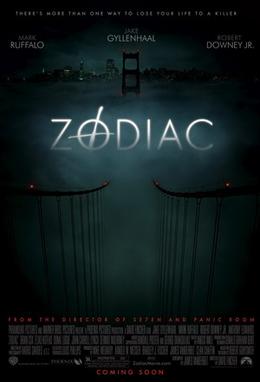
And, if Zodiac survived into the 21st Century, one has to wonder if he showed up in the theaters for 2007’s Zodiac.
One of the best true crime films ever made, Zodiac not only recreates the crimes of the Zodiac but it also examines the mental price of obsessing over the one unknown force of evil. Mark Ruffalo plays Dave Toschi, the celebrity cop who nearly sacrificed his professional reputation in his search for the identity of the killer. Jake Gyllenhaal plays cartoonist Robert Graysmith, who spends over a decade searching for the Zodiac’s identity and who loses his wife (Chloe Sevigny) in the process. And Robert Downey, Jr. plays Paul Avery, the crime reporter to whom the Zodiac wrote and who sunk into paranoia and addiction as a result. This is a film that is less about the Zodiac’s crime and more about how this unknown killer seemed to unleash a darkness that would come to envelope first a city and eventually an entire nation.
As one might expect from a film directed by David Fincher, Zodiac plays out like a filmed nightmare with the starkly portrayed murders being all the more disturbing because they often take place outside, where people would think they would be safe. (The second murder is especially terrifying, as it plays out without even the sound of background music to allow us the escape of remembering that it’s only a movie.) Fincher heightens our paranoia but having a different actor play the killer in each scene, reminding us that the Zodiac could literally be anyone. Indeed, one of the scarier things about Zodiac is that, in the course of his investigation, Graysmith meets so many different people who seem like they could be the killer. Even if they aren’t the Zodiac, the viewer is left with the feeling that the world is full of people who are capable of committing the same crimes. The film becomes a journey into the heart of darkness, with the Zodiac becoming both a malevolent force and potentially your next door neighbor. And with the film’s detailed recreation of the 60s and the 70s, the film becomes a portrait of a country on the verge of changing forever with the Zodaic and his crimes representing all the fear waiting in the future.
Again, as one might expect from a Fincher film, it’s a well-acted film, especially by Robert Downey, Jr. Zodiac came out a year before Iron Man, when Downey was still better known for his personal troubles than for his talent. Downey perfect captures his character’s descent into self-destruction, as he goes from being cocky and self-assured to being so paranoid that he’s carrying a gun. (Paul Avery’s actual colleagues have disputed the film’s portrayal of Avery being mentally destroyed by the Zodiac.) Ruffalo and Gyllenhaal also do a good job of portraying Toschi and Graysmith’s growing obsession with the case while Charles Fleischer and John Carroll Lynch both make strong (and creepy) impressions as two men who might (or might not) be the killer.
Though the film was not a success at the box office and it was totally ignored by the Academy, Zodiac has built up a strong reputation in the years since its released. It’s inspired a whole new generation of web sleuths to search for the killer’s identity. Personally, my favored suspect is Robert Ivan Nichols, an enigmatic engineer who abandoned his former life and changed his name to Joseph Newton Chandler III in the 70s and who committed suicide in 2002. I think much like Jack the Ripper, the Zodiac’s identity will never be definitely known. There have been many compelling suspects but most of the evidence seems to be circumstantial. (That’s certainly the case when it comes to Nichols.) The Zodiac was thought to be in his 30s or even his early 40s in 1969 so it’s doubtful that he’s still alive today. In all probability, his identity and his motive will forever remain an unsolvable mystery.
 The year is 2036 and the world is at war. Col. Flemming (Troy Donahue) assigns his protégé, Major Agatha Doyle (Terry Farrell), to infiltrate a facility with a group of specially selected soldiers. All of the soldiers were previously on death row and will be given a full pardon if they complete their mission. Siegal (Corey Feldman) is the neurotic hacker who was convicted of desertion. Cutter (Trevor Goddard) is a straight-up psycho. Ryan (Rick Springfield) wishes he had Jessie’s Girl… no wait, he’s a demolitions expert. Sorry, my mistake. Dr. Jones (Audie England) is a doctor who is also a religious fanatic. Koosman (Richmond Arquette) is probably on death row for having an embarrassing name. Captain Aldrich (Parker Stevenson) is the most competent officer on death row and also the only one of the soldiers who isn’t a complete lunatic. Poe (Elston Ridgle) is the soldier who initially gets blamed when members of the team start dying inside the facility. It’s actually not Poe’s fault. There’s something in the facility and it’s not human.