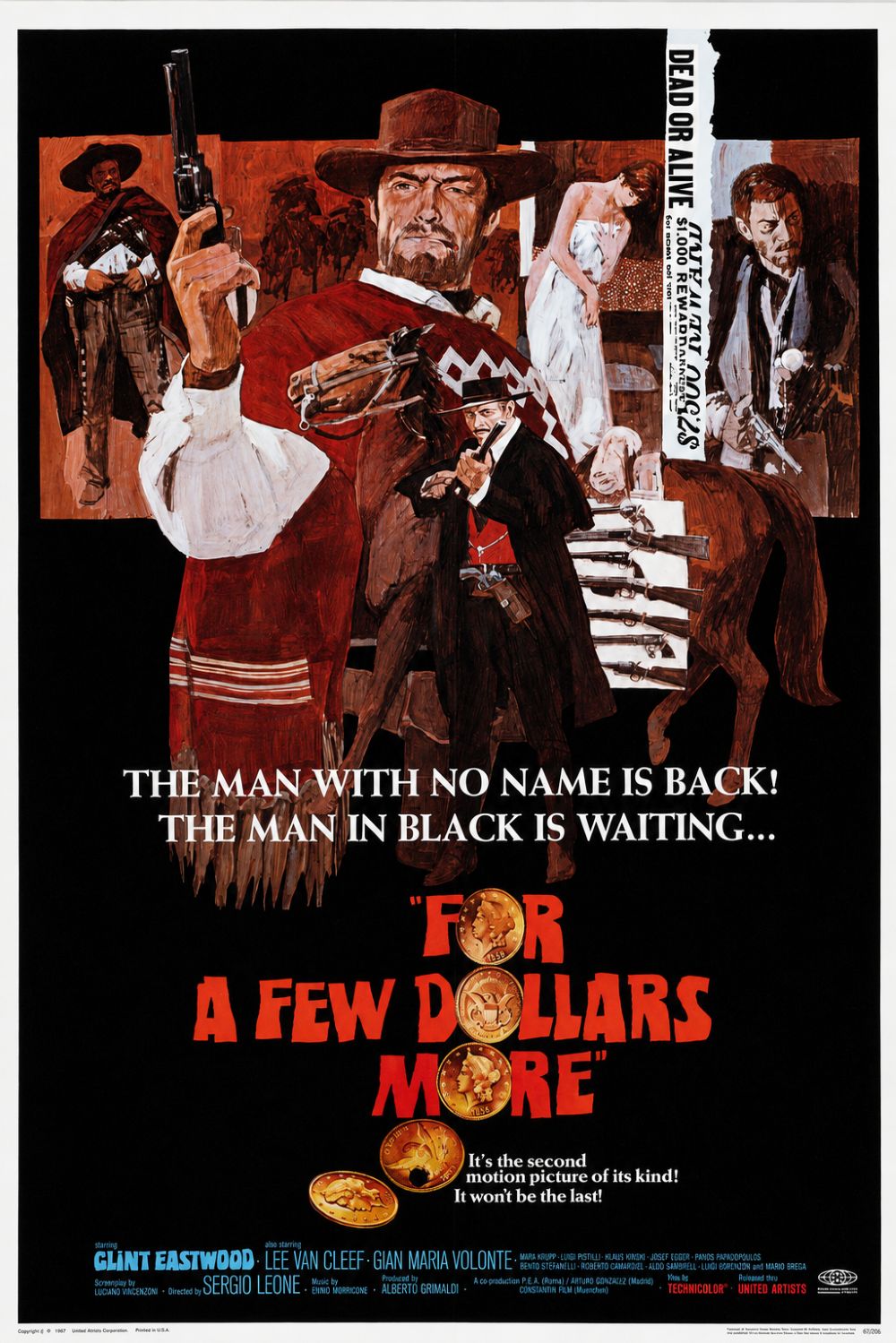
“When two hunters go after the same prey, they usually end up shooting each other in the back. And we don’t want to shoot each other in the back.” — Col. Douglas Mortimer
For a Few Dollars More is the moment Sergio Leone’s western style starts to feel fully formed: larger, stranger, more emotionally bruised, and far more confident in its ability to turn silence into suspense. Released in 1965, it serves as the second leg of Leone’s “Dollar’s Trilogy,” following A Fistful of Dollars and preceding The Good, the Bad and the Ugly. It shares the earlier film’s basic ingredients—dusty towns, morally compromised gunmen, crooked institutions, and Ennio Morricone’s unforgettable music—but it is not simply a bigger repeat. Leone takes the stripped-down revenge-and-gold framework of the first movie and gives it a darker emotional center. This is a western about obsession, damaged masculinity, and a world in which violence does not restore order so much as expose how little order existed in the first place.
Clint Eastwood returns as the Man with No Name, although he is called Manco here, and he is still the same lean, poncho-wearing opportunist viewers met in A Fistful of Dollars. He moves through the film with that familiar mixture of cocky calm and barely concealed menace. Manco is a bounty hunter, collecting rewards for dead criminals with an efficiency that makes his work feel almost casual. There is comedy in his early scenes, especially in the way he manages an absurdly large number of wanted men, but the humor has a sharp edge. Manco is not a conventional hero. He is charming because he is capable, because he has style, and because Eastwood knows exactly how little effort the role needs. A squint, a pause, or a hand resting near a gun does more than most full pages of dialogue.
The major difference is that this time Eastwood is not alone at the center of the story. Lee Van Cleef enters as Colonel Douglas Mortimer, another bounty hunter, and his presence gives the film its real dramatic charge. Mortimer is older, more formal, and more openly haunted than Manco. Where Manco seems motivated largely by money and survival, Mortimer carries himself like a man pursuing something much more personal. Their relationship begins as a rivalry, with both men circling the same targets and testing one another’s abilities. Leone gets a lot of mileage out of the contrast: Eastwood is loose and youthful, Van Cleef is rigid and calculating; one looks like he has wandered in from the wilderness, while the other has the manner of a retired officer who never truly left the battlefield.
Their eventual partnership is what makes For a Few Dollars More so satisfying. It is a buddy movie in the least sentimental sense possible. Neither man becomes especially warm or expressive, and their bond is built less on trust than on mutual respect for professional competence. They know the other is dangerous. They also know that the other may be necessary. Leone stages their alliance with a kind of deadpan amusement, particularly when Manco and Mortimer try to outdo each other with increasingly elaborate shooting demonstrations. Those sequences are entertaining because they are absurdly masculine, but the film never lets the spectacle become completely weightless. In this world, skill with a gun is not a sport; it is a qualification for survival.
The villain, Gian Maria Volonté’s El Indio, pushes the film decisively into darker territory than A Fistful of Dollars. Volonté had already played a memorable antagonist in Leone’s previous film, but El Indio is far more unsettling than Ramón Rojo. He is not merely greedy or power-hungry. He is psychologically ruined, driven by trauma and by a sadistic need to revisit it. His recurring pocket-watch motif, paired with Morricone’s chiming melody, becomes one of the film’s great inventions. The tune begins almost innocently, but Leone gradually turns it into a signal of dread. Every time El Indio opens the watch, it feels as though time itself has stopped and everyone nearby has been sentenced to wait for death.
The backstory tied to El Indio is where the movie reveals just how much more disturbing its narrative ambitions are. Leone and his screenwriters introduce subjects that are much uglier than the genre’s usual tales of outlaws and frontier justice: rape, suicide, and the lingering horror of sexual violence. The film does not handle these ideas with contemporary sensitivity, and it is not interested in exploring their victims with the depth they deserve. Still, their presence changes the atmosphere. El Indio’s trauma is not abstract; it is tied to a violent violation and the suicide that follows it. That history does not humanize him in any easy way, nor does it excuse him. Instead, it explains the repetitive, self-destructive pattern of his cruelty. He is obsessed with an event he cannot undo, and he converts that obsession into violence against everyone around him.
That theme of obsession runs through nearly every important character. Mortimer’s pursuit of El Indio turns out to be rooted in a personal wound that has shaped his entire life. His bounty-hunting career, disciplined exterior, and almost mechanical precision are revealed as part of a long-delayed act of vengeance. Manco, meanwhile, is obsessed in a different and less tragic way: with winning, with money, and with proving that he cannot be manipulated. Even the gang’s massive bank robbery has an obsessive quality. It is overcomplicated, theatrical, and clearly more about El Indio demonstrating power over his men than about securing wealth. Leone’s characters do not simply want things. They become imprisoned by them.
The plot itself is fairly direct, though Leone fills it with enough betrayal and shifting alliances to keep it lively. El Indio and his gang target the bank in El Paso, using a jailbreak as part of a larger scheme. Manco and Mortimer separately infiltrate the group, both pursuing the reward on El Indio’s head while working toward their own goals. From there, the film becomes a tense contest of patience. Leone is never in a rush to deliver a payoff. He lets scenes breathe, often lingering on faces, boots, hands, doorways, and empty spaces. In another director’s hands, this could feel slow. Here, it feels like the movie is daring the audience to notice every tiny movement before the gunfire begins.
That visual patience is one of Leone’s greatest strengths. For a Few Dollars More is full of faces that feel weathered by the landscape around them. The film’s close-ups are almost confrontational, catching sweat, stubble, suspicious glances, and flashes of fear. Leone makes the human face as important as the wide-open Spanish locations standing in for the American West. He also understands that scale works best through contrast. A showdown can begin with an extreme close-up of a man’s eyes, then pull back to reveal two tiny figures facing each other in a vast, empty space. The result is both operatic and intimate.
Morricone’s score deserves equal credit for making the movie feel larger than life. The music is less a background element than another character in the story. Whistles, bells, guitar, percussion, and that eerie watch melody give the film a sound unlike the traditional Hollywood western. It is playful in some moments and nightmarish in others. Most importantly, it makes the climactic duel feel like the culmination of everything the film has been building toward. The final confrontation is not just about who draws first. It is about memory, guilt, revenge, and whether a person can ever truly escape the worst moment of their life.
If A Fistful of Dollars was Leone proving that he could reinvent the western with attitude, For a Few Dollars More is him demonstrating that the formula could carry genuine darkness. It is still stylish, funny, and gleefully exaggerated. It still has impossible gunplay, swaggering antiheroes, and scenes designed purely to make the audience grin. But beneath all that is a colder film. Its violence is tied to trauma. Its men are defined by grudges they cannot release. Its most memorable villain is terrifying not because he is invincible, but because he is already spiritually broken.
Eastwood remains iconic, but Van Cleef is arguably the film’s emotional anchor. His performance gives the story weight without ever becoming melodramatic. Volonté, meanwhile, creates one of the great spaghetti-western villains: volatile, wounded, cruel, and unforgettable whenever that pocket watch begins to play. Leone would go even bigger and more ambitious with The Good, the Bad and the Ugly, but For a Few Dollars More may be the trilogy’s most focused character piece. It takes the sparse coolness of its predecessor and adds scars, grief, and a genuinely haunted sense of purpose.


Pingback: Review: The Good, the Bad and the Ugly (dir. by Sergio Leone) – Through the Shattered Lens