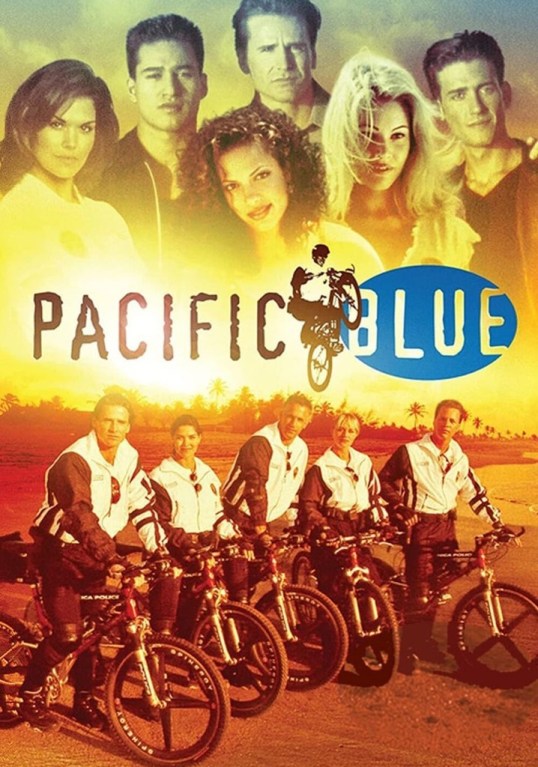
Welcome to Late Night Retro Television Reviews, a feature where we review some of our favorite and least favorite shows of the past! On Tuesdays, I will be reviewing Pacific Blue, a cop show that aired from 1996 to 2000 on the USA Network! It’s currently streaming everywhere, though I’m watching it on Tubi.
This week, Pacific Blue is all about the guest stars,
Episode 4.15 “Stargazer”
(Dir by Sara Rose, originally aired on January 24th, 1999)
When he was younger, Johnny Osiris (Danny Bonaduce) was a teen idol and the star of Stargazer, a show about a singing family that lived in outer space. As an adult, Johnny is a drug addict and an alcoholic who can’t pay his rent and who eventually turns to robbing stores and pharmacies. It’s difficult to be a criminal when everyone immediately recognizes you. However, when both he and Steve Gugliermo (Noah Blake) try to rob the same pharmacy at the same time, they decide to team up. Of course, Steve is hardened master criminal while Johnny is still an amateur.
This was a bit of a melancholy episode. Chris and Cory can’t say Johnny’s name without screaming but they’re still trying to put him in jail. The younger cops don’t have the slightest idea who Johnny was. As for Johnny, his criminal career makes him a celebrity again but the episode still ends with him heading off for prison. Along with Bonaduce, the episode features Susan Olsen as Johnny’s sister, Erik Estrada as Johnny’s lawyer, and Adam West as Johnny’s father. The entire thing is full of actors who probably never thought they would someday be appearing on a show about cops who rode bikes. The whole thing feels sad.
This episode also firmly establishes that Cory and Bobby are now a couple and that everyone pretty much knows about it. Hey, Victor’s dead so I guess Cory might as well move on. Still, some of the scenes of Bobby and Cory making out generated some heat. They’re a good couple so hopefully, the show won’t screw things up.
This episode also featured a discussion of sex-ceptions, i.e. celebrities that you’re allowed to fool around with even if you’re already in a relationship. For Chris, her sex-ception was Johnny Osiris, though it never actually came down to that. For Cory, it was Mel Gibson. Granger selected Winona Ryder, Bobby went with Salma Hayek, and Jamie said Denzel Washington. Myself, I have to wonder why they assumed Salma Hayek or Denzel Washington would have anything to do with a Santa Monica bicycle cop.
Anyway, this is kind of a depressing episode. Johnny was a star but then his entire life fell apart when he wasn’t. He made a few bad decisions and he never recovered. He should have auditioned for Baywatch. Live and learn.
“When two hunters go after the same prey, they usually end up shooting each other in the back. And we don’t want to shoot each other in the back.” — Col. Douglas Mortimer
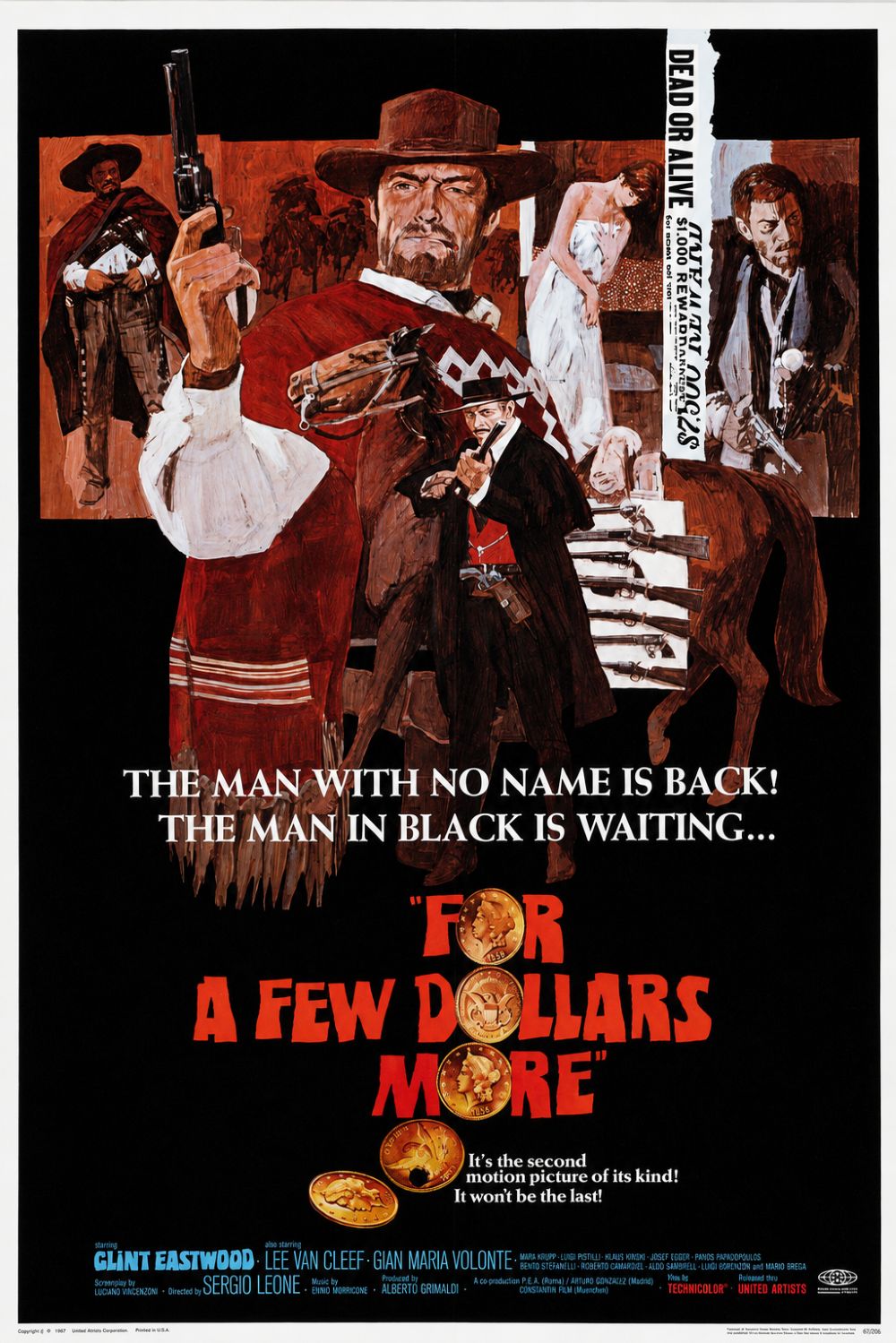
For a Few Dollars More is the moment Sergio Leone’s western style starts to feel fully formed: larger, stranger, more emotionally bruised, and far more confident in its ability to turn silence into suspense. Released in 1965, it serves as the second leg of Leone’s “Dollar’s Trilogy,” following A Fistful of Dollars and preceding The Good, the Bad and the Ugly. It shares the earlier film’s basic ingredients—dusty towns, morally compromised gunmen, crooked institutions, and Ennio Morricone’s unforgettable music—but it is not simply a bigger repeat. Leone takes the stripped-down revenge-and-gold framework of the first movie and gives it a darker emotional center. This is a western about obsession, damaged masculinity, and a world in which violence does not restore order so much as expose how little order existed in the first place.
Clint Eastwood returns as the Man with No Name, although he is called Manco here, and he is still the same lean, poncho-wearing opportunist viewers met in A Fistful of Dollars. He moves through the film with that familiar mixture of cocky calm and barely concealed menace. Manco is a bounty hunter, collecting rewards for dead criminals with an efficiency that makes his work feel almost casual. There is comedy in his early scenes, especially in the way he manages an absurdly large number of wanted men, but the humor has a sharp edge. Manco is not a conventional hero. He is charming because he is capable, because he has style, and because Eastwood knows exactly how little effort the role needs. A squint, a pause, or a hand resting near a gun does more than most full pages of dialogue.
The major difference is that this time Eastwood is not alone at the center of the story. Lee Van Cleef enters as Colonel Douglas Mortimer, another bounty hunter, and his presence gives the film its real dramatic charge. Mortimer is older, more formal, and more openly haunted than Manco. Where Manco seems motivated largely by money and survival, Mortimer carries himself like a man pursuing something much more personal. Their relationship begins as a rivalry, with both men circling the same targets and testing one another’s abilities. Leone gets a lot of mileage out of the contrast: Eastwood is loose and youthful, Van Cleef is rigid and calculating; one looks like he has wandered in from the wilderness, while the other has the manner of a retired officer who never truly left the battlefield.
Their eventual partnership is what makes For a Few Dollars More so satisfying. It is a buddy movie in the least sentimental sense possible. Neither man becomes especially warm or expressive, and their bond is built less on trust than on mutual respect for professional competence. They know the other is dangerous. They also know that the other may be necessary. Leone stages their alliance with a kind of deadpan amusement, particularly when Manco and Mortimer try to outdo each other with increasingly elaborate shooting demonstrations. Those sequences are entertaining because they are absurdly masculine, but the film never lets the spectacle become completely weightless. In this world, skill with a gun is not a sport; it is a qualification for survival.
The villain, Gian Maria Volonté’s El Indio, pushes the film decisively into darker territory than A Fistful of Dollars. Volonté had already played a memorable antagonist in Leone’s previous film, but El Indio is far more unsettling than Ramón Rojo. He is not merely greedy or power-hungry. He is psychologically ruined, driven by trauma and by a sadistic need to revisit it. His recurring pocket-watch motif, paired with Morricone’s chiming melody, becomes one of the film’s great inventions. The tune begins almost innocently, but Leone gradually turns it into a signal of dread. Every time El Indio opens the watch, it feels as though time itself has stopped and everyone nearby has been sentenced to wait for death.
The backstory tied to El Indio is where the movie reveals just how much more disturbing its narrative ambitions are. Leone and his screenwriters introduce subjects that are much uglier than the genre’s usual tales of outlaws and frontier justice: rape, suicide, and the lingering horror of sexual violence. The film does not handle these ideas with contemporary sensitivity, and it is not interested in exploring their victims with the depth they deserve. Still, their presence changes the atmosphere. El Indio’s trauma is not abstract; it is tied to a violent violation and the suicide that follows it. That history does not humanize him in any easy way, nor does it excuse him. Instead, it explains the repetitive, self-destructive pattern of his cruelty. He is obsessed with an event he cannot undo, and he converts that obsession into violence against everyone around him.
That theme of obsession runs through nearly every important character. Mortimer’s pursuit of El Indio turns out to be rooted in a personal wound that has shaped his entire life. His bounty-hunting career, disciplined exterior, and almost mechanical precision are revealed as part of a long-delayed act of vengeance. Manco, meanwhile, is obsessed in a different and less tragic way: with winning, with money, and with proving that he cannot be manipulated. Even the gang’s massive bank robbery has an obsessive quality. It is overcomplicated, theatrical, and clearly more about El Indio demonstrating power over his men than about securing wealth. Leone’s characters do not simply want things. They become imprisoned by them.
The plot itself is fairly direct, though Leone fills it with enough betrayal and shifting alliances to keep it lively. El Indio and his gang target the bank in El Paso, using a jailbreak as part of a larger scheme. Manco and Mortimer separately infiltrate the group, both pursuing the reward on El Indio’s head while working toward their own goals. From there, the film becomes a tense contest of patience. Leone is never in a rush to deliver a payoff. He lets scenes breathe, often lingering on faces, boots, hands, doorways, and empty spaces. In another director’s hands, this could feel slow. Here, it feels like the movie is daring the audience to notice every tiny movement before the gunfire begins.
That visual patience is one of Leone’s greatest strengths. For a Few Dollars More is full of faces that feel weathered by the landscape around them. The film’s close-ups are almost confrontational, catching sweat, stubble, suspicious glances, and flashes of fear. Leone makes the human face as important as the wide-open Spanish locations standing in for the American West. He also understands that scale works best through contrast. A showdown can begin with an extreme close-up of a man’s eyes, then pull back to reveal two tiny figures facing each other in a vast, empty space. The result is both operatic and intimate.
Morricone’s score deserves equal credit for making the movie feel larger than life. The music is less a background element than another character in the story. Whistles, bells, guitar, percussion, and that eerie watch melody give the film a sound unlike the traditional Hollywood western. It is playful in some moments and nightmarish in others. Most importantly, it makes the climactic duel feel like the culmination of everything the film has been building toward. The final confrontation is not just about who draws first. It is about memory, guilt, revenge, and whether a person can ever truly escape the worst moment of their life.
If A Fistful of Dollars was Leone proving that he could reinvent the western with attitude, For a Few Dollars More is him demonstrating that the formula could carry genuine darkness. It is still stylish, funny, and gleefully exaggerated. It still has impossible gunplay, swaggering antiheroes, and scenes designed purely to make the audience grin. But beneath all that is a colder film. Its violence is tied to trauma. Its men are defined by grudges they cannot release. Its most memorable villain is terrifying not because he is invincible, but because he is already spiritually broken.
Eastwood remains iconic, but Van Cleef is arguably the film’s emotional anchor. His performance gives the story weight without ever becoming melodramatic. Volonté, meanwhile, creates one of the great spaghetti-western villains: volatile, wounded, cruel, and unforgettable whenever that pocket watch begins to play. Leone would go even bigger and more ambitious with The Good, the Bad and the Ugly, but For a Few Dollars More may be the trilogy’s most focused character piece. It takes the sparse coolness of its predecessor and adds scars, grief, and a genuinely haunted sense of purpose.
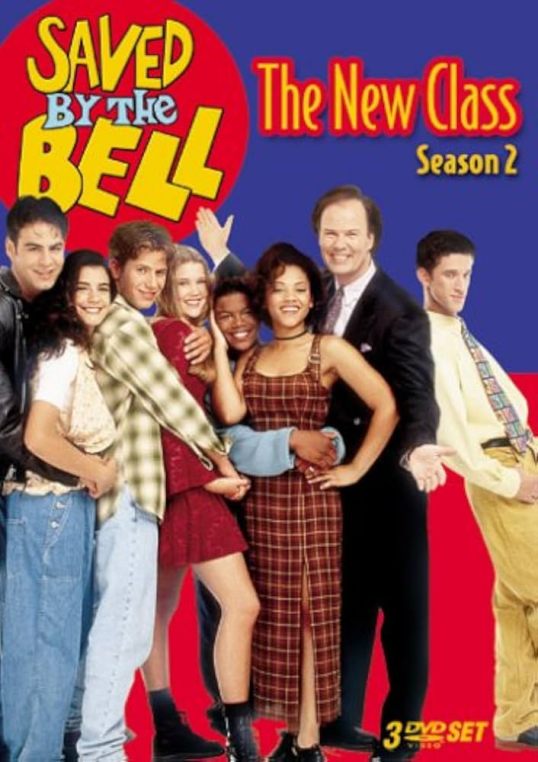
Welcome to Retro Television Reviews, a feature where we review some of our favorite and least favorite shows of the past! On Tuesdays, I will be reviewing Saved By The Bell: The New Class, which ran on NBC from 1993 to 2o00. The show is currently on Prime.
Yay! It’s the final country club episode!
Episode 2.14 “Farewell Dance”
(Dir by Don Barnhart, originally aired on October 22nd, 1994)
The summer is coming to an end and so is the gang’s indentured servitude at the Palisades Country Club. The farewell dance approaches and with it comes the hope of romance and the pain of the heartbreak.
For instance, Bobby pretends to be rich so that snobby club member Michele (Ebonie Smith) will go to the dance with him. Michele loves it when Bobby talks about how his father is a millionaire who owns a private jet and hangs out with the Queen of England. But when Lindsay points out that Michele isn’t falling for the real Bobby, Bobby decides to tell Michele the truth. Michele dumps Bobby and apparently, we’re meant to see Bobby as the victim here. Bobby shouts that he wouldn’t ever go on a date with a girl who refuses to date poor people. Uhmm, Bobby, have you considered that maybe she just refuses to date liars? Anyway, as often happened on any episode where Bobby or Megan even thought about dating anyone who wasn’t listed in the opening credits, Bobby and Megan ended up going to the dance together.
Meanwhile, Screech is upset because Allison is going to be moving to New York to attend Julliard. Screech announces that he’s going to go to New York with her, even though that means he won’t get his degree. (Can’t Screech just transfer to a school in New Yor?) Allison decides that she can’t go to Julliard because it would mean Screech giving up his dreams. (“You have a future with Mr. Belding and Bayside,” Allison tells him. Uhmm ….. what?) Screech realizes that Allison has to pursue her dreams so he tells her to go to New York without him. Allison plays Screech a really bland piano piece that she wrote for him and then they share a final dance.
The main problem with this episode …. oh Hell, you know what the main problem was. The main problem’s initials are D and D. Dustin Diamond gives such a cartoonish performance that it’s hard to believe that Allison would have ever fallen for him in the first place. There are no emotional stakes when it comes to any story involving Screech because there’s nothing real about Screech. As a character, he’s the equivalent of Bobby’s father’s private jet.
All that said, at least the county club episodes are over with! Yay! Always be thankful for the little things.
I’ve shared several episodes of the “This Week in Charles Bronson” podcast with our readers over the last year. I just love visiting with my Buchinsky Buddy Eric Todd about all things related to Charles Bronson. In our latest episode, Eric pays tribute to actress Antoinette Bower, who passed away on April 30th, 2026, at the age of 93. The first Bronson film he ever saw was THE EVIL THAT MEN DO (1984), where Bower plays Claire Molloch, the sister and the love of the life of political torturer Clement Molloch (Joseph Maher). In Bower’s three-decade career she starred in just about every classic TV series you can think of, including Have Gun, Will Travel, The Man from U.N.C.L.E., Star Trek, and with Bronson and Kurt Russell in The Travels of Jaimie McPheeters. It’s a lot of fun revisiting much of her film work, and finding out a lot of other interesting things about her life after she retired from show business in the early 90’s.
After that, I get to tell you all about my trip to Vermont! My wife and I were able to visit Charles Bronson’s gravesite at the Brownsville Cemetery in West Windsor, as well as the property that was once his and Jill Ireland’s horse farm on Bronson Road. We were able to eat at places where he liked to eat and even go shopping at places where he liked to shop! And to top it all off, we had the good fortune to meet his son, Valentine McCallum, who still has property in the area and just happened to be visiting when we were there. Val’s an incredible professional musician and singer, and we were able to catch him performing at the Skunk Hollow Tavern on our last night in the area. I share a couple of his songs on the podcast. What I love the most is that these are very personal songs that Val performed that night. I think you’ll enjoy them. I know we sure did!
So, if any of that sounds like fun to you, take some time to give us a listen. I’m sharing the YouTube and Spotify links below, but you can find us on Apple Podcasts as well!
4 Or More Shots From 4 Or More Films is just what it says it is, 4 shots from 4 of our favorite films. As opposed to the reviews and recaps that we usually post, 4 Shots From 4 Films lets the visuals do the talking!
Today, we pay tribute to the year 2004! It’s time for….
4 Shots From 4 2004 Films
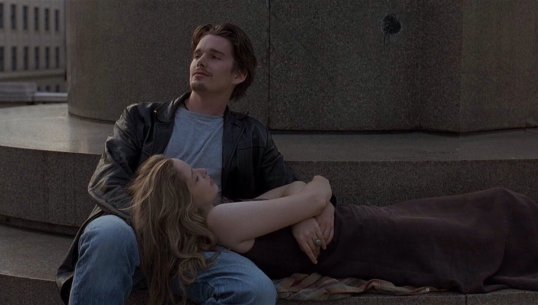
Before Sunset (2004, dir by Richard Linklater, DP: Lee Daniel)
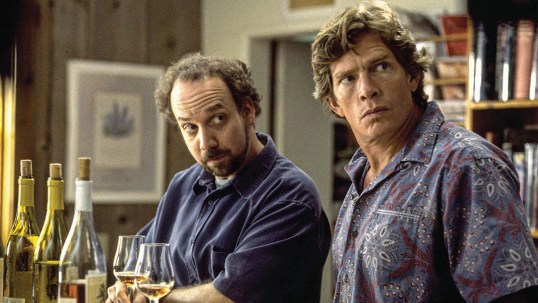
Sideways (2004, dir by Alexander Payne, DP: Phedon Papamichael)
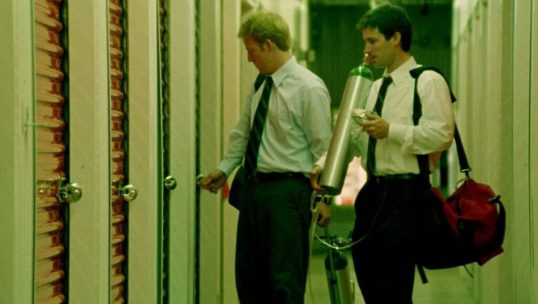
Primer (2004, dir by Shane Carruth)
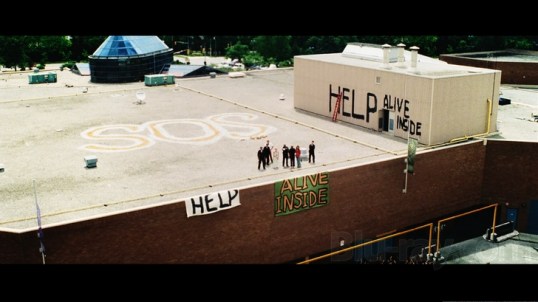
Dawn of the Dead (2004, dir by Zack Snyder, DP; Matthew F. Leonetti)
Pop Muzik, which was written from the perspective of a DJ, was arguably the first new wave hit and this music video was extremely popular during the early years of MTV. The video was the first to be directed by Brian Grant, who was a BBC producer at the time. Working with a £2000 budget, Grant created a video that was revolutionary for the time. (In the late 70s, music videos were mostly just straight performance clips.) The success of Pop Muzik led to Grant becoming one of the busiest music video directors around. Grant went on to direct videos for The Human League, The Fixx, Squeeze, Duran Duran, and many others. If you were a New Wave group, Brian Grant probably directed at least one video for you.