Batman: Crimson Mist (by Doug Moench & Kelley Jones) Horror Review


“The answer to life’s every riddle: death and hungry darkness.” — Batman

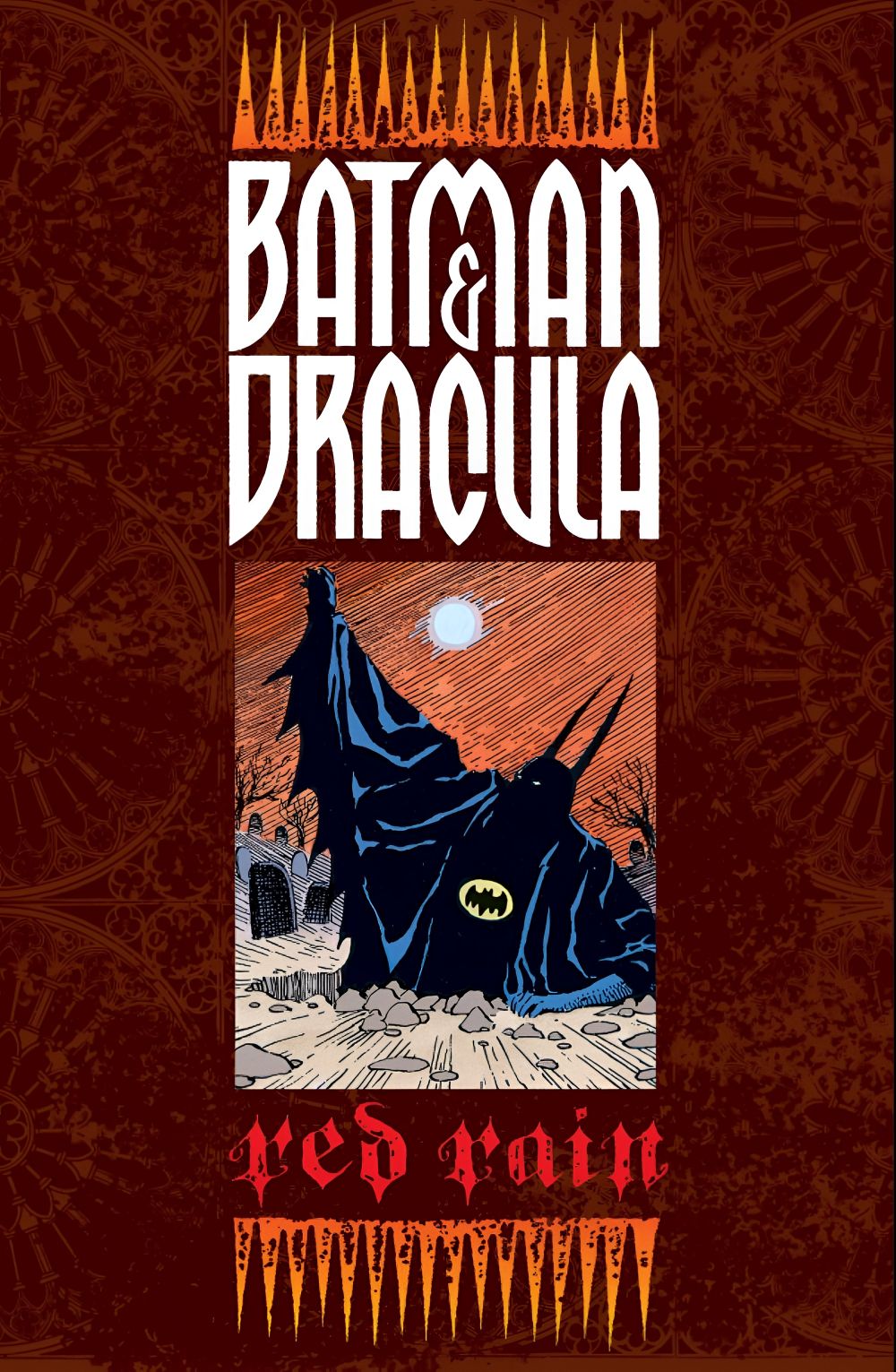
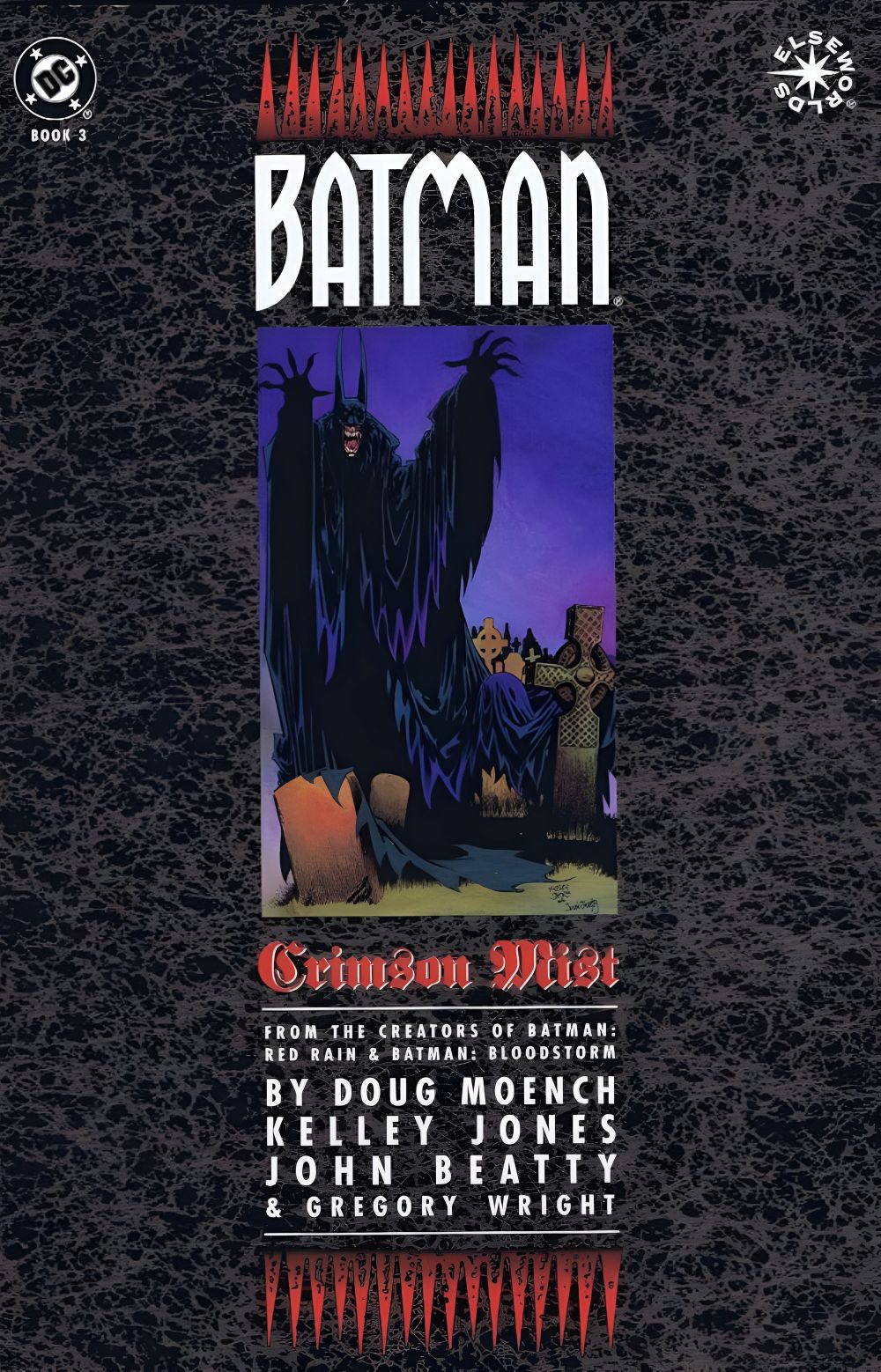
Doug Moench and Kelley Jones’s Batman: Crimson Mist is what happens when a superhero story stops pretending it can still be saved. The third and final entry in their Batman/Dracula Elseworlds trilogy, it takes the vampire-Batman concept introduced in Batman & Dracula: Red Rain and developed in Batman: Bloodstorm, then drags it into a bleak, blood-drenched finale where Gotham is overrun, Batman is undead, and the usual rules of heroism have completely collapsed. This is not a book interested in clever detective work, heroic triumph, or a reassuring ending. It is a gothic horror comic about a man who became a monster trying to decide whether he can still protect the city that made him. The result is excessive, melodramatic, and sometimes messy—but also memorably nightmarish.

The premise is deliberately bleak. Batman has already died, but death does not exactly stick in this universe. He returns as an undead creature still wrestling with Dracula’s curse, while Gotham has descended into a vampire-infested ruin. The book turns Batman’s usual moral code into the central conflict: he is supposed to protect the city, yet the thing inside him wants to feed. That is a strong hook because Batman stories work best when his discipline and restraint matter. Here, restraint is not just a personality trait; it is literally the difference between hero and monster. The story presents Batman as someone who has to give up everything, including life itself, to face the final reckoning, and that gives it an apocalyptic, no-way-back tone.

Moench’s writing is very much in “gothic comic book” mode. There are lots of declarations, ominous speeches, dramatic captions, and characters who seem incapable of saying anything quietly. At times, the dialogue gets so overwrought that it borders on parody. Batman broods, villains cackle, and the story constantly announces its own darkness. But honestly, that is part of the appeal. This is not trying to be a grounded crime story or a restrained psychological thriller. It is a big, pulpy vampire opera, and Moench leans into that identity completely. The book works best when you accept that everyone is performing at maximum theatrical intensity.

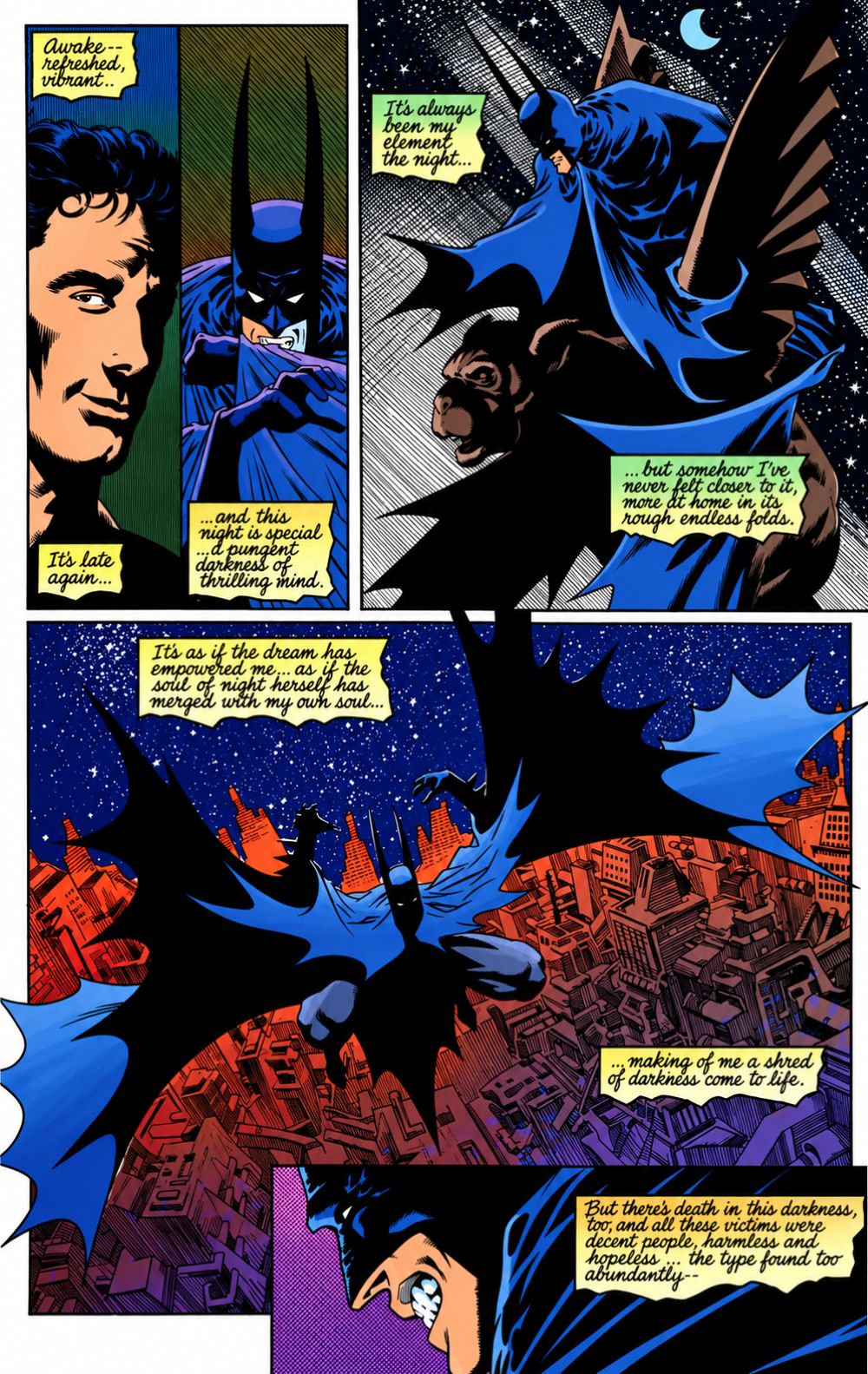
What gives the story real weight is the way it treats Batman’s vampirism as a tragedy rather than just a cool visual upgrade. He has power, but it comes with hunger. He can fight monsters, but he is increasingly one of them. The tragedy is that Batman’s greatest strength—his refusal to kill—has been compromised before the story even begins. He is already damned, or at least believes he is, so the question becomes whether he can still choose to protect people when every instinct tells him to consume them. That gives Crimson Mist a more emotional core than you might expect from a book with this much fang-baring carnage.
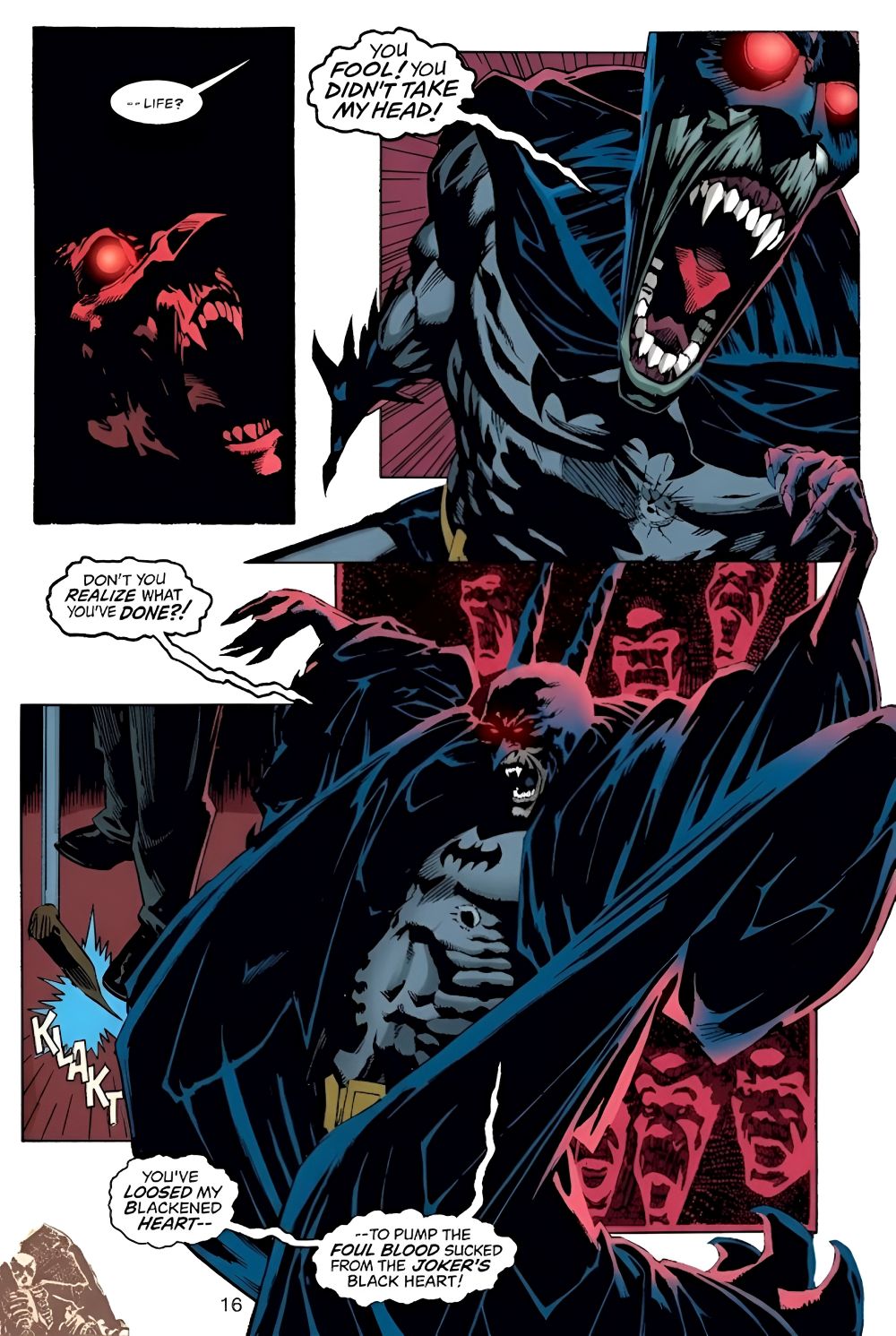
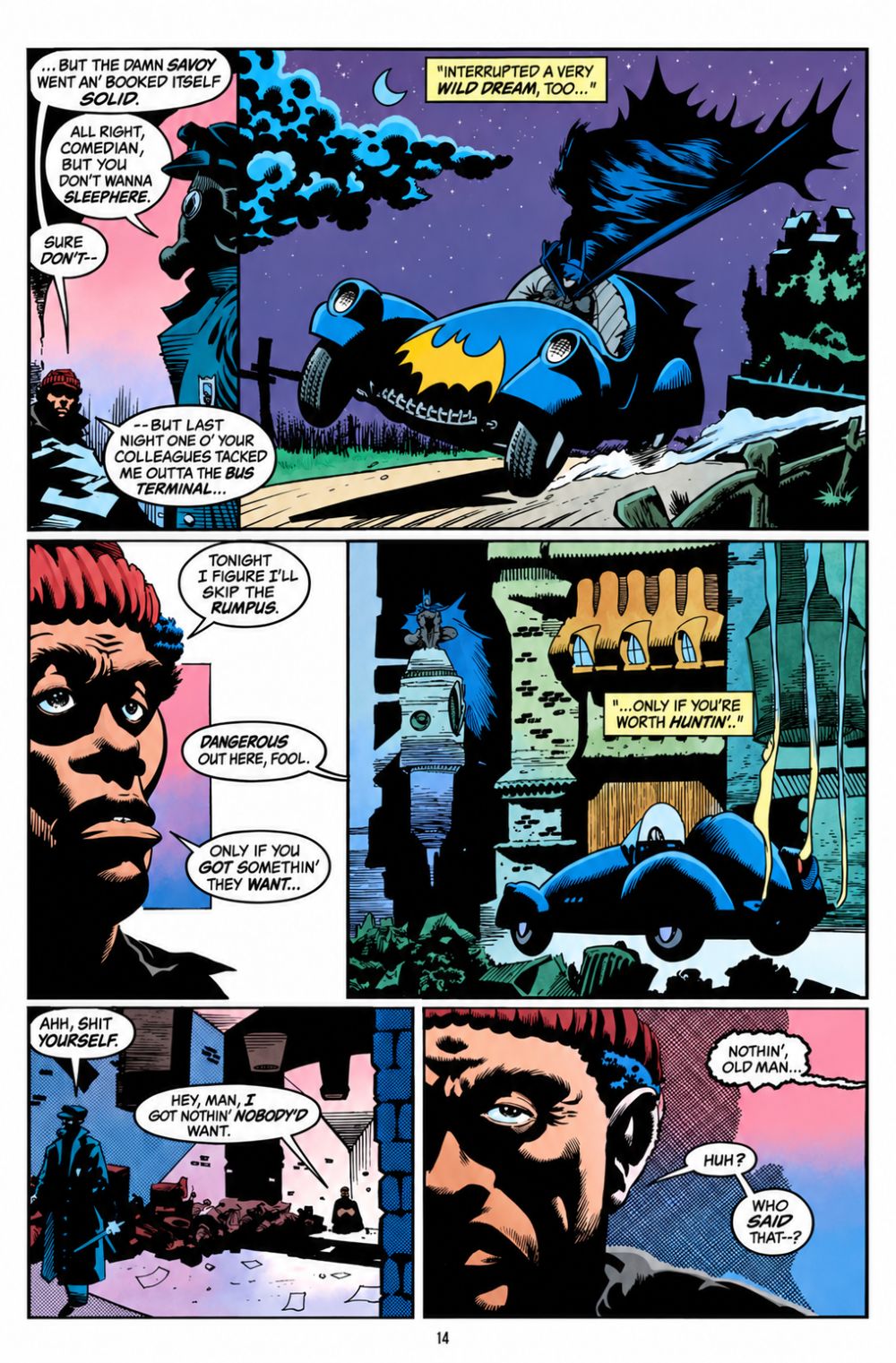
Kelley Jones’s art is the main reason this book feels so distinctive. Jones has always drawn Batman like a creature from a nightmare: huge cape, gaunt limbs, exaggerated shadows, a face that can shift from heroic determination to monstrous hunger. In Crimson Mist, that style is perfectly matched to the material. Gotham looks rotten and haunted. The vampires look genuinely repulsive. Batman himself often looks less like a man in a costume and more like a wraith who happens to wear one. The book is credited to Moench with art by Kelley Jones, John Beatty, and Malcolm Jones III, and the inking especially helps give the pages that scratchy, decayed texture.

The color work is a little more divisive. Some readers find the later trilogy books less polished than Red Rain, and Crimson Mist can look muddy or harsh depending on the printing. But that griminess fits the story. This is not a clean, glossy Gotham. It is a city already half-consumed by corruption, blood, and supernatural rot. The art may not be conventionally beautiful, but it is atmospheric in a way that suits the material. Jones makes every panel feel like it is breathing fog, dripping blood, or hiding something with too many teeth.

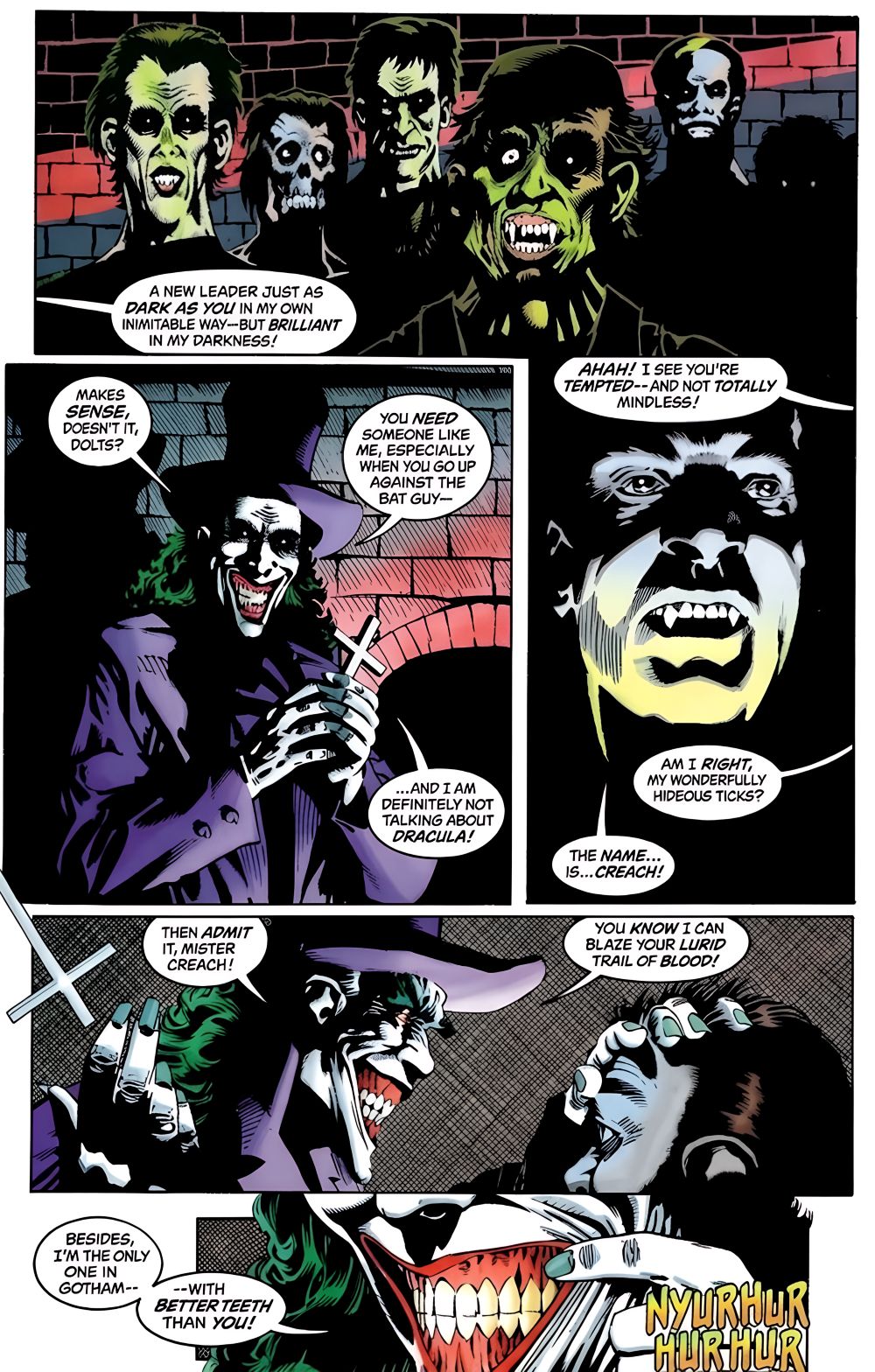
One of the most notorious aspects of Crimson Mist is its treatment of Batman’s villains. The Penguin, Two-Face, Killer Croc, Poison Ivy, Scarecrow, the Riddler, Black Mask, and the Joker all appear in the story’s larger cast, and the book has no interest in preserving the usual rules of superhero combat. Batman is not merely defeating criminals; he is hunting them. The violence is extreme, sometimes shocking, and often deliberately grotesque. For some readers, that will feel like a betrayal of the character. For others, it is the whole point: this is an Elseworlds where the usual safety rails have been removed, and Batman’s no-kill rule has collapsed under the weight of the vampire curse.

That said, the book’s biggest weakness is also its willingness to go too far. Crimson Mist sometimes mistakes escalation for depth. Once Batman starts tearing through familiar villains, the story can feel like a checklist of shocking moments rather than a carefully built narrative. The Joker’s involvement, in particular, has the potential to be fascinating, but the book often seems more interested in the spectacle of Batman versus his enemies than in exploring what those confrontations mean. There is a difference between “Batman has become a monster” and “the comic keeps showing Batman doing monstrous things,” and Crimson Mist occasionally lands on the wrong side of that line.
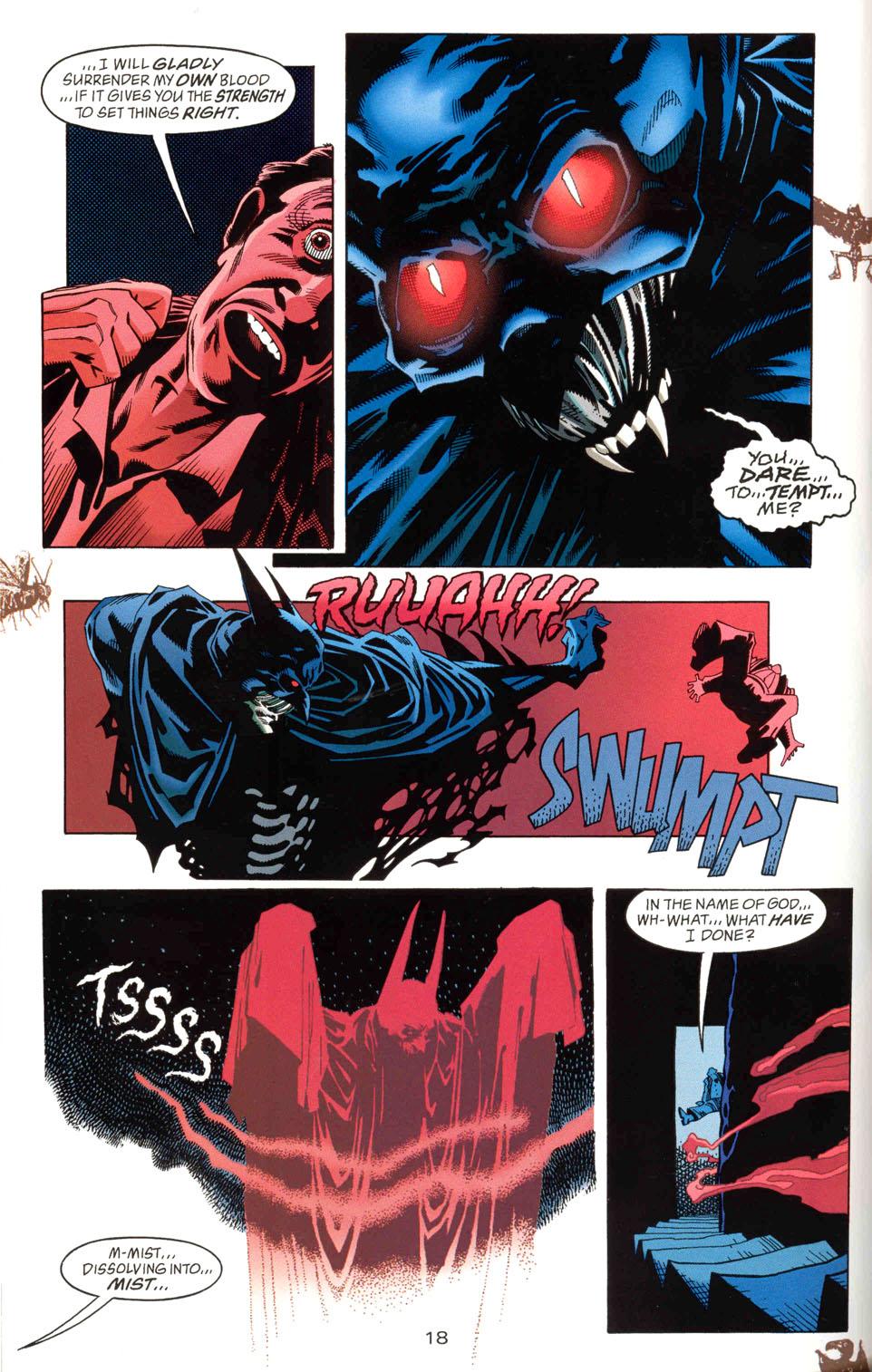
Still, the final chapter has a bleakness that gives it purpose. Unlike a standard superhero story, there is no obvious route to a happy ending. Batman cannot simply punch the curse away. Gotham cannot simply be saved by better policing or a clever gadget. The trilogy has spent two books making the world worse, and Crimson Mist has to confront the consequences. That gives the story a fatalistic energy. It feels like a horror movie’s final act, where the heroes are exhausted, the monsters are everywhere, and survival itself may be too much to ask.

As a standalone graphic novel, Crimson Mist is probably not the ideal entry point. It assumes familiarity with Red Rain and Bloodstorm, and without those books, the emotional stakes will feel thinner. Batman’s relationship with Selina Kyle, the fallout from his battle with Dracula, and the overall state of Gotham all carry over from the earlier chapters. The book is collected alongside both predecessors in Elseworlds: Batman Vol. 2, which is really the best way to experience it. Read on its own, it can feel like an exaggerated finale; read after the first two books, it feels like the inevitable, ugly conclusion to a tragedy that started when Bruce Wayne accepted vampire blood to save Gotham.

The trilogy’s appeal is that it understands something important about Batman: he is already a horror character. He dresses like a bat, operates at night, uses fear as a weapon, and lives in a city that practically begs to be overrun by monsters. Moench and Jones simply make the metaphor literal. Batman becomes the thing he has always dressed as. That idea alone gives the trilogy its power, and Crimson Mist takes it to its logical extreme.

Is it the best of the three? Probably not. Red Rain has the cleaner concept and the stronger sense of discovery, while Bloodstorm expands the mythology and gives the tragedy more room to develop. Crimson Mist is messier, louder, and more extreme. But it is also the most purely Kelley Jones book of the bunch. If you like his art, this is essential. If you do not, this may be the book that finally breaks you. Every page seems designed to remind you that Jones does not draw Batman as a handsome adventurer; he draws him as a haunted, elongated nightmare given a cape and a mission.

For all its excess, Batman: Crimson Mist is a memorably deranged piece of late-’90s DC horror comics. It is melodramatic, violent, ugly in places, and completely uninterested in being subtle. But it is also visually striking, thematically appropriate, and a genuinely fitting end to the Batman/Dracula saga. It asks what happens when Batman’s war on crime becomes literal predation, then answers with blood, shadows, and a Gotham that may be beyond saving. If you want a Batman story that feels like a Hammer horror film crossed with a nightmare, this is absolutely worth reading. Just do not come in expecting the World’s Greatest Detective to solve the case with a batarang and a stern lecture. By the time Crimson Mist is over, Batman is less a detective than a curse with a conscience—and that is exactly the kind of deranged Elseworlds premise DC should occasionally let creators run wild with.
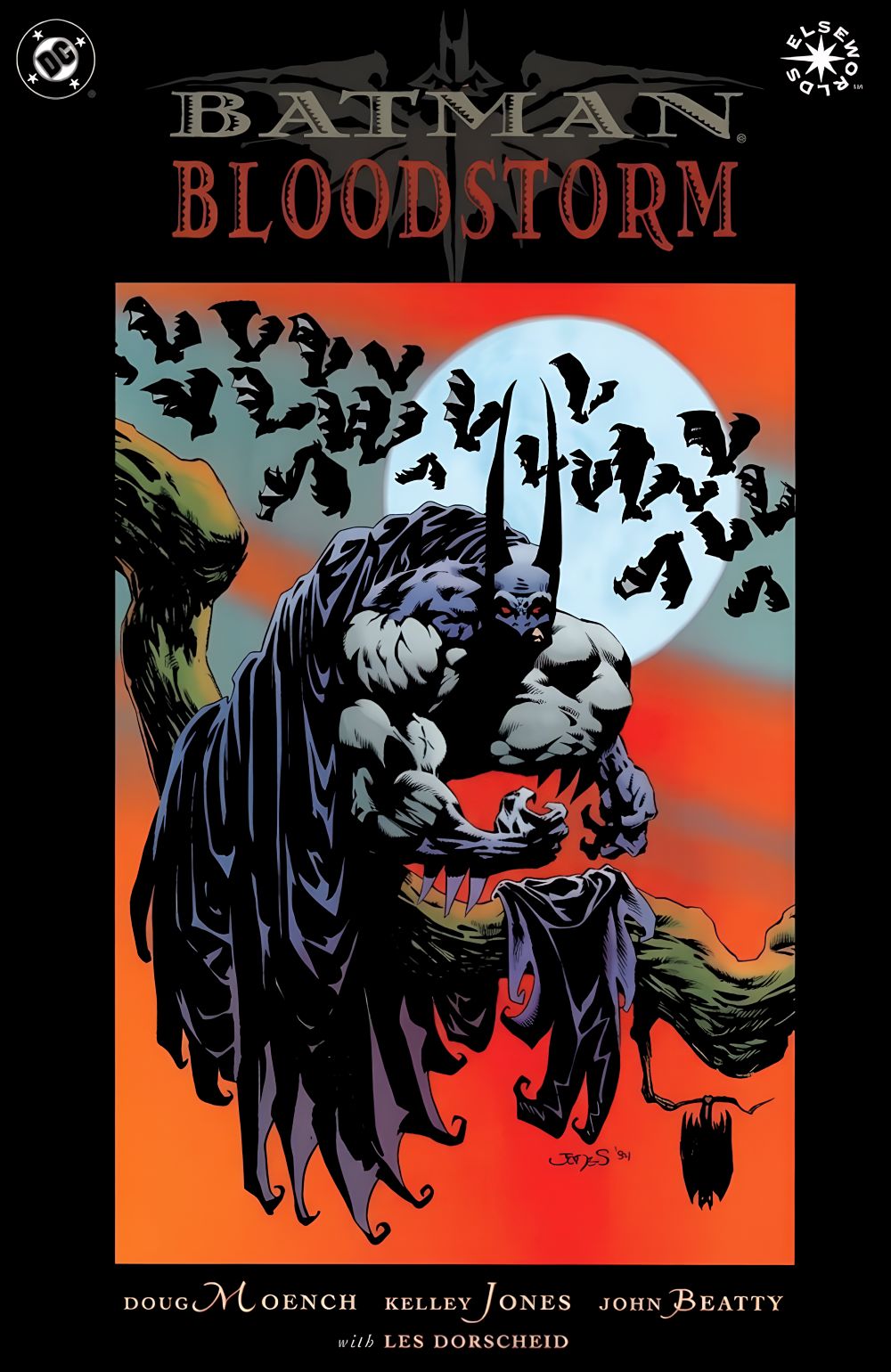
Batman: Bloodstorm (by Doug Moench & Kelley Jones) Horror Review


“Gotham does not need another monster!”– Batman

Batman: Bloodstorm is the middle chapter of Doug Moench and Kelley Jones’ wonderfully deranged Batman & Dracula trilogy, and it might be the best of the three because it finally gives the premise somewhere to go beyond “Batman versus Dracula.” The first book, Batman & Dracula: Red Rain, established the hook: Gotham is invaded by vampires, Batman defeats Count Dracula, and the cost is that Bruce Wayne himself becomes a vampire. Bloodstorm picks up immediately after that ending and asks the question that makes the whole Elseworlds experiment click: what happens when Batman is now the thing he swore to destroy?

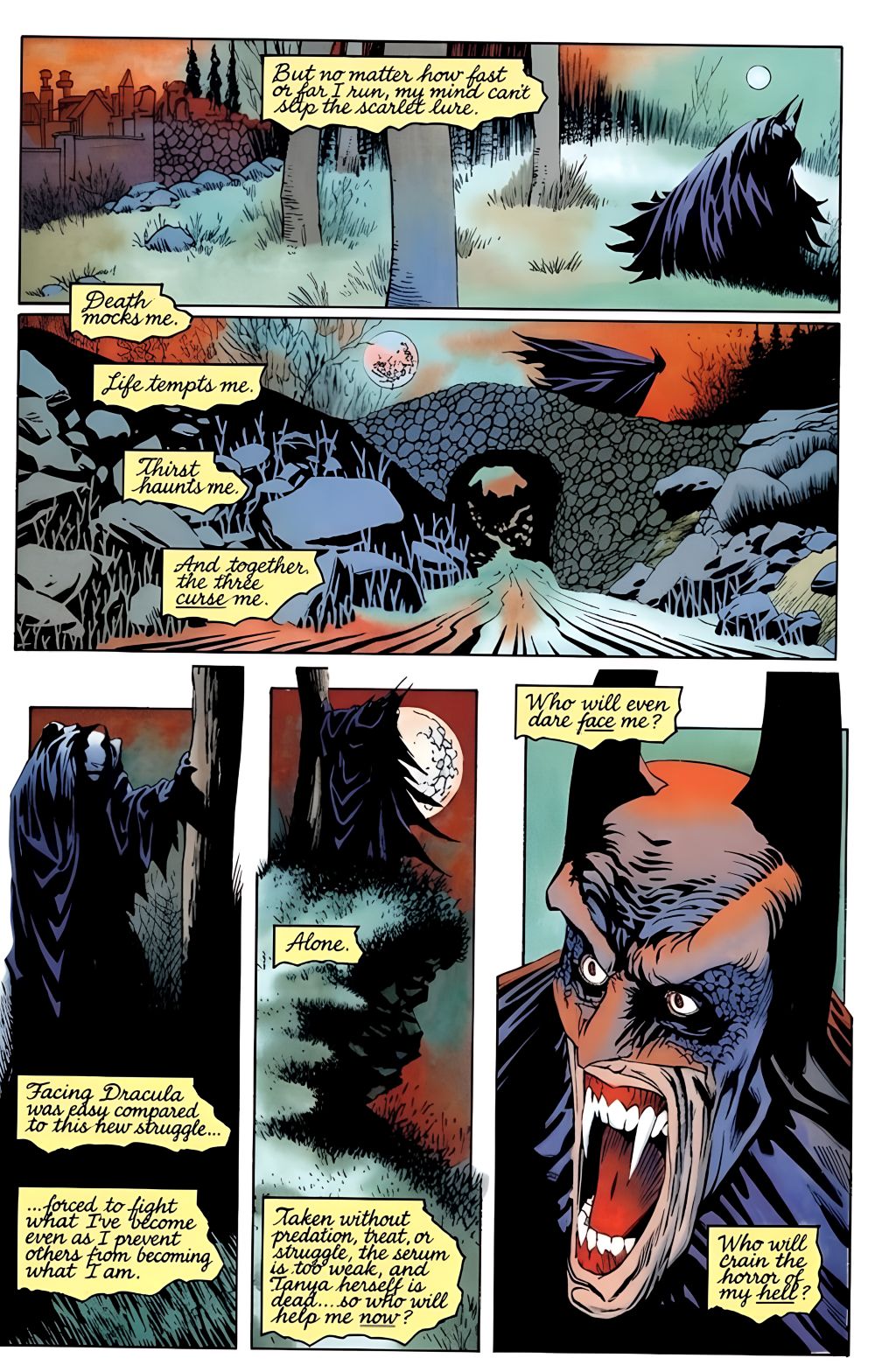
The answer is grim, pulpy, and a lot of fun. Batman has retained his mission, but he is no longer simply a man using fear and discipline to fight crime. He is a creature of the night with a hunger he cannot fully control, fighting remnants of Dracula’s undead army while trying to keep from becoming Gotham’s next monster. That is a great setup, and Moench understands why it works. Batman’s usual moral code—especially his refusal to kill—is not just challenged here; it is structurally compromised. He has to destroy vampires permanently, he needs blood to survive, and every act of violence brings him closer to the edge.

What makes Bloodstorm more interesting than a standard vampire-Batman novelty is that Moench treats vampirism as both a horror curse and a metaphor for Batman’s already obsessive, self-punishing nature. Bruce has always lived in darkness, dressed like a nightmare, and used terror as a weapon. Here, the metaphor becomes literal. He is isolated, increasingly unstable, and forced to confront the possibility that his crusade is not noble self-sacrifice but addiction dressed up as virtue. The book’s central tension is not whether Batman can defeat the vampires; it is whether he can preserve any part of his soul while doing it.

Moench leans into that internal torment without turning the book into a dry psychological study. This is still a big, gothic comic-book melodrama, full of blood, thunder, graveyards, ruined Gotham streets, and villains chewing the scenery with admirable commitment. The Joker’s arrival is the obvious but effective escalation. If Dracula was the ancient evil who turned Gotham into a hunting ground, the Joker is the chaotic local disease that infects the remains. He takes over Dracula’s undead followers and turns the vampire threat into something even more unpredictable and cruel. It is one of those “of course” ideas that feels inevitable once you hear it: the Joker with an army of vampires is almost too perfect for a dark Elseworlds story.

Catwoman also plays a major role, and she is one of the book’s more emotionally effective elements. Her relationship with Batman gives the story a human anchor amid all the fangs and shadows. Batman is barely holding himself together, and Selina Kyle becomes someone who can still see the man underneath the monster. That does not make the book soft, but it gives the tragedy a direction. The supporting cast also includes Alfred and Jim Gordon, which helps keep the story connected to the familiar Batman mythology even as the world becomes increasingly unhinged.

Kelley Jones’ artwork is the reason this book has such a strong identity. His Batman is not the sleek, athletic tactician of modern comics; he is a towering, crooked, almost demonic silhouette, with a cape that seems to have a life of its own and a cowl that makes him look like something crawled out of a nightmare. In a vampire story, that exaggeration is exactly right. Jones’ Gotham is a place of jagged architecture, oppressive shadows, distorted faces, and bodies arranged for maximum gothic impact. The book is drawn by Jones with inks from John Beatty and Malcolm Jones III, and the result is one of the most visually distinctive versions of Batman DC has ever published.

Jones’ style is not for everyone. His figures can be elongated, his anatomy deliberately strange, and his compositions sometimes favor atmosphere over clarity. But in Bloodstorm, those qualities become assets. Batman looks like a vampire even before the story reminds you that he is one. The Joker looks genuinely repellent rather than merely clownish. The vampires have a theatrical, old-school horror-movie menace, and the color work gives the whole thing a blood-soaked, moonlit finish. Jones had grown as an artist since Red Rain, with stronger page images and more distinctive action staging, and Bloodstorm feels more confident than its predecessor, more willing to commit to the grotesque beauty of its premise.

The art also helps cover some of the book’s rougher edges. Moench’s writing can get a little overwrought, with characters delivering dialogue that sounds like it was marinating in candle wax and thunderstorms. But that is part of the charm. This is not a grounded crime story; it is a gothic pulp nightmare, and the dialogue mostly matches the artwork’s operatic intensity. When Batman broods, he really broods. When the Joker menaces, he really menaces. The book knows what tone it wants, and it commits.

The main weakness is that Bloodstorm occasionally mistakes escalation for depth. The story has strong ideas about Batman’s hunger, guilt, and moral collapse, but it sometimes circles the same emotional territory: Batman fears becoming a monster, Batman resists the hunger, Batman worries that he is losing himself. That tension is effective, but after a while you want the story to find new angles rather than restate the central dilemma. The Joker is a blast, but some of his scenes lean on shock value and broad villainy rather than the sharper psychological warfare he can bring out in Batman.

There is also the issue of pacing. At 96 pages, the book moves quickly, but its plot can feel like a bridge between the clean Dracula showdown of Red Rain and the even darker final chapter, Batman: Crimson Mist. It introduces a compelling status quo—vampire Batman, Joker-led undead forces, a Gotham sliding further into ruin—then has to resolve enough of it to set up the next installment. That gives the story momentum, but it also means a few developments feel rushed or designed more for shock than long-term payoff.

Still, those flaws do not sink it. Bloodstorm is more focused than Red Rain because its conflict is personal rather than merely external. Dracula was the big villain, but Batman’s own transformation is the real antagonist here. The book understands that the scariest version of this premise is not “Batman fights vampires.” It is “Batman is a vampire, and he still thinks he can save Gotham.”

Batman: Bloodstorm is a proudly excessive piece of ’90s DC horror comics: moody, violent, melodramatic, and visually unforgettable. Doug Moench gives the story a genuinely compelling moral crisis, while Kelley Jones turns every page into a gothic fever dream. It is not flawless—the dialogue can be purple, the pacing can be uneven, and the book occasionally leans too hard on grimness—but its best moments have real power. If you enjoy Batman stories that push the character into moral darkness without losing sight of why he fights in the first place, this is an easy recommendation.

As the second part of the Batman & Dracula trilogy, it also works better if you have read Red Rain first, since it begins directly from that book’s aftermath. But on its own terms, Bloodstorm is a strong example of what Elseworlds did best: taking a familiar hero, changing one essential rule, and discovering that the character becomes both more frightening and more tragic. Batman has always been a creature of the night. This book simply asks what happens when the night finally claims him.

Batman and Dracula: Red Rain (by Doug Moench & Kelley Jones) Horror Review


“The red rains do not cease until well past midnight…” — Intro

There is something almost inevitable about Batman & Dracula: Red Rain, as if the Dark Knight had spent decades waiting for a story that would finally let him face the ultimate creature of the night. Written by Doug Moench and drawn by Kelley Jones, this 1991 DC Elseworlds graphic novel takes Batman out of mainstream continuity and places him in a Gotham City invaded by Dracula and his vampire followers. It is a simple premise, but it is also a perfect one. Batman has always borrowed from horror—the bats, the shadows, the fear, the whole “I am the night” attitude—so pitting him against literature’s most iconic vampire feels less like a random crossover and more like the character finally meeting the genre that helped shape him.

The story begins with Gotham under a different kind of threat. Dracula arrives in the city and begins preying on its homeless population, people whose disappearances attract little attention from police, politicians, or the wealthy citizens who prefer not to look too closely at the city’s suffering. Batman notices the pattern and starts investigating, initially believing he may be dealing with a serial killer or some new criminal operation. What he discovers is far worse: an ancient vampire lord has chosen Gotham as his hunting ground. Moench uses that early investigation well, giving the book a detective-story structure before it becomes something much larger and more supernatural. Batman is at his best when he is the person paying attention when nobody else will, and that quality gives the horror a stronger emotional foundation.

The choice to make the homeless Dracula’s first victims is one of the book’s smartest decisions. It gives Red Rain a social dimension without turning it into a lecture. Gotham has always been portrayed as a city that exploits and abandons vulnerable people, and here that neglect becomes literally deadly. Dracula does not need to conquer Gotham through armies or public spectacle at first; he can feed quietly because society has already decided these lives do not matter. Batman, for all his wealth and privilege, refuses to accept that indifference. That conflict gives the story more weight than a standard hero-versus-monster plot. Dracula is not merely powerful; he is a predator thriving in the cracks of a broken city.

Kelley Jones’ artwork is the biggest reason Red Rain remains so memorable. His Gotham is a nightmare landscape of leaning rooftops, twisted spires, graveyards, fog, rain, and cavernous shadows. His Batman is especially striking: long-limbed, heavily caped, and more batlike than usual, almost like a creature that crawled out of the city’s own nightmares. This is not the clean, athletic Batman of many mainstream comics. Jones’ version feels ancient, dangerous, and perfectly suited to a story about vampires. Dracula receives equally strong visual treatment. He is elegant and commanding, but Jones never lets him become too glamorous. He remains a monster first, with a presence that makes every appearance feel threatening.

The colors and lettering add a lot to the atmosphere as well. Les Dorscheid’s palette relies on deep reds, blacks, purples, sickly greens, and shadowy blues, making the book feel like a classic Gothic horror comic. Todd Klein’s lettering gives the narration a textured, literary quality that suits the Bram Stoker-inspired material. Moench’s prose is deliberately ornate, full of ominous descriptions and heightened Gothic language. Some readers might find it overly purple, and there are moments where the narration becomes a little too dramatic for its own good. But the excess fits. This is a story about Batman versus Dracula, and it should feel theatrical, bloody, and grandiose. Moench is not trying to write a grounded crime thriller; he is writing a horror opera.

At its heart, the book is about Batman confronting a threat that attacks not only Gotham but his own identity. Batman’s character has always depended on discipline. He refuses to kill, refuses to surrender to fear, and refuses to become the thing criminals see when they look into the darkness. Dracula represents the opposite of that discipline: predatory power, immortality, and the willingness to treat human beings as prey. The central tension is not just whether Batman can stop him, but what it costs to fight an enemy whose very nature is built around corruption and control. Moench keeps that tension simmering beneath the Gothic atmosphere, giving the conflict more meaning than a simple battle between hero and villain.

That thematic focus is what keeps Red Rain from feeling like just another “what if?” comic. Red Rain is part of DC’s Elseworlds line, which is essentially DC’s version of Marvel’s What If…? concept: familiar characters are placed in alternate universes or alternate histories, allowing writers to explore scenarios that would be difficult or impossible in regular continuity. In this case, the premise asks what would happen if Batman’s Gothic Gotham were confronted by Dracula and an actual vampire invasion. The Elseworlds format gives Moench and Jones freedom to make the stakes feel real. Batman can be vulnerable, Gotham can be endangered, and the story does not have to preserve the usual superhero status quo. It also helps that this is the first chapter of a trilogy that continues in Batman: Bloodstorm and Batman: Crimson Mist, so the book clearly has consequences beyond its own pages.

Still, the graphic novel is not without weaknesses. Once the vampire threat becomes clear, the plot follows a fairly direct path: Dracula wants Gotham, Batman wants to stop him, and the conflict builds toward a violent confrontation. Some supporting characters are thinly developed, existing mainly to serve the plot or provide exposition. Commissioner Gordon is present, but he does not get especially deep characterization, and several familiar Gotham figures are either absent or reduced to brief appearances. The pacing can also feel uneven. The opening investigation is wonderfully eerie, but the later action sequences occasionally move so quickly that the story’s mood has to carry more of the emotional weight than it should. Readers looking for a detailed psychological portrait of Bruce Wayne may find the book more interested in atmosphere and spectacle than character depth.

Even so, those flaws are easy to forgive because the book knows exactly what it wants to be. Red Rain is not trying to be subtle. It wants rain-drenched streets, graveyards, ancient evil, blood, thunder, and a hero pushed beyond his usual limits. It wants Batman to be frightening as well as heroic. It wants Dracula to feel like a threat worthy of Gotham’s protector. And it succeeds. The collaboration between Moench’s Gothic writing and Jones’ expressionistic art creates a unified vision of Batman as a horror figure, one that still feels distinctive decades after publication.

There is also a pleasing symmetry between the two lead characters. Batman uses fear as a weapon, but he remains human and protects the innocent. Dracula feeds on fear, blood, and human weakness, turning people into instruments of his will. Batman is a self-made creature of the night; Dracula is the original one. Their conflict becomes a battle over what the darkness means. For Batman, it is a place from which he can protect people. For Dracula, it is a hunting ground. That contrast gives their confrontation a moral clarity without making it simplistic.

Few Batman stories lean as completely into the character’s horror roots as Batman & Dracula: Red Rain. It may not be the most nuanced Batman story ever told, and its prose can occasionally lean too hard into Gothic melodrama, but its mood is exceptional and its central idea is executed with real confidence. If you like Batman best when he is treated as a creature of horror rather than simply a detective or martial artist, this is essential reading. It captures the character at his most Gothic: surrounded by death, threatened by darkness, and still refusing to let Gotham be consumed.

Hellboy: Almost Colossus (by Mike Mignola) Horror Review


“I pray to God to kill me.” — Roger

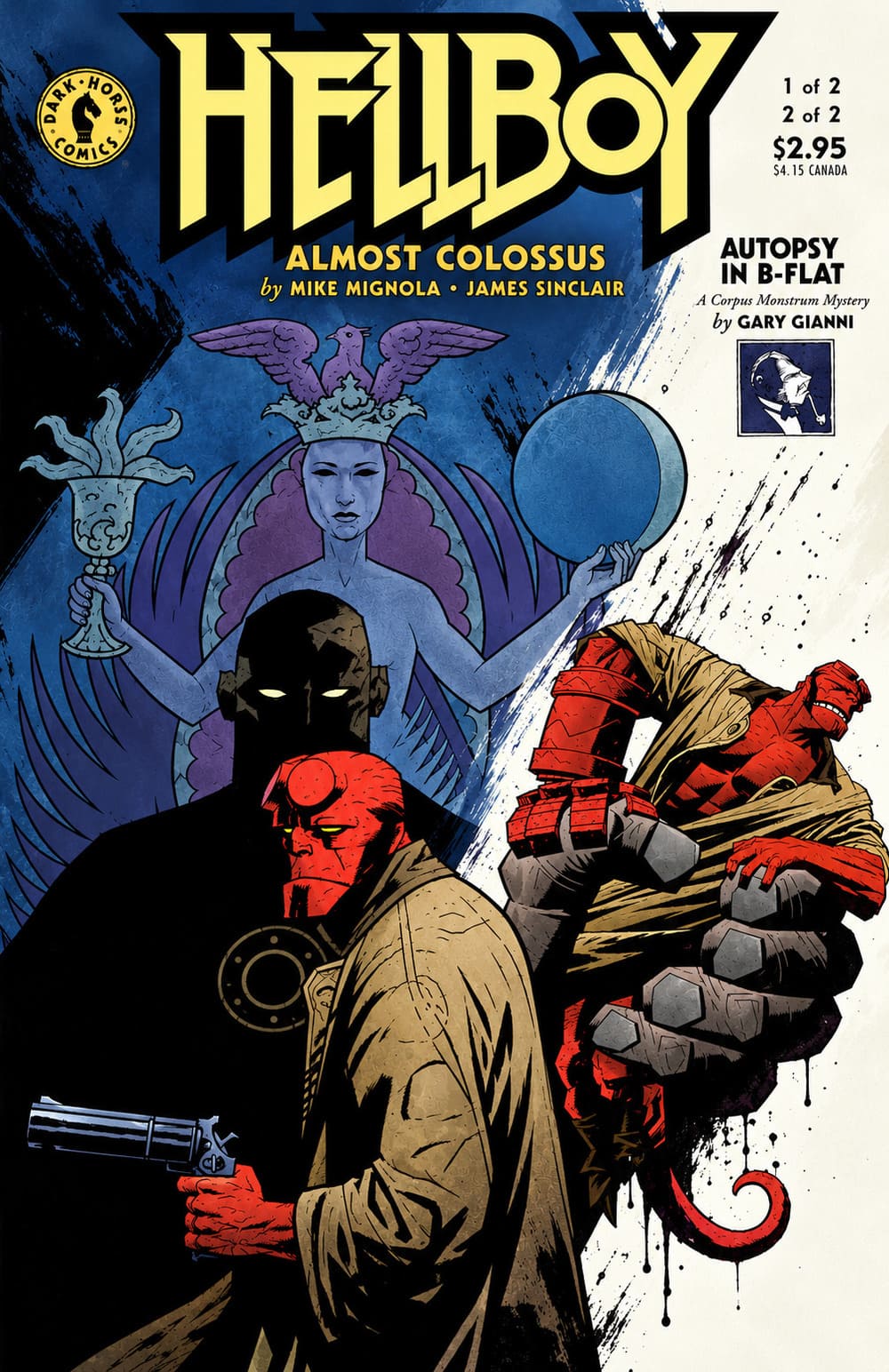
Mike Mignola’s Hellboy: Almost Colossus gets its best mileage out of a simple question: what makes someone a monster once you look past the body they were born—or built—into? This two-issue miniseries takes the unfinished business of Hellboy: Wake the Devil and turns it into a compact Gothic adventure with a surprisingly tender center. There are disturbed graves, shadowy ruins, unnatural bodies, and a villain whose ambitions are considerably bigger than his conscience. But underneath that familiar horror setup is a story about two artificial beings who respond to their existence in very different ways. One wants to make the world suffer. The other barely knows how to face it.

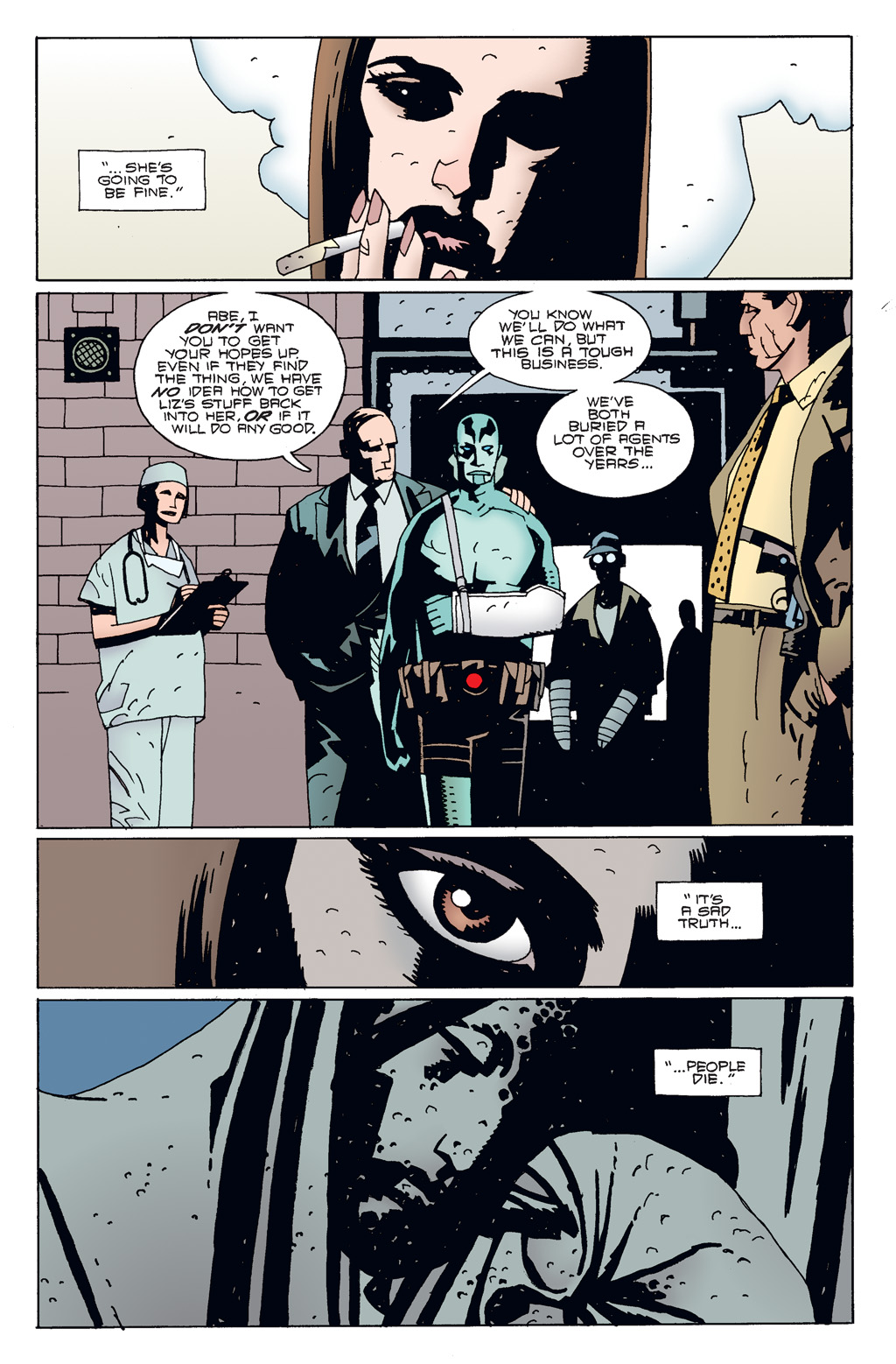
The immediate problem is Liz Sherman’s deteriorating condition. During Hellboy: Wake the Devil, her fire brought an ancient homunculus to life, but the transfer left her without the powers that had sustained her. Now Hellboy and Kate Corrigan need to find the creature and discover whether that process can be reversed. It is a clean, urgent premise that gives the story direction without requiring another elaborate explanation of Hellboy’s destiny. The stakes are personal rather than cosmic. Liz is dying, and Hellboy is not about to stand around waiting for someone else to fix it.

That smaller scale is one of the comic’s biggest strengths. Hellboy: Wake the Devil has the pleasure of watching several supernatural threats overlap, but Hellboy: Almost Colossus benefits from having less to juggle. Mignola takes an incident that could have remained a disturbing subplot and follows its consequences. Liz’s awakening of the homunculus was not just another strange encounter in a haunted castle. It created a life while endangering another, and the people involved now have to deal with that imbalance. The supernatural events feel consequential because they leave emotional damage behind.

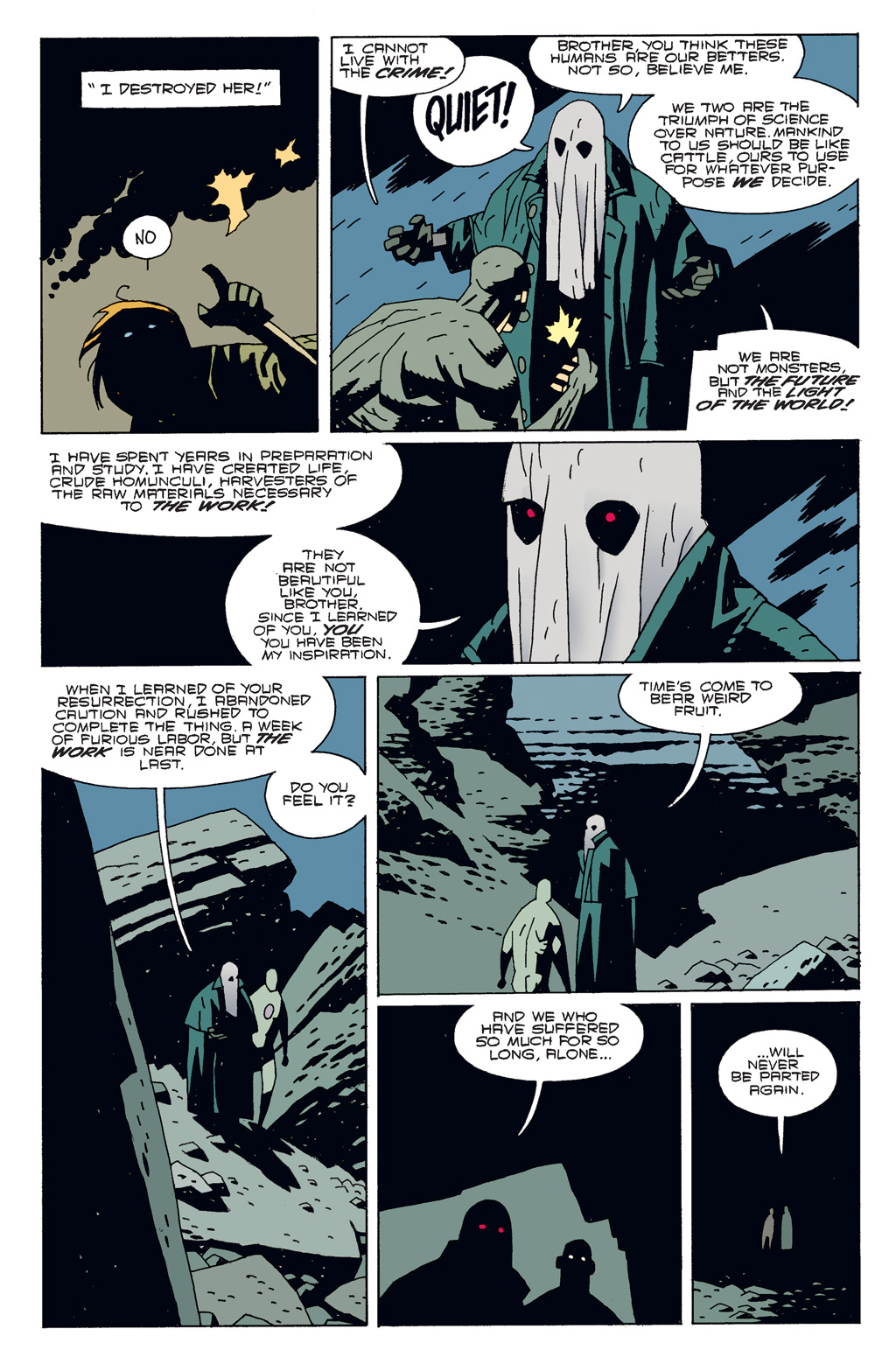
The homunculus, Roger, is the heart of the story. His physical appearance initially places him within the familiar territory of the lumbering artificial monster, but Mignola quickly complicates that impression. Roger is not thrilled to be alive. He is frightened, confused, and overwhelmed by guilt over the suffering connected to his awakening. His desire for death gives the story an unsettling sadness. Life has arrived before understanding, and he has no idea what to do with either. Rather than making him immediately lovable, Mignola allows his distress to remain awkward and uncomfortable, which makes his eventual choices more affecting.

Roger’s older brother provides the nasty counterpoint. Another homunculus created through alchemy, he has responded to his origins with resentment and grandiosity. His solution to feeling wronged is to build himself into something powerful enough to dominate everyone else. Other bodies become material for his ambitions, and other lives become expendable. He is grotesque not simply because of what he is, but because of how casually he reduces people to things. The contrast with Roger is sharp: one brother is horrified by the possibility of causing harm, while the other treats harm as a necessary step toward greatness.

That distinction gives the comic its moral backbone. Mignola does not suggest that unnatural creation automatically produces evil, nor does he make suffering an excuse for cruelty. Both brothers have reasons to feel alienated, but they still make different decisions. Roger’s brother converts his grievances into a claim of superiority. Roger must learn that guilt does not have to end in surrender or self-destruction. It can become responsibility. That is a substantial idea for such a short adventure, and the story makes it tangible through the brothers’ behavior rather than stopping to explain its own message.

The Frankenstein influence is easy to recognize, particularly in the loneliness and resentment surrounding manufactured life. What makes this more than a familiar variation is how naturally those concerns fit Hellboy himself. His appearance suggests danger, and his origins carry implications he refuses to accept as instructions. Roger’s predicament echoes that larger conflict without turning the miniseries into another extended discussion of prophecy. Hellboy becomes an example of the difference between what someone looks like and what someone chooses to do. He is not delivering inspirational speeches, either. He is simply trying to save a friend.

His blunt attitude helps keep the material from becoming too mournful. Hellboy can move through an ancient horror as though it is an especially irritating assignment, and that practical impatience gives the comic some welcome personality. The humor does not erase the danger; it makes his concern feel less theatrical. Kate also helps ground the investigation. Her presence supplies a human perspective beside Hellboy’s familiarity with the bizarre, and her vulnerability gives the confrontation immediate stakes beyond the brothers’ argument. Their partnership makes the supernatural setting feel inhabited rather than merely arranged for atmosphere.

Visually, Mignola makes the ruins and artificial bodies feel like parts of the same uneasy world. His heavy blacks and simplified forms give stonework a looming presence, while the homunculi look assembled, weighty, and uncomfortable in their own shapes. The pages do not need elaborate detail to suggest history. A dark opening or a fragment of architecture can imply whole rooms of forgotten experiments. James Sinclair’s coloring supports that starkness, allowing the drawing’s silhouettes and shadows to carry the mood. The result feels closer to a grim illustrated folktale than a glossy superhero adventure.

The two-issue format does leave some limitations. Liz functions mainly as the reason for the mission, and the older brother’s ambitions could have supported more development. Reading Hellboy: Wake the Devil first also gives the opening greater emotional weight. Still, the brevity keeps the story from diluting its strongest material. The climax matters because Roger has to decide what kind of being he will become, not simply because something enormous needs to be punched. Hellboy: Almost Colossus delivers the Gothic spectacle, but its real achievement is making compassion feel like an active choice. The most human figure in the story may be the one who has the least idea how to be human.

Hellboy Saga

Horror Guilty Pleasure No. 132: The Convent of Hell (by Ricardo Barreiro & Ignacio Noé)


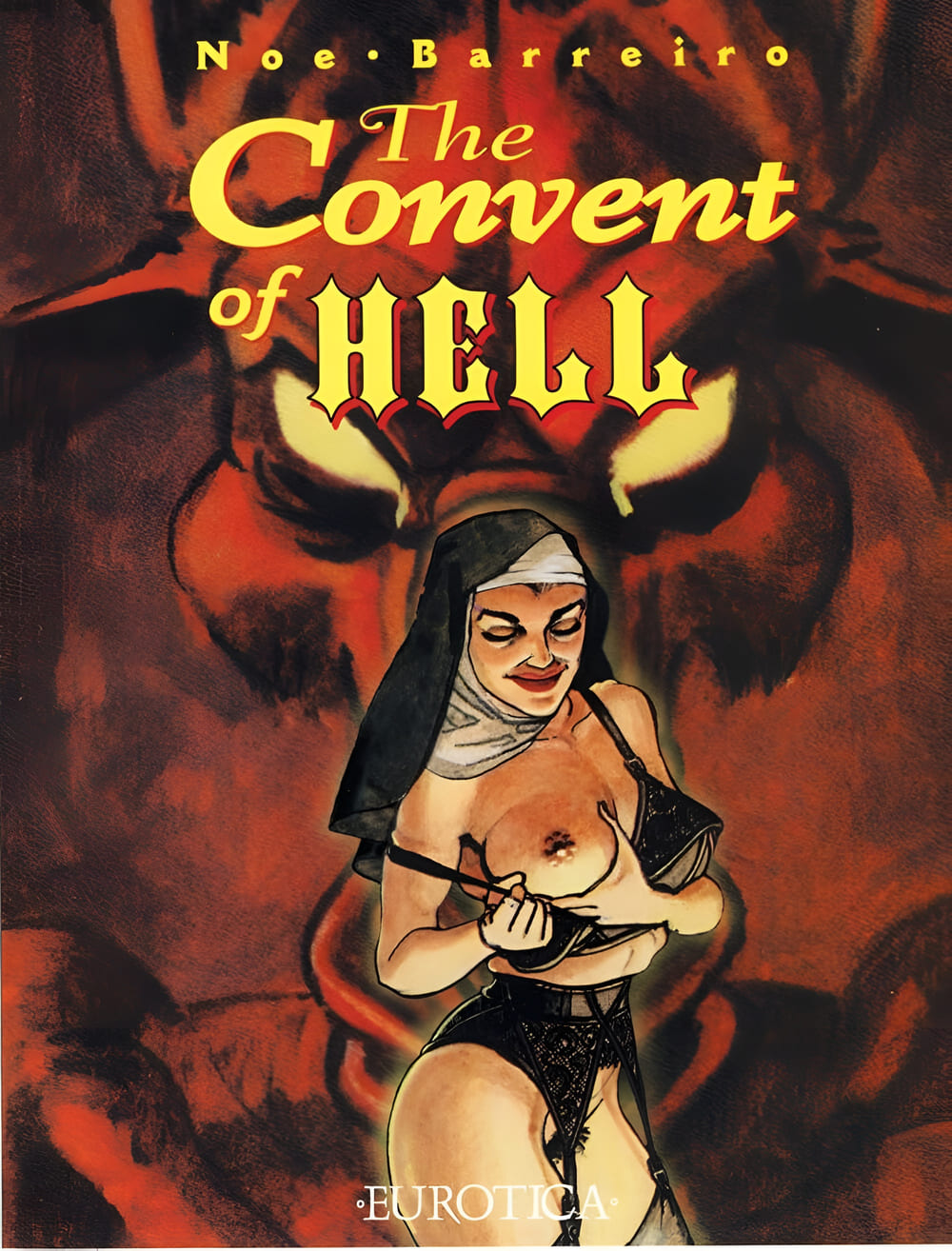
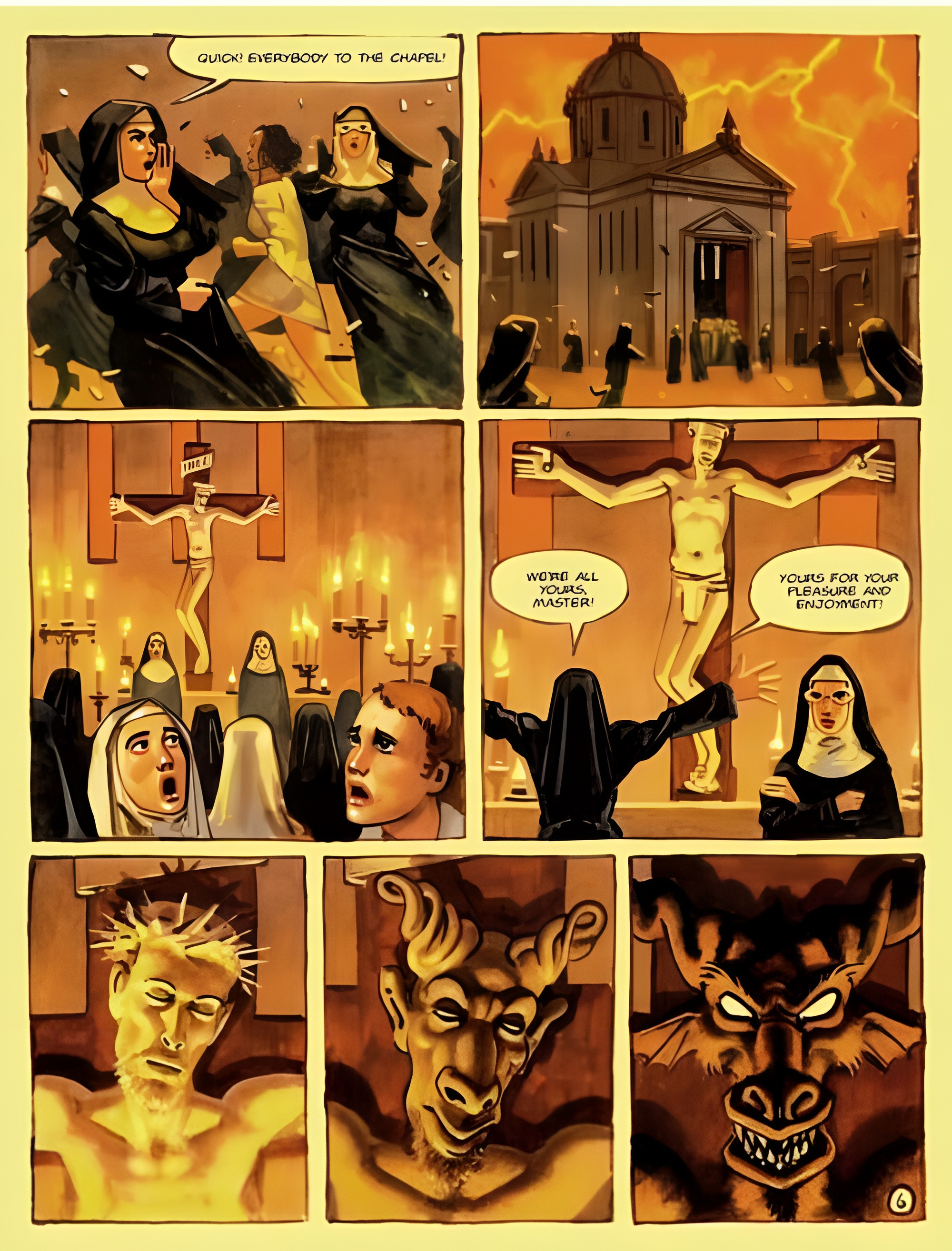
The Convent of Hell is the kind of guilty pleasure that makes you admire the artwork while hoping nobody walks in and asks what you’re reading. Written by Ricardo Barreiro and illustrated by Ignacio Noé, it feels like what would happen if European exploitation films of the 1970s collectively decided they weren’t being exploitative or extreme enough. Whatever restraint those movies occasionally exercised gets thrown out the convent window, leaving a delirious collision of religious imagery, explicit adult material, and grotesque supernatural horror. It is definitely not safe for work, and that warning covers considerably more than nudity. Still, beneath the shock tactics sits an impressive piece of visual storytelling, presented with more artistic conviction than its premise might suggest.

The setup is wonderfully suited to this kind of lurid entertainment. An isolated Spanish convent conceals a mysterious door in its basement, and investigating what lies behind it proves spectacularly unwise. Religious discipline already exists alongside cruelty, repression, and compromised authority before the supernatural threat fully emerges. That matters because the horror does not simply invade an otherwise innocent sanctuary. It finds an institution with weaknesses already built into its foundations. The Mother Superior’s fascination with the forbidden doorway turns curiosity into catastrophe, giving the story a clear dramatic engine even when its increasingly outrageous content threatens to take over completely. You know opening that door is a terrible idea, but watching the inevitable disaster unfold is part of the appeal.

Noé’s artwork is the biggest reason the book rises above being a disposable exercise in provocation. His painted imagery gives the convent a physical presence that makes its corruption feel unusually tangible. The building looks oppressive rather than comforting, with an atmosphere of isolation that establishes unease before the demonic spectacle arrives. There is a strong contrast between the solidity of the setting and the impossible things that eventually occupy it. Instead of treating the backgrounds as empty space between bodies, Noé uses the environment to sustain the mood. The result is a comic whose visual atmosphere remains compelling even when the narrative is operating at its most ridiculous. You can question the taste involved while still admiring the craftsmanship.

That craftsmanship also helps the horror retain some genuine ugliness. The demonic presence is not simply a glamorous fantasy figure with a few sinister accessories. Its animalistic design and exaggerated scale make it feel invasive, alien, and fundamentally wrong within the convent’s enclosed world. This is important because the book constantly moves between erotic spectacle and disgust, sometimes refusing to give the reader a comfortable distinction between them. Noé makes that collision visually forceful. The imagery can be excessive, but it rarely feels timid or accidentally awkward. Whether a particular page fascinates or repels you, there is usually little doubt that the artist knows exactly what kind of reaction he is trying to provoke.

Barreiro’s writing deserves some credit for giving the excess a framework. The discovery of the door, the growing mystery surrounding it, and the escalation into outright supernatural disaster create a recognizable progression rather than a completely shapeless collection of adult scenes. There is anticipation, a threshold being crossed, and a widening sense of consequences. The opening stretch gives the setting time to acquire some menace, which makes the later chaos feel like a release of pressure rather than an arbitrary change of subject. That does not mean the book becomes a deeply layered psychological drama. It simply means its exploitation elements benefit from actual pacing, and pacing makes a considerable difference when the premise is this aggressively overblown.

The characters are less convincing as complicated individuals than as participants in a nightmare about repression and corrupted power. The Mother Superior is the most important figure because her authority and transgression become inseparable, but the book is not especially interested in patiently exploring everyone’s interior life. Its religious imagery supplies an immediate vocabulary of purity, temptation, punishment, and desecration, then twists those ideas into spectacle. There is potential for a sharper critique of institutional hypocrisy here, yet the comic generally prefers another outrageous escalation to a sustained argument. That limitation is worth acknowledging. A reader looking for an insightful examination of faith or convent life will probably find the book much thinner than its elaborate artwork initially promises.

The biggest obstacle, however, is not the thin characterization. It is the sexual violence. Calling this a cheeky naughty-nuns comic would badly undersell how cruel and confrontational parts of it become. Its explicit content includes nonconsensual acts, so the guilty-pleasure label needs a serious qualification: the pleasure comes from the feverish horror, visual skill, and sheer audacity, not from pretending the disturbing material is harmless. For some readers, that combination will be an immediate dealbreaker, and understandably so. Even readers comfortable with extreme horror may find the balance between eroticism and brutality unpleasant rather than entertaining. This is a book whose content warnings are genuinely useful, not merely promotional shorthand for something mildly scandalous.

What ultimately makes The Convent of Hell memorable is the mismatch between its disreputable subject matter and its committed execution. It has the instincts of a midnight exploitation feature, but Noé gives those instincts a richly realized visual identity, while Barreiro supplies enough structure to keep the descent into chaos moving. It is excessive, uncomfortable, occasionally absurd, and unmistakably adults-only. As a guilty pleasure for readers who can tolerate its extreme content, it delivers a distinctive collision of supernatural horror and sacrilegious spectacle. As a recommendation for the average graphic-novel reader, it comes with enormous reservations. The artistry is real; so are the reasons to leave it on the shelf.

Previous Guilty Pleasures

  1. Half-Baked
  2. Save The Last Dance
  3. Every Rose Has Its Thorns
  4. The Jeremy Kyle Show
  5. Invasion USA
  6. The Golden Child
  7. Final Destination 2
  8. Paparazzi
  9. The Principal
  10. The Substitute
  11. Terror In The Family
  12. Pandorum
  13. Lambada
  14. Fear
  15. Cocktail
  16. Keep Off The Grass
  17. Girls, Girls, Girls
  18. Class
  19. Tart
  20. King Kong vs. Godzilla
  21. Hawk the Slayer
  22. Battle Beyond the Stars
  23. Meridian
  24. Walk of Shame
  25. From Justin To Kelly
  26. Project Greenlight
  27. Sex Decoy: Love Stings
  28. Swimfan
  29. On the Line
  30. Wolfen
  31. Hail Caesar!
  32. It’s So Cold In The D
  33. In the Mix
  34. Healed By Grace
  35. Valley of the Dolls
  36. The Legend of Billie Jean
  37. Death Wish
  38. Shipping Wars
  39. Ghost Whisperer
  40. Parking Wars
  41. The Dead Are After Me
  42. Harper’s Island
  43. The Resurrection of Gavin Stone
  44. Paranormal State
  45. Utopia
  46. Bar Rescue
  47. The Powers of Matthew Star
  48. Spiker
  49. Heavenly Bodies
  50. Maid in Manhattan
  51. Rage and Honor
  52. Saved By The Bell 3. 21 “No Hope With Dope”
  53. Happy Gilmore
  54. Solarbabies
  55. The Dawn of Correction
  56. Once You Understand
  57. The Voyeurs 
  58. Robot Jox
  59. Teen Wolf
  60. The Running Man
  61. Double Dragon
  62. Backtrack
  63. Julie and Jack
  64. Karate Warrior
  65. Invaders From Mars
  66. Cloverfield
  67. Aerobicide 
  68. Blood Harvest
  69. Shocking Dark
  70. Face The Truth
  71. Submerged
  72. The Canyons
  73. Days of Thunder
  74. Van Helsing
  75. The Night Comes for Us
  76. Code of Silence
  77. Captain Ron
  78. Armageddon
  79. Kate’s Secret
  80. Point Break
  81. The Replacements
  82. The Shadow
  83. Meteor
  84. Last Action Hero
  85. Attack of the Killer Tomatoes
  86. The Horror at 37,000 Feet
  87. The ‘Burbs
  88. Lifeforce
  89. Highschool of the Dead
  90. Ice Station Zebra
  91. No One Lives
  92. Brewster’s Millions
  93. Porky’s
  94. Revenge of the Nerds
  95. The Delta Force
  96. The Hidden
  97. Roller Boogie
  98. Raw Deal
  99. Death Merchant Series
  100. Ski Patrol
  101. The Executioner Series
  102. The Destroyer Series
  103. Private Teacher
  104. The Parker Series
  105. Ramba
  106. The Troubles of Janice
  107. Ironwood
  108. Interspecies Reviewers
  109. SST — Death Flight
  110. Undercover Brother
  111. Out for Justice
  112. Food Wars!
  113. Cherry
  114. Death Race
  115. The Beast Within
  116. Girl Series
  117. Gone in 60 Seconds
  118. Swordfish
  119. Marked For Death
  120. The Internship
  121. The Angry Red Planet
  122. 2012
  123. Old School
  124. No Escape
  125. In Death Series
  126. Alligator
  127. Little Annie Fanny
  128. Wicked Wanda
  129. Congo
  130. The 13th Warrior
  131. Sudden Death