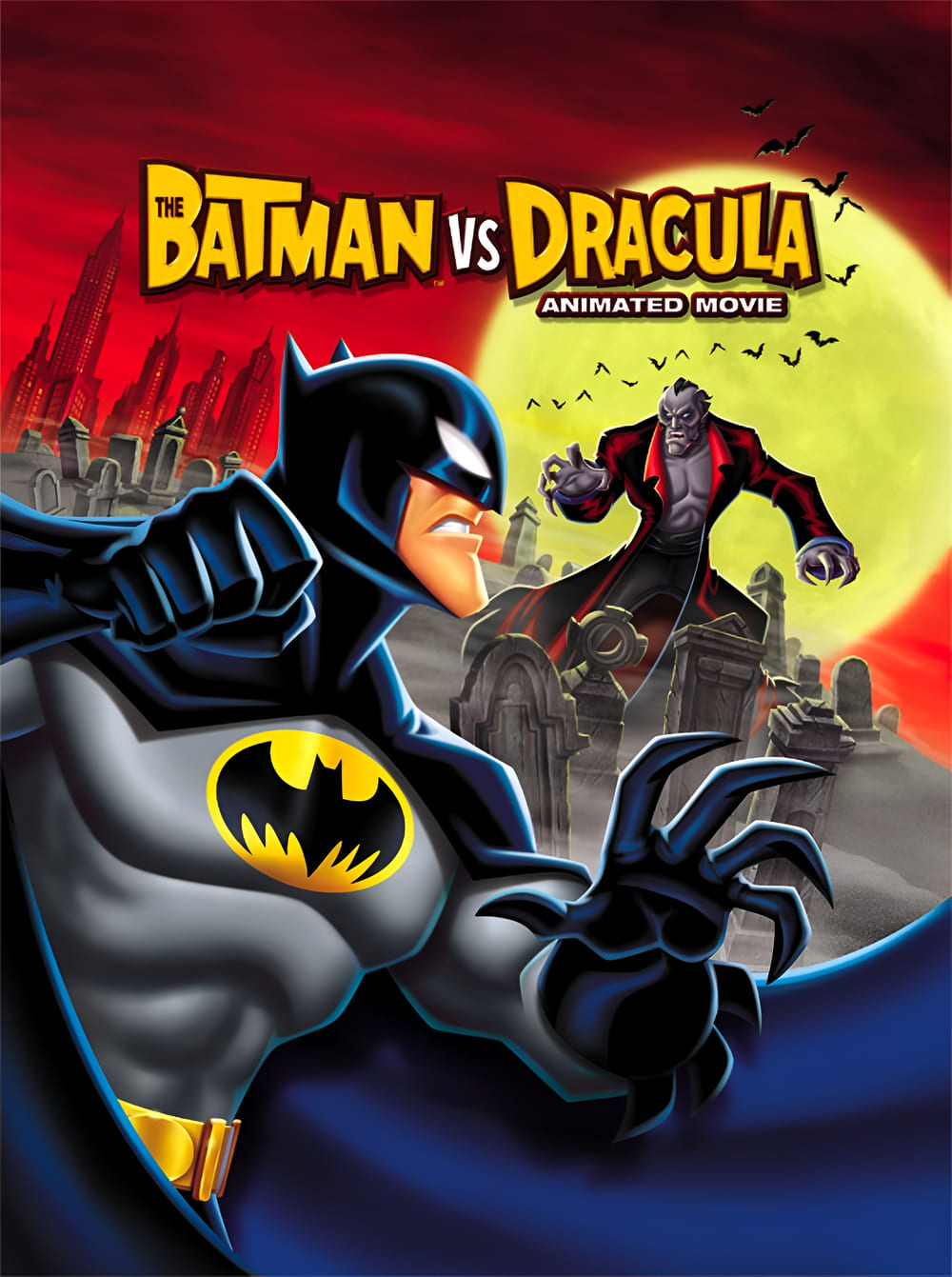
“We cast kindred shadows.” — Dracula
Few Batman stories sound as wonderfully absurd as The Batman vs. Dracula, a 2005 direct-to-video animated film that pits the Dark Knight against literature’s most famous vampire in a Gotham overrun by the undead. Spun off from The Batman television series, the movie could have been a disposable Halloween cash-in, but it turns out to be a stylish, energetic, and genuinely atmospheric monster movie. It draws inspiration from DC’s Elseworlds graphic novel Batman & Dracula: Red Rain, and while it is not as dark or graphic as that comic, it understands why Batman and Dracula make such a natural pairing.
The film immediately separates itself from the more famous Batman: The Animated Series. This is not Kevin Conroy’s Batman, Mark Hamill’s Joker, or the sleek, noir-influenced world associated with Bruce Timm and Paul Dini. Instead, it uses the visual language of The Batman, the 2004 series that presented a younger, more athletic, and more stylized version of the Dark Knight. Rino Romano voices Bruce Wayne and Batman, while the character designs are longer, sharper, and more angular than the classic animated-series versions. The animation has a strong early-2000s action-cartoon identity, with exaggerated movement, dramatic camera angles, bold colors, and a constant emphasis on kinetic action.
That art style can be divisive, especially for viewers who prefer the timeless look of the Timm-era shows. Yet The Batman vs. Dracula may be one of the best possible uses of it. The story is not trying to be grounded or realistic; it is a comic-book monster movie. Gotham becomes a place of foggy graveyards, moonlit rooftops, blood-red lighting, underground tunnels, and shadowy streets. The film embraces vampire-movie imagery with enthusiasm, and its action scenes have enough movement and visual flair to make Dracula feel like a legitimate threat rather than just another costumed villain.
The plot begins with Joker and Penguin escaping Arkham Asylum. Joker immediately returns to causing chaos, while Penguin heads to a cemetery in search of buried treasure. In classic comic-book fashion, Penguin accidentally awakens Dracula, who has been imprisoned for centuries. Once free, the Count begins feeding on Gotham’s citizens and transforming them into vampires. He also hopes to resurrect his lost bride, giving the story a more personal and gothic motivation than a simple plan for conquest. Batman must investigate the disappearances, protect Vicki Vale, and find a way to stop an enemy whose powers push him far beyond the limits of ordinary crime-fighting.
The influence of Batman & Dracula: Red Rain is one of the film’s most interesting aspects. That 1991 Elseworlds graphic novel, written by Doug Moench and illustrated by Kelley Jones, imagined an alternate Gotham threatened by Dracula and his vampire followers. The animated movie does not directly adapt the comic, but it borrows its central idea: Batman confronting a supernatural outbreak that cannot be solved with fists, gadgets, and a few well-timed detective deductions. The film softens the comic’s darker horror elements for a younger audience, but the connection gives the premise more comic-book credibility than a random crossover might otherwise have.
Dracula is the movie’s greatest asset. Peter Stormare gives him a cold, aristocratic voice that makes him feel ancient, arrogant, and genuinely menacing. He does not behave like a generic monster; he acts like a ruler who sees humanity as prey. The film wisely gives him several moments where he overpowers Batman, which keeps the conflict from feeling too easy. Batman cannot simply throw batarangs and win. Dracula’s speed, strength, hypnotic abilities, and growing vampire army force Bruce Wayne to research, adapt, and prepare.
That detective element gives the film more structure than expected. Batman spends much of the runtime investigating strange attacks and disappearances, gradually uncovering the source of the vampire outbreak. Because he spends so much of the story on the defensive, the eventual solution feels earned. The movie lets Batman be vulnerable and clever rather than turning him into an invincible action hero. It is a simple approach, but it works well for a film that runs only about 83 minutes.
The supporting cast adds plenty of personality. Penguin accidentally releasing Dracula is a fun setup, and Tom Kenny gives the character a greedy, nervous energy that fits this version of Oswald Cobblepot. Joker receives the more memorable arc, however. Voiced by Kevin Michael Richardson, he eventually becomes a vampire, and the result is appropriately creepy. Vampire Joker is one of the movie’s best visual ideas, transforming a familiar Batman villain into something closer to pure horror. The design and voice work make him unsettling without pushing the film too far beyond its family-friendly boundaries.
Vicki Vale, voiced by Tara Strong, has a larger role than many viewers might expect. She serves partly as a love interest and partly as someone Batman must protect, but she is not entirely passive. The romance between Bruce and Vicki is fairly conventional, but it gives the story a small emotional anchor amid all the vampire chaos. Alastair Duncan’s Alfred provides the usual steady support, helping Bruce stay focused while Gotham descends into supernatural panic. The film keeps its cast and plot focused, which helps it avoid the padding that sometimes affects direct-to-video superhero movies.
The biggest weakness remains the visual style. The Batman was always a more divisive interpretation of the character, and its angular designs will not appeal to everyone. Compared with Batman: The Animated Series, this film can look less refined and less iconic. Some faces appear stiff, the proportions can seem strange, and the overall aesthetic is very much a product of its era. Still, the movie benefits from fully committing to its own look rather than trying to imitate the classic animated series. It feels like a one-off horror experiment, not a lesser attempt to recreate a beloved version of Batman.
At around 83 minutes, The Batman vs. Dracula moves quickly and never overstays its welcome. It has action, humor, mystery, horror imagery, and enough atmosphere to feel like a genuine seasonal movie rather than a random superhero crossover. It may not reach the artistic heights of the best DC animated films, but it does something those films rarely attempted: it places Batman in a full-blooded monster movie and lets him face one of horror’s most enduring icons.
For Batman fans, vampire-movie fans, or anyone seeking an easy Halloween watch, The Batman vs. Dracula is an easy recommendation. It is not essential Batman viewing, but it is far more stylish and entertaining than its title suggests. By borrowing the spirit of Batman & Dracula: Red Rain and pairing it with the distinctive look of The Batman, the film becomes a pulpy, gothic, early-2000s adventure that embraces its absurd premise and makes it work.

