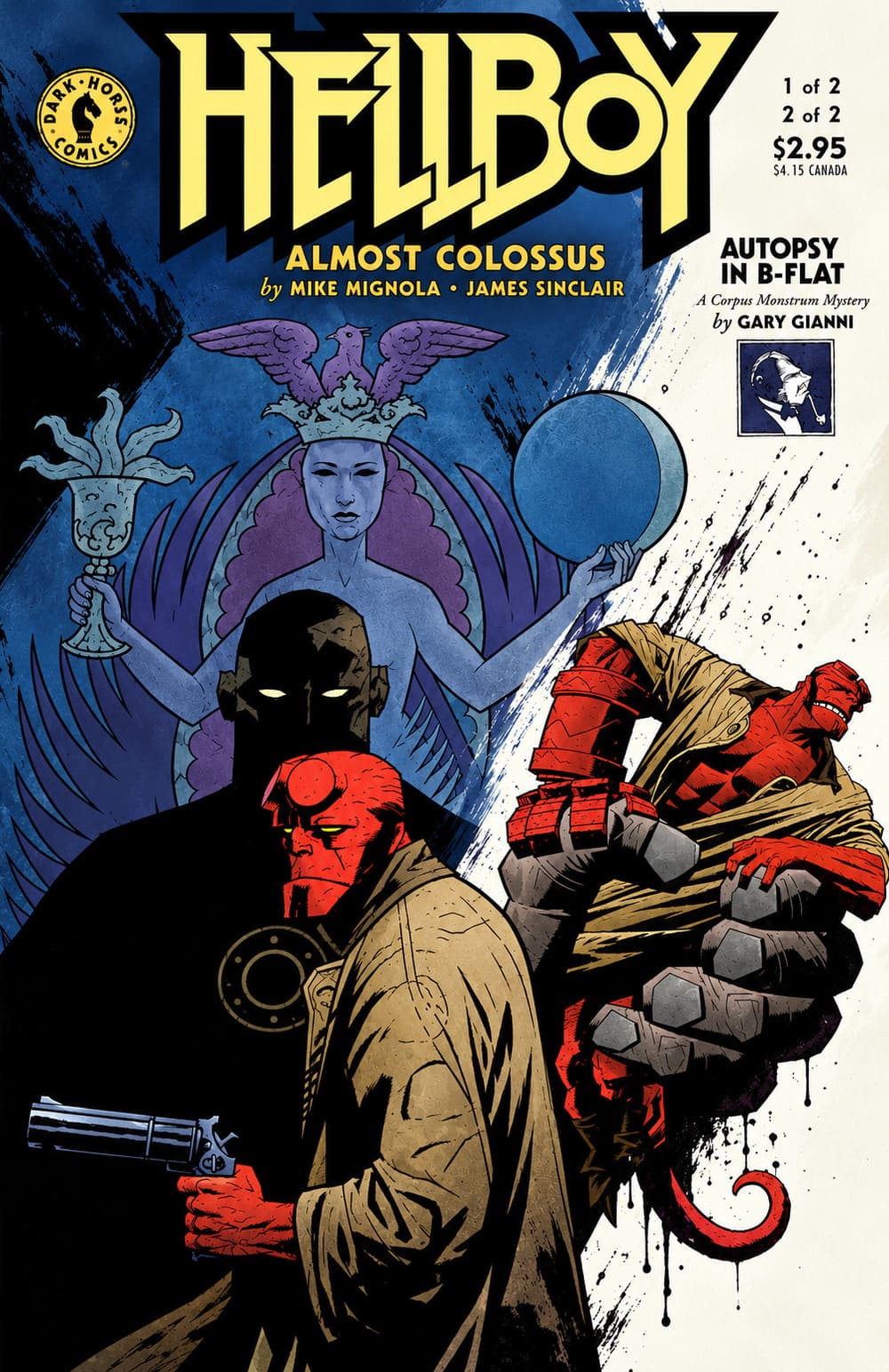
“I pray to God to kill me.” — Roger
Mike Mignola’s Hellboy: Almost Colossus gets its best mileage out of a simple question: what makes someone a monster once you look past the body they were born—or built—into? This two-issue miniseries takes the unfinished business of Hellboy: Wake the Devil and turns it into a compact Gothic adventure with a surprisingly tender center. There are disturbed graves, shadowy ruins, unnatural bodies, and a villain whose ambitions are considerably bigger than his conscience. But underneath that familiar horror setup is a story about two artificial beings who respond to their existence in very different ways. One wants to make the world suffer. The other barely knows how to face it.
The immediate problem is Liz Sherman’s deteriorating condition. During Hellboy: Wake the Devil, her fire brought an ancient homunculus to life, but the transfer left her without the powers that had sustained her. Now Hellboy and Kate Corrigan need to find the creature and discover whether that process can be reversed. It is a clean, urgent premise that gives the story direction without requiring another elaborate explanation of Hellboy’s destiny. The stakes are personal rather than cosmic. Liz is dying, and Hellboy is not about to stand around waiting for someone else to fix it.
That smaller scale is one of the comic’s biggest strengths. Hellboy: Wake the Devil has the pleasure of watching several supernatural threats overlap, but Hellboy: Almost Colossus benefits from having less to juggle. Mignola takes an incident that could have remained a disturbing subplot and follows its consequences. Liz’s awakening of the homunculus was not just another strange encounter in a haunted castle. It created a life while endangering another, and the people involved now have to deal with that imbalance. The supernatural events feel consequential because they leave emotional damage behind.
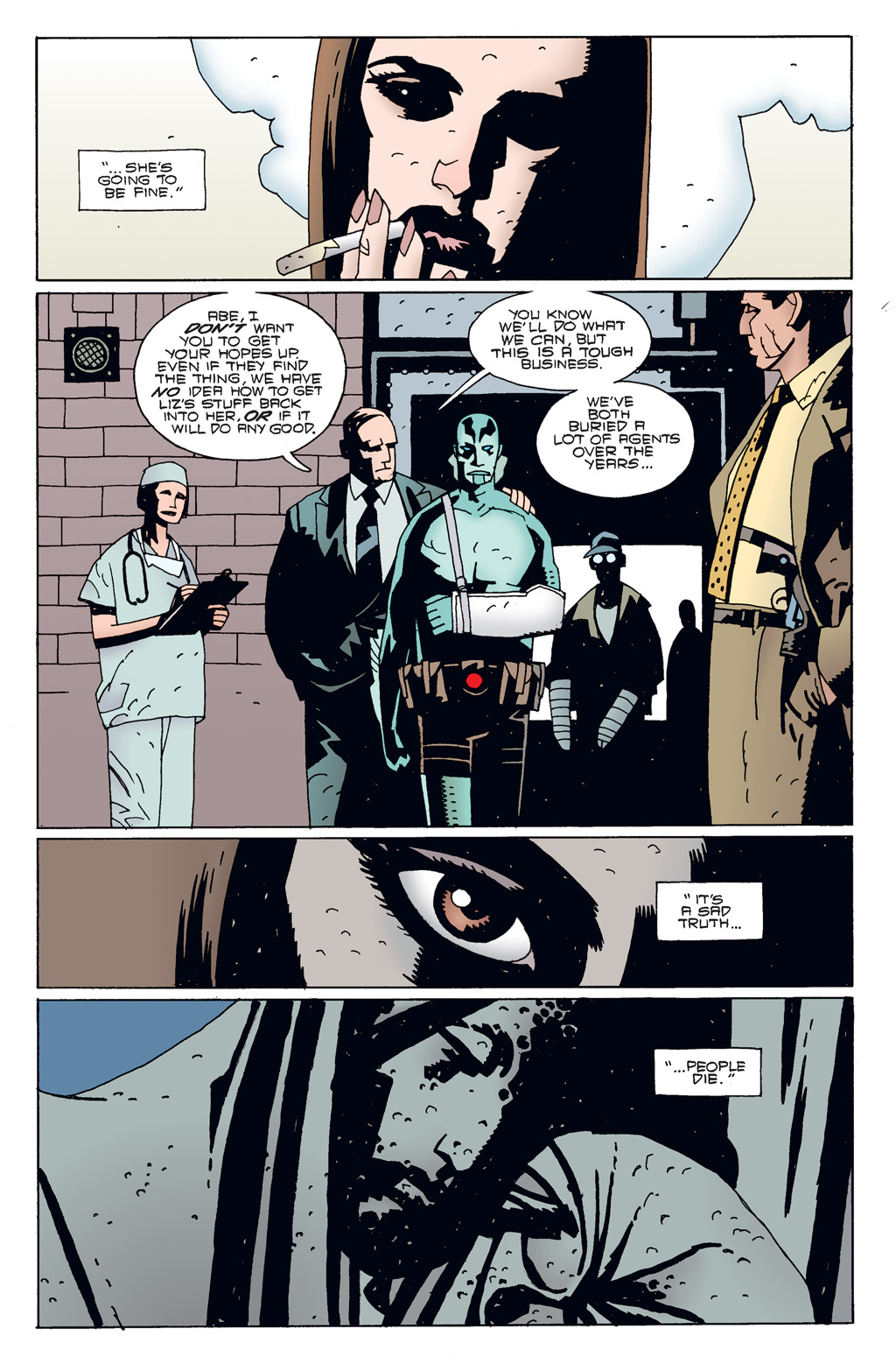
The homunculus, Roger, is the heart of the story. His physical appearance initially places him within the familiar territory of the lumbering artificial monster, but Mignola quickly complicates that impression. Roger is not thrilled to be alive. He is frightened, confused, and overwhelmed by guilt over the suffering connected to his awakening. His desire for death gives the story an unsettling sadness. Life has arrived before understanding, and he has no idea what to do with either. Rather than making him immediately lovable, Mignola allows his distress to remain awkward and uncomfortable, which makes his eventual choices more affecting.
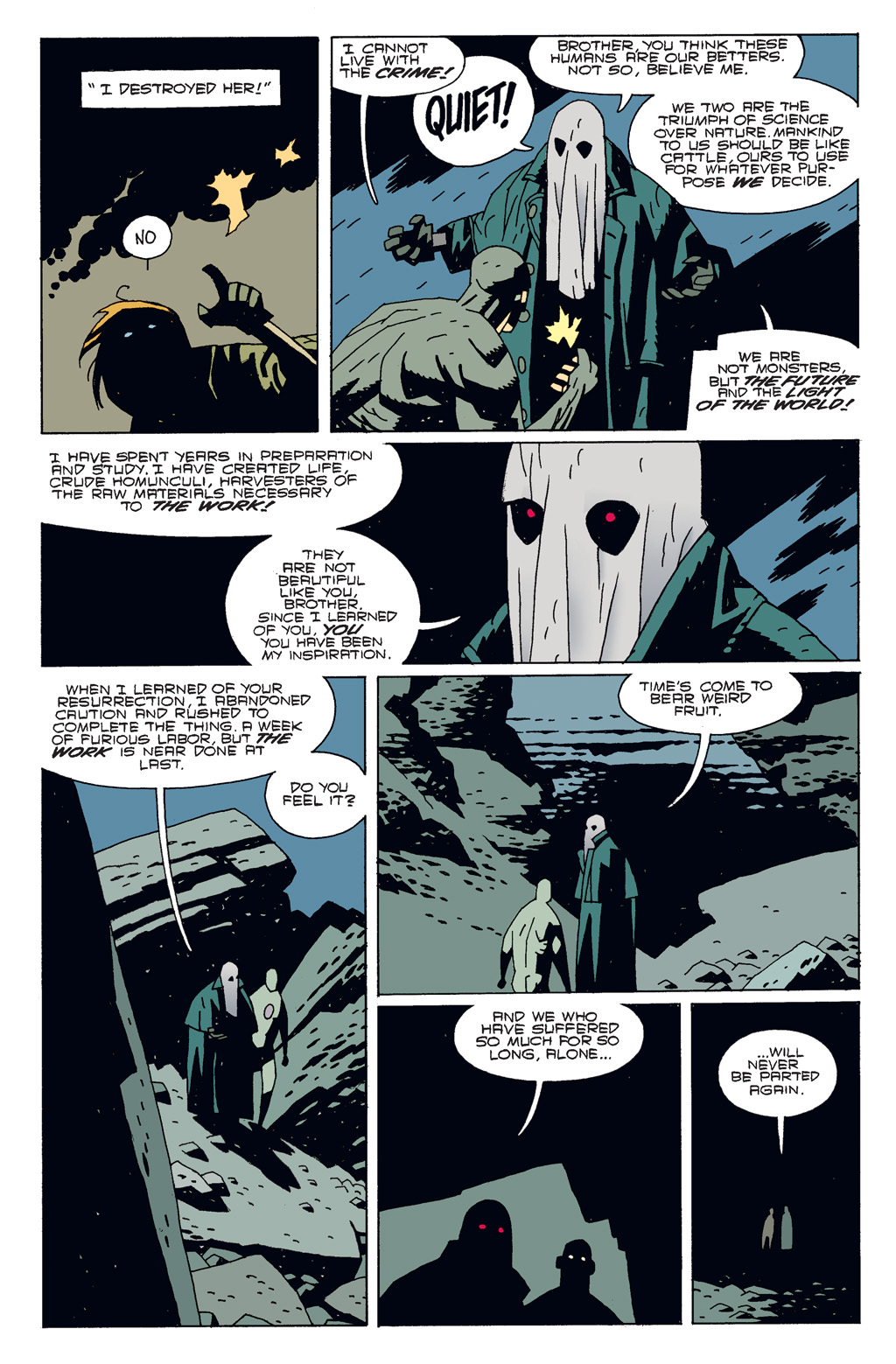
Roger’s older brother provides the nasty counterpoint. Another homunculus created through alchemy, he has responded to his origins with resentment and grandiosity. His solution to feeling wronged is to build himself into something powerful enough to dominate everyone else. Other bodies become material for his ambitions, and other lives become expendable. He is grotesque not simply because of what he is, but because of how casually he reduces people to things. The contrast with Roger is sharp: one brother is horrified by the possibility of causing harm, while the other treats harm as a necessary step toward greatness.
That distinction gives the comic its moral backbone. Mignola does not suggest that unnatural creation automatically produces evil, nor does he make suffering an excuse for cruelty. Both brothers have reasons to feel alienated, but they still make different decisions. Roger’s brother converts his grievances into a claim of superiority. Roger must learn that guilt does not have to end in surrender or self-destruction. It can become responsibility. That is a substantial idea for such a short adventure, and the story makes it tangible through the brothers’ behavior rather than stopping to explain its own message.
The Frankenstein influence is easy to recognize, particularly in the loneliness and resentment surrounding manufactured life. What makes this more than a familiar variation is how naturally those concerns fit Hellboy himself. His appearance suggests danger, and his origins carry implications he refuses to accept as instructions. Roger’s predicament echoes that larger conflict without turning the miniseries into another extended discussion of prophecy. Hellboy becomes an example of the difference between what someone looks like and what someone chooses to do. He is not delivering inspirational speeches, either. He is simply trying to save a friend.
His blunt attitude helps keep the material from becoming too mournful. Hellboy can move through an ancient horror as though it is an especially irritating assignment, and that practical impatience gives the comic some welcome personality. The humor does not erase the danger; it makes his concern feel less theatrical. Kate also helps ground the investigation. Her presence supplies a human perspective beside Hellboy’s familiarity with the bizarre, and her vulnerability gives the confrontation immediate stakes beyond the brothers’ argument. Their partnership makes the supernatural setting feel inhabited rather than merely arranged for atmosphere.
Visually, Mignola makes the ruins and artificial bodies feel like parts of the same uneasy world. His heavy blacks and simplified forms give stonework a looming presence, while the homunculi look assembled, weighty, and uncomfortable in their own shapes. The pages do not need elaborate detail to suggest history. A dark opening or a fragment of architecture can imply whole rooms of forgotten experiments. James Sinclair’s coloring supports that starkness, allowing the drawing’s silhouettes and shadows to carry the mood. The result feels closer to a grim illustrated folktale than a glossy superhero adventure.
The two-issue format does leave some limitations. Liz functions mainly as the reason for the mission, and the older brother’s ambitions could have supported more development. Reading Hellboy: Wake the Devil first also gives the opening greater emotional weight. Still, the brevity keeps the story from diluting its strongest material. The climax matters because Roger has to decide what kind of being he will become, not simply because something enormous needs to be punched. Hellboy: Almost Colossus delivers the Gothic spectacle, but its real achievement is making compassion feel like an active choice. The most human figure in the story may be the one who has the least idea how to be human.
Hellboy Saga

