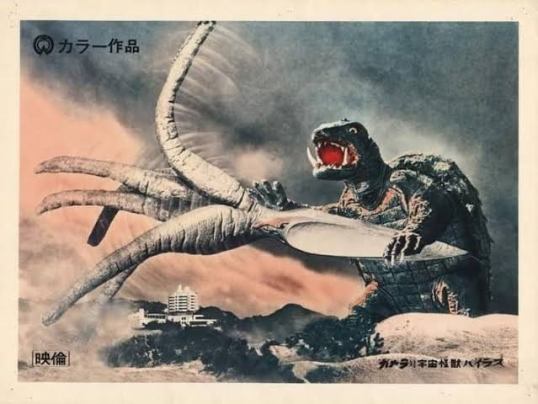
Gamera Film Review: Gamera vs Viras (dir by Noriaki Yuasa)


1967’s Gamera vs. Viras opens with what appears to be a yellow and black-striped Tupperware container spinning through space.  Looks can be deceiving, though.  It’s not actually a freshness-sealed container that’s heading towards Earth.  Instead, it’s a spaceship from the planet Viras.  It seems that the inhabitants of Viras are dependent upon Nitrogen to live.  Foolishly, they’ve wasted all of their own Nitrogen and now they’re planning on coming to Earth to steal ours!

GAMERA, WE NEED YOU!

Gamera vs Viras is yet another Gamera film in which everyone’s favorite flying turtle also serves as the defender of Earth.  Even though the adults on Earth frequently mistake Gamera for being a threat, Gamera has a sentimental attachment to the planet’s children.  In this film, when he’s not fighting aliens and orbiting the planet, he’s hanging out with a bunch of boy scouts.  Unfortunately, for Gamera, the aliens realize that his protectiveness of children is also his greatest weakness.  The aliens abduct two of the boy scouts, American Jim (Carl Craig) and Japanese Masao (Tōru Takatsuka) and lure Gamera into space.  The aliens manage to take control of Gamera’s mind and soon, they’re forcing him to attack humanity!

In America, Gamera vs Viras is one of the best-known Gamera films.  That’s because, in 1969, American International Television released it directly to American television in a re-edited and dubbed version that was entitled Destroy All Planets.  (I assume that the title, which doesn’t really anything to do with the plot, was meant to bring to mind Destroy All Monsters.)  Destroy All Planets is the version of this film that went on to be included in hundreds of DVD box sets.  Destroy All Planets is a great title.  I mean, if you’re a monster movie fan of a certain age, there’s no way you’re going to able resist watching something called Destroy All Planets.

Whether you call it Gamera vs Viras or Destroy All Planets, this is one of my favorite Gamera films.  Yes, the kids are a little bit annoying but Gamera is absolutely adorable and this movie finds him going up against a giant squid.  To be honest, this film is totally worth it just to see the Squid.
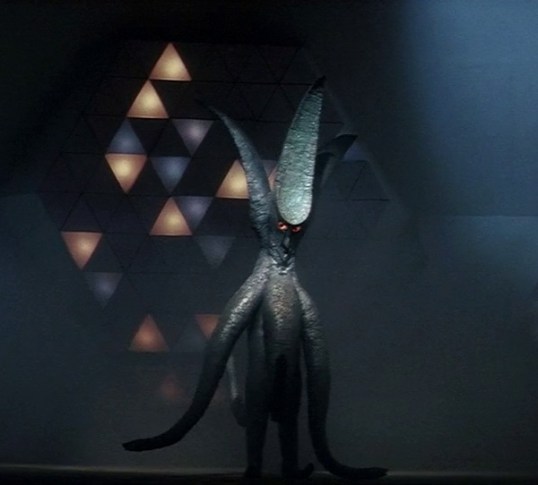
Watching this film, I thought about how sad it was that the Squid didn’t just politely ask for some Nitrogen, as opposed to trying to conquer the planet and steal all of it.  I’m sure that humanity would have been willing to share.  I mean, a planet that has embraced a giant fire-breathing turtle has to have a good heart, right?  I also felt sorry for Gamera because those kids wouldn’t stop yelling at him.  I get that Gamera has a soft spot for kids but I imagine even the most loyal of giant turtles needs a break every once and a while.

Speaking of turtles (both giant and otherwise), turtles are really cool creatures that don’t cause any trouble for anyone.  We live near a creek and it’s not unusual to look outside and see a turtle slowly making its way down the sidewalk.  One thing that I love about this neighborhood is that everyone gives the turtles their space.  The turtles may not be fast but they know where they’re going.

Previous Gamera Reviews:

  1. Gamera, The Giant Monster (1965)
  2. Gamera vs Barugon (1966)
  3. Gamera vs Gyaos (1967)
  4. Gamera vs. Jiger (1970)

Godzilla Film Review: Shin Godzilla (dir by Hideaki Anno and Shinji Higuchi)


In 2004, Godzilla: Final Wars was released by Toho and promoted as Godzilla’s final film.

And indeed, for ten years, there was no sign of Godzilla. There were rumors that he would return but, for the most part, he was a fondly remembered relic of a different era. That changed in 2014, when Legendary Pictures produced and Warner Bros. distributed a new Americanized version of Godzilla. Though the new version was not particularly well received by critics, it did well enough at the box office to convince Toho that it was time to make a new Godzilla film of their own.

2016’s Shin Godzilla is not a sequel to any of the previous Godzilla films. Instead, Shin Godzilla imagines a continually evolving Godzilla attacking Japan, for the first time, in 2016. When Godzilla first appears, he definitely doesn’t look like himself. He doesn’t have his famous scaly skin. Instead of proudly striding through the cities and stepping onto buildings, he slithers through the streets. To be honest, he actually looks a little… well, goofy. At first, I wasn’t really sure that I would be able to accept this Godzilla. However, the film apparently predicted my reaction. Throughout the film, Godzilla slowly transforms (or “evolves,” as the film puts it) into the majestic monster that we all know and love. And when that Godzilla finally made his appearance, I wanted to cheer. I also wanted to hide behind the couch, because this is one of those films where Godzilla has no interest in being a nice guy. He lives to destroy, and Shin Godzilla, made in the aftermath of the earthquake, tsunami, and nuclear crisis that rocked Japan in March 2011, doesn’t shy away from showing the amount of damage and death that would result from an actual monster attack.

The film uses Godzilla sparingly. Instead, most of the running time is taken up with meetings. The Japanese government meets and tries to figure out what to do about the monster that’s attacking their country. The military is unprepared. The citizens have no memory of being put under a national emergency. The prime ministers (yes, the film goes through more than one) all look like they’re about to have a panic attack when they’re expected to make a decision. The Americans send over an envoy (Satomi Ishihara) who views dealing with Godzilla as a way to further her own political ambitions. Running throughout the film is the idea that the Japanese government has been left powerless to deal with real emergencies. The film’s ineffective bureaucrats become stand-ins for the same bureaucrats who failed in 2011. This is the most openly political Godzilla film since the first one.

Indeed, Shin Godzilla is far more concerned with how the government reacts to Godzilla than with Godzilla himself. I imagine that was, and probably still is, an issue for some viewers of the film. Myself, I appreciated the film’s portrait of a useless and largely impotent bureaucracy full of entrenched people who were more concerned with their own advancement than with protecting the citizens they were supposed to be serving. There’s a satirical edge to Shin Godzilla that I absolutely loved. Be glad Godzilla isn’t real, the film seems to be saying, because these idiots certainly aren’t going to protect you. Instead, all they can do is issue meaningless statements and pointless regulations designed to maintain the illusion of their own power. In its way, Shin Godzilla predicted the entire COVID era. It’s a Godzilla film with a lesson for us all.

Previous Godzilla Reviews:

  1. Godzilla, King of the Monsters (1958)
  2. Godzilla Raids Again (1958)
  3. King Kong vs Godzilla (1962)
  4. Mothra vs. Godzilla (1964)
  5. Ghidorah: The Three-Headed Monster (1964)
  6. Invasion of the Astro-Monster (1965)
  7. Godzilla vs. The Sea Monster (1966)
  8. Son of Godzilla (1967)
  9. Destroy All Monsters (1968)
  10. All Monsters Attack (1969)
  11. Godzilla vs Hedorah (1971)
  12. Godzilla vs Gigan (1972)
  13. Godzilla vs Megalon (1973)
  14. Godzilla vs Mechagodzilla (1974)
  15. The Terror of Mechagodzilla (1975)
  16. Cozilla (1977)
  17. Godzilla 1985 (1985)
  18. Godzilla vs. Biollante (1989)
  19. Godzilla vs King Ghidorah (1992)
  20. Godzilla vs. Mothra (1992)
  21. Godzilla vs Mechagodzilla 2 (1994)
  22. Godzilla vs SpaceGodzilla (1994)
  23. Godzilla vs. Destoroyah (1995)
  24. Godzilla (1998)
  25. Godzilla 2000 (1999)
  26. Godzilla vs Megaguirus (2000)
  27. Godzilla, Mothra, and King Ghidorah: Giant Monsters All-Out Attack (2001)
  28. Godzilla Against Mechagodzilla (2002)
  29. Godzilla: Tokyo S.O.S. (2003)‘
  30. Godzilla: Final Wars (2004)
  31. Godzilla (2014)
  32. Godzilla: Planet of the Monsters (2017)
  33. Godzilla, King of the Monsters (2019)
  34. Godzilla vs Kong (2021)
  35. Godzilla Minus One (2023)

October Positivity: Gramps Goes To College (dir by Chip Rossetti)


The title character of 2014’s Gramps Goes To College may be known as Gramps but his actual named Ty Bounds. Played by Donald James Parker, Ty is a sixty-something resident of South Dakota who has recently retired from his job as a computer programmer. Despite being retired, Ty is not ready to fade away. In fact, he’s decided that it’s time to start a new chapter in his life so he enrolls in a college that is located in Tennessee. He hopes to eventually get his Master’s Degree in Biology.

Good luck with that, Gramps!

Gramps, you see, is a Christian and a believer in creationism. No sooner does he step into his Into to Biology class than he finds himself arguing with Professor Tucker (Carol Anderson). Tucker takes pride in turning religious students into atheists. She sees Ty as a challenge. She invites him to lunch. She invites him to dinner. She tries to seduce him. Nothing that she does can convince Ty to believe in evolution. Darwin wasn’t evil, Ty explains at one point. He was just misguided by the Devil.

Ty becomes a hero on campus and he even starts his own team of Christian athletes so that they can compete in the school’s Intramural competition. He becomes a mentor to his roommate, Brad (Rusty Martin). Ty worries that Brad is bein led astray by Stephanie (Courtney Lee Simpson). When Brad comes back to the dorm after a party, Ty demands to know why Brad reeks of alcohol. Can you imagine going away to college and discovering that your new roommate is not only old enough to be your grandfather but that he’s also going to scold you whenever you stay out late? Yikes!

(As I watched this movie, I was reminded of how, when I was in college, there was a student who was in her forties and who lived in the dorms. I always felt a little bit sorry for her. She was given a private room and people treated her respectfully — certainly more respectfully than they treat Gramps in this film — but I always wondered what it was like to be an adult, trying to finally get a degree, and finding yourself living in a dorm occupied by brats like …. well, like me. I’ve always told myself that if I ever run into her again, I’ll apologize for all those nights I played my music too loud. I’m older now so I understand why that would be annoying.)

Eventually, Stephanie dies of alcohol poisoning but she’s revived. She talks about how, while she was dead, all she saw were the flames of Hell. Well, that’s one way to get someone convert.

Gramps Goes To College is a fairly amateurish film. That’s not really a surprise. If anything did surprise me, it was how wrathful Gramps came across as being. To be honest, I was expecting a corny “old person” comedy. Instead, Gramps spent a lot of time suggesting that different people and ideas had been sent by the Devil. In the film, Gramps becomes a beloved celebrity on campus. He even gets Professor Tucker to doubt her atheism, despite the fact that none of his arguments seem to be anything that Tucker would not have heard before. To be honest, Gramps kind of comes across as being kind of a crank. His intentions may have been benevolent but he was so preachy and so frequently angry that he was often more intimidating than inspiring.

Myself, I’m just glad that I went to a party school and I didn’t actually have to pay attention in any of my classes. That’s the best way to do the college!

Late Night Retro Television Review: Sledge Hammer 1.8 “Over My Dead Bodyguard”


Welcome to Late Night Retro Television Reviews, a feature where we review some of our favorite and least favorite shows of the past! On Fridays, I will be reviewing SLEDGE HAMMER!, a cop comedy which ran on ABC from 1986 to 1988. The entire series can be found on Prime!

This week, Captain Trunk’s life is in Sledge Hammer’s hands!

Episode 1.8 “Over My Dead Bodyguard”

(Dir by Charles S. Dubin, originally aired on November 14th, 1986)

Captain Trunk is scheduled to testify against a racketeer, and as a result the mob is determined to stop him. The police commissioner orders Sledge Hammer to serve as Trunk’s bodyguard. Trunk isn’t happy to hear that. He’s trying to get back together with his ex-wife (Tracy Reed). The last thing he needs or wants is Hammer around.

Hammer, however, takes his job seriously. When Trunk and his ex have dinner, Sledge is there to keep an eye on him and beat up an assassin. When it becomes obvious that Trunk is not safe at his own home, Hammer takes him to his apartment. When an assassin still manages to shoot Trunk, Hammer tells the world that Trunk is dead.

Doreau is shocked to see that Hammer doesn’t seem that upset over Trunk’s death. She asks him if he has any emotions. Hammer replies that he has a full range of emotions: “Anger, rage, hate. Hate.”

Hammer also explains that Trunk isn’t really dead. He’s at the hospital, preparing for surgery. Hammer takes Doreau to the hospital to see their captain. Outside the hospital room, the guard looks at Hammer and asks, “Why did the chicken cross the road?” “To avoid the death penalty,” Hammer says. He looks over at Doreau. “Guess who came up with that password?”

An assassin (Robert O’Reilly) has disguised himself as an anesthesiologist. The assassin even manages to drug Hammer. Fortunately, a half-drugged and stumbling Hammer still knows how to throw a punch. He knocks out the assassin and then announces that, because the hospital has been compromised, he’s going to have to remove the bullet himself. “Don’t worry. I’ve practiced on myself.”

Trunk somehow survives being protected by Hammer and gives his testimony. The commissioner congratulates Trunk and then assigns Hammer to continue guarding him for at least a month.

This episode felt a bit off. There were a few funny lines and some good physical humor (especially when Doreau was helping the drugged Hammer to his feet), but otherwise it lacked the fast-paced, anything-for-a-joke feel of some of the previous episodes. In fact, it felt almost like a regular cop show. The only surprising thing is that it’s an assassin who shoots Trunk and not Sledge Hammer himself.

As I said, this episode did make me laugh. David Rasche, Anne-Marie Martin, and Harrison Page are quite a comedic team. It just didn’t leave as lasting an impression as some of the other episodes I’ve watched.

Poem of The Day: The Raven, written by Edgar Allan Poe, Recited by Vincent Price


Here to help you get into the holiday spirit is Vincent Price, reading Edgar Allan Poe’s The Raven.  This scene comes from a 1985 television special that was called The Teller and the Tale.


Horror Film Review: War of the Satellites (dir by Roger Corman)


1958’s War of the Satellites opens with a tragedy.

The United Nations is leading the way in humanity’s attempt to explore space.  Unfortunately, ten manned spaceships (or “satellites” as they’re called in this film) all run into the same problem.  There’s a “space barrier” around the Earth, one that traps any ship that flies into it.  On Earth, Dr. Pol Van Ponder (Richard Devon) is forced to remotely blow up both the ships and the UN’s astronauts.  It looks like the the UN’s space program is coming to an end.

Or, at least, it does until an unseen group of aliens drop a missile on Earth.  The missile, when it’s discovered by two “teenagers” who appear to be in their 30s, doesn’t explode.  Instead, it simply carries a message.  Don’t try to explore space, the message says.  A group of snooty aliens have decided that humanity is not ready to leave the planet.  The message is read at the UN.  In a scene that warmed my heart, the American delegate replies that no one tells humanity what to do.  The aliens don’t want us in space?  Well, guess where we’re going, baby!

(Woo hoo!  I love my country!)

Unfortunately, Dr. Van Ponder is in a serious car accident and is killed.  Or, at least, that’s what everyone believes until he shows up at the UN without a scratch on him.  Van Ponder explains that he miraculously survived the accident and he’s now ready to lead the UN mission into space.  The UN takes his survival as a sign that Van Ponder is meant to take humanity to the stars.

Of course, the truth of the matter is that Dr. Van Ponder actually was killed in that accident and the man at the UN is not Van Ponder but instead just an alien pretending to be him.  A few people notice that Dr. Van Ponder is acting strangely.  He speaks without emotion and uses curious phrases.  When he burns his hand during an experiment, he barely seems to notice.  When he’s alone in his office, he creates a second duplicate Van Ponder so that he can be two places at once.  Everyone who suspects that Van Ponder is actually an alien ends up dead.  Once the satellite takes off, it falls to crewman Dave Boyer (Dick Miller) to not only thwart Van Ponder’s evil scheme but to also convince Sybil Carrington (Susan Cabot) that Van Ponder is no longer the man who she thinks she loves.

Reportedly, a day after the Russians launched Sputnik, Roger Corman met with film producer Steve Broidy and said that, in return for $80,000, he could have a satellite movie ready to go in 90 days.  Broidy asked him what the film would be about and Corman replied, “I don’t know but I will have the picture ready.”  Broidy handed over the money and Corman shot War of the Satellites over the course of ten days.  Corman also said that Broidy was so impressed with the film that he gave Corman an extra $500 to throw a party for the cast and crew.  Corman never threw the party.

As for War of the Satellites, it clearly a rush job.  The interior of the space ship is basically two rooms and a couple of chairs.  The idea of the UN having a space program feels ridiculous today and I imagine it probably felt just as ridiculous in 1958.  (We should have kicked the UN out of New York decades ago)  That said, I have to admit that I really enjoyed this film.  Richard Devon gives an appropriately off-center performance as Dr. Van Ponder and this film actually features Dick Miller in a rare heroic starring role.  Even though he’s playing an astronomer, Miller still comes across like a New York wiseguy and my favorite scenes are the one where he gives Van Ponder a look that just seems to shout, “What are ya talking about, ya putz?”  There’s something really enjoyable about watching scrappy Dick Miller play the type of role that would usually go to someone like Peter Graves or Kenneth Tobey.  In an interview, Miller said that he felt miscast as the hero because he was only 5’5 while Devon was 6’1.  But the fact that Devon is actually so much taller than Miller only makes us rooft for Dick Miller even more.  As played by Dick Miller, Dave Boyar becomes the type of underdog that you can’t help but cheer for.

The best thing about this film is that it loudly declares that no one, no matter how scientifically-advanced or snooty, gets to tell humanity what to do.  You want us to stay on Earth?  We’re coming for the moon!

No one puts us in a corner.

Moments #36: October Rain


I used to love storms.

Living in Texas, you eventually get used to the long and dry summers, but it’s still always a good feeling when it starts to rain again. Up until two years ago, I got excited whenever I saw that we were under any type of weather alert. I loved the sound of the rain. I loved the way the wind howled. I even loved the thunder and the lightning. Sometimes, the lights would blink and the power would go out, but it didn’t bother me because it just added to the atmosphere.

That all changed on the night of May 27th, 2o24. I was already feeling anxious because my father was in the hospital. On Sunday, he had been in a car accident and, when I went to the hospital, he seemed like he was going to be okay. He had a broken shoulder and was obviously tired, but he was speaking normally and, when he saw me, he said he was happy to see me. He smiled, I remember that. A nurse told me that they were going to keep him for the night for observation. On Monday morning, I drove back to the hospital and, when I arrived, he was basically passed out in his bed. When I asked another nurse if he would be ready to go home anytime soon, she looked at me like I was asking a crazy question. I remember another nurse saying something about “rehab.” They promised me that a doctor would call. I went home. It turned out that they weren’t lying. A doctor did call that evening. He said my father was having trouble walking. I explained that he had Parkinson’s. The doctor said he would email me some information on the rehab centers that worked with my father’s insurance. “So,” I dumbly asked, “he’s not going home tonight?” The doctor laughed and said, “No, it’s going to be a while.”

At 9:00, I lay down on my couch and, exhausted, I fell asleep. I didn’t even bother to take off my clothes. I woke up at four in the morning to the sound of thunder and rain and howling wind. I tried to turn on the living room light, just to discover that the power was out. I stood up, stubbed my toe on an end table, said the F-word as loudly as I’ve ever said it, and then I limped over to the front door. I looked outside and the scene was apocalyptic. Rain was falling in sheets, the streets were flooded, and there were tree limbs strewn everywhere. A few trees had fallen over. The ones that still stood were violently swaying in the wind. I immediately thought of the stray cats that I fed every morning. Stupidly, I opened the front door to yell for them and I was immediately drenched.

By 7 in the morning, the rain was steady but light. I saw that Hunter and Hannah, who lived across the street from me, were outside, looking at the storm’s aftermath. I stepped outside, waved, and started to walk towards them. They saw me limping so they told me to stay where I was and came over to me. They asked me if Erin and I were okay. They told me that power was out all over town and that, when they called Oncor, they were told there was no estimate on when it would come back. We stood there and we looked up and down the block. Everything was wet. The road was so full of limbs that it appeared to be practically impassable. Trees had fallen over. Some people had broken windows. My own front door was sitting slightly off of its hinges.

(Don’t worry. Despite all the damage, the strays showed up to ask for food.)

I assumed that we would have our power back by the end of the day. Instead, the power was out for six days. It fell to the people living in the neighborhood to clean up the debris. (Even after the power came back, it would still be nearly a month before city clean-up crews got to us.) I saw a lot of really impressive things during those six days. Jeff helped to clean the streets and also helped our older neighbors with their fallen trees. Erin Nicole went to the store for people who couldn’t make it there on their own. As for me, I worried. I worried about everything. Several times, I tried to call the hospital to check on my father and all I got was some vague talk about how he had been moved to a different room. Meanwhile, the rain continued to fall. Sometimes, it was a drizzle and sometimes it was a shower, but every time it was a reminder of how little control I had over anything.

Eventually, the power came back. All of the debris was cleared. The rain stopped. My father was transferred from the hospital to the rehab center and then to home hospice, where he died two and a half months later. Ever since that week, there’s been a part of me that’s gotten anxious whenever I’ve seen that there’s a storm coming. It just brings back too many bad feelings.

A storm was predicted for October 1st this year and I was nervous. What if the power went out? What if I couldn’t contribute to this year’s Horrorthon? Well, I’m happy to say that the storm turned out to be a gloriously beautiful and rather peaceful rain shower. Sometimes, it was a heavy shower and sometimes it was a light shower, but there was a gentleness to it. I spent most of Thursday afternoon lying in bed in a comfy t-shirt and underwear, looking out the window and watching as the trees slowly and rhythmically swayed. The sound of the rain was relaxing and, as I listened to it, I remembered how much I loved the rain when I was growing up. And I realized that I still do.

It was the perfect start for October.

Previous Moments:

  1. My Dolphin by Case Wright
  2. His Name Was Zac by Lisa Marie Bowman
  3. The Neighborhood, This Morning by Erin Nicole
  4. The Neighborhood, This Afternoon by Erin Nicole
  5. Walking In The Rain by Erin Nicole
  6. The Abandoned RV by Erin Nicole
  7. A Visit To The Cemetery by Erin Nicole
  8. The Woman In The Hallway by Lisa Marie Bowman
  9. Visiting Another Cemetery by Erin Nicole
  10. The Alley Series by Erin Nicole
  11. Exploring The Red House by Erin Nicole
  12. The Halloween That Nearly Wasn’t by Erin Nicole
  13. Watchers and Followers by Erin Nicole
  14. Visitors by Erin Nicole
  15. Fighting by Case Wright
  16. Walking In The Fog by Erin Nicole
  17. A Spider Does What It Can by Erin Nicole
  18. Downtown Richardson, In The Rain by Erin Nicole
  19. Me, our kids, and ONCE UPON A TIME IN HOLLYWOOD! by Bradley Crain
  20. The Statues of SMU by Erin Nicole
  21. Exploring the Back Yard Of An Abandoned House by Erin Nicole
  22. The Ugly Old Swing by Erin Nicole
  23. The Fourth of July In My Town by Erin Nicole
  24. A 4th of July Tradition: Blurry Firework Pictures! by Erin Nicole
  25. That Doll by Erin Nicole
  26. Invasion of the Dolls by Erin Nicole
  27. The Dollhouse by Erin Nicole
  28. Jake and Max by Erin Nicole
  29. The Morning of October 26th by Erin Nicole
  30. Casper The God by Erin Nicole
  31. Carrying The Flag by Erin Nicole
  32. The First Morning Of 2026 by Erin Nicole
  33. This Squirrel by Erin Nicole
  34. That Duck by Erin Nicole
  35. The Turkey Vulture by Erin Nicole

Horror On TV: Fear Itself 1.1 “The Sacrifice” (dir by Breck Eisner)


Produced by Mick Garris, Fear Itself was an attempt to bring the Masters of Horror format to network television.  Each week, a different director would present a tale of terror.  The series aired on NBC.  13 episodes were filmed but only five were broadcast before the show was put on hiatus for the 2008 Summer Olympics.  The Olympics eventually ended but Fear Itself never returned.

The first episode of Fear Itself featured Jesse Plemons as one of four criminals who finds themselves holed in an isolated fort with three mysterious women.  The women are not what they seem and the criminals soon find themselves fighting for their lives.

The Sacrifice first aired on June 5th, 2008.  It was directed by Breck Eisner, who went on to direct the 2010 remake of The Crazies.


October Hacks: Slashlorette Party (dir by Paula Ragsdale and Angelica de Alba)


First released in 2020, Slashlorette Party is a decent indie slasher. It isn’t totally successful, but it deserves credit for respecting the rules of the genre while using those rules to explore something more than the usual hacking and slashing. This is a film that never apologizes for being a slasher, and I appreciated that. I’m tired of horror movies made by people who think they’re better than the genre. At the same time, this is a film that not only has blood on the floor but thoughts in its head. There’s something to be said for that.

Molly Souza plays Brie, who is engaged to Dolph (Andrew Brown). The wedding is just around the corner, but there’s one big problem: Brie has just realized that she doesn’t really like Dolph that much. In fact, Dolph is such a jerk that he almost feels like a parody of the bad boyfriend who always shows up in romantic comedies so the sweet, sensitive guy will look even better as he encourages the female lead to dump him. (Strangely, no one ever asks, “What did you ever see in someone like that to begin with?”) Brie’s therapist (Ginger Lynn Allen) thinks Brie should consider ending the engagement. Meanwhile, Brie’s friends Alexa (Brooke Morris) and Nia (Nina Lanee Kent) want her to stay engaged at least long enough for them to throw her a bachelorette party at a remote cabin in the woods. You know who else loves parties in remote cabins in the woods? Homicidal maniacs!

Slashlorette Party is about more than just people being murdered in the woods. Absolutely no one in the film seems to believe that Brie should marry Dolph. Dolph is such a jerk that even when Brie disappears in the woods, he responds by sitting around and drinking a beer. Brie can barely stand Dolph, but she feels that she’s obligated to marry him because he asked and that otherwise she’ll run the risk of being forever single. Meanwhile, Dolph and his friends spend their time talking about how easy they believe women have it compared to men. In their worldview, all women are teases and all men are victims. (Ironically, the dumbest and most outspoken of the men actually does end up getting teased by one of the women shortly before getting his hand cut off by someone who is even more misogynistic than he is. His prediction of being both teased and victimized comes true, even if he’s too stupid to appreciate it.) When the deaths occur, they feel like a commentary on incel self-pity. Brie and her friends are targeted because of the male gaze. The men fall victim because they’re too hopelessly whiny and beta to defend themselves.

Slashlorette Party is a low-budget indie horror film. At first I didn’t have much hope for it. It seemed like just another movie that would feature a lot of bad acting and maybe some semi-decent gore. For the first half, the pace does feel off, and I spent a lot of time wondering if anyone was actually going to die. In the second half, though, things pick up. There are a few memorably bloody deaths. There are a few interesting twists. It becomes obvious that the film is meant to be more than a typical wilderness slasher. There’s some bite to the dialogue. There’s a funny joke about a male stripper who shows up as a policeman and finds himself stumbling onto a real crime scene. When the film started, I thought Dolph was too much of a lout to be believed, but the movie has a few surprises up its sleeve when it comes to his character. It ends with a final twist you will either love or hate. I always appreciate a film that’s willing to risk being hated.

I’ve been to enough bachelorette parties that I could relate. It isn’t really a bachelorette party until at least one person has said something they shouldn’t have and the bride-to-be is locked in the bathroom having a panic attack. If nothing else, this film captures the feeling of a bunch of people realizing their friend is about to make the biggest mistake of her life and deciding to throw a party to celebrate.

SOV Horror: Psycho Scarecrow (dir by Steve Galler)


 In an alley in the middle of a big city, a junkie puts a human-sized mirror on the ground so that he can snort one tiny line of cocaine. Suddenly a disturbing image is reflected in the glass: a young woman (Tracy Rankin) plunges to the ground and crashes straight into the mirror. The mirror is shattered. So is the woman. The cocaine? Presumably it’s scattered to the wind. There’s probably a lesson for us all there.

So starts Psycho Scarecrow, a surprisingly enjoyable shot-on-video horror film from 1996.

The woman is named Sheila Murphy. When two detectives (Tim Vince and Joe Parro) arrive at Sheila’s apartment, they debate whether she committed suicide or was thrown to her death. The veteran detective thinks it is a clear case of suicide. It’s late, and he just wants to wrap up the investigation and go home. The younger detective, however, insists that they listen to the message Sheila tape-recorded before her death.

The rest of the film switches back and forth between the past and the present. Sheila’s final message tells the story of how she and her friends decided to go camping for the weekend and, after their car broke down, ended up spending the night in a cornfield. When one of the friends was accidentally killed, they decided to cover up the death by dressing him up as a scarecrow and leaving him in the field. Unfortunately, the field was cursed. Soon Sheila and her friends found themselves being stalked by a heavy-set scarecrow that had a pumpkin for a face. He also rides a motorcycle.

Psycho Scarecrow took me by surprise. This is a low-budget, shot-on-video horror film that actually features clever dialogue, a lot of atmosphere, and a villain who should be silly but is actually pretty creepy. Psycho Scarecrow pokes fun at the conventions of the horror genre while also showing that it understands how to use those conventions to tell an effectively spooky story. It plays out like a story you might hear while sitting around a campfire, or maybe in your living room when a storm is raging outside and the electricity is out. (Sheila’s taped narration definitely helps as far as that’s concerned.) It’s a story that will occasionally make you roll your eyes or even laugh, but it’s still told effectively enough that you’ll look over your shoulder before walking off on your own.

What makes this film so effective is that the filmmakers obviously understood the limitations of the shot-on-video (SOV) genre and, instead of being imprisoned by those limitations, used them to their advantage. The majority of the film is shot at night. Actually shooting at night is a dangerous thing. I’ve seen so many SOV films where the night scenes were so dark that you couldn’t even see what was happening on screen. (There’s a reason Hollywood developed the day-for-night shot.) In Psycho Scarecrow, the night scenes are dark but still lit enough that you can actually see who is in the scene. The background darkness becomes a character of its own. Characters emerge from and disappear into the darkness, and we’re always aware that there could be anything hiding in the shadows.

I assume the cast was made up of amateur and local actors, but everyone does a good job of bringing their characters to life. Even the scenes with the two detectives don’t slow down the action, and it’s hard not to smile at how the veteran detective refuses to accept that Sheila was murdered despite all of the evidence his partner easily uncovers.

Ultimately, what makes the film work is its rural atmosphere, which is both intriguing and ominous at the same time. Watching the film, I was reminded of the times I’ve spent in the country. I remembered walking through fields of high grass in shorts and a T-shirt and freezing in place because I heard what sounded like a snake slithering nearby. I remembered stopping to use my inhaler and trying not to think about how easy it would be for someone or something to hide behind the round bales of hay that decorated the landscape. I remembered the feeling that anything could be out there. It was scary and exciting at the same time.

Psycho Scarecrow is an enjoyably creepy SOV production. It’s the type of film that deserves to be rediscovered this Halloween.