1966’s This Property Is Condemned opens and closes with the same image. The time is the Great Depression. Willie Stark (Mary Badham), a teenage girl, walks on a set of abandoned railroad tracks in the dilapidated town of Dodson, Mississippi. Willie is wearing a dress that is too big for her and jewelry that she doesn’t seem old enough to own. She runs into a boy named Tom (Jon Provost) who is skipping school. Willie points over at the condemned and shuttered former boarding house in which she grew up and where she currently lives alone. She tells Tom the story of her sister Alva (Natalie Wood) and what happened when a stranger named Owen (Robert Redford) came to town.
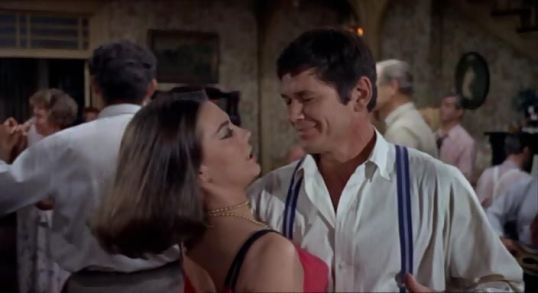
Back when the boarding house was still open, it was owned by Alva and Willie’s mother, Hazel (Kate Reid). She was engaged to J.J. Nichols (Charles Bronson) and she made a good-enough living renting out rooms to the men who worked for the railroad. She pressured Alva to marry the much older and financially stable Mr. Johnson (John Harding) but Alva was restless and not ready to settle. Almost every man at the boarding house was in love with Alva, including Sidney (Robert Blake) and J.J. himself. However, when Owen arrived, Alva became fascinated by him. Unfortunately, Owen had been sent to town to close the local railroad depot and to put almost all of them in town out of work.
This Property Is Condemned is based on a play by Tennessee Williams and, like so many of the films adapted from Williams’s works, it’s a bit uneven. The dialogue occasionally feels a bit overwritten. (The screenplay was adapted by Fred Coe, Edith Sommer, and Francis Ford Coppola.) While Natalie Wood is well-cast as the flirtatious but deeply sad Alva and Robert Redford is a handsome (if somewhat dull) Owen, Mary Badham, Kate Reid, and Robert Blake all tend to overact. (Few dramatists can inspire otherwise good actors to chew the scenery quite like Tennessee Williams.) That said, when the film is good, it’s very, very good. Director Sydney Pollack captures the atmosphere of a town that’s slowly dying. Everyone knows that Owen’s visit is going to kill the town, including Owen. (One of the screenplay’s weaknesses is that Owen continually says that he dislikes his job but he never explains why he does it.) Pollack captures Williams’s sultry Southern atmosphere without allowing the film to sink into self-parody. The film is at its strongest when it just concentrates on Natalie Wood, who plays Alva as an intelligent young woman who knows that she’s never going to escape the prison of her mother’s demands or her own reputation. As someone who grew up in Hollywood and spent almost her entire life being watched and judged, one gets the feeling that Wood could relate to Alva and that comes through in her performance.
Of course, the main reason that I watched this film is because today is the 105th birthday of Charles Bronson. The film features Bronson as a character actor and he definitely makes an impression with limited screen time. Bronson plays J.J. as being a tough and unapologetic working man. From the minute the well-coifed Owen shows up in his nice suit and his polite manners, you can tell that J.J. isn’t going to like or trust him and, considering that Owen fires most of J.J.’s co-workers, it turns out that J.J.’s instincts were correct. Bronson may not have had the greatest range as an actor but he had something even more important. He was authentic in a way most actors weren’t. While the other actors are clearly acting, Bronson just is. J.J. Nichols is not a huge role but Charles Bronson is unforgettable.