Film Review: This Property is Condemned (dir by Sydney Pollack)


1966’s This Property Is Condemned opens and closes with the same image. The time is the Great Depression. Willie Stark (Mary Badham), a teenage girl, walks on a set of abandoned railroad tracks in the dilapidated town of Dodson, Mississippi. Willie is wearing a dress that is too big for her and jewelry that she doesn’t seem old enough to own. She runs into a boy named Tom (Jon Provost) who is skipping school. Willie points over at the condemned and shuttered former boarding house in which she grew up and where she currently lives alone. She tells Tom the story of her sister Alva (Natalie Wood) and what happened when a stranger named Owen (Robert Redford) came to town.

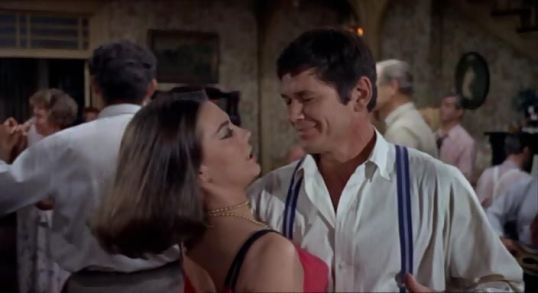
Back when the boarding house was still open, it was owned by Alva and Willie’s mother, Hazel (Kate Reid). She was engaged to J.J. Nichols (Charles Bronson) and she made a good-enough living renting out rooms to the men who worked for the railroad. She pressured Alva to marry the much older and financially stable Mr. Johnson (John Harding) but Alva was restless and not ready to settle. Almost every man at the boarding house was in love with Alva, including Sidney (Robert Blake) and J.J. himself. However, when Owen arrived, Alva became fascinated by him. Unfortunately, Owen had been sent to town to close the local railroad depot and to put almost all of them in town out of work.

This Property Is Condemned is based on a play by Tennessee Williams and, like so many of the films adapted from Williams’s works, it’s a bit uneven. The dialogue occasionally feels a bit overwritten. (The screenplay was adapted by Fred Coe, Edith Sommer, and Francis Ford Coppola.) While Natalie Wood is well-cast as the flirtatious but deeply sad Alva and Robert Redford is a handsome (if somewhat dull) Owen, Mary Badham, Kate Reid, and Robert Blake all tend to overact. (Few dramatists can inspire otherwise good actors to chew the scenery quite like Tennessee Williams.) That said, when the film is good, it’s very, very good. Director Sydney Pollack captures the atmosphere of a town that’s slowly dying. Everyone knows that Owen’s visit is going to kill the town, including Owen. (One of the screenplay’s weaknesses is that Owen continually says that he dislikes his job but he never explains why he does it.) Pollack captures Williams’s sultry Southern atmosphere without allowing the film to sink into self-parody. The film is at its strongest when it just concentrates on Natalie Wood, who plays Alva as an intelligent young woman who knows that she’s never going to escape the prison of her mother’s demands or her own reputation. As someone who grew up in Hollywood and spent almost her entire life being watched and judged, one gets the feeling that Wood could relate to Alva and that comes through in her performance.

Of course, the main reason that I watched this film is because today is the 105th birthday of Charles Bronson. The film features Bronson as a character actor and he definitely makes an impression with limited screen time. Bronson plays J.J. as being a tough and unapologetic working man. From the minute the well-coifed Owen shows up in his nice suit and his polite manners, you can tell that J.J. isn’t going to like or trust him and, considering that Owen fires most of J.J.’s co-workers, it turns out that J.J.’s instincts were correct. Bronson may not have had the greatest range as an actor but he had something even more important. He was authentic in a way most actors weren’t. While the other actors are clearly acting, Bronson just is. J.J. Nichols is not a huge role but Charles Bronson is unforgettable.
Retro Television Reviews: Dragnet 1966 (dir by Jack Webb)


Welcome to Retro Television Reviews, a feature where we review some of our favorite and least favorite shows of the past!  On Sundays, I will be reviewing the made-for-television movies that used to be a primetime mainstay.  Today’s film is 1969’s Dragnet 1966!  It can be viewed on YouTube!

“This is the city….”

So begins Dragnet, a television movie version of the classic cop show that was the Law & Order of it’s day.  Dragnet began as a radio program in 1949 before making it’s way over to television in 1951.  Each episode starred (and the majority were directed by) Jack Webb, who played a no-nonsense cop named Joe Friday.  Friday narrated every episode, dropping trivia about the history of Los Angeles while also showing viewers how the cops went about catching criminals.  Despite what is commonly believed, Joe Friday never said, “Just the facts, ma’m,” but he did investigate each case with the cool determination of a professional who kept his emotions under control.  The majority of Dragnet’s episodes were based on actual cases that were worked by the LAPD, hence the opening declaration of, “The story you are about to see is true.”

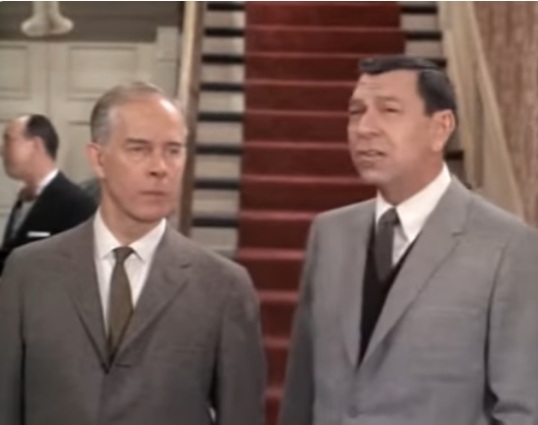
On television, Dragnet originally ran from 1951 to 1959, during which time Dragnet also became the first television series to be adapted into a feature film.  Jack Webb decided to relaunch Dragnet in 1966 and he produced a made-for-television movie that followed Friday and his latest partner, the far more talkative Bill Gannon (Harry Morgan), as they worked multiple cases over the course of one long weekend.  The pilot movie did lead to a new show, one that lasted from 1967 to 1970 and which is today fondly remembered for scenes of Friday and Gannon debating the merits of the legal system with hippies.  However, for whatever reason, the 1966 pilot movie was not actually aired until 1969.

The made-for-TV movie features Friday and Gannon searching not for LSD dealers and draft dodgers but instead for a crazed photographer (Vic Perrin) who hires women to pose for him and then ties them up and takes their picture right before her murders them.  The photographer is based on real-life serial killer Harvey Glatman and Perrin is perfectly creepy in the role.  Though Friday never loses his composure, his disgust at the photographer and his crimes is palpable and it adds an extra charge to the scene where, in the middle of a drenching rain storm, Friday tries to sneak up on the trailer where he believes the photographer is holding his latest victim.  It’s actually a pretty exciting scene and definitely one that will take by surprise anyone who thinks of the 60s Dragnet as just being a campy exercise in establishment resentment.

Of course, catching a serial killer is not all that Friday and Gannon deal with.  It’s a long weekend so Friday and Gannon end up investigating the murder of a French tourist and Friday helps a younger, black detective deal with a racist criminal.  (The scene where Friday stands up to the racist was obviously meant to answer those who claimed the LAPD was a racist organization.)  At the start of the film, Joe almost gets collared into working security for a visiting Russian diplomat and the Russian’s paranoid security team is contrasted to the level-headed and capable men of the LAPD.  Some of these scenes are better than others.  The French tourist subplot features some truly risible acting and the scene with the racist is well-intentioned but still feels a bit condescending in its portrayal of the black detective needing Friday to help him deal with the suspect.  That said, I did enjoy listening to Bill Gannon talking about his plans for retirement and how working for the LAPD was destroying his teeth.  Harry Morgan’s folksy humor was always the perfect counterpart to Jack Webb’s perpetually rational Friday.

Finally, I appreciated that the movie featured a scene with Friday and Gannon went undercover at a lonely hearts club.  If you’ve watched the 1960s version of Dragnet, you know that, for all the times that Friday and Gannon went undercover, they never really put much effort into it.  I mean, they didn’t ever bother to take off their jackets!

Though I was disappointed by the lack of hippies, Dragnet 1966 was still not only a good police procedural but also a fun time capsule of its era.