The TSL Horror Grindhouse: Amityville A.I. (dir by Matt Jaissle)


Let’s give some credit to the Amityville franchise. It simply does not stop.

 In November 1974, 23-year-old Ronald DeFeo Jr., a heroin user, murdered his entire family in their home at 112 Ocean Avenue in Amityville, New York. After realizing no one was going to buy his original claim that the Mafia killed everyone but left him alive, he eventually said a demon had possessed him. Some people believed that story because some people will believe anything that involves demonic possession.

A family called the Lutzes moved into the Amityville murder house, lasted a few weeks, then fled and claimed they’d been haunted by the same demons that drove DeFeo to kill. It was a stupid story, but it fed the 1970s obsession with the apocalypse and demonic possession. That was the decade of The Exorcist and The Omen. A “non-fiction” novel was published and became a bestseller. In 1979 a movie was made and became a hit. In the years since, there have been dozens upon dozens of films with “Amityville” in the title. Some are actual Amityville films. Most are generic low-budget horror that just borrowed the name. What they all have in common is the claim that DeFeo was possessed by Satan and that the Lutzes weren’t lying about the house being haunted. If there really is an Amityville Demon, it’s probably furious by now. These films do not make it look good.

In 2024’s Amityville A.I., Stuart Birdsall (William Childress) is the latest person to move into a house in the Amityville area. (It doesn’t appear to be the original house, though a few shots suggest they share the same attic windows.) Stuart is developing an A.I. and he’s convinced he’ll get the work done in the new place. Unfortunately the house is possessed, and soon so is his program. Even worse, the demon starts possessing the other electronic devices in the neighborhood. Stuart’s neighbor owns a sex doll that is soon running around saying, “Do you want to have sex?” while flashing a knife.

Amityville A.I. mixes demonic possession with the current moral panic around artificial intelligence and data centers. To be honest, Stuart’s A.I. doesn’t seem particularly practical. Its name is VIC 3000 and it is clearly riffing on HAL 9000 from 2001: A Space Odyssey. Setting Vic up means lugging around a lot of bulky equipment. There are several scenes of Stuart staring at diagrams on his laptop, and it’s never quite clear what any of it has to do with VIC or why anyone would pick VIC over the other A.I. options out there. Perhaps that’s why the demon starts messing with him. Hubris, not artificial intelligence, will be the downfall of .… well, it feels a bit too dramatic to say humanity. How about Amityville? Hubris will be the downfall of Amityville.

That said, I actually enjoyed Amityville A.I. It’s a low-budget movie that looks like a low-budget movie, but it commits to the bit. The sight of Stuart being chased by a psychotic, smiling sex doll belongs in the Amityville Hall of Fame. Whether it’s the demon, the A.I., or just his own twisted mind, Stuart is put through the wringer, and the film does tap the fear a lot of people have right now: that A.I. is both convenient and destined to destroy us.

If the first Amityville film’s message was that you should just leave the house, this one suggests you should consider disconnecting. Good luck with that.

Previous TSL Amityville Reviews:

  1. The Amityville Horror (1979)
  2. Amityville II: The Possession (1981)
  3. The Amityville Cure (1990)
  4. The Amityville Haunting (2011)
  5. Amityville Death House (2015)
  6. Amityville Toolbox (2016)
  7. Amityville: The Awakening (2017)
  8. The Amityville Murders (2018)
  9. Amityville Cop (2021)
  10. Amityville Emanuelle (2023)


Retro Television Review: St. Elsewhere 4.13 “To Tell The Truth”


Welcome to Retro Television Reviews, a feature where we review some of our favorite and least favorite shows of the past! On Fridays, I will be reviewing St. Elsewhere, a medical show which ran on NBC from 1982 to 1988.  The show can be found on Daily Motion.

Has John Doe finally discovered his real identity?

Episode 4.13 “To Tell The Truth”

(Dir by Mark Tinker, originally aired on January 15th, 1986)

Last week’s episode ended with an abortion protester hiding a bomb in a custodial cart. The majority of this episode features various characters pushing that cart around the hospital, leaving us to wonder if and when the bomb is going to go off. At one point, even Dr. Craig gives the cart a frustrated shove. When the bomb finally does go off, it’s sitting outside the hospital gift shop. The hospital survives. An orderly is seriously injured. And Morrison gets to yell at the bomber (Rob Garrison).

Fiscus isn’t in the hospital when the bomb goes off. Instead, he’s out doing his Westphall-mandated community service. Fiscus is sent out on house calls, visiting elderly patients in their homes and doing follow-up exams. Fiscus hates it, and it’s easy to see why. For the most part, the old people are stereotypes. This episode is a rare case of St. Elsewhere trying too hard to be sentimental.

(And yes, when Fiscus complains, you can be sure that Westphall is ready with a long monologue about the time he spent in Ethiopia.)

The Valeres (George DelHoyo and Deborah May) are both getting frustrated with their inability to conceive. With Dr. Turner currently visiting her hometown in Mississippi, Ehrlich and Chandler have taken over the case. Ehrlich recommends that the Valeres consider adoption. Chandler, however, tells them that they should continue with IVF.

After a long day in court, Lucy slaps Helen, declares them to be even, and then drops her lawsuit.

Finally, Ramsey Headley (Ellis Rabb) and Lucinda Ferrare-Headley (Carrie Nye) show up at the hospital and claim that John Doe No. 6 is their long-lost brother and the heir to their family’s fortune. John Doe No. 6, who had been experimenting with being Shakespeare, says that he knows them and that he now realizes that he is Thomas Headley of New Orleans. Auschlander is happy that John has found his identity, but he’s still sad to see him go. (Auschlander does not seem to notice that the Headleys all speak like characters in a bad Tennessee Williams play.) After John leaves, the hospital gets a call from a “New Orleans sanitarium,” informing them that two of their patients have escaped and are heading to Boston. Yikes! If John returns next week, this will be a funny little incident. If he doesn’t, I’m never going to forgive Auschlander for letting him leave with two obvious charlatans.

This week’s episode was .… well, it was okay. It had its good moments, like the suspense with the custodial cart and the John Doe storyline. But it also got a bit too sentimental with the old people, and I’m at the point where I’m going to scream if I have to listen to another Westphall lecture about life in Ethiopia.

Let’s just be happy that the show didn’t kill Santa Claus again.

Horror Book Review: The Funhouse by Dean Koontz, writing as Owen West


In 1980, Dean Koontz was hired to write a novelization of The Funhouse. At the time, he was not yet a household name. He still regularly worked as an author-for-hire under a string of pseudonyms; for this book, he originally published as Owen West. While Tobe Hooper was in pre-production, Koontz was assigned to turn Larry Block’s screenplay into a fast, accessible novel. He was not particularly impressed by Block’s story, but he liked the idea of writing about a carnival. Production delays meant the novelization reached stores in late 1980, months before the film. It sold well at first. When the movie finally opened in 1981 and did disappointing business, the book’s sales collapsed. Years later, after Koontz had become a bestselling author in his own right, The Funhouse was reissued under his real name.

The first thing that stands out is how little the novel has in common with Hooper’s film. The movie, of which I am a fan, is a fairly straightforward, atmosphere-heavy slasher. Teenager Amy and her three friends hide in the funhouse after the carnival closes, witness a murder, and find themselves hunted by a carny and his son. Those elements are all present in Koontz’s book, but he adds a large amount of backstory, most of it centered on Amy’s alcoholic mother, Ellen.

In the novel, Ellen is the ex-wife of Conrad the carny. A runaway, she married him without realizing he was a Satanist who hoped she would give birth to the Antichrist. When their demonic infant attacked her, Ellen crushed the baby. Conrad swore revenge: he would let her go so he could hunt her down later and destroy whatever family she built. What plays as random bad luck in the film becomes something very different here. Over the years, Conrad and his second son, the deformed Gunther, take their carnival from town to town in search of Ellen and her new family. The other carnival workers are drawn as sympathetic figures, people on the margins who have formed a family of their own and have no idea how depraved Conrad and Gunther really are.

Family is the novel’s real subject. Ellen has remarried and has two children, Amy and Joey. In the film, Amy is a typically naïve final girl, and Joey is an annoying brat who sneaks out to the carnival. Ellen appears only briefly and makes little impression, though she is seen drinking as Amy leaves the house. In the book, Ellen hits Amy when her daughter says she is pregnant, then pays for the abortion because she fears Amy might give birth to the Antichrist. Joey is terrified of Ellen and runs away to the carnival because, like Ellen before him, he wants an escape from a dysfunctional home. The contrast between the carnies’ supportive found family and Amy and Joey’s abusive “respectable” household is easy to spot, but it still works.

Koontz’s eye for detail and his gift for vivid characterization lift The Funhouse above the usual horror novelization. The plot is occasionally stretched thin. Conrad’s revenge scheme never quite makes sense.  What if Ellen had stayed unmarried and never had another child? Even so, Koontz keeps the action moving and is smart enough to lean into the melodrama without apology. He even lands a surprisingly moving final scene.

This is a case of a novelization that diverges sharply from its source. I like both Hooper’s film and Koontz’s novel. They are both wonderfully macabre. The film is true to Hooper’s aesthetic. The novel is pure Koontz.


October True Crime: Devil On Campus (dir by Elisabeth Rohm)


Remember The Vow?

A two-season docuseries that aired on HBO, The Vow featured former members of the NXIVM cult telling their stories and trying to downplay their own involvement in all of the cult’s crimes. In one of the show’s key scenes, former filmmaker and NXIVM follower Mark Vicente angrily exclaimed that anyone could get brainwashed. Anyone could become a member of a cult.

I have never really believed that.

I’ve sat through several documentaries and docudramas about cults. I have listened to countless interviews with disillusioned former members. One thing that has always really stood out to me is that people who get brainwashed and join cults are usually some of the stupidest, flakiest people in the world. Inevitably, they always say they felt they were missing something in their lives and that they needed a greater purpose. And to that, I say, “Big deal.” If something’s missing from your life, volunteer at a soup kitchen. Don’t give up your identity for a commune. Cults seem to appeal to weak-willed people who want to be told that they’re victims first and individuals last.

I found myself thinking about all of this as I watched 2024’s Devil on Campus: The Larry Ray Story. Based on a true story, Devil on Campus opens in 2010 with Larry Ray (Billy Zane) showing up at his daughter’s dorm room at Sarah Lawrence College. Larry has just been released from prison, though he claims that he was set up by Rudy Giuliani and former NYPD Commissioner Bernie Kerik. Larry is charismatic and energetic. He has a gift for telling stories that sound like they could potentially be credible as long as you don’t give them too much thought. Larry also has a lot of money and, at the start, he seems to have a generous nature.

Larry is soon living in the dorm room and controlling the lives of both his daughter and her roommates. He can be tough. He can be erratic. But he repeatedly tells all of them that he’s just trying to help them. Larry encourages them to express their emotions and to cry and to have sex with each other. Eventually, he encourages them to live in an off-campus apartment with him, to work (without pay) on his family farm, and finally to work as sex workers. Eventually, some break away from him and some do not. It’s good that some realized the truth, but it’s hard not to be disappointed that it took them so long to do so.

Though a few names have been changed, Devil on Campus sticks close to the facts of the case. The movie works largely due to Billy Zane’s bigger-than-life screen presence. The minute that Zane appears in the film, he dominates every frame. He plays Larry as someone smart enough to know that the way to keep people from questioning you is to just keep talking. Larry instinctively recognizes when someone is too weak-willed or slow-witted to resist being manipulated. Zane’s performance dominates the film. His victims, on the other hand, come across as ciphers, but perhaps that’s a reflection of reality. Regardless of what Mark Vicente claimed in The Vow, not everyone is dumb enough to get brainwashed.

As for the real-life Larry Ray, he’s currently in federal prison. He’s scheduled to be released in 2071, when he will be 111 years old.

Horror Film Review: Tony Manero (dir by Pablo Larrain)


Pablo Larraín’s 2008 film Tony Manero tells the story of an odd man named Raúl (Alfredo Castro). At the height of the Pinochet dictatorship, Raúl lives in a dilapidated boarding house with his girlfriend’s family. The boarding house has a small stage for putting on shows, and Raúl uses it to choreograph dances that pay tribute to his favorite movie, Saturday Night Fever, and his favorite character, Tony Manero. Raúl is a quiet man who comes to life whenever he imitates John Travolta’s dance moves. He goes to see Saturday Night Fever on a daily basis and can recite all of the dialogue by heart. A Chilean TV show is hosting a Tony Manero look-alike contest, and Raúl is determined to win. He even gets a white suit and looks forward to becoming a star instead of just a poor nobody.

That may sound like the setup for a heartwarming, crowd-pleasing movie, but it is not. Raúl is a bitter and paranoid man in his 50s. He’s on the short side. Despite owning a white suit and being able to do all the moves, he really doesn’t look much like Tony Manero. Throughout the film, he goes out of his way to find the secret to becoming Tony Manero. (He becomes obsessed with making the boarding house stage light up just like the disco dance floor in the movie.) But the truth of the matter is that he is not Tony Manero. He is not a charismatic young man trying to find himself in Brooklyn. He is a rather creepy and obnoxious middle-aged man living under a dictatorship. The film turns into a full horror film as it becomes obvious how far Raúl will go to accomplish his dream. When the kindly theater owners swap out Saturday Night Fever for Grease, Raúl is not pleased.

There is a humorous scene early in the film in which Raúl shows up at the television studio in his Tony Manero costume, only to discover that he has gotten the date wrong and has shown up a week early. Everyone in the studio is dressed up to look like Chuck Norris. At the same time, the subtext is very serious. Director Pablo Larraín is showing the influence of American culture on Chile and commenting on American involvement in helping Pinochet take power in 1973. While Raúl tries to turn himself into Tony Manero, people are informing on their neighbors and dissidents are being executed in the streets. Raúl is indifferent to the violence around him. (When he witnesses an execution, his response is to loot the body.) While his girlfriend’s son gets involved with the anti-Pinochet underground, Raúl focuses on trying to transform himself into Tony Manero. In Saturday Night Fever, Tony Manero can escape his oppressive home life by riding the train to a different borough. Raúl doesn’t have that option.

Seen from today’s perspective, Tony Manero’s portrayal of Pinochet’s Chile brings to mind what a lot of people wanted America to become during the COVID era, complete with secret police, neighborhood informants, and the rich getting to flout the rules while the poor were expected to be happy with whatever crumbs were left over. If Raúl survived the Pinochet years, it is easy to imagine him in his 90s, reporting his neighbors for not wearing a face mask and then settling in to watch Saturday Night Fever for the thousandth time.

Lifetime For October: Nightmare PTA Moms (dir by Dave Thomas)


At the start of 2022’s Nightmare PTA Moms, Gayle (Brianna Cohen) and Rick (Jonathan Stoddard) have just relocated to Florida.  Rick is the new regional manager for everyone’s favorite chic retail outfit, Jackie Z.  Gayle is looking forward to reopening her bakery, Gayle’s Goodies.  (If there’s anything that I’ve learned from watching Lifetime movies, it’s that there’s apparently nothing easier than opening up a bakery in a new town.)  Gayle and Rick’s teenage daughter, Chloe (Madison Paige), will soon be starting at her new high school.  When Gayle meets PTA president Vanessa VanDeBerg (Alison Filoramo), she’s invited to join.  Gayle accepts.

Gayle has no idea what she’s getting into.

Under the velvet glove of Vanessa, the PTA has become a cult.  No husbands are allowed at the after-meeting parties.  They would ruin the mood as Vanessa hands out tequila shots and invites a male stripper into the house.  Don’t tell, Vanessa orders, largely so she can seek revenge against anyone who does tell.  Vanessa enjoys being PTA president and she’s not going to let anyone take that joy away from her.  Of course, the only reason that Vanessa is president is because the woman who actually won the election, Lexie Wilson, supposedly committed suicide a month after his victory.  And then Vanessa’s husband mysteriously fell to his death.  “Vanessa doesn’t like to talk about that,” another member of the PTA warns Gayle.

Meanwhile, Chloe has befriended Vanessa’s daughter, Serena (Gracie Silva).  Yay!  Whenever you’re starting a new chapter in your life — whether it’s a new school or a new job — you should always befriend the most popular people around.  However, Serena is soon taking advantage of Chloe’s friendship.  Serena insists that Chloe use her Jackie Z discount card to pay for Serena’s purchases.  Serena also steals a pair of sunglasses.  I don’t really blame Serena.  Those sunglasses were pretty cute.

Soon, Gayle is asking questions about all of the deaths surrounding the PTA and Vanessa is vamping it up whenever she stops by Jackie Z.  Gayle worries that Rick is going to cheat.  Rick worries that Gayle is going to get hurt if she doesn’t stop poking around the PTA.  Chloe worries that she’s going to be friendless.  The only person who doesn’t seem to be all that worried is Vanessa.  That’s what makes her a great character.  As played by Alison Filoramo, Vanessa is an unapologetic manipulator.  She’s the epitome of the mean girl grown up, delivering every passive aggressive line with just the right amount of snarky menace.  It’s not just that Vanessa’s bad.  It’s that she has so much fun being bad.  Gayle may be the hero but Vanessa is the character that most viewers are going to enjoy watching.

Nightmare PTA Moms is a delight, an unapologetically over-the-top film that is fully willing to embrace the melodrama.  That said, there’s definitely an element of truth to the film’s portrayal of self-important, self-absorbed, affluent people who have joined the PTA not because they care about their children’s education but instead because they just love to wield even the smallest amout of power.  As campy as the film may have been, it worked because there was just enough reality to make the film relatable.  After living through the COVID lockdowns, it’s not longer a shock to see a movie about an entitled sociopath who thinks that she has the right to tell other people what to do, what to think and what to say.

In the end, the nightmare becomes reality.


Horror Film Review: The Mist (dir by Frank Darabont)


Based on a novella by Stephen King, The Mist opens the morning after a sudden thunderstorm in Maine. Artist David Drayton (Thomas Jane) steps outside and sees that a tree has crashed through one of his front windows. Meanwhile, his neighbor, attorney Brent Norton (Andre Braugher), stares at the tree that has crushed his car. Though David and Brent are not exactly on friendly terms, the storm briefly brings them together. When David says that he’s going into town to pick up supplies, Norton asks if he can come with him. David’s wife stays back at the house while David drives his son (Nathan Gamble) and Brent to the local grocery store. Before David leaves, he notices a thick mist moving over a nearby lake.

The entire town is without power and the grocery store is crowded. Three soldiers, who are picking up supplies before going on leave, are told that the leave has been abruptly canceled. Once the mist surrounds the store, it soon becomes obvious why that is. There are monsters in the mist and David, Norton, and several others find themselves trapped in the store. Going outside, as some insist on doing, only leads to death at the hands of the Lovecraftian monsters that inhabit the mist.

The Mist was first released in 2007 and I have to admit that I didn’t care much for it the first time that I saw it. I thought that some of the performances were a bit too histrionic and the film’s dark ending was almost too portentous to be credible. When I first saw it, I thought the film was almost trying too hard with the tragic conclusion. However, when I recently rewatched the film, I discovered that it had grown on me. I was better able to appreciate the fact that the monsters were both ludicrous and deadly at the same time. Performances that once seemed over-the-top in 2007 now seemed almost subtle when compared to how I’ve seen people actually behave in the real world over the past ten years. Once you’ve been yelled at for not wearing a mask while jogging, it’s a lot easier to buy the idea of a bunch of people in a grocery store losing their collective minds. Even the film’s dark ending now seemed like the only honest way the film could have ended.

The Mist is a film that plays much differently in a post-COVID world. The idea of innocent people losing their lives because of an accident at a government lab no longer seems all that unbelievable. The argument about whether or not to leave the store mirrored many of the same arguments that I heard during the COVID lockdowns. If Mrs. Carmody (Marcia Gay Harden) and her followers originally seemed like standard Stephen King religious fanatics, Carmody now brings to mind the loathsome Randi Weingarten and her insistence that the only way to defeat COVID was to sacrifice the future of the young. Even the film’s final moments of self-destruction reflected the attitude that many had in 2020, that the situation was hopeless and that there was no escape beyond waiting for the world to end. The final image of one man, driven mad and screaming, brings to mind both the fate of the typical Lovecraftian explorer and also the excesses of the COVID era. That Stephen King continues to be one of the major defenders of these excesses brings a wonderful irony to the film’s subtext.

The Mist has definitely grown on me. It still has its flaws but those flaws are less of a problem now than they were in 2007. In 2007, The Mist seemed overlong. In 2026, that 2-hour running time feels like a relief from the slow-moving miniseries that have become a signature part of the streaming age. Even Thomas Jane’s performance, which seemed rather stiff when I first saw the movie, has improved in hindsight. His tight-jawed stoicism makes his eventual breakdown all the more effective. Everyone reaches the limit, the film seems to be saying.

The Mist is a film that has aged well. It’s one of the better Stephen King adaptations, one that largely stays true to the source material while still having the courage to develop its own identity. The first time I saw it, I was wrong about The Mist. It’s a film that deserves to be remembered as one of the most relevant horror films of the past 20 years.

Horror On The Lens: Planet of the Vampires (dir by Mario Bava)


Today’s horror on the lens is a true classic, 1965’s Planet of the Vampires!

Directed by the great Mario Bava, Planet of the Vampires follows a space expedition that lands on a seemingly dead planet.  The members of the expedition soon discover that the undead aren’t just an Earth phenomenon.  This atmospheric mix of horror and science fiction was later acknowledged as being a major inspiration for Alien.

Enjoy this classic from Mario Bava!


Lisa Marie Reviews The Amazing Race 39.2 “Are Tomatoes Good For Skin Care?”


Up until I checked the schedule to see whether or not the Big Brother finale was going to be two hours, I didn’t realize that CBS was going to be airing the second leg of The Amazing Race on Friday. Since I already had something else planned for Thursday night, I didn’t get a chance to watch the latest episode of The Amazing Race until this morning.

I was really happy about the second leg taking place in Madrid. My maternal grandmother was born in Spain and came to the United States after World War II. (Growing up, I was usually the only girl in any of my classes who knew who General Franco was.) I love Spain, even if it is currently being governed by a smug Socialist.

My sister Erin Nicole and I often joke about trying out for The Amazing Race and I think we would have done well during this leg. I would have let her do the Roadblock with the tomatoes. We definitely would have been able to tell the difference between Puerta del Sol and Puerta del Sur. I would have totally dominated the Slice of History detour. Along with the fact that our grandmother was born in Spain, I’ve got a degree in art history and I’m a big history nerd in general. I would not have needed to ask the locals who Picasso was and who Dalí was. We would have made it to the pit stop without having to use the express pass and I totally would have hugged Phil when he said that we were team number one.

I rolled my eyes a bit when Ann-Marie and Riley decided to form the Boss Lady alliance with Ali & Joanna, Jody & Jenn, and Dafina & Saran. I always cringe whenever the people on this show, Big Brother, or Survivor try to do the “all-girls alliance” thing because it always starts with everyone going, “Girl power!” and it always ends with people getting mad over the pettiest of things. We saw some of that during last night’s episode, when Ali ignored Dafina at the roadblock. I also noticed that, for all the talk of women supporting other women, they didn’t bother to invite Katie & Charlotte to join the alliance. In truth, The Amazing Race is not a game that really benefits from alliances. I can think of one season in which an alliance really worked and most of the viewers hated that season because the alliance members were all so unlikable.

(Interestingly enough, Ann-Marie and Riley also suggested that all of the players doing the Slice of Ham roadblock should work together as well. Ann-Marie’s definition of working together appears to be that everyone else should do all the work while she benefits. If I seem to have issues with Ann-Marie, it’s just because I can imagine her being the passive-aggressive HOA president from Hell. Of course, if I was actually running the Race, I would want to get Ann-Marie eliminated because there’s only room for one Marie.)

In the end, the main lesson of this week’s episode was to always make sure that you’re on the right train. Katie and Charlotte got on a train going to Puerta del Sur instead of Puerta del Sol and it basically led to their elimination.

Here are my thoughts on how each team is looking after this leg.

Coming in first were the soccer players, Ali and Joanna. Ann-Marie and Riley really want to work with the soccer players but I never really got the feeling that Ali and Joanna really wanted to work with them. Ali and Joanna are too competitive for that. I personally would not enter into an alliance with Ali. It’s hard for me to trust someone who won’t stand up for her own country’s national anthem.

Coming in second were Michelle & Matthew. Michelle and Matthew are a strong team, even if Michelle did go a little bit overboard while yelling at Matthew during the Roadblock. So far, they’ve finished 3rd and 2nd and they’ve done it without wasting an express pass.

Coming in third were Cody and Jaime. Cody and Jaime used their express pass to get out of doing Slice of Ham. They seem like a strong team and I was touched by their backstory. I’m hoping for the best for them.

Coming in fourth were Ann-Marie and Riley. Initially, I liked the mother-daughter team but, after tonight’s episode, I just see them as being the type of neighbors who smile when they visit and then make fun of your furniture when they think you’re not listening.

Jody and Jenn came in fifth. They totally wasted their express pass to get out of doing the Slice of History detour. Jody said that, as a history teacher, she was embarrassed. She should have been. Seriously, I’ve got no respect for that team now.

Daisha and Dalton used their express pass to get out of doing the Roadblock and they still only came in sixth. If I were them, I would be worried.

Erin and Javi came in seventh. I actually liked Erin and Javi more during the second leg than I did the first. They work well together.

Coming in eighth were Anuar and Andrea. My main impression of them is that Andrea is one bad leg away from having a massive meltdown.

Conner and Garrett finished in ninth place. I was a bit surprised that they finished so far back. Conner and Garrett seem like a strong team, though. I expect they’ll be around for a while.

Doug and Dylan came in tenth. I like Doug and Dylan but they’ve really struggled and they no longer have an express pass. I don’t think they’re going to be racing for much longer.

Dafina and Saran came in eleventh. They were doing well until they hit the Slice of History detour. They no longer have an express pass but I think they’re still stronger than they seemed to be last night.

Finally, Charlotte and Katie came in last and were eliminated. They got on the wrong train and it cost them.

Six express passes have been used. The express passes are only good through the sixth leg. Here’s who still has them:

  1. Ali & Joanna
  2. Michelle & Matthew
  3. Ann-Marie & Riley
  4. Anuar & Andrea
  5. Conner & Garrett

Next week, the teams head to Morocco and discover a whole new twist!

Previous Amazing Race 39 reviews

  1. Sorry, Guys, We Used Our Express Pass

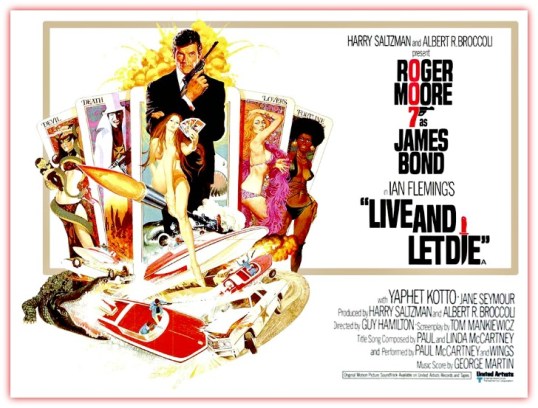
Live Tweet Alert: Join #FridayNightFlix for Live and Let Die!


As some of our regular readers undoubtedly know, I am involved in a few weekly watch parties.  On Twitter, I host #FridayNightFlix every Friday and I co-host #ScarySocial on Saturday.  On Mastodon, I am one of the five hosts of #MondayActionMovie!  Every week, we get together.  We watch a movie.  We tweet our way through it.

Tonight, at 10 pm et, I will be hosting #FridayNightFlix!  We will be welcoming October with a mix of James Bond and voodoo!  Join us for Live and Let Die!

If you want to join us this Friday, just hop onto twitter, find Live and Let Die on Prime, start the movie at 10 pm et, and use the #FridayNightFlix hashtag!  I’ll be there happily tweeting.  It’s a friendly group and welcoming of newcomers so don’t be shy.

See you there!