Playing Catch-Up: Carol (dir by Todd Haynes)


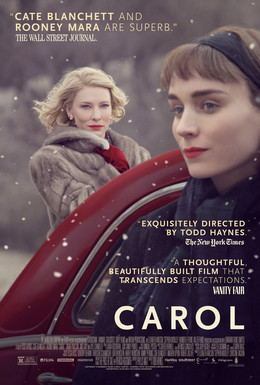
Carol_(film)_POSTER

(Minor Spoilers Below)

Carol is the best film of 2015.

I say that without a hint of hesitation or doubt.  2015 was a wonderful year for movies and I would say that there were at least 20 film released that I would call great.  And, out of those 20, Carol is the best.

Carol opens in 1952.  Therese Belivet (Rooney Mara) is young, lonely, and living in New York City.  She’s an aspiring photographer who can’t afford a decent camera, a secret bohemian living in a world where morality and culture are defined by the bourgeoisie.  She has a boyfriend named Richard (Jake Lacey) and he’s eager to marry her and move to France but, try as she might, Therese simply cannot bring herself to feel the same way about him that he feels about her.  Though she lives with him, she refuses to have sex with him.  At one point, she asks him if he’s ever heard of men being attracted to other men and she asks if he thinks the same can be true of women.  Richard says sure, before adding that it’s always the result of “something wrong” psychologically.

It’s Christmas.  Therese gets a temporary job, working at a department store in Manhattan.  From the moment we see Therese surrounded by the Christmas crowds, we realize that she feels totally out-of-place among the rest of the world.  She is withdrawn and quiet and rarely looks anyone in the eye.  That is until she meets Carol (Cate Blanchett).

Carol is searching for a gift for her daughter and accidentally leaves her gloves behind at the store.  When Therese arranges for the gloves to be returned to Carol, Carol thanks her by taking her out to lunch.  Soon, Carol is inviting Therese to spend Christmas at her house in New Jersey and a jealous Richard is complaining that Therese has a “crush” on the older woman.

Carol is going through a difficult divorce.  Her alcoholic husband, Harge (Kyle Chandler), is demanding full custody of their children.  Harge knows that years ago, Carol had a brief affair with her best friend, Abby (Sarah Paulson), and he can’t handle it.  When he stops by, drunk and belligerent, on Christmas, he discovers Therese visiting Carol and he freaks out even more.

(With all the attention being paid to the exquisite performances of Blanchett and Mara, now would be good place to mention that Kyle Chandler does a great job playing a loathsome character.  With his performance here and his role in The Spectacular Now, Chandler has cornered the market on playing abusive alcoholics.)

For New Year’s, Carol and Therese go on a trip and they finally consummate their relationship (in Iowa, of all places).  But what they don’t know is that Harge has hired men to follow them and to get proof of their relationship.  If Carol wants to see her daughter again, she knows that it means seeing a psychotherapist for help with her “problem” and never seeing Therese again…

Carol is an amazing and beautiful film, a portrait of both forbidden love and the struggle to survive in a society that demands total and complete conformity.  In many scenes, director Todd Haynes pays homage to the masters of 50s melodrama, filmmakers like Mark Robson, Douglas Sirk and Nicholas Ray.  The film’s lushly vibrant colors and attention to detail feels reminiscent of the films that Sirk made for MGM, with Cate Blanchett often made up to resemble Lana Turner.  Meanwhile, Rooney Mara often resembles Natalie Wood from Rebel Without A Cause.  One shot in particular, with the shadows of a window bar falling across Blanchett’s face like the bars of a prison cell, immediately brought to mind the end of Ray’s Bigger Than Life.

For the longest time, I have complained about Rooney Mara’s performance in David Fincher’s rehash of The Girl With The Dragon Tattoo.  Well, I’m prepared to stop complaining because Mara is brilliant in Carol.  Her blossoming as an actress mirrors Therese’s blossoming as a woman.  Rooney Mara is being promoted for best supporting actress but make no mistake.  There’s nothing “supporting” about Rooney Mara’s performance.  Carol is all about Therese and it works because of Mara’s wonderful performance.

Regardless of what may or may not happen with the Oscar nominations on Thursday, Carol is the best film of 2015.  It’s a film that we will still be talking about decades from now.

mara_blanchett_carol

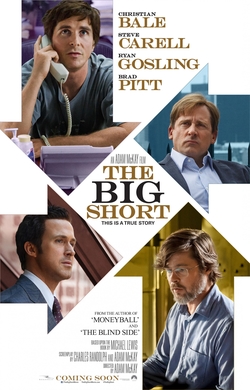
Playing Catch-Up: The Big Short (dir by Adam McKay)


The_Big_Short_teaser_poster

The Big Short is a film that is so critically acclaimed and that has been so passionately embraced by those who enjoyed it that it’s a bit intimidating to admit that it really didn’t do much for me.  (It’s even more intimidating for me to admit that I nearly included it on my list of the 16 worst films of 2015.)  It’s a big, angry movie and, even though it’s not really that good, it definitely taps into the zeitgeist.  It captures the anger, the frustration, and the fears that people (including me) are feeling right now.  It didn’t do much for me but I can understand why others have so passionately embraced it.

As for the film itself, it’s about the housing collapse and the financial crisis of 2008.  The main characters are all people who realized that the economy was about to collapse and who managed to make a profit off of the crisis.  For the most part, everyone gets at least two scenes where they get to rail about how angry they are that they’re making a profit off of other people’s misery.  However, they all still collect their money at the end of the film.

For the most part, our main characters are the type of quirky eccentrics who always tend to pop up in ensemble films like this.  They’re all played by recognizable actors and they all have an identifiable trait or two so we can keep them straight.  For instance, Christian Bale has trouble relating to people socially, plays drums, and looks like he probably has terrible body odor.  Steve Carell has a bad haircut and spends a lot of time yelling at people.  He’s also haunted by the suicide of his brother and he’s married to Marisa Tomei but she only gets to appear in two scenes and doesn’t really do much because this is a film about menfolk, dagnabit.  (I love Steve Carell but this is probably the least interesting performance that he’s ever given.)  John Magaro and Finn Wittrock are two young investors and they especially get upset when they realize that the economy is about to collapse.  Their mentor is played by Brad Pitt.  Since this is an important film, Brad Pitt plays his role with his important actor beard.

And then there’s Ryan Gosling.  Gosling plays a trader and he also narrates the film.  And really, Gosling probably gives the best performance in the film, perhaps because his character is the only one who is actually allowed to enjoy making money.  I think we’re supposed to be outraged when he brags about making money while people lose their houses but Gosling’s so charismatic and the character is so cheerful that it’s hard to dislike him.

(Of course, listening to Gosling’s narration, it’s impossible not to be reminded of The Wolf of Wall Street.  And it’s appropriate because The Big Short is kind of like The Wolf of Wall Street for people who don’t want to have to deal with ambiguity or nuance.)

The film has gotten a lot of attention for Adam McKay’s direction, which is flashy and always watchable but, at the same time, also rather shallow.  For the most part, McKay’s directorial tricks only served to remind me of other movies.  The narration, of course, made me think about The Wolf of Wall Street.  The scenes where characters look straight at the camera and say, “This isn’t the way it really happened,” only reminded me of how much more effective it was when the same thing happened in Michael Winterbottom’s 24 Hour Party People.

And then there’s the celebrity cameos.  These are the scenes where a special guest celebrity is brought on screen to explain to us how Wall Street actually works.  The first time, it’s Margot Robbie in a bubble bath and it works well because it admits the debt that The Big Short owes to Wolf of Wall Street.  (Plus, it ends with Robbie telling the viewers to “fuck off,” which is probably what I would do if a huge group of strangers interrupted my bubble bath.)  If McKay had limited himself to just doing it once, it would have been brilliant.  But McKay drags out three more celebs and, with repeated use, the technique gets less and less interesting.

But I guess it’s debatable whether any of that matters.  The Big Short taps into the way people are feeling now.  It’s a zeitgeist film.  People are rightfully angry and The Big Short is all about that anger.  A decade from now, it’ll probably be as forgotten as Gabriel Over The White House.  But for now, it’s definitely the film of the moment.

Playing Catch-Up: The End of the Tour (dir by James Ponsoldt) and Love & Mercy (dir by Bill Pohland)


Two of the best films released last year dealt with troubled artists.

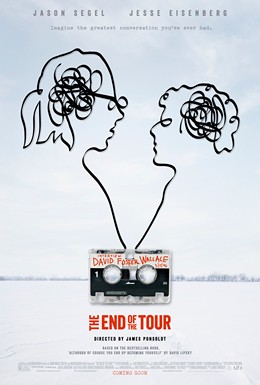
The_End_of_the_Tour

The End of the Tour opens in 2008, with a writer David Lipsky (Jesse Eisenberg) getting a call that the famous and acclaimed author, David Foster Wallace (Jason Segel), has committed suicide.  After learning of the tragedy, Lipsky remembers a few days that he spent interviewing Wallace 12 years earlier.  Wallace had just published his best known work, Infinite Jest.  At the time, Lipsky himself was a struggling writer and he approached Wallace with a combination of admiration and professional envy.  Lipsky hoped that, by interviewing Wallace, he could somehow discover the intangible quality that separates a great writer from a merely good one.

Almost the entire film is made up of Lipsky’s conversations with Wallace.  We watch as both the somewhat reclusive Wallace (who seems both bemused and, at times, annoyed with his sudden fame) warms up to Lipsky and as Lipsky forces himself to admit that Wallace might actually be a genius.  There are a few conflicts, mostly coming from the contrast between the withdrawn Wallace and the much more verbose Lipsky.  Lipsky’s editor (Ron Livingston) continually pressures him to ask Wallace about rumors that Wallace was once a drug addict.  But, for the most part, it’s a rather low-key film, one that’s more interested in exploring ideas than melodrama.  It’s also a perfect example of what can be accomplished by a great director and two actors who are totally committed to their roles.  Jason Segel, especially, gives the performance of his career so far.

The shadow of Wallace’s suicide hangs over the entire film.  Throughout their conversation, Wallace drops hints about his own history with depression.  Much as Lipsky must have done after Wallace’s suicide, we find ourselves looking for clues to explain his death.  But ultimately, Wallace remains a fascinating enigma in both life and death.

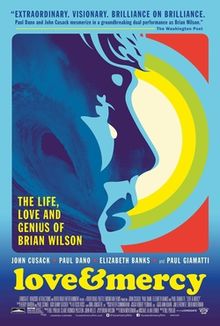
Love_&_Mercy_(poster)

Love & Mercy (dir by Bill Pohland)

Love & Mercy opens with Cadillac saleswoman Melinda Ledbetter (Elizabeth Banks) selling a car to a polite but nervous man (John Cusack).  The man sits in the car with her and rambles for a bit, mentioning that his brother has recently died.  Soon, the man’s doctor, Eugene Landy (Paul Giamatti), shows up and Melinda learns that the man is Brian Wilson, a musician and songwriter who is famous for co-founding The Beach Boys.  After having a nervous breakdown decades before, Brian is now a recluse.  He and Melinda start a tentative relationship and Melinda quickly discovers that Brian is literally being held prisoner by the manipulative Dr. Landy.

Throughout the film, we are presented with flashbacks to the 1960s and we watch as a young Brian (Paul Dano) deals with both the pressures of fame and his own relationship with his tyrannical father (who, in an interesting parallel to Brian’s later relationship with Landy, is also Brian’s manager).  As Brian struggles to maintain his grip on reality, he obsesses on creating “the greatest album ever.”

Love & Mercy is an enormously affecting story about both the isolation of genius and the redeeming power of love.  Whether he’s played by Cusack or Dano, Brian Wilson remains a fascinating and tragic figure.  It’s hard to say whether Cusack or Dano gives the better performance.  Indeed, they both seem to be so perfectly in sync with each other that you never doubt that the character played by Paul Dano will eventually grow up to become the character played by John Cusack.  Both of them do some of the best work of their careers in Love & Mercy.

Playing Catch-Up: Straight Outta Compton (dir by F. Gary Gray)


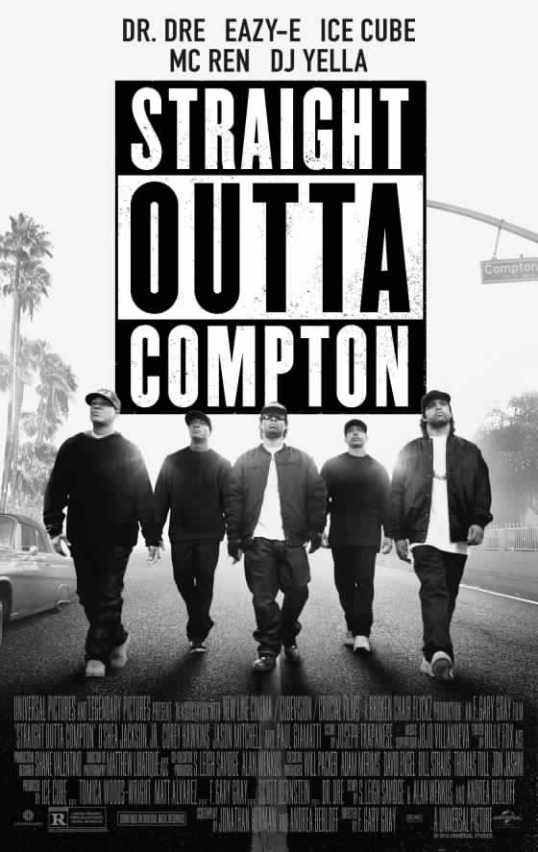
Straight_Outta_Compton_poster

Let’s just start with the obvious.

I am probably the last person who would be expected to appreciate Straight Outta Compton.   In the months leading up to the film’s release last year, I doubt anyone expected me to be a part of the audience.  After all, I’m a Caucasian girl from Texas.  I may have been born in Oak Cliff but, for the most part, I’ve lived in suburbs, small towns, and a few farming communities.  When it comes to music, my taste runs that gamut from EDM to more EDM.  I was less than a year old when NWA formed and I hadn’t even heard Straight Outta Compton or Fuck tha Police until I first heard about this movie.  Going into the movie, I knew who both Ice Cube and Dr. Dre were but, otherwise, I knew nothing about NWA.

And yet, with all that in mind, I was in tears by the end of Straight Outta Compton.  That’s proof of how strong a film Straight Outta Compton truly is.  I went into the film with next to zero knowledge of what I was about to see but from the very first minute, it captured my attention and my emotions. From the minute I saw Eazy-E (Jason Mitchell) fleeing from a police raid at a crack house, Dr. Dre (Corey Hawkins) dreaming of becoming a success, and Ice Cube (O’Shea Jackson, Jr.) being threatened by both gang members and police, I was totally invested in their stories.

Straight Outta Compton is a big film and director F. Gary Gray is obviously interested in a lot more than just telling a conventional musical biopic.  Instead, he uses Straight Outta Compton to explore what it’s like to grow up and live in the shadows of America.  That pre-credits raid on that crack house sets the tone for much of Straight Outta Compton, revealing a world where the only escape comes from money and where the police are essentially an invading army.

The film also deserves a lot of credit for capturing the excitement of creation.  The scene where NWA records their first album is pure exhilaration and even better are the concert scenes, all of which capture chaos in the best possible way.  Perhaps the best sequence comes when a defiant NWA performs Fuck tha Police while a similarly defiant swarm of policeman make their way through the crowd, all holding their badges in the air.  In that scene, Straight Outta Compton captures the feel of a society at war with itself.

Straight Outta Compton is an ensemble film in the best sense of the word, with Hawkins, Jackson, and Mitchell all giving excellent and charismatic performances.  Somewhat inevitably, Paul Giamatti shows up as their manipulative manager, Jerry Heller.  It’s a role that feels as if it was tailor-made for Giamatti and, needless to say, he performs the Hell out of it.

I’ve read that Straight Outta Compton takes some liberties with the historical facts and it’s true that the other two members of NWA — MC Ren and DJ Yella — are both largely portrayed as being bystanders.  (That said, Neil Brown did have some funny lines as DJ Yella.)  Towards the end of the film, whenever Eazy-E said, “I should have listened to Dre and Cube!,” I was reminded of the fact that Straight Outta Compton was produced by Dr. Dre and Ice Cube and not Jerry Heller.

But, historical liberties or not, Straight Outta Compton is an exhilarating and important film and one of the best of the year.


Here Are The DGA Nominations!


The Directors Guild of America announced their nominees today!  The DGA is usually one of the best of the Oscar precursors.  Getting a DGA nomination usually translates to a Best Picture nomination.

Here are the nominees.  There really aren’t any surprises among them, though, based on its strength with the other guilds, I did think that Steven Spielberg might sneak in there with Bridge of Spies.

Alejandro G. Inarritu for The Revenant

Tom McCarthy for Spotlight

Adam McKay for The Big Short

George Miller for Mad Max: Fury Road

Ridley Scott for The Martian

And here are the nominees for a new award that the DGA is giving out this year!

Outstanding Directorial Achievement for a First-Time Feature Film Director

The nominees are:

Fernando Coimbra, “A Wolf at the Door”
Joel Edgerton, “The Gift”
Alex Garland, “Ex Machina”
Marielle Heller, “The Diary of a Teenage Girl”
Laszlo Nemes, “Son of Saul”
The best thing about this new category?  Knowing that Sasha Stone is probably pissed off that Diary of a Teenage Girl received a nomination.

Here Are The Cinema Audio Society (CAS) Nominations!


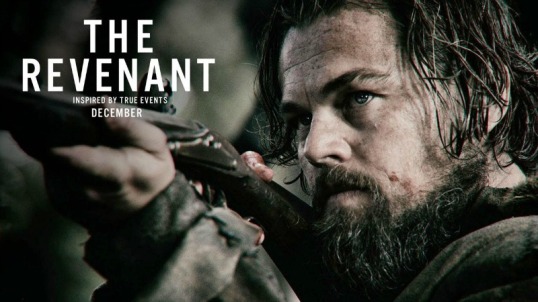
The Revenant

MOTION PICTURE – LIVE ACTION

Bridge of Spies
The Hateful Eight
Mad Max: Fury Road
The Revenant
Star Wars: The Force Awakens

MOTION PICTURE—ANIMATED

The Good Dinosaur
Hotel Transylvania 2
Inside Out
MinionsThe Peanuts Movie

Here Are The Visual Effects Society Nominations!


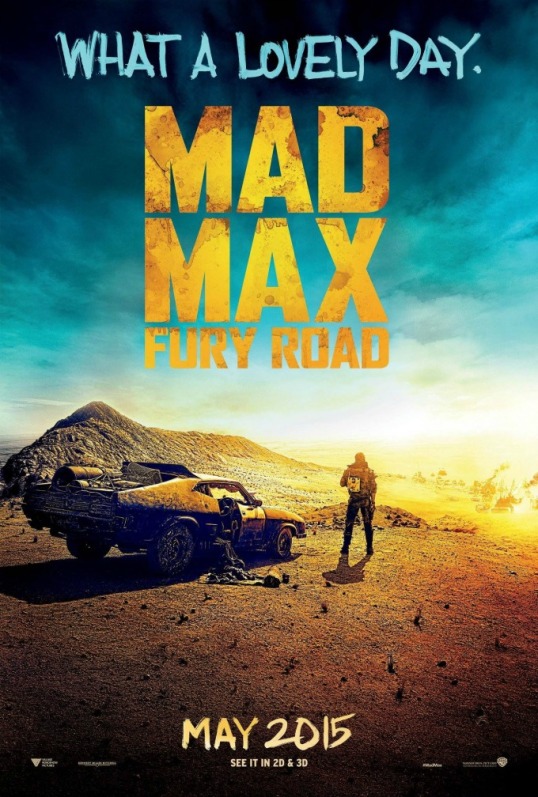
MadMaxFuryRoad

FEATURE FILM

Outstanding Visual Effects in a Photoreal Feature

Furious 7

San Andreas

Star Wars: The Force Awakens

Mad Max: Fury Road

The Martian

Outstanding Supporting Visual Effects in a Photoreal Feature

In The Heart of The Sea

Bridge of Spies

The Walk

Everest

The Revenant

Outstanding Created Environment in a Photoreal Feature

The Walk; World Trade Center

Star Wars: The Force Awakens; Falcon Chase / Graveyard

Ant-Man; The Microverse

Jurassic World; Jungle Chase

Tomorrowland; Tomorrowland Center

Outstanding Animated Performance in a Photoreal Feature

Star Wars: The Force Awakens; Maz

The Revenant; The Bear

Avengers: Age of Ultron; Hulk

Chappie; Chappie

Outstanding Virtual Cinematography in a Photoreal Project

Ant-Man; Macro Action

Mission Impossible: Rogue Nation; Underwater Torus Chamber

Star Wars: The Force Awakens; Falcon Chase / Graveyard

The Walk; Towers Walk

Outstanding Compositing in a Photoreal Feature

San Andreas; Los Angeles Destruction

Star Wars: The Force Awakens

Tomorrowland

Mad Max: Fury Road

The Revenant; Bear Attack

Outstanding Models in a Photoreal or Animated Project

Star Wars: The Force Awakens; BB-8

Avengers: Age of Ultron; Hulkbuster

Everest; Mt. Everest

Jurassic World; Indominus Rex

Outstanding Effects Simulations in a Photoreal Feature

Mad Max: Fury Road; Toxic Storm

Avengers: Age of Ultron; Hulk vs Hulkbuster

San Andreas; Hoover Dam / San Francisco Tsunami

San Andreas; Los Angels Destruction

Star Wars: The Force Awakens; Starkiller Base

ANIMATED FEATURE FILM

Outstanding Visual Effects in an Animated Feature

The Peanuts Movie

Inside Out

Anomalisa

Hotel Transylvania 2

The Good Dinosaur

Outstanding Animated Performance in an Animated Feature

The Peanuts Movie; Snoopy

The Peanuts Movie; Charlie Brown

Inside Out; Joy

The Good Dinosaur; Spot

Outstanding Created Environment in an Animated Feature

The Good Dinosaur; The Farm

Inside Out; Imagination Land

The Peanuts Movie; Charlie Brown’s Neighborhood

Shaun the Sheep Movie; Under the Arches

Outstanding Effects Simulations in an Animated Feature

Inside Out

The Peanuts Movie

The Good Dinosaur

Home

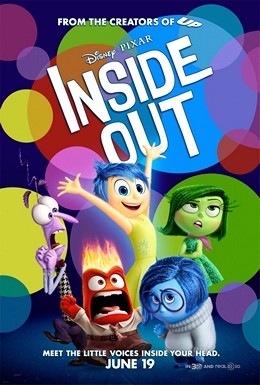
Inside_Out_(2015_film)_poster

Playing Catch-Up: Room (dir by Lenny Abrahamson)


Room_Poster

Have you seen Room yet?

I ask because I’m debating how much information I should share in this review.  Room came out a few months ago and I’ve been late in reviewing it because watching the film was such an emotionally overwhelmingly experience that I wasn’t sure where to begin.  Now, all of this time has passed and I’m in a hurry to review this film because it’s obviously going to be nominated for some Oscars on Thursday morning and I’m wondering how much I can reveal without spoiling the movie.

It’s always tempting to say “Spoilers be damned!” but I’m not going to do that this time.  Room is a great film and it’s one that deserves to be discovered with a fresh mind.  I imagine that many people who missed the film the first time will see it once Brie Larson has been nominated for Best Actress.  Out of respect for those people, I am going to hold off from going into too much detail about the film’s plot.

Of course, this means that, if you haven’t seen the film, you’re going to have to have a little bit of faith in me.  You’re going to have to trust me.  When I tell you that this is an amazing film that will take you by surprise, you’re just going to believe me.  Because if I ruin those surprises … well, then they won’t be surprises anymore, will they?

When I first heard all the Oscar talk swirling around Room, my initial instinct was to make a joke about Tommy Wiseau finally getting the credit he deserves.  But then I saw Room and, within a few minutes of the film, I was in tears.  It’s hard for me to think of any other film this year that made me cry as much as Room.

Room is narrated by Jack (Jacob Tremblay), a 5 year-old boy whose hair is so long that he is frequently mistaken for being a girl.  Jack lives in a filthy room with Ma (Brie Larson).  The tiny room has only a toilet, a sink, a bed, a small kitchen area, and a cheap television.  There’s also the small closet where Jack sleeps and a skylight in the ceiling.  As quickly becomes apparent from his narration, Jack has never been outside of the room.  All he knows about the outside world comes from TV and the stories told to him by Ma.

Occasionally, a nervous man named Old Nick (Sean Bridgers) enters the room.  Whenever Old Nick shows up, Ma orders Jack to hide in the closet.  However, even in the closet, Jack listens to Ma and Nick talking in the room.  Ma talks about how Nick kidnapped her when she was 17.  Nick talks about how he has recently lost his job and may not be able to continue to take care of his two prisoners.  Fearful for her life, Ma humors the self-pitying Nick.  Nick, meanwhile, plays the victim and complains about how difficult it is to keep her and Jack prisoner.  It quickly becomes apparent that Jack is Nick’s child.

Now that Jack is five, Ma knows that he’s old enough that she can tell him about her plan to escape from Nick.  However, escaping means exposing Jack to a world that he’s never experienced and that Ma fears she no longer remembers.

Meanwhile, Ma’s parents wonder what has happened to their missing daughter.  (It’s from her parents that we learn that, much like a character played by fellow Oscar contender Jennifer Lawrence, Ma’s name is Joy.)  Ma’s mother, Nancy (Joan Allen), is now divorced from Joy’s emotionally repressed father (William H. Macy).  Nancy is now married to the kind and appealingly disheveled Leo (Tom McCamus).  However, still hoping that her daughter will someday return, Nancy hasn’t even touched Joy’s old bedroom.

Finally, the opportunity comes for Ma and Jack to escape and…

…and that’s all I can tell you without spoiling the film.  Room is an emotionally exhausting film, one that will make you cry but which will also leave feeling strangely hopeful for the future.  Brie Larson gives a courageously vulnerable and emotionally raw performance as Joy while Jacob Tremblay is perfectly cast as Jack.  Since Larson and Tremblay are both getting a lot of attention as possible Oscar nominees, I want to take a few minute to single out one member of the cast who, so far, has been overshadowed.  Tom McCamus doesn’t have a lot of screen time but he makes the most of every second he gets, turning Leo into the ideal father figure.

Room made me cry and cry and I can’t wait to see it again.