I Rewatched A League Of Their Own (1992, Dir. by Penny Marshall)


Last night, I saw that A League of Their Own was on Netflix. I tried to get my sister to watch it with me, but she just told me that she liked the high ones and called me a nag. (It makes sense if you’ve seen the movie.) So I rewatched it by myself and cried all over again.

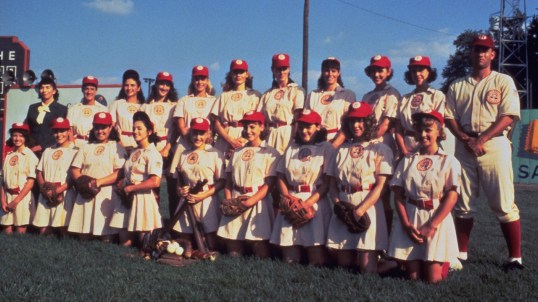
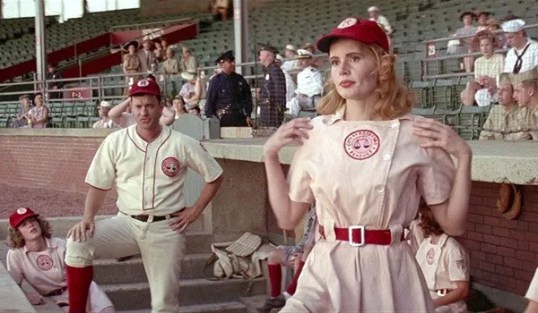
In case you’re one of the two people who haven’t heard of this movie, A League of Their Own takes place during World War II. With professional baseball players either enlisting or getting drafted, people worry there might not be another season of baseball until the war ends. Candy-bar manufacturer Walter Harvey (played by director Penny Marshall’s brother, Garry) creates the All-American Girls Professional Baseball League, with the requirement that the players not only know how to handle a bat but also look good in the impractical short skirts he expects them to wear while sliding into home. The movie follows the first season of the Rockford Peaches. Geena Davis plays Dottie, the catcher whose husband is serving overseas. Lori Petty plays Kit, the pitcher who struggles to hit high fastballs and who is also Dottie’s sister. Rosie O’Donnell and Madonna play two players from New York. Tom Hanks is Jimmy, the alcoholic former player turned manager who says, “There’s no crying in baseball!”
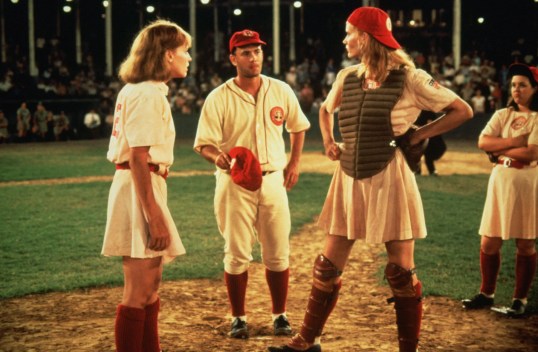
It may be heresy to admit it, but A League of Their Own is not my favorite baseball movie. (That would be Major League.) Most of the actresses, especially Geena Davis, are convincing as baseball players, and I love that the movie shone a light on the real-life AAGPBL. (Sixty former AAGPBL players appear in the movie.) But as a baseball fan, it’s always bothered me that the movie doesn’t really examine any of their games in depth. We know that Dottie is a good catcher, that Kit is a good pitcher, that Madonna can catch a baseball in her hat, and that Evelyn (Bitty Schram) cries when she gets yelled at, but we don’t learn much about the other players on the team and what they’re good at. The Peaches win games, but I would have liked to see more of how they won.

I still love A League of Their Own, though. The bonding between the players gets to me. They’re all from different parts of the country. Some of them are married and some of them are definitely single. But from the minute they’re selected to play in the AAGPBL, they form a family of their own. When one of them reveals that she’s never learned how to read, the players teach her. When Evelyn needs to bring her bratty problem child on the road, the team looks after him. When Jimmy makes Evelyn cry, the team rallies around Evelyn. Everyone remembers Jimmy saying there’s no crying in baseball, but they forget he got kicked out of the game afterward. (Jimmy eventually becomes a better coach.) When one player gets the telegram that her husband has been killed in the war, everyone cries. In the film’s epilogue, Evelyn’s son says that she was never happier than when she was playing for the Peaches, and I can understand why. The heart of the film is the relationship between Dottie and Kit. Even though you can guess from the start that Kit and Dottie are eventually going to end up on different teams and face each other in the big game, it’s still an emotional moment when they find themselves on opposite sides of the plate.

A League of Their Own is on Netflix, so watch it if you haven’t seen it before. Or, if you’re like me, rewatch it and try not to cry all over again when the former players reunite at the Baseball Hall of Fame. Hurry up, though. It’s leaving on September 30th.
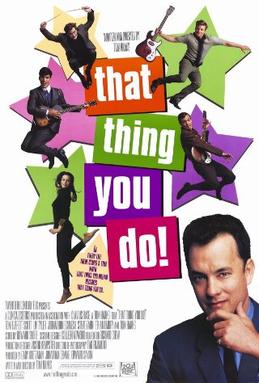


That Thing You Do! (1996, directed by Tom Hanks)


That Thing You Do! is the story of a one-hit wonder.

In 1964, an aspiring Jazz drummer named Guy (Tom Everett Scott) is a last minute addition to the a local band called the Oneders.  (It’s meant to sound like Wonders but almost everyone mispronounces it as O-Needers.)  The band’s egotistical leader, James (Jonathon Schaech) has written a slow ballad called That Thing You Do! but when Guy’s drumming causes the band to perform the song at a faster tempo, they end up with a local hit on their hands.  That local hit becomes a national hit when The Oneders are signed by Play-Tone Records.  First, Mr. White (Tom Hanks), their new manager, officially changes the name to The Wonders.  Secondly, he makes sure that every teen in America is dancing to That Thing You Do!  Third, he tells Guy to always wear sunglasses.  Fourth, he tells James that he will record and perform what Play-Tone tells him to.  Guitarist Lenny (Steven Zahn) and the unnamed Bass Player (Ethan Embry) are happy to be along for the ride but James chafes at his lack of artistic freedom.  Guy, meanwhile, falls for James’s girlfriend (Liv Tyler, at her loveliest) and dreams of meeting his idol, jazzman Del Paxton (Bill Cobbs).

That Thing You Do! was Tom Hanks’s directorial debut and, with its careful recreation of a bygone era and its collection of authentic sounding early 60s rock on the soundtrack, it was obviously a labor of love.  Considering the number of times that the song is played in the movie, it helps that it is a very good song.  That Thing You Do! is a catchy tune, one that you can’t help but tap your feet to.  At the same time, it also sounds like a one hit wonder.  It’s good but not so great as to make you expect much else from The Wonders.

Not surprisingly, Tom Hanks gets great performances from the entire ensemble cast.  Johnathon Schaech and Tom Everett Scott have never been better.  Liv Tyler is lovely and vulnerable as James’s unappreciated girlfriend.  Familiar faces like Peter Scolari, Kevin Pollak, Chris Isaak, and Clint Howard make welcome appearances.  Hanks himself is surprisingly intimidating as Mr. White.  When he says that the band will cover something the Play-Tone catalogue, it’s obvious that he’s not making a request.

The film is a tribute to being young and to loving music bit it’s also a study in the disillusionment of discovering that everything is ultimately a business.  James is frequently an arrogant jerk and he treats his girlfriend terribly but it’s hard not to sympathize with him when he says that he wants to do more than just cover songs from the Play-Tone catalogue.  To James and Guy, the Wonders are about self-expression and their love of music.  To Mr. White, the Wonders are just another band that came up with one catchy tune and who probably aren’t ever going to be heard from again.   That Thing You Do! pays tribute to all of the one-hit wonders out there, the bands who you forget about until you just happen to hear that one song on the radio or in a movie and suddenly, all the memories come flooding back.


A Movie A Day #323: Ted & Venus (1991, directed by Bud Cort)


Strange movie, Ted & Venus.

Actor Bud Cort (you remember him from Harold and Maude) both directs and stars as Ted.  Ted is a homeless poet who lives on the beach and only has one friend, a mellow beach bum named Max (Josh Brolin).  Kim Adams plays Linda, who is the Venus of the title, a social worker who has a bodybuilder jerk for a boyfriend (Brian Thompson, who you might remember as the main villain in Cobra).  When Ted sees Linda, it is love at first sight and at first, the movie seems like it is going to be a quirky romantic comedy where Ted eventually wins Linda over.  When Linda turns down Ted’s advances, Ted does not give up.  Instead, Ted starts following her everywhere and making harassing phone calls.  Ted starts out as a nuisance and goes on to become a full-out stalker.  Everyone, even Max, tells Ted to stop bothering Linda but he is convinced that he can make her fall in love him.  He’s wrong.

Because of the presence of Cort both in front of and behind the camera, Ted & Venus sometimes seems like Harold and Maude: The Later Years.  Harold, the iconoclast that everyone loved, has grown up and become Ted, the unemployable stalker.  It’s an interesting idea and Cort pulls it off as an actor but not as a director.  You have to admire Cort’s devotion to his vision but it’s impossible to be certain what that vision was because the film’s tone is all over the place.  Cort gets a far better performance from himself than he does from the rest of the cast.

Speaking of the cast, the movie is full of familiar faces.  In fact, there are almost too many familiar faces.  It’s hard not to get distracted by all of the cameos.  If you somehow see this obscure movie, keep an eye out for: Woody Harrelson (who gets two lines and five seconds of screen time), Rhea Pearlman, Carol Kane, Martin Mull, Gena Rowlands, Pat McCormick, Vincent Schiavelli, Cassandra Peterson, and Andrea Martin.  When Ted is hauled into court, charged with stalking, the judge is played by LSD guru Timothy Leary.  I am not sure what Ted & Venus was trying to say but Bud Cort assembled an impressive cast to say it.

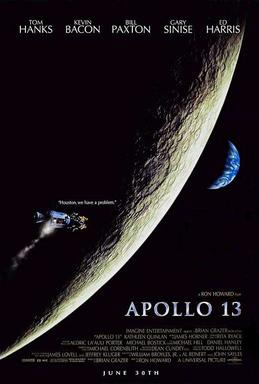
Lisa Reviews An Oscar Nominee: Apollo 13 (dir by Ron Howard)


Apollo_thirteen_movie

I just finished watching the TCM premiere of the 1995 Best Picture nominee, Apollo 13.  Of course, it wasn’t the first time I had seen it.  Apollo 13 is one of those films that always seems to be playing somewhere and why not?  It’s a good movie, telling a story that is all the more remarkable and inspiring for being true.  In 1970, the Apollo 13 flight to the moon was interrupted by a sudden explosion, stranding three astronauts in space.  Fighting a desperate battle against, NASA had to figure out how to bring them home.  Apollo 13 tells the story of that accident and that rescue.

There’s a scene that happens about halfway through Apollo 13.  The heavily damaged Apollo 13 spacecraft is orbiting the moon.  Originally the plan was for Apollo 13 to land on the moon but, following that explosion on the craft, those plans have been cancelled.  Inside the spacecraft, three astronauts can only stare down at the lunar surface below them.

As Commander Jim Lovell stares out the craft’s window, we suddenly see him fantasizing about what it would be like if the explosion hadn’t happened and if he actually could fulfill his dream of walking on the moon.  We watch as Lovell (and, while we know the character is Jim Lovell, we are also very much aware that he’s being played by beloved cinematic icon Tom Hanks) leaves his foot print on the lunar surface.  Lovell opens up his visor and, for a few seconds, stands there and takes in the with the vastness of space before him and making the scene all the more poignant is knowing that Tom Hanks, before he became an award-winning actor, wanted to be a astronaut just like Jim Lovell.  Then, suddenly, we snap back to the film’s reality.  Back inside the spacecraft, Lovell takes one final look at the moon and accepts that he will never get to walk upon its surface.  “I’d like to go home,” he announces.

It’s a totally earnest and unabashedly sentimental moment, one that epitomizes the film as a whole.  There is not a hint of cynicism to be found in Apollo 13.  Instead, it’s a big, old-fashioned epic, a story about a crisis and how a bunch of determined, no-nonsense professionals came together to save the day.  “Houston,” Lovell famously says at one point, “we have a problem.”  It’s a celebrated line but Apollo 13 is less about the problem and more about celebrating the men who, through their own ingenuity, solved that problem.

That Apollo 13 is a crowd-pleaser should come as no surprise.  It was directed by Ron Howard and I don’t know that Howard has ever directed a film that wasn’t designed to make audiences break into applause during the end credits.  When Howard fails, the results can be maudlin and heavy-handed.  But when he succeeds, as he does with Apollo 13, he proves that there’s nothing wrong with old-fashioned, inspirational entertainment.

Of course, since Apollo 13 is a Ron Howard film, that means that Clint Howard gets a small role.  In Apollo 13, Clint shows up as a bespectacled flight engineer.  When astronaut Jack Swiggert (Kevin Bacon) mentions having forgotten to pay his taxes before going into space, Clint says, “He shouldn’t joke about that, they’ll get him.”  It’s a great line and Clint does a great job delivering it.

Apollo 13 is usually thought of as being a Tom Hanks film but actually, it’s an ensemble piece.  Every role, from the smallest to the biggest, is perfectly cast.  Not surprisingly, Bacon, Bill Paxton, Gary Sinise, Kathleen Quinlan, and Ed Harris all turn in excellent performances.  But, even beyond the marquee names, Apollo 13 is full of memorable performances.  Watching it tonight, I especially noticed an actor named Loren Dean, who played a NASA engineer named John Aaron.  Dean didn’t get many lines but he was totally believable in his role.  You looked at him and you thought, “If I’m ever trapped in space, this is the guy who I want working to bring me home.”

Apollo 13 was nominated for best picture but it lost to Mel Gibson’s film Braveheart.  Personally, out of the nominees, I probably would have picked Sense and Sensibility but Apollo 13 more than deserved the nomination.