Film Review: Not Without My Daughter (dir by Brian Gilbert)


In 1991’s Not Without My Daughter, Sally Field plays Betty Mahmoody, a Michigan housewife who marriage to Dr. Sayyed “Moody” Mahmoody (Alfred Molina) is perfect until he convinces her to travel with him to his native Iran.  Moody says that the trip will only be for two weeks and that it will give his family a chance to finally meet their five year-old daughter, Mahtob (Sheila Rosenthal).  Once they arrives in Iran, Betty meets Moody’s family and is immediately made to feel unwelcome.  The men glare at her and the women seem to be annoyed that she’s bringing unwanted attention to them.  Betty struggles to fit in, covering her head and trying not to complain.  But then Moody announces that he’s decided that he will not be returning to America and that Betty and Mahtob will be staying in Iran with him.

I’m not really a huge fan of saying that a show or a movie “could not be made today,” because I often feel that’s just code for saying that you’ve reached the age where people younger than you no longer care about your taste in music or have the patience to explain the latest slang to you.  There’s no real shame in reaching that point.  It happens to everyone eventually.  (Even I find myself getting unreasonably worked up over people using “ate” as a way to praise something.)  There’s a lot of movies that would not be made today because cultural changes.  Sometimes that’s a good thing and sometimes that’s a bad thing but it’s mostly just an inescapable fact of life.  The thing to remember is that there is a difference between would and could.

Could Not Without My Daughter be made today?  Of course, it could.  It just wouldn’t be made by a major studio and it probably wouldn’t star an acclaimed actress like Sally Field.  Today, Not Without My Daughter would probably be made by a small studio somewhere in Utah and it would probably star Taryn Manning.  The major studios would be too worried about being accused of being Islamophobic to make a movie in which a seemingly charming man turns into a monster as soon as he returns home to the Middle East.  One imagines that they would probably move the action to a Mennonite community.

And it must be said that Not Without My Daughter does not feature many sympathetic Iranians.  There are a few who help Sally Field escape but they are presented as being the exception to the rule.  Even more importantly, they’re portrayed as not being particularly religious.  While Moody does start to change as soon as he and his wife land in Tehran, the film suggests that Moody’s main problem is that he’s desperate to please his male relatives.  He seems to be desperate to show that he has not allowed himself to become westernized.  For him, that means turning his wife into a virtual prisoner and declaring that she will not be allowed to see their daughter unless she submits to his demands and accepts his abuse.

Here’s the thing, though.  Iran has one of the worst human rights records out there.  Women’s rights are severely restricted in Iran.  Women are legally required to cover their hair and wear modest clothing.  Legally, husband do hold the power in the household.  They can forbid their wives from leaving the country and, as shown in this movie, they are given sole custody of their children.  The Morality Police are a real thing and women have been killed for not covering their hair.  There’s a reason why so many brave Iranian women have risked their lives to protest the Iranian government.  Being opposed to the War with Iran is not a justification for turning a blind eye to Iran’s human rights record.  Yes, one can quite rightly complain that there aren’t many sympathetic Iranians to be found in Not Without My Daughter but let’s not pretend that there isn’t some truth to the scenes where Betty is warned that she has not properly covered her head.

In the end, Not Without My Daughter is a heavy-handed but crudely effective film.  Sally Field is instantly sympathetic as Betty.  Alfred Molina is frightening as Moody.  There’s not a subtle moment to be found but I still cheered when Betty made her escape.
Street Fighter (1994, directed by Stephen E. de Souza)


What does the M. stand for in M. Bison?

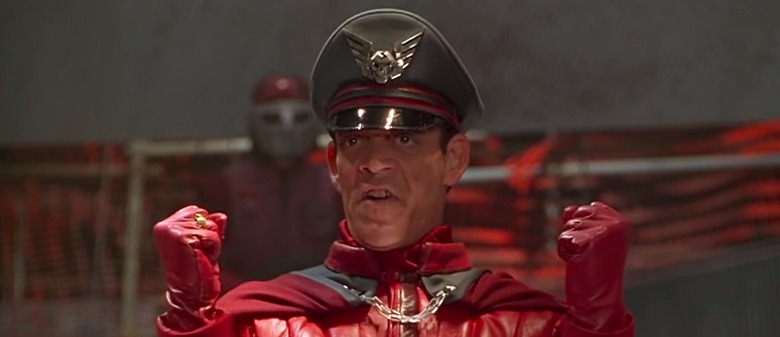
Originally, it was supposed to stand for Mike but my theory is that it stands for Marvelous because how else can you describe Raul Julia’s performance as the villain of Street Fighter?  Julia was dying of stomach cancer when he played Bison, a condition reflected by his gaunt appearance.  But Julia still obviously threw himself into every scene, delivering every melodramatic line as if it was the most important piece of dialogue that he had ever been trusted with delivering.  As a film, Street Fighter is an overedited mess that features one of Jean-Claude Van Damme’s worst performances.  Raul Julia saves it, though.  He gets some of the worst lines and transforms them into the best lines through sheer determination.  That man could have read the phone book and made it interesting.

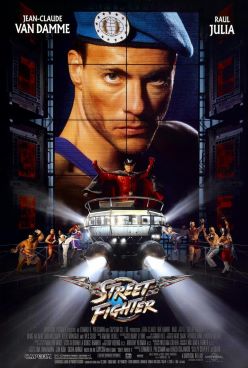
Jean-Claude Van Damme is Col. Guile in this early video game adaptation.  This isn’t one of Van Damme’s better performances.  He doesn’t really play the Guile from the game.  Instead, he’s just Van Damme with a blue beret and an American flag on his bicep.  Far better are Damian Chapa as Ken and Bryon Mann as Ryu, even though neither gets to do as much as a fan of the game would want them to.  Ming-Na Wen is a promising Chun Li but, instead of focusing on her fighting skill, the movie gets bogged down in trying to set her up for a sequel that would never come.  Are you a fan of Cammy?  Don’t get excited because all Kylie Minogue does is ask Guile if he’s okay.  I did like Wes Studi as Sagat and Gregg Rainwater and Peter Tuiasosopo as T. Hawk and Honda but it still feels like only Raul Julia gives a performance that can compete with the video game version of his character.

There were four editors credited for Street Fighter and maybe that explains why the fights are a mess and the plot is impossible to follow.  It’s a video game adaptation and I don’t demand much but I would like to know who is winning each fight.  The film’s visual scheme, meant to duplicate the look of the game, showed some promise but the editing gave the movie a frantic feel that made it difficult to really appreciate the production design.

There’s never really been a good Street Fighter film but I still think it could happen with the right cast and crew.  If Mortal Kombat could (eventually) be turned into a decent movie, why not Street Fighter?  I still don’t think anyone will ever top Raul Julia as M. Bison, though.  Raul Julia made you believe in Pax Bisonica!

“And peace will reign and all humanity will bow to me in humble gratitude.” — M. Bison

Film Review: Dumbo (dir by Tim Burton)


Tim Burton’s remake of Dumbo actually wasn’t that bad.

I know!  I’m as shocked as anyone.  Usually, I’m against remakes on general principle and I’m certainly not a fan of the current trend of doing live-action versions of classic animated films.  (There’s a reason why I haven’t seen the new The Lion King.)  Dumbo is one of my favorites of the old Disney films, one that’s always brought tears to my mismatched eyes so I was naturally predisposed to be critical of the remake.  Add to that, I’m not particularly a huge fan of Tim Burton, a director who too often seems to be coasting on his reputation for being a visionary as opposed to actually being one.

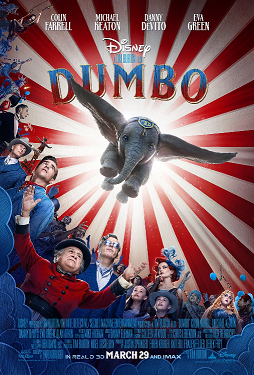
And yet, I have to admit that I enjoyed this new version of Dumbo.  To call it a remake is actually a mistake.  It’s a reimagining, as I suppose any live action remake of an animated film about a flying elephant, a talking mouse, and a group of sarcastic crows would have to be.  So, the crows are gone, which is understandable as I doubt you could get away with a bird named “Jim Crow” today.  And sadly, Timothy the Mouse is gone.  He’s been replaced by several human characters, including Colin Farrell as a one-armed, former equestrian, Eva Green as a French trapeze artist, and Danny DeVito as the rough-around-the-edges but good-hearted ringmaster.  However, Dumbo’s still present and he’s still got the big ears.  He can still fly, as long as he’s holding a feather.

Dumbo’s only a CGI elephant but he’s still adorable.  Of course, I should be honest that I’ve always loved elephants.  I even rode one at Scarborough Fair once!  It was like a totally bumpy and somewhat uncomfortable ride but, at the same time, it was also totally cool because I was on top of an elephant!  The other thing I love about elephants is that elephants form real families.  They love each other.  They look out for each other.  They mourn their dead, which is one of many reasons why ivory poachers are some of the worst people in the world.  Elephants may not fly but there’s a sweetness to them that makes the story of Dumbo and his mother extra poignant, regardless of whether it’s animated, CGI, or live-action.  Anyway, the remake’s version of Dumbo is absolutely lovable, from the minute he reveals his ears to the triumphant moment when he soars through the circus tent.

As a director, Tim Burton has always struggled with pacing.  Watching his films, you always dread the inevitable moment when he gets distracted by a red herring or a superfluous storyline because you know that, once it happens, the entire film is going to go off the rails.  Dumbo starts out slowly and it seems like forever before the baby elephant actually shows up.  Fortunately, once Dumbo does show up, Burton’s direction becomes much more focused.  The story stops meandering and, for once, Burton actually manages to maintain some sense of narrative momentum.

Visually, the film’s a feast for the eyes.  Even though it’s a live-action film, the sets and the costumes are all flamboyantly and colorfully over-the-top, giving the film the feeling of being a child’s imagination come to life.  I mean, when you’re making a film about a flying elephant, there’s no point in trying to go for gritty realism.  While the film does mention some real-world tragedies — Farrell lost his arm in World War I and his wife to Spanish Flu — Burton plays up the fantasy elements of the story.  He’s helped by Danny DeVito and Michael Keaton who both give cartoonishly broad performances.  Fortunately, they’re both good enough actors that they can get away with it.

So, the live-action reimagining of Dumbo is not that bad.  It has its slow spots and it really can’t match the emotional power of the original animated version.  But, with all that taken into consideration, it’s still an undeniably entertaining two hours.

Lisa Reviews An Oscar Winner: Gandhi (dir by Richard Attenborough)


Gandhi-poster

I just finished watching the 1982 best picture winner Gandhi on TCM.  This is going to be a tough movie to review.

Why?

Well, first off, there’s the subject matter.  Gandhi is an epic biopic of Mohandas Gandhi (played, very well, by Ben Kingsley).  It starts with Gandhi as a 23 year-old attorney in South Africa who, after getting tossed out of a first class train compartment because of the color of his skin, leads a non-violent protest for the rights of all Indians in South Africa.  He gets arrested several times and, at one point, is threatened by Daniel Day-Lewis, making his screen debut as a young racist.  However, eventually, Gandhi’s protest draws international attention and pressure.  South Africa finally changes the law to give Indians a few rights.

Gandhi then returns to his native India, where he leads a similar campaign of non-violence in support of the fight for India’s independence from the British Empire.  For every violent act on the part of the British, Gandhi responds with humility and nonviolence.  After World War II, India gains its independence and Gandhi becomes the leader of the nation.  When India threatens to collapse as a result of violence between Hindus and Muslims, Gandhi fasts and announces that he will allow himself to starve to death unless the violence ends.  Gandhi brings peace to his country and is admired the world over.  And then, like almost all great leaders, he’s assassinated.

Gandhi tells the story of a great leader but that doesn’t necessarily make it a great movie.  In order to really examine Gandhi as a film, you have to be willing to accept that criticizing the movie is not the same as criticizing what (or who) the movie is about.

As I watched Gandhi, my main impression was that it was an extremely long movie.  Reportedly, Gandhi was a passion project for director Richard Attenborough.  An admirer of Gandhi’s and a lifelong equality activist, Attenborough spent over 20 years trying to raise the money to bring Gandhi’s life to the big screen.  Once he finally did, it appears that Attenbrough didn’t want to leave out a single detail.  Gandhi runs three and a half hours and, because certain scenes drag, it feels ever longer.

My other thought, as I watched Gandhi, was that it had to be one of the least cinematic films that I’ve ever seen.  Bless Attenborough for the nobility of his intentions but there’s not a single interesting visual to be found in the entire film.  I imagine that, even in 1982, Gandhi felt like a very old-fashioned movie.  In the end, it feels more like something you would see on PBS than in a theater.

The film is full of familiar faces, which works in some cases and doesn’t in others.  For instance, Gandhi’s British opponents are played by a virtual army of familiar character actors.  Every few minutes, someone like John Gielgud, Edward Fox, Trevor Howard, John Mills, or Nigel Hawthorne will pop up and wonder why Gandhi always has to be so troublesome.  The British character actors all do a pretty good job and contribute to the film without allowing their familiar faces to become a distraction.

But then, a few American actors show up.  Martin Sheen plays a reporter who interview Gandhi.  Candice Bergen shows up as a famous photographer.  And, unlike their British equivalents, neither Sheen nor Bergen really seem to fit into the film.  Both of them end up overacting.  (Sheen, in particular, delivers every line as if he’s scared that we’re going to forget that we’re watching a movie about an important figure in history.)  They both become distractions.

I guess the best thing that you can say about Gandhi, as a film, is that it features Ben Kingsley in the leading role.  He gives a wonderfully subtle performance as Gandhi, making him human even when the film insists on portraying him as a saint.  He won an Oscar for his performance in Gandhi and he deserved one.

As for Gandhi‘s award for best picture … well, let’s consider the films that it beat: E.T., Tootsie, The Verdict, and Missing.  And then, consider some of the films from 1982 that weren’t even nominated: Blade Runner, Burden of Dreams, Class of 1984, Fast Times At Ridgemont High, My Favorite Year, Poltergeist, Tenebrae, Vice Squad, Fanny and Alexander…

When you look at the competition, it’s clear that the Academy’s main motive in honoring Gandhi the film was to honor Gandhi the man.  In the end, Gandhi is a good example of a film that, good intentions aside, did not deserve its Oscar.