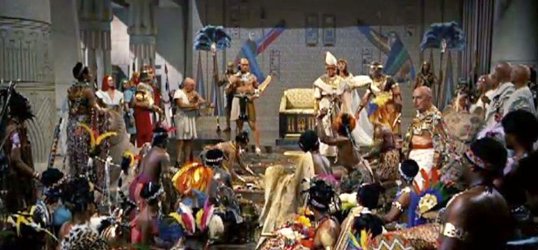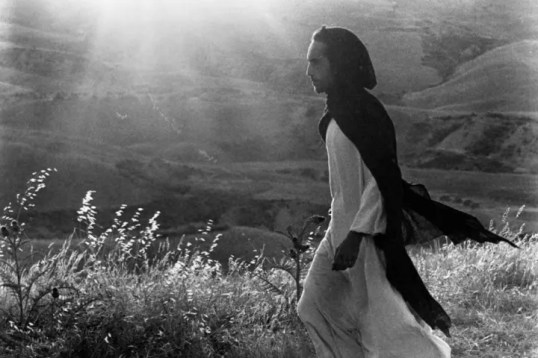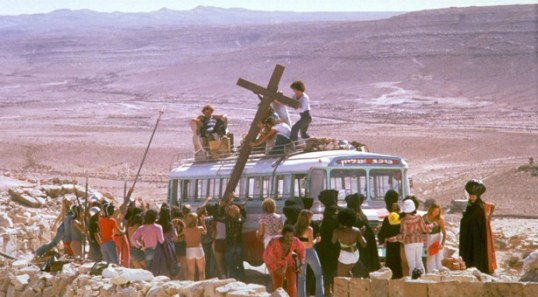
4 Shots from 4 Films is just what it says it is, 4 shots from 4 of our favorite films. As opposed to the reviews and recaps that we usually post, 4 Shots from 4 Films lets the visuals do the talking!
4 Shots From 4 Biblical Epics
4 Shots from 4 Films is just what it says it is, 4 shots from 4 of our favorite films. As opposed to the reviews and recaps that we usually post, 4 Shots from 4 Films lets the visuals do the talking!
4 Shots From 4 Biblical Epics
What’s an Insomnia File? You know how some times you just can’t get any sleep and, at about three in the morning, you’ll find yourself watching whatever you can find on cable or streaming? This feature is all about those insomnia-inspired discoveries!
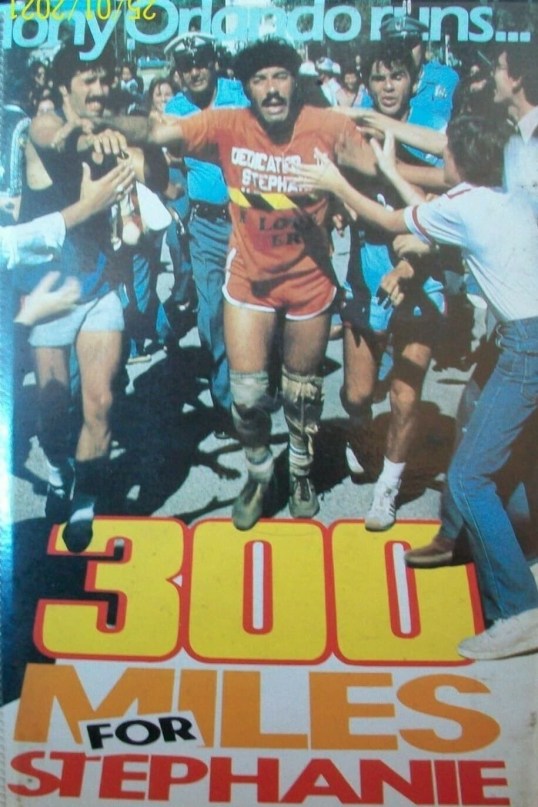
If you were having trouble getting to sleep last night, you could have watched 1981’s 300 Miles For Stephanie.
Tony Orlando — yes, the singer — plays Alberto Rodriguez. When the movie begins, Alberto is a rambunctious military veteran who is notorious for drinking too much and getting into fights. After his latest arrest, he is ordered to turn his life around. With the help of his cousin (Edward James Olmos), he gets a job as a cop in San Antonio. Eventually, he gets married and he becomes a father to Stephanie.
When Stephanie is born, Alberto is told that his daughter probably won’t make it to her fifth birthday. The struggle of raising a handicapped daughter becomes too much for Alberto’s wife and soon, Alberto is a single father. When Stephanie makes it to her fifth birthday, Alberto rides a bicycle 300 miles to a chapel so he can give thanks to God. Later, after his story is picked up the San Antonio media, Alberto resolves to run to the chapel, covering 300 miles on foot in just five days.
300 Miles For Stephanie is clearly a made-for-TV movie from the early 80s. It’s the type of movie where every dramatic beat leads to the inevitable fade-out for commercials. The budget is low and there’s not a single subtle moment to be found in the film but the story itself is so touching that it doesn’t matter. Maybe it’s because it’s Holy Week. Maybe it’s because I’ve recently had to say goodbye to people that I loved. Maybe I’m just as sucker for these type of stories. It doesn’t matter. I cried.
As an actor, Tony Orlando was a little stiff but he still brought a likable earnestness to the role and he got good support from Edward James Olmos, Pepe Serna, Gregory Sierra, and Peter Graves. Graves’s role is small but, as Alberto’s captain, he’s exactly the type of fair-minded authority figure who we could use more of nowadays.
It’s a touching film. In real life, Stephanie, who no one expected to see her second birthday, lived to be 26 years old.
Previous Insomnia Files:
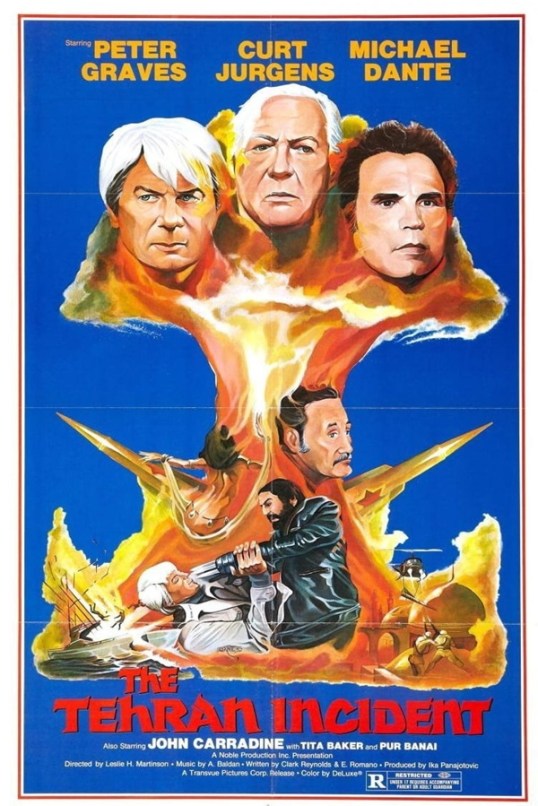
1979’s The Teheran Incident opens with a daring theft. A cruise missile with a nuclear warhead is stolen from a Russian military demonstration and somehow transported to pre-Islamic Revolution Iran. (I say somehow because I’m not really sure how one moves a cruise missile from one country to another without anyone noticing.) The plot was masterminded by the Baron (Curd Jurgens), an international criminal who lives on a yacht. With the help of Professor Nikolaeff (John Carradine, making no effort to sound Russian), the Baron plans to use the missile to blow up a conference that’s being held in Iran.
When an American diplomat is murdered after discovering the Baron’s plan, American spy Alec Franklin (Peter Graves) is sent to Teheran to investigate. Alec teams up with KGB agent Konstantine Senyonov (Michael Dante, who makes even less effort than John Carradine to sound or even come remotely across as being Russian). Together, they investigate the Baron’s operations, which means spending a lot of time wandering around Tehran while a “wacka wacka” beat plays in the background. They also spend a lot of time in a casino because all international criminals own a casino. The Baron, I might add, is such a diabolical villain that he actually hides a cruise missile underneath his casino.
The Teheran Incident is an example of what I like to call “James Bond On A Budget.” In the 60s, 70s, and 80s, the Bond films were a big deal and they inspired a slew of imitators. Most of these imitation Bond films were made by people who really couldn’t afford to spend the millions of dollars that went into the Bond films. What’s important though is that they still tried. It’s hard not to appreciate the effort that goes into trying to recreate a luxurious casino without going bankrupt. The film has the ambitions of Las Vegas and the look of Reno and it’s hard not to look at it and say, “Well, at least they tried. They didn’t give up, even if maybe they should have.” Also, as was the case with many of the budget Bonds, the producers were able to get at least Bond veteran to appear in the film. In The Spy Who Loved Me, Curd Jurgens stole a nuclear missile and got shot in the crotch for his trouble. In The Teheran Incident, Curd Jurgens steals a nuclear missile and gets to hang out on a yacht with his mistress and collection of pinch-faced henchmen. Along with both films featuring Jurgens as their main villain, both films also feature a villainous plot that doesn’t really make much sense. But only The Teheran Incident has John Carradine!
As for our heroes, Peter Graves does his job with his usual stoic professionalism while Michael Dante comes across like he’s never even picked up War and Peace, much lest read it. The true star of the film is the disco soundtrack, which is entertainingly out-of-place and impossible to get out of our head.. This is a bad film that you can dance to!
Apparently, the pre-Mullah Iranian government enthusiastically helped with the production of The Teheran Incident, hoping for a popular film that would bring tourists to Iran. Unfortunately, before the film was released, the Iranian government fell to the Islamic Revolution. (I guess it’s a good thing we took care of that cruise missile.) Needless to say, when it was finally released, The Teheran Incident did not do much to help Iranian tourism.
Previous Icarus Files:
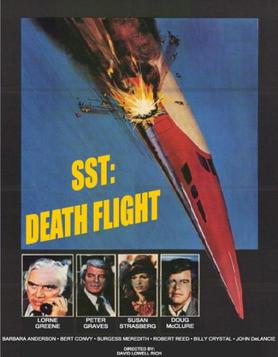
In 1977’s SST: Death Flight, we follow a supersonic jet as it makes it’s maiden flight, going from New York to Paris in just three hours. Not surprisingly, there’s an “all-star” cast waiting for the plane to take off.
Regis Philbin appears as the reporter who breathlessly covers the excitement at the airport. Lorne Greene plays the owner of the jet who is staying behind in New York. Burgess Meredith is the plane’s designer. Robert Reed is the hard-driving pilot. Peter Graves is a businessman who is surprised to see that his former secretary (Season Hubley) has boarded the plane with her stick-in-the-mud fiancé (John De Lancie). Doug McClure is a disgraced pilot who will also be on the flight. Billy Crystal is a bowtie-wearing flight attendant. Bert Convy is the PR man who is traveling with his pregnant mistress (Misty Rowe). Martin Milner, Tina Louise, Susan Strasberg, they’re all on the flight! Finally, there’s a epidemiologist (Brock Peters) who is transporting a box that contains a sample of the Senegal Flu. Now, you might question why anyone would transfer a sample of a highly infectious disease that has a 30% fatality rate on a commercial flight and that’s a good question.
Unfortunately, a disgruntled executive (George Maharis) tries to sabotage the plane, which leads to an explosive decompression that causes the Flu box to burst open. Uh-oh, people are getting sick! And now, Paris refuses to let the plane land in their city because they don’t have time to set up a quarantine. London, however, is willing to let the plane land at one of their airports. However, London hasn’t finalized their quarantine plans so there’s a chance that landing there could lead to British people getting sick.
Brock Peters suggests that they land in Senegal, which already has a quarantine going on. When it is reasonably pointed out that the plane might not have enough fuel to make it to Senegal and that everyone, including those who are not sick, might die in the resulting crash, Martin Milner gives a speech about morality and demands that all of the passengers agree to further risk their lives by going to Senegal. John de Lancie argues for London.
And you know what?
Watching the film, I agreed with John de Lancie. De Lancie points out, quite correctly, the no one on the airplane knew that they were going to be traveling with a deadly disease, that London is preparing a quarantine even while the plane is in flight, and that it’s unfair to demand that everyone on the plane agree to possibly die in a horrific crash. We’re supposed to really hate de Lancie’s character but he makes sense!
The passengers and crew vote 3 to 1 to go to Senegal.
And, of course, the plane crashes.
“Did we do the right thing?” Susan Strasberg asks.
Well, the plane crashed. I think that kind of answers your question.
Some survive and some don’t. The epidemiologist survives without a scratch on him and somehow, no one in the film ever gets mad at him. Seriously, though, what was he thinking bringing his deadly disease samples on a commercial fight!?
Why is this a guilty pleasure? Well, first off, it’s a terrible movie but the cast is full of so many familiar faces that it’s hard to look away. Just the casting of Peter Graves in a “serious” disaster film about an airplane makes this a guilty pleasure. Secondly, the film is the epitome of both the 70s and the disaster genre. The supersonic jet can break the sound barrier but it still looks incredibly tacky. I’m surprised it didn’t have shag carpeting.
Finally, there’s a moment where Bert Convy tells his pregnant girlfriend, “Don’t worry.”
She replies, “That’s what you said last time and look what happened!”
Convy looks straight a the camera and shrugs.
Best guilty pleasure ever!
Previous Guilty Pleasures
President Jeremy Harris (Tod Andrews) has a lot on his plate. With America and China inching closer and closer to war, Secretary of State Freeman Sharkey (Raymond Massey) is advocating for diplomacy while National Security Advisor George Oldenburg (Rip Torn) feels that America must be more aggressive and ready to launch the first nuclear missile. Of course, no one pays much attention to Vice President Kermit Madigan (Buddy Ebsen). Kermit is viewed with such contempt that he’s never even been given a briefing on what’s going on with China. However, when Air Force One crashes in the California desert and the President cannot be definitively identified as one of the bodies found in the wreckage, Vice President Madigan finds himself with a very difficult decision to make.
That’s quite a crisis. Personally, though, I’m more interested in how the United States ended up with Secretary of State named Freeman Sharkey. I mean, that’s just an amazing name for a diplomat. Why didn’t they elect that guy President? No one messes with Sharkey!
The majority of 1973’s The President’s Plane Is Missing follows a reporter named Mark Jones (Peter Graves) as he tries to get to the bottom of what has happened to President Harris. As usual, Graves is likably stoic. Mark Jones doesn’t show much emotion but, at the very least, he does seem to be trying to do a good job as an old school journalist. What’s interesting is that Mark has an editor (played by Arthur Kennedy) who is constantly yelling at him and threatening to fire him. There’s something very odd about seeing Peter Graves taking order from someone who isn’t intimidated by him.
Mark Jones does learn the truth about why the President has gone missing and he also learns why he, as the reporter assigned to follow the President, wasn’t allowed to board Air Force One when it initially took off. Unfortunately, the solution is a bit anti-climatic. In fact, it’s so anti-climatic that it’s actually kind of annoying. All of the drama ultimately feels rather unnecessary and pointless.
By today’s standards, The President’s Plane Is Missing is a bit on the dull side. There are so many obvious plot holes that I get the feeling that it was probably a bit boring when it originally aired in 1973 as well. The most interesting thing about the film is that it was directed by Daryl Duke, who also directed Payday, a harrowing film about a self-destructive country-western singer. Rip Torn, the star of Payday, appears here as a calm and collected intellectual who advocates for nuclear war without a hint of ambivalence. Torn is a bit miscast as a man without emotions but it’s still always nice to see him in a film.
Who gives the best performance in The President’s Plane Is Missing? Believe it or not, Buddy Ebsen. Ebsen is totally believable as the vice president who, after years of being ignored, is suddenly thrust into a position of power. I’d vote for Kermit Madigan but only if he wasn’t running against Freeman Sharkey.
2020’s Hard Luck Love Story tells the tale of a man named Jesse (Michael Dorman).
Jesse is a drifter, heading from town to town and staying in cheap motels. He plays the guitar and sings to himself. He goes to pool halls and hustles people out of their money, earing him the enmity of a heavily tattooed redneck named Rollo (Dermot Mulroney). He drinks when he’s alone. He drinks when he’s with other people. On the one hand, he’s a pool hustler who makes his living by cheating other people. On the other hand, he’s the type who will hug strangers and give them all of his money. Jesse’s not really a bad guy but he’s someone who, as fate would have it, seems to live in a world that’s dominated by frequently bad people. When Jesse has enough money to afford some beer and some cocaine, he calls his ex-girlfriend, Carly (Sophia Bush), to his hotel. Over the course of a night, we get to know them. Neither one is quite who we originally assumed. Jesse makes a lot of mistakes and he has a talent for angering even the people who try to help him but it’s impossible not to like him. Some of that is due to Michael Dorman’s charismatic performance. Even more of it is because everyone has known someone like Jesse, the well-meaning guy who just has a talent for screwing up.
Hard Luck Love Story is a piece of Americana, one that captures the atmosphere of small towns struggling to survive, dive bars full of broken dreams, and rain-slicked nights when it seems like just about anything can happen. It captures life on the fringes with empathy and a sense of humor. Jesse and Carly may be the heart of the story but the film is full of interesting characters, the types who you could only find in the small cities of Middle America. I particularly liked Zach (Brian Sacca), the bearded cop who goes from being intimidating to being likable in his own dorky way.
Eric Roberts has a small role in this film. He plays Skip, an associate of Carly’s. Roberts doesn’t have a lot of screentime but he makes the most of it. There’s a tendency to be dismissive of the roles that Roberts does nowadays. In his autobiography, Roberts is himself fairly dismissive of a lot of them. But, in Hard Luck Love Song, he gets a chance to create an actual character and he definitely makes an impression. He’s not just Eric Roberts doing a cameo. Instead, he’s very much a part of the film’s world.
Hard Luck Love Song is an engrossing trip through the parts of America that tend to get overlooked by other films. The film is based on an alt-country song and it hits all the right notes.
Previous Eric Roberts Films That We Have Reviewed:
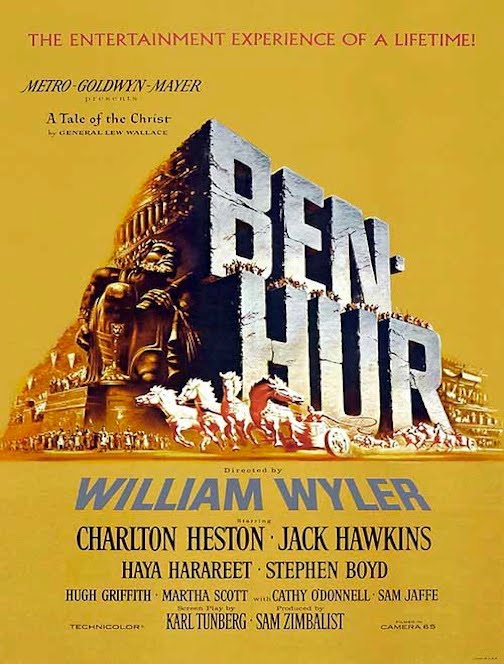
Today’s scene that I love comes from 1959’s Ben-Hur. The chariot race was one of the great action sequences of its era and its influence is still felt to this day. Rumor has it that Mario Bava was among the crew that helped to shoot the chariot race. Personally, I choose to believe that even if I can’t prove it!
In December of 2021, I was nearly attacked in a Target.
This was nearly two years into the COVID pandemic and the world was slowly reopening. (Since I live in Texas, my world reopened earlier than everyone else’s. Despite the predictions of folks up north, who were almost gleeful in their predictions that Texas would be wiped out by people coughing on each other at football games, we survived.) In 2020, my sisters and I couldn’t really celebrate Christmas the way we usually did because everything was closed. In 2021, we were l0oking forward to making up for lost time.
What I was not looking forward to was wearing a mask. Due to an ambitious politician named Clay Jenkins who was hoping to ride the COVID pandemic into the governor’s mansion, Dallas County still had a mask mandate. The mandate was unenforceable due to Governor Abbott’s executive order but still, a lot of people in Dallas were masking up. Sitting in the parking lot of Target, I told my three older sisters that I was not going to wear a mask inside the store. I have asthma. Having to wear a mask was more than just an inconvenience for me. Wearing a mask made it difficult for me to breathe and, given that more and more health authorities were starting to admit that masks didn’t make any difference as far as the spread of the disease was concerned, I didn’t see why I should have to unnecessarily suffer. My sisters said that they understood and that they would have my back if anyone said anything to me about my maskless state. “But no one will,” my sister Megan assured me.
As soon as I stepped into the store, I heard it.
“GET A MASK ON HER!”
It wasn’t a store manager or a cop or any other sort of authority figure yelling. It was an overweight, middle-aged woman riding around the store on her little scooter. Apparently, she spotted me as soon as I entered the store and immediately started driving herself in my direction, yelling the entire time. I couldn’t really understand the majority of what she yelled but I did manage to make out words like “Mask,” “kill all of us,” “selfish,” and a few others that I can’t repeat during Lent.
Again, because of Lent, I can’t tell you what my older sister Melissa said in response to her. My sisters, all three of whom had been masked up, removed their masks in solidarity. I wish I could say that the entire store applauded but most people were just trying to avoid looking at the fat banshee on her scooter.
Even after my sisters removed their masks, the woman continued to focus her anger on me, still yelling as I walked past her. (I attempted to smile politely at her, which did not help the situation.) Eventually, her voice faded away. She either left the store or found someone else to yell at.
I tell this story to illustrate one point. The COVID pandemic was a very strange time. One can both acknowledge the very real tragedy of COVID while also acknowledging that quite a few people fell down the doom rabbit hole and allowed themselves to be driven mad by the constant drumbeat of government officials, members of the media, and other commentators telling us that everyone was going to die unless we wore masks and maintained a distance of 6 feet from each other. Due to the COVID pandemic, businesses were forced to shut down. People lost their jobs. Families were not allowed to comfort each other. In many states, students were not allowed to go to school. To doubt any element of the government’s response to COVID meant running the risk of being listed as a “conspiracy theorist.” Blue states started to gleefully keep track of how many died in red states. Red states started to keep track of how many civil liberties were suspended by the blue states. (We all should have been keeping track of their number of politicians who violated their own mandates and simply shrugged off the outrage.) We were constantly told that we were in a war against the virus but if felt more as if the country was actually at war with itself and a lot of people seemed to be happy with that.
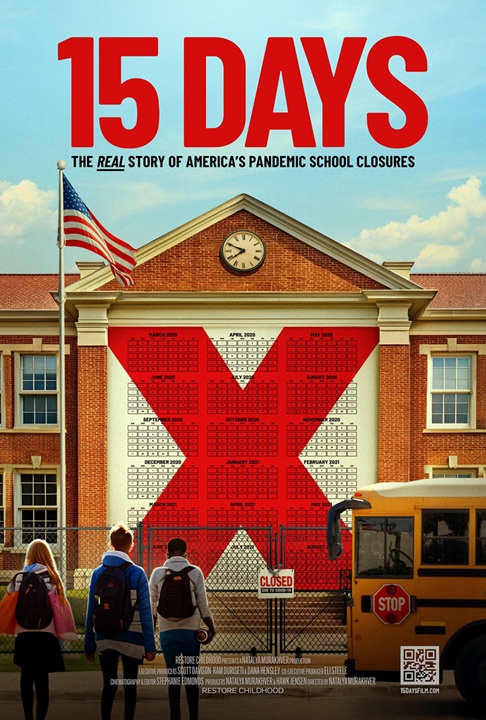
The documentary 15 Days opens with clips from a zoom meeting, in which Jane Fonda, Randi Weingarten, and a host of others discuss the pandemic as an opportunity to bring about social change. The documentary goes on to document how the school shutdowns went from being “15 days to slow the spread,” to nearly two years of remote learning. Parents discuss going from trusting the government and wanting to do the right thing to the growing disillusionment of realizing that “15 Days to Slow The Spread” was, from the start, an empty slogan. Epidemiologists who opposed the school closings discuss being censored and dismissed as “fringe extremists.” Student athletes talk about losing out on college scholarships. We learn about the struggles of doing remote learning. We learn how some students merely disappeared from the system.
As you probably already guessed, 15 Days has a political agenda and, as such, it won’t be for everyone. Certain parts of it were certainly not for me. (Personally, I think the film lets the Trump administration off too easily when it comes to the federal government’s COVID response.) But that doesn’t change the fact that 15 Days shows just how much damage was done to an entire generation by the senseless and largely partisan-driven decision to shut down the schools in so many states. In between clips of people claiming that “kids are resilient,” we get interviews with actual kids who lost two years of not just education but also social development to the shutdowns. The contrast between what we were told was happening with remote learning and what actually happened is stark. The director, a disillusioned and self-described “progressive Democrat” named Natalya Murakhver compares America during the pandemic to the totalitarian government that her family fled when she was a child and it’s hard not to feel that she has a point.
You may or may not agree with the film’s politics but, with each passing day, it becomes more and more obvious how screwed up the federal government’s response to the COVID pandemic truly was. Documentaries like this are important because right now, the gaslighting we’re seeing about what really happened in 2020 and 2021 is incredible. Neighbors turned against neighbor (or shopper, as they case may be). And an entire generation lost two of the most important developmental years of their lives.

When Charlotte (Jessica Morris) meets a younger man named Chris (Philip McElroy), she is both flattered and amused when he asks her out. “You’re a little young for me,” Charlotte says. However, Charlotte’s friend, Maddie (Akari Endo), insists that Charlotte really does need to get out more so Charlotte meets up with Chris for drinks. One things leads to another and soon, Charlotte is having sex with Chris in her classroom!
(Charlotte is an English teacher, along with being a struggling romance novelist.)
The next day, as Charlotte teachers her class, she is shocked when Chris shows up. “What are you doing here?” Charlotte asks. Chris reveals that he’s a new student and Charlotte is now his English teacher!
2018’s The Wrong Teacher is one of the many “Wrong” films that David DeCoteau directed for Lifetime. This one follows the usual pattern. Chris isn’t ready to let go of his one night of passion with the teacher. When he discovers that Charlotte is getting back together with her ex-boyfriend (Jason-Shane Scott), he snaps. Soon, people are getting shot and hit with baseball bats and videos of Chris and Charlotte going at it in the classroom are showing up on the school’s twitter page. Vivica A. Fox is alarmed that Charlotte could be so foolish. Charlotte declares, “You messed with the wrong teacher!” Thanks to some last minute strangeness that sees Charlotte adopting a Southern accent, The Wrong Teacher is enjoyably over the top.
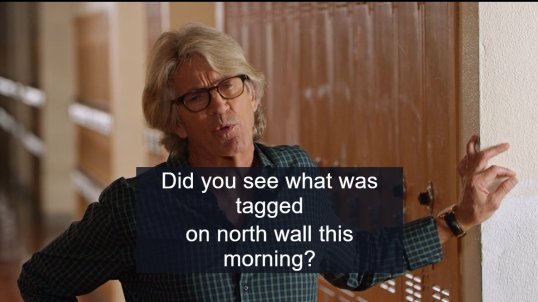
As for Eric Roberts, he plays the assistant principal. He’s a bit burned-out. He’s easily annoyed. He doesn’t want any scandalous behavior in his school. He’s Eric Roberts and he makes the most of his three scenes. Eric even stands up and walks in this movie. He only does that when he’s particularly invested in a role. The Wrong Teacher? More like The Right Vice Principal.
Previous Eric Roberts Films That We Have Reviewed:
Today is Christopher Walken’s 83rd birthday so it seems appropriate to share a Walken scene that I love. Without further ado, here is the classic gold watch speech from the 1994 film, Pulp Fiction: