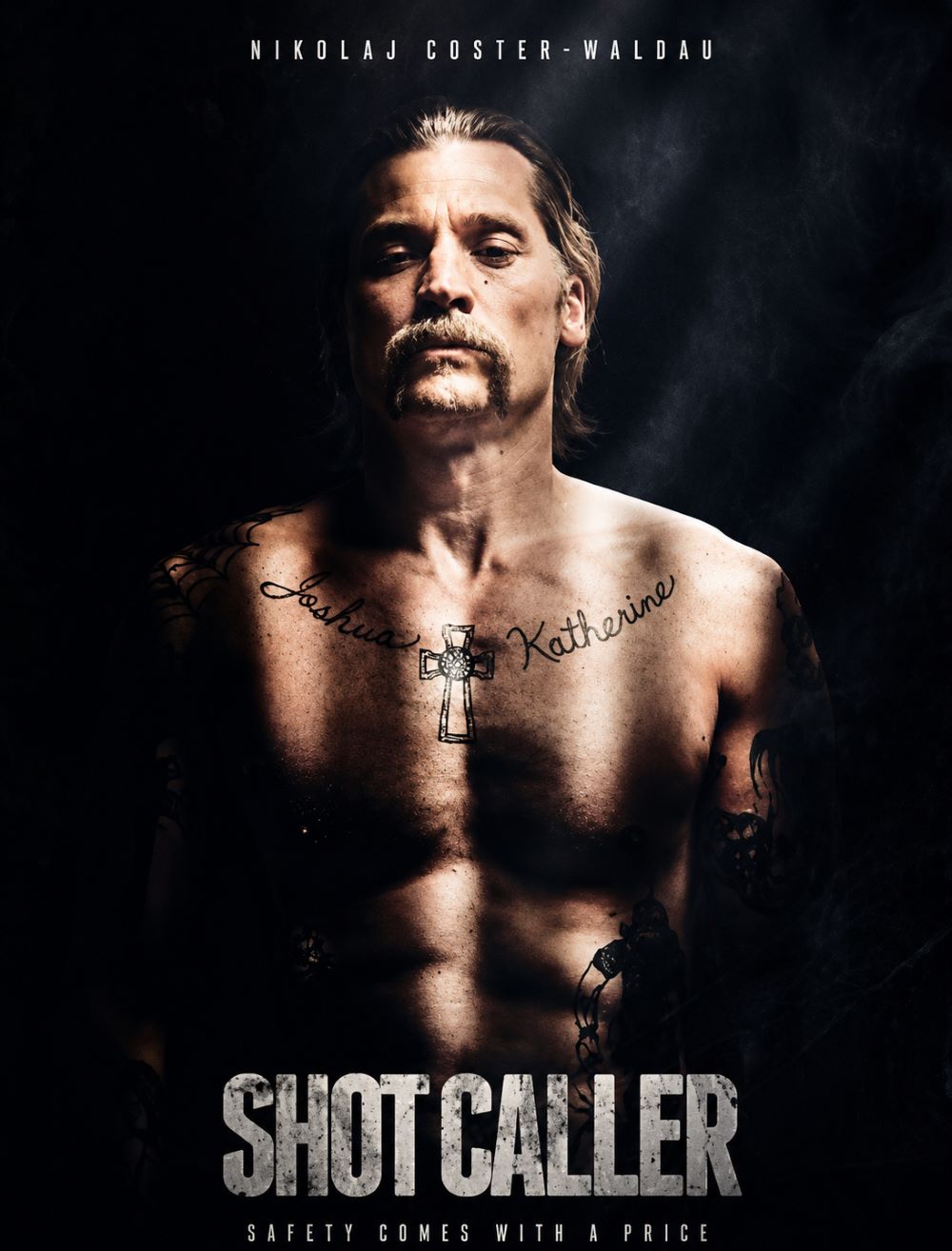
“The fact is, we all started out as someone’s little angel. And a place like this forces us to become warriors or victims. Nothing in between can exist here.” — “Bottles”
Shot Caller (released in 2017), directed by Ric Roman Waugh, is a gritty, morally complex crime drama that dives deep into the brutal world of prison gangs, redemption, and the blurred lines between justice and survival. Clocking in at just over two hours, it’s a tense, character-driven story that doesn’t shy away from the harsh realities of its setting, delivering a raw and unfiltered look at life behind bars and the psychological toll it exacts.
The film follows Jacob Harlon, played by Nikolaj Coster-Waldau, a successful businessman whose life spirals out of control after a DUI accident leaves his best friend dead. Sentenced to prison, Jacob is thrust into a violent, hierarchical world where survival means adapting to the rules of the Shot Callers—high-ranking gang members who control the prison’s underground economy. The film’s title itself is a nod to this brutal hierarchy, where every decision, every move, is dictated by those at the top. As Jacob navigates this treacherous landscape, he transforms from a naive new inmate into a hardened, strategic player, adopting the moniker “Money” for his financial acumen. His journey is as much about physical survival as it is about the psychological toll of losing his identity and grappling with the moral compromises he’s forced to make.
What makes Shot Caller stand out is its unflinching portrayal of prison life. Waugh, who also co-wrote the screenplay, doesn’t romanticize the violence or the characters. The film opens with a visceral, almost documentary-like sequence of Jacob’s first days in prison, where he’s immediately targeted by a white supremacist gang. The brutality is shocking, but it sets the tone for a story that refuses to sugarcoat the realities of incarceration. The prison scenes are claustrophobic, the tension palpable, and the stakes feel painfully real. Waugh’s direction ensures that every punch, every stab, every whispered threat carries weight. There’s no glorification here—just the cold, hard truth of a system that chews people up and spits them out. Even the brief but chilling appearance of Holt McCallany as The Beast, a high-ranking Aryan Brotherhood member, leaves a lasting impression. Though his screen time is limited, McCallany’s performance is unforgettable, exuding a quiet, menacing authority that underscores the danger lurking in every corner of the prison.
Nikolaj Coster-Waldau delivers a career-best performance as Jacob. Known to many as Jaime Lannister from Game of Thrones, Coster-Waldau sheds his noble, charismatic image to embody a man broken by guilt and reshaped by circumstance. His physical transformation is striking—he bulked up significantly for the role, but it’s his emotional range that truly impresses. Jacob’s arc is one of the most compelling aspects of the film. Early on, he’s a fish out of water, a man clinging to his old life and morals. But as the story progresses, we see the gradual erosion of his principles. The moment he finally snaps and fights back is a turning point, not just for his character but for the audience’s perception of him. By the time he’s released from prison, he’s almost unrecognizable—both physically and psychologically. Coster-Waldau makes you believe every step of this transformation, and it’s a testament to his skill as an actor that you’re rooting for Jacob even as he makes increasingly questionable decisions.
The supporting cast is equally strong. Omari Hardwick plays Shotgun, a high-ranking member of the black gang who becomes Jacob’s reluctant mentor. Hardwick brings a quiet intensity to the role, balancing threats with moments of unexpected humanity. Lake Bell plays Jacob’s wife, Kate, and her performance is heartbreaking in its restraint. Kate’s struggle to hold her family together while her husband is in prison is a grounded counterpoint to the chaos unfolding behind bars. Jon Bernthal, another standout, plays a prison guard with a morally ambiguous role in Jacob’s journey. Bernthal, as always, brings a raw, simmering energy to his scenes, making his character’s motivations feel authentic, even when they’re not entirely clear.
The film’s pacing is deliberate, almost methodical. Waugh takes his time building the world and the characters, and while this might frustrate viewers looking for constant action, it pays off in the long run. The first act is heavy on exposition, introducing the prison’s power structures and the various factions at play. But once Jacob starts to find his footing, the story picks up momentum. The middle act is where Shot Caller really shines, as Jacob’s alliances and rivalries become more complex. The film’s climax is a high-stakes heist that feels both inevitable and earned, a culmination of everything Jacob has learned—and lost—during his time inside.
One of the most interesting themes in Shot Caller is the idea of control. The title itself refers to those who call the shots, but the film constantly questions who really has power in this world. Jacob starts as a man who thinks he’s in control of his life, only to have that illusion shattered. In prison, he learns that control is a fragile, often violent thing, constantly shifting hands. Even after his release, he’s not truly free—he’s still bound by the rules of the criminal underworld he’s now a part of. The film suggests that in a system as broken as this one, no one is ever truly in control. It’s a bleak message, but one that feels authentic to the story being told.
The cinematography, by Dana Gonzales, is another highlight. The prison scenes are shot in a way that emphasizes the claustrophobia and tension of the environment. The color palette is muted, with lots of grays and blues, reflecting the cold, harsh reality of Jacob’s new world. The action sequences, when they do occur, are brutal and realistic, with a handheld camera style that puts you right in the middle of the chaos. There’s no glamour to the violence here—it’s messy, desperate, and often over in seconds.
If Shot Caller has a weakness, it’s that some of its themes and plot points might feel familiar to fans of the genre. The story of a man falling into the criminal underworld and struggling to escape isn’t exactly new. What saves the film from feeling derivative is its commitment to authenticity and its strong performances. Waugh’s script also avoids easy answers. Jacob isn’t a hero, and the film doesn’t pretend he is. He’s a flawed, complicated man making the best of a series of terrible situations. The ending, without spoiling too much, is bittersweet and ambiguous, leaving you to ponder just how much of Jacob’s old self is left—and whether he can ever truly escape the life he’s been drawn into.
Another aspect worth praising is the film’s soundtrack. The score, composed by Antonio Pinto, is understated but effective, using a mix of electronic and orchestral elements to underscore the tension and emotional beats of the story. The use of silence is also notable—there are moments where the absence of music makes the violence or the weight of a decision hit even harder.
Shot Caller is a film that lingers with you long after the credits roll. It’s not an easy watch, and it’s certainly not for the faint of heart. The violence is graphic, the language is harsh, and the themes are heavy. But for those willing to engage with it, the film offers a gripping, thought-provoking experience. It’s a story about survival, identity, and the cost of redemption. Ric Roman Waugh has crafted a prison drama that stands alongside classics like The Shawshank Redemption and American History X, even if it doesn’t quite reach their lofty heights. What it lacks in originality, it makes up for in execution, with stellar performances and a relentless commitment to its vision. In a world where crime dramas often glorify the outlaw life, Shot Caller is refreshingly honest. It doesn’t ask you to root for Jacob because he’s a good guy—it asks you to understand him, flaws and all. And by the end, you do. You understand the choices he makes, even if you don’t agree with them. That’s the mark of a great character study, and Shot Caller delivers on that front in spades. It’s a film that will leave you thinking, long after the final shot fades to black.

