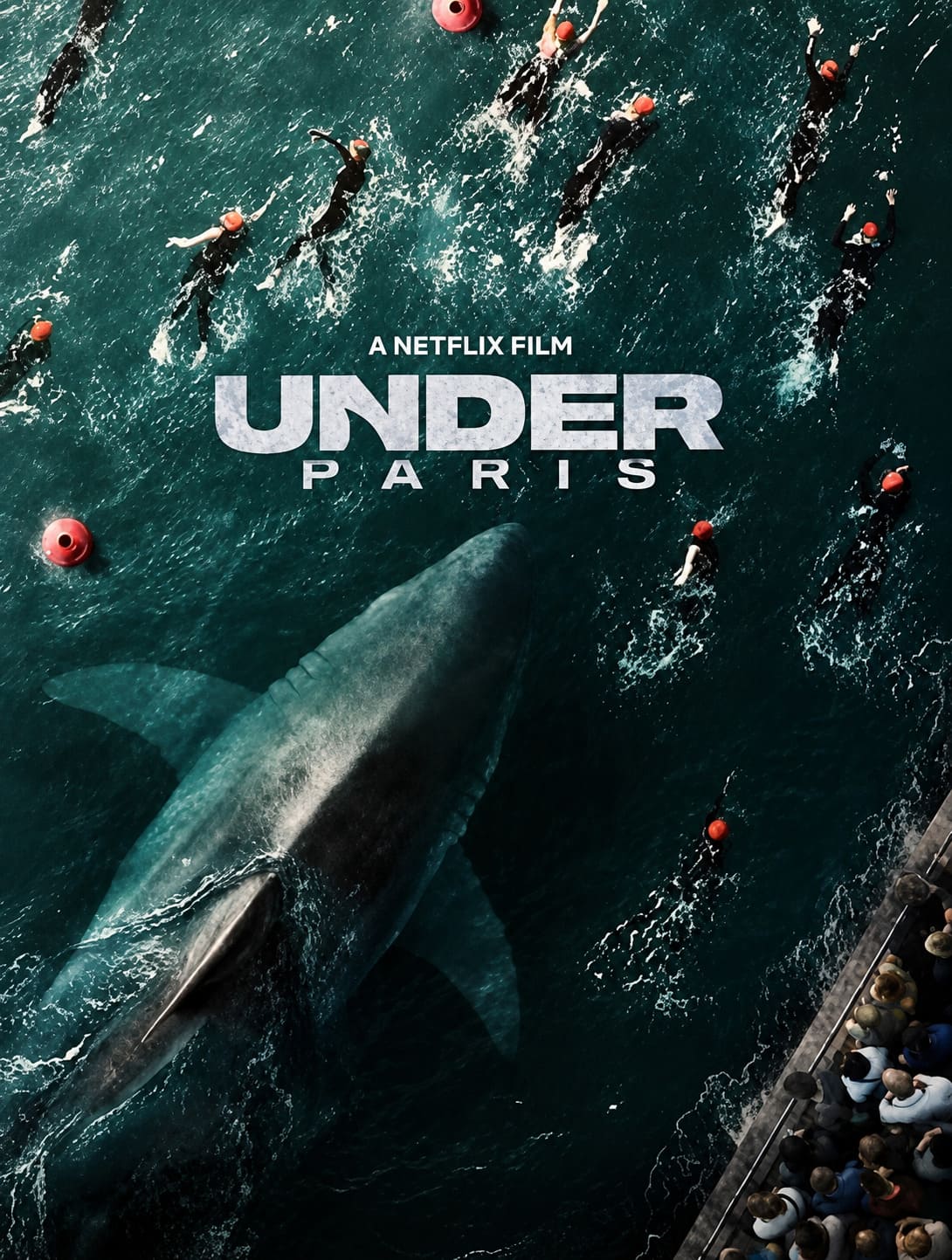
Review: Under Paris (dir. by Xavier Gens)


“It is not the strongest of the species that survives, nor the most intelligent, it is the one that is most adaptable to change.” — Sophia

Under Paris is one of those movies that grabs you by the throat and doesn’t let go—literally, in this case. Directed by Xavier Gens, the mind behind gritty, high-octane thrillers like Frontier(s) and The Divide, this creature feature dives headfirst into the claustrophobic nightmares lurking beneath the City of Light. And let me tell you, if you’ve ever romanticized the Parisian catacombs, this film will cure you of that real quick.

The story kicks off with a team of scientists exploring the unexplored tunnels under Paris, only to stumble upon something that definitely shouldn’t exist. What starts as a routine expedition turns into a fight for survival when they realize they’re not alone down there. The creatures in question are blind, feral, and terrifyingly fast, with a taste for human flesh. It’s The Descent meets Tremors, but with a distinctly French flair. The film wastes no time setting up its premise, throwing the audience into the dark, cramped corridors where every shadow could be a predator. The tension is palpable from the jump, and Gens doesn’t bother with slow-burn scares—this is a full-throttle horror ride.

What makes Under Paris stand out is its commitment to practicality. The creatures are brought to life with a mix of practical effects and CGI, and for the most part, it works. The designs are grotesque yet believable, with elongated limbs, jagged teeth, and a primal way of moving that makes them feel like something out of a nightmare. The practical effects, in particular, give the creatures a tangible weight that CGI alone often struggles to achieve. When they’re on screen, you believe they’re real, and that’s half the battle in a monster movie. The sound design deserves a shoutout too—the way the creatures communicate through clicks and hisses is unsettling in the best way, adding to the immersive dread.

The characters are, admittedly, a mixed bag. The cast is led by a group of scientists and urban explorers, each with their own quirks and backstories, but the film doesn’t spend much time fleshing them out. This is a survival horror flick, not a character study, so don’t expect deep emotional arcs. That said, the actors do a solid job with what they’re given. The standout is probably the team’s leader, whose growing desperation as the situation spirals out of control feels authentic. There’s also a refreshing lack of the usual horror-movie stupidity—most of the characters make decisions that, while not always smart, at least feel human. They panic, they argue, they try to rationalize the irrational, and it makes their plight all the more relatable.

The setting is a character in its own right. The labyrinthine tunnels under Paris are a horror fan’s dream—narrow, dimly lit, and filled with the kind of eerie silence that makes every distant noise sound like a death sentence. Gens and his cinematographer make the most of the claustrophobic environment, using tight camera angles and rapid cuts to keep the audience on edge. There’s a sequence early on where the team’s headlamps flicker, plunging them (and us) into total darkness, and it’s a masterclass in building tension without relying on jump scares. The film also does a great job of playing with sound, or the lack thereof. In the quiet moments, all you hear is the characters’ ragged breathing and the distant, unsettling skittering of something inhuman.

If Under Paris has a weakness, it’s that it doesn’t always know when to slow down. The pacing is breakneck, which works for the most part, but there are moments where a little breathing room would’ve helped. Some of the CGI, particularly in the wider shots, can look a bit rough, though it’s never bad enough to pull you out of the movie. And while the creatures are terrifying, their backstory is a bit thin. The film hints at a larger mythology—something about evolution and isolation—but it’s never fully explored. That’s not necessarily a dealbreaker, but it does leave you with a few unanswered questions.

All that said, Under Paris delivers exactly what it promises: a tense, visceral, and often downright terrifying descent into madness. It’s a film that understands the assignment—give the audience scares, gore, and a sense of dread that lingers long after the credits roll. Gens has a knack for blending horror with social commentary, and while Under Paris doesn’t dive as deep into the latter as some of his other work, it’s still there in the margins. The idea of something monstrous lurking beneath the surface of one of the world’s most romanticized cities is a potent one, and the film doesn’t shy away from the metaphorical implications.

In the end, Under Paris is a must-watch for horror fans, especially those who appreciate their scares with a side of action. It’s not a perfect movie, but it’s a damn effective one. It’s the kind of film you’ll want to watch with the lights off, the volume up, and maybe a friend or two to clutch onto when things get really intense. And trust me, they do. Xavier Gens has crafted a creature feature that’s as brutal as it is brilliant, and it’s a testament to his skill as a director that, even in the darkest, most chaotic moments, you’re never quite sure what’s going to happen next. Just don’t blame me if you start side-eying manhole covers after this one.
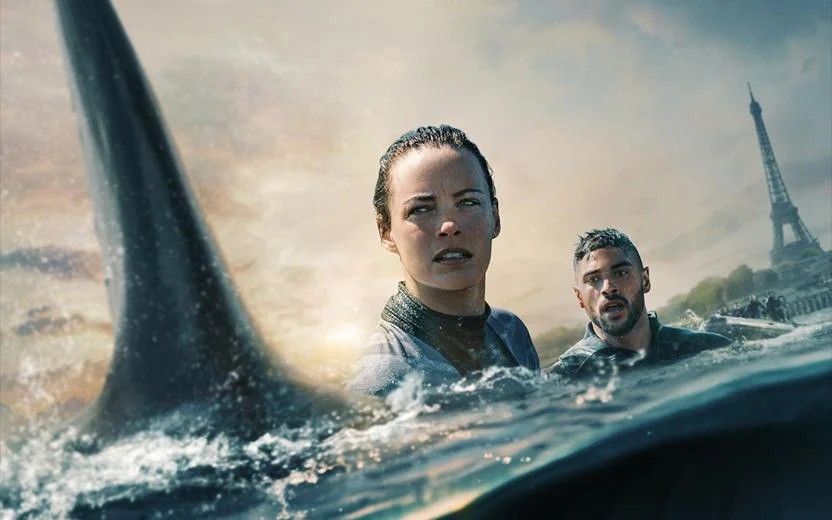
Brad reviews the Netflix shark movie UNDER PARIS (2024)!


Last week Sierra and I had dinner with our kids, and as usual, at some point the conversation turned towards movies. Sierra has been watching a lot of terrible shark movies, so I asked the kids if they had seen any decent shark movies lately. Our son mentioned this movie UNDER PARIS, and both he and his wife agreed that they thought it was a good movie. We had not heard of it before, but being tired of the SHARKNADO’s of the world, we decided to check it out.

UNDER PARIS opens with marine biologist Sophia Assalas (Berenice Bejo) and her dive team, which includes her husband Chris, tracking a shark named Lilith. The divers go into the water to obtain a blood sample, expecting to find a normal sized Lilith, but instead discover that Lilith has grown to three times her normal size and is aggressively hunting with a pack of other sharks. Before they can get back to the boat, the divers are all attacked and killed. Three years later and still traumatized by the events of that fateful day, Sophia is now an employee of a Paris aquarium when a young environmentalist named Mika (Lea Leviant) approaches her and says that Lilith’s tracking beacon seems to be active in Paris’ Seine River. Skeptical at first since Lilith shouldn’t be able to survive in fresh water, Sophia changes her tune when a homeless man is found half eaten with wounds clearly caused by a shark. Sophia then works closely with the river police and Sergeant Adil (Nassim Lyes) to try to find the shark before it can kill other Parisians. Wouldn’t you know it, it seems that Paris is about to host a large triathlon that’s tied to the upcoming Paris Olympics. Concerned that the participants could turn into shark food, Sophia and the police meet with the Mayor of Paris (Anne Marivin) to ask her to put off the triathlon. The mayor, however, doesn’t want the bad publicity that would come from cancelling the triathlon due to a “shark problem” so she refuses to cancel and tells them to just deal with it. I think we can all imagine where the story goes from there!

UNDER PARIS is better than most of the shark movies that Sierra and I have been watching, but it’s also a bit of a mess. There are a few things I really did like about the movie. First, I liked the Paris setting, which is not your typical setting for a shark movie. It was fun seeing the Eiffel Tower in the background as our various characters went through all the familiar shark movie tropes, speaking in French no less. Second, I enjoyed the somewhat serious and suspenseful tone of the early portions of the film. Our main character Sophia, as played by Berenice Bejo, is dealing with real tragedy and the movie treats her grief seriously. I think Bejo is good in the film, and I felt for her through these early sequences. I also liked her relationship with Sergeant Adil. Of course he would be skeptical at first, but I thought actor Nassim Lyes did a fine job of balancing rationality with a desire to get to the truth no matter how outlandish it may seem. The suspense around the tragedy at the opening of the film, as well as the portions dealing with convincing the police that the shark is in Paris, are quite effective. Even though it’s a cliché at this point, it was a fun throwback to JAWS (1975) when the mayor of Paris didn’t want to cancel the triathlon due to the bad publicity it would cause. In other words, I really did enjoy a lot of the world that UNDER PARIS created as it was building to the catastrophic shark attacks

UNDER PARIS does have its share of problems. When the big set pieces start and the shark(s) start attacking Paris, the movie pretty much abandons the human stories for CGI shark attacks. I won’t deny that there is some excitement in these scenes, but while the effects are decent, they’re not great, and the non-stop carnage took me out of the parts of the movie that I was really enjoying. Some of the characters, I’m looking at you mayor and environmentalist Mika, are especially naïve and silly, and their downright idiotic decisions lead to the majority of death and destruction presented in the film. By the time half the environmentalists and triathletes have been eaten or severely disabled, I was already wondering how much time we had left to the end of the movie.

Overall, I do think UNDER PARIS is better than most of the shark movies you can find on the streaming services. The unique setting, serious tone, and strong performances get the movie off to a solid start. Unfortunately, it’s just not able to sustain its early momentum throughout to the end.

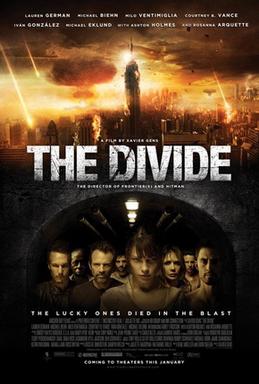
Film Review: The Divide (dir by Xavier Gens)


It seems like whenever there’s any sort of disaster, people are advised to seek shelter.  Often, if the disaster is national news, people are told to take shelter in their basement, as if everyone in the world has a basement.  This is a bit of a pet peeve of mine because I live in North Texas, where the land is completely flat and no one has a basement, a cellar, or any other sort of underground shelter.  (We also don’t have mud rooms and, in fact, I’m not even sure what a mud room is.)

That said, there’s a part of me that’s glad that it would be impossible for me to take shelter because, from what I’ve seen in the movies, it appears that spending months in a shelter can actually be worse than dying in a disaster.

Take the 2011 film, The Divide, for instance.

The Divide opens with several people watching while a mushroom cloud blooms over New York City.  Eight of those people all end up taking shelter in the same basement.  While that means that they don’t get incinerated by the nuclear blast, it also means that they now have to figure out how to live together.  That’s not going to be easy because it doesn’t take long to realize that none of these people should be anywhere near each other.

For instance, there’s Mickey (Michael Biehn).  Mickey’s the one who built the shelter.  He says that he specifically built it so that, in case of a nuclear war or a terrorist attack, he could safely sit underground and laugh at everyone dying above him.  That’s not a nice sentiment but Mickey is played by Michael Biehn so he’s still one of the more likable characters in the film.

There’s Josh (Milo Ventimiglia) and his brother Adrien (Ashton Holmes) and their friend Bobby (Michael Eklund), three idiots who are clearly destined to end up going crazy before the ordeal is over.

There’s Eva (Lauren German) and her boyfriend, Sam (Ivan Gonzalez), who are both obviously destined to be the voices of reason to which no one is going to listen.

And then there’s Marilyn (Rosanna Arquette) and her daughter (Abby Thickson), who are there because it’s not a shelter-movie without a child being put in jeopardy.

Lastly, there’s Devlin (Courtney B. Vance), who is there to be the older authority figure who ultimately fails to exercise much authority.

After an effectively chilling scene where the basement is briefly invaded by some mysterious men in Hazmat suits, The Divide settles down to be a fairly predictable and, to be honest, rather unpleasant examination of a group people going crazy from the stress of being trapped together.  It may seem odd to complain that a film about the aftermath of a nuclear apocalypse was unpleasant and I guess it is.  But The Divide runs a little over two hours and it’s so relentlessly bleak and everyone is ultimately so nasty that it becomes a bit of a chore to sit through.  By the time the torture scenes begin, The Divide has slipped into Hostel territory and it’s hard not to feel that the film is being grotesque simply for the sake of being grotesque.

That said, the film does have its strength.  The shelter is an effectively claustrophobic location and Michael Biehn does what he can with the role of Mickey.  When some of the characters end up getting radiation sickness, it creates some effectively scary visuals.  I mean, if you ever thought it would be cool to poison yourself with radiation, this film will change your mind.  That’s a good thing, I suppose.

The Divide is a very long movie about some very unpleasant people in an even more unpleasant situation.  It’s well-made but not particularly entertaining to watch.  In the end, it’s easy to feel that everyone would have been better off just staying above ground and getting it over with.