SOV Horror Review: City of the Vampires (dir by Ron Bonk)


The city of Braddock has a problem.

1993’s City of the Vampires opens with a news report about Braddock. The city appears to be dying, and no one is sure why. The population numbers have plunged. People are scared to go out at night. Most of the people interviewed for the news story talk about how they can’t wait to get out of Braddock. As I watched, I found myself wondering if this was the same Braddock that would later elect John Fetterman as mayor and appear in those Levi’s commercials. The commercials aired around 2009–2010 and were all about how important it was to save the city of Braddock. I remember watching them and thinking, “Why is some Yankee city more worthy of a commercial than the cities that are struggling in the South?”

(Fetterman, at the time, was branded “America’s coolest mayor” by The Guardian. People forget just how much the media loved Fetterman when he was just another predictable liberal.)

As for the movie, it follows Sam Helling (Matthew Jason Walsh) as he explores the city of Braddock at night. He’s looking for his girlfriend Christine (Anne-Marie O’Keefe), but instead he finds himself in a city that has been taken over by vampires. I should mention that some online sites insist the character is named Sam Helsing, which would seem to be a callback to Dracula’s Dr. Van Helsing. Watching the movie, though, it’s made clear that Sam’s last name is indeed Helling. Leave the Van Helsings out of this.

City of the Vampires is a shot-on-video horror film, and it definitely deserves some credit for its ambition. Whereas most SOV horror films were content to just rip off the latest slasher and zombie pictures, City of the Vampires was obviously meant to be a low-budget action epic. There are a few interesting camera angles. There’s a deliberate echo effect on some of the dialogue, the better to give it a supernatural, dreamlike feel. There are several fairly convincing shots of melting faces. Despite the low budget, the filmmakers were obviously trying to make something memorable. One could easily imagine an alternate universe where City of the Vampires launched a whole franchise about vampires taking over American cities in decline. Look out, Gary, Indiana. The bloodsuckers are coming.

That said, it’s still a shot-on-video horror film, and the low budget really does show in more than a few scenes. The film takes place largely at night, it appears to have been shot at night, and there are several scenes so darkly lit that it’s a struggle to make out what’s happening. As cool as the echo effects were, the soundtrack is generally not that clear, and I sometimes found myself straining to hear what people were talking about. Proper lighting and sound recording have been the downfall of many SOV films. They’re the kind of thing people take for granted until they’re gone.

Still, I’ll give this film credit for its ambition. I always appreciate the effort, even if it’s not fully successful.

The TSL Horror Grindhouse: Amityville La Llorna (dir by Jamie Grefe)


In 2025’s Amityville La Llorona, a couple (played by director Jamie Grefe and Sloane Tower) move into a house and spend the entire time arguing about every little thing.  Eventually, the husband has visions of a mysterious woman (Skya Theobold) and a strange figure who keeps shouting, “Mama!  Mama!”  The film is only 63 minutes.  Unfortunately, the dialogue is largely improvised and it takes forever for anything to actually happen in the movie.  I felt every one of those 63 minutes.

Since there’s really not a helluva lot to say about the film, let’s talk about La Llorona.

The legend of La Llorona is a well-known one in Mexico and the southwestern half of the United States.  It’s a story that I was told by both my mom and my aunts and, as a result, I never went off with a stranger while I was growing up.  Of course, I also had some pretty intense nightmares but that’s kind of the point.  If someone tells you the story of La Llorona and you don’t end up having a nightmare about being drowned by a weeping woman, they didn’t tell the story correctly.

La Llorona was originally named Maria.  She lived, in a rural village, with her family and she was famous for both her beauty and her virtue.  When a wealthy nobleman saw her and immediately proposed to her, Maria accepted.  However, the nobleman’s father was upset that his son was marrying into a poor family and he refused to accept Maria as his daughter-in-law.  Maria and her husband ended up having two sons and living in a house by the river.  Maria’s husband doted on their sons but he ignored her and eventually, Maria learned that he was having an affair.

In a fit of blind rage, Maria drowned her children in the river.  After realizing what she had done, Maria died of grief.  However, when she arrived at the gates of Heaven, she was asked why her children were not with her.  When Maria explained that she had lost them, she was told that she would not be allowed to enter Heaven until she found them.  Now, known as La Llorona (or “the weeping woman”), she wanders the Earth, crying and looking for her children.

Where does one find La Llorona?  It depends on who is telling the story.  Some stories say that you’ll only see her near a body of water.  My mom used to tell me that La Llorona could be anywhere, including under my bed or in the bedroom closet.  Regardless of where you might find her, La Llorona is always wearing her wedding dress and she’s always sobbing.  Approach her and she’ll grab you and either kidnap you or drown you, all the while begging for forgiveness.  Many have seen La Llorona but few have survived to tell the story.

“And that is why we do not talk to strangers,” my mother would say while I looked out the bedroom window, searching for the sight of La Llorona walking through the Texas night.

Though Skya Theobold’s character is credited as being La Llorona in Amityville La Llorana, she doesn’t have much in common with the true La Llorona.  Then again, this film also has nothing to do with any of the previous Amityville films.  Amityville, as either a town or franchise, is never mentioned in this film.  Normally, I’m willing to cut an exploitation film a little bit of slack when it comes to having a misleading title.  Usually, that’s just a part of the game.  In this case, though, it just serves to remind me of how cool a film about the real La Llorona visiting the real Amityville house would have been.

As I mentioned earlier, the dialogue in this film appears to have been improvised.  One of the unfortunate things about improv is that everyone thinks that can they do it.  They think that as long as they’re given a scene to play, they’ll be able to come up with appropriately compelling dialogue.  This film proves that is not always the case.  As I watched Amityville La Llorona, I found myself hoping that Michael Scott would kick open a door and shout, “MICHAEL SCARN, FBI!”

Michael Scarn in Amityville.  Now that would be a movie!

Previous TSL Amityville Reviews:

  1. The Amityville Horror (1979)
  2. Amityville II: The Possession (1981)
  3. The Amityville Cure (1990)
  4. The Amityville Haunting (2011)
  5. Amityville Death House (2015)
  6. Amityville Toolbox (2016)
  7. Amityville: The Awakening (2017)
  8. The Amityville Murders (2018)
  9. Amityville Cop (2021)
  10. Amityville Emanuelle (2023)
  11. Amityville A.I. (2024)

Retro Television Review: Homicide: Life On The Street 6.6 “Birthday”


Welcome to Retro Television Reviews, a feature where we review some of our favorite and least favorite shows of the past!  On Sundays, I will be reviewing Homicide: Life On The Street, which aired from 1993 to 1999, on NBC!  It  can be viewed on Peacock.

This week, it’s yet another Falsone episode.

Episode 6.6 “Birthday”

(Dir by Alison MacLean, originally aired on November 7th, 1997)

This episode is an example of the good, the bad, and the ugly.

The good part of the episode is that Mary Pembleton finally goes into labor and gives birth to a son.  Andre Braugher was so intense on this show that it was always nice to see an episode where Frank could just be happy.

The bad is that Georgia Rae Mahoney has surveillance camera footage of Kellerman killing Luther Mahoney.  The Mahoney stuff is just getting dragged out.  As Luther Mahoney, Erik Todd Dellums was a magnificent villain.  Hazelle Goodman is considerably less compelling as Georgia Rae but, then again, the writers aren’t doing her any favor by having Georgia Rae always talk like a comic book villain.

The ugly is that the main storyline is yet another Falsone story.  This time, Falsone, Lewis, and Stivers investigate the rape and violent assault of a woman named Grace Riviera (Allison Folland).  As you might expect, Falsone takes the case — wait for it — PERSONALLY!  When one suspect doesn’t give Falsone the answers that he wants in the box, Falsone beats him up.  He guarantees Giardello that he will close the case.  Giardello responds that he likes Falsone.  Well, good for Giardello, I guess.

As I’ve said before, there’s several problems with Falsone’s character.  The biggest one is that Falsone doesn’t really have much depth, especially when compared to characters like Pemblton, Bayliss, or even Lewis.  He’s a collection of cop show cliches.  He’s the epitome of everything that Homicide was supposed to be against.  Jon Seda’s one-note performance is jarring when compared to the rest of the cast.  Callie Thorne’s Laura Ballard may not be a particularly interesting addition to the ensemble but at least Thorne can show a hint of emotion.

The biggest problem with Falsone is the way that this season keeps trying to force him on the viewer.  If a viewer wants to watch Pembelton, Bayliss, Munch, or any of other other detective solve a murder, they’re out of luck.  It’s the Falsone show!

This episode ends with Falsone going to the hospital to tell Grace that he’s arrested the man who attacked her, just to discover that Grace died.  It’s not the shocking moment that the show meant it to be.  And emotionally, it falls flat because it’s a Falsone moment.

Homicide is the series that I want to review.  I have no interest in The Falsone Show.

Lifetime For October: Surviving The Sleepover (dir by Patricia Fontain)


When I was 11 years old, I spent about a month and a half living in a motel with my mom and my sisters. We were between homes, and since my mom didn’t really have the money to pay for our rooms, she and my two oldest sisters would work as maids during the day while my sister Erin and I stayed in our own room and watched stuff on the television that we probably shouldn’t have been watching. (“What are you watching!?” Mom would say as either Erin or I grabbed the remote and tried to get the TV off of HBO as quickly as possible.)

In retrospect, I know that all probably sounds very dramatic and traumatic, but I have to admit that, at the time, it just felt like an adventure. I was jealous of my mom and my sisters getting to wear uniforms every day and basically go anywhere they wanted in the motel. I would ask my mom and sisters about what they found in the rooms they had to clean, and I would beg for a chance to go with them because I figured it had to be fun to see how other people lived. They always refused. Years later, my sister Megan would tell me that they usually just found discarded underwear, used condoms, and half-eaten fast food.

Sometimes I would sit in the front lobby, bothering whoever was working behind the desk and trying to overhear conversations. I loved watching the various people who checked in and out of the motel, and I would imagine amazing identities and life stories for them. At night, I would listen for sounds coming from other rooms. One time, the police were called because the people below us were fighting, and I remember watching the reflection of the red lights flashing across the walls of my room.

That said, I think my main memory of living at that motel was that there was a creek right next to the hotel (though I always envision it as a raging river whenever I think back to those days), and on the other side of that creek there was a drive-in movie theater. Every night, I would go out on the balcony and look into the distance, at the silent images flickering across the giant screens. The fact that I couldn’t actually hear what Bill Paxton and Helen Hunt were saying only made the experience more enjoyable. I could make up my own stories to go along with the images. Watching those movies became a ritual for me. I had to watch every night, at the same time, and if anyone tried to keep me from doing so, I would throw a fit. Though I didn’t fully realize it at the time, for me that drive-in came to represent stability.

I found myself thinking back to those days as I watched Surviving the Sleepover, a Lifetime film from 2024. Hannah (Sloan Mannino) is a teenage girl who has been living in a motel with her mother (Dawn Marie) ever since they moved to a new town. Hannah, whose father was killed in a fire, does not have any sisters or a drive-in to keep her company. Instead, she uploads videos and spends her time missing all of her friends. However, when popular girl Melissa (Jenna Hogan) invites Hannah to a sleepover, it seems like things might be looking up.

Of course, they’re not.

Melissa is mean as well as popular. Melissa is also obsessed with her stepbrother (Joshua Bertell), and when it becomes apparent that he likes Hannah, Melissa goes off the deep end. Soon Melissa is threatening her guests with a knife, tying people up in the attic, and basically being a very bad host.

This is an enjoyably berserk little Lifetime film, one that understands the importance of embracing the melodrama. Jenna Hogan gives an entertaining performance as the unhinged Melissa. From the moment she complained that Hannah was still “salty” just because Melissa had attempted to drown her earlier, I knew this film was going to be a Lifetime classic.

And yet, as I watched the film, my main thought was that this all could have been avoided if the nation’s drive-ins hadn’t closed. When you don’t have a drive-in theater to visit, you end up threatening people at sleepovers. That’s just the truth of the matter.

There aren’t many drive-ins left.

Protect them at all costs.

Horror Book Review: The Fury by John Farris


First published in 1976, John Farris’s The Fury tells the story of two teenagers whose powers could change the world. Robin and Gillian both possess potentially devastating psychic abilities. Robin is the son of Peter, a government assassin. Peter’s boss, a demented film lover named Childermass, eventually learns of Robin’s power and kidnaps him. Peter is led to believe Robin is dead; Robin is led to believe the same of Peter. Gillian, meanwhile, is Robin’s psychic twin. The book implies that Robin and Gillian have lived several past lives, always connected and always returning after death. Robin realizes this. Gillian does not, and is genuinely confused by her powers.

While Robin and his growing abilities are manipulated by a doctor ordered to keep him placated through sex, Childermass spends his time trying to track down Gillian. Peter, having discovered that Robin isn’t dead, is now searching for Gillian as well.

The Fury is a tawdry, pulpy mix of psychic horror and over-the-top espionage, a collision of the entertainingly sordid and the shockingly vulgar. (Let’s just say the novel goes into a lot of detail about how Robin is seduced by his psychiatrist.) If the plot seems familiar, it’s probably because you’ve seen Brian De Palma’s film adaptation. Farris wrote both the novel and the screenplay. As over-the-top as De Palma’s version was — he was still riding high on Carrie, so he got to indulge every trademark flourish — Farris’s novel is somehow even more flamboyant, stuffed with odd characters and action sequences that sometimes seem to erupt almost at random. That actually works in the book’s favor. It creates a secret world of psychics, assassins, and pervy doctors living in the shadows of ours.

It’s very much a book of the ’70s, and as with any work that epitomizes an era, whether that’s a problem depends on how easily offended the reader is. It mixes Watergate-era paranoia with telekinetic mayhem and even a hint of New Age nonsense. It also features sex scenes that almost read like a parody of ’70s swinger culture — though it’s harder to laugh when you remember Robin is meant to be 14 in the novel. (When De Palma made the film, he was smart enough to cast actors in their twenties and keep the characters’ ages ambiguous.) It’s sordid and trashy in a way few authors could get away with today.

Sordid and trashy, but undeniably entertaining. That’s The Fury.

October True Crime: She Made Them Do It (dir by Grant Harvey)


At the start of 2012’s She Made Them Do It, Sarah Jo Pender (Jenna Dewan) is a student at Purdue University who has a good-for-nothing boyfriend named Rick (Greyston Holt) and two roommates who think nothing using her tuition money to buy drugs.  At first, Sarah seems to be frustrated with the losers around her but, after smoking some weed and doing some coke, she’s soon dancing and making out with another woman while Rick plays a video game.  (Who among us hasn’t?)

Sarah leaves to get some cigarettes and, when she comes back, she discovers that her roommates have been executed by a shotgun.  A shaken Rick explains that an argument over money led to him retrieving the shotgun (one that Sarah bought for him because Rick’s criminal record made it illegal for him to buy a gun) and killing everyone else in the house.  At least, that’s what Sarah claims Rick told her.  When the police eventually arrest Rick and Sarah, Rick claims that Sarah was the mastermind behind the killings.  The prosecution describes Sarah as being a “female Charles Manson” and she’s sentenced to 110 years in prison.

Yikes!  That’s a long time!  Luckily, the prison is a pretty nice place.  Sure, some of the inmates are a little rough and everyone is initially jealous of Sarah’s combination of brains and beauty.  But the prison also hosts courtyard dance parties and eventually, Sarah proves herself as a jailhouse lawyer.  Much like Hester Prynne, Sarah show herself to be able and hard-working.  That said, prison is still prison and soon, Sarah is plotting her escape.  Luckily, there’s a smitten prison guard (Nels Lennarson) who is willing to help her out.

The title She Made Them Do It has, of course, a double meaning.  During her trial, the prosecution claims that Sarah Jo Pender made Rick murder her roommates.  Rick even produces a letter that he claims Sarah wrote to him in which she confessed to being responsible.  Even though the letter is itself dismissed as being a forgery, the courts still rule that there is more than enough evidence to argue that Sarah was involved with the murders.  However, the title also refers to the fact that everyone in prison seems to be determined to help Sarah.  Nearly everyone who she meets after she escapes tries to provide Sarah with some sort of aid.  In the end, everyone claims that she made them do it.  A few regret helping her but the majority do not.

Because the controversy over Sarah Jo Pender’s conviction is still ongoing, the film tries to play it both ways as far as the question of her guilt is concerned.  We see her version of the murder.  We see Rick’s version of the murder.  In prison, we see her helping the other prisoners.  Outside of prison, we watch as she clearly manipulates everyone that she meets.  There’s nothing wrong with a little ambiguity but this film takes it so far that Sarah often seems to be a totally different character from scene to scene.  Jenna Dewan tries her best and the film’s early scenes definitely capture the sordid atmosphere of trailer park drama but the film’s refusal to take a definite stand on Sarah’s guilt or innocence ultimately makes the story feel shallow.  It’s one thing for the prisoners and the guards to feel as if they don’t know what’s going on in Sarah Jo Pender’s head.  It’s another thing for the audience to feel that way.

As for the real Sarah Jo Pender, she is still in prison and she still claims to be innocent.  She had a lot of supporters.  I wouldn’t consider myself to be one of them.  I doubt she ‘s a female Charles Manson but I also have a hard time buying her claim that every piece of evidence against her was just a coincidence or a case of bad luck.  Unfortunately, some activists are so eager to turn every conviction into a miscarriage of justice that they ignore anything that doesn’t support their preferred narrative.  (Call it the Mumia Abu-Jamal effect.)  Sarah Jo Pender’s earliest possible relate date is 2054, when she will be 75 years old.

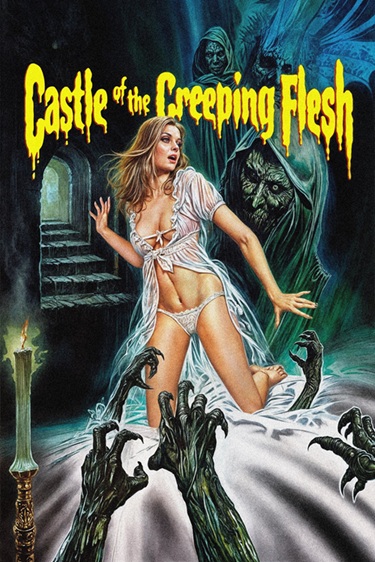
Horror Film Review: Castle of Creeping Flesh (dir by Adrian Hoven)


In 1968’s Castle of the Creeping Flesh, a group of wastrel aristocrats stumble upon a castle inhabited by Graf Saxon (Howard Vernon). It is explained to Baron Brack (Michel Lemoine) and his drunken friends that Saxon’s daughter died just an hour earlier. Everyone is sorry to hear that, but they still want to spend the night at the castle for… reasons, I guess.

Actually, their reasons aren’t that obscure. Night is falling. It’s stormy. There’s a bear on the loose. The Baron and his friends have their reasons for not wanting to travel at night, but that doesn’t change the fact that our film’s “heroes” are demanding that a grieving father not only put them up for the night but also serve them dinner. Saxon would be totally justified in kicking them all out and allowing the bear to have its way with them, but one of the Baron’s friends (Claudia Butenuth) looks just like Saxon’s dead daughter.

Scenes of Saxon looking depressed are mixed with scenes of the Baron’s friends all trying to seduce each other. Meanwhile, a group of surgeons in the castle’s basement are performing open-heart surgery. Every few moments the film cuts to documentary footage of an actual operation, and it’s pretty icky to watch. The heart is an amazing organ, but it’s not really something you want to spend a lot of time staring at. Saxon is trying either to save his daughter or to bring her back to life; the film is never really clear which.

Watching this German film, I was reminded of the work of Jess Franco, and I was not shocked to discover that Franco himself was credited with the incoherent story. The credited director is Adrian Hoven, but it would not shock me if Franco had a hand in the direction as well. Everything about the film—from the meandering storyline to the perpetually horny characters to the scenes of aristocratic decadence—brought Franco to mind. Like many of his films, Castle of the Creeping Flesh is atmospheric and totally incoherent.

Also leading me to suspect Franco contributed more than an outline is the casting of his favorite leading man, Howard Vernon, as Saxon. Vernon plays essentially the same character he did in the Dr. Orloff films. Unlike his co-stars, he is at least consistently entertaining. Outside of Udo Kier, no actor captured wasted European decadence the way Howard Vernon did. If any actor was born to play an early Bond villain, it was Vernon. (When I read Fleming’s originals I pictured him every time Blofeld appeared.) Here he gives a better performance than the material deserved. That was usually how it went with Howard Vernon.

Castle of the Creeping Flesh is a slow, incoherent film, but it has occasional moments strange enough to be entertaining. One woman sensually licks a chicken bone as part of her seduction ritual. Another character runs into that bear mentioned earlier. And of course no one seems to notice there is open-heart surgery happening a few doors down. It’s weird the way any film with Jess Franco’s fingerprints usually is.

That said, Howard Vernon is the main reason to watch. He did his best.

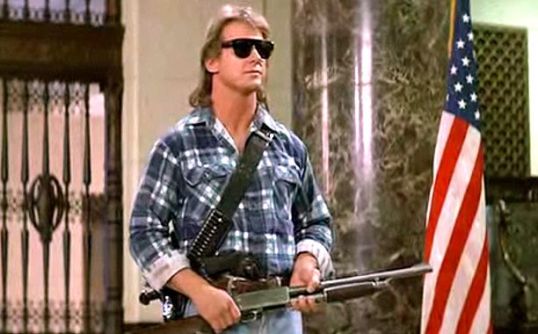
Hero Of The Day: John Nada (They Live)


“I have come here to chew bubble gum and kick ass. And I’m all out of bubble gum.”

— John Nada (Roddy Piper)

Roddy Piper improvised the most famous line in 1988’s They Live.

When John Carpenter was casting They Live, he specifically sought someone who was not a film star to play John Nada. The character was meant to be a drifter, an often-homeless man who lived on the fringes of society and did what he had to do to survive. Carpenter viewed John as the epitome of “the forgotten man,” and he knew that casting a big star would sabotage what he was going for. Ultimately, Carpenter cast professional wrestler Roddy Piper as Nada, and history, as they say, was made. Piper showed up on set with a notebook full of one-liners he had jotted down but hadn’t gotten a chance to use while wrestling. The famous line was not in the script. Piper came up with it on his own and spontaneously used it in the bank scene. Carpenter kept it in the film.

The line worked because of its combination of unhinged humor and genuine bravado. It was a line that would have worked before a wrestling match but, even more importantly, a line that perfectly captured John Nada’s worldview after he put on the dark glasses and saw the reality of the world around him. The line was pure John Nada.

John Nada. John Nothing. It was the perfect name for a man with no home, no family, and, until he meets Keith David’s Frank Armitage, no real friends. He’s the 1980s version of Clint Eastwood’s Man with No Name. John has nothing, and once he puts on those glasses, that becomes his greatest strength. John has nothing to lose, and therefore the aliens who have convinced everyone else to “Obey” have nothing to offer him. Because society has given him nothing, he’s far less susceptible to being manipulated. He’s too angry to be controlled, and once he sees the truth, he becomes determined to share it with everyone. When he and Frank fight in the alley, it’s not just a fight scene. It’s John committing to opening his friend’s eyes, no matter how much pain it may cause. John, who lives on the fringes, who has no home, and who would probably get the police called on him if he ever showed up in the suburbs, sacrifices his life for humanity. He still manages to give the finger to the aliens before he goes, and somehow that feels like the character’s greatest triumph. He remains defiant to the end. No one brainwashes John Nada.

They Live works because of John Nada, and John Nada works as a character because he’s vulnerable throughout. If he were played by a traditional star, we would have no doubt about his ability to defeat the aliens. But with Piper in the role, we’re not quite sure. John Nada doesn’t set out to be a hero, but by the end of They Live, he definitely is one.

Hero of the Day

Horror Film Review: They Live (dir by John Carpenter)


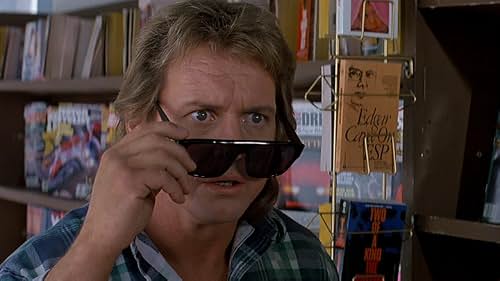
When it comes to John Carpenter’s 1988 masterpiece, They Live, everyone remembers the moment that a drifter named Nada (Roddy Piper) first puts on the dark glasses.

They remember him putting them on and suddenly seeing that the city of Los Angeles is stark black-and-white. They remember the mix of humans and skeletal-looking aliens that surrounded Nada and they remember how the aliens were the ones who went out of their way to be rude. What they especially remember are the billboards and the magazine covers reduced to simple orders like “OBEY,” “CONFORM/STAY ASLEEP,” “CONSUME,” “DO NOT QUESTION AUTHORITY,” and “NO INDEPENDENT THOUGHT.”

What is often forgotten is that it takes a while for the film to get to that point. Carpenter starts the film with a rather lengthy first act, in which Nada arrives in Los Angeles, tries to find work, tries to stay fed, and ends up camping out at a shanty town. Nada is one of America’s forgotten people, a drifter with no real home, no past, and it would appear no future. Nada hears a blind street preacher (Raymond St. Jacques) talking about how the rich and the powerful have been recruited to control humanity and he agrees, even before he puts on the glasses. It’s not until the shanty town has been destroyed in a police raid and Nada has put on the glasses that he sees just who exactly has been doing the recruiting.

After he puts on the glasses and sees the way the world really looks (it’s even suggested that what we perceive as color is something artificial that the aliens are using to distract us), Nada hardly ever takes them off. Some of that is for self-preservation. Wearing the glasses allows him to see who is an alien and who is not. But even more importantly, it’s a sign that having now seen the truth, Nada cannot return to the lie. Instead, Nada tries to win his freedom and expose the aliens. It’s not easy. It takes a lengthy and deservedly famous fight in an alley for him to convince his friend Frank (Keith David) to wear the glasses as well. Once Frank does put them on, he automatically understands what is happening. Wearing the glasses doesn’t leave one confused. Instead, wearing them makes everything suddenly make sense.

If this is not a traditional film review, that’s because They Live is one of those films that everyone seems to already know. Even those who have not watched the entire film know what happens when Nada puts on the glasses. For a film that was not a box office hit and which was initially dismissed by many critics, They Live has become very much a part of our shared culture. Today, everyone knows the messages that are being sent through media. Unlike Nada, most people don’t try to rebel. They don’t announce that they’re all out of gum. We’ve become used to it all.

They Live is often described as being an anti-capitalist film, though John Carpenter has said that it’s not. Carpenter has also been quick to say that it’s not meant to be a Marxist film either, regardless of what the film professors may say. Indeed, the messages of “NO INDEPENDENT THOUGHT” and “CONFORM” are about as Marxist as you can get. (Wearing the glasses can be compared to taking the red pill in The Matrix, except of course leaving The Matrix means becoming a part of Zion, a community whose slogan might as well be “DO NOT QUESTION AUTHORITY.”) They Live is a film that celebrates rebellion against the establishment, regardless of how that establishment might disguise itself. In They Live, the right and the left are different sides of the same manipulative coin. The aliens and their human allies thrive regardless of who might technically be in charge. It’s not really a surprise that my more Libertarian-minded friends tend to view They Live as being a sacred text.

It should be noted that there’s a savage humor running through They Live. It’s present in the first time that Nada puts on the glasses. It’s there in his one-liners. But it’s also present at unexpected moments. I love that this movie gives George “Buck” Flower an actual character to play and, when he shows up during the third act in a suit, I can’t help but smile. The aliens, when they are gathered together, still speak in the language of sales and stockholder meetings. They’re in business and business is good.

They Live is one of those films that feels even more relevant today than when it was first released. Anyone who lived through the COVID era will be able to relate to the media telling them to obey authority and to conform with everyone else. It’s easy to imagine that, if one put on the glasses today, they would see a lot of aliens. The sad truth is that there are no aliens to blame things on. The actions of the past few years were done without any help. Carpenter ended They Live with humanity waking up. Escape from L.A. ended with Kurt Russell shutting down the country. One can only imagine how things would end today.

Horror on the Lens: Destroy All Planets (dir by Noriaki Yuasa)


Aliens are trying to conquer Earth.  It’s a pretty good thing that we’ve got a giant, fire-breathing turtle to protect us!

In Japan, this film was released as Gamera vs Viras.  In 1969, when it aired on American television, the Japanese actors were dubbed and the title was changed to Destroy All Planets, presumably to try to capitalize on the success of Destroy All Monsters.  As any true kaiju fan can tell you, Gamera and Godzilla exist in different cinematic universes but that’s not something that the average American was worried about, especially in 1969!  Myself, I love both Gamera and Godzilla.  That said, my favorite remains Jet Jaguar.  Whatever happened to that robot?

Here, for your viewing pleasure, is today’s Horror on the Lens!  Enjoy Destroy All Planets!