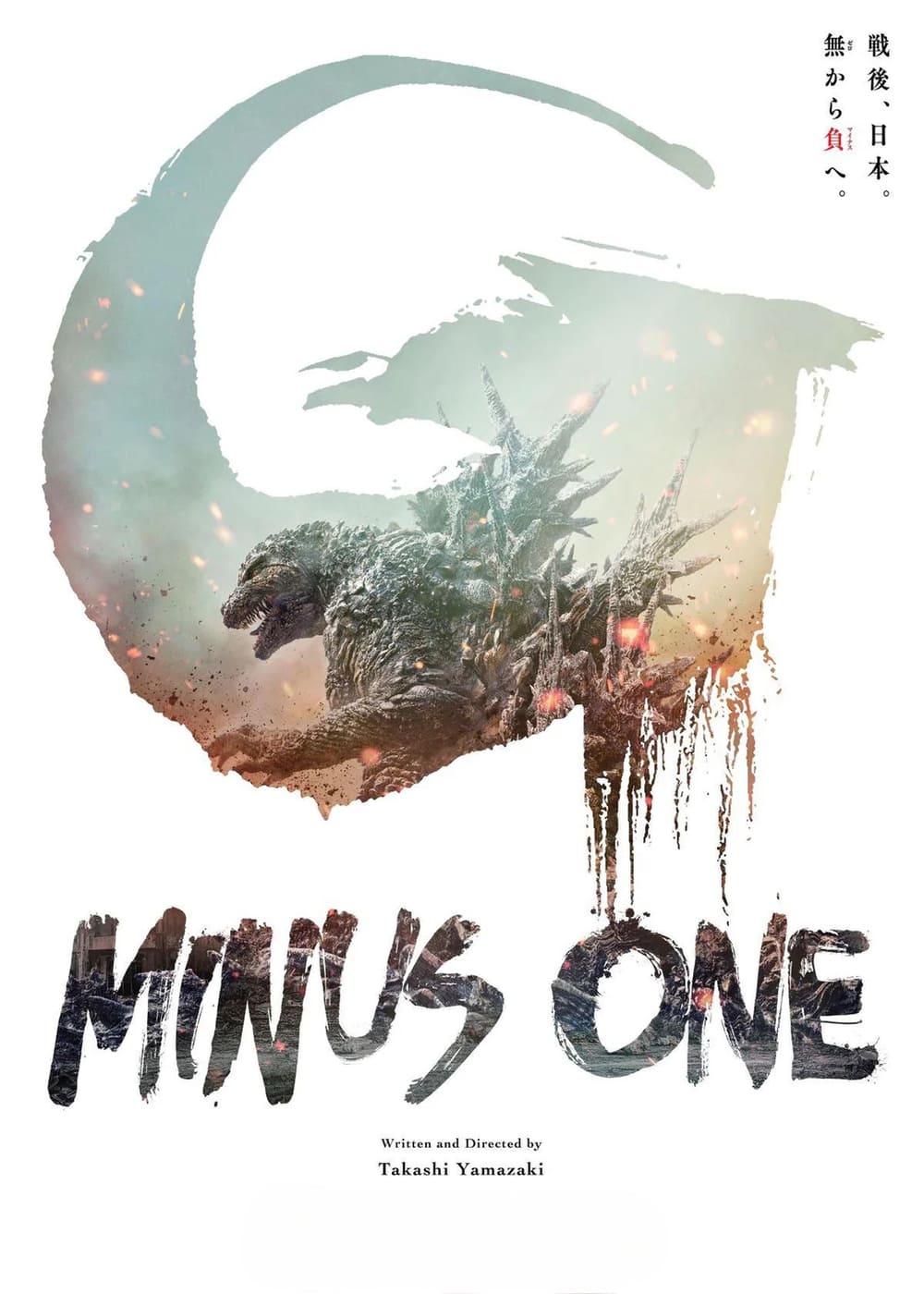
“Everyone who survived the war is meant to live.” — Noriko
The most terrifying thing in Godzilla Minus One isn’t necessarily the monster’s roar. It’s the anticipation—the awful stretch of time when people realize something unstoppable is coming and there’s nowhere safe to go. Takashi Yamazaki’s 2023 film understands that dread, but its real trick is making the quieter scenes feel just as haunted. Godzilla threatens a country already struggling to recover from catastrophe. For the people trying to rebuild their lives, the creature brings another unbearable possibility: that everything they’ve survived, and everything they’ve managed to put back together, could disappear all over again. The destruction matters because the movie takes the time to show us what’s being destroyed.
The film follows Koichi Shikishima, a young kamikaze pilot who lands on Odo Island in the closing months of World War II, claiming his plane needs repairs. The mechanics find nothing wrong with it; he’s trying to escape a mission that demands his death. That night, Godzilla attacks the base. Koichi freezes when he has an opportunity to fire the plane’s guns, and only he and lead mechanic Sosaku Tachibana survive. When Koichi returns to a Tokyo devastated by firebombing, he carries that failure home like luggage he can’t put down. His parents are dead, his neighborhood is barely recognizable, and being alive feels less like good fortune than another reason for shame.
Ryunosuke Kamiki makes Koichi’s suffering convincing without turning him into an endlessly sympathetic victim. He can be distant, defensive, and frustratingly unwilling to accept the affection offered to him. There’s something painfully believable about that. His problem isn’t that nobody cares whether he lives; it’s that he can’t understand why they should. Kamiki gives the impression of someone who is constantly holding part of himself back, as though fully participating in life would mean forgetting the dead. Even in moments of relative comfort, Koichi seems prepared for happiness to be taken away—or to discover that accepting it was a mistake.
That discomfort becomes especially affecting when he shares his damaged home with Noriko, played by Minami Hamabe, and Akiko, an orphaned baby she has taken into her care. Their household begins as an improvised arrangement, but gradually develops the rhythms of a family. Yamazaki understands how much emotional weight ordinary routines can carry in a story like this. Having someone to feed, somewhere to sleep, and a reason to come home becomes meaningful precisely because those things are no longer guaranteed. Koichi helps create that security, yet struggles to recognize himself as someone entitled to enjoy it. He’s building a future while keeping himself at a distance from it.
The brilliance of Yamazaki’s script is that Godzilla isn’t Koichi’s only enemy. There’s also his guilt—the corrosive belief that because he lived when others died, he has forfeited the right to happiness. The film doesn’t treat that belief as evidence of hidden nobility. It shows how guilt can become a closed system, turning every good thing into another accusation. If Koichi finds work, companionship, or affection, he’s reminded that others never got the same chance. Survival stops being an event and becomes a debt he can never repay. That makes his struggle more complicated than simply finding the courage he lacked during the attack on Odo Island.
His experience also opens onto the larger emotional landscape of a nation’s survivors. The people around him are rebuilding in spaces defined as much by absence as by what remains. Homes, families, and entire neighborhoods have been broken apart, leaving the living to decide what can be recovered and what must be carried. Not everyone expresses Koichi’s particular shame, and that distinction matters. The film doesn’t need every survivor to respond identically for his anguish to have collective resonance. Instead, his story offers one way into the question that can haunt people after mass catastrophe: why did I get another day when so many others didn’t?
That question gives the film a particular connection to the survivors of Hiroshima and Nagasaki. Koichi and Noriko aren’t identified as survivors of those atomic bombings; their immediate losses belong to Tokyo’s destruction. Still, the radioactive monster invites a broader reading that reaches beyond their individual experiences. Godzilla becomes a way of imagining the terror of catastrophic violence returning, even after people have begun trying to live with its consequences. The collective survivor’s guilt suggested here isn’t a claim that every Japanese person felt the same thing. It’s an acknowledgment that rebuilding a country also means living beside losses that reconstruction alone cannot repair.
The Ginza attack brings that historical shadow into terrifying focus. Godzilla’s heat ray produces a blinding explosion and devastating shock wave, making the sequence feel less like a conventional monster rampage than an eruption of atomic nightmare. The spectacle is overwhelming, but its emotional force comes from how suddenly a populated place becomes a landscape of destruction. Yamazaki makes the connection through imagery rather than stopping the movie to explain it. Godzilla’s radioactive origins preserve the atomic horror associated with the original Godzilla, while Koichi’s story brings us close to the burden left with the living. The catastrophe doesn’t end when the immediate violence stops.
It’s important, though, not to confuse survivor’s guilt with collective responsibility for Japan’s wartime aggression. Yamazaki concentrates on ordinary people’s suffering rather than offering a comprehensive historical reckoning. That gives the film a clear emotional focus, although it also leaves difficult parts of the larger picture outside the frame. Its strongest criticism concerns the treatment of human lives as expendable. Koichi has absorbed the idea that his death would have been more valuable than his continued existence. The movie asks us to recognize the cruelty of that assumption. A country cannot genuinely rebuild if its people are still being taught that dying is the best thing they have to offer.
What keeps these ideas from becoming abstract is the companionship Koichi finds among his mine-clearing crew. Their work is dangerous, but their conversations and contrasting personalities give the film room to relax. The humor doesn’t erase what they’ve experienced; it shows that grief and ordinary human silliness can occupy the same space. These men offer Koichi something different from either pity or judgment. They give him a place in a group, practical responsibilities, and relationships that aren’t entirely organized around his worst memories. Recovery starts to look less like a private breakthrough and more like the slow experience of being needed by other people.
Of course, none of this would work as well if Godzilla weren’t genuinely frightening. Yamazaki strips away the comfortable familiarity that can come with such a recognizable screen icon. This creature feels brutally indifferent to the people below him. His lumbering movement gives him weight, while his capacity for sudden destruction makes that apparent sluggishness deceptive. The sea sequences are particularly effective because they make the imbalance so clear: a small boat, a handful of men, and an enormous animal that renders their equipment almost laughably inadequate. The tension comes from that vulnerability, not simply from the size of the effects.
The visual work is impressive beyond its reported budget of less than $15 million, and the film’s Oscar for Best Visual Effects feels easy to understand. But “good for the money” is too small a compliment. What matters is how the effects serve the staging. Yamazaki keeps finding human perspectives that make Godzilla’s scale legible and frightening. The monster isn’t just a large object occupying the frame; he changes the meaning of everything around him. A boat becomes a fragile shell. A street becomes a trap. Buildings that might have suggested the return of normal life become reminders of how quickly security can vanish.
The eventual operation against Godzilla brings the film’s practical and emotional concerns together. With direct American intervention withheld amid tensions with the Soviet Union, civilian initiative and the experience of former naval personnel become crucial. Kenji Noda’s plan depends on cooperation, specialized knowledge, and people willing to trust one another under extraordinary pressure. Just as importantly, the film questions the assumption that taking on a dangerous task requires embracing death. Its emphasis on trying to bring people home gives the mission a different character from the wartime thinking that has damaged Koichi. Ingenuity matters, but so does refusing to treat participants as disposable.
The film isn’t flawless. Some speeches underline themes that the performances have already made clear, and the final operation asks for a generous attitude toward its logistics. Noriko also deserves more development beyond her importance to Koichi’s emotional journey. Her presence is affecting, but there are moments when the film seems more interested in what she represents to him than in her own interior life. Even so, its sincerity carries considerable weight. Yamazaki isn’t embarrassed by tenderness or afraid to let an emotional moment land without cushioning it with a joke. The movie earns much of its intensity by allowing us to care openly.
That’s what gives Godzilla Minus One its staying power. The monster supplies the terror, but the people give that terror meaning. Every fragile connection they form becomes an argument against the idea that the war has already decided the rest of their lives. Yamazaki delivers the destruction expected of a kaiju movie while making an ordinary future feel like its greatest imaginable prize: a home, a family, work to do, someone waiting for you. Beneath all the noise is a gentler, more difficult question: how do you honor the people who never came home without surrendering your own chance to live? The film is strongest when it gives that question room to linger.

