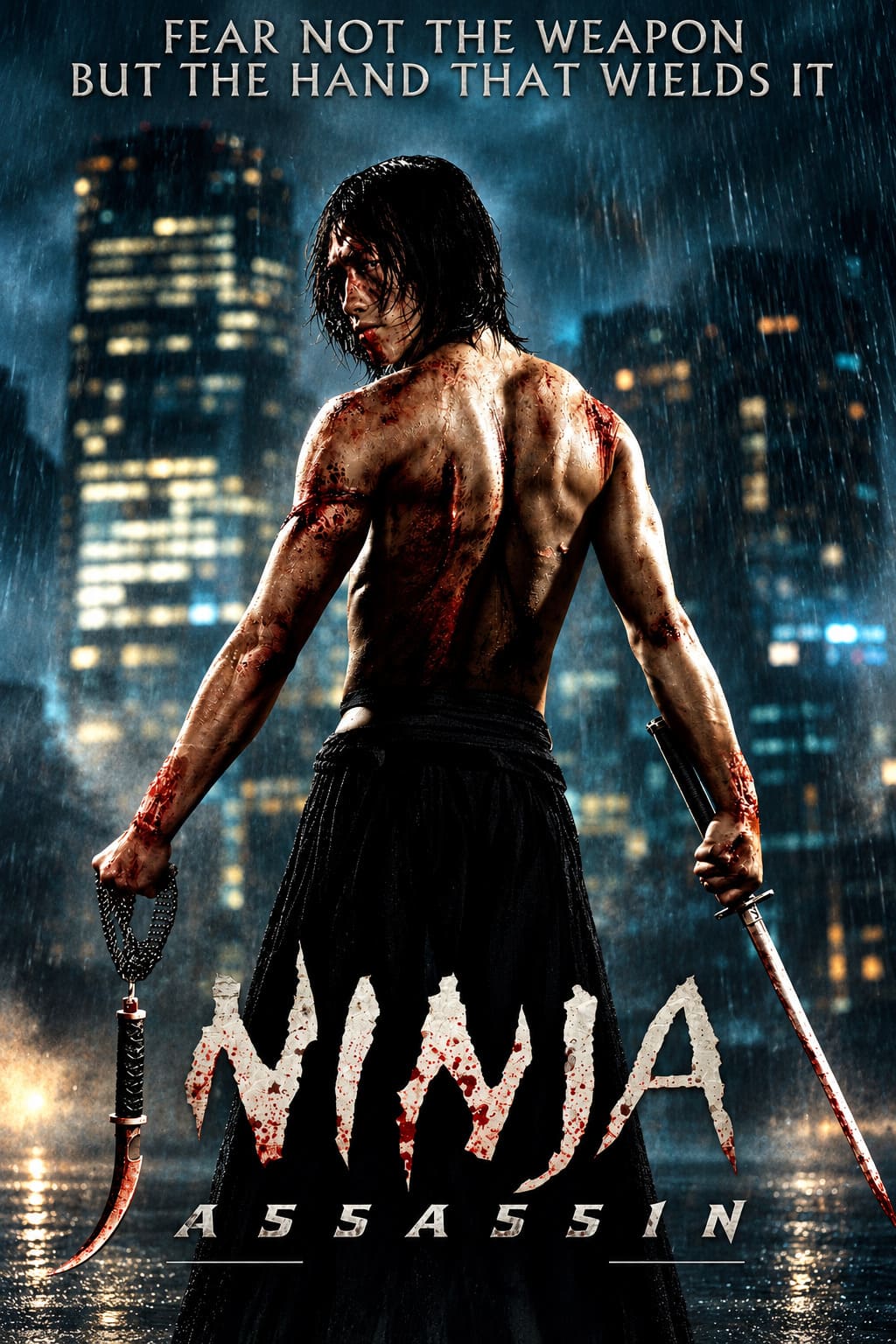
Review: Ninja Assassin (dir. by James McTeigue)


“This is not my family. You are not my father. And the breath I take after I kill you will be the first breath of my life.” — Raizo

Watching Ninja Assassin feels a little like stumbling onto a late-night cable movie that has been given a much bigger budget, a larger blood supply, and zero interest in restraint. It is a blood-soaked, over-the-top revenge movie about a superhuman killer carving his way through an army of shadowy cult ninjas, and it wants blades, bodies, darkness, shredded limbs, dramatic training flashbacks, and a hero so physically intimidating that the camera occasionally seems to pause just to admire how absurdly ripped he is. It is loud, grimy, excessively violent, and frequently ridiculous. It is also, depending on your tolerance for late-2000s CGI carnage and ultra-serious ninja mythology, a pretty entertaining slice of trashy action cinema.

The film stars Korean pop superstar Rain as Raizo, a prodigiously gifted killer raised by the Ozunu Clan, a secret organization that turns stolen children into elite assassins. Raizo is trained from childhood to erase fear, reject compassion, and become basically invisible in the darkness. The clan’s motto might as well be “trauma builds character,” because every flashback involves some new level of horrifying abuse: children fighting one another, training through severe pain, learning to tolerate wounds, and being punished for even the smallest sign of vulnerability. It is all delivered with the straight-faced intensity of a dark comic book, which is probably the best way to approach the movie as a whole.

The present-day story follows Raizo after he breaks from the Ozunu Clan and goes rogue. His target is Lord Ozunu, played by genuine ninja-film legend Sho Kosugi, who runs the entire organization like a supernatural military cult. Raizo’s path crosses with Mika Coretti, played by Naomie Harris, a Europol researcher in Berlin who discovers evidence that a string of political assassinations may be connected to an apparently mythical network of ninja killers. Naturally, nobody believes her, because this is a movie where the phrase “ninja assassins are real” is treated with the same bureaucratic skepticism as an expense-report discrepancy. Once Mika gets too close to the truth, the Ozunu Clan sends people to remove her from the equation, and Raizo enters the picture as both protector and revenge machine.

The plot is not really the point, but it does enough to move the movie from one stabbing to the next. Ninja Assassin has the basic shape of a revenge story, with Raizo torn between the brutal identity he was given and the humanity he is trying to reclaim. The flashbacks fill in his childhood bond with Kiriko, another member of the clan who pays the price for refusing to fully submit to Lord Ozunu’s cruelty. That loss becomes the emotional engine for Raizo’s rebellion, and while the movie does not exactly dig deep into the character’s psychology, it gives Rain a clear enough motivation to work with. He is not just killing bad guys because the script needs more bodies on the floor. He is trying to destroy the institution that made him into a weapon.

Rain is honestly one of the movie’s biggest strengths. He does not have to carry the film through nuanced dialogue or complicated dramatic scenes, and that is probably for the best, because the screenplay does not give him much room for that kind of performance. But he has undeniable screen presence. He looks the part, moves like someone who trained brutally for it, and sells the physical exhaustion of a man who has spent his whole life getting cut, beaten, stabbed, and forced to keep moving anyway. The movie’s action depends on Raizo feeling almost superhuman without becoming completely weightless, and Rain finds that balance most of the time. He is less a conventional action hero than a human weapon who has finally decided to aim himself at the people who built him.

Sho Kosugi is also a welcome presence as Lord Ozunu. He does not get a huge amount of screen time, but he has the kind of weathered, stern authority that makes the role work. Lord Ozunu is not a layered villain; he is an evil master who talks in cold pronouncements about weakness and loyalty, tortures his students, and commands legions of black-clad killers. Still, Kosugi makes him feel more substantial than the usual disposable martial-arts-movie villain. His involvement also gives Ninja Assassin a connection to the ninja-cinema boom of the 1980s, when Kosugi was one of the genre’s biggest names. The film feels like it is trying to combine that old-school ninja-movie sensibility with the slick, digital, hyperviolent style that came out of the Matrix era.

That connection makes sense given the people behind the movie. McTeigue had previously directed V for Vendetta and worked closely with the Wachowskis, who produced Ninja Assassin alongside Joel Silver. You can feel that late-1990s and 2000s action aesthetic all over it: cold blue lighting, rain-slick streets, rapid editing, wire-assisted movement, slow-motion impacts, and CGI blood that erupts in fountains whenever a blade touches skin. The action is often designed less around realism than around visual impact. A ninja does not just stab somebody; he slices through them with enough force to send gallons of digital blood spraying across the frame. Arms come off. Heads come off. Bodies are carved up so thoroughly that the movie sometimes feels like a slasher picture with martial-arts choreography.

When Ninja Assassin is working, that excess is part of the fun. The early sequence in a Bangkok nightclub is a strong example. Gangsters laugh at the idea that ninjas exist, and then the lights go out. Bodies start falling apart in the darkness while unseen attackers move through the room. It is silly, but it is exactly the kind of silly the movie needs to be. The clan’s assassins are framed less like ordinary people than horror-movie monsters: they emerge from shadows, disappear into smoke, and leave mutilated corpses behind. The best moments make ninja combat feel supernatural and frightening rather than simply athletic.

The problem is that the movie sometimes sabotages its own action with its visual style. It is extremely dark, often to the point that it becomes hard to tell who is hitting whom. The rapid editing can also make fights feel more like a blur of limbs, blades, and blood splatter than a clearly staged exchange. There are sequences where the choreography seems like it could be impressive if the camera would just pull back and let the audience see it. Instead, McTeigue often keeps everything moving so fast that the action loses some of its physical clarity. This is particularly frustrating because the film clearly put real effort into Rain’s training and the stunt work.

The CGI is another mixed bag. At times, the exaggerated gore has a knowingly cartoonish quality that fits the movie’s pulpy tone. At other times, it looks like a video-game cutscene from the late 2000s, especially when blood splashes directly toward the camera. The film wants to be nasty and visceral, but the artificial effects can create distance rather than impact. You are rarely shocked by the violence because it is so obviously constructed as spectacle. Then again, nobody should go into a film called Ninja Assassin expecting the sober realism of The Bourne Identity. This is a movie where shadow ninjas attack police officers with chains, blades, and explosive acrobatics. Subtlety was never invited.

Naomie Harris does what she can with Mika, though the character is written mostly as the audience’s entry point into the ninja conspiracy. She gets some decent moments of determination and disbelief, but the film does not give her nearly as much agency as it should. Once Raizo arrives, Mika increasingly becomes someone who needs to be rescued, protected, and dragged through the story’s bloodier sections. Ben Miles is fine as her superior, Ryan Maslow, but the Europol material is the least exciting part of the film. Whenever it cuts away from Raizo’s training, his revenge, or another batch of black-clad assassins, the energy drops.

Still, there is something oddly admirable about how committed Ninja Assassin is to its own trashy premise. It does not pretend to be a prestige thriller, a grounded espionage drama, or a sophisticated martial-arts epic. It is a hard-R revenge movie built around a simple promise: Rain versus an army of ninjas. On that level, it delivers enough mayhem to satisfy viewers who enjoy excessively violent action movies and do not need the script to be smarter than the title.

Ninja Assassin is not a hidden masterpiece, and it has plenty of flaws: thin characters, clunky dialogue, uneven CGI, murky camerawork, and a plot that exists mainly to connect the fight scenes. But it has a strong lead, a memorable villain, a few genuinely cool action-horror moments, and an unapologetically ridiculous energy. It is best enjoyed as a guilty-pleasure throwback to the era when Hollywood action movies believed every problem could be solved with a black mask, a sword, and several gallons of CGI blood.
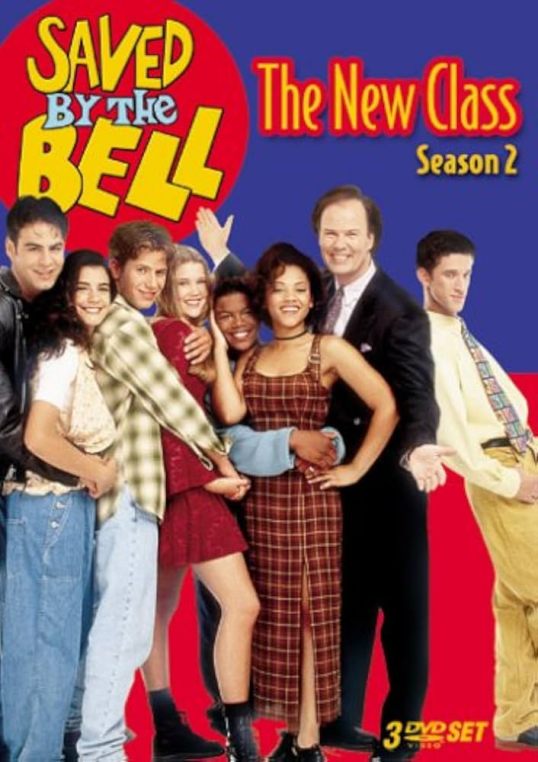

Retro Television Review: Saved By The Bell: The New Class 2.20 “Drinking 101”


Welcome to Retro Television Reviews, a feature where we review some of our favorite and least favorite shows of the past!  On Tuesdays, I will be reviewing Saved By The Bell: The New Class, which ran on NBC from 1993 to 2o00.  The show is currently on Prime.

It’s time for the Bayside Gang to learn a lesson!

Episode 2.20 “Drinking 101”

(Dir by Don Barnhart, originally aired on November 19th, 1994)

It’s school trip time!  Mr. Belding, Screech, the Gang, and a bunch of anonymous Bayside students are spending a week at a ski lodge!

Rachel thinks the ski lodge is romantic but Brian doesn’t care about any of that.  He just wants to ski.  (“I have not skied since I lived in Switzerland,” he says and, for not the first time, I find myself wondering if the show is ever going to explain why he no longer lives in Switzerland.) Lindsay wants to go to a frat party, even if it means lying and saying that she’s a college student.  And Mr. Belding …. he just wants to survive.

It won’t be easy because Belding sprains his ankle as soon as he arrives at the ski lodge.  “My chief!” Screech yells in an early use of the falsetto that will define his character in later seasons.  Belding is supposed to stay off his ankle so, of course, Screech keeps tripping over him and dragging him up the slopes.  As a dancer, I more than know the pain of a sprained ankle and the scenes of Screech reinjuring Belding’s ankle did not make me smile.

While Screech throws a party for Mr. Belding, Lindsay, Rachel, and Megan sneak into a frat party so they can meet some boys.  (Yes, Rachel is dating Brian but she’s mad because all he wants to do is ski.)  Tommy, Bobby, and Brian soon end up at the same party.  Lindsay gets drunk.  Tommy gets drunk.  Tommy rides off on a skimobile and later has an accident.

Lesson learned!

Tommy has a broken leg.  His parents could totally sue the school district for not keeping an eye on him during a school trip.  Screech trips over Tommy’s cast, causing Tommy incredible pain.  Belding tells Lindsay and Tommy that they shouldn’t have been drinking and then he tells Rachel, Brian, Megan, and Bobby that they shouldn’t have let Lindsay and Tommy drink.  Hey, Belding, maybe you should have brought along more adults so they could keep an eye on the students.

Myself, I rarely drink because my tolerance for alcohol is pathetically low.  Still, I have to say that I found it funny that Lindsay woke up with the “worst hangover ever!” even though she only had two beers.  Even with my low tolerance, I’ve never had a hang over.  From my experience, it would have been more realistic for Lindsay to throw up and then fall asleep on a yoga mat.

Anyway, this episode ends with Belding and Tommy recovering from their injuries, the rest of the Gang “grounded for the weekend,” and Screech skiing.  I was kind of hoping the episode would end with the ski lodge being revealed to be the one that Lorena’s father owned on California Dreams.  That would have been a cross-over to remember!

The big problem with this episode — and really, this is something that seem to happen in every Peter Engel-produced teen sitcom — is that the actors were obviously having way too much fun pretending to be drunk.  I mean, hangover or not, Lindsay seemed to be having a good time.

Go Team!!!


The MLB post-season is starting today and, with my Rangers not in contention, it’s time for me to pick a team to cheer for.

Usually, when the Rangers aren’t in the playoffs, I support the Astros because they’re the other team for Texas.  This year, though, there’s too many hard feelings.  I could justify cheering for the Rangers if they got into the post-season with an 81-81 record but I just can’t do it for the Astros.

When I can’t cheer for either the Astros or the Rangers, I usually cheer for whatever team is representing the South in the playoffs.  This season, that would appear to be the Braves but the Braves are a National League team and I just can’t bring myself to support the NL.

So, who am I supporting this year?

Congratulations, Tampa Bay!  I hope I’ll be cheering for you all the way through the World Series!

Go Rays!

Scenes That I Love: Naomi Watts in Twin Peaks: The Return


Yesterday was the birthday of the great Naomi Watts!

In this scene from 2017’s Twin Peaks: The Return, Watts tells off to low-level hoodlums who have been demanding money from her husband.

4 Shots From 4 Films: Special Nicolas Winding Refn Edition


4 (or more) Shots From 4 (or more) Films is just what it says it is, 4 (or more) shots from 4 (or more) of our favorite films. As opposed to the reviews and recaps that we usually post, 4 (or more) Shots From 4 (or more) Films lets the visuals do the talking.

Today, the Shattered Lens wishes a happy 56th birthday to Danish director Nicholas Winding Refn!  Drive was one of the first films to really be celebrated on this site, receiving reviews from several contributors.  Personally, I preferred The Neon Demon.

In honor of of the man and his work, it’s time for….

4 Shots from 4 Nicolas Winding Refn Films

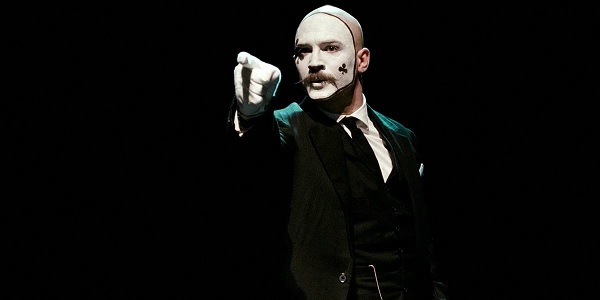
Bronson (2008, dir by Nicolas Winding Refn, DP: Larry Smith)

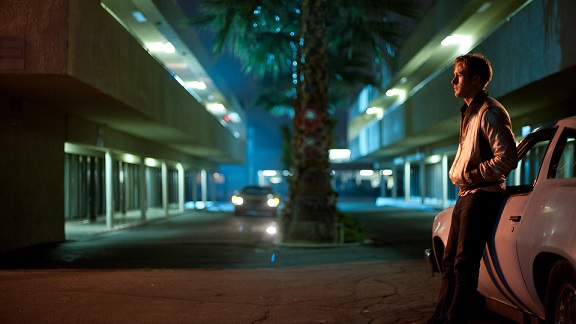
Drive (2011, dir by Nicolas Winding Refn, DP: Newton Thomas Sigel)

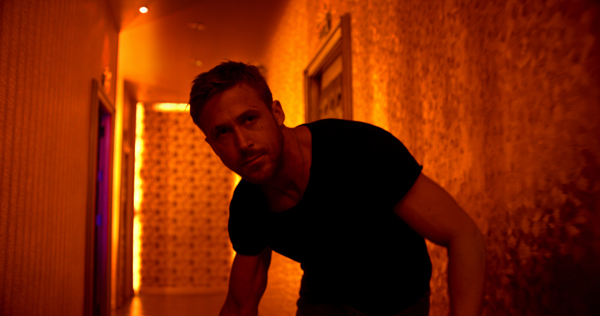
Only God Forgives (2013,dir by Nicolas Winding Refn, DP: Larry Smith)

The Neon Demon (2016, dir by Nicolas Winding Refn, DP: Natasha Braier)

Music Video of the Day: Obsession by Animotion (1985, directed by Amos Poe)


Obsession was originally written and recorded as a duet by Michael Des Barres and Holly Knight.  The original version was included in the soundtrack for a forgotten 80s film called A Night In Heaven, which featured Lesley Ann Warren as a professor who has an affair with one of her students, a male stripper played by Christopher Atkins.  The film was a flop but the song caught the attention of the band, Animotion.  Their cover version is not only the best-known version of the song but it was also Animotion’s biggest hit.

Directed by underground filmmaker Amos Poe, the video featured the band performing in front of a pool and in a luxury house while dressed up in different costumes.  Why Mark Anthony and Cleopatra?  Why Amelia Earhart and Rudolph Valentino?  Why not?  It was the 80s and cocaine was very popular.  The important thing is that both the video and the song came to epitomize an era.

I know this is running the risk of becoming a cliché but this is another song that I originally came to appreciate while playing Grand Theft Auto: Vice City.  It was the perfect song for going for a midnight joyride in a stolen car.  I crashed any number of vehicles into the ocean while listening to Animotion.

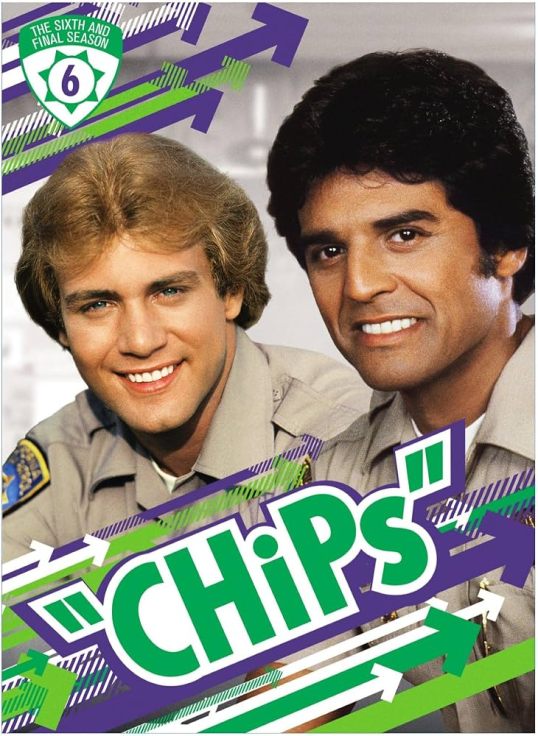
Late Night Retro Television Review: CHiPs 6.10 “Fallout”


Welcome to Late Night Retro Television Reviews, a feature where we review some of our favorite and least favorite shows of the past!  On Mondays, I will be reviewing CHiPs, which ran on NBC from 1977 to 1983.  The entire show is currently streaming on Prime!

This week, Bobby learns a lesson and the Getraer family has a crisis!

Episode 6.10 “Fallout”

(Dir by Nicholas Sgarro, originally aired on December 19th, 1982)

Ellen Getraer (Lynn-Holly Johnson), the never-before-mentioned daughter of Sgt. Getraer, has fallen in with a bunch of Episcopalians and is planning to protest a nuclear plant with them. The only problem is that the church bus has bad brakes, and it keeps causing accidents on the highway. Personally, I would have thrown that smarmy Rev. Porter (John Elerick) in prison, but instead the Highway Patrol just gives him a ticket at the first accident and, at the second, they help him and the protesters escape from their burning bus. (Ellen helps too.) At the end of the episode, both Porter and Ellen do get arrested while sitting in front of the nuclear plant, but they’re released soon afterwards. Sgt. Getraer is proud of his daughter for sticking up for what she believes in. And I’m sure he’ll probably remove the arrest from her record when no one’s watching.

This episode was actually more about Bobby Nelson learning how to control his temper while performing crowd control. At a training exercise, for instance, he throws a fit when Bruce brings up the name of his ex-girlfriend. All of this probably would have been more effective if we had previously seen any evidence of Bobby having any sort of temper. Ever since he was first introduced, Bobby has come across as something of a mellow airhead. Anyway, Bobby learns how to control that supposedly fearsome temper, and he does a good job at the nuclear protest. He makes his arrests politely and courteously. As a result, the plant workers (one of whom is played by a young Dennis “Mr. Belding” Haskins) can go to work.

The other big storyline was Ponch and Nelson arriving at the scene after young Louis Hindall (Adam Rich) is hit by a car. You would think this would be especially difficult for Ponch, seeing as how his fiancée was hit and killed by a drunk driver just two weeks ago. But Ponch never mentions her. Instead, he gets upset when he sees the bruises on Louis’s back and realizes that the boy is being abused by his mom’s new boyfriend, Hal (Paul Tulley).

Later, at the hospital, Hal overhears Ponch and Bobby talking about how Hal is an abuser, and he promptly takes off in his car. This leads to a high-speed chase and a fairly impressive stunt where Hal’s car somehow goes airborne and rolls across the top of a trailer. It’s kind of amazing that, while being chased by the cops, Hal’s first instinct was to turn into a lot full of cars that he could crash into.

Finally, upon learning that the LAPD has changed their height requirements, mechanic Harlan Arliss (played by 5’2″ Lou Wagner) puts in for a transfer. Unfortunately, he fails the physical because his eyesight isn’t 20/20. Ponch tells him that with the LAPD, he would have just been another cop. But with the Highway Patrol, he’s the world’s greatest mechanic. Awwww!

At one point, Ponch opens his locker and the inside of it is covered with pictures of women. But there’s no picture of his dead fiancée. Have you no heart, Ponch!?

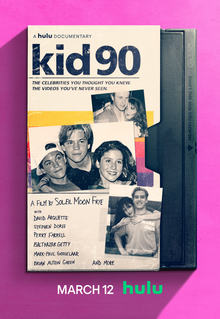
Documentary Review: Kid 90 (dir by Soleil Moon Frye)


First released in 2021, Kid 90 is a documentary about what it’s like to be rich, famous, and young.  Apparently, it sucks.  The time that it sucks the most is when you’re no longer a teenager and you’re looking back on on your past and trying to somehow shape it all into a coherent narrative.

The documentary was produced, directed, and written by Soleil Moon Frye, a former child actress who originally found fame in the early 80s as the star of a sitcom called Punky Brewster.  That show was a bit before my time but I do remember seeing her on that episode of Saved By The Bell where she pretended to like Screech for his spaghetti sauce money.  She’s also appeared in a few horror films, many of whom have found a second life in the streaming era.  The daughter of actor Virgil Frye (he was the creepy in security guard in Herb Freed’s Graduation Day), Soleil apparently started carrying a video camera around at a young age and was constantly filming her friends, who included people like Leonardo DiCaprio, Mark-Paul Gosselaar, Mark Wahlberg, David Arquette, Stephen Dorff, the skaters who appeared in Larry Clark’s Kids, and a host of others.  She also saved all of her diaries and her voicemails.  Kid 90 was assembled from those artifacts.  Soleil tells her story while discussing the pressures of being a young woman in Hollywood and being objectified when she was barely old enough to be considered a teenager.  She talks about drugs, sex, her friends who died young, and the unique trauma of growing up while the entire world watches and judges.  She talks about a relationship with an older man, who she doesn’t name even while pictures of her with Charlie Sheen appear on the screen.  What she doesn’t do is go into too much detail.

Indeed, while watching Kid 90, the main thing that struck me was how guarded everyone seemed to be, even in the candid footage that was shot when they were all teens.  Young Soleil asks her friends about their philosophy of life and none of them can come up with anything particularly interesting.  Instead, they all sound like their reading from a script that was handed to them by a publicist.  The voicemails that we hear are largely generic and uninteresting and, if not for the title card that accompanies each one, we would have no idea who was talking.  (There’s only so much meaning that one can wring out of, “Hey, just calling to see if you were around.”)  Yes, Leonard DiCaprio appears in a clip or two but DiCaprio also served as a producer on the film so you can be sure that those clips were very carefully selected.  In the present, a handful of actors talk about the process of going from being teen actors to adults.  Brian Austin Green talks about the first time that he realized that there were people who did not like him.  (His shock about the failure of his rap career is actually kind of poignant.)  David Arquette is goofy but honest when discussing his history of drug abuse.  Stephen Dorff is thoughtful.  Mark-Paul Gosselaar is likable but obviously careful about saying anything that could come back to haunt him.  (I’ve never seen Gosselaar give a bad interview, largely because he’s a master of revealing just enough without revealing too much.)  And then you’ve got poor Soleil, who struggles to assign some sort of bigger meaning to her youthful memories.  She obviously doesn’t want to be known as just another spoiled child actress but, when she shares footage of herself hanging out with a bunch of New York skaters, it’s hard not to see her as being anything other than a rich kid slumming.

(Not that’s anything wrong with that!  I did plenty of slumming when I was in college.)

In the end, Kid 90 is really about the innate human desire to take all of the random events of our life and shape them into some sort of grand narrative.  Unfortunately, life is never really that easy to explain or categorize.  No one in the film, Soleil included, really lets their guard down.  I can’t say that I blame them.