“You see, in this world there’s two kinds of people, my friend: those with loaded guns and those who dig. You dig.” — Blondie
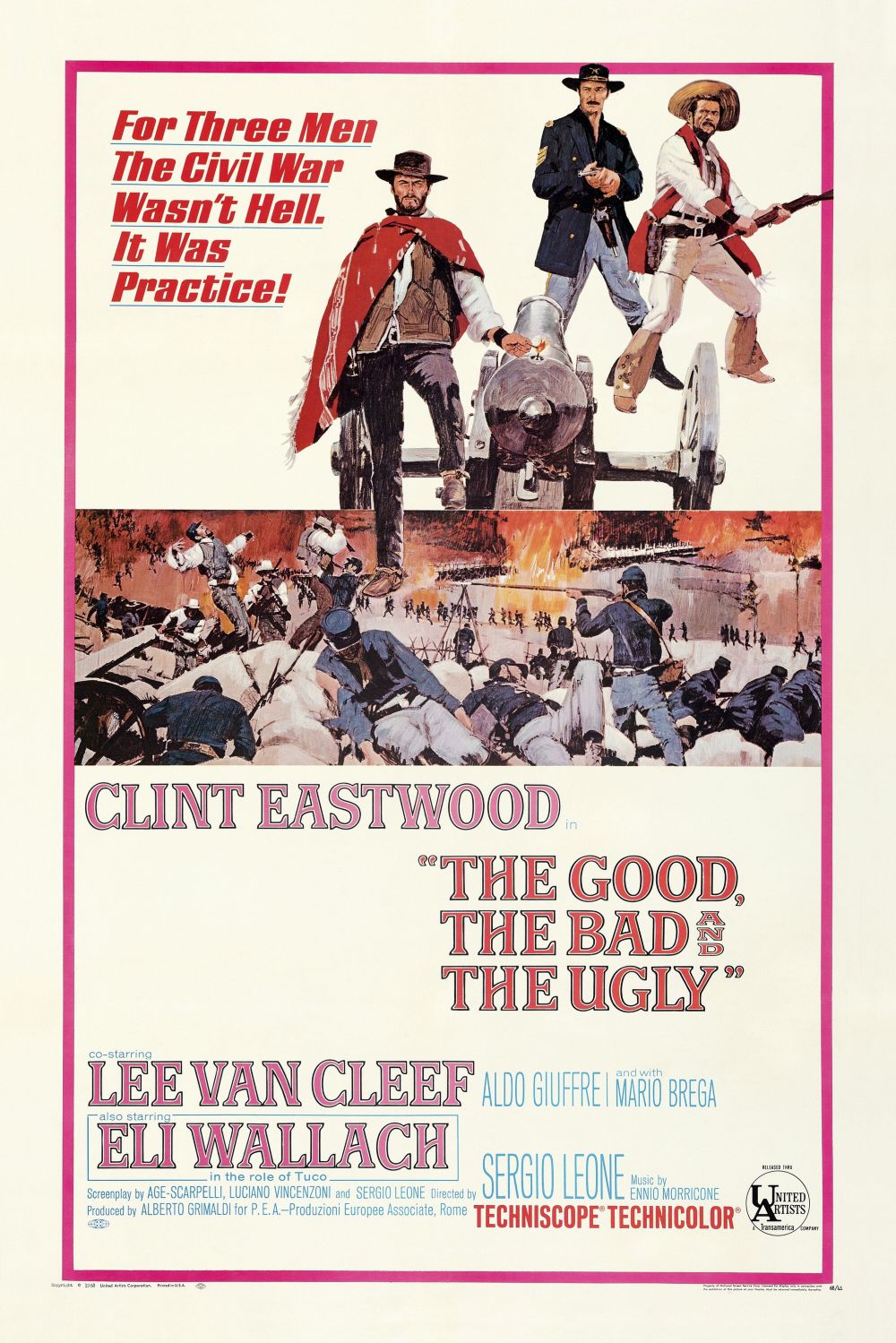
Sergio Leone’s The Good, the Bad and the Ugly is the kind of movie that feels so foundational that it can be easy to forget how strange, bold, funny, and downright operatic it still is. Released in 1966, it was the third and final leg of Leone’s “Dollar’s Trilogy,” following A Fistful of Dollars and For a Few Dollars More, and it takes the stripped-down antihero Western formula of those earlier films to its most grandiose extreme. It is bigger in scale, longer in runtime, more openly concerned with the Civil War, and more confident about lingering on faces, landscapes, corpses, explosions, and silences until they become almost mythic. It is also just an enormously entertaining movie: violent, cynical, hilarious, tense, and powered by one of the greatest scores ever written for film.
The title is simple, but the movie’s moral categories are deliberately slippery. Clint Eastwood plays Blondie, the “Good,” though he is not good in any conventional heroic sense. He is a mercenary drifter with a cool head, a quick draw, and a willingness to exploit the desperate when there is money involved. Lee Van Cleef is Angel Eyes, the “Bad,” a cold professional killer whose cruelty is more orderly and methodical than emotional. Eli Wallach, meanwhile, plays Tuco, the “Ugly,” a bandit, liar, survivor, and chaos agent who is arguably the most human person in the whole film. Leone uses those labels less as literal definitions than as a rough guide to the way each man moves through the world. Blondie may possess the closest thing the story has to a moral code, Angel Eyes is openly monstrous, and Tuco is shamelessly selfish, but all three are driven by greed and survival.
The plot begins with Blondie and Tuco running a scam across the frontier. Blondie collects bounties by turning Tuco in to authorities, then rescues him at the last possible moment before a hanging, allowing the two men to repeat the process elsewhere. Their partnership is profitable but unstable, especially because Blondie holds all the power. When he finally abandons Tuco in the desert after an argument, it sets the tone for the film’s shifting alliances and personal grudges. From there, the story expands into a hunt for buried Confederate gold, with Angel Eyes learning of the treasure independently and pursuing it with ruthless efficiency. The treasure hunt is the basic engine of the story, but the movie keeps finding detours that make it richer: prison camps, mistaken identities, Confederate soldiers, battlefield carnage, a destroyed bridge, family resentments, and a final trip to a cemetery that has become one of the most famous endings in cinema.
Leone’s great gift is making time itself feel dramatic. The movie is long, but it rarely feels aimless because the director understands how to stretch anticipation. He can hold a close-up for what seems like an eternity, cut between eyes and hands, let a character slowly realize they are trapped, and then release all that pressure in a flash of violence or a perfectly timed joke. The famous three-way standoff at Sad Hill Cemetery is the clearest example. It is not simply a gunfight. It is a miniature psychological war in which every glance matters, every hand movement becomes a potential death sentence, and Ennio Morricone’s music turns the scene into a kind of ritual. The sequence is so iconic because Leone earns it through buildup. He has spent nearly three hours teaching the audience that in this world, watching someone’s eyes can be more important than hearing what they say.
The direction is often described as stylized, but that undersells how carefully Leone balances visual exaggeration with emotional clarity. His close-ups are huge and intimate, showing cracked skin, sweat, stubble, narrowed eyes, and crooked grins in almost absurd detail. Then he will cut to an enormous wide shot in which a lone person barely registers against a desert, battlefield, or cemetery. That contrast makes the characters feel both larger than life and insignificant before the violence surrounding them. Leone’s West is not the clean, heroic frontier found in many older Hollywood Westerns. It is dusty, harsh, crowded with hungry people, and full of soldiers dying for causes that seem distant from their actual suffering. Even when the movie is funny, its world feels unforgiving.
The Civil War setting gives The Good, the Bad and the Ugly a weight that the earlier films in the trilogy do not have in quite the same way. Leone does not transform the picture into a historical drama, and the central story remains about three men chasing money, but he keeps placing their selfish adventure against the machinery of mass death. Blondie and Tuco witness prisoners being beaten, soldiers dying pointlessly, and whole military operations built around the destruction of a bridge. One of the film’s most memorable passages involves a Union captain who has become numb to the casualties under his command. His view of war is not glorious or triumphant; it is weary and sickened. That attitude makes Leone’s spectacle more complicated. The explosions are impressive, and the battle scenes are visually massive, but the movie never suggests that war is noble simply because it looks grand on screen.
Clint Eastwood’s performance is a major reason Blondie remains one of cinema’s defining gunslingers. Eastwood had already established the character type in the previous Leone films, but here he seems fully at ease with the role’s economy. He does not need much dialogue because his posture, timing, and faintly amused stare communicate almost everything. Blondie is always calculating. Even when he appears relaxed, he is noticing the exit, the weapon, the weakness in the other person’s plan. Eastwood makes him cool without making him hollow, and he wisely avoids trying to turn Blondie into a conventional saint. The character can be compassionate, especially compared with Angel Eyes, but he also enjoys having leverage over Tuco. Their relationship is not friendship in any easy sense. It is an ugly, funny bond forged out of mutual usefulness.
Lee Van Cleef is equally effective, though in a very different register. Angel Eyes is terrifying because he never seems hurried or uncertain. He treats murder as a job, and his calm politeness only makes him worse. There is a scene early in the movie where he murders a man after receiving information from him, and the point is immediately clear: Angel Eyes does not make promises he considers inconvenient, and he does not feel guilty about it. Van Cleef’s sharp features and measured delivery make him seem almost supernatural, like death walking around in a black hat. Yet he is not a cartoon. He is a predator with discipline, and the movie understands that competence can be frightening on its own.
Still, Eli Wallach is arguably the film’s secret weapon. Tuco is the character who gives the movie much of its energy, humor, and emotional unpredictability. He is loud where Eastwood is quiet, messy where Van Cleef is controlled, and constantly talking because silence would probably drive him crazy. Wallach gives a performance that could have become exhausting in lesser hands, but he makes Tuco vivid rather than merely obnoxious. You can see the intelligence beneath his impulsiveness. Tuco survives because he can adapt, plead, threaten, deceive, and explode into violence depending on what the moment requires. He also has flashes of pain that make him more than comic relief, particularly when the story briefly brings him face to face with his brother and the life he might have had. That scene gives the movie an unexpected emotional wrinkle without forcing Tuco into a redemption arc he does not deserve.
Morricone’s score deserves its legendary reputation because it does much more than decorate the action. The music creates the film’s atmosphere from the first seconds, with its coyote-like call, whistles, percussion, voices, and electric-guitar edge. It sounds ancient and modern at the same time, perfectly suited to Leone’s version of the West, which is less historical recreation than fever dream. Themes such as “The Ecstasy of Gold” and “The Trio” have become inseparable from the film, but they retain their power even outside their famous scenes. “The Ecstasy of Gold,” accompanying Tuco’s frantic run through the cemetery, is especially remarkable. The music turns what could have been a simple moment of greed into a spiritual experience. Tuco is not merely looking for a grave; he is racing through a landscape of death toward the possibility of salvation, wealth, and survival.
What makes the movie endure is that it never asks the audience to choose between pleasure and substance. It is a masterpiece of style, full of unforgettable faces, brilliant editing, enormous landscapes, and some of the sharpest visual storytelling in the genre. At the same time, it is funny in a dark, mean-spirited way, and it is skeptical about every institution around its characters. Governments send men to die. Criminals betray one another. Families fail to heal old wounds. Religion offers comfort but not necessarily rescue. Money remains the closest thing to a shared religion, and even that cannot guarantee anyone’s safety.
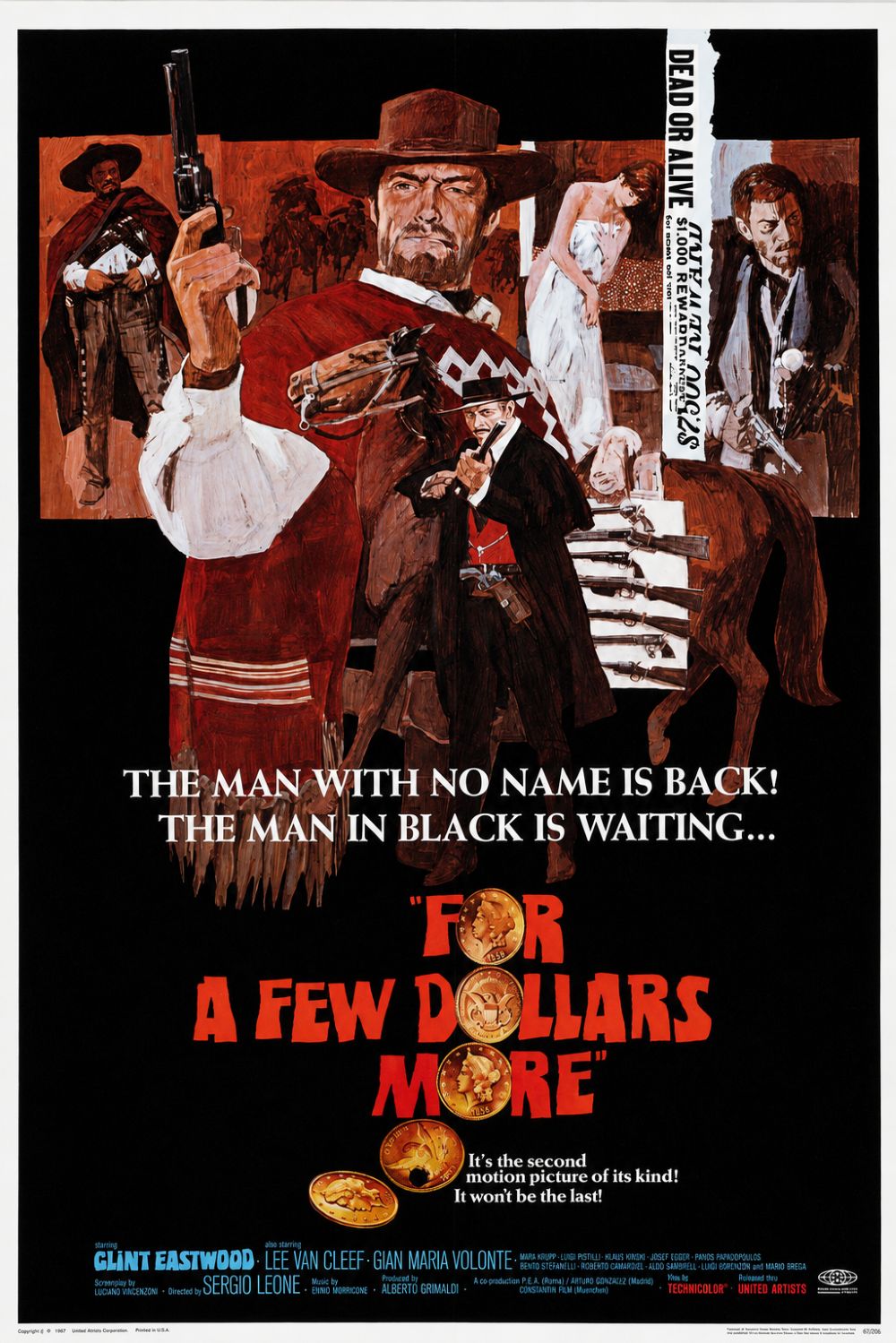
As the final installment of Leone’s “Dollar’s Trilogy,” The Good, the Bad and the Ugly feels like a culmination rather than just a sequel. It takes the mysterious Eastwood gunslinger, the tension between rival bounty hunters and criminals, and the morally barren frontier of the first two films, then expands them into something almost epic. The movie’s scale can make it feel less intimate than For a Few Dollars More, but that is part of its appeal. Leone is not trying to make a neat ending to a continuous story. He is making the biggest, loudest, most definitive statement he can with the ideas the trilogy has been building toward.
Even now, the film’s influence is everywhere: in action movies that use silence as suspense, in antiheroes whose morality is relative rather than pure, in directors who treat a showdown as choreography, and in scores that become characters in their own right. But influence is not the same as replacement. Plenty of movies have copied Leone’s close-ups, pacing, gunfighters, and musical bravado. Very few have matched the strange balance that makes The Good, the Bad and the Ugly feel so alive. It is simultaneously a Western adventure, a black comedy, a war movie, a fable about greed, and a giant cinematic performance piece. By the time the final duel arrives, the film has become exactly what the title promises: a collision between the good, the bad, and the ugly parts of human nature, staged with enough style to make it unforgettable.