However, it might be nice if they had been. It would certainly put a lot less pressure on me. Here we are — it’s September and the Oscar race is still largely up in the air. Hopefully, the picture will start to become a bit more clear over the next few weeks. For instance, Beasts of No Nation was just acclaimed at the Venice Film Festival and, as I write this, we are just a few days into the Toronto Film Festival.
But for now, it still looks like it is anyone’s race to win!
Below are my predictions for September! If you want to see just how confused I’ve been (and how random my predictions have occasionally been) for the majority of the year, be sure to check out my predictions for January, February, March, April, May, June, July, and August!
Well, here we are. The year is more than halfway over. The fall movie season is approaching. And yet, not a single true Oscar front-runner has yet to emerge. Could this be the year that a true populist hit, like Mad Max: Fury Road, or an unexpected art house wonder, like Ex Machina, manages to secure a spot?
Well, probably not. But still, it’s fun to speculate!
(Are Oscar pundits being too quick to dismiss Straight Outta Compton? I have not seen it yet but look at those reviews and look at that box office. It’s an interesting question.)
Anyway, here are my prediction for August! To see how my thinking has evolved over the year, check out my predictions of January, February, March,April, May, June, and July!
Here’s the trailer for the latest David O. Russell/Jennifer Lawrence/Bradley Cooper/Robert De Niro film, Joy!
Joy is scheduled to be released in December, just in time for Oscar consideration and, judging from this trailer, it looks like it may just get it. After watching this, Joy has gone from being a film that I was barely aware of to being one of my most anticipated films of the year.
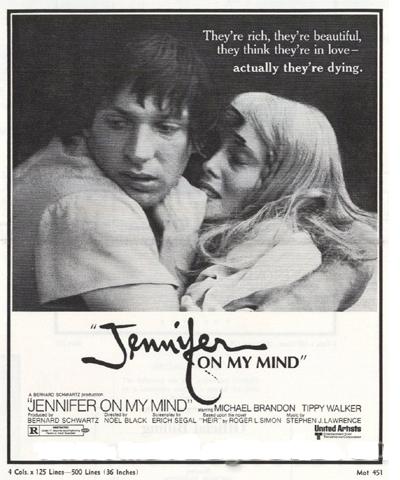
The 1971 film Jennifer On My Mind opens with a lengthy montage of black-and-white photographs of immigrants arriving at Ellis Island. These, the film tells us, are the men and women who came to America with nothing and who fought and struggled to have something. The film itself deals with the grandchildren of those immigrants, who, as opposed to their ancestors, now have everything and who seem to be determined to reduce it all down to nothing.
24 year-old Marcus Rottner (Michael Brandon) would appear to have everything. Following the death of his father, Marcus has inherited the fortune that his immigrant grandfather earned. (The ghost of his grandfather shows up at one point and smokes a joint.) Marcus will never have to work a day in his life, owns a nice apartment, and can go to Europe whenever he feels like it. However, Marcus does have one problem: his girlfriend Jennifer (Tally Walker) just died of a heroin overdose in his living room. Now, Marcus has to try to dispose of the body without anyone discovering what has happened.
The film alternates between showing Marcus’s attempts to get ride of Jennifer’s body and flashbacks to his romance with her. We see how he first met Jennifer in Venice and how he fell in love with her. Like Marcus, Jennifer comes from a rich family. Her parents are alive but we never see them. (Reportedly, scenes were filmed that featured Kim Hunter as Jennifer’s mother but they were cut after a disastrous preview.) As she leaves Venice, Jennifer tells Marcus to visit her back in the states.
Which is just what Marcus does. Marcus and Jennifer’s relationship plays out like a romantic comedy, except for the fact that Jennifer doesn’t really seem to care that much for Marcus. After Jennifer jumps off a roof, Marcus takes her back to Venice and tries to recreate their earlier romance. However, Jennifer just wants to go back to New York…
About ten minutes into the film, I nearly stopped watching Jennifer On My Mind. Both Marcus and Jennifer seemed like such unlikable characters that I couldn’t imagine spending a full 90 minutes with them. The fact that they were both rich and spoiled didn’t help.
But I kept watching because the first part of the film was set in Venice and I love Venice! Watching those scenes reminded me of visiting Italy the summer after I graduated from high school. It was a great time and, despite how I felt about Marcus and Jennifer, the film still brought back some nice memories.
However, then Marcus and Jennifer returned to New York and, since I don’t really care about New York the way that I care about Venice, I again found myself tempted to stop watching. However, it was around this time that I started to realize that Michael Brandon was actually giving a pretty good performance in the role of Marcus. So, I decided to keep giving the film a chance.
And then the ghost of Marcus’s grandfather showed up. And then, the film gave us a scene of Jennifer hanging out with the two traveling “minstrels.” And I thought to myself, “This is getting unbearably cutesy…”
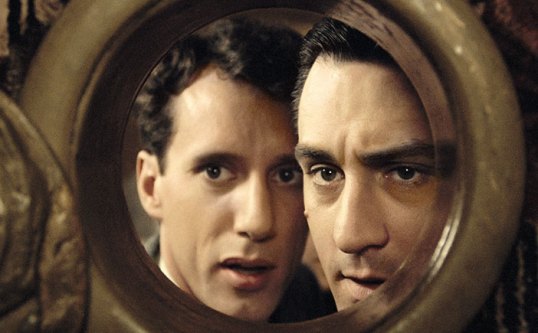
But then, Robert De Niro showed up! That’s right — Jennifer On My Mind is an early De Niro movie. When Marcus hails a cab and asks for a ride to Long Island, the taxi driver is played by none other than Robert De Niro. And while De Niro is only in the film for a few minutes, he totally steals those few minutes. He plays a “gypsy” cab driver in this film and, as he drives Marcus to Long Island, he rambles about his sister, his drugs, and his fear of driving Marcus to see a bunch of “squares.” De Niro is such an eccentric and energetic presence that he brings the whole film to life.
After De Niro’s scene, there was only 30 minutes left in the film and I thought to myself, “Okay, I can give this another 30 minutes…”
Written by Love Story‘s Erich Segal and directed by Pretty Poison‘s Noel Black, Jennifer On My Mind is an uneven but oddly watchable film. If you’re looking for quirky love story … well, I really can’t recommend Jennifer On My Mind because it never really convinces you that Marcus and Jennifer are in love. For the most part, their relationship seems to be one of convenience. Jennifer wants drugs and Marcus can afford them. Marcus wants a girlfriend and Jennifer is willing to pretend. Instead, Jennifer On My Mind is more like a parody of true romance. Marcus spends the entire film wanting Jennifer’s body and now that he has it, he has to find a way to get rid of it.
It’s undeniably uneven; for every scene that works, there’s another one that doesn’t. But, at the same time, it’s undeniably watchable. Plus, you get an early performance from Robert De Niro!
Jennifer On My Mind is currently available to viewed on Netflix.
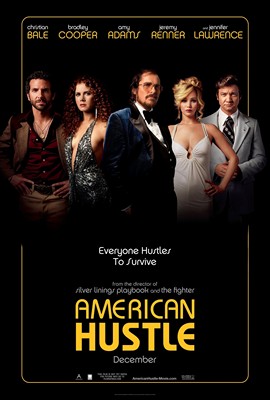
I have always been surprised by how much some people hate the 2013 best picture nominee, American Hustle. Even two years after the film was first released, you’ll still find people whining that the film felt like David O. Russell’s attempt to remake Goodfellas (yes, I have actually seen more than a few people online making this idiotic claim) or claiming that the movie was overrated or that there wasn’t anyone in the film that they could root for. While every film has its detractors, I’m always a little bit taken aback by just how passionately some people dislike this film.
Some of it, of course, is because the film that beat American Hustle for best picture was the universally acclaimed 12 Years A Slave. As hard as it may seem to believe now, there were a lot of people who thought that American Hustle might actually beat 12 Years A Slave. Strangely enough, a lot of online film bloggers tend to take a Manichaen approach to the Oscars, viewing each year’s race in terms of good and evil. The film that they want to win represents good and, therefore, every competing film must represent evil. It’s a pretty stupid and immature way of looking at things but, then again, the stupid and immature approach has worked pretty well for Sasha Stone and Ryan Adams over at AwardsDaily.com so who am I to criticize?
Of course, I don’t think it’s a coincidence that the majority of American Hustle‘s most strident online critics have been male. I imagine that they watched the film and, in Amy Adams and Jennifer Lawrence, they saw every unresolved crush of their adolescence. When Amy Adams successfully fooled Christian Bale and Bradley Cooper, these critics saw themselves being fooled. When Jennifer Lawrence called Bale a “sick son of a bitch,” these critics felt that they were being called a sick son of a bitch. American Hustle is a film about men who don’t know how to talk to women and that probably struck a little too close to home for a lot of those online critics.
(I imagine that the majority of online American Hustle haters probably preferred Rooney Mara’s version of the Girl with the Dragon Tattooto Noomi Rapace’s.)
Of course, the truth of the matter is that American Hustle was one of the best films of a very good year. Of all the films nominated for best picture of 2013, American Hustle was my personal favorite.
Based, very loosely, on true story, American Hustle is a period piece. It takes place in the late 70s, which of course means that we get a lot of great music, a scene in a disco, and clothes that are both somehow ludicrous and to die for at the same time. It’s a glamorous film about glamorous people doing glamorous and not-so-glamorous things and how can you not love that?
Irving (Christian Bale, giving a brave performance) is a generally nice guy who also happens to be a con artist. His unlikely partner is Sydney (Amy Adams), a former stripper turned Cosmo intern. When Sydney is working with Irving, she takes on a totally different identity and tells people that she’s Lady Edith Greensly, a British aristocrat who has international banking connections. When Sydney plays Edith, she speaks in a posh British accent and what’s interesting is that her accent is often (deliberately) inconsistent. However, as Irving points out, it doesn’t matter whether her accent is a 100% convincing or not. What’s important is that people want her to be Lady Edith Greensly and people will make excuses for almost anything as long as it confirms what they want to believe.
Eventually, Irving and Sydney are arrested by ambitious and highly strung FBI Agent Richie DiMaso (Bradley Cooper). Richie, who spends a good deal of the film with curlers in his hair, lives with his mother and has a boring fiancée who he doesn’t seem to like very much. (Richie is also briefly seen sniffing coke, which might explain a lot of his more extreme behavior.) Richie wants to make a name for himself and he views Irving and Sydney as his way to do so. He blackmails them into helping him set up and arrest crooked politicians and businessmen. Richie also finds himself growing obsessed with Sydney, who he believes to be English even after she tells him that she isn’t.
All of this eventually leads to Irving and Richie setting up the Mayor of Camden, New Jersey, Carmine Polito (Jeremy Renner). Polito, who may be corrupt but who also seems to sincerely care about helping the citizens of his town, wants to revitalize gambling in Atlantic City. Irving and Richie introduce him to FBI agent Paco Hernandez (Michael Pena), who is disguised as Sheik Abdullah and who they claim is interested in investing in Carmine’s plans. This, of course, leads to a meeting both with a local Mafia don (Robert De Niro) and with several politicians who agree to help out the Sheik out in exchange for money.
Complicating things is the fact that Irving himself comes to truly like the generous and big-hearted Carmine and how can you not? When the film was first released, Jeremy Renner was a bit overshadowed by Bale, Cooper, Adams, and Jennifer Lawrence. However, Renner gives the best performance in the film, playing Carmine with a disarming mix of innocence and shrewdness. He’s the type of guy who is smart enough to walk out on the first meeting with the fake sheik’s associates but who is still naive enough that he can be charmed by Irving. When the fake sheik gives Carmine an equally fake knife as a gift, the look of genuine honor on Carmine’s face is heart-breaking.
The other big complication is Irving’s wife, Rosalyn (Jennifer Lawrence). Rosalyn is jealous, unstable, unpredictable, and, in her own way, one of the smarter people in the film. She’s also a bit of pyromaniac and, when she accidentally blows up a new microwave, you’re really not surprised. (And, when Rosalyn starts to obsessively clean the house while singing Live and Let Die at the top of her lungs, I felt like I was watching a blonde version of myself.) When Rosalyn starts to have an affair of her own, it leads to American Hustle‘s satisfying and twisty conclusion.
(Again, a lot of the same online toadsuckers who irrationally hate American Hustle seem to hold a particular contempt to Jennifer Lawrence’s performance in this film, as if to acknowledge that Lawrence — as always — kicks ass would somehow be a betrayal of Lupita Nyong’o’s award-winning performance in 12 Years A Slave.)
Don’t listen to the haters. American Hustle is a great film, a stylish and frequently funny look at politics, corruption, and the ways that people con themselves into believing what they want and need to be true.
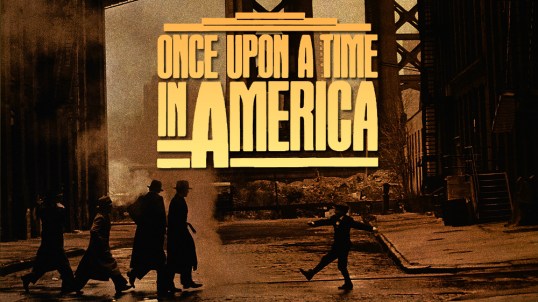
Before I start this review of Sergio Leone’s 1984 gangster epic, Once Upon A Time In America, I want to issue two warnings.
First off, this review is going to have spoilers. I’ve thought long and hard about it. Usually, I try to avoid giving out spoilers but, in this case, there’s no way I can write about this movie without giving away a few very important plot points. So, for those of you who don’t want to deal with spoilers, I’ll just say now that Once Upon A Time In America is a great film and it’s one that anyone who is serious about film must see.
Secondly, I’m not going to be able to do justice to this film. There’s too much to praise and too much going on in the film for one simple blog post to tell you everything that you need to know. Once Upon A Time In America is the type of film that books should be written about, not just mere blog posts. Any words that I type are not going to be able to match the experience of watching this film.
For instance, I can tell you that, much as he did with his classic Spaghetti westerns, Sergio Leone uses the conventions of a familiar genre to tell an epic story about what it means to be poor and to be rich in America. But you’ll never truly understand just how good a job Leone does until you actually see the film, with its haunting images of the poverty-stricken Jewish ghetto in 1920s New York and it’s surreal climax outside the mansion of a very rich and very corrupt man.
I can tell you that Ennio Morricone’s score is one of his best but you won’t truly know that until you hear it while gazing at Robert De Niro’s blissfully stoned face while the final credits roll up the screen.
I can tell you that the film’s cast is amazing but you probably already guessed that when you saw that it featured Robert De Niro, James Woods, Treat Williams, Danny Aiello, Joe Pesci, Burt Young, Tuesday Weld, Elizabeth McGovern, and Jennifer Connelly. But, again, it’s only after you’ve seen the film that you truly understand just how perfectly cast it actually is. Given the politics of Hollywood and the fact that he’s unapologetically critical of Barack Obama, it’s entirely possible that James Woods might never appear in another major motion picture. A film like Once Upon A Time in America makes you realize what a loss that truly is.
So, if you haven’t seen it yet, I encourage you to see it. Order it off of Amazon. Do the one day shipping thing. Pay the extra money, the film is worth it.
Much like The Godfather, Part II (and Cloud Atlas, for that matter), Once Upon A Time In America tells several different stories at once, jumping back and forth from the past to the present and onto to the future.
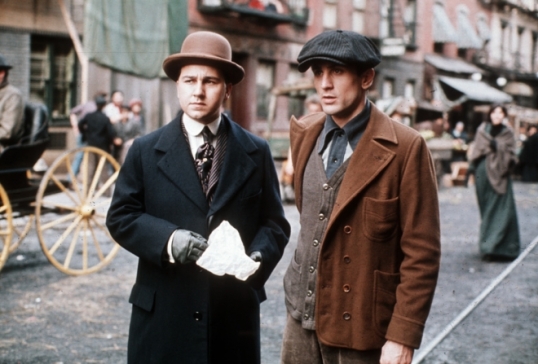
The film’s “past” is 1920. Noodles (Scott Tiler) is a street kid who lives in New York’s ghetto. He makes a living by doing small jobs for a local gangster and occasionally mugging a drunk. He’s also the head of his own gang, made up of Patsy (Brian Bloom), Cockeye (Adrian Curry), and Dominic (Noah Moazezi). Despite his rough edges, Noodles has a crush on Deborah (Jennifer Connelly), a refined girl who practices ballet in the back of her family’s store. When Nooldes meets Max (Rusty Jacobs), the two of them become quick friends. However, their criminal activities are noticed by the demonic Bugsy (James Russo), who demands any money that they make.
The film’s “present” is 1932. Noodles (Robert De Niro) has spent twelve years in prison and, when he’s released, he discovers that some things have changed but some have remained the same. Max (James Woods), Cockeye (William Forsythe), and Patsy (James Hayden) are still criminals but they’ve prospered as bootleggers. Occasionally, they do jobs for a local gangster named Frankie (Joe Pesci) and sometimes, they just rob banks on their own. During one such robbery, they meet a sado-masochistic woman named Carol (Tuesday Weld), who quickly becomes Max’s girlfriend.
As for Noodles, he continues to love Deborah (Elizabeth McGovern). But, when he discovers that she’s leaving New York to pursue a career as an actress, he reveals his true nature and rapes her. It’s a devastating scene — both because all rape scenes are (or, at the very least, should be) devastating but also because it forces us to ask why we expected Noodles to somehow be better than the men who surround him. After spending nearly two hours telling ourselves that Noodles is somehow better than his friends and his activities, the movie shows us that he’s even worse. And, when we look back, we see that there was no reason for us to believe that Noodles was a good man. It’s just what we, as an audience, wanted to believe. After all, we all love the idea of the romanticized gangster, the dangerous man with a good heart who has been forced into a life of crime by his circumstances and who can be saved by love. In that scene, Once Upon A Time In America asks us why audiences continue to romanticize men like Noodles and Max.
As for the gang, they’re hired to serve as unofficial bodyguards for labor leader Jimmy O’Donnell (Treat Williams) and, in their way, help to found the modern American labor movement. (“I shed some blood for the cause,” Patsy says while showing off a huge bandage on his neck.) When fascistic police chief Aiello (Danny Aiello) needs to be taken down a notch, they kidnap his newborn son and hold him for ransom. (While pulling off this crime, they also manages to switch around all the babies and, as a result, poor babies go home with rich families and vice versa, neatly highlighting both the power of class and the randomness of fate.) However, the good times can’t last forever and, when prohibition is repealed, the increasingly unstable Max has to find a new way to make some money.
Finally, the film’s third storyline (the “future” storyline) takes place in 1967. Noodles has spent decades living under a false identity in Buffalo. When he gets a letter addressed to his real name, Noodles realizes that someone knows who he is. He returns to a much changed New York. Carol now lives in a retirement home. Deborah is an acclaimed Broadway actress. Jimmy O’Donnell is the most powerful union boss in America. Fat Moe’s Speakeasy is now Fat Moe’s Restaurant.
Once Noodles is back in town, he receives a briefcase full of money and a note that tells him that it’s an advanced payment for his next job. He also receives an invitation to a party that’s being held at the home of Christopher Bailey, the U.S. Secretary of Commerce.
Who is Secretary Bailey? He’s a shadowy and powerful figure and he’s also a man who is at the center of a political scandal that has turned violent. And, when Noodles eventually arrives at the party, he also discovers that Secretary Bailey is none other than his old friend Max.
How did a very Jewish gangster named Max transform himself into being the very WASPy U.S. Secretary of Commerce? That’s a story that the film declines to answer and it’s all the better for it. What doesn’t matter is how Max became Bailey. All that matters is that he did. And now, he has one final favor to ask Noodles.
(There’s a very popular theory that all of the 1967 scenes are actually meant to be a hallucination on Noodles’s part. And the 1967 scenes are surreal enough that they very well could be. Though you do have to wonder how Noodles in 1932 could hallucinate the Beatles song that is heard when he returns to New York in 1967.)
Once Upon A Time In America is an amazing film, an epic look at crime, business, and politics in America. It’s a film that left me with tears in my eyes and questions in my mind. The greatness of the film can not necessarily be put into words. Instead, it’s a film that everyone needs to see.
We’ve never had a President named Charles. We’ve had several Presidents named John and a quite a few named James. We’ve even had three named George. But we’ve never had a Charles. We’ve come close. Charles Evans Hughes nearly beat evil old Woodrow Wilson in 1916. Charles Cotesworth Pinckney was nominated two times in a row by the Federalists but lost to Thomas Jefferson and James Madison respectively. We’ve had three Vice Presidents names Charles — Fairbanks, Dawes, and Curtis — but never a President.
And, if we ever do elect a President named Charles, he’s probably go by either Charlie or Chuck. The United States has always liked to think of itself as being a country that has no official royal family and, as a name, Charles probably sounds far to aristocratic for most voters.
That’s why I’m sure that, once U.S. Sen. Charles Palatine won the Democratic presidential nomination back in 1976, he probably insisted that people start calling him Chuck. Of course, Sen. Palatine probably had no idea how lucky he was to win that nomination. If not for a few secret service agents, Sen. Palatine could very well have fallen victim to a psychotic taxi driver named Travis Bickle.
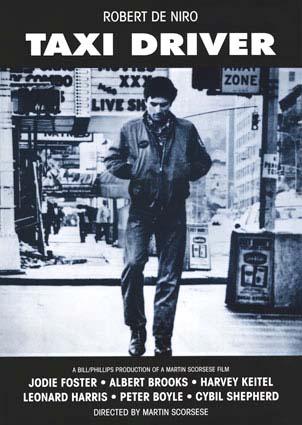
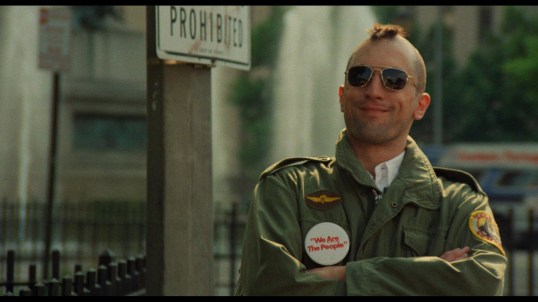
Sen. Palatine’s presidential campaign is a major subplot of Martin Scorsese’s 1976 masterpiece of paranoia, Taxi Driver. As played by an actor named Leonard Harris, Sen. Palatine appears to be the epitome of a politician. He may smile at the right moment but his eyes are always shifty. Even his campaign slogan (“We Are The people!”) is vapid in an all too plausible way. (How different is “We Are the People” from “We Are The People We’ve Been Waiting For?”) For the most part, Palatine remains a remote figure, giving speeches and appearing in television commercials. The only time that we get to know Palatine as a person is when he gets in a taxi being driven by Travis Bickle (Robert De Niro).
Travis recognizes him immediately and tells him that he tells everyone who gets in the cab that “they gotta vote for you.” Palatine smirks a little as he asks Travis what he thinks the most important issue of the election is. Travis goes on a bit about how someone needs to destroy all of the scum and filthy lowlifes who seem to populate Travis’s section of New York. As Travis rambles, Palatine’s smile disappears and it becomes obvious that he’s realized that he is essentially being driven by a psycho. Oh shit, Palatine is probably thinking, this guy is telling people that they gotta vote for me? However, Palatine quickly regains his composure and assures Travis that the wisest people that he’s ever met have been taxi drivers.
Of course, what Palatine doesn’t realize is that Travis only knows about the campaign because he happens to be obsessed with a Palatine campaign worker named Betsy (Cybill Shepherd). And Betsy even goes out with Travis a few times. But then Travis, who spends the majority of the film showing how little skill he has when it comes to understanding and relating to other people, takes Betsy to an adult film.
With Betsy refusing to take his calls, Travis’s attention shifts to Iris (Jodie Foster), a teenage prostitute. Obviously seeing himself as being a knight in shining armor, Travis tells Iris that she has to go back home to her parents. As Travis talks, it becomes apparent that he’s simply repeating talking points that he’s heard on TV. (If Taxi Driver was made today, Travis would be one of those people constantly sharing “inspirational” Facebook posts.) Iris laughs at Travis and goes back to her pimp, Sport (Harvey Keitel).
And, of course, Travis goes even crazier than before.
38 years after it was first released, Taxi Driver remains a disturbing and powerful film. However, what makes it effective is that, in many ways, it’s perhaps the darkest comedy ever made. Throughout the entire film, Travis essentially tells everyone that he meets that he’s disturbed and potentially dangerous and, throughout the entire film, everyone seems to be determined to ignore all of the signs.
Critics always talks about the scene where Travis points a gun at his mirror and asks, “You talkin’ to me?” And that’s a great scene. It deserves to be famous, just as De Niro deserves all of the praise that he’s gotten for his iconic performance in Taxi Driver.
However, for me, there are two other scenes that are just as brilliant. The first is where Travis attempts to get some advice from an older cabbie named Wizard (Peter Boyle). Travis says he’s been having a lot bad thoughts. Wizard shrugs and says that everyone has those. What makes this scene particularly memorable are the lengths that Wizard goes to in order to avoid acknowledging that Travis is obviously disturbed.
And then, there’s the scene where Travis buys a gun from Easy Andy (Steven Prince). Andy is such a salesman and is so nonchalant about all of his weaponry that, for a few brief minutes, Steven Prince actually manages to steal the spotlight from Robert De Niro.
Whenever one thinks about Taxi Driver, one automatically pictures Robert De Niro. That’s why it’s all the more interesting that De Niro was not the first choice for Travis. When Taxi Driver was in pre-production and a pre-Jaws Steven Spielberg (of all people) was thinking about directing it, Jeff Bridges as briefly attached to the role. And while it’s always tempting to think about what a Spielberg/Bridges version of Taxi Driver would look like, I think we’re all right to be happy that the actual film was directed by Scorsese and starred De Niro. They truly made Taxi Driver into one of the most memorable films ever made.
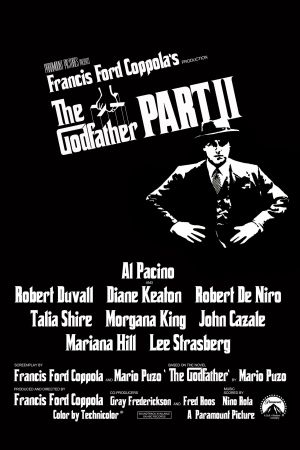
Believe it or not, The Trial of Billy Jackwas not the only lengthy sequel to be released in 1974. Francis Ford Coppola’s The Godfather Part II was released as well and it went on to become the first sequel to win an Oscar for best picture. (It was also the first, and so far, only sequel to a best picture winner to also win best picture.) Among the films that The Godfather, Part II beat: Chinatown, Coppola’s The Conversation, and The Towering Inferno. 1974 was a good year.
Whenever I think about The Godfather, Part II, I find myself wondering what the film would have been like if Richard Castellano hadn’t demanded too much money and had actually returned in the role of Clemenza, as was originally intended. In the first Godfather, Clemenza and Tessio (Abe Vigoda) were Don Corleone’s two lieutenants. Tessio was the one who betrayed Michael and was killed as a result. Meanwhile, Clemenza was the one who taught Michael how to fire a gun and who got to say, “Leave the gun. Take the cannoli.”
Though Castellano did not return to the role, Clemenza is present in The Godfather, Part II. The Godfather, Part II tells two separate stories: during one half of the film, young Vito Corleone comes to America, grows up to be Robert De Niro and then eventually becomes the Godfather. In the other half of the film, Vito’s successor, Michael (Al Pacino), tries to keep the family strong in the 1950s and ultimately either loses, alienates, or kills everyone that he loves.
During Vito’s half of the film, we learn how Vito first met Clemenza (played by Bruno Kirby) and Tessio (John Aprea). However, during Michael’s half of the story, Clemenza is nowhere to be seen. Instead, we’re told that Clemenza died off-screen and his successor is Frankie Pentangeli (Michael V. Gazzo). All of the characters talk about Frankie as if he’s an old friend but, as a matter of fact, Frankie was nowhere to be seen during the first film. Nor is he present in Vito’s flashbacks. This is because originally, Frankie was going to be Clemenza. But Richard Castellano demanded too much money and, as a result, he was written out of the script.
And really, it doesn’t matter. Gazzo does fine as Frankie and it’s a great film. But, once you know that Frankie was originally meant to be Clemenza, it’s impossible to watch The Godfather Part II without thinking about how perfectly it would have worked out.
If Clemenza had been around for Michael’s scenes, he would have provided a direct link between Vito’s story and Michael’s story. When Clemenza (as opposed to Frankie) betrayed Michael and went into protective custody, it would have reminded us of how much things had changed for the Corleones (and, by extension, America itself). When Tom Hagen (Robert Duvall) talked Clemenza (as opposed to Frankie) into committing suicide, it truly would have shown that the old, “honorable” Mafia no longer existed. It’s also interesting to note that, before Tessio was taken away and killed, the last person he talked to was Tom Hagen. If Castellano had returned, it once again would have fallen to Tom to let another one of his adopted father’s friends know that it was time to go.
Famously, the Godfather, Part II ends with a flashback to the day after Pearl Harbor. We watch as a young and idealistic Michael tells his family that he’s joined the army. With the exception of Michael and Tom Hagen, every character seen in the flashback has been killed over the course of the previous two films. We see Sonny (James Caan), Carlo (Gianni Russo), Fredo (John Cazale), and even Tessio (Abe Vigoda). Not present: Clemenza. (Vito doesn’t appear in the flashback either but everyone’s talking about him so he might as well be there. Poor Clemenza doesn’t even get mentioned.)
If only Richard Castellano had been willing to return.
Clemenza and Vito
But he didn’t and you know what? You really only miss him if you know that he was originally meant to be in the film. With or without Richard Castellano, The Godfather, Part II is a great film, probably one of the greatest of all time. When it comes to reviewing The Godfather, Part II, the only real question is whether it’s better than the first Godfather.
Which Godfather you prefer really depends on what you’re looking for from a movie. Even with that door getting closed in Kay’s face, the first Godfather was and is a crowd pleaser. In the first Godfather, the Corleones may have been bad but everyone else was worse. You couldn’t help but cheer them on.
The Godfather Part II is far different. In the “modern” scenes, we discover that the playful and idealistic Michael of part one is gone. Micheal is now cold and ruthless, a man who willingly orders a hit on his older brother and who has no trouble threatening Tom Hagen. If Michael spent the first film surrounded by family, he spends the second film talking to professional killers, like Al Neri (Richard Bright) and Rocco Lampone (Tom Rosqui). Whereas the first film ended with someone else closing the door on Kay, the second film features Michael doing it himself. By the end of the film, Michael Corleone is alone in his compound, a tyrant isolated in his castle.
Michael’s story provides a sharp contrast to Vito’s story. Vito’s half of the film is vibrant and colorful and fun in a way that Michael’s half is not and could never be. But every time that you’re tempted to cheer a bit too easily for Vito, the film moves forward in time and it reminds you of what the future holds for the Corleones.
So, which of the first two Godfathers do I prefer? I love them both. If I need to be entertained, I’ll watch The Godfather. If I want to watch a movie that will truly make me think and make me question all of my beliefs about morality, I’ll watch Part Two.
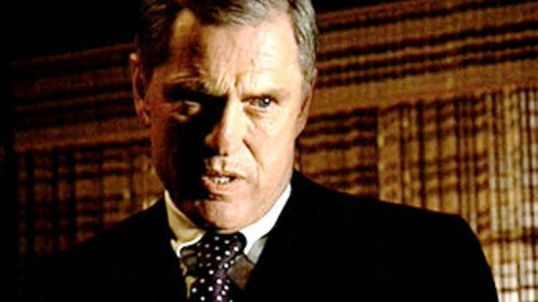
Finally, I can’t end this review without talking about G.D. Spradlin, the actor who plays the role of U.S. Sen. Pat Geary. The Godfather Part II is full of great acting. De Niro won an Oscar. Pacino, Gazzo, Lee Strasberg, and Talia Shire were all nominated. Diane Keaton, Robert Duvall, and John Cazale all deserved nominations. Even Joe Spinell shows up and brilliantly delivers the line, “Yeah, we had lots of buffers.” But, with each viewing of Godfather, Part II, I find myself more and more impressed with G.D. Spradlin.
Sen. Pat Geary doesn’t have a lot of time on-screen. He attends a birthday party at the Corleone Family compound, where he praises Michael in public and then condescendingly insults him in private. Later, he shows up in Cuba, where he watches a sex show with obvious interest. And, when Michael is called before a Senate committee, Geary gives a speech defending the honor of all Italian-Americans.
G.D. Spradlin as Sen. Pat Geary
But the scene that we all remember is the one where Tom Hagen meets Sen. Geary in a brothel. As Geary talks about how he passed out earlier, the camera briefly catches the sight of a dead prostitute lying on the bed behind him. What’s especially disturbing about this scene is that neither Hagen nor Geary seem to acknowledge her presence. She’s been reduced to a prop in the Corleone Family’s scheme to blackmail Sen. Geary. His voice shaken, Geary says that he doesn’t know what happened and we see the weakness and the cowardice behind his almost all-American facade.
It’s a disturbing scene that’s well-acted by both Duvall and Spradlin. Of course, what is obvious (even if it’s never explicitly stated) is that Sen. Geary has been set up and that nameless prostitute was killed by the Corleones. It’s a scene that makes us reconsider everything that we previously believed about the heroes of the Godfather.
For forcing us to reconsider and shaking us out of our complacency, The Godfather, Part II is a great film.
(Yes, it’s even better than The Trial of Billy Jack.)
The 1990 Best Picture nominee Awakenings is exactly the type of film that seems to have been designed to make me cry.
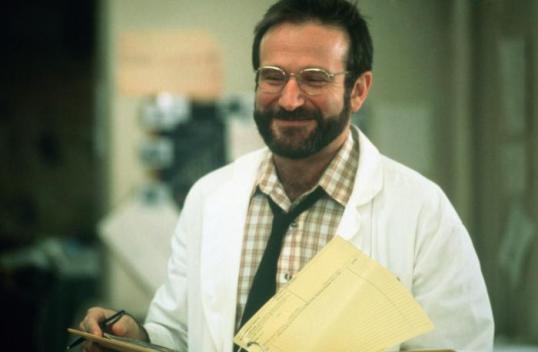
Taking place in 1969 and based (very loosely, I assume) on a true story, Awakenings features Robin Williams as Dr. Malcolm Sayer. Dr. Sayer is a dedicated and caring physician but he also suffers from an almost crippling shyness. He’s at his most comfortable when he’s dealing with a group of patients who have spent the last 40 years in a catatonic state, suffering from a tragic disease known as encephalitis lethargica. (One thing that I learned from watching this film was that, from 1917 to 1928, there was an epidemic of this disease, with millions either dying or being left catatonic.) While the rest of the medical establishment (led by John Heard, who always seems to be the embodiment of the establishment in films made in the 90s) assumes that the patients are destined to spend the rest of their lives in a vegetative state, Dr. Sayer is convinced that the patients can be awakened. He soon discovers that, even in their catatonic state, the patients will react to certain stimulii. One woman can catch a baseball. Another appears to react well to music. And finally, Leonard Lowe (Robert De Niro) — who fell ill with this disease when he was a child — tries to communicate with a Ouija board.
Over the objections of his supervisors, Dr. Sayer treats the patients with an experimental drug. Leonard is the first one to get the drug and is also the first one to wake up. While the rest of the patients wake up, Dr. Sayer tries to help Leonard adjust to the 1960s. At first, everything seems to be going perfectly. Leonard even manages to strike up a sweet romance with a woman named Paula (Penelope Ann Miller). However, it soon becomes obvious that the awakening is only going to be a temporary one as Leonard and all the other patients start to descend back into their catatonic states…
It’s easy to criticize a film like Awakenings for being manipulative and sentimental. And the fact of the matter is that the film is manipulative and it is sentimental and undoubtedly, it probably is a massive simplification of the true story. (The character played by John Heard is such an obvious villain that he might as well have a mustache to twirl.) And yes, you know even before it happens that there’s eventually going to be a montage of an amazed Leonard staring at a girl in a miniskirt while Time of the Season plays on the soundtrack.
But, no matter! It’s a tremendously effective film and it earned the tears that I shed while watching it. Both De Niro and Williams give excellent performances which add a good deal of depth to scenes that could otherwise come across as being overly sappy. De Niro has the more showy role but it really but it’s the performance of Robin Williams that really carries the film. As played by Williams, Dr. Sayer is a fragile soul who hides from the world behind his beard and his professional determination. When he finally asks a nurse (Julie Kavner) out to dinner, it’s impossible not to cheer for him.
It’s also impossible not to cheer a little for Awakenings.
For today’s entry in the 44 Days of Paranoia, we’re taking a look at Barry Levinson’s 1997 political satire, Wag The Dog.
Wag the Dog opens with a White House in crisis. With two weeks to go until the Presidential election, it’s been discovered that the incumbent President has had a brief dalliance with a girl scout. Up until the scandal became public, the President was enjoying at 17 point lead in the polls. Now, that lead is about to evaporate unless something can be done to keep the American public from thinking about the President’s personal life.
Significantly, the President himself never appears on-screen. We never learn his position on the issues. We never hear about anything he’s done during his first term. We don’t even know what political party he belongs to. (However, his opponent is played by Craig T. Nelson so I’m going to assume that the President is a Democrat. Because, seriously, it’s hard for me to imagine Nelson being anything other than a Republican…) The President remains a shadowy and insubstantial figure who, in the end, represents nothing.
Instead of getting to know the President, we instead spend the film with the aides who have to clean up after his mess. One of those aides, Winifred Ames (Anne Heche), calls in a legendary (and rather sinister) political PR man, Conrad Bean (Robert De Niro). Conrad announces that the only way to save the campaign is to distract the American public with a quick and totally fake war with Albania. Why Albania? According to Conrad, Albania has a sinister name and nobody knows anything about it.
To help create this fake war, Conrad recruits Hollywood film producer, Stanley Motts (a hilariously manic Dustin Hoffman). Much as Conrad is a legend in politics, Stanley is a legend in Hollywood. Stanley enthusiastically jumps into the project of creating a fake war of Albania, manufacturing everything from fake war footage to patriotic songs to anything else necessary to rally the American public. Denis Leary shows up as a mysterious figure known as the Fad King and schemes how to make war with Albania the latest trend. Willie Nelson sings a song to stir the spirit of every patriotic American. A very young Kirsten Dunst is recruited to play a terrified orphan in staged Albanian atrocity footage. A shell-shocked vet (Woody Harrelson) is cast as the Albanian War’s first hero. Stanley greets every problem with an enthusiastic exclamation of, “This is nothing!”
Along the way, a rather odd friendship develops between the secretive Conrad and the overly verbose Stanley. However, when Stanley, who often laments that he’s never won an Oscar, starts to complain about the fact that he’s never going to get any recognition for his “greatest production,” Conrad finds himself forced to reconsider their relationship.
Wag the Dog was first released in 1997 and, thanks to David Mamet’s darkly comedic script and Barry Levinson’s brisk direction, the film feels incredibly prophetic. Indeed, all the film needs is for someone to mention making the war a trending topic and it would be impossible to tell that it was made 16 years ago. Wag the Dog accomplishes the best thing that any political satire can hope to accomplish: it makes you question everything. Whenever one watches a news report triumphantly bragging about the latest done strike, it’s hard not to feel that Stanley Motts would approve.