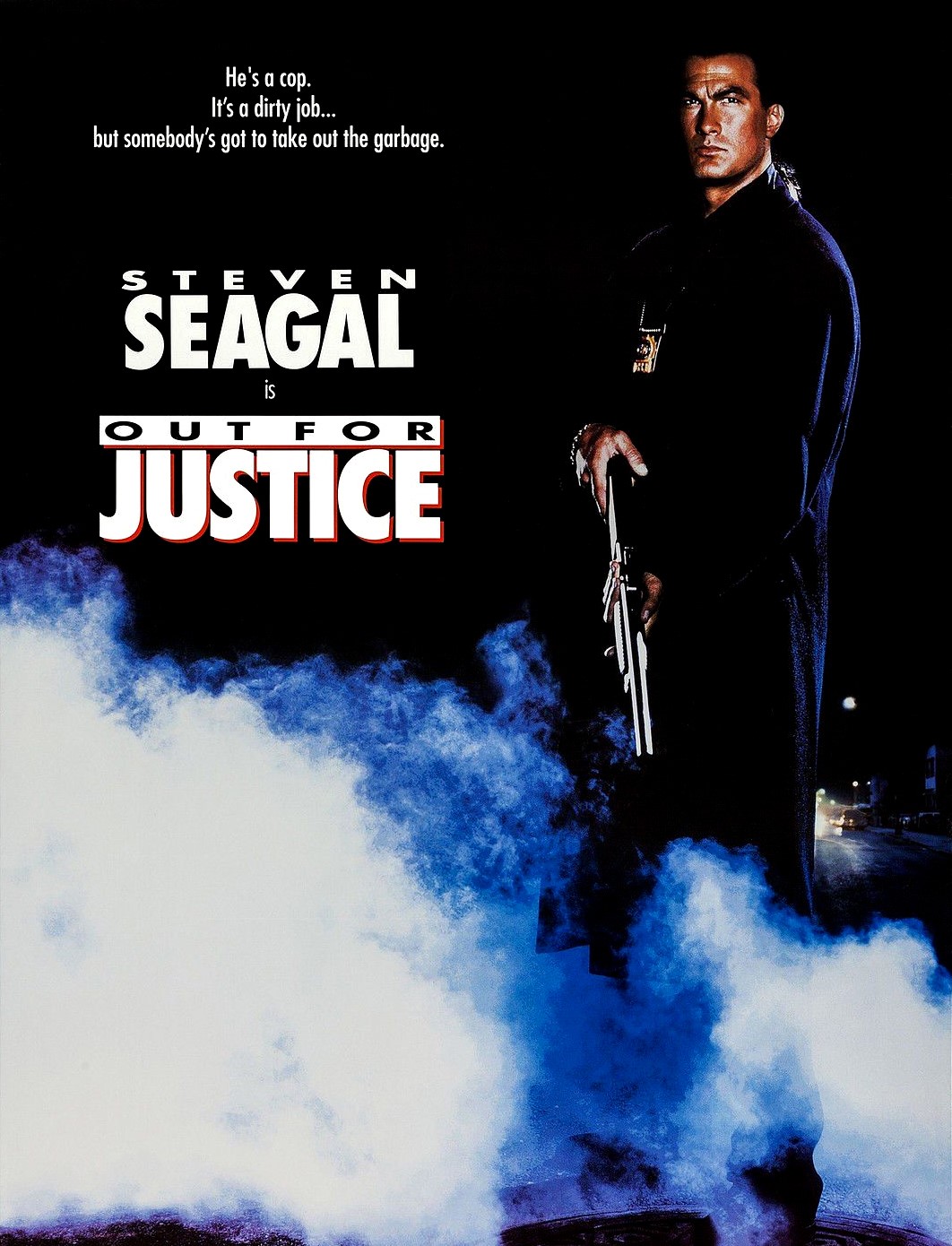
Guilty Pleasure No. 111: Out for Justice (dir. by John Flynn)


Out for Justice is the kind of movie that leans so heavily on its star’s ridiculous swagger that it stops being merely bad and ridiculous and becomes entertaining in a “can’t‑look‑away from the car‑crash” sort of way. It’s not a polished or especially sophisticated action film, but it has a rough, gleefully over‑the‑top energy that makes it a perfect guilty pleasure, the kind of early ’90s action crime movie that works less because of craft and more because of attitude, bruises, and sheer confidence.

At its core, Out for Justice is a revenge story so simple it barely bothers pretending to be anything else. Steven Seagal plays Gino Felino, a Brooklyn cop chasing the man responsible for his partner’s death, and the plot mostly functions as a chain of excuses to send him from one grimy neighborhood stop to the next, collecting broken noses and wounded pride along the way. That stripped‑down structure is part of the movie’s charm, because there’s no attempt to dress it up with complicated twists or emotional depth; it’s all forward momentum, all hard stares, all macho problem‑solving by fist and elbow.

One of the things that gives Out for Justice its off‑kilter charm is how every actor in the cast seems to have read the script as an invitation to extremes. Performances swing violently between scenery‑chewing over‑the‑top theatrics and barely‑there, almost sleepwalking subtlety, with almost nothing in the middle. Either you’re shouting, staring down suspects inches from their faces, or you’re slouched in the background mugging in silence. It shouldn’t work, but the sheer imbalance in energy somehow makes the film feel like a live wire instead of a flat ’90s programmer.

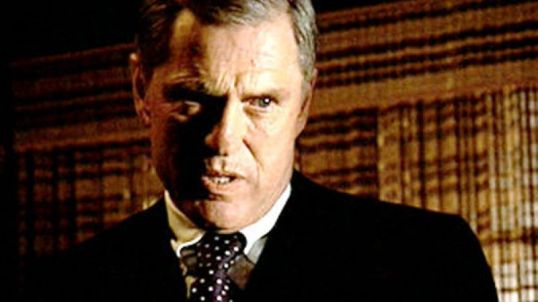
Nowhere is that more obvious than with William Forsythe’s villain, Richie Madano, who plays the role so far “out there” that it’s hard not to wonder if he was actually on a lot of coke like the character was written to be. He leans into every sneer, every twitch, and every unhinged stare until he starts to look less like a character and more like a walking drug‑induced nightmare. There’s a manic, unpredictable edge to his performance that makes him feel genuinely dangerous, even when the dialogue around him is pure tough‑guy parody. It’s a kind of commitment that could easily tip into self‑parody, but Forsythe owns it so completely that he ends up grounding the film’s madness instead of derailing it.

What really makes Out for Justice memorable is how fully it leans into Seagal’s absurd screen persona. He’s at his best here when he’s acting like a man who believes every room belongs to him, and that attitude gives the movie a weird, shameless energy that a lot of his later work lacked. Even when the dialogue is clunky or the Brooklyn swagger feels more imagined than lived‑in, Seagal’s self‑serious delivery turns the whole thing into a performance art piece of tough‑guy certainty. The film is unintentionally funny at times, but that only adds to the appeal, because it makes the movie feel even more like a relic from a time when action stars could be gloriously excessive without irony.

The action is the main draw, and this is where Out for Justice earns most of its reputation. The fights have that satisfying, bone‑crunching roughness that makes the violence feel tangible instead of slick, and the movie keeps finding excuses to escalate from intimidation to outright brutality. Seagal’s style here is less flashy than some of his contemporaries, but that works in the film’s favor because the choreography has a mean, close‑quarters edge to it. The result is a movie that often feels like it’s trying to win by sheer stubbornness, and honestly, that suits it perfectly.

There’s also a strong sleaze factor running through the whole thing, and that’s another reason it works as a “bad but good” movie. The neighborhoods feel dirty, the criminals are exaggerated to the point of cartoonish menace, and the film’s idea of atmosphere is basically to keep everything sweaty, smoky, and angry. Forsythe’s villain, in particular, leans so extravagantly into that sleaze that he ends up giving the film a properly nasty center. A lot of the supporting characters are basically there to be insulted, questioned, or thrown into a wall, but the movie gets enough mileage out of that rhythm that it never really becomes boring.

Still, there’s no reason to pretend Out for Justice is secretly elegant. The script is thin, the character work is mostly functional, and the movie often feels like it was assembled to move from one confrontation to the next as efficiently as possible. Some of the scenes drag, and the film’s macho posturing can wear thin if you’re not already in the mood for this kind of energy. It also has that peculiar Seagal‑era problem where the movie wants him to be a street‑level man of the people, but the character sometimes comes across more like a self‑mythologizing neighborhood warlord than an actual human being. That disconnect is part of the fun, but it is still a disconnect.

What keeps Out for Justice from becoming a throwaway is the confidence behind the nonsense. It feels like a movie made by people who believed that attitude could substitute for sophistication, and in this case, they were mostly right. The pacing may be uneven, the story may be paper‑thin, and the acting may veer into laughable territory, but the movie never loses its nerve, and that gives it a strange kind of integrity. It doesn’t apologize for being dumb, and that unashamed commitment is exactly why it has aged into cult‑status entertainment instead of disappearing into the pile of generic action forgettables.

That’s why Out for Justice works so well as a guilty pleasure. It’s violent, ridiculous, and very much stuck in its own macho time capsule, but those flaws are inseparable from the appeal. The movie’s “bad but good” vibe comes from the way it accidentally becomes bigger and funnier than it likely intended, while still delivering enough real action‑movie satisfaction to justify the ride. It’s the kind of film that invites eye‑rolling and cheers in almost equal measure, and that balancing act is what makes it such a durable little cult object.

In the end, Out for Justice is not a masterpiece, and it doesn’t need to be. It’s a bruised, swaggering, over‑confident slab of early ’90s action cheese that knows how to sell its own nonsense with just enough force to make it lovable. To borrow from film reactor EOM Reacts (who is hilarious, by the way), “This whole movie screams cocaine.” If you want clean storytelling or nuanced performances, it will probably frustrate you. If you want a hard‑edged, trashy, surprisingly watchable Seagal vehicle that embodies the “bad it’s good” spirit—including a cast that either chews every morsel of the scenery or fades into the wallpaper—Out for Justice hits the mark.

Also, be on the look out for a quick cameo of Kane Hodder (who played Jason Voorhees for many of the franchise’s many sequels) as a gang member and for Dan Inosanto (teacher to Bruce Lee and Chuck Norris) as a character named “Sticks.”

Previous Guilty Pleasures

  1. Half-Baked
  2. Save The Last Dance
  3. Every Rose Has Its Thorns
  4. The Jeremy Kyle Show
  5. Invasion USA
  6. The Golden Child
  7. Final Destination 2
  8. Paparazzi
  9. The Principal
  10. The Substitute
  11. Terror In The Family
  12. Pandorum
  13. Lambada
  14. Fear
  15. Cocktail
  16. Keep Off The Grass
  17. Girls, Girls, Girls
  18. Class
  19. Tart
  20. King Kong vs. Godzilla
  21. Hawk the Slayer
  22. Battle Beyond the Stars
  23. Meridian
  24. Walk of Shame
  25. From Justin To Kelly
  26. Project Greenlight
  27. Sex Decoy: Love Stings
  28. Swimfan
  29. On the Line
  30. Wolfen
  31. Hail Caesar!
  32. It’s So Cold In The D
  33. In the Mix
  34. Healed By Grace
  35. Valley of the Dolls
  36. The Legend of Billie Jean
  37. Death Wish
  38. Shipping Wars
  39. Ghost Whisperer
  40. Parking Wars
  41. The Dead Are After Me
  42. Harper’s Island
  43. The Resurrection of Gavin Stone
  44. Paranormal State
  45. Utopia
  46. Bar Rescue
  47. The Powers of Matthew Star
  48. Spiker
  49. Heavenly Bodies
  50. Maid in Manhattan
  51. Rage and Honor
  52. Saved By The Bell 3. 21 “No Hope With Dope”
  53. Happy Gilmore
  54. Solarbabies
  55. The Dawn of Correction
  56. Once You Understand
  57. The Voyeurs 
  58. Robot Jox
  59. Teen Wolf
  60. The Running Man
  61. Double Dragon
  62. Backtrack
  63. Julie and Jack
  64. Karate Warrior
  65. Invaders From Mars
  66. Cloverfield
  67. Aerobicide 
  68. Blood Harvest
  69. Shocking Dark
  70. Face The Truth
  71. Submerged
  72. The Canyons
  73. Days of Thunder
  74. Van Helsing
  75. The Night Comes for Us
  76. Code of Silence
  77. Captain Ron
  78. Armageddon
  79. Kate’s Secret
  80. Point Break
  81. The Replacements
  82. The Shadow
  83. Meteor
  84. Last Action Hero
  85. Attack of the Killer Tomatoes
  86. The Horror at 37,000 Feet
  87. The ‘Burbs
  88. Lifeforce
  89. Highschool of the Dead
  90. Ice Station Zebra
  91. No One Lives
  92. Brewster’s Millions
  93. Porky’s
  94. Revenge of the Nerds
  95. The Delta Force
  96. The Hidden
  97. Roller Boogie
  98. Raw Deal
  99. Death Merchant Series
  100. Ski Patrol
  101. The Executioner Series
  102. The Destroyer Series
  103. Private Teacher
  104. The Parker Series
  105. Ramba
  106. The Troubles of Janice
  107. Ironwood
  108. Interspecies Reviewers
  109. SST — Death Flight
  110. Undercover Brother

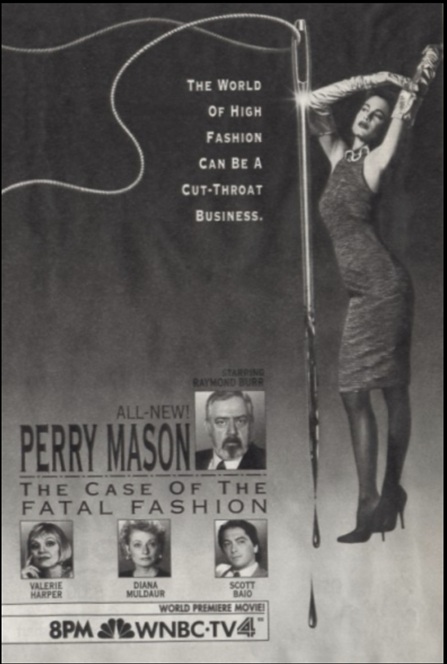
I Watched Perry Mason: The Case of the Fatal Fashion (1991, Dir. by Christian I. Nyby II)


Perry Mason (Raymond Burr), Della Street (Barbara Hale), and Ken Malansky (William R. Moses) are in New York when an old friend of Perry’s, magazine editor Lauren Jeffreys (Diana Muldaur) is accused of murdering a rival editor, Dyan Draper (Valerie Harper). Dyan was infamous for writing about the personal lives of celebrities in her column so there’s a ton of possible suspects. While Ken teams up with a mobster named Tony Loomis (Robert Clohessy) to search for clues, Perry finds himself facing off against a young district attorney (Scott Baio) who is smarter than he seems.

This Perry Mason movie is unique because, for once, the prosecutor is as good an attorney as Perry.  It reminded me of how, when the movies started, David Ogden Stiers always played the prosecutor and came across like someone who would probably win if he has going up against anyone other than Perry Mason.  Even though I immediately thought of Bob Loblaw as soon as I saw him, Scott Baio gives a good performance as a lawyer who worships Perry and can’t wait to face him in court.  For once, there’s mutual respect between the two sides.

The mystery was another one of those where I was able to guess who the killer was from the start.  They had to really stretch things to get the mob involved so that Ken could team up with Tony.  (Ken wanted to bring the killer to court while Tony just waned to shoot them.)  Also, it was obvious that Raymond Burr was not doing well when he filmed this movie.  In almost every scene, he’s either seated or leaning against something.  There are only 6 more Perry Mason films featuring Burr after this one and one of those aired after he died.  Burr still gives a commanding performance whenever Perry’s in court, though.  Sick or not, there’s no other attorney you want on your side.

An Offer You Can’t Refuse: Lepke (dir by Menahem Golan)


When it comes to reviewing mob movies, I usually describe them as either being “an offer you can refuse” or “an offer you can’t refuse.”

Usually, it’s not that difficult to decide which ranking I should use.  If the film is well-acted and if the action unfolds at a steady pace and if there’s plenty of tommy gun action and/or a stylish recreation of the Golden Age of American Gangsterism, chances are that the film will be an offer that you can’t refuse.

Now, if it’s a movie that just features a bunch of guys sitting around trying to sound tough and if it doesn’t really do much to recreate the gangster milieu and if the dialogue sounds like it was cribbed from a hundred other gangster films, it’ll probably be an offer you can refuse.

It’s simple and usually, it only takes me a few minutes to realize which description I’m going to use.  But I have to admit that I went back and forth on 1975’s Lepke.  To refuse or not to refuse, that was the question.

Lepke is a biographic film about Louis “Lepke” Buchalter, an early American gangster who came to prominence in the early days of the National Crime Syndicate.  An ally of Lucky Luciano’s, Lepke was the mastermind behind what became known, in the press, as Murder, Inc.  (Lepke himself was smart enough not to name the organization.)  If the Mob wanted someone killed, they would contact Albert Anastasia who would then contact Lepke who would then assign the job to someone else.  The actual assassin rarely knew who had actually ordered the hit and Lepke was such a feared figure that it was assumed that no one was ever going to turn informant.  Lepke was responsible for some of the most infamous gangland killings of the 20s and 30s, including the murder of Dutch Schultz.  Unfortunately, for Lepke, someone eventually did turn informant and he ended up as one of the few gangster to meet his end in the electric chair.

Lepke features Tony Curtis as the title character.  The film follows him from his youth as a member of a street gang to his early days with the National Crime Syndicate and eventually to his final days at Sing Sing.  Michael Callan plays Lepke’s childhood friend, who goes straight.  Gianni Russo plays Albert Anastasia while Vic Tayback plays Lucky Luciano.  Lepke’s wife, Bernice, is played by Anjanette Comer.  Though the beefy and rather loud Tayback is miscast as Luciano, the cast does a fairly good job.  Comedian Milton Berle gives a surprisingly strong performance as Lepke’s father-in-law.  There’s a great scene in which he interrogates his future son-in-law about what he’s going to get in exchange for giving away his daughter.  Curtis is convincingly tough and menacing as Lepke, who this film presents as being a working class family man whose job just happens to be killing people.  (Tony Curtis later wrote that he was on a cocaine high while filming Lepke, which perhaps explains the intensity of his performance.)

Lepke definitely holds your interest.  There’s enough mob hits and bursts of gunfire to satisfy most gang movie aficionados.  At the same time, the film’s recreation of the 20s and 30s is almost too generic and clean.  For all the tough talk and the gangland violence, there’s a definite lack of grittiness to the film’s recreation of one of the most violent eras in American history, which is why I found myself conflicted on whether to recommend it or not.  I decided that, in the end, the film does enough right to make it worth watching, even if it does still feel more like a made-for-TV crime flick than the gangster epic that so obviously aspires to be,

Historically, this film is important because it was the first American film to be directed by Menahem Golan and produced by Golan and Yoram Globus.  Four years after Lepke, Golan and Globus would purchase Cannon Films and go on to make some of the most deliriously entertaining films of all time.

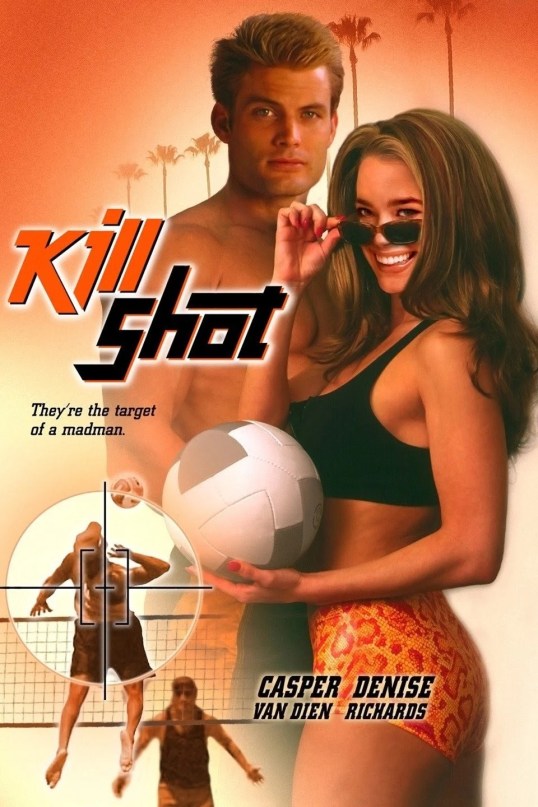
So, I Watched Kill Shot (1995, Dir. by Nelson McCormick)


A group of college students all live in a California apartment complex that’s owned by Jake Mondello (Gianni Russo), who also owns a restaurant and sponsors a beach volleyball team.  From the description that I read of the movie’s plot, I thought there would be a lot more beach volleyball and, from the title, I thought there would be a lot more thrills.  Turns out I was wrong on both counts.

It’s pretty obvious that this was a pilot for a tv show that was inspired by Melrose Place.  A lot of characters are introduced and they’re all shallow but pretty.  Just like with Melrose Place, everyone has a drama and everyone has someone that they like but who they can’t tell about their feelings.  Casper Van Dein is the most recognizable person in the cast.  He plays a rich boy who likes to play volleyball and who falls for a poor girl.  Other characters include Jacqueline Collen as a former volleyball star who is going back to college and who is being stalked by her ex (Jack Scalia), Catherine Lazo as the med student who loses her scholarship, and Ria Pavia as an abrasive science student who falls in love with her new roommate (Mushond Lee), even though he’s gay.  Ernie Reyes, Jr. plays Koji, who is a computer nerd who says stuff like, “I just got a new CD-rom game.”  He’s so good with computers that the police turn to him to help track phone calls and match finger prints.  Denise Richards appears for two seconds and smiles at Casper.  Gianni Russo is the worst actor in the movie but everyone loves Jake because Russo also wrote the script.

This was largely plotless and pointless.  Casper was nice to look at but I didn’t care about any of the characters.  There is a big beach volleyball game at the end but it only lasts for a few minutes and it was impossible to tell who was winning.  One important character is taken out by a kill shot but no one notices.  Watching the movie made me hate both the beach and volleyball.


Retro Television Reviews: The Bait (dir by Leonard J. Horn)


Welcome to Retro Television Reviews, a feature where we review some of our favorite and least favorite shows of the past!  On Sundays, I will be reviewing the made-for-television movies that used to be a primetime mainstay.  Today’s film is 1973’s The Bait!  It  can be viewed on YouTube!

Tracey Fleming (Donna Mills) is the widow of a cop and an undercover detective herself.  Unfortunately, her superior, Captain Maryk (Michael Constantine), is not convinced that Tracey has what it takes to be in a dangerous situation and, as a result, Tracey spends most of her time riding the bus and busting perverts and low-level drug dealers.  When four woman are raped and murdered by the same serial killer, Tracey writes up a report on what she thinks is motivating the killer.  Captain Maryk is, at first, skeptical about Tracey’s claim that the killer is fueled by a puritanical rage but, when it turns out that the killer has been wiping off his victims’s lipstick (just as Tracey speculated that he was), Maryk starts to think that Tracey might have something to offer the investigation.

Tracey becomes the bait in an operation to lure out the killer.  Leaving behind her son and her mother, Tracey moves into an apartment in the neighborhood that is believed to be the center of the killer’s activities.  Tracey is given a job as a survey taker and soon, she’s walking around the neighborhood and asking random men for their opinions on current events and women’s liberation.  A local waitress (Arlene Golonka) recognizes Tracey as a detective but Tracey lies and say that she’s no longer with the force.  When the killer makes the waitress his next victim, Tracey becomes even more determined to capture him but will she able to get Marsyk and the rest of the force to give her the room to investigate the murders?

This may sound like an intriguing whodunit but, for some reason, The Bait reveals early on that the murderer is a bus driver named Earl Stokely (played, in a very early performance, by William Devane).  There’s really nothing to be gained by revealing the killer’s identity as early as the film does.  Perhaps if the film was split between scenes of Tracey investigating the neighborhood and Earl stalking Tracey, that would have generated some sort of suspense but, with the exception of one bus ride, Tracey and Earl barely even interact before he comes after her at the film’s end.  Devane does give a good performance as a homicidal lunatic but, when viewed today, it’s impossible to watch him in this film without spending most of the time thinking, “Hey, that’s the usually Kennedyesque William Devane, playing a killer bus driver!”

I was not surprised to learn that The Bait was intended to be a pilot for a weekly television series that would have followed the future investigations of Tracey Fleming.  Donna Mills was likable in the lead role and she had a good chemistry with the other actors playing her colleagues so it’s easy to imagine a series in which Tracey solved a new case every week while Marsyk continually underestimated her.  Ultimately, though, that series never happened and The Bait would be the sole televised adventure of Detective Tracey Fleming.

Live Tweet Alert: Join #FridayNightFlix for Laserblast!


As some of our regular readers undoubtedly know, I am involved in a few weekly live tweets on twitter.  I host #FridayNightFlix every Friday, I co-host #ScarySocial on Saturday, and I am one of the five hosts of #MondayActionMovie!  Every week, we get together.  We watch a movie.  We tweet our way through it.

Tonight, at 10 pm et, I will be hosting #FridayNightFlix!  The movie? 1978’s Laserblast!

Which film has Kim Milford, Roddy McDowall, Eddie Deezen, Keenan Wynn, Rainbeaux Smith, Gianni Russo, Dennis Burkley, and two Claymation aliens!?  This film!

If you want to join us this Friday, just hop onto twitter, start the movie at 10 pm et, and use the #FridayNightFlix hashtag!  I’ll be there tweeting and I imagine some other members of the TSL Crew will be there as well.  It’s a friendly group and welcoming of newcomers so don’t be shy.

Laserblast is available on Prime, Tubi, YouTube, Pluto, and almost every other streaming service!  On twitter, I’ll be sharing a commercial-free link for the film begins.

See you there!

Spring Break on the Lens: Laserblast (dir by Michael Rae)


Before I say anything else, I should admit that I fully understand why some of you are going to say that the 1978 science fiction film, Laserblast, is not a spring break film.

First off, it takes place not on the beach but in the desert.  There is a scene that takes place at a pool but it’s one of those cheap pools that all of the desert towns have.

Secondly, the film itself doesn’t take place during the spring.  It takes place during the summer, when the sun is bright and harsh.  The teenagers in the film might not be in school but that’s just because it’s their summer vacation.

I get it.

But, as far as I’m concerned, Laserblast is spiritually a spring break film, even if it isn’t technically one.  I mean, just look at the film’s hero, Billy.  As played by the very handsome Kim Milford, Billy is a mellow guy with blonde hair, stoned eyes, and the attitude of someone who can say, “Right on!” and make you believe that everything will be right and on.  Billy even drives a totally 70s van.  Everything about Billy and his girlfriend, Kathy Farley (Rainbeaux Smith), screams Malibu.  Even in the desert and in the summer, they are the ideal spring break couple.

Billy, of course, gets in some trouble over the course of the film.  He stumbles across a space gun in the desert.  Billy doesn’t know what we know, that the space gun was accidentally left there by two adorable claymation aliens who previously visited Earth so that they could kill the gun’s owner.  Billy just thinks it’s a cool gun.  Soon, Billy is blowing up the town and turning into a green-skinned monster.  Billy even blows up a sign that’s advertising Star Wars, which is made doubly interesting by how much Kim Milford resembles Mark Hamill.  (The same year that Laserblast came out, Hamill and Milford acted opposite each other in Corvette Summer, with Milford’s mellow confidence providing a nice counter to Hamill’s somewhat hyperactive earnestness.)  Much like a drunk spring breaker who ends up vomiting into the ocean, Billy has found something that he enjoys and he’s allowing it to take over his life.  The space gun represents every vice and addiction that’s out there to tempt people into risking their lives and their sanity and their totally 70s van.  (We don’t see much of the inside of the van but I’m willing to bet that it has shag carpeting and a strobe light.)  The spring breakers in The Real Cancun spent their week drinking themselves into a stupor.  Billy, on the other hand, spends a week blowing stuff up and turning into a monster.  Of course, that’s the great thing about spring break.  How you spend your time is your business.

Laserblast is a low-budget film, one that is often listed as being one of the worst films ever made.  Myself, I love the film because I think the aliens are cute and I enjoy Kim Milford’s performance as Billy.  Actually, for a film that didn’t cost much to make, Laserblast has a surprisingly impressive cast.  Technically, it’s not a shock to see Roddy McDowall in the film, since McDowall apparently accepted every role that he was offered in the 70s.  But Roddy’s trademark neurotic eccentricity is still welcome in the small role of Billy’s doctor.  The great character actor Dennis Burkley shows up as a fascist deputy.  Gianni Russo, who played Carlo Rizzi in The Godfather, plays a government agent who shows up from out of nowhere and who wears a cream-colored suit that makes him look like a wedding DJ.  Keenan Wynn, who also apparently accepted any role he was offered in the 70s, plays Rainbeaux Smith’s drunk grandfather.  Best of all, Eddie Deezen, who was best known for playing stereotypical nerd characters in films like Grease, shows up as a bully named Froggy!  After getting bullied by Eddie Deezen, who wouldn’t pick up the first space gun they found and start blasting rocks?

Laserblast is fun, just like spring break.  I like it, just like spring break.  So does Arleigh so be sure to check out his review, as well!

Embracing the Melodrama Part II #101: Harvard Man (dir by James Toback)


https://twitter.com/hrmonie/status/358515665419763713

Oh please, Harvard Man sucks.

I watched this 2002 film for one reason and one reason only.  It stars Sarah Michelle Gellar and I used love Buffy the Vampire Slayer.  In fact, now that I think about it, my love for Buffy the Vampire Slayer has led to me watching a lot of really bad movies.  Seriously, somebody give Nichols Brendon a role in a good movie and do it now!  I’m tired of reading about him getting arrested at conventions.

But anyway, in Harvard Man, Sarah plays Cindy Bandolini, a student at Harvard.  Her father is a gangster and he’s played Gianni Russo, who is best known for playing Carlo Rizzi in The Godfather.  Cindy is also dating the star of Harvard’s basketball team, Alan Jenson (Adrian Grenier).  Cindy knows that Alan’s parents have just lost their farm to a tornado.  She tells Alan that if he’ll throw an upcoming basketball game, her father will pay him $100,000.  However, Mr. Bandolini isn’t really in on the deal.  Instead, Cindy has set it up herself with the help of two of her father’s associates, Teddy (Eric Stoltz) and Teddy’s girlfriend, Kelly (Rebecca Gayheart).

But what Cindy doesn’t know is that both Teddy and Kelly work for the FBI.  She also doesn’t know that Teddy and Kelly are engaging in threesomes with a philosophy professor, Chesney Cort (Joey Lauren Adams) and that Chesney is also having an affair with Alan.

Got all that?

Good.  Of course, it doesn’t really make that much of a difference because Alan is such a passive character that you get the feeling that he really doesn’t care what happens one way or another.  About halfway through the film, he takes a massive dose of LSD and he spends the rest of the film tripping while all of the various characters chase him across Boston.

And then Al Franken shows up, playing himself.  As Alan wanders across campus, Al Franken walks up to him and says, “Hi, I’m Al Franken.”  It turns out that the future senator is showing his daughter around Harvard and wants to ask Alan what the campus is like nowadays.  As future President Franken speaks in his nasal tones, we get all sorts of fun distortion effects so, if you’ve ever wanted to see Al Franken with a big googly face, Harvard Man is the film for you.  Al Franken’s scenes are, however, partially redeemed by the way that the actress playing his daughter rolls her eyes at her desperately uncool dad.

And, of course, while this is going on, we get random scenes of Joey Lauren Adams giving an endless lecture about ethics.  Why, exactly?  I imagine it has something to do with fooling critics like me and making us mistake Harvard Man for a movie with a brain.

Harvard Man is a pretentious mess of a film but it’s a fascinating example of what happens when every single role in a movie is miscast.  Eric Stoltz and Rebecca Gayheart are the least believable FBI agents ever.  You don’t believe for a second that short and scrawny Adrian Grenier could be a basketball star.  Joey Lauren Adams comes across like she’d be lucky to teach at Greendale Community College, much less Harvard.  Al Franken makes for a remarkably unconvincing Al Franken.  And, as much as I loved her in Buffy, Cruel Intentions, and Ringer, I do have to say Sarah Michelle Geller is one of the least convincing Italians that I have ever seen on-screen.

Harvard Man is an incredibly bad film but at least you get to see Al Franken with a googly face,

HARVARDMAN

Shattered Politics #36: The Godfather, Part II (dir by Francis Ford Coppola)


Godfather_part_ii

Believe it or not, The Trial of Billy Jack was not the only lengthy sequel to be released in 1974.  Francis Ford Coppola’s The Godfather Part II was released as well and it went on to become the first sequel to win an Oscar for best picture.  (It was also the first, and so far, only sequel to a best picture winner to also win best picture.)  Among the films that The Godfather, Part II beat: Chinatown, Coppola’s The Conversation, and The Towering Inferno.  1974 was a good year.

Whenever I think about The Godfather, Part II, I find myself wondering what the film would have been like if Richard Castellano hadn’t demanded too much money and had actually returned in the role of Clemenza, as was originally intended.  In the first Godfather, Clemenza and Tessio (Abe Vigoda) were Don Corleone’s two lieutenants.  Tessio was the one who betrayed Michael and was killed as a result.  Meanwhile, Clemenza was the one who taught Michael how to fire a gun and who got to say, “Leave the gun.  Take the cannoli.”

Though Castellano did not return to the role, Clemenza is present in The Godfather, Part II.  The Godfather, Part II tells two separate stories: during one half of the film, young Vito Corleone comes to America, grows up to be Robert De Niro and then eventually becomes the Godfather.  In the other half of the film, Vito’s successor, Michael (Al Pacino), tries to keep the family strong in the 1950s and ultimately either loses, alienates, or kills everyone that he loves.

During Vito’s half of the film, we learn how Vito first met Clemenza (played by Bruno Kirby) and Tessio (John Aprea).  However, during Michael’s half of the story, Clemenza is nowhere to be seen.  Instead, we’re told that Clemenza died off-screen and his successor is Frankie Pentangeli (Michael V. Gazzo).  All of the characters talk about Frankie as if he’s an old friend but, as a matter of fact, Frankie was nowhere to be seen during the first film.  Nor is he present in Vito’s flashbacks.  This is because originally, Frankie was going to be Clemenza.  But Richard Castellano demanded too much money and, as a result, he was written out of the script.

And really, it doesn’t matter.  Gazzo does fine as Frankie and it’s a great film.  But, once you know that Frankie was originally meant to be Clemenza, it’s impossible to watch The Godfather Part II without thinking about how perfectly it would have worked out.

If Clemenza had been around for Michael’s scenes, he would have provided a direct link between Vito’s story and Michael’s story.  When Clemenza (as opposed to Frankie) betrayed Michael and went into protective custody, it would have reminded us of how much things had changed for the Corleones (and, by extension, America itself).  When Tom Hagen (Robert Duvall) talked Clemenza (as opposed to Frankie) into committing suicide, it truly would have shown that the old, “honorable” Mafia no longer existed.  It’s also interesting to note that, before Tessio was taken away and killed, the last person he talked to was Tom Hagen.  If Castellano had returned, it once again would have fallen to Tom to let another one of his adopted father’s friends know that it was time to go.

Famously, the Godfather, Part II ends with a flashback to the day after Pearl Harbor.   We watch as a young and idealistic Michael tells his family that he’s joined the army.  With the exception of Michael and Tom Hagen, every character seen in the flashback has been killed over the course of the previous two films.  We see Sonny (James Caan), Carlo (Gianni Russo), Fredo (John Cazale), and even Tessio (Abe Vigoda).  Not present: Clemenza.  (Vito doesn’t appear in the flashback either but everyone’s talking about him so he might as well be there.  Poor Clemenza doesn’t even get mentioned.)

If only Richard Castellano had been willing to return.

Clemenza_and_Vito

Clemenza and Vito


But he didn’t and you know what?  You really only miss him if you know that he was originally meant to be in the film.  With or without Richard Castellano, The Godfather, Part II is a great film, probably one of the greatest of all time.  When it comes to reviewing The Godfather, Part II, the only real question is whether it’s better than the first Godfather.

Which Godfather you prefer really depends on what you’re looking for from a movie.  Even with that door getting closed in Kay’s face, the first Godfather was and is a crowd pleaser.  In the first Godfather, the Corleones may have been bad but everyone else was worse.  You couldn’t help but cheer them on.

The Godfather Part II is far different.  In the “modern” scenes, we discover that the playful and idealistic Michael of part one is gone.  Micheal is now cold and ruthless, a man who willingly orders a hit on his older brother and who has no trouble threatening Tom Hagen.  If Michael spent the first film surrounded by family, he spends the second film talking to professional killers, like Al Neri (Richard Bright) and Rocco Lampone (Tom Rosqui).  Whereas the first film ended with someone else closing the door on Kay, the second film features Michael doing it himself.  By the end of the film, Michael Corleone is alone in his compound, a tyrant isolated in his castle.

Michael’s story provides a sharp contrast to Vito’s story.  Vito’s half of the film is vibrant and colorful and fun in a way that Michael’s half is not and could never be.  But every time that you’re tempted to cheer a bit too easily for Vito, the film moves forward in time and it reminds you of what the future holds for the Corleones.

So, which of the first two Godfathers do I prefer?  I love them both.  If I need to be entertained, I’ll watch The Godfather.  If I want to watch a movie that will truly make me think and make me question all of my beliefs about morality, I’ll watch Part Two.

Finally, I can’t end this review without talking about G.D. Spradlin, the actor who plays the role of U.S. Sen. Pat Geary.  The Godfather Part II is full of great acting.  De Niro won an Oscar.  Pacino, Gazzo, Lee Strasberg, and Talia Shire were all nominated.  Diane Keaton, Robert Duvall, and John Cazale all deserved nominations.  Even Joe Spinell shows up and brilliantly delivers the line, “Yeah, we had lots of buffers.”  But, with each viewing of Godfather, Part II, I find myself more and more impressed with G.D. Spradlin.

Sen. Pat Geary doesn’t have a lot of time on-screen.  He attends a birthday party at the Corleone Family compound, where he praises Michael in public and then condescendingly insults him in private.  Later, he shows up in Cuba, where he watches a sex show with obvious interest.  And, when Michael is called before a Senate committee, Geary gives a speech defending the honor of all Italian-Americans.

G.D. Spradlin as Sen. Pat Geary

G.D. Spradlin as Sen. Pat Geary

But the scene that we all remember is the one where Tom Hagen meets Sen. Geary in a brothel.  As Geary talks about how he passed out earlier, the camera briefly catches the sight of a dead prostitute lying on the bed behind him.  What’s especially disturbing about this scene is that neither Hagen nor Geary seem to acknowledge her presence.  She’s been reduced to a prop in the Corleone Family’s scheme to blackmail Sen. Geary.  His voice shaken, Geary says that he doesn’t know what happened and we see the weakness and the cowardice behind his almost all-American facade.

It’s a disturbing scene that’s well-acted by both Duvall and Spradlin.  Of course, what is obvious (even if it’s never explicitly stated) is that Sen. Geary has been set up and that nameless prostitute was killed by the Corleones.  It’s a scene that makes us reconsider everything that we previously believed about the heroes of the Godfather.

For forcing us to reconsider and shaking us out of our complacency, The Godfather, Part II is a great film.

(Yes, it’s even better than The Trial of Billy Jack.)


Shattered Politics #31: The Godfather (dir by Francis Ford Coppola)


Godfather_ver1

“I got something for your mother and Sonny and a tie for Freddy and Tom Hagen got the Reynolds Pen…” — Kay Adams (Diane Keaton) in The Godfather (1972)

It probably seems strange that when talking about The Godfather, a film that it is generally acknowledged as being one of the best and most influential of all time, I would start with an innocuous quote about getting Tom Hagen a pen.

(And it better have been a hell of a pen because, judging from the scene where Sollozzo stops him in the street, it looked like Tom was going all out as far as gifts were concerned…)

After all, The Godfather is a film that is full of memorable quotes.  “Leave the gun.  Take the cannoli.”  “I’m going to make him an offer he can’t refuse.”  “It’s strictly business.”  “I believe in America….”  “That’s my family, Kay.  That’s not me.”

But I went with the quote about the Reynolds pen because, quite frankly, I find an excuse to repeat it every Christmas.  Every holiday season, whenever I hear friends or family talking about presents, I remind them that Tom Hagen is getting the Reynolds pen.  Doubt me?  Check out these tweets from the past!

[tweet https://twitter.com/LisaMarieBowman/status/411891527837687810  ]

[tweet https://twitter.com/LisaMarieBowman/status/280387983444697088 ]

That’s how much I love The Godfather.  I love it so much that I even find myself quoting the lines that don’t really mean much in the grand scheme of things.  I love the film so much that I once even wrote an entire post about who could have been cast in The Godfather if, for whatever reason, Brando, Pacino, Duvall, et al. had been unavailable.  And I know that I’m not alone in that love.

But all that love also makes The Godfather a difficult film to review.  What do you say about a film that everyone already knows is great?

Do you praise it by saying that Al Pacino, Robert Duvall, James Caan, Diane Keaton, Marlon Brando, John Cazale, Richard Castellano, Abe Vigoda, Alex Rocco, and Talia Shire all gave excellent performances?  You can do that but everyone already knows that.

Do you talk about how well director Francis Ford Coppola told this operatic, sprawling story of crime, family, and politics?  You can do that but everyone already knows that.

Maybe you can talk about how beautiful Gordon Willis’s dark and shadowy cinematography looks, regardless of whether you’re seeing it in a theater or on TV.  Because it certainly does but everyone knows that.

Maybe you can mention the haunting beauty of Nina Rota’s score but again…

Well, you get the idea.

Now, if you somehow have never seen the film before, allow me to try to tell you what happens in The Godfather.  I say try because The Godfather is a true epic.  Because it’s also an intimate family drama and features such a dominating lead performance from Al Pacino, it’s sometimes to easy to forget just how much is actually going on in The Godfather.

The Godfather tells the story of the Corleone Family.  Patriarch Vito Corleone (Marlon Brando) has done very well for himself in America, making himself into a rich and influential man.  Of course, Vito is also known as both Don Corleone and the Godfather and he’s made his fortune through less-than-legal means.  He may be rich and he may be influential but when his daughter gets married, the FBI shows up outside the reception and takes pictures of all the cars in the parking lot.  Vito Corleone knows judges and congressmen but none of them are willing to be seen in public with him.  Vito is the establishment that nobody wants to acknowledge and sometimes, this very powerful man wonders if there will ever be a “Governor Corleone” or a “Senator Corleone.”

Vito is the proud father of three children and the adopted father of one more.  His oldest son, and probable successor, is Sonny (James Caan).  Sonny, however, has a temper and absolutely no impulse control.  While his wife is bragging about him to the other women at the wedding, Sonny is upstairs screwing a bridesmaid.  When the enemies of the Corleone Family declare war, Sonny declares war back and forgets the first rule of organized crime: “It’s not personal.  It’s strictly business.”

After Sonny, there’s Fredo (John Cazale).  Poor, pathetic Fredo.  In many ways, it’s impossible not to feel sorry for Fredo.  He’s the one who ends up getting exiled to Vegas, where he lives under the protection of the crude Moe Greene (Alex Rocco).  One of the film’s best moments is when a bejeweled Fredo shows up at a Vegas hotel with an entourage of prostitutes and other hangers-on.  In these scenes, Fred is trying so hard but when you take one look at his shifty eyes, it’s obvious that he’s still the same guy who we first saw stumbling around drunk at his sister’s wedding.

(And, of course, it’s impossible to watch Fredo in this film without thinking about both what will happen to the character in the Godfather, Part II and how John Cazale, who brought the character to such vibrant life, would die just 6 years later.)

As a female, daughter Connie (Talia Shire) is — for the first film, at least — excluded from the family business.  Instead, she marries Sonny’s friend Carlo Rizzi (Gianni Russo).  And, to put it gently, it’s not a match made in heaven.

And finally, there’s Michael (Al Pacino).  Michael is the son who, at the start of the film, declares that he wants nothing to do with the family business.  He’s the one who wants to break with family tradition by marrying Kay Adams (Diane Keaton), who is most definitely not Italian.  He’s the one who was decorated in World War II and who comes to his sister’s wedding still dressed in his uniform.  (In the second Godfather film, we learn that Vito thought Michael was foolish to join the army, which makes it all the more clear that, by wearing the uniform to the wedding, Michael is attempting to declare his own identity outside of the family.)  To paraphrase the third Godfather film, Michael is the one who says he wants to get out but who keeps getting dragged back in.

And finally, the adopted son is Tom Hagen (Robert Duvall).  Tom is the Don’s lawyer and one reason why Tom is one of my favorite characters is because, behind his usual stone-faced facade, Tom is actually very snarky.  He just hides it well.

Early on, we get a hint that Tom is more amused than he lets on when he has dinner with the crude Jack Woltz (John Marley), a film producer who doesn’t want to use Johnny Fontane (Al Martino) in a movie  When Woltz shouts insults at him, Tom calmly finishes his dinner and thanks him for a lovely evening.  And he does it with just the hint of a little smirk and you can practically see him thinking, “Somebody’s going to wake up with a horse tomorrow….”

However, my favorite Tom Hagen moment comes when Kay, who is searching for Michael, drops by the family compound.  Tom greets her at the gate.  When Kay spots a car that’s riddled with bullet holes, she asks what happened.  Tom smiles and says, “Oh, that was an accident.  But luckily no one was hurt!”  Duvall delivers the line with just the right attitude of “That’s my story and I’m sticking to it!”  How can you not kind of love Tom after that?

And, of course, the film is full of other memorable characters, all of whom are scheming and plotting.  There’s Clemenza (Richard S. Catellano) and Tessio (Abe Vigoda), the two Corleone lieutenants who may or may not be plotting to betray the Don.  There’s fearsome Luca Brasi (Lenny Montana), who spends an eternity practicing what he wants to say at Connie’s wedding and yet still manages to screw it up.  And, of course, there’s Sollozzo (Al Lettieri, playing a role originally offered to Franco Nero), the drug dealer who reacts angrily to Vito’s refusal to help him out.  Meanwhile, Capt. McCluskey (Sterling Hayden) is busy beating up young punks and Al Neri (Richard Bright) is gunning people down in front of the courthouse.  And, of course, there’s poor, innocent, ill-fated Appollonia (Simonetta Stefanelli)…

The Godfather is a great Italian-American epic, one that works as both a gangster film and a family drama.  Perhaps the genius of the Godfather trilogy is that the Corleone family serves as an ink blot in a cinematic rorschach test.  Audiences can look at them and see whatever they want.  If you want them and their crimes to serve as a metaphor for capitalism, you need only listen to Tom and Michael repeatedly state that it’s only business.  If you want to see them as heroic businessmen, just consider that their enemies essentially want to regulate the Corleones out of existence.  If you want the Corleones to serve as symbols of the patriarchy, you need only watch as the door to Michael’s office is shut in Kay’s face.  If you want to see the Corleones as heroes, you need only consider that they — and they alone — seem to operate with any sort of honorable criminal code.  (This, of course, would change over the course of the two sequels.)

And, if you’re trying to fit a review of The Godfather into a series about political films, you only have to consider that Vito is regularly spoken of as being a man who carries politicians around in his pocket.  We may not see any elected officials in the first Godfather film but their presence is felt.  Above all else, it’s Vito’s political influence that sets in motion all of the events that unfold over the course of the film.

The Godfather, of course, won the Oscar for best picture of 1972.  And while it’s rare that I openly agree with the Academy, I’m proud to say that this one time is a definite exception.