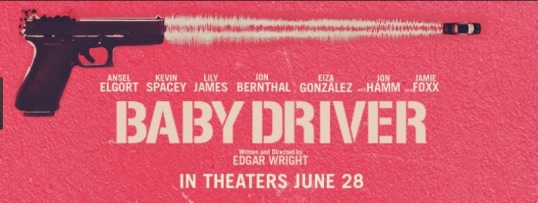
Film Review: Baby Driver (dir by Edgar Wright)


Baby Driver, the new film from director Edgar Wright, is awesome!

That’s the succinct way of putting it and, if you really want to fully enjoy this film, I suggest that you stop reading this review now. There’s no way that a review cannot, to a certain extent, spoil a movie.  Baby Driver is a kinetic blend of action, comedy, romance, and music and it is a movie that you should see without any preconceived notions and expectations.  It’s a movie that earns the right to surprise you with just how good and entertaining it is.  It’s a movie that you should experience fresh.

So, go see the movie.  Seriously, go right now.  GET OUT OF HERE AND SEE THE MOVIE!  This review will still be waiting for you when you get back.  Who knows?  Maybe, while you’re watching the movie, I’ll actually correct some of the typos.  Or maybe not.

Anyway, go away.  I’ll wait for you to return.

la dee da la dee da…

Okay, did you see the movie?  It’s really great, isn’t it?

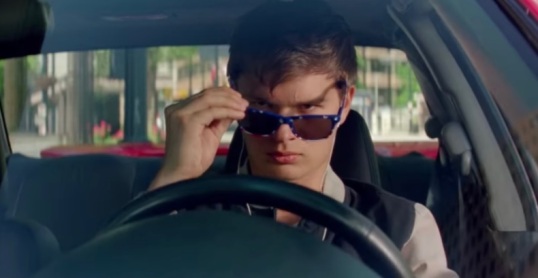
As a result of the childhood car accident that killed his parents, Baby (Ansel Elgort) has been left with a permanent case of tinnitus.  He uses music to drown out the constant ringing in his ears.  There’s almost never a time that Baby isn’t listening to his ipod.  When we first see Baby, he’s sitting behind the wheel of a car, singing along with Jon Spencer and the Blues Explosion.  The second time that we see him, he’s getting coffee while listening to Harlem Shuffle.  In a delirious homage to Singin’ In The Rain (and in a scene that puts the opening traffic jam of La La Land to shame), Baby literally dances across the streets of Los Angeles.  For Baby, every day is a musical.

Of course, Baby doesn’t just use music to block out the ringing.  He also uses the music (and an ever-present pair of sunglasses) to keep the world out.  He rarely speaks or even makes eye contact and, as long as he’s listening to his ipod, he has an excuse not to interact.  He doesn’t have to explain the small scars around his eyes or how he makes his money.  The few times that he does speak to people, it’s to record their voices, which he then turns into music.  Music and the driving are the only two ways this orphan can express his feelings.

When the movie begins, Baby appears to be close to only two men.  One is his deaf foster father, Joseph (CJ Jones).  Baby lives with Joseph, in an apartment where Baby regularly stashes thousands of dollars.  Joseph always watches in disapproval as Baby hides the money under the floorboards.  Joseph signs at Baby that he deserves better than the life he’s leading.  Baby always signs back that he’s only a few jobs away from being done.

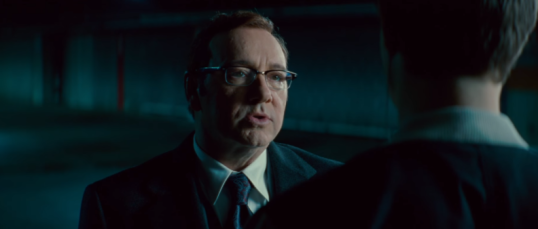
Baby’s other father figure is Doc (Kevin Spacey).  Doc is a rich and connected man.  At times, he seems to sincerely care about Baby but there are other times when Doc is just as quick to threaten to kill him and everyone that he loves.  Doc plans bank robberies for a living.  Doc may change associates from robbery to robbery but one thing always remains consistent.  Baby is always his driver because Baby is the best.  As Doc explains it, the first time he saw Baby, he was stealing Doc’s Mercedes.  Baby drives for Doc as a way of paying off his debt to the older man but you still believe Baby’s sincerity when he tells Doc, “We’re a team.”  (One the film’s best throw-away jokes is the line where Doc reveals that he knows where Baby got the idea to say that.)

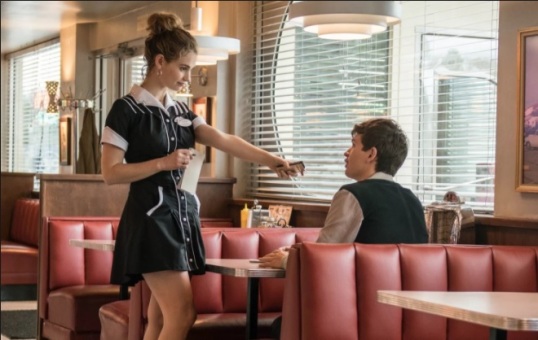
Things start to change for Baby when he meets Debora (Lily James), a waitress who appears to love music just as much he does.  For Baby and Debora, it’s love at first sight but Doc has one more job that he needs Baby for.  It’s their most dangerous job yet and, making thing even more complicated, are the three people who Doc has recruited to work with Baby.  Buddy (Jon Hamm) is a former wall street banker who is eager to prove what a badass he is.  Darling (Eiza Gonzalez) is his wife, who enjoys talking about how many of their former partners have died.  And finally, there’s Bats (Jamie Foxx), a complete and total psycho who brags about never telling a single story that doesn’t end with someone getting killed.

Baby Driver is a propulsive blast of pure adrenaline, perhaps the closest that we will ever get to a genuine pulp musical.  The action scenes left me literally breathless.  I saw the movie at the Alamo Drafthouse and, before the film started, there was a clip of Edgar Wright listing his favorite car chases.  He listed all of the usual suspects, Bullitt, The French Connection, Mad Max: Thunder Road.  The chases scenes in Baby Driver can proudly be listed next to all of those scenes.  This is genuinely exciting crime film, featuring wonderfully over-the-top turns from Foxx, Hamm, and especially Spacey.

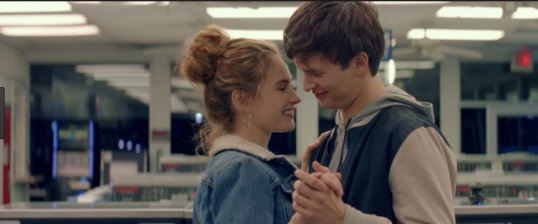
But you know what?  Baby Driver may be a great action film but what makes it special is that it’s also a film with a heart.  Rather bravely, Edgar Wright has not only made an action musical but he’s also mixed in a very sincere and unabashedly sentimental love story.  You never doubt for a second that Baby would give up everything — music, driving, even his life — for Debora.  The scenes between Baby and Debora are almost deliriously romantic.  Ansel Elgort and Lily James both share a very likable and very real chemistry.  You want things to work out for Debora and Baby.  You feel like they belong together and, when it looks like either Baby or Debora might be in danger, you worry for both of them.  As exciting as the film’s action sequences were, it was the ending that brought tears to my eyes and that was almost totally due to the performances of Elgort and James.

Baby Driver is one of the best films that I’ve seen so far this year.  See it this weekend!  If you’ve already seen it, see it again!  This film deserves to be rewarded.


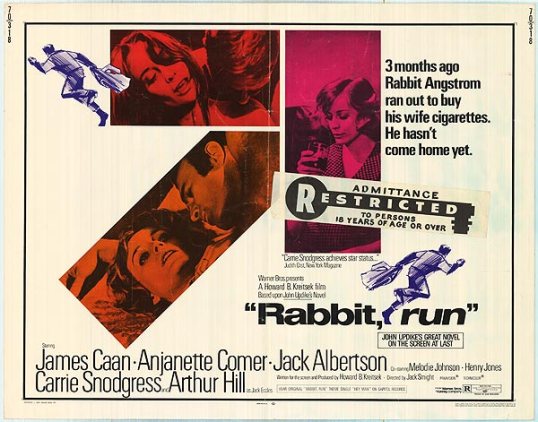
Insomnia File #26: Rabbit Run (dir by Jack Smight)


What’s an Insomnia File? You know how some times you just can’t get any sleep and, at about three in the morning, you’ll find yourself watching whatever you can find on cable? This feature is all about those insomnia-inspired discoveries!

If, at one in the morning on Wednesday, you were suffering from insomnia, you could have turned over to TCM and watched the 1970 film, Rabbit Run.  That’s what I did.

Rabbit Run is the epitome of a dumb lug film.  In a dumb lug film, a male character finds himself living an unfulfilling life but he can’t figure out the reason.  Why can’t he figure it out?  Because he’s a dumb lug, with the emphasis on dumb.  Usually, the viewer is supposed to sympathize with the dumb lug because he doesn’t mean to hurt anyone and everyone else in his world is somehow even more annoying than he is.  Typically, the dumb lug will have an emotionally distant wife who refuses to have sex with him and who is usually portrayed as being somehow at fault for everything bad that has happened in the dumb lug’s face.  (Want to see a more recent dumb lug film than Rabbit Run?  American Beauty.)  Ever since the silent era, there have been dumb lug films.  In particular, male filmmakers and critics seem to love dumb lug films because they allow them to pat themselves on the back for admitting to being dumb while, at the same time, assuring them that everything is the fault of the wife or the girlfriend or the mother or the mother-in-law.

In Rabbit Run, the dumb lug is named Harry Angstrom (James Caan), though most people still remember him as Rabbit, the high school basketball star.  Harry’s life peaked in high school.  Now, he’s 28 and he can’t hold down a job.  He’s married to Janice (Carrie Snodgress), who spends all of her time drinking and watching TV.  He has a son and another baby is on the way.  One day, when the pregnant Janice asks him to go out and get her a pack of cigarettes, Harry responds by getting in his car and driving all the way from Pennsylvania to Virginia.

When he returns to Pennsylvania, Rabbit doesn’t go back to his wife.  Instead, he drops in on his former basketball coach (Jack Albertson) and begs for advice on what he should do.  The coach, it turns out, is more than little creepy.  He also has absolutely no practical advise to give.  He does introduce Rabbit to a part-time prostitute named Ruth (Anjanette Comer).  Rabbit quickly decides that he’s in love with Ruth and soon, he’s moved in with her.

Meanwhile, there’s all sorts of little things going on.  Rabbit gets a job working as a gardener.  Rabbit befriends the local Episcopal minister (Arthur Hill), even while the minister’s cynical wife (Melodie Johnson) tries to tempt Rabbit away from both his wife and his mistress.  Rabbit both resents and envies the sexual freedom of the counter culture, as represented by his younger sister.  And, of course, Janice is pregnant…

Rabbit Run is based on a highly acclaimed novel by John Updike.  I haven’t read the novel so I can’t compare it to the film, beyond pointing out that many great works of literature have been turned into mediocre movies, largely because the director never found a way to visually translate whatever it was that made the book so memorable in the first place.  Rabbit Run was directed by Jack Smight, who takes a rather frantic approach to the material.  Since Rabbit Run is primarily a character study, it needed a director who would be willing to get out of the way and let the actors dominate the film.  Instead, Smight overdirects, as if he was desperately trying to prove that he could keep up with all the other trendy filmmakers.  The whole movie is full of extreme close-ups, abrupt jump cuts, intrusive music, and delusions of ennui.  You find yourself wishing that someone had been willing to grab Smight and shout, “Calm down!”

(On the plus side, as far as the films of 1970 are concerned, Smight’s direction of Rabbit Run still isn’t as bad as Richard Rush’s direction of Gettting Straight.)

James Caan actually gives a likable performance as Rabbit, which is good because Rabbit would be totally unbearable if not played by an actor with at least a little genuine charisma.  There’s nothing subtle about Caan’s performance but he makes it work.  You never like Rabbit but, at the same time, you don’t hate him.

Unfortunately, there’s nothing subtle about the rest of the cast either.  Something rather tragic happens about 80 minutes into the film and, as much as I knew I shouldn’t, I still found myself giggling because Carrie Snodgress’s performance was so bad that it was impossible for me to take any of it seriously.  Even worse is Arthur Hill, as the minister who won’t stop trying to help Rabbit out.  I eventually reached the point where, every time that sanctimonious character started to open his mouth, I found myself hoping someone would hit him over the head and knock him out.  Among the major supporting players, only Anjanette Comer is allowed a chance to be something more than just a sterotype.  Like Caan, she does the best that she can but ultimately. this is James Caan’s movie.

It’s a disappointing movie but it did not put me to sleep.  Give credit for that to James Caan, who is the only reason to see Rabbit Run.

Previous Insomnia Files:

  1. Story of Mankind
  2. Stag
  3. Love Is A Gun
  4. Nina Takes A Lover
  5. Black Ice
  6. Frogs For Snakes
  7. Fair Game
  8. From The Hip
  9. Born Killers
  10. Eye For An Eye
  11. Summer Catch
  12. Beyond the Law
  13. Spring Broke
  14. Promise
  15. George Wallace
  16. Kill The Messenger
  17. The Suburbans
  18. Only The Strong
  19. Great Expectations
  20. Casual Sex?
  21. Truth
  22. Insomina
  23. Death Do Us Part
  24. A Star is Born
  25. The Winning Season


Film Review: Countdown (dir by Robert Altman)


Earlier tonight, on TCM, I watched the 1968 science fiction film, Countdown.

Who will be the first man to walk on the moon?  Will it be Chiz (Robert Duvall), who is a colonel in the Air Force and who has been training for years and who really should get the chance just because he has a really cool name like Chiz?  Or will it be Chiz’s best friend, Lee (James Caan)?  Lee may not have Chiz’s experience but he’s a scientist and selecting him would allow NASA to portray the mission of being one of peace as opposed to one of war.  Add to that, Lee has a full head of hair and he looks like a young James Caan, who was an undeniably handsome man back in his younger days!  I mean, seriously — who would you rather have as the face of the space program: Tom Hagen or Sonny Corleone?

Of course, it might not really matter who NASA picks because the Russians are determined to get to the moon as well.  And you know what that means!  If the Russians land on the moon first, they’ll turn it into a Socialist utopia and that’ll mean ugly architecture, bread lines, and a three-month wait for toilet paper.  The stakes have never been higher!

Countdown was made and released at the height of the space race, at a time when Americans really did feel that they were competing with the Russians to be the first to reach the moon.  (Of course later, it would be learned that the Russian space program actually managed to kill far more cosmonauts than it successfully sent into orbit.)  It came out a year before Apollo 11 landed on the moon and Neil Armstrong became the first Earthling since Stanley Kubrick to ever step on the lunar surface.  As such, it’s interesting to see how Countdown imagines the experience of exploring the moon.  I won’t spoil who reaches the moon first but I will say that he moves remarkably quickly and with great ease for someone in a gravity-free environment.

Countdown is a good example of what I like to call a “time capsule” film.  Seen today, it’s kinda slow and a bit predictable.  For all the time that is spent on getting the astronauts ready to go into space, very little time is actually spent in orbit.  This is a very Earth-bound film.  And yet, if you’re a history nerd like me, it’s hard not to be a little bit fascinated by a movie like this.  In everything, from its fashions to its dialogue to its cultural outlook, this is very much a document of its time.  It may be a while until we have the technology necessary to travel through time.  Until then, watching a film like this might be as close as I’ll ever get to experiencing what the straight, non-Hippie crowd was doing in 1968.

If you’re a student of film history, Countdown is significant for being one of the first films to be directed by Robert Altman.  To be honest, if not for his name in the opening credits, you would probably never guess that Countdown was directed by one of America’s most influential and iconic directors.  Altman specialized in making film that were almost defiantly iconaclastic and there’s very little of that to be found in Countdown.  Admittedly, there are a few scenes that make use of overlapping dialogue and there’s a party scene that’s definitely Altmanesque.  However, the only reason I really noticed that party scene is because I was specifically looking for evidence of Altman’s style.  For the most part, the most identifiably Altmanesque element of Countdown is the casting of Michael Murphy in a small role.

The film is dominated by Robert Duvall and James Caan and, especially if you’re a fan of The Godfather, it’s undeniably fun to see these two acting opposite each other in something other than an epic gangster film.  (Duvall and Caan also acted together in The Rain People and The Killer Elite and were reportedly great friends off-camera as well.)  Duvall is especially good in Countdown, playing Chiz as a man torn between an innate sense of loyalty and his own competitive nature.  The scenes between Duvall and Caan have a charge to them that occasionally bring some much-needed life to this film.

In the end, Countdown is a fairly forgettable film but it’s worth seeing as a piece of history.

TV Review: Twin Peaks: The Return Part 8 (dir by David Lynch)


It is happening again.

Yeah, this isn’t going to be easy.

Tonight’s episode of Twin Peaks was … well, I’m not sure how to describe it.  Basically, if you combined Tree of Life and Kiss Me Deadly with The Beast of Yucca Flats and Tombs of the Blind Dead, you would end up with something resembling tonight’s episode.  Tonight’s episode was David Lynch at both his most brilliant and his most cheerfully defiant.  Tonight was David Lynch unleashed.  People either hated it or they loved it.

The recapper over at E! News Online hated it.  I almost didn’t include a link to their recap, largely because the only reason they’re recapping Twin Peaks is to get the clicks.  They’re certainly not recapping it because they have any sort of genuine understanding or, for that matter, interest in what Lynch is attempting to do.  For the most part, their recap went something like this: “Oh my God, that was soooo weird and the nuclear explosion sequence went on forever and what was the deal with 1956 and look at all the snarky nicknames I’ve come up with for all the characters and oh my God, did I mention that I have a roommate?”  If your main complaint about tonight’s episode is that it was “too weird,” then you obviously are not meant to be a part of this show’s audience.

As for the length of the nuclear explosion … seriously?  What the Hell type of complaint is that?  You might as well complain that the stargate sequence went on for too long in 2001 or maybe that Picasso shouldn’t have taken up so much space with Guernica.  It’s easy to imagine this critic in Elizabethan England, whining that Hamlet was just too talky.  Tonight, we were lucky enough to witness one of the most visually stunning sequences in the history of television and you actually have the freaking nerve to complain that it went on for too long?  I understand that, over at the Kardashian network, being snarky is a part of the job but you can be snarky without being stupid about it.

I was not the only one disappointed by that recap…

(I usually try to cut recappers some slack.  After all, you’re on a deadline and you’re trying to beat everyone else for those clicks and sometimes, you rush and you say something stupid.  I’ve been there.  Just ask Arleigh about the first season Game of Thrones recap where I somehow managed to mix up Jon Snow and Robb Stark.  That was beyond embarrassing.  But, again, there’s a difference between being rushed and being willfully ignorant about what you’ve just watched.  For instance, there’s a reason why I wouldn’t even try to recap that football show starring Dwayne Johnson.  I guess my point is that maybe E! should focus on what they’re good at, like promoting scripted reality programs and helping Scott Disick get laid.)

Anyway, here’s my attempt to recap what I watched.  I will warn you right now that a mere recap is not going to do this episode justice.  If you haven’t seen it, you need to watch it before reading any recap, regardless of who wrote it.  Tonight, I saw images that I never expected to ever see on television.  There were visuals of such unexpected beauty and haunting menace that you simply must see them for yourself.
We open with a classic David Lynch driving scene.  Doppelganger Cooper (Kyle MacLachlan) and Ray (George Griffith) are driving down a country road in the middle of the night.  The Warden attempted to put tracking devices on the car but Doppelganger Cooper was far too clever for him.

Ray apologizes for running off on Doppelganger Cooper and asks where Darya is.  The Doppelganger says that she’s waiting for their phone call.  (If you’ve seen the pilot episode, you know that she was murdered by the Doppelganger.)  The Doppelganger says that Ray has something that he wants.  Ray assures him that he does and that he all the “numbers memorized.”  However, Ray thinks that it might be worth some money if the Doppelganger really wants what he has.

Doppelganger Cooper tells Ray that they’re going to a place called The Farm but Ray asks if they can pull over for a sec so he can, as he so charmingly puts it, “take a leak.”

“Go for it,” Doppelganger Cooper replies.

Well, not surprisingly, Ray has another reason for wanting to pull over.  As soon as Doppelganger Cooper gets out of the car and demands the information, Ray shoots him.

“Tricked ya, fucker,” Ray says.

And that’s when things start to get … strange.

Suddenly, there is a flashing light and, as Ray watches, a group of dark men (much like the dark men who previously appeared in the South Dakota jail and outside the morgue) emerge from the woods.  They surround the doppelganger.  While some dance in a circle, others paw at the the body.  Briefly, it appears as if Cooper’s chest has been opened and the smiling face of Killer BOB (Frank Silva) can be seen.  Ray runs back to his car and speeds off while the dark men vanish.

As he drives away, Ray calls Phillip Jeffries and tells him that Cooper might be dead but he’s not 100% sure.

Meanwhile, at the Roadhouse, Nine Inch Nails performs.  The recapper at E! felt that the Nine Inch Nails performance went on for too long, which again shows a remarkable ignorance about the importance of music in David Lynch’s work.  (Considering how much Twin Peaks: The Return has in common with Lost Highway, the sudden appearance of Nine Inch Nails felt totally appropriate.)
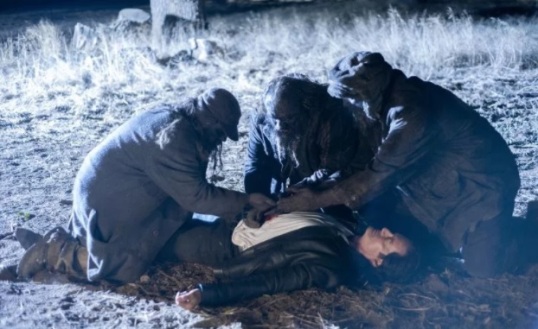
As the song comes to an end, we cut back to the Doppelganger, who suddenly sits up.  Has he come back to life or did those two gunshots really fail to kill him the first time?  And what’s happening with Dougie/Cooper?  It’s been suggested that the only way for Cooper to be Cooper again is for the Doppelganger to die and return to the Black Lodge.  If the Doppelganger was dead for even a moment, does that mean Dougie/Cooper had a moment of clarity?

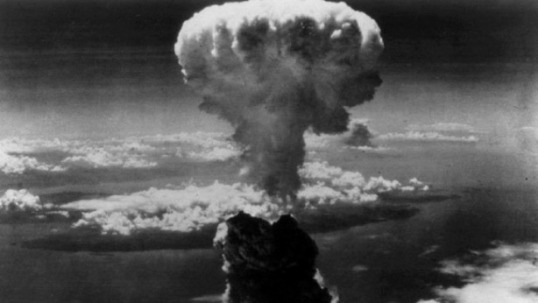
Those are all good questions that were not answered tonight because Lynch suddenly cuts from the Doppelganger to July 16th, 1945.  Suddenly, we are in White Sands, New Mexico, listening as a voice counts down to zero.  We watch from above as the world’s first atomic bomb is detonated.  A mushroom cloud slowly and, it must be said, beautifully rises up into the sky.

The viewer plunges into the mushroom cloud and what follows is a mix of sound and image that so beautiful and so menacing that it is almost indescribable.  We are surrounded by flames and explosions as we plunge into the heart of man-made destruction.  In many ways, it reminded me of the Big Bang sequence of Terence Malick’s Tree of Life but, whereas Malick was imagining creation, Lynch is imagining destruction.

We find ourselves now looking at what appears to be a gas station in the middle of nowhere.  Spurts of static are heard on the soundtrack while lights flash and shadowy men appear (and disappear) inside and outside of the station.
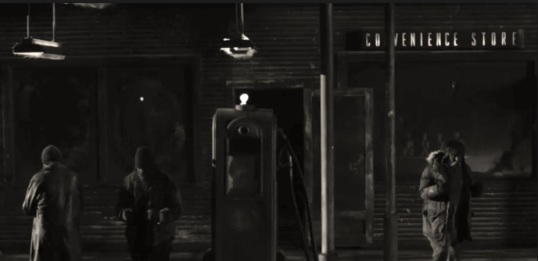
A figure floats in a gray space, apparently spitting up eggs.  One of the eggs floats by us and, again, the face of Killer BOB is seen.

More flames. More explosions.  A golden egg floats towards the camera.  Briefly, we hear a heartbeat.

Cut to: the purple ocean that Cooper saw when he first escaped from the Black Lodge.

A woman who, in the end credits, is identified as being Senorita Dido (Joy Nash) sits in a gray drawing room.  We hear an electronic clanking and a light starts to flash.  The Giant (Carel Struycken) enters the room and turns off the alarm.

Moving slowly, the Giant walks up a flight of stairs.  He walks into a theater, one that looks much like the Silencio theater from Mulholland Drive.  On a screen, he watches the nuclear explosion.  When he sees the egg with BOB’s face, the Giant suddenly starts to float into the air.

Senorita Dido enters the theater and watches as a golden cloud appears over the Giant’s head.  From the cloud descends a golden egg, which Dido catches.  In the egg, she sees the face of Laura Palmer.  Dido kisses the egg and then releases it into the air.  It’s sucked into a tube.

Dido stares at the screen, watching as the golden egg descends on Earth.

We cut to 1956.  The New Mexico desert.  (The rest of the episode is in black-and-white, giving these scenes a Beast of Yucca Flats feel.  You can easily imagine Tor Johnson wandering about.)  Another egg — this one much smaller, sits on the barren ground.  It hatches and winged bug crawls out.  (It looked like a mutated cockroach to me.)

Cut to the gas station, where a teenage couple is talking.  (Coincidentally or not, they resemble James and Donna from the original series.)  The girl (Tikaeni Faircrest) gets excited when she finds a penny on the ground.  Well, who wouldn’t?  Later, the boy (Xolo Mariduena) asks the girl for just one kiss.  I’m not sure who they are or why they’re here but they’re both actually rather sweet.

A shadowy figure — the Woodsman (Robert Broski) — appears walking through the desert.  The recapper at E! News apparently thought that the Woodsman was meant to be a “gorilla.”  Of course, anyone who actually know anything about movies will immediately notice that the Woodsman looks a lot like the evil man who was living behind the dumpster in Mulholland Drive.

The monster from Mulholland Drive
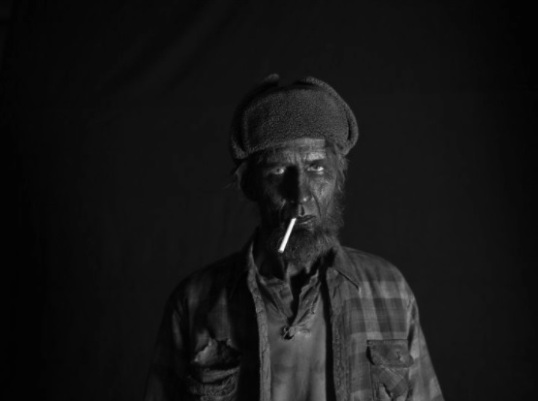
The Woodsman from Twin Peaks, Part 8

The Woodsman stumbles across the highway.  He approaches a couple in a car.  “Got a light?” he asks, his voice deep and almost robotic.  “Got a light?” he repeats, like a malfunctioning recording.  The couple speeds away and we see that the Woodsman is not alone.  At least two other shadowy men are with him.

A radio station, KPJK, sits in the middle of the desert.  The Woodsman approaches.

We see that everyone in the nearby town — from an auto mechanic to a waitress to the teenage girl who found the penny — is listening to the station.

The woodsman enters the station.  “Got a light?” he asks, before crushing the receptionist’s head with his gloved hand.  He does the same thing to the station’s disc jockey but not before the Woodsman gets on the air and says, “This is the water and this is the well. Drink full and descend. The horse is the white of the eyes and dark within.”

As everyone in town listens to the Woodsman’s voice, they pass out.  While the girl lies unconscious, the bug crawls into her mouth.

Having delivered his message and killed everyone at the station, the Woodsman walks into the night.  The sound of a horse whinnying is heard.

And that’s it!

What does it all mean?  I don’t know.  What I do know is that I’ve never seen anything like it before.  This was experimental cinema at its best.  (And make no mistake.  Twin Peaks is not a TV series as much as it’s an 18-hour movie.)  Was it for everyone?  No.  Then again, nothing worthwhile ever is.  David Lynch once described his first feature film, Eraserhead, as being a “dream of dark and disturbing things.”  I can think of no better description for Part 8 of Twin Peaks.

The saga continues in two weeks!  Will we still be in 1956?  Will Dougie/Cooper ever snap back to normal?  Will James Hurley ever show up again?  Who knows!?  But I will say this: I can’t wait to find out.

Twin Peaks on TSL:

  1. Twin Peaks: In the Beginning by Jedadiah Leland
  2. TV Review: Twin Peaks 1.1 — The Pilot (dir by David Lynch) by Lisa Marie Bowman
  3. TV Review: Twin Peaks 1.2 — Traces To Nowhere (directed by Duwayne Dunham) by Jedadiah Leland
  4. TV Review: Twin Peaks 1.3 — Zen, or the Skill To Catch A Killer (dir by David Lynch) by Lisa Marie Bowman
  5. TV Review: Twin Peaks 1.4 “Rest in Pain” (dir by Tina Rathbone) by Leonard Wilson
  6. TV Review: Twin Peaks 1.5 “The One-Armed Man” (directed by Tim Hunter) by Jedadiah Leland
  7. TV Review: Twin Peaks 1.6 “Cooper’s Dreams” (directed by Lesli Linka Glatter) by Lisa Marie Bowman
  8. TV Review: Twin Peaks 1.7 “Realization Time” (directed by Caleb Deschanel) by Lisa Marie Bowman
  9. TV Review: Twin Peaks 1.8 “The Last Evening” (directed by Mark Frost) by Leonard Wilson
  10. TV Review: Twin Peaks 2.1 “May the Giant Be With You” (dir by David Lynch) by Leonard Wilson
  11. TV Review: Twin Peaks 2.2 “Coma” (directed by David Lynch) by Jedadiah Leland
  12. TV Review: Twin Peaks 2.3 “The Man Behind The Glass” (directed by Lesli Linka Glatter) by Jedadiah Leland
  13. TV Review: Twin Peaks 2.4 “Laura’s Secret Diary” (dir by Todd Holland) by Lisa Marie Bowman
  14. TV Review: Twin Peaks 2.5 “The Orchid’s Curse” (dir by Graeme Clifford) by Lisa Marie Bowman
  15. TV Review: Twin Peaks 2.6 “Demons” (dir by Lesli Linka Glatter) by Leonard Wilson
  16. TV Review: Twin Peaks 2.7 “Lonely Souls” (directed by David Lynch) by Jedadiah Leland
  17. TV Review: Twin Peaks 2.8 “Drive With A Dead Girl” (dir by Caleb Deschanel) by Lisa Marie Bowman
  18. TV Review: Twin Peaks 2.9 “Arbitrary Law” (dir by Tim Hunter) by Lisa Marie Bowman
  19. TV Review: Twin Peaks 2.10 “Dispute Between Brothers” (directed by Tina Rathbone) by Jedadiah Leland
  20. TV Review: Twin Peaks 2.11 “Masked Ball” (directed by Duwayne Dunham) by Leonard Wilson
  21. TV Review: Twin Peaks 2.12 “The Black Widow” (directed by Caleb Deschanel) by Leonard Wilson
  22. TV Review: Twin Peaks 2.13 “Checkmate” (directed by Todd Holland) by Jedadiah Leland
  23. TV Review: Twin Peaks 2.14 “Double Play” (directed by Uli Edel) by Jedadiah Leland
  24. TV Review: Twin Peaks 2.15 “Slaves and Masters” (directed by Diane Keaton) by Lisa Marie Bowman
  25. TV Review: Twin Peaks 2.16 “The Condemned Woman” (directed by Lesli Linka Glatter) by Leonard Wilson
  26. TV Review: Twin Peaks 2.17 “Wounds and Scars” (directed by James Foley) by Lisa Marie Bowman
  27. TV Review: Twin Peaks 2.18 “On The Wings of Love” (directed by Duwayne Dunham) by Jedadiah Leland
  28. TV Review: Twin Peaks 2.19 “Variations on Relations” (directed by Jonathan Sanger) by Lisa Marie Bowman
  29. TV Review: Twin Peaks 2.20 “The Path to the Black Lodge” (directed by Stephen Gyllenhaal) by Lisa Marie Bowman
  30. TV Review: Twin Peaks 2.21 “Miss Twin Peaks” (directed by Tim Hunter) by Leonard Wilson
  31. TV Review: Twin Peaks 22.2 “Beyond Life and Death” (directed by David Lynch) by Lisa Marie Bowman
  32. Film Review: Twin Peaks: Fire Walk With Me (dir by David Lynch) by Lisa Marie Bowman
  33. Here’s The Latest Teaser for Showtime’s Twin Peaks by Lisa Marie Bowman
  34. Here’s The Newest Teaser for Showtime’s Twin Peaks by Lisa Marie Bowman
  35. 12 Initial Thoughts About Twin Peaks: The Return Parts One and Two by Lisa Marie Bowman
  36. This Week’s Peaks: Parts One and Two by Ryan C. (trashfilm guru)
  37. TV Review: Twin Peaks: The Return Parts One and Two (dir by David Lynch) by Lisa Marie Bowman
  38. 4 Shots From 4 Films: Special Twin Peaks Edition by Lisa Marie Bowman
  39. This Week’s Peaks: Parts Three and Four by Ryan C. (trashfilm guru)
  40. 14 Initial Thoughts About Twin Peaks: The Return Part Three by Lisa Marie Bowman (dir by David Lynch)
  41. 10 Initial Thoughts About Twin Peaks: The Return Part Four by Lisa Marie Bowman (dir by David Lynch)
  42. TV Review: Twin Peaks: The Return Parts Three and Four (dir by David Lynch) by Lisa Marie Bowman 
  43. 18 Initial Thoughts About Twin Peaks: The Return Part 5 (dir by David Lynch) by Lisa Marie Bowman
  44. This Week’s Peaks: Part Five by Ryan C. (trashfilm guru)
  45. TV Review: Twin Peaks: The Return: Part 5 (dir by David Lynch) by Lisa Marie Bowman
  46. 14 Initial Thoughts On Twin Peaks Part 6 (dir by David Lynch) by Lisa Marie Bowman
  47. This Week’s Peaks: Part Six by Ryan C. (trashfilm guru)
  48. TV Review: Twin Peaks: The Return Part 6 (dir by David Lynch) by Lisa Marie Bowman
  49. 12 Initial Thoughts on Twin Peaks: The Return Part 7 (dir by David Lynch) by Lisa Marie Bowman
  50. This Week’s Peaks: Part Seven by Ryan C. (trashfilm guru)
  51. TV Review: Twin Peaks: The Return Part 7 (dir by David Lynch) by Lisa Marie Bowman
  52. Ten Initial Thoughts on Twin Peaks: The Return Part 8 (dir by David Lynch) by Lisa Marie Bowman
  53. This Week’s Peaks: Part Eight by Ryan C (trashfilm guru)

Music Video of the Day: D7-D5 by Blanck Mass (2016, dir by Jake McGowan)


When Benjamin John Power, the man behind Blanck Mass, was asked about this haunting and surreal video, this is what he told Spin:

“D7-D5′ is intended as the second move in a game of chess initially instigated by Manuel Gottsching when he released (and named said release) ‘E2-E4,’ the recording which many believe pioneered techno. The video was made by [my] good friend Jake McGowan, and follows one man whilst he struggles to deal with a flurry of emotions and human states which are common during a battle of any size, including a game of chess.”

For myself, I’ll say that this video immediately reminded me of the work of David Lynch.  Of course, I’m kind of obsessed with David Lynch’s art right now.  Until Twin Peaks has finished its run, I imagine that almost everything is going to remind me of Lynch in one way or another.

Still, this video is almost unsettling as that famous scene in A Field in England, that one that featured Blanck Mass’s Chernobyl playing in the background.  Remember that scene?

Well, unsettling or not, Blanck Mass helps me to focus, which considering the intensity of my ADD, is no small accomplishment!  If not for well-selected background music, I probably wouldn’t have been able to finish 3,000 of the 3,897 things that I have posted on this site!

Enjoy!


Music Video Of The Day: The Chemical Brothers featuring k-os — Get Yourself High (2003, dir by Joseph Kahn)


This music video features digitally enhanced footage from a 1980 film called 2 Champions of Shaolin.  According to Wikipedia, here’s what the video’s director, Joseph Kahn, had to say about it:

“I edited this on a laptop on a plane to Chicago. I rearranged the time sequencing of the actual movie. The bad guy with the big boombox is actually a minor henchman who dies in the first 30 minutes, but in my visual remix he’s the ultimate antagonist. The lip syncing was motion captured, then applied to 3D models of jaws. I didn’t know 100% if the technology was achievable with the time and money, nor did I know if we could actually get rights to a Chinese kung fu flick. It was a risky venture, but Carole gave me a check and then left me alone. She had some major balls.”

(And if it’s on Wikipedia, it has to be true!)

Anyway, I really love this video and the song.  The only unfortunate thing is that the Get Yourself High clown doesn’t make an appearance.  Who is the Get Yourself High Clown?  If you’ve seen The Chemical Brothers live, there’s a good chance you’ve seen him.  Check him out in this footage from their 2007 performance at Glastonbury:

Enjoy!

Music Video of the Day: The Chemical Brothers — Hey Boy Hey Girl (1999, dir by Dom & Nic)


Hi, everyone!  Lisa here.

So, as you know if you’ve been following the site, Val is currently having a hospital procedure done so she’s going to be gone for a few days.  Since I love Val’s music video of the day posts, I’m going to share a few picks of my own until she returns!

Hey Boy Hey Girl is not only one of my favorite songs from The Chemical Brothers, it’s also one of my favorite videos.  Admittedly, I could do without the saliva at the start of the film but that’s just because I have a thing about visible saliva.  It doesn’t appeal to me.  But otherwise, I absolutely love this video!

(Whenever I watch this video, I end up staring at my reflection and visualizing what my skeleton looks like.  Usually, I’m impressed.)

This video was one of the many directed by Dom & Nic.  Other videos that they’ve done for The Chemical Brothers: Wide Open, Midnight Madness, Salmon Dance, Believe, The Test, and Setting Sun.

Not a day goes by that I don’t see those dancing skeleton recreated in GIF form.  I guess that’s because I hang out on a lot of horror-themed web sites.

Enjoy!

12 Initial Thoughts on Twin Peaks: The Return Part 7 (dir by David Lynch)


As always, a full recap will be posted either later tonight or tomorrow!

1. We’ve all known a stoner like Jerry.

2. I was wondering if we’d hear anything else about or from Annie in the revival, especially since Heather Graham was not listed as being in the cast.  Actually, I’m a little bit surprised that she’s not still working at the diner.  Apparently, nobody ever leaves that place.

3. I always enjoy Harry Goaz’s performance as Deputy Andy, in both the original series and the revival.  There’s an authenticity to Goaz that allows him to make even the strangest of dialogue convincing.

4. It was nice to see Warren Frost, getting in one last hurrah as Doc Hayward.  Frost passed away last year, after filming his scenes.  When I watched the original Twin Peaks, I was struck by how Warren Frost almost seemed like he had stepped out of a Capra film.  He was the epitome of small town decency and fortitude.  Frost was the also the father of Twin Peaks co-creator, Mark Frost.

5. Let’s take a moment to appreciate Laura Dern’s skill with profanity.  For all the talk about how important a collaborator Kyle MacLachlan has been to David Lynch, one could argue that Laura Dern has been just as important.  Along with appearing in Blue Velvet, Dern also starred in Wild at Heart and Inland Empire.  For whatever reason, she — along with Naomi Watts — seems to be the perfect Lynch actress.

6. Ever since the new cast was announced, I’ve been wondering who David Koechner would play.  It’s hard to think of any other actor who does quite as well with playing obnoxious characters as Koechner.

7.  OH MY GOD!  Suddenly, Dougie’s a badass!  I have to admit that I’m also getting a big kick of Dougie/Cooper’s childlike fascination with badges.

8. It took 6 episodes but, finally, Richard Beymer and Ashley Judd are back.

9. How many Renault brothers are there?  Has it occurred to anyone to just not hire them to work at the roadhouse?  It seems like that would be a way to avoid a lot of trouble.

10. I loved the shot of Doppelganger Cooper leaving his cell and walking down that dark hallway.

11. For the first time since the series began, we end somewhere other than the roadhouse.  Instead, we end at the much more wholesome diner.

12. So, Doppelganger Cooper is on the loose and it looks like Dougie/Cooper might be getting his face on the news as a result of beating up Ike the Spike.  I’m sure that won’t lead to any complications.

Twin Peaks on TSL:

  1. Twin Peaks: In the Beginning by Jedadiah Leland
  2. TV Review: Twin Peaks 1.1 — The Pilot (dir by David Lynch) by Lisa Marie Bowman
  3. TV Review: Twin Peaks 1.2 — Traces To Nowhere (directed by Duwayne Dunham) by Jedadiah Leland
  4. TV Review: Twin Peaks 1.3 — Zen, or the Skill To Catch A Killer (dir by David Lynch) by Lisa Marie Bowman
  5. TV Review: Twin Peaks 1.4 “Rest in Pain” (dir by Tina Rathbone) by Leonard Wilson
  6. TV Review: Twin Peaks 1.5 “The One-Armed Man” (directed by Tim Hunter) by Jedadiah Leland
  7. TV Review: Twin Peaks 1.6 “Cooper’s Dreams” (directed by Lesli Linka Glatter) by Lisa Marie Bowman
  8. TV Review: Twin Peaks 1.7 “Realization Time” (directed by Caleb Deschanel) by Lisa Marie Bowman
  9. TV Review: Twin Peaks 1.8 “The Last Evening” (directed by Mark Frost) by Leonard Wilson
  10. TV Review: Twin Peaks 2.1 “May the Giant Be With You” (dir by David Lynch) by Leonard Wilson
  11. TV Review: Twin Peaks 2.2 “Coma” (directed by David Lynch) by Jedadiah Leland
  12. TV Review: Twin Peaks 2.3 “The Man Behind The Glass” (directed by Lesli Linka Glatter) by Jedadiah Leland
  13. TV Review: Twin Peaks 2.4 “Laura’s Secret Diary” (dir by Todd Holland) by Lisa Marie Bowman
  14. TV Review: Twin Peaks 2.5 “The Orchid’s Curse” (dir by Graeme Clifford) by Lisa Marie Bowman
  15. TV Review: Twin Peaks 2.6 “Demons” (dir by Lesli Linka Glatter) by Leonard Wilson
  16. TV Review: Twin Peaks 2.7 “Lonely Souls” (directed by David Lynch) by Jedadiah Leland
  17. TV Review: Twin Peaks 2.8 “Drive With A Dead Girl” (dir by Caleb Deschanel) by Lisa Marie Bowman
  18. TV Review: Twin Peaks 2.9 “Arbitrary Law” (dir by Tim Hunter) by Lisa Marie Bowman
  19. TV Review: Twin Peaks 2.10 “Dispute Between Brothers” (directed by Tina Rathbone) by Jedadiah Leland
  20. TV Review: Twin Peaks 2.11 “Masked Ball” (directed by Duwayne Dunham) by Leonard Wilson
  21. TV Review: Twin Peaks 2.12 “The Black Widow” (directed by Caleb Deschanel) by Leonard Wilson
  22. TV Review: Twin Peaks 2.13 “Checkmate” (directed by Todd Holland) by Jedadiah Leland
  23. TV Review: Twin Peaks 2.14 “Double Play” (directed by Uli Edel) by Jedadiah Leland
  24. TV Review: Twin Peaks 2.15 “Slaves and Masters” (directed by Diane Keaton) by Lisa Marie Bowman
  25. TV Review: Twin Peaks 2.16 “The Condemned Woman” (directed by Lesli Linka Glatter) by Leonard Wilson
  26. TV Review: Twin Peaks 2.17 “Wounds and Scars” (directed by James Foley) by Lisa Marie Bowman
  27. TV Review: Twin Peaks 2.18 “On The Wings of Love” (directed by Duwayne Dunham) by Jedadiah Leland
  28. TV Review: Twin Peaks 2.19 “Variations on Relations” (directed by Jonathan Sanger) by Lisa Marie Bowman
  29. TV Review: Twin Peaks 2.20 “The Path to the Black Lodge” (directed by Stephen Gyllenhaal) by Lisa Marie Bowman
  30. TV Review: Twin Peaks 2.21 “Miss Twin Peaks” (directed by Tim Hunter) by Leonard Wilson
  31. TV Review: Twin Peaks 22.2 “Beyond Life and Death” (directed by David Lynch) by Lisa Marie Bowman
  32. Film Review: Twin Peaks: Fire Walk With Me (dir by David Lynch) by Lisa Marie Bowman
  33. Here’s The Latest Teaser for Showtime’s Twin Peaks by Lisa Marie Bowman
  34. Here’s The Newest Teaser for Showtime’s Twin Peaks by Lisa Marie Bowman
  35. 12 Initial Thoughts About Twin Peaks: The Return Parts One and Two by Lisa Marie Bowman
  36. This Week’s Peaks: Parts One and Two by Ryan C. (trashfilm guru)
  37. TV Review: Twin Peaks: The Return Parts One and Two (dir by David Lynch) by Lisa Marie Bowman
  38. 4 Shots From 4 Films: Special Twin Peaks Edition by Lisa Marie Bowman
  39. This Week’s Peaks: Parts Three and Four by Ryan C. (trashfilm guru)
  40. 14 Initial Thoughts About Twin Peaks: The Return Part Three by Lisa Marie Bowman (dir by David Lynch)
  41. 10 Initial Thoughts About Twin Peaks: The Return Part Four by Lisa Marie Bowman (dir by David Lynch)
  42. TV Review: Twin Peaks: The Return Parts Three and Four (dir by David Lynch) by Lisa Marie Bowman 
  43. 18 Initial Thoughts About Twin Peaks: The Return Part 5 (dir by David Lynch) by Lisa Marie Bowman
  44. This Week’s Peaks: Part Five by Ryan C. (trashfilm guru)
  45. TV Review: Twin Peaks: The Return: Part 5 (dir by David Lynch) by Lisa Marie Bowman
  46. 14 Initial Thoughts On Twin Peaks Part 6 (dir by David Lynch) by Lisa Marie Bowman
  47. This Week’s Peaks: Part Six by Ryan C. (trashfilm guru)
  48. TV Review: Twin Peaks: The Return Part 6 (dir by David Lynch) by Lisa Marie Bowman

What Lisa Watched Last Night #167: The Killing Pact (dir by John Lyde)


Last night, I watched The Killing Pact on Lifetime!

Why Was I Watching It?

Because it was on Lifetime, of course!  Y’all know that I can’t resist a Lifetime movie, especially one that has the word “killing” in the title.  At the very least, I figured The Killing Pact would feature the over the top melodrama and tasteful interior design that we’ve all come to expect from Lifetime movies.

(That said, The Killing Pact was advertised as being a premiere but, actually, it aired on the Lifetime Movie Network last month.  I DVR’d it when it first aired but I hadn’t gotten around to watching it yet.  By watching it on Lifetime last night, I was able to clear a little more space on my DVR.  Yay!)

 What Was It About?

Strangers In An Uber!

Strangers In A Train Without The Train!

Take your pick, they’re both adequate descriptions of what was going on in The Killing Pact.  When Hayley (Emily Rose), a single mother and Uber driver, gives a ride to two weirdos (Melanie Stone and Brandon Ray Olive), she is drawn into an unexpected situation.  It turns out that all three of them have people in their lives that they wish were dead.  So, why not agree to a killing pact?  At first, Hayley thinks it’s all a joke but then her sleazy loser of an ex-husband is brutally murdered.  Hayley’s new friends have kept their end of the bargain.  Now, it’s time for Hayley to do her part…

What Worked?

I liked the look of the film.  Almost every scene was drenched in this moody, overcast atmosphere and, as a result, the film was almost always interesting to look at, even if the plot didn’t always work.  There was one scene — of Hayley pulling up in front of a cheap motel — that I thought was especially well put together.  The dark clouds, the wet pavement, the dilapidated motel — the whole scene was full of menace.

What Did Not Work?

For the most part, this film just didn’t work for me.  At first, I was a little confused as to why the movie was doing so little for me but, the more I thought about it, the more I realized that the film just moved way too slowly, especially for a movie that was frequently interrupted by commercials.  The typical Lifetime film has 8 acts.  That means that, over the course of a typical Lifetime movie, there are at least 7 cliffhangers, all designed to make you stick around through the commercials so you can see what happens during the 8th act.  The Killing Pact, however, felt more like a three or four act movie.  There was no forward momentum to hold your interest even through the commercial breaks.  The film’s pacing was definitely off and Lifetime films are all about maintaining a steady pace.

“Oh my God!  Just like me!” Moments

One of the murders involved an autocratic theater producer.  It reminded me of all the murders that nearly occurred during a community theater production of Little Shop of Horrors that I was once involved with.

Lessons Learned

Pacing is everything!

Film Review: Factory Girl (dir by George Hickenlooper)


Oh God.  Factory Girl.

Released in 2006, Factory Girl was a biopic about Edie Sedgwick, the tragic model/actress/artist who was briefly both Andy Warhol’s muse and one of the most famous women in America.  Before I talk too much about this film, I should probably admit that I’m probably the worst possible person to review a movie about Edie Sedgwick.

Why?

Allow me to repost something that I wrote when I reviewed Edie’s final film, Ciao Manhattan:

“In the late 60s, Edie Sedgwick was a model who was briefly the beautiful face of the underground.  Vogue called her a “youthquaker.”  She made films with Andy Warhol, she dated the rich and the famous and for a brief time, she was one of the most famous women in America.  But a childhood full of tragedy and abuse had left Edie fragile and unprepared to deal with the pressures of being famous.  She was fed drugs by those who claimed to care about her, she had numerous mental breakdowns, and, when she was at her most vulnerable, she was pushed away and rejected by the same people who had loved her when she was on top of the world.  Edie died because, when she asked for help, nobody was willing to listen.


Edie Sedgwick (1943 — 1971)

I guess I should explain something.  I don’t believe in reincarnation but if I did, I would swear that I was Edie Sedwick in a past life.  Of all the great icons of the past, she, Clara Bow, andVictoria Woodhull are the ones to whom I feel the closest connection. (Edie is the reason why, for the longest time, I assumed I would die when I was 28.  But now I’m 29, so lucky me.)”

(Incidentally, I wrote that two years ago and I’m still alive so, once again, lucky me.)

Anyway, my point is that I’m always going to be a hundred times more critical of a film about Edie Sedgwick as I would be about any other film.  If you’re already guessing that I didn’t particularly care for Factory Girl, you’re right.  However, there are some people whose opinions I respect and some of them love this film.

Anyway, Factory Girl is a biopic that’s structured so conventionally that it even opens with Edie (played by Sienna Miller) narrating her story to an unseen interviewer.  I can count on one hand the number of successful biopics that have featured someone telling the story of their life to an unseen interviewer.  It’s a conventional and kind of boring technique.  Anyway, the film follows all of the expected beats.  Edie arrives in New York.  Edie is spotted by Andy (Guy Pearce).  Edie makes films with Warhol.  Her famous dance in Vinyl is recreated.  Edie becomes Andy’s platonic girlfriend but then, she meets and falls in love with Bob Dylan…

Oh, sorry.  He’s not actually Bob Dylan.  According to the credits, his name is Folksinger.  He says Bob Dylan type stuff.  He rides around on a motorcycle.  He carries a harmonica.  Oh, and he’s played by Hayden Christensen.

See, the first half of Factory Girl is actually not bad.  Sienna Miller gives a pretty good performance as Edie, even if she never comes close to capturing Edie’s unforced charisma.  Despite being several years too old, Guy Pearce is also credible as Andy Warhol.  The film itself is full of crazy 60s clichés but, even so, that’s not always a terrible thing.  Some of those 60s clichés are a lot of fun, if they’re presented with a little imagination.

But then Hayden Christensen shows up as Bob Dylan and the film loses whatever credibility it may have had.  Hayden, who gave his best performance when he played a soulless and largely empty-headed sociopath in Shattered Glass, is totally miscast as a musician who once said that if people really understood what his songs were about, he would have been thrown in jail.  The film attempts to portray Dylan and Warhol as two men fighting for Edie’s soul but Christensen is so outacted by Guy Pearce that it’s never really much of a competition.  Even though the film makes a good case that Edie’s relationship with Andy was ultimately self-destructive, Guy Pearce is still preferable to Hayden Christensen trying to imitate Dylan’s distinctive mumble.

Anyway, Factory Girl doesn’t really work.  Beyond the odd casting of Hayden Christensen, Factory Girl is too conventionally structured.  In its portrayal of the Factory and life in 1960s New York, the film never seems to establish a life beyond all of the familiar clichés.  (Before anyone accuses me of contradicting myself, remember that I said that the old 60s clichés are fun if they’re presented with a little imagination.  That’s a big if.)  At no point, while watching the film, did I feel as if I had been transported back to the past.  If you want to learn about Edie Sedgwick, your best option is to try to track down her Warhol films.

Edie!