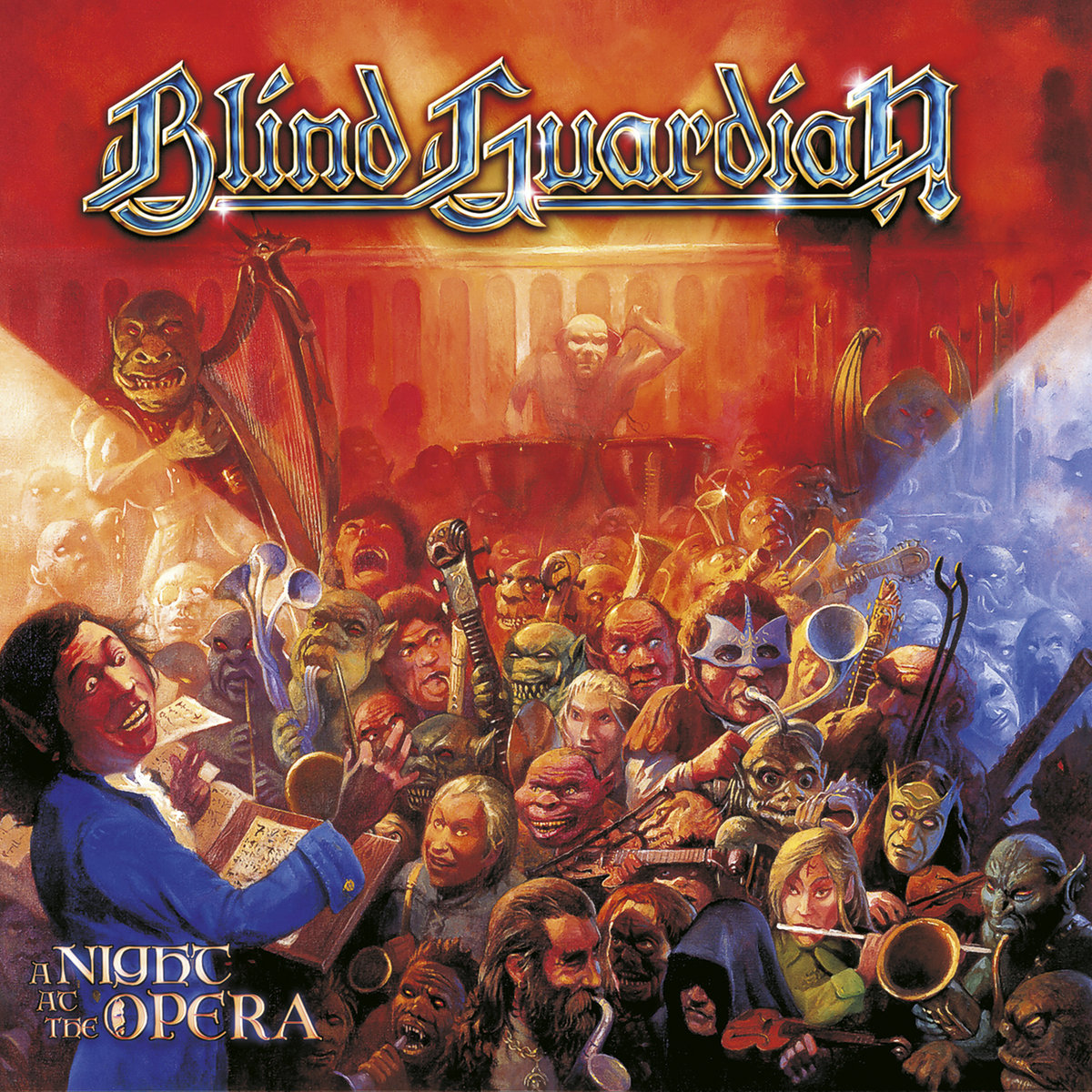
Before getting into it, a little context: this album was my first introduction to Blind Guardian, courtesy of TSL writer necromoonyeti — the same person responsible for putting Boris on my radar. So if this review reads like someone who came in completely cold and got their face melted off, that’s because that’s exactly what happened.
Let’s get one thing straight right away: A Night at the Opera is not a casual listen. It’s not something you throw on while you’re folding laundry or zoning out on the commute home. This is the kind of album that demands you sit down, maybe pour yourself something nice, and just let it completely steamroll you for about an hour. And honestly? That’s exactly the kind of album Blind Guardian needed to make at that point in their career.
Released in 2002, A Night at the Opera is the German power metal legends’ seventh studio album, and it arrived after the already-enormous Somewhere Far Beyond and Imaginations from the Other Side had already cemented the band as giants of the genre. So naturally, Hansi Kürsch and company decided to throw the rulebook entirely out the window. The result is one of the most ambitious, over-the-top, maximalist records in the history of metal — and it rules, even when it’s utterly overwhelming.
The album opens with Precious Jerusalem, and within about thirty seconds you understand exactly what kind of ride you’ve signed up for. The layered vocals, the orchestral bombast, the sheer density of the production — it all comes crashing in like a wall of sound that somehow never feels muddy. Hansi’s voice is front and center, soaring over a choir that sounds like it’s made up of about four hundred people, and it sets the tone perfectly. This isn’t metal with some orchestral elements sprinkled on top. This is something else entirely — something almost operatic in the truest sense of the word.
From there, Battlefield kicks in with a bit more aggression and momentum, which is a welcome shift. André Olbrich and Marcus Siepen’s guitar work throughout the record is phenomenal, but Battlefield is one of the spots where the riffs really get a chance to breathe and cut through the orchestral layering. It’s not quite the straightforward power metal banger you might want it to be, but it’s driving and epic in all the right ways.
Then there’s Under the Ice, which slows things down into something that almost feels mournful. It’s one of the quieter moments on the record, but it’s deceptively powerful. Hansi’s vocal performance here is genuinely moving, and the restraint the band shows — relative to literally everything else on this album — makes it stand out in a really effective way.
If there’s a centerpiece that most people point to when discussing A Night at the Opera, it’s almost certainly And Then There Was Silence. Clocking in at nearly fifteen minutes, it is an absolute monster of a track — a prog-metal epic that tells the story of the fall of Troy through the eyes of Cassandra. Yes, really. And somehow it doesn’t feel self-indulgent. Well, okay, it does feel self-indulgent, but in the best possible way. The track builds and shifts and spirals through so many phases that by the time it reaches its climactic final stretch, you’ve completely forgotten where it started. It’s one of the most impressive things Blind Guardian have ever put to tape, and that’s saying something.
The Maiden and the Minstrel Knight is probably the most accessible thing on the record — a more traditional Blind Guardian ballad that sits comfortably alongside tracks from their earlier work. It’s a bit of a breather in the middle of all the chaos, and it’s genuinely gorgeous. The vocal harmonies are lush and warm, and it’s one of those songs that reminds you how good Hansi Kürsch is at pure melody when he wants to be.
Sadly Sings Destiny and Wait for an Answer keep the epic atmosphere rolling in the back half of the album, though they can start to feel a little dense if you’re not fully locked in. That’s perhaps the one honest criticism of A Night at the Opera— it’s a lot. The production, helmed by Charlie Bauerfeind and the band themselves, is incredibly thick. There are reportedly hundreds of vocal overdubs on some tracks, and while that creates an incredible sound, it can also make the album feel like it’s working very hard to impress you, all the time, without pause. By the time you hit the later tracks, the sheer weight of everything can start to feel a little exhausting if you’re not in the right headspace.
But then The Soulforged comes along and reminds you why you’re here. Inspired by the Dragonlance fantasy series — classic Blind Guardian territory — it’s one of the most energetic tracks on the album, and the chorus is an absolute earworm. It’s big, it’s bright, and it shows that even buried under all the orchestral grandeur, the band still knows how to write a hook that sticks with you for days.
Closing things out, Age of False Innocence and Punishment Divine bring the album home in suitably dramatic fashion. By this point, you’ve been through the full experience, and the record ends feeling genuinely complete — like a proper album with a beginning, middle, and end, rather than just a collection of songs.
So where does A Night at the Opera land in the Blind Guardian catalog? Honestly, it’s one of those records that rewards the people willing to meet it on its own terms. If you go in expecting Somewhere Far Beyond or Imaginations from the Other Side, you might come out a little shell-shocked. But if you give it the time and attention it demands, you’ll find one of the most unique and daring records in power metal history — a band swinging for the absolute fences and largely connecting. It’s not always easy listening, but it’s always worth it.


Pingback: Lisa Marie’s Week In Review: 6/22/26 — 6/28/26 | Through the Shattered Lens