Film Review: Basquiat (dir by Julian Schnabel)


Basquiat.  I love this movie.

I Shot Andy Warhol was not the only 1996 film to feature Andy Warhol as a character.  He was also a prominent supporting character in Basquiat.  In this film, he’s played by David Bowie and Bowie gives a far different performance than Jared Harris did in I Shot Andy Warhol.  Whereas Harris played Andy as a detached voyeur, Bowie’s performance is far more sympathetic.  (Of course, it should be noted that Harris and Bowie were playing Andy Warhol at very different points in the artist’s life.  Harris played the younger, pre-shooting Warhol.  Bowie played the older, post-shooting Warhol.)

Then again, it’s not just Andy Warhol who is portrayed more positively in Basquiat than in I Shot Andy Warhol.  The entire New York art scene is portrayed far more positively in Basquiat.  Whereas I Shot Andy Warhol was a film about an outsider who was destined to forever remain an outsider, Basquiat is a film about an outsider who becomes an insider.  On top of that, Basquiat was directed by a fellow insider, painter Julian Schnabel.

The film itself is a biopic of Jean-Michel Basquiat (very well played by Jeffrey Wright), the graffiti artist who, in the 1980s, briefly became one of the superstars of the New York art scene.  However, it’s less of a conventional biopic and more of a meditation on what it means to be an artist.  Throughout the film, Basquiat looks up to the New York skyline and sees a surfer riding a wave across the sky.  The image itself is never explicitly explained.  We never learn why, specifically, Basquiat visualizes a surfer.  But then again, that’s what makes the surfer a perfect symbol of Basquiat’s artistic sensibility and talent.  It’s a reminder that, while we can appreciate an artist’s work, only the artist can truly understand what that work is saying.  All attempts to try to explain or categorize art are as pointless as trying to understand why that surfer is in the sky.  Ultimately, the why is not as important as the simple fact that the surfer is there.

The film follows Basquiat as he goes from living on the streets to being a protegé of Andy Warhol’s and, until he overdosed on heroin, one of the shining lights of the New York art scene.  Along the way, Basquiat struggles to maintain a balance between art and the business.  In one of the key scenes of the film, an empty-headed suburbanite (Tatum O’Neal) looks at Basquiat’s work and whines that there’s too much green.  She just can’t handle all of that green.

Basquiat’s friendship with Andy Warhol provides this film with a heart.  When Bowie first appears — having lunch with a German art dealer played by Dennis Hopper — one’s natural instinct is to assume that Bowie as Warhol is stunt casting.  However, Bowie quickly proves that instinct to be wrong.  As opposed to many of the actors who have played Andy Warhol over the years, Bowie gives an actual performance.  Instead of resorting to caricature, Bowie plays Warhol as being mildly bemused by both his fame and the world in general.

Basquiat also develops a close friendship with another artist.  Gary Oldman may be playing a character named Albert Milo but it’s obvious from the moment that he first appears that he’s playing the film’s director, Julian Schnabel.  If there was any doubt, Schnabel’s studio stands in for Milo’s studio.  When Milo shows off his work, he’s showing off Schnabel’s work.  When Albert Milo introduced Basquiat to his parents, the nice old couple is played by Julian Schnabel’s actual parents.  It’s perhaps not surprising that Albert Milo is presented as being one of the most important and popular artists in New York City.  In a film full of bitchy characters, Albert Milo is unique in that literally everyone likes and respects him.  And yet Gary Oldman gives such a good and heartfelt performance that you can’t hold it against the character that he happens to be perfect.  There’s a small but touching scene in which Albert Milo and his daughter share a dance in front of one of Schnabel’s gigantic canvases.  Of course, Milo’s daughter is played by Julian Schnabel’s daughter.

The entire cast is full of familiar actors.  Willem DaFoe appears as a sculptor.  Christopher Walken plays a hilariously vapid interviewer.  Courtney Love plays a groupie.  Benicio Del Toro plays Basquiat’s best friend.  Parker Posey shows up as gallery owner Mary Boone.  Michael Wincott plays Rene Ricard, the somewhat infamous art critic who was among the first to celebrate the work of both Basquiat and Schnabel.  For once, the use of familiar actors does not sabotage the effectiveness of the film.  If anything, it helps to explain why Basquiat was so determined to make it.  There’s a magical scene where a then-unknown Basquiat peeks through a gallery window and sees Andy Warhol, Albert Milo, and Bruno Bischofberger.  However, the film’s audience sees David Bowie, Gary Oldman, and Dennis Hopper.  What both Basquiat and the audience have in common is that they’re both seeing bigger-than-life stars.

Basquiat is an often magical and poignant film and I absolutely love it.

Film Review: I Shot Andy Warhol (dir by Mary Harron)


When did Andy Warhol die?

The official date of death is February 22nd, 1987.  The 58 year-old artist died in his sleep of a cardiac arrhythmia.  He was at Manhattan’s New York Hospital, recovering from gallbladder surgery.  The surgery itself had been a minor procedure and, in the days before his death, Warhol was reported to be making a good recovery.  Warhol himself was scared of doctors and had continually put off having the procedure done.

Others, however, argue that Warhol might as well have died on June 3rd, 1968.  That was the day that the world-famous pop artist was shot, at point blank range, by a woman named Valerie Solanas.  Warhol barely survived the attack, spending five hours in surgery and carrying both the mental and physical scars with him for the rest of his life.  It’s debatable whether Warhol ever physically recovered from being shot.  It’s been theorized that the reoccurring gallbladder problems that led to Warhol entering the hospital were directly the result of being shot.  If that’s the case, then Solanas murdered Andy Warhol.

But even beyond the lingering physical injuries, the shooting left Warhol mentally shaken.  The artist who, in the 60s, was famous for hosting a never-ending party at The Factory became far more reclusive and paranoid.  No longer could anyone from anywhere show up in New York and, if they were interesting enough, become a member of Warhol’s entourage.   No longer would Warhol direct films that challenged the assumption of what film had to be.  Warhol spent most of the 70s doing portrait commissions and finding new ways to make money.  (As he wrote in 1975, “Making money is art, and working is art and good business is the best art.”)

It can be argued that, with the pull of a trigger, Valerie Solanas changed the course of history and yet, she has always remained an obscure figure.  (Many would argue that she deserves to remain an obscure figure.)  After the shooting, when Solanas turned herself in, she said that she had no choice but to shoot Andy because “he had too much control over my life.”  Others theorize that Solanas was upset because Andy hadn’t helped her get her book, The SCUM Manifesto, published.  Solanas was diagnosed with paranoid schizophrenia and, for nearly a killing an artist, she spent three years in prison.  While she was in prison, The SCUM Manifesto was finally published.  Ironically, she died in poverty and obscurity, just a few months after Warhol, as forgotten as Andy as was celebrated.

So, who was Valerie Solanas?  That’s the question that 1996’s I Shot Andy Warhol attempts to answer.  Lili Taylor portrays Valerie, giving a performance that is both frightening in its intensity and empathetic in its portrayal of Valerie’s desperation to be heard as a human being and respected as an artist.  Wherever Valerie goes, she’s an outsider.  As a lesbian, she’s been rejected by conventional society.  When she appears on a local talk show, the audience boos her and the host has her thrown off the set.  As a writer, she is rejected by publishers and readers who view her work as being, as one person puts it, “too sick even for us.”  When, like many aspiring artists and lost souls, she arrives at the Factory, the members of Warhol’s entourage reject her because she’s neither beautiful nor glamorous.  Valerie is stuck in a winless situation.  It’s her intensity that makes her a memorable writer but it’s the same intensity that guarantees that almost no one will be willing to read what she writes.

Valerie has written The SCUM Manifesto.  (SCUM stands for Society of Cutting Up Men.)  Throughout the film, we see black-and-white scenes of Valerie reading from the opening of her book:

“Life” in this “society” being, at best, an utter bore and no aspect of “society” being at all relevant to women, there remains to civic-minded, responsible, thrill-seeking females only to overthrow the government, eliminate the money system, institute complete automation and eliminate the male sex.”

Today, of course, Valerie could just start a tumblr or maybe get a job teaching at Evergreen State.  In the 1960s, though, Valerie believes that the only way she’ll ever be heard is by getting her work to Andy Warhol.  When she first meets Andy (Jared Harris), he seems to be receptive to her but we soon see that this film’s version of Andy is receptive to almost anyone.  I Shot Andy Warhol portrays Andy as being an emotionally detached voyeur, a master of passive aggressive behavior.  Instead of personally rejecting Valerie, he lets the more bitchy members of his entourage do it for him.  In fact, at times it seems as if the reason that Warhol surrounds himself with such angry people is so he’ll never have to get angry himself.  It’s actually a rather interesting interpretation of Warhol and the Factory, though it does rely a bit too much on the clichéd image of Andy Warhol as a passive voyeur.  Whenever Jared Harris is onscreen, you never forget that you’re watching someone imitate Andy Warhol as opposed to feeling like you’re watching Warhol yourself.

(When Andy Warhol died, he was worth 220 million dollars.  That alone should be enough to debunk the image of Andy Warhol being a passive voyeur of his own life.)

I Shot Andy Warhol is a frequently fascinating film, one that is sympathetic to both Solanas’s artistic ambitions and her desperate need to be acknowledged as a writer, while also not shying away from the fact that she was a very sick and dangerous person.  At the same time, the film does leave out one very important detail of Solanas’s later life.  After she was released from prison, she still continued to stalk Andy and other members of the New York art world.  That’s an important detail that should have, at the very least, been acknowledged.

Finally, after Andy Warhol’s death, Lou Reed wrote a song called “I believe.”  The song dealt with his feelings towards Valerie Solanas and it’s reasonable to assume that Reed spoke for many of Warhol’s associates.  Here are just a few of the lyrics: ” “I believe life’s serious enough for retribution… I believe being sick is no excuse. And I believe I would’ve pulled the switch on her myself.”

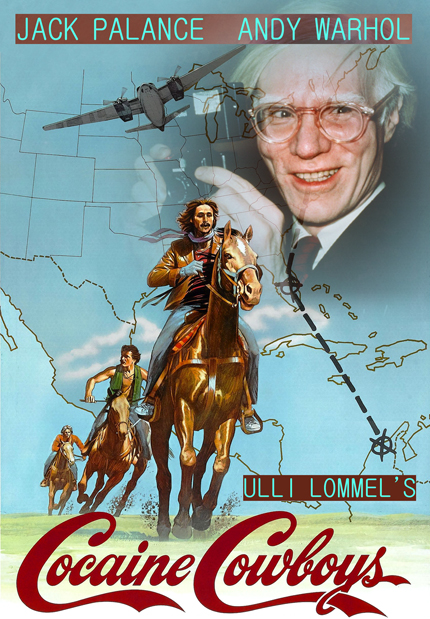
Film Review: Cocaine Cowboys (dir by Ulli Lommel)


Two million dollars worth of cocaine has gone missing in Long Island and Andy Warhol is on the case!

Believe it or not, that’s actually a fairly accurate summation of this 1979 film.  The film does feature a plot about several people looking for a lot of missing cocaine and Andy Warhol does play himself.  And Andy does discover what happened to the cocaine!  He even leaves behind some helpful Polaroids of the cocaine’s location, all of which he signs, “Good Luck, Andy!”

But, here’s the thing.  This is an 80 minutes film.  Though Andy appears at different moments throughout the film, he really only has less than 10 minutes of screentime.  He spends most of that time lurking around with a camera and muttering the occasional word of wisdom.

What’s goes on during the rest of the movie?  Not much.  While waiting to make it big with his band, Dustin (Tom Sullivan) has been making ends meet by smuggling cocaine.  Even though Dustin and the rest of the band want to get out of the drug business, their manager (Jack Palance … wait, Jack Palance!?) sets up one last score.  Unfortunately, while the cocaine is being flown out to Long Island, it falls out of the plane and lands in the water!  Uh-oh!  The drug dealers want their cocaine.  Jack Palance wants the cocaine.  The band wants to find the cocaine and they’re even willing to ride around to horses to look for it.  Some other people want the cocaine but I’m not sure who they were supposed to be.  Andy Warhol does not want the cocaine.  He just wants to talk about Interview Magazine and take pictures of the band.

Almost everyone wants to find the cocaine but, interestingly enough, they’re all pretty laid back about it.  Sure, the band might spend some time looking but they’re just as likely to be found performing a song.  To be honest, the band’s not that bad.  I went to the University of North Texas, which is famous for its music school, and the band definitely has a UNT sound to it.  They’re good without being so good that you’d ever expect them to become stars.  The band’s best song features Dustin going, “We’re cocaine cowboys,” over and over again.

According to The Warhol Diaries, the film’s star, Tom Sullivan, was a real-life drug dealer.  This movie was his attempt to recreate himself as both a film star and rock star.  It didn’t work.  This was Tom Sullivan’s only film credit and he died two years later, at the age of 23.

So, maybe you’re wondering how Jack Palance and Andy Warhol ended up in this obscure little film.  Well, I don’t know what Palance was doing there and, judging from his performance, he didn’t know either.  Warhol was in the film because 1) it was filmed at his Long Island estate and 2) he was friends with director Ulli Lommel.  Today, Lommel is best known for directing crappy true crime horror films but, at the start of his career, he was a protegé of both Rainer Werner Fassbinder’s and Andy Warhol’s.

(Lommel’s then-wife and financial backer, Suzanna Love, also appears in the film.  Horror fans will immediately recognize her from her starring turns in Lommel’s The Boogeyman and The Devonsville Terror.)

Particularly when compared to Ulli Lommel’s later, better-known films (like the unwatchable Curse of the Zodiac), Cocaine Cowboys isn’t that bad.  It’s pointless but it’s pointless by design.  Everyone in the film is so detached and out-of-it that the film becomes a portrait of ennui.  It’s a film that very much shows the influence of Fassbinder and Warhol, taking a popular genre — in this case, the drug rip-off film — and then tearing away at all of the artifice.  “Really?  The French Connection had a car chase?” the film seems to be saying, “Well, Cocaine Cowboys doesn’t have anything!  Just like real life.”

Of course, that’s not totally true.  Cocaine Cowboys does have something.  It has Andy Warhol solving a mystery and that’s got to be worth something.

Film Review: The Driver’s Seat (dir by Giuseppe Patroni Griffi)


The only reason that I watched the 1974 film, The Driver’s Seat, was because I had heard that Andy Warhol was in it and that he actually played a character other than Andy Warhol.

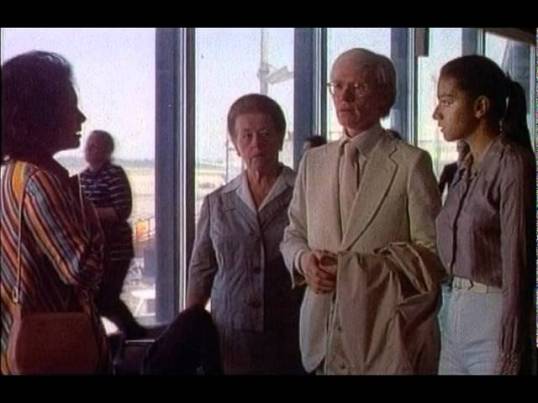
And that, it turns out, is true.  Andy Warhol does appear in The Driver’s Seat.  He plays a character known as “The English Lord” and he even attempts to speak with a posh British accent.  At the same time, though, it’s hard not to feel that Andy Warhol was still essentially playing himself.  Though not lacking in screen presence, Andy played the role with eccentric detachment.  It’s stunt casting, which Andy himself probably would have appreciated but, in the larger context of the film, his presence never quite makes sense.  Then again, the same can be said about just about every actor in The Driver’s Seat.  It’s not a film that’s overly concerned with making sense.

Andy is only in two scenes and they’re both rather short ones.  In his first scene, he approaches Lise (played by Elizabeth Taylor) in an airport and hands her a paperback book that she dropped earlier.  (The book is called The Walter Syndrome.)  As he and his entourage walk away from her, Lise says, “Why is everyone so afraid of me?”

Later on in the movie, Lise runs into the English Lord for a second time.  She approaches him and tries to talk to him but, just as before, he doesn’t have much to say to her.  He’s deep in conversation with some sort of government minister.  At one point, he says, “The King’s an idiot.”

And that’s pretty much the extent of Andy Warhol’s performance.

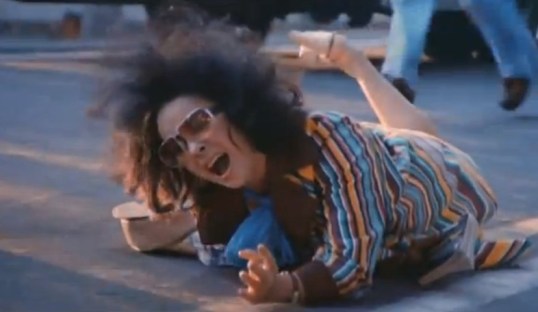
As for the rest of The Driver’s Seat, it’s one of the many oddly surreal films that Elizabeth Taylor made in the 1970s.  Taylor plays Lise, a middle-aged and overweight spinster who goes on an apparently spontaneous trip to Rome.  When she’s not trying to flirt with almost every man that she sees, she is obsessing on death.  (When she spots a police officer, he asks him if he has a gun and points out that, if he did, he could shoot her right that minute.)

Everyone seems to be scared of Lise, or I should say everyone but Bill (Ian Bannen).  Bill is, without a doubt, one of the most annoying characters of all time.  When Lise first sees him and his orange tan, she says, “You look like Little Red Riding Hood’s Grandmother.  Do you want to eat me?”

Bill laughs and happily replies, “I’d like to, I’d like to. Unfortunately, I’m on a macrobiotic diet and I can’t eat meat.”

Bill’s not joking either.  He is obsessed with his macrobiotic diet and won’t shut up about it.  He also tells Lise that, as a result of his diet, “I have to have an orgasm a day.”

When I diet, I diet,” Lise replies, “And when I orgasm, I orgasm!”  Lise also assures him, “I’m not interested in sex, I’m interested in other things!”

Meanwhile, while all this is going on, random people are getting blown up by terrorists and police officers are chasing young men down in airports.  The film is full of flash forwards in which the various characters who have met Lise are roughly interrogated by some sort of shadowy security agency.  Interpol, we’re told, is looking for Lise.  Everyone is looking for Lise!

Why?  Don’t expect an answer.  Why doesn’t matter in this film!  The Driver’s Seat is one of the most pretentious movies that I’ve ever watched.  Fortunately, I have a weakness for pretentious movies from the 1970s.  I’ve seen a lot of incoherent movies but I’ve rarely seen one that embraces and celebrates incoherence with quite the enthusiasm of The Driver’s Seat and it’s hard not to respect the film’s determination to be obscure.  The movie may make no sense but at least it’s weird enough to be watchable.  Elizabeth Taylor actually gives a pretty good performance as Lise, even if you never forget that you’re actually watching Elizabeth Taylor in one of her weird 1970s films.  Taylor plays the role with a conviction that sells even the most overwritten and/or obscure piece of dialogue.  Add to that, in the 70s, Elizabeth Taylor was probably one of the few people who truly could relate to the situation of having everyone in the world searching for her.

The Driver’s Seat is a pretentious mess and that’s just fine.

Film Review: Portrait of Jason (dir by Shirley Clarke)


The 1967 film, Portrait of Jason, is one of the most fascinating documentaries that I’ve ever watched.  It’s also one of the most exhausting.

Directed by Shirley Clarke and filmed over the course of 12 hours in Clarke’s apartment, Portrait of Jason is, at its most basic, an interview with a self-described “hustler” who goes by the name of Jason Holliday. Holliday starts things off by explaining that he was born Aaron Payne but that he was renamed Jason Holliday by a friend of his in San Francisco.

“Jason Holliday was created in San Francisco,” he explains, “and San Francisco is a place to be created.”

The entire film is Jason either standing or sitting in front of a fireplace and talking about his life as a gay black man in America in the 1960s.  (Occasionally, voices are heard off camera, asking him questions.)  From the start of the film, it’s obvious that Jason is a great talker.  He has a way with words and it’s almost impossible not to get swept up in his stories, even if they are frequently hard to follow and sometimes contradict themselves.  As Holliday admits from the start, he is a man playing a role.  Over the course of the film, he smokes, he drinks, and he gets stoned.  He talks about being both a cabaret performer and a prostitute.  He wraps a feather boa around his neck and, when he sings, he takes on a totally different persona.  In fact, it can be argued that the entire film is about Jason taking on different personas.  Over the course of his marathon interview, he is sometimes happy, sometimes angry, sometimes sad, sometimes manipulative, and sometimes defiantly honest.  He admits to using people but, at the same time, when he suddenly very coldly announces, “I can make you feel like the most desirable human being on Earth,” you can’t held but admire his honesty.

In the beginning, Jason laughs.  Jason’s high-pitched giggle almost becomes a separate character, we hear it so often.  He uses the laugh in the way that some people use a period to end a sentence.  The laugh comes out when a story is over.  And yet, over the course of the film, we come to realize that the laugh is Jason’s left defense.  Whenever he feels that the story is getting too personal or that he might be revealing too much of what’s underneath the surface, Jason laughs.  The laugh is what Jason Holliday uses to keep Aaron Payne from coming out.

And yet, as the film progresses, the laugh is heard less and less.  Drunk and stoned, Jason starts to let down his defenses just a little bit.  The off-screen voices, which originally had been so encouraging of Jason, starts to become vaguely hostile.  They ask him about specific instances that Jason has used all of the unseen people in the room.  And Jason starts to change.  His tone becomes sarcastic.  When he breaks down crying, the camera gives us a close-up of his face and it’s hard to watch.  You realize not only how exhausted Jason is but also how exhausted you are as well.  And yet, at the same time, you wonder if Jason is really crying or if this is just a part of his extended performance.

To be honest, this is one of those documentaries that raises all sorts of ethical questions.  Jason’s a fascinating character but it’s obvious that he was set up by the filmmakers.  Much as the film will leave you with mixed feelings about Jason Holliday, it will also leave you with mixed feelings about the people who got him drunk and then filmed his subsequent breakdown.

At the end of the film, we hear Shirley Clarke telling Jason, in almost comforting tone, “That’s it, that’s the end.”  When I first saw this film, I was happy to hear that it was over because I didn’t how much more of Jason’s breakdown I could take.  However, at the same time, I found myself looking forward to the next time that I would watch Portrait of Jason so that I could search for more clues as to just who Jason Holliday actually was.

Long thought to be a lost film, Portrait of Jason occasionally shows up on TCM Underground.  Keep an eye out for it.  It’s not always an easy film to watch but it’s worth the effort.

Film Review: The Connection (dir by Shirley Clarke)


1961’s The Connection opens with a title card and voice over from someone identifying himself as being J.J. Burden.  Burden explains that what we are about to see is the last known work of an aspiring documentarian named Jim Dunn.  Burden explains that, after he and Dunn filmed the footage that’s about to be shown, Dunn disappeared.  It was left to Burden to put the footage together and he swears that he has gone out of his way to stay true to Dunn’s intentions.

Of course, if you’ve watched enough old movies, you might recognize Burden’s resonate voice as belonging to the distinguished actor, Roscoe Lee Browne.  And, once the film starts, you may also notice that you’ve seen Jim Dunn in other movies.  That’s because Dunn is played by William Redfield, a character actor who specialized in playing professional types.

The Connection takes place in a New York loft.  A group of jazz musicians are waiting for their drug dealer.  Sometimes, they play music.  Sometimes, they look straight at the camera and answer questions about what it’s like to be a heroin addict.  While Burden always remains behind the camera, Jim Dunn occasionally steps in front of it and scolds the men for not being dramatic enough.  Dunn is attempting to stage reality.  Leach (Warren Finnerty), the most verbose of the addicts, taunts Dunn over never having done drugs himself.  Dunn jokingly says that maybe he could start with some marijuana.

This is no Waiting for Godot.  The dealer does eventually arrive.  His name is Cowboy and he’s slickly played by Carl Lee.  (Carl Lee was the son of Canada Lee, who appeared in Hitchcock’s Lifeboat.  Sadly, 25 years after filming his role in The Connection, Lee would die of a heroin overdose.)  He’s accompanied by a flamboyant woman named Sister Salvation (Barbara Winchester).  As Burden films, the musicians enter a small bathroom one-by-one, so that they can shoot up.  Music is played.  Overdoses are dealt with.  And Dunn, who was originally so detached, becomes more and more drawn into the junkie life style…

Was The Connection the first mockumentary?  To be honest, I’m really not sure but it definitely has to be one of the first.  The beginning title card (and Burden’s narration) feels like it could easily be used in front of any of the hundreds of found footage horror films that have been released over the last few years.  The film itself makes good use of the found footage format, though it’s also trapped by the genre’s limitations.  With all of the action taking place in just one room, there’s no way that The Connection can’t feel stagey.  (And, indeed, it was based on a play.)  Along with detailing the lives of those on the fringes of society, The Connection makes some good points about the staging of reality, though it never goes quite to the lunatic extremes of Ruggero Deodato’s Cannibal Holocaust.

(The Cannibal Holocaust comparison is not as crazy as it may sound.  Much as how the arrogant filmmakers in Deodato’s film attempted to exploit the cannibals, Jim Dunn attempts to exploit the addicts.  When the addicts and Cowboy start pressuring Dunn to try heroin, it’s not that much different from the cannibals eating the cameraman in Cannibal Holocaust.  The exploited are getting their revenge.)

The Connection was the first dramatic film to be directed by documentarian Shirley Clarke and, like many of Clarke’s films, it struggled to find an audience.  (Both the film and Clarke would have to wait several decades before getting the recognition that they deserved.)  The subject matter was considered to be so sordid (and the language so shocking) that the film was originally banned in New York.  The filmmakers actually had to file a lawsuit to get the film released.  The New York State Court of Appeals ruled the film was “vulgar but not obscene.”

Seen today, the film seems to be neither vulgar nor obscene.  Instead, it seems like a time capsule of the era in which it was made.  We tend to think of the early 60s as a time of beach movies, drive-ins, early rock and roll, and Kennedy optimism.  The Connection reveals that there was a lot more going on than just that.

Lisa Cleans Out Her DVR: Change of Habit (dir by William A. Graham)


(Lisa is currently in the process of cleaning out her DVR!  How long is it going to take?  Some would say forever but, here at the Shattered Lens, we’re hoping that she might have it all done by August.  Anyway, she recorded the 1969 film Change of Habit off of Starz on March 20th!)

It’s Elvis vs. God for the heart of Mary Tyler Moore!

(Okay, so that may be a little bit glib on my part but, seriously, that pretty much sums up Change of Habit.)

Change of Habit opens with three nuns walking through New York City.  There’s the forgettable nun, Sister Barbara (Jane Elliott).  There’s the black, streetwise nun, Sister Irene (Barbara McNair).  And then there’s the idealistic and wholesome nun, Sister Michelle (Mary Tyler Moore).  Because they’re nuns, even notoriously rude New Yorkers are nice to them.  They walk across a busy intersection and all of the cars stop for them.  A cop sees them jaywalking and just smiles and nods at them.  In case you were ever wondering why someone would become a nun, it’s because nuns always have the right-of-way and they don’t have to obey arbitrary laws.  It’s a good life.

The sisters are shopping and, as the opening credits roll, the three of them duck into a dressing room and change into contemporary civilian clothing.  Obsessively, the camera keeps zooming in on everyone’s bare legs.  You can literally hear the film’s producers telling all the boys in the audience, “This may be a G-rated Elvis film but that’s not going to stop us from implying nun nudity!”

It’s Sister Michelle’s idea that the nuns should wear contemporary clothing, the better to relate to the Godless youth of the 1960s.  Unfortunately, now that they’re dressed like everyone else, they have to actually obey traffic laws.  When they attempt to cross the street for a second time, cars honk at them and the cop yells at them for jaywalking.

Michelle, Irene, and Barbara get jobs working at a free clinic.  The clinic is run by John Carpenter (Elvis Presley).  Carpenter is looking for aspiring actresses to appear in a movie about a babysitter being stalked by a masked murderer on Halloween and … oh sorry.  Wrong John Carpenter.  This John Carpenter is a no-nonsense doctor who will stop at nothing to bring peace and good health to the most poverty-stricken neighborhoods in New York!

That’s right.  It’s an Elvis film with a social conscience!

And that probably sounds like a joke but Change of Habit‘s heart is in the right place.  It’s intentions are good.  At least a few of the people involved in the film were probably trying to make the world a better place.  There’s a subplot involving an autistic child that, when you consider this film was made in 1969, is handled with unusual sensitivity.  Of course, that doesn’t mean that the rest of Change of Habit doesn’t feel totally and completely out-of-touch.  The entire film feels so dated that I imagine it probably even felt dated when it was initially released.  This is one of those films where the local black militants give Sister Irene a hard time about being a sell-out, just to eventually admit, during a block party, that maybe white folks aren’t so bad after all.  By the end of the movie, they’re even joking with the cops.  All that was needed was for Elvis to sing a song or two.  To be honest, there are times when Change of Habit feels like the 1969 version of Kendall Jenner’s Pepsi commercial.

Of course, the majority of the film deals with Elvis falling in love with Mary Tyler Moore.  He doesn’t know that she’s a nun and, as she falls in love with him, she’s forced to make a difficult choice.  Does she follow God or does she follow Elvis?  Actually, the film ends before she officially makes that choice but there’s little doubt as to what she’s going to eventually do.  In his final non-concert film appearance, Elvis is totally miscast as a serious-minded doctor and, it must be said, he looked miserable throughout the entire film.  You get the feeling he’d rather be doing anything than starring in Change of Habit.  (Maybe he was already thinking about how much he wanted a special FBI badge.)  Mary Tyler Moore is a bit more believable as a nun.  Fortunately, both Moore and Elvis were likable performers and their likability makes Change of Habit, as ludicrous as it often is, far more watchable than it has any right to be.

In the end, Elvis may not have saved society but he did get to sing a gospel song or two.

Lisa Cleans Out Her DVR: The Girl In the Red Velvet Swing (dir by Richard Fleischer)


(Lisa is currently in the process of cleaning out her DVR!  How long is it going to take?  Forever!  For instance, she recorded 1955’s The Girl In the Red Velvet Swing off of FXM on February 1st and has now gotten around to actually watching and reviewing it.)

The story of Evelyn Nesbit is an interesting one, even if it is now a largely forgotten one.

In 1901, Evelyn Nesbit was a showgirl in New York City.  While she always claimed that she was 16 at the time, there are some historians that think it more likely that she was only 14.  One night, the beautiful Evelyn was introduced to Stanford White.  At the time, White was 47 years old and the most successful and prominent architect in New York City.  White was also a notorious womanizer and Evelyn soon became his latest mistress.  He moved her into one of his many apartments.  Years later, when the details of their relationship became public knowledge, people were shocked to hear that Stanford White kept a red velvet swing in the apartment and that he enjoyed watching Evelyn swing back and forth.  They would be even more scandalized by the news that Stanford also had a “mirror room.”  As Evelyn would later testify, she “entered the room a virgin” but did not come out as one.

Though Evelyn occasionally claimed that she and Stanford were truly in love, she never married him.  (Indeed, Stanford White apparently never married anyone over the course of his life.)  Instead, she ended up meeting and marrying Harry K. Thaw.  Harry was the heir to a 40 million dollar fortune.  He also had a long history of mental illness.  When he learned that, before meeting him, Evelyn had lost her virginity to Stanford White, he was outraged.

(It’s debatable how well Stanford and Harry knew each other.  Some historians claim that they were barely acquainted.  Other accounts claim that Harry and Stanford were business rivals even before Evelyn Nesbit arrived in New York.)

In 1906, Harry and Evelyn ran into Stanford White at Madison Square Garden.  Harry promptly pulled out a pistol and, in front of hundreds of witnesses, shot Stanford dead.

Harry’s subsequent trial was reportedly the first to ever be described as being “the trial of the century.”  Because hundreds of people had seen Harry Thaw shoot Stanford White and the Thaw family was adamant about not publicizing Harry’s history of mental illness, Harry’s defense team attempted to make the trial about Stanford White.  The defense attempted to portray Stanford as being such a depraved predator that Harry really had no other option but to shoot him in cold blood.  Evelyn took the stand and testified to every single detail of her relationship with Stanford White.  The details appeared in every major newspaper in America.

In the end, Harry was found not guilty by reason of insanity and was committed to the  Matteawan State Hospital for the Criminally Insane.  (Reportedly, due to his great wealth, he had the best room in the hospital.)  Meanwhile, Evelyn became one of America’s first reality stars.  Her notoriety led to her appearing in several silent films.  It’s a fascinating story, one that very much feels ahead of his time.  If Evelyn was a star in 1906, just imagine how famous she would be today.

The Girl in the Red Velvet Swing is about Evelyn Nesbit and her relationships with both Stanford White and Harry Thaw.  It’s a shame that the film isn’t as interesting as the real life story.  Ray Milland plays Stanford White.  Farley Granger is Harry Thaw.  Joan Collins is Evelyn Nesbit.  They all give good performances, especially Farley Granger.  But the film itself is just so bland.  Perhaps because it was made in the 1950s, it leaves out the majority of the sordid details that made the story so fascinating to begin with.  For instance, the red velvet swing appears but, in this film, no time is spent in the mirror room.  This true life story is pure tabloid material but The Girl In The Red Velvet Swing is way too respectful for its own good.  By refusing to come down firmly on the side of Harry Thaw or Stanford White, the film feels shallow and a bit empty.  (All good melodramas — even fact-based ones — need a good villain.)  And poor Evelyn Nesbit!  In real life, she was a savvy self-promoter who knew exactly how to manipulate the press.  In this film, she’s just an innocent ingenue.  Considering the facts of the case, the film version is unforgivably dull.

So, I don’t recommend The Girl In The Red Velvet Swing but I do recommend Paula Uruburu’s fascinating 2008 biography, American Eve: Evelyn Nesbit, Stanford White, The Birth of the ‘It’ Girl, and the ‘Crime of the Century.’  It goes into all of the fascinating details that were left out of this film.

Lisa Cleans Out Her DVR: Sinister Minister (dir by Jose Montesinos)


(Lisa is currently in the process of cleaning out her DVR.  She’d probably be done already if she wasn’t trying to review every single movie that she watches.  Sometimes, it takes longer to write the review than to watch the movie.  Boo hoo.  Anyway, she recorded Sinister Minister off of Lifetime on May 28th.)

“Oh hell yeah!”

That’s what I shouted when Sinister Minister began and I saw the following: “The Asylum Presents…”

I’ve explained in the past why I love Asylum films but I will be more than happy to explain again.  After all, it’s possible that you may not have read my previous reviews and, anyway, I’ve got a word count to meet.  I love those three words — “The Asylum Presents” — because the Asylum specializes in making films that are pure entertainment.  There’s no pretension when it comes to the Asylum.  There’s no attempt to try to fool the audience into thinking that they’re seeing something more than they actually are.  There’s none of the silly BS that makes so many other films so tedious.  No.  The Asylum promises to entertain you and, usually, they keep that promise.

Take Sinister Minister for example.  First off, there’s the title.  Sinister Minister has got to be one of the most brilliant titles that I’ve ever seen.  You read that title and you know exactly what you’re getting.  It’s going to be a film about minister and he’s going to be sinister.  The only question is whether or not he’s going to be a man of God or if he’s going to be an official in some dreary socialist country in Europe.

In this case, he’s pretending to be a man of God.  DJ (Ryan Patrick Shanahan) is a charismatic dynamo on the pulpit, giving fiery sermons and encouraging people to read their bibles.  (I didn’t catch his denomination.  I’m going to assume that he a part of that all-purpose, nameless denomination that all television and movie protestants seem to be a part of.)  When we first meet DJ, he’s married but his wife promptly dies in an auto “accident.”  That frees him up to marry his mistress.

However, no sooner has DJ gotten remarried then he meets the recently divorced Trish (Nikki Howard).  DJ likes Trish and Trish likes DJ.  Less impressed is Trish’s teenage daughter, Siena (Angelica Briones).  Of course, it doesn’t matter because DJ’s married, right?  Well, that can be taken care of…

So, is it possible that DJ is just murdering one wife after another and now he’s planning on marrying Trish?  And, in order to do that, is he going to have to target everyone who might have reason to be suspicious of his intentions, including Siena?  Well, he wouldn’t be a sinister minister otherwise!

Anyway, Sinister Minister is one of those totally over the top melodramas that has just enough self-awareness to also be a lot of fun.  (It’s based on a true story but don’t let that scare you off.)  Ryan Patrick Shanahan brings the right mix of bad boy charisma and mustache twirling villainy to the role.  As always, The Asylum promises and enjoyable movie and it delivered.

Lisa Cleans Out Her DVR: Homer and Eddie (dir by Andrei Konchalovsky)


(Lisa is currently in the process of cleaning out her DVR.  It’s taking her such a long time that she’s running out of cutesy ways to talk about how long it’s taking.  She recorded this 1989 comedy off of Starz on May 10th.)

This is another strange one.

Homer and Eddie opens with Homer (James Belushi) standing on the corner of an isolated stretch of desert road.  He is hitchhiking.  When a car finally stops to pick him up, Homer is so excited!  He gets in the back seat, gives the two men in the front seat a really wide smile, and innocently asks them how they’re doing.

One of the men (played by director John Waters) holds up a gun and demands all of Homer’s money.  After Homer hands the money over, he is kicked out of the car.  As the car drives away, Homer pulls a few dollars out of his sock and loudly yells that he fooled them and that they didn’t get all of his money.

The car abruptly stops and, going in reverse, pulls back up to Homer.  Homer gives up his money and the car speeds off.

In short, Homer probably shouldn’t be hitchhiking on his own.  Homer, you see, was hit in the head by a baseball when he was younger.  He has the mind and the innocent outlook of a child.  He is cheerful, he is religious, and he is totally unprepared to deal with real world.

Fortunately, Homer won’t be alone for too long.  Homer comes across an apparently deserted car and, without money or a place to stay, he decides to use the car as shelter.  However, it turns out that the car isn’t as abandoned as it looks!  No, the car is being used by Eddie (Whoopi Goldberg).  Eddie stole the car when she escaped from a mental institution.  Why was Eddie in the mental institution?  She’s a paranoid schizophrenic and she occasionally kills people.  Eddie and Homer are soon taking a very strange road trip, heading up north so that Homer can see his dying father.

It’s a very disjointed film, one that switches tone from scene to scene.  The two stars seem to be acting in totally different movies.  Belushi gives a very broad performance, one that often crosses the line into pure goofiness.  Eddie, meanwhile, is continually and constantly full of rage.  You never know when she’s going to snap and kill someone.  I spent a good deal of the movie waiting for her to kill Homer.  Maybe that was the point but it’s still hard to laugh at scenes of Homer and Eddie waving at a school bus full of cheerleaders when you’re also waiting for Whoopi Goldberg to beat and dismember Jim Belushi.

Homer and Eddie can  summed up by one lengthy sequence.  Eddie takes Homer to a brothel so that he can lose his virginity.  While Homer is dancing around in his underwear, Eddie is at a convenience store, shooting the clerk (played by Pruitt Taylor Vince).  The clerk, who was perfectly nice to Eddie before getting shot, looks at his wound and feebly says, “Why did you do that?” before dying.

It’s a weird little movie.  Usually, I love weird moves but this one is too much of a mess for even me.  As I watched it, I couldn’t help but think of how much more interesting the movie would be if it was the child-like Homer killing people and schizophrenic Eddie trying to keep him calm.  On a positive note, this was decades before Whoopi Goldberg gave up her edginess to co-host The View and she gives shockingly good performance.  When Eddie loses control, she’s actually frightening.  But, unfortunately, the film itself just doesn’t work.