Today, we pay respect to Edward D. Wood, Jr. on the date of his birth. He was born 102 years ago today.
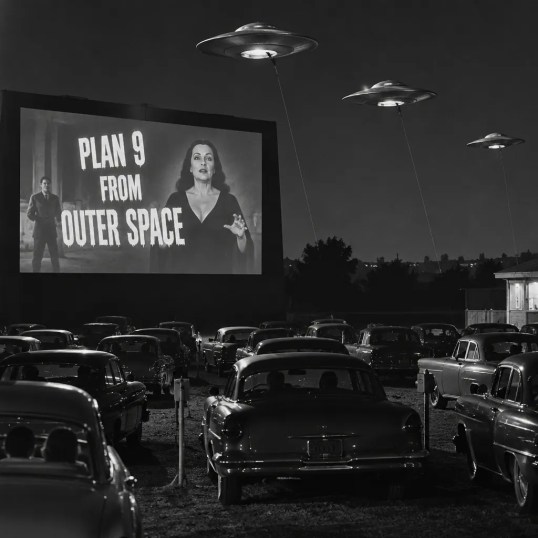
Some films need no introduction and that’s certainly the case with Wood’s 1957 masterpiece, Plan 9 From Outer Space.
Plan9 is a film like no other, a film that mixes UFOs with zombies and which ends with a rather sincere plea for world peace. When Eros the Alien explains that the Solarnite bomb could destroy the entire universe, the film’s hero, airline pilot Jeff, doesn’t point out that Eros’s logic doesn’t make sense. Instead, he just says that he’s glad that America is the one that has the bomb. “You’re stupid! Stupid minds!” Eros shouts before Jeff flattens him with one punch. Go Jeff! Don’t take any backtalk from that judgmental alien!
From Criswell’s introduction to Tor Johnson’s rise from the dead to Lyle Talbot casually standing with his hands in his pockets while a UFO explodes above him, Plan9 is a true classic of some sort.
Though the Academy of Motion Picture Arts and Sciences claim that the Oscars honor the best of the year, we all know that there are always worthy films and performances that end up getting overlooked. Sometimes, it’s because the competition too fierce. Sometimes, it’s because the film itself was too controversial. Often, it’s just a case of a film’s quality not being fully recognized until years after its initial released. This series of reviews takes a look at the films and performances that should have been nominated but were, for whatever reason, overlooked. These are the Unnominated.
Why am I talking about 1979’s The Warriors in October?
No, it’s not a traditional horror movie, even though the film does have some creepy moments and it features David Patrick Kelly playing one of the most memorable psychos in film history. At heart, it’s a film about a group of youngish gang members trying to survive the night and reach safety. (The characters are all meant to be teenagers, though that can be hard to remember when two of the film’s main characters are played by Michael Beck and James Remar, both of whom were close to 30 when the film was made.) The other gangs that the Warriors mostly either battle or escape from often feel as if they’ve stepped out of a nightmare. Everyone remembers the Baseball Furies because, as a gang, they were both intimidating and ludicrous at the same time. Myself, I was freaked out by the skinheads who drove around New York in a bus. The gang led by the guy on roller skates was pretty frightening as well. One thing about the rival gang members is that, with the exception of Luther, few of them speak. Instead, they simply show up and attack.
The Warriors (1979, directed by Walter Hill, DP: Andrew Laszlo)
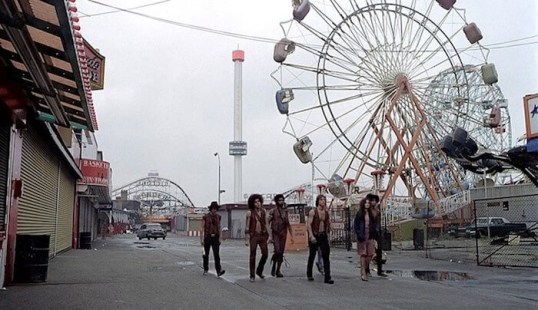
The Warriors is a surreal film, which is not surprising when you consider that it was written by Walter Hill. The film takes place almost entirely at night and the streets of New York are eerily empty. Watching the film, I was reminded of the dying Paris from Jean Rollin’s Night of the Hunted and Dario Argento’s claim that Tenebraewas meant to take place in a future where there were far fewer people on the planet. At the same time, there are hints of the real world littered throughout the film. Four teenagers who are obviously heading home from prom find themselves on a train, sitting across from a bruised Swan (Michael Beck) and Mercy (Deborah Van Valkenburgh). Occasionally, we see people in bars or just trying to get back to their own homes. The subway stations are crawling with cops, one of whom throws Fox (Thomas G. Waites) in front of a moving train. Throughout the film, the members of the Warriors keep count of who is still with them on their journey to Coney Island, but no one mentions Fox after his sudden death. One could argue that they don’t want to think about how easily things could go wrong for them. They’re in a fantasy world where there are no consequences. Of course, a more likely reason is because Fox’s death was a last-minute development that was a result of actor Waites proving to be difficult to work with.
The Warriors (1979, dir by Walter Hill, DP: Andrew Laszlo)
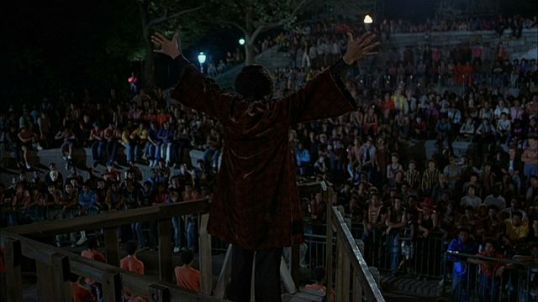
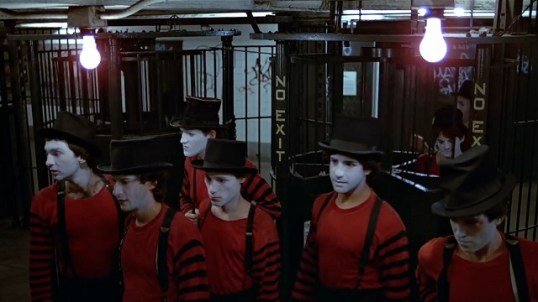
Ultimately, The Warriors is a film for Halloween because it’s a film about costumes. The members of each gang are defined by what they wear. Some of them dress up. Some of them dress like they’re doing some sort of Bruce Springsteen-style working-class cosplay. There’s even a group of mimes who wear top hats. I feel bad for any neighborhood that is weak enough to be taken over by mimes. The film’s first great set piece—the meeting in the park—is rightly remembered for Roger Hill’s charismatic performance as Cyrus. (“Can you dig it!?”) But it also deserves to be remembered for the hundreds of extras, all of whom are wearing their costumes and mixing together. That’s the respect that Cyrus commands. The mimes and the pimps and the skinheads and the roller skaters are all willing to come together for Cyrus. And when Luther assassinates Cyrus and then blames the Warriors, the gangs of the city are prepared to destroy the gang of Coney Island.
The Warriors (1979, dir by Walter Hill, DP: Andrew Laszlo)
It’s a great and exciting film that has stood the test of time. It’s not a surprise that it wasn’t Oscar-nominated. The film was controversial when it was released, with some claiming that it glorified gang life and that it promoted violence. Beyond that, the film is unapologetically pulpy. Walter Hill was and is a brilliant genre filmmaker and he’s never apologized for that fact. His films were never obvious award bait. That said, it does seem a shame that The Warriors didn’t even get a nomination for its propulsive score. The film’s cinematography turned a familiar city into an alien landscape and the editing kept viewers on the edge of their seats. It’s rare to see a film that captures the feeling of the world closing in on a group of people as well as The Warriors does. As far as the acting goes, the majority of the cast was inexperienced and there were more than a few times when that inexperience came through. It’s a film that’s more about visual style than deep performances. That said, Michael Beck was likable and had the right look to be a leader and Hill was very smart in how he framed him on screen. James Remar also did a good job as Ajax, playing him as being strong-willed and obnoxious and a bit too obsessed with proving his masculinity but also fiercely loyal to his gang. (As played by Remar, Ajax was the only Warrior who truly seemed like he could handle himself in a fight.) Deborah Van Valkenburgh was effective in an underwritten role. If anyone from the cast deserved a nomination, it was probably David Patrick Kelly. “Warriors, come out to play!” Kelly was a force of pure chaos. In the end, the big Oscar winner of 1979 was Kramer vs. Kramer, a film that might as well have taken place on a different planet from The Warriors.
If I may close on a personal note, I was feeling pretty sick last Thursday. I hadn’t gotten much sleep. I was stressed about getting my Horrorthon reviews written. I had given myself a headache. But then, I watched The Warriors and I got so sucked into its world (despite the fact that I had already watched the film more than a few times) that I forgot that I wasn’t feeling well. My headache went away. By the time the film ended, I was feeling a hundred times better.
Nominated or not, that’s the power of a good movie.
The Warriors (1979, dir by Walter Hill, DP: Andrew Laszlo)
In 2025’s Stan The Man, Angus Benfield stars as Stan Jacobs, a football coach looking for redemption.
When we first meet Stan, he’s one of the most popular men in Texas. He’s a pro football coach, one who has been leading his team to victory after victory. One commentator states that Stan has put Texas “on the map.” He’s known as “Stan the Men” and everyone wants his autograph. What the public doesn’t know is that Stan is an alcoholic. After coaching while drunk (and even worse, losing the game), Stan is suspended from coaching. Because he can’t control his drinking, he soon finds himself in prison and then living on the streets. Eventually, Stan finds God, stop drinking, and gets the opportunity to coach a high school team. By an amazing coincidence, his star player just happens to have an alcoholic father who could use some counseling from someone who has been there….
It’s a nice storty and a well-intentioned film. That said, I am begging the directors of these low-budget, faith-based films to study how to tell a story and how to maintain narrative momentum. Stan The Man takes over a 100 minutes to tell an 80-minute story. Indeed, Stan isn’t even offered the high school coaching job until about 40 minutes into the movie. Before that, we have to sit through a lot of scenes that basically tell us the exact same thing over and over again: Stan is an alcoholic. Most of what happened during the first half of this film could have easily been compressed to just a handful of minutes. As it is, the movie just plays out too slowly.
And that’s a shame because there were some things that I definitely appreciated about this film. The film was set and shot in Texas and the scenery was lovely. Angus Benfield gave a good performance as Stan and most of the members of the supporting cast were believable in their roles. The film’s intentions were definitely good and I appreciated the emphasis that was put on forgiveness and second chances. Even at his worst and his most obnoxious, Stan is still clearly someone who, deep down, wants to change and fix his life. The film did not sugarcoat just how difficult it can be to grow up in the shadow of alcoholism. At the end of the film, I have to admit that I genuinely smiled when one of the characters introduced himself by sayin that he was a week sober. It was a genuinely sweet moment and, when he said those words, I remembered when my Dad was a week sober. And then a month sober. And then a year sober. And then several years sober. In that moment, the film definitely got to me.
If only the film wasn’t so slow. I think that directors sometimes think that good intentions are enough. But I would ask anyone who is making a movie to watch and truly study other films before they ever say, “Action!” for the first time. Stan The Man reaches a decent conclusion but it takes forever for it to really get started.
Welcome to Late Night Retro Television Reviews, a feature where we review some of our favorite and least favorite shows of the past! On Fridays, I will be reviewing SLEDGE HAMMER!, a cop comedy which ran on ABC from 1986 to 1988. The entire series can be found on Prime!
A man’s got to know his limitations.
Episode 1.9 “Magnum Farce”
(Dir by Charles Braverman, originally aired on November 22nd, 1986)
Someone is executing the criminals that the justice system fails to convict. The new district attorney, Ms. Collins (Janice Lynde), demands that the police discover who is acting as judge, jury, and executioner. Sledge Hammer is not happy about his new assignment. Not only is he having to go after people who hate criminals almost as much as he does but he’s also having to work for a woman.
When the latest victim holds up two fingers before dying, Sledge Hammer assumes that he’s saying he was shot by hippies. However, when the shell casings turn out to be from police-issued ammunition, Sledge realizes that the victim was actually signing that he had been shot by two cops. “I’m really bad at Charades,” Hammer explains.
Hammer and Trunk stage a fight so that the vigilantes will attempt to recruit Sledge Hammer. It works, even though Hammer accidentally knocks out Trunk. However, it turns out that the head of the vigilantes is none other than the liberal district attorney, Ms. Collins!
If this sounds familiars, that because this episode borrows a lot from the classic Dirty Harry sequel, Magnum Force. The vigilantes are even motorcycle cops, just like in the earlier film. Whereas Magnum Force was a rather grim film, this episode is silly even by the standards of Sledge Hammer. The two murders are largely bloodless, the dialogue is full of non-sequiturs, and the whole thing ends with Ms. Collins firing her gun at Sledge Hammer while Sledge calmly stands still because, according to him, women are terrible shots. The humor is nonstop and bizarre and the end result is the funniest episode since the pilot.
My favorite moment cames towards the end, when Captain Trunk burst into Ms. Collins’s mansion with several other police officers. When Hammer asks Trunk to explain to Collins the careful police work that went into uncovering her role as the head of the vigilantes, Tunk replies, “I live next door.”
For once, Sledge Hammer makes the city safe for criminals and it’s absolutely hilarious. He knows what he’s doing.
On tonight’s episode of Fear Itself, Wendell Pierce plays a veterinarian who gets bitten by a werewolf and then has to prove that he’s not the same werewolf who is currently on a killing spree. This episode was directed by Ernest Dickerson, who first came to prominence as Spike Lee’s cinematographer and subsequently directed several horror films and thrillers of his own.
This episode didn’t air because Fear Itself was put on hiatus in July of 2008. However, it was included when the show was subsequently released n DVD.
Welcome to Retro Television Reviews, a feature where we review some of our favorite and least favorite shows of the past! On Fridays, I will be reviewing St. Elsewhere, a medical show which ran on NBC from 1982 to 1988. The show can be found on Daily Motion.
This week, the matriarch of a powerful Massachusetts political family comes to St. Eligius.
Episode 4.14 “Family Ties”
(Dir by Allan Arkush, originally aired on January 22nd, 1986)
After Elliot makes a clerical error that leads to one of his patients getting a mohawk, he’s more than happy to be assigned to check on a sick gorilla. Elliot not only diagnoses the gorilla as suffering from a brain tumor (luckily, it’s not malignant) but also gets a date with the animal’s keeper, Dr. Valerie Harding (Diana Canova).
When Fiscus freaks out about getting older, he tries to push up his wedding date with Mona and pressures her to abandon her career to start a family immediately. After Fiscus interrupts an operation to argue with her, Mona dumps him. (“I told you he was a bubblehead,” Dr. Craig says.) When Fiscus learns that his sperm has been used in an IVF procedure, he becomes obsessed with tracking down the woman who might be having his child. He then runs into Morrison’s ex-girlfriend, Clancy (Helen Hunt), and is soon flirting with her.
Why is Clancy back at the hospital? Morrison slipped on a wet floor and injured his knee. He has to have surgery. Clancy comes up with Morrison’s little-seen son, Pete. Pete, for his part, wanders over to Ken Valere (George Deloy), who, along with his wife (Deborah May), has been having second thoughts about whether to use a surrogate. Meeting Pete inspires the Valeres to adopt. So I guess that plotline is finally over, and I won’t have to ignore it anymore.
The majority of this episode is taken up with the arrival of Augusta Endicott (Dorothy McGuire), the matriarch of one of Massachusetts’s most powerful political families. She’s also the widow of a notorious anti-Semite, one who kept Auschlander from getting appointed to a state board in the 1960s.
From the minute Augusta and her family show up at the hospital, it’s obvious that they’re meant to be stand-ins for the Kennedys, even though Endicott is not an Irish name. (One gets the feeling the Endicotts are meant to be WASPy Episcopalians.) I always find it curious when an obvious Kennedy stand-in turns up on a television show. Does that mean St. Elsewhere takes place in a universe where the Kennedys don’t exist? The parallels are so obvious that it seems strange no one would point them out in-universe. This show is set in Boston. It seems as if someone would say, “Hey, Augusta Endicott sure has a lot in common with Rose Kennedy.”
Augusta is in the hospital for a checkup. She’s having heart problems, but she tells Dr. Craig that she would prefer to let nature take its course rather than spend the rest of her life having surgeries. Augusta also arranges for Auschlander to finally be appointed to the state medical board.
I’m getting the feeling that the Endicott family is going to be around for at least a few episodes. I can’t say I’m particularly enthused about the idea, but I get it. This is a show about Boston. You’ve got to have Kennedys.
In 2022’s The Harbinger, Gabby Beans stars as Monique. At the height of the COVID hysteria, Monique and her family have done everything that they’ve been told to do. They’ve locked their doors. They’ve kept outsiders from entering their home. Monique always wears a facemask. For all of their attempts to be safe, Monique and her family still seem like the most anxious people on the planet. However, anyone who is honest about the COVID era and who doesn’t listen to the revisionists who insist that it was actually just a little inconvenience and not a major trauma-causing event will immediately recognize Monique and her family. Even those of us who didn’t lose our minds during the lockdowns all know someone who did.
(Three things that I’ll never forget about the COVID era: 1) all of my friends on Twitter changing their bio to “Wear your damn mask” and not understanding how pointlessly aggressive that sounded, 2) my cousin Allison in tears because she thought everyone in Tyler, Texas was trying to kill her by getting her sick, and 3) the fat lady at Target who screamed at me because I wasn’t wearing a mask because my asthma was acting up.)
When Monique learns that her best friend, Mavis (Emily Davis), is currently being haunted by nonstop nightmares that are threatening her sanity, Monique makes a momentous decision. She decides to leave her house, drive through New York, and check on her friend. What she discovers is that Mavis, locked away in her apartment and even wearing a mask when she’s inside and alone, is even more anxious than her. In the apartment above her, there’s a child who is sick and in quarantine and who, in theory, could infect everyone with COVID. Meanwhile, Mavis’s neighbor thinks the whole masking inside thing is ludicrous and refuses to put on one. Monique loses some points, in my book at least, when she confronts the neighbor and points to a sign that says masks are required in the building. The movie tries to hedge its bets with the neighbor character, as if it’s saying, “See? We’re on the right side!” What’s funny is that, when I watched this movie with the #ScarySocial live tweet group, most of the people watching were pretty much on the neighbor’s side.
Soon, Monique is having nightmares, both about the sick kid upstairs and also about her family back home. The nightmares are the film’s strongest element. The Harbinger really does capture the feeling of finding yourself in a dream that feels like real life, and I have to admit that it succeeded in fooling me more than a few times. The film really does keep you off-balance as to what is real and what isn’t. Ultimately, the film suggests that a monster is feeding off of all of the fear and anxiety in the world. If such a monster did exist, the COVID era is definitely when it would show up.
The Harbinger has its flaws. Like a lot of “elevated” horror films, the pace is a bit slow at times. There was an interesting subtext to the intensity of Monique and Mavis’s friendship that felt a bit unexplored. But the dream sequences are effectively done and the film does capture the bleak worldview that many held during the COVID era. (We tend to forget that The New York Times referred to the pre-COVID era as “the before times.”) Today, as the truth about the COVID era itself is being rewritten by revisionists, this film almost feels like a time capsule.
I have been spoiled so far this year. I have yet to see a bad film or short. The AIs have been pretty good too. Are people getting better at making things? I think Gen-Z is really throwback generation. The stories have structure and order. I went to school with Gen-Z and they talked in hushed tones a lot about 2009 crash and the War; honestly, they all sounded like my Depression Era grandparents. The men sounded really conservative and the ladies were taking a sharp left turn. In all of their angst, they returned to clear storytelling. “Obsession” followed proper story structure to the letter and this short does too. It’s a sci-fi comedy, but it has a clear plot with good jokes.
The story takes place in the early 70s with a sleazy land developer and a waitress, who despise one another, are abducted by aliens. The aliens just want to probe and eat the two captives and then annihilate all of mankind. However, the Gotterdammerung is not until 2026 because today is all about probing and eating the captives. The land developer convinces the aliens to let them go, but the aliens insist on probing still – off screen.
It is a simple plot, but the jokes are funny and the acting is good. It’s weird for me to see actual people acting because I’m so used to seeing AI films. Human can still act! Who knew?! I recommend this highly. Enjoy it!
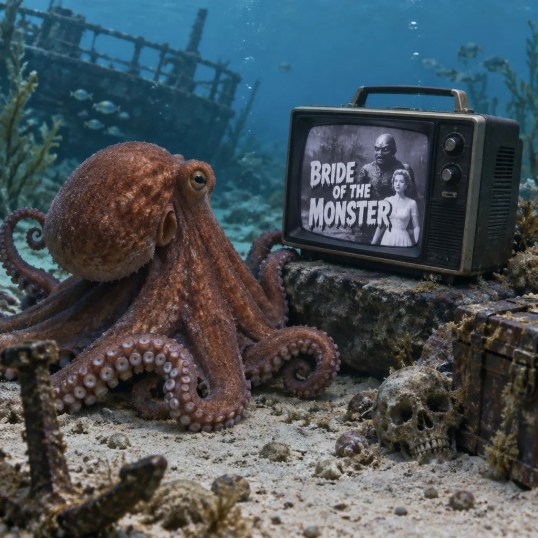
First released in 1955 and directed by the legendary Ed Wood, Bride of the Monster is a classic mix of a haunted house, a mad scientist, a lumbering assistant, and a giant octopus. The plot may be impossible to follow but it doesn’t matter when you’ve got Tor Johnson grunting and Bela Lugosi giving a surprisingly good performance as the persecuted Dr. Vornoff, a man who “tampered in God’s domain.”
A lot of people consider this to be Wood’s best film. Personally, I would go with Plan 9 From Outer Space but Bride of the Monster is still an entertaining look at monsters and madmen.
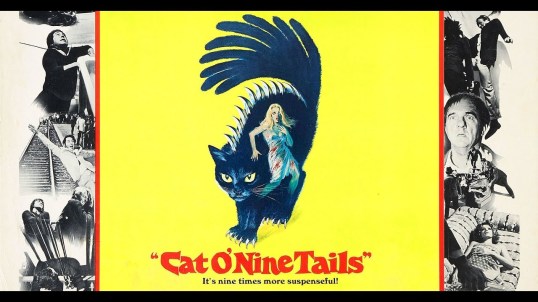
Today’s song of the day the main theme from Dario Argento’s The Cat O’Nine Tails. Ennio Morricone’s score brought a lot of atmosphere to Argento’s classic giallo.