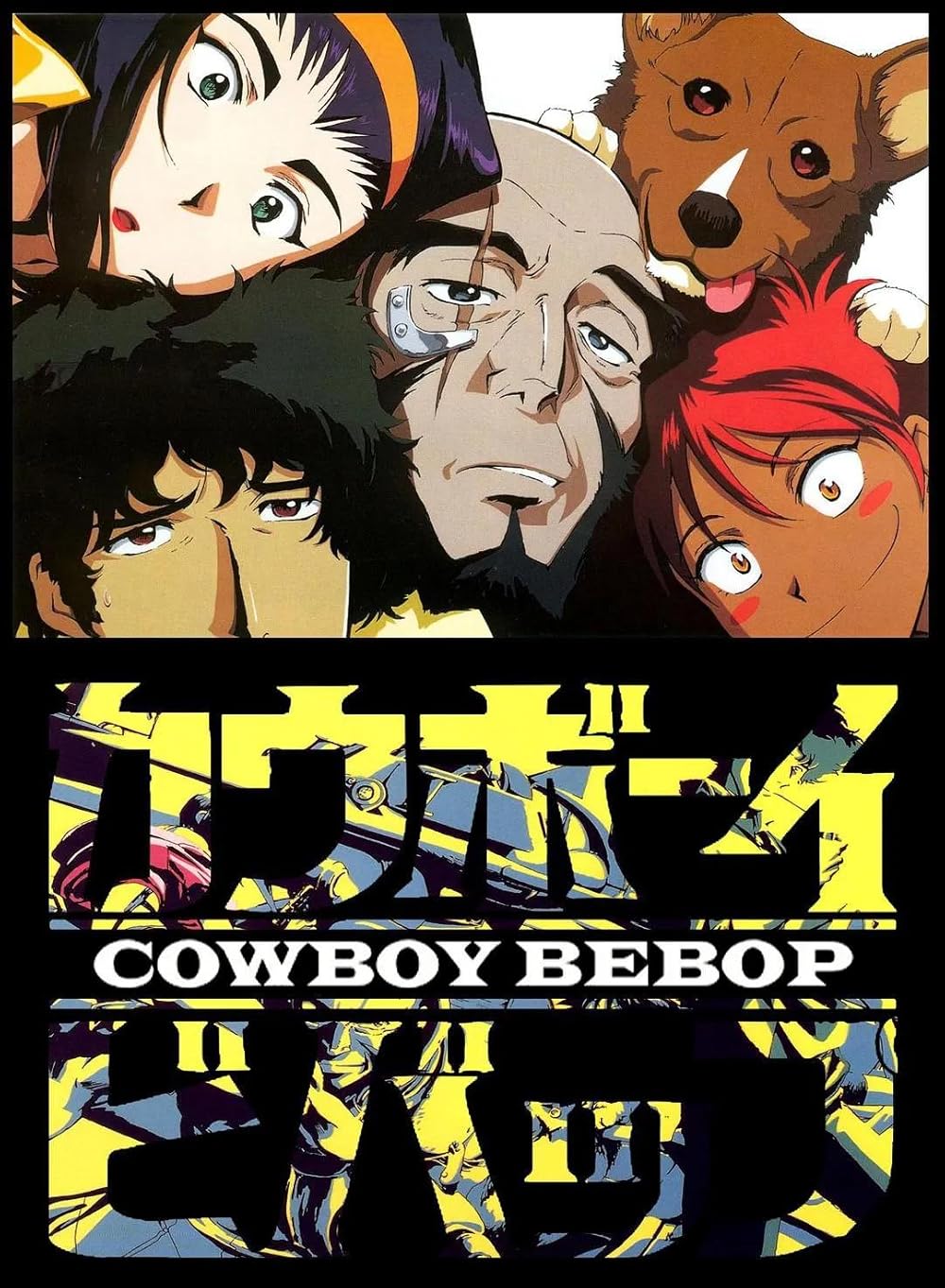
“Men always seem to think about their past before they die, as though they were frantically searching for proof that they truly lived.” — Spike Spiegel
There are certain works of art that transcend their medium to become cultural landmarks, and Cowboy Bebop is one of them. Shinichirō Watanabe’s magnum opus isn’t just a great anime; it’s the classic for many, the show that gets brought up in the same breath as Akira and Ghost in the Shell when people talk about anime as an art form. Even now, decades after its initial run, it absolutely earns that reputation, which is why it non-negotiably belongs on any new anime fan’s must-see list. If someone tells me they want to get into anime but don’t know where to start, this is the first title I throw at them, because it serves as the ultimate gateway, a perfect primer on what the medium is capable of.
At its core, Cowboy Bebop is a space western noir, a genre mash-up that sounds chaotic on paper but plays out with such effortless cool that you never question it. You’ve got Spike Spiegel, a former syndicate hitman with a killer right hook and a death wish; Jet Black, a grizzled ex-cop with a cybernetic arm and a heart of gold; Faye Valentine, a femme fatale with amnesia and a gambling problem; Radical Edward, a chaos-gremlin child hacker; and Ein, a data-dog who is frankly way smarter than everyone else. They’re bounty hunters in the year 2071, just scraping by in a solar system that’s still recovering from a major accident that made Earth largely uninhabitable, and they’re not saving the world—they’re just trying to make enough woolongs to afford their next meal of bell peppers and beef, which, as Jet will remind you, never actually has any beef.
The episodic structure is a huge part of the show’s charm, as you never really know what you’re going to get from one episode to the next. One week, it’s a high-octane action romp; the next, it’s a somber, almost silent meditation on loss; and then it might pivot to a bizarre, almost comedic episode about a fridge floating through space. This variety keeps things endlessly fresh, but it’s the overarching narrative, the slow burn of Spike’s past with the Red Dragon Syndicate, that gives the whole thing its devastating emotional weight. The show rewards multiple viewings because you pick up on new little details, new visual cues, and new emotional resonances every time, and the animation by Sunrise, even by today’s standards, is fluid and expressive with a cinematic flair that often feels like watching a classic film.
If you talk about Cowboy Bebop and don’t immediately mention the music, you’ve missed the entire point. The influence of the soundtrack is so profound that it’s essentially another main character, as Watanabe has always had a brilliant, intuitive understanding of music’s power in storytelling. With composer Yoko Kanno at the helm, he created something that transcends a typical score; the music isn’t just there to heighten the mood, it shapes the mood, defines the narrative, and creates the show’s entire identity. “Tank!” is perhaps the most iconic anime opening of all time, a roaring, brassy jazz piece that screams “style and energy” before you’ve even seen a single frame, but Kanno’s genius is in her range, shifting seamlessly from the bluesy harmonica of “Rain” to the ethereal, Celtic-tinged vocals of “Adieu” to the frantic rock of “What Planet is This?” during a chaotic fight, all of which makes the space-faring adventure feel gritty and lived-in but also achingly beautiful.
This masterful use of sound creates the overall mood of the series, which is one of profound, melancholy cool, steeped in a pervasive sense of loneliness and existential drift. Each of the main characters is running from something—a past they can’t escape, a memory they can’t forget, or a future they can’t imagine—and Spike lives by a philosophy that a man only dies when he’s forgotten, with his entire arc about confronting a past he’s been trying to outrun. They are a found family, but they’re a family of loners, each so wrapped up in their own personal baggage that they can never truly connect on a deeper level; they share meals, they bicker, they fight together, but they rarely share their deepest fears or true feelings, creating a bittersweet undercurrent to all their interactions. This juxtaposition—the cool, action-packed surface and the lonely, emotional depth—is what makes Cowboy Bebop so unforgettable.
For a newcomer, that blend is exactly why the show serves as a perfect gateway, as you don’t need to be steeped in anime tropes or have a tolerance for over-the-top melodrama to appreciate it. The storytelling is grounded, character-driven, and deeply human, with a cinematic sensibility that feels instantly familiar to anyone who loves Western films, noir, or sci-fi, sidestepping the more esoteric quirks that can sometimes be a barrier for new fans and delivering pure, universal storytelling. It shows that anime can be mature, thoughtful, and emotionally complex without being dark and miserable for the sake of it, setting the bar incredibly high and giving newcomers a clear benchmark for quality.
So, is it as good as everyone says it is? Yes, it’s a masterclass in visual storytelling, world-building, and character development, managing to be mature without being gratuitous, philosophical without being pretentious, and deeply sad without being depressing. It’s a singular work of art where every single element—the animation, the story, the characters, and most importantly, the music—aligns perfectly to create something that is so much more than the sum of its parts. Honestly, if you watch Cowboy Bebop and don’t find something to love, anime might just not be your thing, but for the vast majority, it’s the beginning of a beautiful, lifelong obsession. It’s the show you’ll recommend to your friends, rewatch years later, and still find yourself tearing up at the finale—essential viewing, plain and simple. It’s a perfect, beautiful, jazz-infused tragedy, and you’re gonna carry that weight, whether you want to or not.
Anime You Should Be Watching
- Gakuen Utopia Manabi Straight
- Chōjin Densetsu Urotsukidōji
- School Days
- Higurashi no Naku Koro ni
- Toradora!
- Aria
- Azumanga Daioh
- Bible Black
- Puella Magi Madoka Magica
- Black Lagoon
- Ika Musume
- High School DxD
- Bakemonogatari
- Sailor Moon
- Princess Tutu
- Another
- Hellsing Ultimate
- Sword Art Online
- Wolf Children Ame and Yuki
- Toaru Kagaku no Railgun
- Nichijō
- Redline
- Gakkou Gurashi (School Live)
- Gate: Thus the Japanese Self-Defense Force Fought in Their Land
- Hinamatsuri
- Asobi Asobase
- Zombie Land Saga
- Monster
- Farming Life In Another World (Isekai Nonbiri Nouka)
- Perfect Blue
- Shiki
- Angel of Darkness (Injū Kyōshi)
- Blood: The Last Vampire
- Akira
- Space Battleship Yamato (Uchū Senkan Yamato)
- Macross Plus
- Ninja Scroll (Jūbē Ninpūchō)
- Tokyo Godfathers (Tōkyō Goddofāzāzu)
- Memories
- That Time I Got Reincarnated as a Slime (Tensei Shitara Suraimu Datta Ken)
- Spy x Family
- Record Of Lodoss War (Rōdosu-tō Senki)
- Berserk (Kenpū Denki Berserk)
- Jin-Roh
- Made In Abyss (Meido in Abisu)
- Legend of the Galactic Heroes (Ginga Eiyū Densetsu)
- Nausicaä of the Valley of the Wind
- May I Ask for One Final Thing? (Saigo ni Hitotsu dake Onegai Shitemo Yoroshī Deshō ka)
- Initial D (Inisharu Dī)
- Vinland Saga (Vinrando Saga)
- Grave of the Fireflies (Hotaru no Haka)
- How a Realist Hero Rebuilt the Kingdom (Genjitsu Shugi Yūsha no Ōkoku Saikenki)
- Ghost in the Shell


Pingback: Anime You Should Be Watching: Tengen Toppa Gurren Lagann | Through the Shattered Lens