This week was all about getting caught up on the shows that might be nominated for this year’s Emmys. I ended up watching a lot of TV. Here’s a few thoughts on it all!
60 Days In (A&E)
I watched this show’s seventh season this week. Sending former criminals undercover was an interesting idea and Carlos, who struggled with the temptation to return to his old ways, was definitely the most compelling character this season. It really was one of the worst jails that they’ve ever featured on this show. It’s easy to be dismissive of a show like this and it definitely is a bit exploitive. But it also does portray why jails fail to rehabilitate its inmates.
Big Beasts (Apple TV+)
I watched an episode on Friday about the great whales! I enjoyed it. Whales are fascinating creatures and it certainly didn’t hurt that the whole thing was narrated by Tom Hiddleston.
City Guys (YouTube)
I wrote about City Guys here!
The Crown (Netflix)
I’ve always had mixed feelings about The Crown. On the one hand, I absolutely love it as a well-made, well-acted, and well-produced royal soap opera. On the other hand, I have never been comfortable about the idea of turning anyone’s life into a miniseries while they’re still alive. Of course, Queen Elizabeth passed away last year but the show itself still feels a bit invasive. That said, the fifth season was as addictive as ever. Imelda Stauton took over at Elizabeth. Dominic West made Charles into a far more interesting person than he probably is in real life. Of all the seasons so far, this season was the most melancholy as it portrayed a world that was suddenly changing faster than ever before. Not only did Charles and Diana divorce but the UK lost Hong Kong. The decommissioning Britannia felt like the true end of an era. It was hard to watch this season without thinking about how the people portrayed had no idea how much worse things were going to get in just a few more years.
Daisy Jones & The Six (Prime)
I binged this miniseries on Tuesday and Wednesday. Full of music and 70s atmosphere, this series charted the rise and the fall of a fictional rock group. Riley Keough, who really seems like she should be a bigger star, was wonderful in the lead role.
Dead To Me (Netflix)
Unfortunately, I really haven’t had time to binge the final season of Dead To Me but I did jump ahead and watch the final episode on Saturday afternoon. Christina Applegate and Linda Cardellini were still a great and messy team and I definitely got a bit watery-eyed at the episode’s conclusion.
The Diplomat (Netflix)
I watched the first episode of this show on Wednesday. It didn’t really hold my attention but Keri Russell was convincing as the title character and it was kind of amusing to see Michael McKean playing an apparently sincere and idealistic president.
Fleishman Is In Trouble (Hulu)
This was an excellent miniseries that I binged on Monday and Tuesday. Jesse Eisenberg and Claire Danes were excellent as a divorced couple who struggled with life in New York City. This miniseries felt like some great 70s movie that just happened to be set in 2016.
Forgive or Forget (YouTube)
I watched an episode on Thursday. Former best friends were demanding apologies. Very few apologies were given, which I think may have been due to the fact that host Robin Givens kept interrupting everyone so that she could yell at them. If Mother Love had been there, everyone would have come through the door.
House of the Dragon (HBO)
HBO’s Game of Thrones prequel turned out to be quite a bit better than I was expecting. That said, I would be lying if I said that I was always able to follow what was happening on the show without the help of Wikipedia. I had the same problem with Game of Thrones, to be honest. However, the chaos and the feeling that you could never be sure who was actually plotting what was one of the things that made both the early seasons of Game of Thrones and the first season of this show so intriguing.
The Last Of Us (HBO)
I binged this throughout the week and I have to say that I’m a bit disappointed in myself that I didn’t watch it earlier. Because I had so much to watch this week, I feel as if I rushed through the show, going from one episode to another so quickly that I didn’t get a chance to really contemplate and savor everything that happened. That said, The Last Of Us was well-acted and created a convincing dystopian society. For once, the “zombie” apocalypse felt realistic as opposed to contrived.
The Last Thing He Told Me (Apple TV+)
Enjoyably twisty and melodramatic, this adaptation of Laura Dave’s novel featured great performances from Jennifer Garner, Angourie Rice, and David Morse. Even though I had read the novel and knew what was going to happen, the show still held my interest
Love & Death (Max)
Elizabeth Olsen and Jesse Plemons were great but this limited series’s story was better told by Hulu’s Candy. As a producer and a writer, David E. Kelly has always had a tendency to rely on easy caricatures and too much of Love & Death felt like a Yankee fantasy of what life in small town Texas is like.
The Love Boat (Paramount Plus)
I wrote about The Love Boat here!
The Master (Tubi)
I wrote about The Master here!
MH370: The Plane That Disappeared (Netflix)
During the early hours of Wednesday morning, I watched this 3-part docuseries on the Malaysian airline that mysteriously disappeared a few years ago. (Remember Don Lemmon suggesting it had flown into a black hole?) It was interesting viewing, though ultimately I think it works better as a look at how quick people are to buy into conspiracy theories than anything else.
Midnight Special (YouTube)
From 1973, the first episode of Midnight Special was hosted by Helen Reddy and featured performances from Ike and Tina Turner, George Carlin, Curtis Mayfield, Don McLean, Rare Earth, Kenny Rankin, The Byrds, and The Impressions. Helen Reddy was a bit of a boring host but the music was great.
The Old Man (Hulu)
With the Emmy nominations due to be announced next Tuesday, I finally got around to binging The Old Man this week. On the one hand, it was yet another morally ambiguous thriller featuring the government pursuing a former agent who had gone underground. On the other hand, Jeff Bridges, John Lithgow, and Amy Brenneman all brought a lot of conviction to their roles and the film was as much about dealing with one’s own morality as it was about dealing with the dark side of the intelligence community. I liked it far more than I was expecting too.
The Patient (Hulu)
I watched the first three episodes of this miniseries on Monday morning and that was enough for me. Steve Carell plays a psychiatrist who is being held captive by a serial killer (Domhnall Gleeson) who is looking for help curbing his homicidal impulses. Carell gave a great performance, proving again that he’s just as capable of doing drama as he is comedy. But, other than Carell’s performance, I found the show to be tedious and I haven’t felt any real desire to finish binging it.
Real Time With Bill Maher (Max)
I watched the episode where Russell Brand yelled at John Heilenmann. I was on Brand’s side but a lot of that has to do with Heilenmann just be annoying in general. Bernie Sanders was also on the show and seemed kind of tired of the whole thing.
Rollergames (YouTube)
On the 2nd episode of Rollergames (which I watched with Jeff and our friend Pat on Friday night), the Thunderbirds competed against Bad Attitude. Thunderbirds were heroic but Bad Attitude had style. I’m not sure who actually won.
Slasher: Ripper (Shudder)
I’m always tempted to call this program Canadian Horror Story but Slasher is actually far better than Ryan Murphy’s show. The fifth season, which I binged throughout the week, has an intriguing mystery, many macabre deaths, a lot of atmosphere, and a wonderfully villainous performance from Eric McCormack.
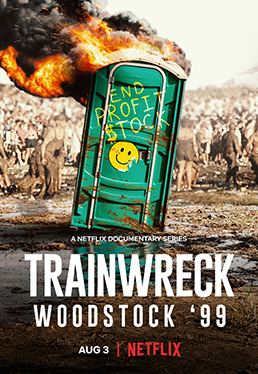
Trainwreck: Woodstock ’99 (Netflix)
I finally watched this docuseries on Saturday morning, after finishing up Midnight Special. I guess I was in a musical mode. The mix of hubris, greed, and celebrity that went into making Woodstock ’99 a disaster will never not be fascinating.
Welcome Back, Kotter (Tubi)
I wrote about Welcome Back Kotter here!