The Unnominated #22: The Warriors (dir by Walter Hill)


Though the Academy of Motion Picture Arts and Sciences claim that the Oscars honor the best of the year, we all know that there are always worthy films and performances that end up getting overlooked.  Sometimes, it’s because the competition too fierce.  Sometimes, it’s because the film itself was too controversial.  Often, it’s just a case of a film’s quality not being fully recognized until years after its initial released.  This series of reviews takes a look at the films and performances that should have been nominated but were, for whatever reason, overlooked.  These are the Unnominated.

Why am I talking about 1979’s The Warriors in October?

No, it’s not a traditional horror movie, even though the film does have some creepy moments and it features David Patrick Kelly playing one of the most memorable psychos in film history. At heart, it’s a film about a group of youngish gang members trying to survive the night and reach safety. (The characters are all meant to be teenagers, though that can be hard to remember when two of the film’s main characters are played by Michael Beck and James Remar, both of whom were close to 30 when the film was made.) The other gangs that the Warriors mostly either battle or escape from often feel as if they’ve stepped out of a nightmare. Everyone remembers the Baseball Furies because, as a gang, they were both intimidating and ludicrous at the same time. Myself, I was freaked out by the skinheads who drove around New York in a bus. The gang led by the guy on roller skates was pretty frightening as well. One thing about the rival gang members is that, with the exception of Luther, few of them speak. Instead, they simply show up and attack.

The Warriors (1979, directed by Walter Hill, DP: Andrew Laszlo)

The Warriors is a surreal film, which is not surprising when you consider that it was written by Walter Hill. The film takes place almost entirely at night and the streets of New York are eerily empty. Watching the film, I was reminded of the dying Paris from Jean Rollin’s Night of the Hunted and Dario Argento’s claim that Tenebrae was meant to take place in a future where there were far fewer people on the planet. At the same time, there are hints of the real world littered throughout the film. Four teenagers who are obviously heading home from prom find themselves on a train, sitting across from a bruised Swan (Michael Beck) and Mercy (Deborah Van Valkenburgh). Occasionally, we see people in bars or just trying to get back to their own homes. The subway stations are crawling with cops, one of whom throws Fox (Thomas G. Waites) in front of a moving train. Throughout the film, the members of the Warriors keep count of who is still with them on their journey to Coney Island, but no one mentions Fox after his sudden death. One could argue that they don’t want to think about how easily things could go wrong for them. They’re in a fantasy world where there are no consequences. Of course, a more likely reason is because Fox’s death was a last-minute development that was a result of actor Waites proving to be difficult to work with.
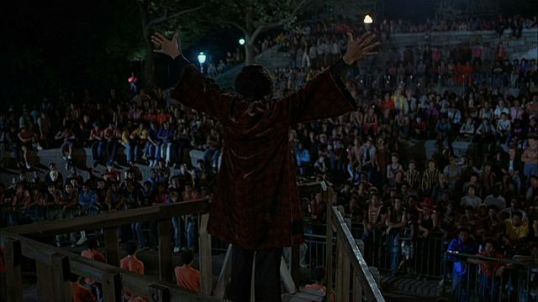
The Warriors (1979, dir by Walter Hill, DP: Andrew Laszlo)

Ultimately, The Warriors is a film for Halloween because it’s a film about costumes. The members of each gang are defined by what they wear. Some of them dress up. Some of them dress like they’re doing some sort of Bruce Springsteen-style working-class cosplay. There’s even a group of mimes who wear top hats. I feel bad for any neighborhood that is weak enough to be taken over by mimes. The film’s first great set piece—the meeting in the park—is rightly remembered for Roger Hill’s charismatic performance as Cyrus. (“Can you dig it!?”) But it also deserves to be remembered for the hundreds of extras, all of whom are wearing their costumes and mixing together. That’s the respect that Cyrus commands. The mimes and the pimps and the skinheads and the roller skaters are all willing to come together for Cyrus. And when Luther assassinates Cyrus and then blames the Warriors, the gangs of the city are prepared to destroy the gang of Coney Island.
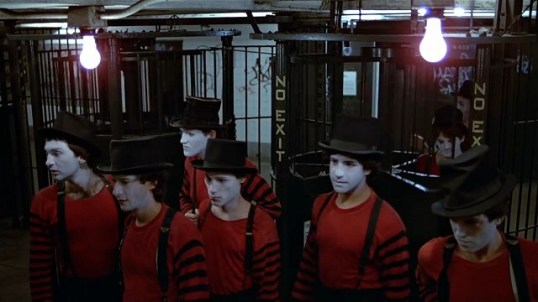
The Warriors (1979, dir by Walter Hill, DP: Andrew Laszlo)

It’s a great and exciting film that has stood the test of time. It’s not a surprise that it wasn’t Oscar-nominated. The film was controversial when it was released, with some claiming that it glorified gang life and that it promoted violence. Beyond that, the film is unapologetically pulpy. Walter Hill was and is a brilliant genre filmmaker and he’s never apologized for that fact. His films were never obvious award bait. That said, it does seem a shame that The Warriors didn’t even get a nomination for its propulsive score. The film’s cinematography turned a familiar city into an alien landscape and the editing kept viewers on the edge of their seats. It’s rare to see a film that captures the feeling of the world closing in on a group of people as well as The Warriors does. As far as the acting goes, the majority of the cast was inexperienced and there were more than a few times when that inexperience came through. It’s a film that’s more about visual style than deep performances. That said, Michael Beck was likable and had the right look to be a leader and Hill was very smart in how he framed him on screen. James Remar also did a good job as Ajax, playing him as being strong-willed and obnoxious and a bit too obsessed with proving his masculinity but also fiercely loyal to his gang. (As played by Remar, Ajax was the only Warrior who truly seemed like he could handle himself in a fight.) Deborah Van Valkenburgh was effective in an underwritten role. If anyone from the cast deserved a nomination, it was probably David Patrick Kelly. “Warriors, come out to play!” Kelly was a force of pure chaos. In the end, the big Oscar winner of 1979 was Kramer vs. Kramer, a film that might as well have taken place on a different planet from The Warriors.

If I may close on a personal note, I was feeling pretty sick last Thursday. I hadn’t gotten much sleep. I was stressed about getting my Horrorthon reviews written. I had given myself a headache. But then, I watched The Warriors and I got so sucked into its world (despite the fact that I had already watched the film more than a few times) that I forgot that I wasn’t feeling well. My headache went away. By the time the film ended, I was feeling a hundred times better.

Nominated or not, that’s the power of a good movie.
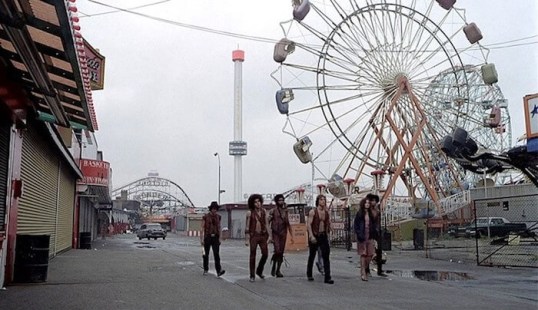
The Warriors (1979, dir by Walter Hill, DP: Andrew Laszlo)

Previous Entries In The Unnominated:

  1. Auto Focus 
  2. Star 80
  3. Monty Python and The Holy Grail
  4. Johnny Got His Gun
  5. Saint Jack
  6. Office Space
  7. Play Misty For Me
  8. The Long Riders
  9. Mean Streets
  10. The Long Goodbye
  11. The General
  12. Tombstone
  13. Heat
  14. Kansas City Bomber
  15. Touch of Evil
  16. The Mortal Storm
  17. Honky Tonk Man
  18. Two-Lane Blacktop
  19. The Terminator
  20. The Ninth Configuration
  21. Southern Comfort

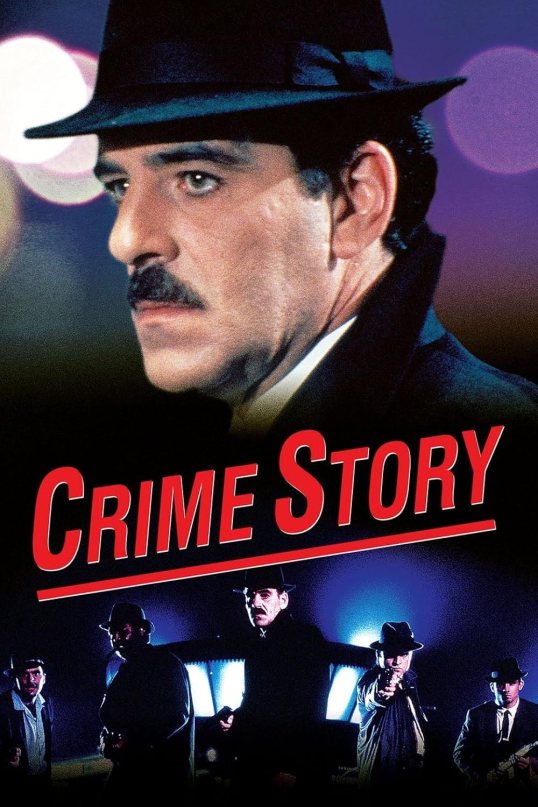
Retro Television Review: Crime Story 1.6 “Abrams For The Defense”


Welcome to Retro Television Reviews, a feature where we review some of our favorite and least favorite shows of the past!  On Mondays, I will be reviewing Crime Story, which ran on NBC from 1986 to 1988.  The entire show can be found on Tubi!

This week, David Abrams gets his time in the spotlight.

Episode 1.6 “Abrams For The Defense”

(Dir by Aaron Lipstadt, originally aired on October 14th, 1986)

In the slums of Chicago, Hector Lincoln (Ving Rhames) strikes his landlord, Sturkowski (Frederick Nuemann), after one of Hector’s children is bitten by one of the rats that roams freely through the apartment building.  Hector is arrested and facing time in prison.  Public defender David Abrams (Stephen Lang) defends Hector in court, claiming that conditions in the slums were so bad that Hector only struck Sturkowski in self-defense.  Helping David to make his case about the conditions in Sturkowski’s building is a crusader reporter named Suzanne Terry (Pam Grier).

This episode was all about showing us who David Abrams is.  David’s father was a mob lawyer but David has no interest in working with people like Ray Luca and Phil Bartoli.  Instead, he wants to defend the poor and the downtrodden.  Torello and Krychek happen to stop by the trail and they’re impressed with David’s passion.  Krychek is disgusted when Sturkowski says that Hector and his family don’t deserve to live a better life.  Who knew that two Chicago cops would be so liberal?

To celebrate Hector’s acquittal, a block party is held.  David is the guest of honor and, for reasons that aren’t really clear, he decides to invite Torello and Krychek to come celebrate with him.  Everyone at the block party is super excited that two cops are hanging out with them.  But then Sturkowski tries to evict the Lincolns and Hector strikes him again.  This time, he kills Sturkowski.  Torello and Krychek promptly arrest Hector as the episode comes to an end.

(And that is why you don’t invite cops to the block party.)

This episode was well-acted, if a bit heavy-handed.  (To a certain extent, it reminded me of those episodes of Miami Vice where Crockett would certainly start talking like an undergrad who had just read about Marx for the first time.)  It certainly allowed us to get to know more about David Abrams and Stephen Lang and Pam Grier had a good deal of chemistry as two people who appear to be poised on pursuing a relationship that was not all that common in 1963 Chicago.  The block party was where the episode kind of lost me, just because I found it hard to believe that Torello and Krychek would not only show up but be treated as the guests of honor despite the fact that most of the people at the party wouldn’t have the slightest idea who they were.  I can understand Abrams being welcomed because Abrams kept Hector out of prison.  But Torello and Krychek are just two random, middle-aged, white cops.

This episode established David Abrams as being a man caught between two different worlds, the law and lawless.  I can’t wait to see what the show does with him.


The Eric Roberts Collection: The Savant (dir by Sherri Kauk)


I swear, I will sit through the worst films for the promise of an Eric Roberts cameo.

Roberts is only featured in about two minutes of 2019’s The Savant.  According to the credits, he was playing a character named Lonnie.  At one point, he called the film’s hero, police officer Nick Tantino (Frank Giglio), and had a nonsensical conversation with him while he was arresting a random person.  I’m not really sure who Lonnie was supposed to be and the scene had very little to do with the film’s story.  In fact, the scene just randomly occurred.  I’m going to guess that the film needed to be padded out and someone said, “Let’s call Eric Roberts and add another name to the cast.”

Eric Roberts is not the only familiar face to show up in the film.

Martin Kove plays a literature professor who is also a sensei.  One of his former students, an evil District Attorney named Zane Carroll (played by Eric Etebari), calls him for advice.

Former TV actress Joyce DeWitt plays a detective.  Her partner, who tells a lot of bad jokes, is played by comedian and former Howard Stern flunky, Jackie Martling.

Veteran genre actress Julie McCullough plays a judge, who screams at a defense attorney.

Thomas G. Waites, who was one of The Warriors, plays a police chief.

Robert Loggia shows up as Dr. Reno, a psychiatrist who bellows at everyone and who explains how the savant mind works.  Of all the “names” in the film, Loggia gets the most screentime.  Interestingly enough, Loggia died in 2015 and The Savant was released four years later.  I’m not sure when The Savant was actually filmed but considering how messy the film is and how many plot points are brought up and then abandoned and also the fact that the characters often look totally different from scene-to-scene, I’m going to guess shooting went on for a while.

As for the film, it’s about an autistic savant named Anthony (Miguel Jarquin-Moreland) who beats up a bully.  Nick, who has been assigned to work as a glorified security guard at Anthony’s high school, takes Anthony under his wing and trains him to be a MMA fighter.  It turns out that the secret of communicating with Anthony is to speak to him in Spanish so we get several scenes of Nick calling him a “pendejo” in order to get Anthony to fight.  The entire film builds up to a cage match between Anthony and his bully just for Nick to suddenly cancel the match and instead enter the ring to fight Zane, who is not just a district attorney but also the sensei of his own karate school.

Zane is determined to not only defeat Nick in the ring but to also destroy Nick’s career by telling the police about the time that Nick killed two men in Italy.  The murders are not in the record because, according to Zane, they happened “before we had international law.”  What?  Anyway, Zane decides to create a false criminal record for Nick because Zane is jealous over the fact that Nick is falling in love with Anthony’s sister, a defense attorney named Cassy (Suzy Kaye).  Zane even sleeps with Nick’s ex-wife to get revenge.  Seriously, I love the fact that Zane is both a prosecutor and a sensei.  I mean, how does he find the time?

There’s a lot of plot in this movie.  None of it really makes sense but it’s hard not be amused at just how incoherent it all is.  The film is full of random and seemingly unrelated scenes, like a lengthy sequence where a defense attorney argues that his client, a doctor, was performing euthanasia when he shot three heroin addicts in the head.  “Free Dr. Clark!” the courtroom crowd chants.  (Of course, Dr. Clark is never again mentioned after this scene.  The shouts of “Free Dr. Clark” brought to mind the “Free Hat!” episode of South Park.)  The Savant plays out like a fever dream, one that dares you to try to make sense of it all.

Well, good luck with that.  I could sit here and spending hours write about all of the film’s plot holes.  But what’s important is that this film featured a lot of Robert Loggia yelling and about two minutes of Eric Roberts.  Plan accordingly.

Previous Eric Roberts Films That We Have Reviewed:

  1. Star 80 (1983)
  2. Blood Red (1989)
  3. The Ambulance (1990)
  4. The Lost Capone (1990)
  5. Love, Cheat, & Steal (1993)
  6. Love Is A Gun (1994)
  7. Sensation (1994)
  8. Dark Angel (1996)
  9. Doctor Who (1996)
  10. Most Wanted (1997)
  11. Mr. Brightside (2004)
  12. Six: The Mark Unleased (2004)
  13. Hey You (2006)
  14. In The Blink of an Eye (2009)
  15. Enemies Among Us (2010)
  16. The Expendables (2010) 
  17. Sharktopus (2010)
  18. The Dead Want Women (2012)
  19. Deadline (2012)
  20. The Mark (2012)
  21. Miss Atomic Bomb (2012)
  22. Lovelace (2013)
  23. The Mark: Redemption (2013)
  24. Self-Storage (2013)
  25. This Is Our Time (2013)
  26. Inherent Vice (2014)
  27. Road to the Open (2014)
  28. Rumors of War (2014)
  29. Amityville Death House (2015)
  30. A Fatal Obsession (2015)
  31. Stalked By My Doctor (2015)
  32. Joker’s Poltergeist (2016)
  33. Prayer Never Fails (2016)
  34. Stalked By My Doctor: The Return (2016)
  35. The Wrong Roommate (2016)
  36. Dark Image (2017)
  37. Black Wake (2018)
  38. Stalked By My Doctor: Patient’s Revenge (2018)
  39. Clinton Island (2019)
  40. Monster Island (2019)
  41. Seven Deadly Sins (2019)
  42. Stalked By My Doctor: A Sleepwalker’s Nightmare (2019)
  43. The Wrong Mommy (2019)
  44. Exodus of a Prodigal Son (2020)
  45. Free Lunch Express (2020)
  46. Her Deadly Groom (2020)
  47. Top Gunner (2020)
  48. Deadly Nightshade (2021)
  49. Just What The Doctor Ordered (2021)
  50. Killer Advice (2021)
  51. The Poltergeist Diaries (2021)
  52. A Town Called Parable (2021)
  53. Bleach (2022)
  54. My Dinner With Eric (2022)
  55. Aftermath (2024)

Retro Television Review: Miami Vice 2.9 “Bushido”


Welcome to Retro Television Reviews, a feature where we review some of our favorite and least favorite shows of the past!  On Mondays, I will be reviewing Miami Vice, which ran on NBC from 1984 to 1989.  The entire show can be purchased on Prime!

This week, a man from the past returns to haunt Castillo.

Episode 2.9 “Bushido”

(Dir by Edward James Olmos, originally aired on November 22nd, 1985)

This week’s episode opens with yet another intricately plotted drug bust going awry.  This time, a dealer ends up dead, a DEA Agent ends up knocked out and tied up in a bathroom, and $50,000 goes missing.  Watching the tapes of the bust, Castillo is shocked to spot a familiar face on the scene.  Castillo says that Jack Gretsky (Dean Stockwell) was his partner when he was working for the CIA in Vietnam.  Gretsky has long been thought dead but there he is, on tape and ruining Castillo’s bust.

Realizing that Gretsky was sending him a message, Castillo decides to deal with the situation personally.  After visiting two CIA agents (Jerry Hardin and Tom Bower) who work out of an adult novelty shop, Castillo tracks Gretsky down to a Buddhist temple.  The two of them talk.  Gretsky reveals that he’s married to a Russian woman and that he has a son.  He asks Castillo to watch over them if anything happens to him.  The stoic Castillo agrees and then gives Gretsky a hug.  Castillo says that he has to arrest Gretsky.  Gretsky says he knows and then pulls a machine gun, forcing Castillo to kill him.  The CIA agents are happy to no longer have to deal with Gretsky.

A day later, the coroner’s office calls Vice and says that Gretsky was terminally ill with cancer and probably only had a few days left to live.  When Crockett and Tubbs go to tell Castillo, they find his badge and a note sitting in the office.  Castillo is fulfilling Gretsky’s final wish and protecting his wife (Natasha Schneider) and his son, Marty (Robin Kaputsin).  Castillo sees it as being a part of the samurai code by which he lives his life.  Meanwhile, a rogue CIA agent named Surf (David Rasche, giving a wonderfully unhinged performance) is working with the KGB to track down Gretsky’s family.

Directed by Edward James Olmos, Bushido is a wonderfully odd episode.  With a combination of skewed camera angles and deliberately eccentric performances from Dean Stockwell and David Rasche, this episode plays out with the relentless intensity of a fever dream.  (The opening drug bust even features Zito burying himself in the sand and using a straw to breathe until its time to emerge and knock out one of the bad guys.  It’s weird but it’s great.)  Olmos contrasts Castillo’s trademark stoicism with the more verbose characters played by Stockwell and Rasche and, as a result, Castillo emerges as an honorable man who hides his emotions because he knows that’s the only way to survive in his world.  To fall in love like Jack or to get cocky like Surf can only lead to one’s downfall.

After a few uneven episodes, Bushido is a nice reminder of what Miami Vice was capable of at its best.

McBain (1991, directed by James Glickenhaus)


In the year 1973, Bobby McBain (Christopher Walken) was an American POW, fighting for his life in a North Vietnamese prison camp that was run by a general so evil that he wore a necklace of human ears.  Luckily, on the last day of the war, McBain was rescued by Roberto Santos (Chick Vennerra).  When Bobby asked how he could ever repay Santos, Santos gave him half of a hundred dollar bill and told him that someday, Santos would give him the other half.  McBain swears that he will be ready when the day comes to get the other half.  I guess he’s like Caine in Kung Fu, waiting for the chance to snatch the pebble from his master’s hand.

15 years later, McBain is a welder in New York.  One day, while sitting in a bar, he watches as Santos is executed on live television after a failed attempt to overthrow the dictator of Colombia.  Shortly afterwards, McBain is approached by Santos’s sister (Maria Conchita Alonzo), who asks McBain to help her finish Santos’s revolution.  McBain tells her a long story about attending Woodstock and then reunites with his Vietnam War buddies, Frank (Michael Ironside!), Eastland (Steve James), Dr. Dalton (Jay Patterson), and Gil (Thomas G. Waites).  After killing a bunch of drug dealers, stealing their money, and harassing Luis Guzman, the gang heads for Colombia.

I wonder how many people have watched this movie over the years with the expectation that it would be a live action version of the famous Rainier Wolfcastle film that was featured in several episodes of The Simpsons.  Unfortunately, this movie has nothing to do with the Simpsons version of McBain.  (Sorry, no “Bye, book.”)  Instead, it’s just another strange and overlong action film from director James Glickenhaus.  The film mixes scene of total carnage with dialogue that often seems to be going off on a totally unrelated tangent, like McBain’s musings about what Woodstock ultimately stood for.  Walken doesn’t seem to be acting as much as he’s parodying his own eccentric image.  Walken takes all of his usual quirks and trademark vocal tics and turns them up to 11 for this movie.

Even though the movie is twenty minutes too long, it still feels like scenes are missing.  Alonzo leaves Colombia on a mule and then is suddenly in New York.  (The mule is nowhere to be seen.)  We don’t actually see Walken recruiting the majority of his team.  Instead, they just show up in his house.  Once the action moves to Colombia, it turns out that overthrowing the government is much simpler than it looks.  While the rebels lay down their lives while attacking the palace, McBain and his crew pretty much stroll through the movie without receiving even a scratch.  Maybe welders should be put in charge of all of America’s foreign policy adventures.  It couldn’t hurt.

With its hole-filled plot and confusingly edited combat scenes, McBain isn’t great but 80s action enthusiasts should enjoy seeing Michael Ironside and Steve James doing their thing.  Others will want to see it just for Christopher Walken’s characteristically odd performance.  He may not be Rainier Wolfcastle but, for this movie, Christopher Walken is McBain.