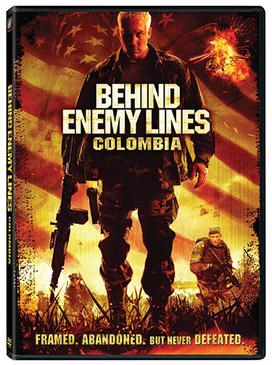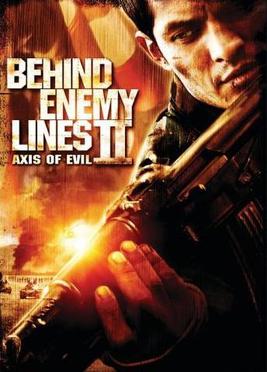
Behind Enemy Lines II: Axis of Evil (2006, directed by James Dodson)


After an intelligence satellite reveals that the North Koreans have built a nuclear missile that can hit anywhere in the world and that they’re currently pointing the missile right at the United States, the President (Peter Coyote) orders a team of Navy SEALs to parachute into North Korea and take out the missile site.  At the last minute, the mission is canceled but two SEALs have already jumped out of the airplane and two more follow because a SEAL leaves no man behind.

While the world sits on the brink of war, the stranded SEALs attempt to reach the missile site and knock it out of commission.  Unfortunately, two of the SEALs get killed by the North Koreans and the two survivors end up getting captured and are forced to undergo extreme torture.  With time running out, the president authorizes a military strike on the missile site, a move that could plunge the world into a nuclear war.  It’s now up to Lt. James (Nicholas Gonzalez) and Master Chief Callaghan (Matt Bushell) to escape from the North Koreans and complete their mission before the stealth bombers show up and do their thing.

Behind Enemy Lines II: Axis of Evil has nothing to do with the previous Behind Enemy Lines film, beyond featuring a Naval officer stranded in enemy territory.  Behind Enemy Lines II: Axis of Evil is one of those films that should be simple and easy to follow but it’s so frantically directed and edited that it’s actually difficult to understand what’s going on from scene to scene.  This isn’t a case where, as in Black Hawk Down, the film is deliberately confusing in order to show what it would be like to be under enemy fire.  Instead, Behind Enemy Lines II feels as if it was edited by someone who was getting paid per jump cut.  It becomes difficult to keep track of who is shooting at who and the overuse of the shaky handheld camera effect didn’t help.  Also, for some reason, there are some fantasy sequences that feel as if they belong in a different movie.

The scenes in Washington D.C., where the President and his advisers debate whether or not to plunge the world into war, are marginally better.  Peter Coyote has the right amount of moral authority to play the president and the great Glenn Morshower (you may remember him as Aaron of the Secret Service on 24) plays the admiral who suggests that maybe it would be a good idea not to hastily destroy the world.  Because this movie was made in 2006, the actress playing the Secretary of State is a dead ringer for Condoleezza Rice.

Behind Enemy Lines II is not a good movie but it made enough money to get a sequel, which I’ll review tomorrow.


A Movie A Day #341: Hot Pursuit (1987, directed by Steven Lisberger)


When high school student Dan Bartlett (John Cusack) is late arriving at the airport, he finds himself watching as the plane taking his girlfriend (Wendy Gazelle) and her parents (Monte Markham and Shelley Fabares) to the Caribbean takes off without him.  Dan catches the next available flight and tries to track down his girlfriend and her family.  Helping him out is a Ganja-smoking islander (Keith David) and a crusty sea captain (Robert Loggia).  Complicating matters is that Dan’s girlfriend has been kidnapped by pirates (Jerry Stiller and his son, Ben)!
John Cusack got his start appearing in dopey 80s teen comedies and Hot Pursuit shows why he eventually declared that he would never appear in another one.  Hot Pursuit relies on the idiot plot.  If everyone in the movie didn’t act like an idiot, there wouldn’t be much of a movie.  Cusack seems bored in his role, only waking up towards the end of the movie when he gets to pick up a machine gun and blow away the pirates’ hideout.  (Cusack even gets to do a Rambo-style yell while riddling the building with bullets.)  This was Ben Stiller’s film debut and he has a few funny scenes.  The movie probably would have worked better if Stiller and Cusack had switched roles.

One final note; Hot Pursuit was produced by Pierre David, who also produced several of David Cronenberg’s early films.  It’s probably not a coincidence that Wendy Gazzelle’s character is named Lori Cronenberg.

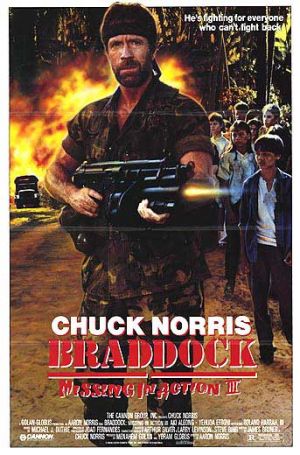
A Movie A Day #137: Braddock: Missing in Action III (1988, directed by Aaron Norris)


Chuck Fucking Norris, dude.  Chuck Norris is so cool that continuity bends to his will and thanks him for the opportunity.
Need proof?

Just watch Braddock: Missing in Action III.

The third Missing in Action film starts in 1975, with the fall of Saigon.  The communists are taking over.  The Americans are fleeing Vietnam.  Colonel James Braddock (Chuck FUCKING Norris) is determined to bring his Vietnamese wife to America with him but, when she loses her papers and is not allowed to make her way to the American embassy, Braddock believes that she had been killed. (Keep an eye out for Keith David as the Embassy guard.  Only Chuck Norris could overshadow Keith David in a movie.)  Heartbroken, Braddock returns to the United States.

Every fan of the Missing in Action franchise knows better.  We all know that Chuck was in a POW camp when Saigon fell.  In Missing in Action 2, he and his fellow prisoners did not even know if the war had ended.  Also, Chuck mentioned having a wife waiting for him back in the United States.  What gives?

I can think of only two possible explanations.

Either Chuck Norris and Cannon Films did not care about continuity

or

Chuck Norris is so cool that, in order to prevent his collected coolness from knocking the Earth off of its axis, the U.S. Army split Chuck’s coolness in half by creating a clone.  One clone spent ten years in a POW camp.  The other clone escaped during the Fall of Saigon but had to leave behind his wife.

Thirteen years later and back in the U.S., Chuck is contacted by Reverend Polanski (Yehuda Efroni), who tells him that his wife is still alive in Vietnam and that he has a 12 year-old son.  Chuck’s boss at the CIA tells him that, under no circumstances, is Chuck to go to Vietnam.

Anyone who thinks they can tell Chuck Norris what do is a fool.

Chuck goes to Vietnam and is reunited with his wife and son.  Unfortunately, when Chuck tries to get his new family out of the country, they are captured by sadistic General Quoc (Aki Aleong).  Again, Braddock must escape from a Vietnamese prison camp.

Braddock: Missing in Action III was co-written by Chuck Norris and it was directed by his brother, Aaron.  It’s a Norris production all the way, which means a lot of heroic shots of Chuck and a lot of bad guys wondering why Chuck is so much better than them.

Braddock was released four years after the first Missing in Action but, more importantly, it was released two years after Oliver Stone’s Platoon changed the way that movies dealt with the war in Vietnam.  By the time that Braddock came out, films in which lone American refought and single-handedly won the war were no longer in fashion.  Braddock was a flop at the box office and it ended the franchise.  However, continuity errors aside, Braddock is actually the best of the Missing in Action films.  It features Chuck’s best performance in the series and Chuck searching for his wife and child gives Braddock more emotional weight than the first two Missing in Action films. Maybe Chuck should have co-written and selected the director for all of the films he made for Cannon.

Chuck Norris, dude.

Chuck Fucking Norris.

Playing Catch-Up: The Nice Guys (dir by Shane Black)


the-nice-guys

Last night, along with seeing Trainspotting at the Alamo Drafthouse and watching The BFG at home, I also rewatched The Nice Guys.

Now, I saw The Nice Guys when it was first released last May and I absolutely loved it.  However, before I started rewatching it, I was a little worried .  I remembered that The Nice Guys was a stylish and often hilarious action film, one that featured a great comedic turn from Ryan Gosling and a performance from Russell Crowe that showed why he deserves to make a comeback as a leading man.  I also remembered that, for all of its graphic violence and often profane dialogue, The Nice Guys was also an unexpectedly sweet-natured movie.  I loved not only the rapport shared between Gosling and Crowe but also the relationship between Gosling and Angourie Rice, the actress playing his daughter.  In fact, I remembered enjoying The Nice Guys so much that I was worried that it wouldn’t hold up to a second viewing.

It often happens when you love a film the first time that you see it.  On a second viewing, you start to notice all the little flaws that you didn’t notice the first time.  Lines that you remembered as being brilliant are no longer impressive, largely because you know they’re coming.  All too often, the films that blow you away fail to hold up over time.

(Anyone tried to rewatch Inherent Vice lately?)

But you know what?

The Nice Guys is not one of those films.  I watched the film for a second time and I loved it even more than the first time.

The Nice Guys takes place in Los Angeles in 1977.  It’s a time of wide lapels, leisure suits, tacky interior design, porno chic, and concerns that the L.A. air is so full of smog that not even bumble bees are willing to fly around in it.  Ryan Gosling is Holland March, a well-meaning if somewhat sleazy private investigator who has been hired to track down a porn star named Misty Mountains.  Of course, Holland know that Misty is dead.  Everyone knows that she’s dead.  She died in a car crash, one that made all the headlines.  But Misty’s aunt swears that she saw Misty after Misty’s supposed death.

Holland thinks that Misty’s aunt may have mistaken her niece for Amelia Kutner (Margaret Qualley), the daughter of Judith Kutner (Kim Basinger, whose presence is meant to remind audiences of L.A. Confidential), an official at the Justice Department who has been leading a crusade against pornography.  Holland starts to search for Amelia which leads to Amelia paying Jackson Healy (Russell Crowe) to intimidate Holland.

Who is Jackson Healy?  Well, he’s not a licensed private investigator, though he’d certainly like to be.  Instead, he’s a professional enforcer.  If you pay him enough money, he’ll beat people up for you.  Usually, he beats up stalkers and ex-boyfriends.  When he discovers that Holland is a private investigator, Jackson is intrigued.  Jackson would like to be a private investigator.  Of course, that doesn’t stop Jackson from breaking Holland’s arm.  Jackson’s a professional, after all.  As Jackson leaves Holland’s house, he runs into Holly (Angourie Rice), Holland’s twelve year-old daughter.  She gives him a bottle of Yoohoo.

Later, Jackson is confronted by two men.  Keith David plays Older Guy and he’s intimidating because he’s Keith David.  His partner is a giggly sociopath played by Beau Knapp.  For reasons that are too much fun for me to spoil, he is known as Blue Face.  The two men demand to know where Amelia is.  After Jackson manages to chase them off with a shotgun, he teams up with Holland to try to track down Amelia and find out what’s going on…

Got all that?

The mystery — which eventually expands to involve everything from porn to political protest to the Detroit auto industry — is deliberately and overly complex but at the same time, it’s actually rather clever.  And, as I can now say after rewatching the film, it actually holds up quite well.  But, to be honest, the mystery is not as important as the whip smart dialogue, the frequently over the top action, and the chemistry between Gosling, Crowe, and Rice.  As good as the action may be, the film’s best scenes are simply the ones that feature the three leads talking to each other.

(Upon discovering that Jackson both broke her father’s arm and that he beats people up for a living, Holly immediately asks how much it would cost to have one of her friends beat up.)

And you know what?  As played by Gosling and Crowe, they really are the nice guys.  Holland tries to be cynical but, for the most part, he’s just an overprotective father.  Jackson may beat people up for a living but he’s not a sadist.  He’s a lot like the film, violent but with a good heart.

The Nice Guys is full of wonderful set pieces, like when Gosling, Crowe, and Rice infiltrate a sleazy 70s party or the film’s explosive finale.  For me though, I love the little details and the quieter moments.  I love the fact that even one of the worst people in the movie responds postively to having someone innocently hold his hand.

(I also love that Matt Bomer shows up, playing a totally terrifying hitman.  It’s a small role but Bomer does so much with it.)

It’s a shame that The Nice Guys came out as early in the year as it did.  It’s also a shame that it didn’t do better at the box office.  The Oscars could use a little action and a little comedy this year, don’t you think?

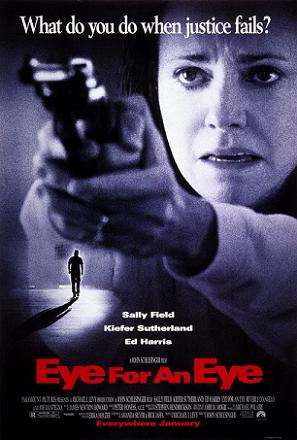
Insomnia File #10: Eye For An Eye (dir by John Schlesinger)


What’s an Insomnia File? You know how some times you just can’t get any sleep and, at about three in the morning, you’ll find yourself watching whatever you can find on cable? This feature is all about those insomnia-inspired discoveries!

Eye_for_an_Eye_(1996_film)_poster

If you were awake at midnight and trying to get some sleep, you could have turned over to ThillerMax and watched the 1996 revenge thriller, Eye For An Eye.  However, the film wouldn’t have helped you get to sleep.  Eye For An Eye is not a film that you sleep through.

Eye For An Eye opens with Karen McCann (Sally Field) comforting her youngest daughter, Megan (Alexandra Kyle).  Megan is terrified of a moth that has flown into her bedroom.  “Kill it, mommy, kill it!” Megan shouts.  Instead, Karen gently takes the moth in her hand and allows it to escape through an open window.  In those first few minutes, the film tells us everything that it feels to be important about Karen.  She’s a mother.  She lives in a big house in the suburbs.  And she wouldn’t kill a moth…

But — the name of the title is Eye For An Eye and that would seem to promise killing so we know that something terrible is going to happen to change Karen’s outlook on life.

And it does!  The next afternoon, Karen is stuck in traffic and calls her oldest daughter, 17 year-old Julie (Olivia Burnette).  In an extremely harrowing sequence that is pure nightmare fuel, Karen helplessly listens as Julie is raped and murdered.

A white trash deliveryman named Robert Doob is arrested for the crime and we immediately know that he’s guilty.  First off, his name is Robert Doob and that’s a serial killer name if I’ve ever heard one.  Secondly, he smirks at Karen and her husband (Ed Harris) and, in a particularly cruel moment that was especially upsetting to this former stutterer, he imitates Julie’s stammer.  Third, Robert has tattoos and Satanic facial hair.  And finally, Robert Doob is played by Keifer Sutherland.  And usually, I find Keifer and his growl of a voice to be kinda sexy in a dangerous sorta way but in Eye For An Eye, he was so icky that he just made my skin crawl.

Robert Doob is obviously guilty but an evil liberal judge throws the case out on a technicality.  After Karen gets over the shock of seeing justice perverted, she decides to take the law into her own hands.  After meeting a professional vigilante (Philip Baker Hall, looking slightly amused no matter how grim he tries to act), Karen decides to learn how to use a gun so that she can get her revenge…

There’s not a single subtle moment in Eye For An Eye but that’s actually the main reason I enjoyed the film.  Everything — from the performances to the script to the direction to the music to … well, everything — is completely and totally over-the-top.  The symbolism is so heavy-handed and the film is so heavily stacked in favor of vigilante justice that the whole thing becomes oddly fascinating.  It may not be a great film but it’s always watchable.  It may not be subtle and it may even be borderline irresponsible in its portrayal of the American justice system but who cares?  By the end of the movie, I was over whatever real world concerns I may have had about the film’s premise and I was totally  cheering Karen on in her quest for vengeance.  I imagine I’m not alone in that.  Eye For An Eye is the type of film that elitist movie snobs tend to dismiss, even while secretly knowing that it’s actually kinda awesome.

Previous Insomnia Files:

  1. Story of Mankind
  2. Stag
  3. Love Is A Gun
  4. Nina Takes A Lover
  5. Black Ice
  6. Frogs For Snakes
  7. Fair Game
  8. From The Hip
  9. Born Killers

The TSL’s Daily Horror Grindhouse: Smiley (dir by Michael Gallagher)


Smiley_Movie_Poster

Oh God, this movie.

Whenever I watch 2012’s Smiley (and, since this is one of those films that always seems to be playing whenever I have insomnia, I actually have seen Smiley more times than I should probably admit), I always find myself hoping that it will actually be a better film than I remember it being.

Some of that, I have to admit, is because I once dated a frat boy whose nickname was Smiley.  His high school football coach gave him that name because he was always smiling!  (Yes, I once dated a football player who smiled a lot and didn’t really care much about literature, art, movies, history, or anything else that I was actually interested in. Don’t ask me to explain how these things happen.)  His pickup truck even had a personalized licence plate that read, “SMILY.”  That’s right — he wasn’t really sure how to spell Smiley.  Whenever I see the title Smiley listed in the guide, I think of him and I have to kind of laugh.

Beyond that, Smiley was an independent, low-budget film and I have to admit that my natural inclination is always to support independent filmmakers.  If Smiley was a huge studio production, I’d have absolutely no qualms about ripping it apart.  But when I see an indie horror film like Smiley, there’s a part of me that almost feels that I have to be supportive.  But the things is, it’s one thing to be supportive and it’s another thing to be delusional.  I may want Smiley to be a good horror film but it’s not and I’m really not doing anyone any good if I pretend otherwise.

Finally, I always want Smiley to be better than it actually is because the film features one of the creepiest killers that I’ve ever seen.  Even if the character is cheapened by a rather stupid twist, Smiley is scary looking.  Smiley is presented as being the spirit of a man who, after stitching his own eyes closed, carved a permanent smile on his face.  As a force of evil, Smiley is genuinely frightening and it’s unfortunate that the rest of the film doesn’t live up to the character’s potential.

As for the rest of the film … well, it’s pretty much your typical slasher.  All of the characters are loathsome, the murders are neither suspenseful nor gory enough to really be memorable, and this is one of those films that relies far too much on scenes of people running into someone, screaming in terror, and then discovering that it was just one of their friends.  It is true that there is a twist towards the end of the film that’s designed to make you question everything that you’ve just see but since the twist doesn’t make much sense and comes out of nowhere, it’s hard to get excited about it.  The best thing the film had going for it was the character of Smiley and the twist pretty much ruins that.

(The film’s other big twist is that the cast is full of YouTube personalities, which makes Smiley the spiritual descendant of The Scorned, a similarly bad slasher film that was full of reality TV stars.)

By the way, the idea behind Smiley is that you can go on Chatroulette and, if you type “I did it for the lulz” three times, Smiley will appear and kill whoever your chatting with.  Just for the record, I’ve tried it and it doesn’t work.*

——

* Well, to be honest, I got a friend of mine to try it and it didn’t work.  I’ve got better things to do then watch some guy jerking off on Chatroulette.

Scenes I Love: They Live


TheyLiveFight

Another childhood hero has passed on undertake the last great journey. Rowdy Roddy Piper might have played the greatest of heels when he was in WWF (now WWE) as I grew up during the 80’s, but he was also a favorite wrestler and character. He seemed genuine in both attitude and charisma where I thought Hulk Hogan was all bluster and fake.

I’m sure I won’t be the only one to miss the Hot Rod. I pay tribute to the Man and the Legend in my own way by sharing one of the best moments of Roddy Piper’s career. It’s the greatest fight scene ever put on celluloid.

Anyone who says differently gets a boot to the face.

Icarus Files No. 1: Cloud Atlas (dir. by The Wachowskis and Tom Tykwer)


CloudAtlas

“My life amounts to no more than one drop in a limitless ocean. Yet, what is any ocean, but a multitude of drops?” — David Mitchell

Let me tell you about Icarus. He took flight with wings of feather and wax. Warned not to fly too low so as not to have the sea’s dampness clog his wings or to climb too high to have the sun melt the wax. Icarus heeded not the latter and tried to fly as close to the sun. Just as his father had warned him the wax in his wings melted as he flew too close to the sun and soon fell back to earth and into the sea.

A tale from Greek mythology that taught has taught us about ambition reaching so high that it’s bound to fail. One such ambitious failure of recent times has been the epic science fiction film Cloud Atlas directed by The Wachowskis and Tom Tykwer.

The film was adapted from the novel of the same name by author David Mitchell which looked to take six stories set in 19th-century South Pacific and right up to a distant, post-apocalyptic future. Each story’s characters and actions would connect with each other through the six different time and space. The film attempts to do what Mitchell’s novel did through several hundred dense and detailed pages.

CLOUD ATLAS

Just like Icarus The Wachowski and Tom Tykwer’s attempt to connect the lives and actions of all six stories amounts for what admirers and detractors can only agree on as an admirable and ambitious failure.

The film boasts a large ensemble cast led by Tom Hanks, Halle Berry, Jim Broadbent, Hugh Grant and Hugo Weaving. More than one of the actors in the cast would perform characters in each and every six interconnecting stories in the film which added a sense of rhythmic continuity to the whole affair, but also made for some very awkward and uncomfortable scenes of what could only amount to as “yellowface”. This was most evident in the story set in 22nd-century Neo Seoul, South Korea where actors such as James D’Arcy, Jim Sturgess, Keith David and Hugo Weaving have been heavily made-up to look Asian.

Cloud Atlas was and is a sprawling film that attempts to explore the theme that everything and everyone is connected through time and space. It’s how the action of one could ripple through time to have a profound effect on others which in turn would create more ripples going forward through time. The film both succeeds and fails in portraying this theme.

cloud_atlas_hd_movie_trailer_stills_cinemavine_144.png.scaled1000

It’s the film’s narrative style to tell the six stories not in a linear fashion from 19th-century to the post-apocalyptic future, but instead allow all six tales to weave in and out of each other. At times this weaving style and how it would seamlessly go from one time location to another without missing a beat made for some very powerful and emotional moments. But then it would also make these transitions in such a clunky manner that it brings one out of the very magical tale the three directors were attempting to weave and tell.

Yet, even through some of it’s many faults and failings the film does succeed in some way due to the performances of the ensemble cast. Even despite the awkwardness of the “yellowface” of the Neo Seoul sequence the actors in the scenes perform their roles such admirable fashion. One would think that someone like Tom Hanks who has become such a recognizable presence in every film he appears in wouldn’t be able to blend into each tale being shown and told, but he does so in Cloud Atlas and so does everyone else.

It helps that the film was held up from a very hard landing after reaching so high with an exquisite and beautiful symphonic score composed by Tom Tykwer, Reinhold Heil and Johnny Klimek. It’s a score that manages to accentuate the film’s exploration of emotions and actions rippling through time without ever becoming too maudlin and pandering to the audiences emotions.

o0800045112460141324

Cloud Atlas was hyped as the next epic science fiction film from The Wachowskis and Tom Tykwer leading up to it’s release. This hype was further built-up with thundering standing ovation during it’s screening at the 37th Toronto International Film Festival. But once the film finally was released and more critics and the general public were able to see it for themselves the reaction have been divisive. This was a film that brooked no middle-ground. One either loved it flaws and all or hated it despite what it did succeed in accomplishing amongst the failures.

Just like Icarus, Cloud Atlas and it’s three directors had high ambitions for the film. It was a goal that not many filmmakers seem to want to put themselves out on the limb for nowadays because of how monumental the failure can be if their ambitions are just too high. It’s been the reputation of The Wachowskis since they burst into the scene with their Matrix trilogy. Their eclectic and, somewhat esoteric, storytelling style have made all their films an exercise in high-risk, high reward affairs that makes no apologies whether they succeed or fail. Each of their films have a unique vision that they want to share with the world and they make no compromises in how this vision is achieved.

One could call Cloud Atlas an ambitious failure. It could also be pop, New Age psychobabble wrapped up in so-called high-art. Yet, what the two siblings and Tom Tykwer were able to achieve with the film has been nothing less by brave and daring. If more filmmakers were willing to allow their inner Icarus to fly then complaints of Hollywood and the film industry not having anymore fresh new ideas would fade.

Embracing the Melodrama #53: Crash (dir by Paul Haggis)


crash-2004-poster

For the past two weeks, I’ve been reviewing, in chronological order, some of the most and least memorable melodramas ever filmed.   We started way back in 1916 and now, after 52 reviews, we’ve finally reached the year 2004.  And that can only mean that it is time to review the worst film to ever win an Oscar for best picture of the year.  I am, of course, talking about Crash.

Crash is an ensemble piece that follows a multi-racial cast of characters as they deal with issues of race, crime, and — well, that’s about it.  In Crash, everyone’s life revolves around race and crime.  Well, I take that back,  There is at least one character whose life revolves around being a good maid to the white woman who employs her.  But otherwise, it’s all about race and crime.  The film is set in Los Angeles which, from what I’ve read, is actually a pretty big city but you really wouldn’t know that from watching Crash.  All of the characters in Crash are constantly and randomly running into each other.  I think director/screenwriter Paul Haggis is trying to make a statement about the power that coincidence plays in the world but, often times, it just feels like lazy plotting.

Anyway, here are the characters who are meant to bring Los Angeles to vivid cinematic life:

Brendan Fraser and Sandra Bullock play rich white people Rick and Jean Cabot.  Rick Cabot has just been elected District Attorney of Los Angeles County.  (Because when I think of a successful urban politician, I automatically think of Brendan Fraser…)  Jean is his materialistic wife.  At the start of the film, they’re carjacked by two young black men, which leads to Jean suspecting that every non-white she sees is secretly a gang member.  Later, Jean falls down a flight of stairs but she’s helped by her maid, who happens to be — surprise, surprise — not white!  Apparently, this teaches Jean an important lesson about tolerance.  The message, I guess, is that white people can be redeemed by interacting with their minority servants.

And then there’s Cameron (Terrence Howard) and his wife Christine (Thandie Newton) who are upper class and black.  Cameron directs sitcoms for a living and, at work, he has to deal with Fred (Tony Danza) constantly double guessing him and demanding that he reshoot scenes.  One night, as they leave an awards ceremony, Cameron and Christine are pulled over by two white cops — the racist Ryan (Matt Dillon) and his idealistic partner Hansen (Ryan Phillippe).  Ryan proceeds to molest Christine while giving her a pat down.  The next day, Christine is involved in a car accident on the freeway and is pulled from the burning car by none other than Officer Ryan.  The point here, I suppose, is that the same pervert who finger rapes you one night is just as likely to be the same guy who comes across your overturned car on the freeway.  For that scene alone, Crash deserves the title of worst best picture winner ever.

crash-2004 4

But that’s not all!

There’s also Detective Graham Waters (Don Cheadle), who has been assigned to investigate a police corruption case that would not be out of place in an episode of … well, just insert your own generic cop show title here.  Graham also visits his mentally unstable mother who demands that Graham find his younger brother.  Now, of course, as soon as we hear this, we know that Graham’s brother is going to have to turn out to be one of the other characters in the film.  Since there are only three other black males in this film (and since Cameron appears to be the same age as Graham), it’s not difficult to figure out who it’s going to be.

It’s either going to be Anthony (Ludacris) or Peter (Larenz Tate), who also happen to be the same two men who carjacked the Cabots’ car at the start of the film.  Larenz Tate probably gives the best performance in this whole sorry mess of a film, even if his role is ultimately a thankless one.

There’s also a locksmith named Daniel (Michael Pena), who finds himself being stalked by an angry Middle Eastern man.  Daniel’s story contains a hint of magic realism, presumably because Paul Haggis was reading something by Gabriel Garcia Marquez while writing the script.

Crash

You can fault Crash for many things but you also can’t deny that it’s far more ambitious than the typical bad film.  In the space of 112 minutes, Paul Haggis attempts to say everything that needs to be said about race and class in America.  Unfortunately, while watching the film, it quickly becomes obvious that Haggis really doesn’t know much about race and class in America.  Hence, the film becomes a collection of scenes that think they mean something while actually meaning nothing.  Crash is less about race in America and more about how other movies have traditionally portrayed race in America.  Unfortunately, director Haggis does not have the self-awareness to truly bring the subtext of screenwriter Haggis’s script to life.

The main theme of Crash seems to be that everyone has a good side and a bad side and that you can the hero of one story while being the villain of another.  That’s not a bad theme, it’s just an incredibly mundane one.  The film illustrates this theme by continually having a character say something racially offensive just to then have him do something heroic in the very next scene.  As a result, the characters don’t come across as being so much complex as just incredibly inconsistent.  Crash is never as deep as it thinks it is.

Reportedly, Crash was inspired by Paul Haggis’s own experience of getting carjacked.  Haggis has said that being a victim of crime led to some intense soul searching on his part.  Hopefully, Haggis got something better than just Crash out of the whole experience.

still-of-terrence-howard-in-crash-(2004)-large-picture

Trailer: Cloud Atlas (Extended Trailer)


We’ve been getting quite a bit of hype for the fall and holiday releases of 2012 but for some reason one film that should’ve been on more people’s radar seem to have gone unnoticed until this week when an extended trailer for the film was released to the public. It’s the film adaptation of David Mitchell’s epic sci-fi novel Cloud Atlas.

The film is directed by Lana Wachowski (formerly Larry Wachowski), Andy Wachowski and German-filmmaker Tom Tykwer. It’s a film that has a cast which includes Tom Hanks, Halle Berry, Jim Broadbent, Jim Sturgess and Susan Sarandon for starters. The story looks to stay faithful to the original novel source which interweaves six different stories spanning time from the 19th-century all the way to a post-apocalyptic far future.

It’s going to be interesting whether the Wachowskis and Tykwer will be able to keep these six stories from becoming too confusing for the general audience to follow. Most important of all will be if these filmmakers will be able to create an entertaining film out of a novel heavy on themes and ideas. One thing the trailer sure points out is that the Wachowskis haven’t lost their touch when it comes to the visual side of filmmaking.

Cloud Atlasis set for an October 26, 2012 release date.