Embracing the Melodrama #53: Crash (dir by Paul Haggis)


crash-2004-poster

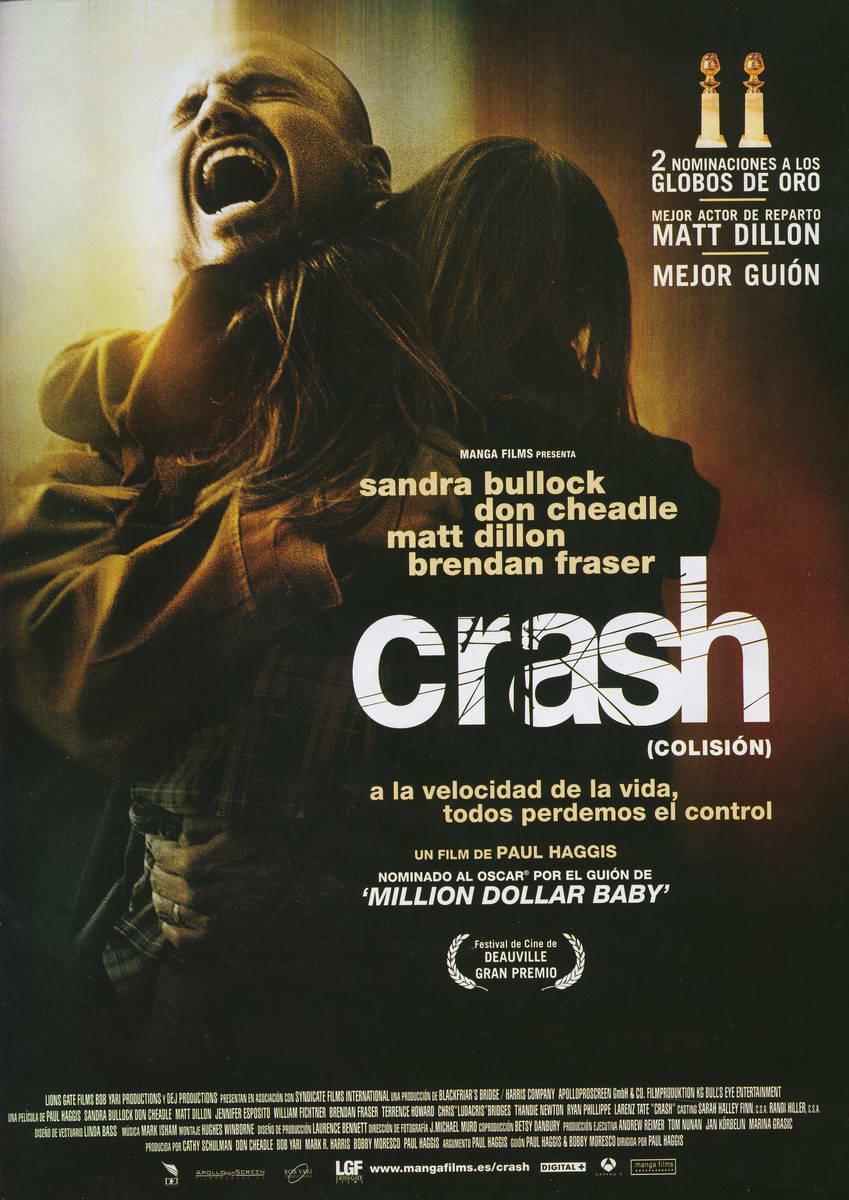
For the past two weeks, I’ve been reviewing, in chronological order, some of the most and least memorable melodramas ever filmed.   We started way back in 1916 and now, after 52 reviews, we’ve finally reached the year 2004.  And that can only mean that it is time to review the worst film to ever win an Oscar for best picture of the year.  I am, of course, talking about Crash.

Crash is an ensemble piece that follows a multi-racial cast of characters as they deal with issues of race, crime, and — well, that’s about it.  In Crash, everyone’s life revolves around race and crime.  Well, I take that back,  There is at least one character whose life revolves around being a good maid to the white woman who employs her.  But otherwise, it’s all about race and crime.  The film is set in Los Angeles which, from what I’ve read, is actually a pretty big city but you really wouldn’t know that from watching Crash.  All of the characters in Crash are constantly and randomly running into each other.  I think director/screenwriter Paul Haggis is trying to make a statement about the power that coincidence plays in the world but, often times, it just feels like lazy plotting.

Anyway, here are the characters who are meant to bring Los Angeles to vivid cinematic life:

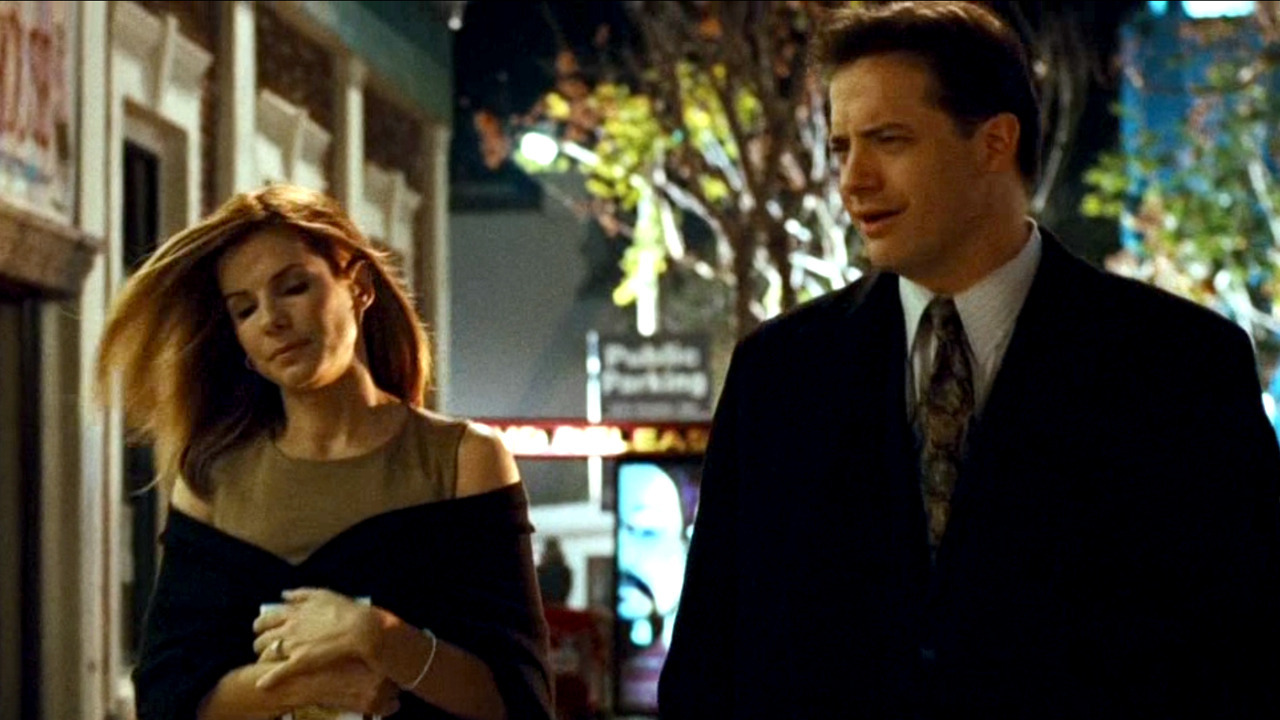
Brendan Fraser and Sandra Bullock play rich white people Rick and Jean Cabot.  Rick Cabot has just been elected District Attorney of Los Angeles County.  (Because when I think of a successful urban politician, I automatically think of Brendan Fraser…)  Jean is his materialistic wife.  At the start of the film, they’re carjacked by two young black men, which leads to Jean suspecting that every non-white she sees is secretly a gang member.  Later, Jean falls down a flight of stairs but she’s helped by her maid, who happens to be — surprise, surprise — not white!  Apparently, this teaches Jean an important lesson about tolerance.  The message, I guess, is that white people can be redeemed by interacting with their minority servants.

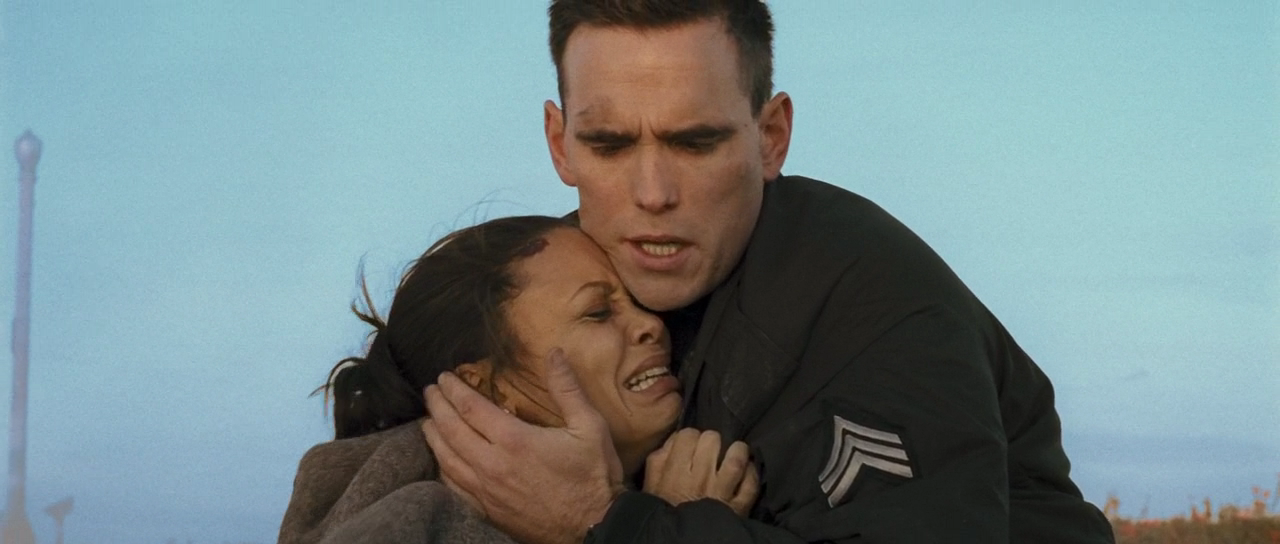
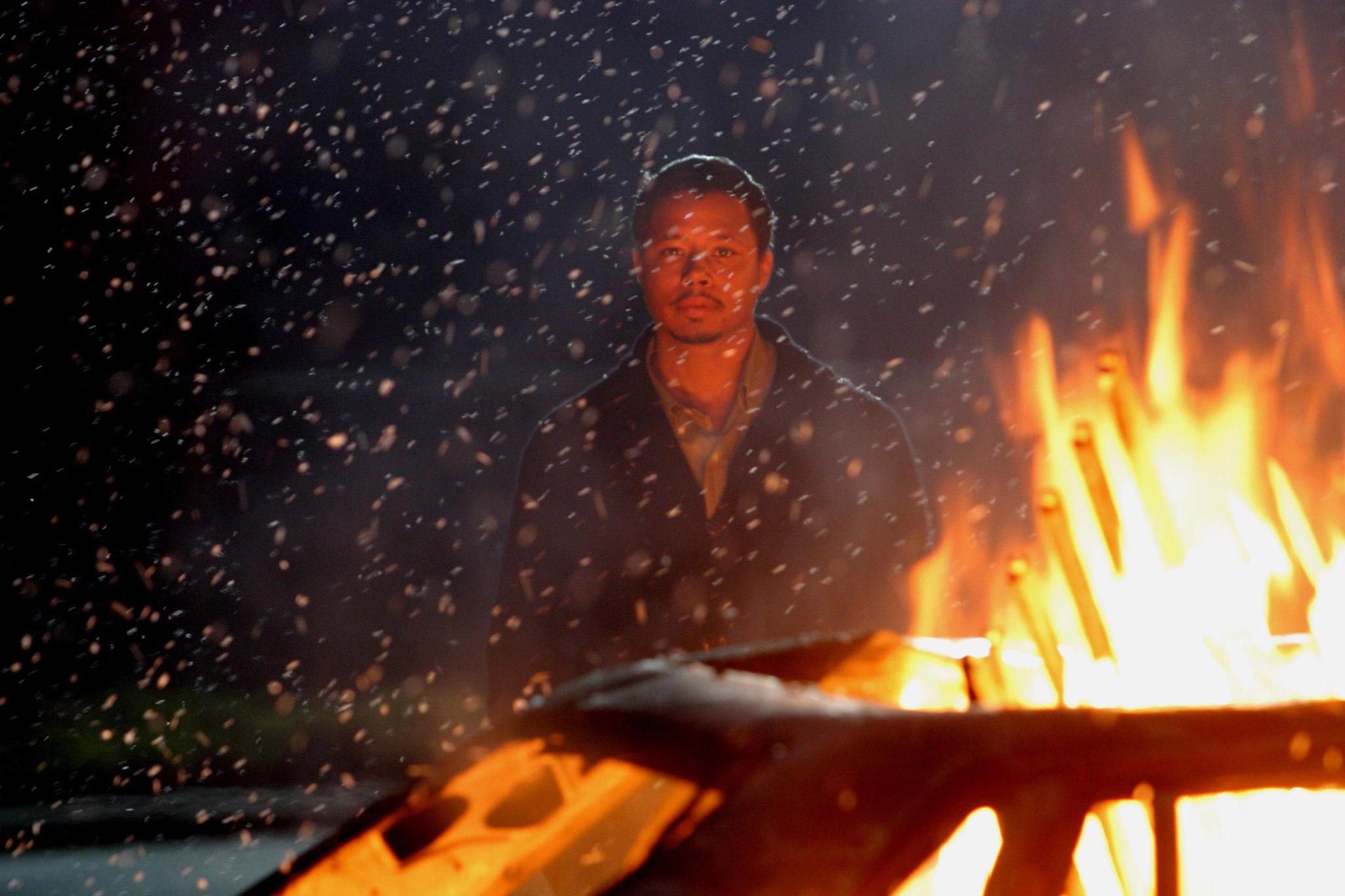
And then there’s Cameron (Terrence Howard) and his wife Christine (Thandie Newton) who are upper class and black.  Cameron directs sitcoms for a living and, at work, he has to deal with Fred (Tony Danza) constantly double guessing him and demanding that he reshoot scenes.  One night, as they leave an awards ceremony, Cameron and Christine are pulled over by two white cops — the racist Ryan (Matt Dillon) and his idealistic partner Hansen (Ryan Phillippe).  Ryan proceeds to molest Christine while giving her a pat down.  The next day, Christine is involved in a car accident on the freeway and is pulled from the burning car by none other than Officer Ryan.  The point here, I suppose, is that the same pervert who finger rapes you one night is just as likely to be the same guy who comes across your overturned car on the freeway.  For that scene alone, Crash deserves the title of worst best picture winner ever.
crash-2004 4

But that’s not all!

There’s also Detective Graham Waters (Don Cheadle), who has been assigned to investigate a police corruption case that would not be out of place in an episode of … well, just insert your own generic cop show title here.  Graham also visits his mentally unstable mother who demands that Graham find his younger brother.  Now, of course, as soon as we hear this, we know that Graham’s brother is going to have to turn out to be one of the other characters in the film.  Since there are only three other black males in this film (and since Cameron appears to be the same age as Graham), it’s not difficult to figure out who it’s going to be.

It’s either going to be Anthony (Ludacris) or Peter (Larenz Tate), who also happen to be the same two men who carjacked the Cabots’ car at the start of the film.  Larenz Tate probably gives the best performance in this whole sorry mess of a film, even if his role is ultimately a thankless one.

There’s also a locksmith named Daniel (Michael Pena), who finds himself being stalked by an angry Middle Eastern man.  Daniel’s story contains a hint of magic realism, presumably because Paul Haggis was reading something by Gabriel Garcia Marquez while writing the script.
Crash

You can fault Crash for many things but you also can’t deny that it’s far more ambitious than the typical bad film.  In the space of 112 minutes, Paul Haggis attempts to say everything that needs to be said about race and class in America.  Unfortunately, while watching the film, it quickly becomes obvious that Haggis really doesn’t know much about race and class in America.  Hence, the film becomes a collection of scenes that think they mean something while actually meaning nothing.  Crash is less about race in America and more about how other movies have traditionally portrayed race in America.  Unfortunately, director Haggis does not have the self-awareness to truly bring the subtext of screenwriter Haggis’s script to life.

The main theme of Crash seems to be that everyone has a good side and a bad side and that you can the hero of one story while being the villain of another.  That’s not a bad theme, it’s just an incredibly mundane one.  The film illustrates this theme by continually having a character say something racially offensive just to then have him do something heroic in the very next scene.  As a result, the characters don’t come across as being so much complex as just incredibly inconsistent.  Crash is never as deep as it thinks it is.

Reportedly, Crash was inspired by Paul Haggis’s own experience of getting carjacked.  Haggis has said that being a victim of crime led to some intense soul searching on his part.  Hopefully, Haggis got something better than just Crash out of the whole experience.
still-of-terrence-howard-in-crash-(2004)-large-picture

Trailer: Cloud Atlas (Extended Trailer)


We’ve been getting quite a bit of hype for the fall and holiday releases of 2012 but for some reason one film that should’ve been on more people’s radar seem to have gone unnoticed until this week when an extended trailer for the film was released to the public. It’s the film adaptation of David Mitchell’s epic sci-fi novel Cloud Atlas.

The film is directed by Lana Wachowski (formerly Larry Wachowski), Andy Wachowski and German-filmmaker Tom Tykwer. It’s a film that has a cast which includes Tom Hanks, Halle Berry, Jim Broadbent, Jim Sturgess and Susan Sarandon for starters. The story looks to stay faithful to the original novel source which interweaves six different stories spanning time from the 19th-century all the way to a post-apocalyptic far future.

It’s going to be interesting whether the Wachowskis and Tykwer will be able to keep these six stories from becoming too confusing for the general audience to follow. Most important of all will be if these filmmakers will be able to create an entertaining film out of a novel heavy on themes and ideas. One thing the trailer sure points out is that the Wachowskis haven’t lost their touch when it comes to the visual side of filmmaking.

Cloud Atlasis set for an October 26, 2012 release date.

Quick Review: John Carpenter’s The Thing


When I was little, my family used to have this cable service called WHT. I can’t remember what it stood for, but recall that it was a one channel station that would constantly show movies. It was like Starz for anyone who didn’t want to pony up the extra money for actual HBO at the time. Since it was set up at my Grandparents house (where I lived), sometimes we’d all gather around for a Movie Night on Saturdays. This is something my family’s done often during the years, and the current part of my family does this on Sundays now, premiering films we haven’t seen yet.

It was one of these Saturday nights that I first witnessed John Carpenter’s The Thing. I had to go to bed for it, being as young as I was for the film, but with the door open I could hear the music and sounds from my bed. At one point, I climbed out of the top bunk and snuck to the stairs, watching the film in my PJ’s. My family would get pretty engrossed with movies, so they never bothered to glance in my direction. After all, this was the first time any of them were seeing this film, and they all loved the original.

I was doing fine until that Husky’s head split open. If I just kept my mouth shut, I could have seen the whole film. After that, I couldn’t stop screaming, “Omigod! The doggie!!” I was met with cries of “Go to Bed!!” from just about everyone. Even though I climbed back into bed, there was no way I was able to fall asleep. Every gunshot, every yell caused me to bundle myself under my blankets with my eyes wide open.

Since then, The Thing has become a family favorite, a reliable go to film for any time it’s cold or rainy or dark. I even showcased it for my friends in Oregon who hadn’t seen it before and they also had almost the same reaction to that poor dog.

So, what is The Thing?

Other than maybe being John Carpenter’s strongest film (which many will argue, because there’s always a place for Big Trouble in Little China for me), it’s a great example of a work in progress that was just done and put to print. Like Jaws, the film ran into some problems. Special FX member Rob Bottin suffered from exhaustion from working so hard on the film. They had some issues with coming up with the final representation of The Thing that wouldn’t appear too cartoon-like or animatronic. There was even a fire during the taping of a huge effect shot involving a body ripping open because of the chemicals that were put into the latex workup. Even though the movie takes place in Antarctica (which I believe roughly 6 months of night), the film actually has a day and night cycle, having filmed in Juneau, Alaska. On top of that, with all of the money thrown at the film, it pretty much tanked at the box office. As quirky as all those elements are, the movie just works because of both the isolation of the characters, the trust issues that occur as a result of the events, and the claustrophobic space they live in. In some ways, it’s very similar to Ridley Scott’s Alien to me (sans the trust issues), but with much better lighting. The Thing is pretty much a cult classic at this point.

The story of The Thing is boosted if you’ve seen the original The Thing From Another World with the late James Arness, but it’s not a requirement. It starts off with a dog being chased by a helicopter, who manages to reach a Research Outpost in Antarctica, occupied by Twelve members. The crew soon discovers that that things aren’t exactly what they seem, but neither are they. Unlike the original movie, the creature in this film has the ability to absorb and mimic whatever organism comes into contact with (which actually is pretty creepy in its own right, that sense of violation). Trust plays a huge part in the story as the crew fight to save themselves while still trying to keep a close eye on who’s walking among them.

The atmosphere of the film is really augmented by the sound. As old as the film is, the sound quality holds up incredibly well on a surround system. The wind from the snow, bullets ricocheting, the panting of dogs and of course the dripping of blood all sound like someone put a microphone right up to all of them to capture it as best they could. The outpost, as big as it is, actually has a lot of narrow hallways with canisters stacked to the sides in many places, giving the place a cramped feel. Add to that Ennio Morricone’s haunting theme and you’ve got a recipe for horror. I mean, for someone who’s scored fantastic Westerns, one would think that Morricone and a Carpenter film might not gel well, but it really does.

Visually, compared to films today, The Thing is pretty tame for it’s effects, and some (the final rendering of the Thing itself, in particular) can be a little dated, but not so much that you should groan about it. At the time, however, it was considered gory (and I guess when you’re in shock on seeing a dog’s face split open, there’s someone smiling somewhere saying to themselves..”Yeah, that worked right there”).

The Thing marks another John Carpenter / Kurt Russell pairing. Russell’s R.J. MacReady is the figure we follow through the film. It’s through him that we try to make sense of everything going on. In one scene that involves him huddled in a corner with a flamethower and some dynamite, defending himself from his friends, you get the notion that you want to be on that guy’s side. Even if following him means getting blown up to a million pieces, because it really becomes difficult to trust anyone in this film. Paranoia plays a huge role.

The cast is rounded out by a few other notable members. Richard Dysart (L.A. Law, Prophecy) plays Doc Copper, and is actually pretty good here. Keith David (Requiem for a Dream, They Live) plays Childs, who really doesn’t believe in any of that “voodoo bullshit”. Thomas Waites (The Warriors) is Windows, who for me, represents the scared kid of the group. He’s not sure what’s up, he just wants to be away from it. Then, of course, you have Wilford Brimley, who seems to realize the problem but takes measures in his own hands rather telling the others just how bad things could get.

Overall, The Thing is highly recommended. I know there’s a remake in the works, and part of me is a little excited for it, hoping that it’s done well. I can’t imagine the filmmakers today running into half of the issues they had in the original.

The Thing also marks one of the best Director commentaries I’ve heard. If you have a chance to watch the film with the Director track on (which I believe Russell also has a hand in with Carpenter in talking about the film), it’s pretty interesting what they elaborate on. Also noteworthy (and funny) is Rob Bottin’s story on the effect sequence that started a fire.  That’s definitely worth a listen.

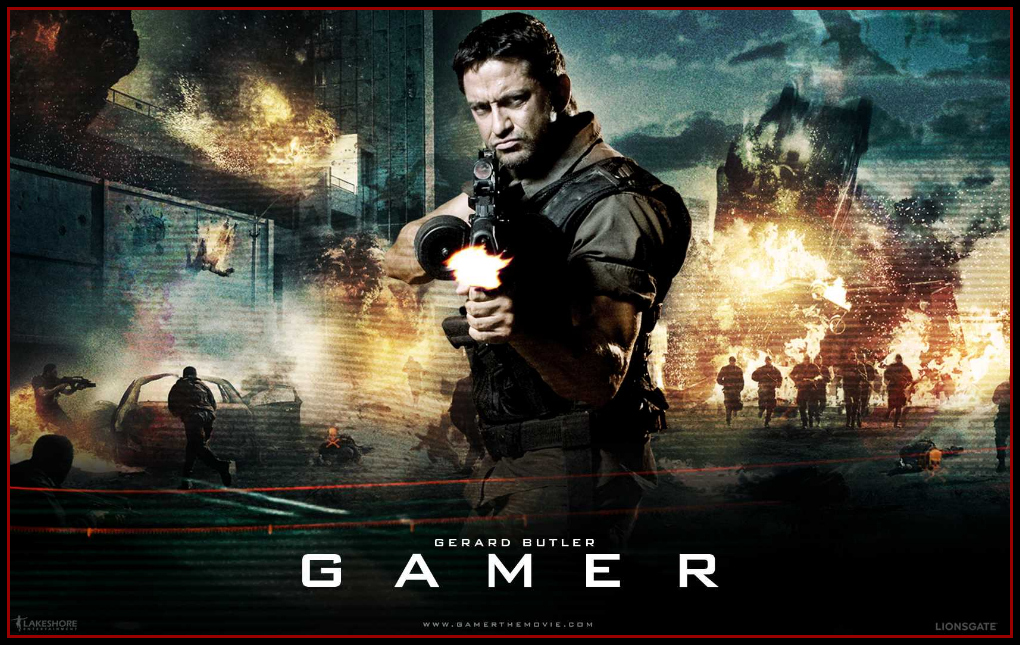
Review: Gamer (dir. by Neveldine/Taylor)


No one will ever mistake the writer-director duo of Neveldine/Taylor (Mark Neveldine and Brian Taylor) as the next Coen Brothers, but they definitely have made their mark in creating entertaining films which some have called exploitative, pandering to the lowest common denominator and exercises in excess. Maybe these critics are right, but they also seem to view the films by these two filmmakers through the narrow-minded lens of their elistist and so-called cineaste sensibilities. They won’t be the next Coen Brothers but they’re way ahead of other so-called filmmaker duos such as The Spierig Brothers (Undead and the pretentious and awful Daybreakers) or The Strause Brothers (AvP: Requiem and the awful Skyline). They came onto the scene with their cult classic action thrillers Crank and it’s sequel, Crank: High Voltage.

Their third film took the gaming influences so inherent in their first two films (which for all intents and purpose were video games that happened to be film) and went the next step. Gamer is all about a near-future world where two games with on-line social media foundations have become the rage of the entertainment world. One is a game called “Society” that looks to be the nightmare evolution of privacy advocates everywhere to the on-line virtual world Second Life and The Sims. It is the other game in this film which makes up the foundation of the film’s plot. “Slayers” takes the ultra-popular multiplayer on-line experiences of games such as Call of Duty and HALO to the next level by allowing gamers to actually control real people (inmates sentenced to death) to act as their avatars in a real-life battlefield arena with real weapons and real deaths.

These games which have become the obsession of hundreds of millions of people worldwide are the brainchild of the film’s antagonist. Michael C. Hall plays the creator of these games and his performance looks to combine the sociopathic charm of his Dexter character with that of Steve Jobs is the latter was openly honest about his douchebag tendencies. Playing his opposite is the character of Kable who happens to be the reigning champion of the game Slayers and who knows a secret that could tear down the billion-dollar empire created by Castle. Gerard Butler plays the desperate but very capable inmate Kable who just wants to survive past the final match and earn his freedom thus return to his wife and young daughter on the outside.

Gamer posits the question of how far are we willing to go to experience realism in our games and entertainment. With the game Society people pay to be able to control other people in a social setting (albeit in a controlled area). These so-called avatars will do anything and everything their real-life controllers tell them to do. In the film these avatars get paid to become virtual slaves and with most people signing up for the job being the socially desperate. Their situation is not so dissimilar from the condemned inmates who populate the game Slayers. The film hits the audience with a sledgehammer that these virtual entertainments have become popular worldwide because people have stopped looking at these “volunteers” as real people. Morality has been replaced by the need for instant gratification by way of these virtual on-line systems.

The film doesn’t make any apologies for the heavyhanded delivery of it’s message and also doesn’t skimp on the entertainment side of the equation. Neveldine/Taylor have shown that they have a certain flair for creating visual chaos and action on the screen. Their unique visual style does look like something out of a video game especially those from hyperrealistic shooters such as Call of Duty and its ilk. The filmmakers have always accomplished the high-quality visual look of their films despite the low to modest budget given to them by the studios they’re working for. Gamer is no exception and the film benefits from the decision by these two filmmakers to continue working with the Red One digital cameras thus allowing them to add in the visual effects right into the shot scenes the very same day of shooting.

It’s this very style of hi-tech guerrilla filmmaking which makes Neveldine/Taylor this current era’s Cormans. Unlike most low-budget filmmakers they don’t use the size of their budget to dictate how their films turn out visually, aurally and narratively. The first two this film succeeds in ways that makes an audience think the film was higher budgeted than it really was. The third would depend on the viewer whether the film succeeds or not. For those who seem intent on viewing every film as if they were made to be worthy of high awards and accolades would probably dismiss and hate this piece of exploitation cinema. Gamer succeeds in a narrative sense because it delivers on the promise of telling a story about a world where free will has been seconded to control in the need of a population in search of a the next virtual playground. It’s a heady premise that has been explored in past films such as the Matrix Trilogy and another film similar to this one which came out weeks later in Surrogates.

Gamer doesn’t have the philosophical and existential sermoning in combination with futuristic action sequences as the Wachowski Brothers’ trilogy, but it does have the same visceral action DNa as those three films and also more entertaining than the Bruce Willis vehicle Surrogates. This film will appeal to the very people who it condemns as sheep to the rising tide of on-line control in entertainment, but then that’s what all exploitation films tend to do best. Cater to the very people it uses as examples of what’s wrong in society and build an entertaining film around them and what they represent.

The film’s cast revolves around Gerard Butler and Michael C. Hall and the roles they play. Whether its Amber Valletta playing Kable’s desperate wife who has sold herself to become a controllable avatar in Society to try and earn enough to get her young daughter back or to Logan Lerman playing the role of Simon the gamer who controls Kable during the Slayer matches. They all do enough with their roles to keep their characters from becoming less than one-notes. Again, for some having a film with characters that are quite basic and one-note might make for a bad film, but when put into context of the story being told they’re quite good and needed to become motivators for Butler’s character.

In the end, Neveldine/Taylor have made a modern day exploitation and grindhouse film in Gamer without having to resort to the visual tricks used in the Rodriguez/Tarantino grindhouse homage film Grindhouse. A film doesn’t need to have film scratches, overexposed film stock, scratchy audio track or missing film reels to be grindhouse. It just have to espouse the very nature of the films which made up the kind of films which became prime example of grindhouse/exploitation cinema. Gamer won’t win any awards, but I suspect that more people who saw it were entertained by it’s blatant, in-your-face entertainment than would normally admit to it. It’s a film that has cult status and guilty pleasure written all over it.

Plus, this film is definitely worth at least a curiosity viewing if just to see the musical number performed by Michael C. Hall at the climactic sequence near the end of the film. I don’t think any film has ever combined gratuitous violence, musical dance numbers using bloodied death row inmates and Michael C. Hall singing Frank Sinatra’s “Ive Got You Under My Skin“. That sequence alone is worth a rental or Netflix Instant streaming.