
1989’s The Phantom of the Opera opens in what was then-modern day Manhattan.
Christine Day (Jill Schoelen) is a young opera singer who is searching for the perfect audition piece. Her friend, Meg (Molly Shannon), suggests that she use an obscure opera piece called Don Juan Triumphant. The opera was written by Erik Destler, a mysterious composer who was accused of murdering several opera singers in the 1800s. That morbid fact only makes Christine all the more convinced that she should use the piece in her audition and you know what? I would probably feel the same way. If nothing else, it would certainly appeal to my subversive side.
Even after Christine imagines seeing blood seeping off the pages of the opera, she remains committed to auditioning with it. Unfortunately, at the audition, a sandbag falls on her head. She’s knocked unconscious and, when she wakes up, she finds herself in 1885 London. She’s an understudy for a diva named La Carlotta (Sharon Lawrence). Carlotta has skill and technique but her singing lacks emotion. She hits each note perfectly but she brings no deeper meaning to her performances. Christine may lack Carlotta’s polish but she sings with emotion. For that reason, Carlotta is jealous of Christine. Meanwhile, Erik Destler (Robert Englund), who lives in the sewers of London’s opera house and who wears a mask over his disfigured face, feels that Christine is the only one who can do his work justice and he’s willing to go to any length to make sure that she’s the one who performs on stage.
At the time he made The Phantom of the Opera, Robert Englund was still regularly playing Freddy Krueger. The film’s version of Erik Destler does owe a bit to Krueger. Erik is as ruthless as Freddy, he’s good with a quip, he’s just as willing to kill, and, needless to say, he also has a face that will haunt your nightmares. That said, Erik is also a creative artist, which is something that Freddy never was. If Freddy was motivated by revenge, Erik is motivated by a desire to see his work come to life the way that he’s always imagined it. Erik murders to help Christine (regardless of whether or not Chrsitine actually wants the help) whereas Freddy killed because he enjoyed it. Englund gives a good performance as Erik, occasionally playing the role with the type of broadness that is to expected from a B-horror film but also still offering hints of the artist that Erik once was. Englund is well-matched with Jill Schoelen, who brings a likable energy to Christine.
Produced by Menahem Golan and Harry Alan Towers, The Phantom of the Opera is an entertaining B-movie, one that is obviously not meant to be taken too seriously. Director Dwight H. Little keeps the action moving at a steady pace, the sets and the costumes are to die for, the kills are unapologetically bloody, and the film even manages to put an interesting twist on the whole “it was all dream!” thing. The Phantom of the Opera is an enjoyably macabre showcase for two of the best horror performers of the 80s and 90s, Jill Schoelen and Robert Englund.
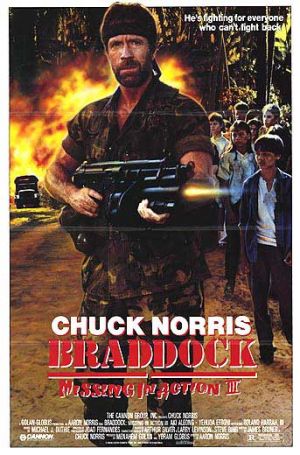 Chuck Fucking Norris, dude. Chuck Norris is so cool that continuity bends to his will and thanks him for the opportunity.
