Alone In The Neon Jungle takes place in a Pittsburgh police precinct that is supposedly so crime-ridden that it is called The Sewer. After two cops are arrested while committing a burglary, the Chief of Police (Danny Aiello) sends tough Captain Jane Hamilton (Suzanne Pleshette) to take over the precinct. Her mission? To enforce discipline and root out police corruption!
There’s a lot of corruption to root out. Crime boss Nahid (Tony Shalhoub) has half the precinct on his payroll and corrupt cops like Brad Stafowski (Jon Polito) are quick to to drag new transfers, like Todd Hansen (Jon Tennery), into the rackets. Along with enforcing the dress code and cleaning up the streets, Jane also has to figure out who is responsible for the murder of one of her sergeants.
This made for TV movie was probably meant to be a pilot for a weekly television series. It just has the sort of feel to it. It features just about every cop cliche imaginable, from the weary detective who comes to respect the new boss to the crime lord who claims to be a respectable businessman. The main problem is that the precinct never seems as bad as its described. For a place called The Sewer, the streets are surprisingly clean. The majority of the crimes committed seem to be burglary and prostitution. If you’re a cop and that’s all you have to deal with in a big city like Pittsburgh, count yourself lucky. The precinct never lives up to the title “Neon Jungle” and no one’s ever alone in it.
Suzanne Pleshette does a good enough job in the lead role. By this point in her career, Pleshette’s voice was as deep as the voice of the toughest patrolman around. It worked for her.
I first found out about the 1976 made-for-tv movie The Tenth Level while I was doing some research on the Milgram experiment. The Milgram experiment was a psychological experiment that was conducted, under the direction of Prof. Stanley Milgram, in 1961. Two test subjects were placed in two separate room. One test subject was known as the “Learner” and he was hooked up to a machine that could deliver electric shocks. The other subject was the “Teacher.” His job was to ask the Lerner questions and, whenever the Learner gave an incorrect answer, the Teacher was supposed to correct the error by pushing a button and delivering the electric shock. With each incorrect answer, the shock would get worse.
Of course, what the Teacher did not know was that the Lerner was an associate of Prof. Milgram’s and that pushing the button did not actually deliver a shock. The Lerner would intentionally give wrong answers and, after the Teacher pushed each subsequent button, the Lerner would groan in pain and eventually beg the Teacher to stop. The test was to see how long the Teacher would continue to push the buttons.
The study found that 65% of the Teachers, even when the Lerner stopped responding, continued to push the buttons until delivering the experiment’s final 450-volt shock. It was a surprising result, one that is often cited as proof that ordinary people will do terrible things if they’re ordered to do so by an authority figure.
The Tenth Level is loosely based on the Milgram experiment. Prof. Stephen Turner (William Shatner) is a psychology professor who conducts a similar experiment. Turner claims that he’s looking for insight into the nature of blind obedience but some of his colleagues are skeptical. His best friend (Ossie Davis) thinks that Turner is mostly trying to deal with the guilt of being a WASP who has never had to deal with discrimination. His ex-wife, Barbara (Lynn Carlin), thinks that the experiment is cruel and could potentially traumatize anyone who takes part in it. Turner, meanwhile, is fascinated by how random people react to being ordered to essentially murder someone.
Eventually, a good-natured carpenter/grad student, Dahlquist (Stephen Macht), volunteers. At first, Turner refuses to allow Dahlquist to take part because he’s previously met Dahlquist and Dahlquist is a friend of one of Tuner’s assistants. However, Dahlquist literally begs to be allowed to take part in the experiment and Turner relents.
Unfortunately, the pressure of administering shocks proves to be too much for Dahlquist and he has a 70s style freak-out, which essentially means that the screen changes colors and everything moves in slow motion as he smashes up the room. As a result of Dalquist’s violent reaction, Turner is called before a disciplinary committee and basically put on trial.
The Tenth Level is an interesting film. On the one hand, the subject matter is fascinating and, if nothing else, the film deserves some credit for trying to seriously explore the ethics of psychological experimentation. On the other hand, this is a film from 1976 that features William Shatner giving numerous monologues about the nature of man. And, let us not forget, this is William Shatner before he apparently developed a sense of humor about himself. That means that, in this film, we get the Shatner that inspired a thousand impersonations. We get the Shatner who speaks precisely and who enunciates every single syllable. And let’s not forget that Shatner is paired up with Ossie Davis, an actor who was never exactly subtle himself.
The end result is a film that is both thought-provoking and undeniably silly. This is a film that will make you think even while it inspires you to be totally snarky.
(Also of note, John Travolta supposedly makes his film debut in the Tenth Level. Apparently, he plays a student. I have yet to spot him.)
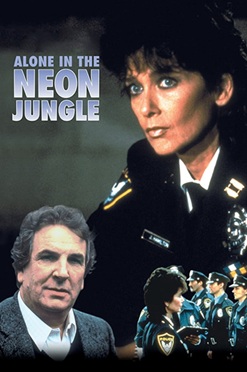 Alone In The Neon Jungle takes place in a Pittsburgh police precinct that is supposedly so crime-ridden that it is called The Sewer. After two cops are arrested while committing a burglary, the Chief of Police (Danny Aiello) sends tough Captain Jane Hamilton (Suzanne Pleshette) to take over the precinct. Her mission? To enforce discipline and root out police corruption!

