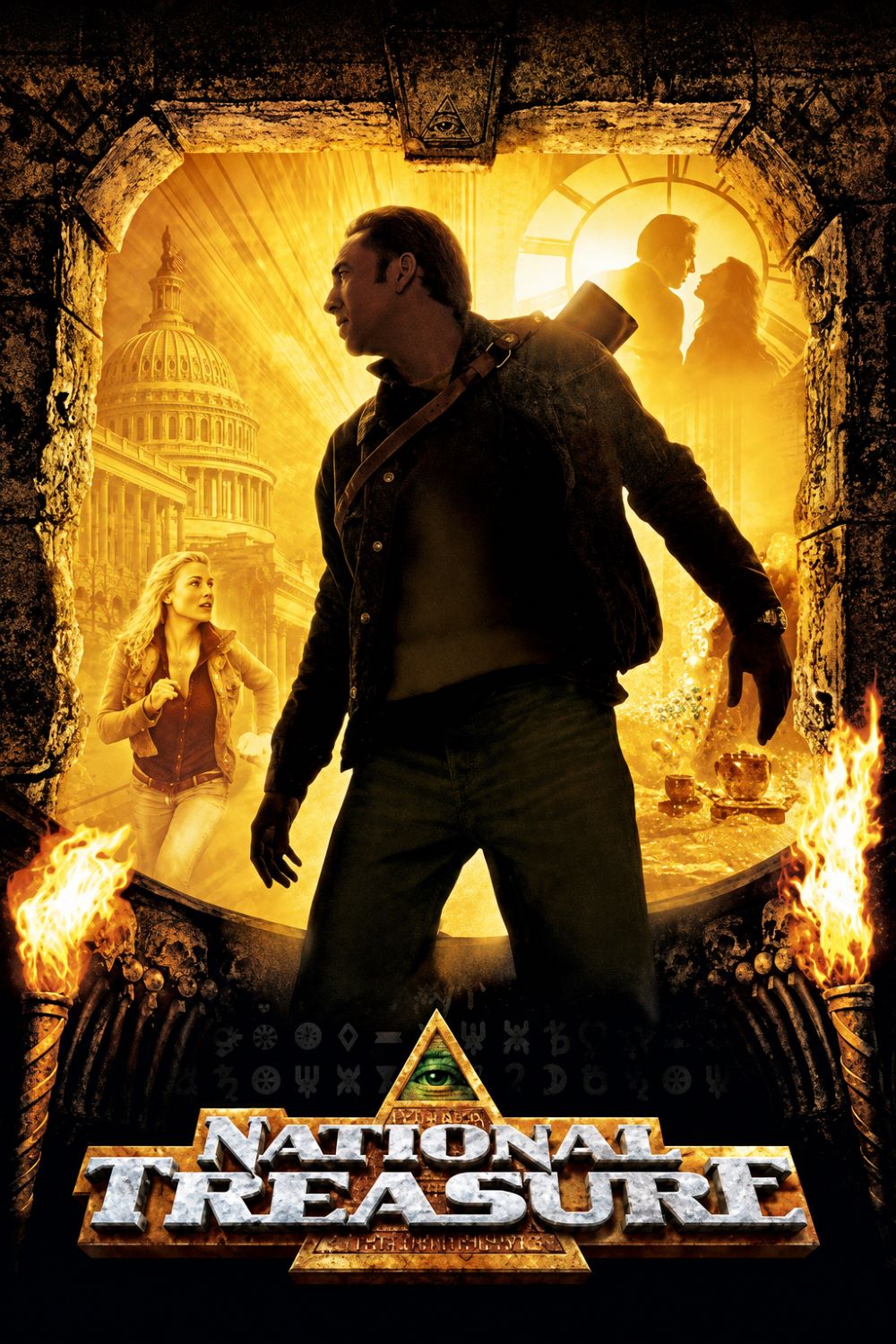
Review: National Treasure (dir. by John Turteltaub)


“If there’s something wrong, those who have the ability to take action have the responsibility to take action.” — Benjamin Gates

National Treasure directed by John Turteltaub is one of those movies that feels like a love letter to adventure, history, and a bit of old-fashioned treasure hunting. It’s the kind of film that doesn’t take itself too seriously but still manages to pull you in with its charm, puzzles, and non-stop action. At its heart, it’s a story about obsession, legacy, and the idea that history isn’t just something you read about in books—it’s something you can touch, chase, and maybe even uncover if you’re clever enough.

The movie kicks off with Benjamin Franklin Gates, played by Nicolas Cage in one of his most Nicolas Cage roles, as a historian and amateur treasure hunter convinced that a massive treasure hidden by the Freemasons and the Founding Fathers is real. The idea is wild: a secret stash of gold, artifacts, and historical riches hidden away to keep them out of the wrong hands. Most people, including his own father, think he’s nuts. But Ben’s got a lead, and when a rival treasure hunter, Ian Howe (played by Sean Bean), starts closing in on the same clues, the race is on. The stakes get higher when Ben realizes that if Howe finds the treasure first, it could mean disaster—not just for Ben’s reputation, but for history itself.

What makes National Treasure so much fun is how it blends history with a modern-day adventure. The film takes real historical figures and events—like the Declaration of Independence, the Liberty Bell, and the National Archives—and weaves them into a fictional but plausible treasure hunt. It’s the kind of movie that makes you want to dust off your old history textbooks or visit a museum the next day. The puzzles and clues are clever, even if they’re a little far-fetched. From invisible ink on the back of the Declaration to a series of riddles leading to the next location, the film keeps you guessing and engaged. And let’s be honest, who hasn’t daydreamed about finding a hidden message in a famous document or stumbling upon a secret that changes everything?

You really cannot talk about National Treasure without talking about Nicolas Cage. By 2004, Cage had already firmly established his reputation as an actor who brings a very specific, slightly unhinged energy to every role, and Benjamin Franklin Gates might be the perfect vessel for that energy. Ben is a nerd, but he is a nerd who somehow knows how to do parkour and execute complex heists. Cage plays him with this weird, endearing earnestness that anchors the movie. He delivers ridiculous lines about the Illuminati and secret tunnels with the gravity of a Shakespearean monologue, and it is hilarious, but it also makes you genuinely root for him. He never winks at the audience; he truly believes in the treasure, and that conviction pulls the whole thing together.

Of course, Cage cannot carry the entire movie on his own, and the supporting cast is surprisingly well-calibrated for this kind of ridiculous adventure. Justin Bartha plays Riley Poole, Ben’s tech-savvy sidekick who provides a running commentary of sarcastic quips. Bartha is essentially the audience surrogate, constantly pointing out how insane everything is, but he never gets annoying, which is a tough balancing act for a comic relief character in an action movie. Then there is Diane Kruger as Abigail Chase, an archivist at the National Archives who gets dragged into the chaos. Kruger does a great job of playing the exasperated straight woman to Cage’s eccentric history buff, and their chemistry is surprisingly charming, even if her character arc basically boils down to realizing that stealing national monuments is actually kind of fun.

On the villain side of things, we have Sean Bean as Ian Howe, and honestly, casting Sean Bean as a treasure-hunting bad guy is just a cheat code for making your movie better. Howe is a classic blockbuster villain—polished, ruthless, and driven entirely by greed—but Bean gives him just enough suave charm that he feels like a genuine threat rather than a cartoonish punching bag. Rounding out the main cast is Jon Voight as Ben’s estranged father, Patrick, and Christopher Plummer as his grandfather, John. Their inclusion adds a nice generational family drama to the story. The Gates family has been mocked for centuries for chasing this mythical treasure, and seeing Ben finally prove his father wrong adds a surprising amount of emotional weight to a movie that is otherwise about stealing the Declaration of Independence with a bunch of plastic ciphers.

John Turteltaub’s direction keeps the movie moving at a brisk pace. There’s never a dull moment, and the film balances its action sequences with quieter moments of discovery and problem-solving. The chase scenes, whether it’s through the streets of Washington D.C. or the tunnels beneath Philadelphia, are exciting without being over-the-top. The film also does a great job of making the historical elements feel tangible. When Ben and his team are examining a clue or piecing together a puzzle, you feel like you’re right there with them, trying to figure it out alongside them. It’s a testament to Turteltaub’s ability to make the implausible feel plausible, at least for the two hours you’re watching the movie.

Of course, National Treasure isn’t without its flaws. The plot does require a fair amount of suspension of disbelief. The idea that a treasure of this magnitude could stay hidden for centuries, or that Ben could outsmart everyone from the FBI to a team of professional thieves, is a stretch. And some of the historical liberties the film takes might make purists cringe. But that’s part of the fun. This isn’t a documentary—it’s a popcorn movie, and it embraces that wholeheartedly. The film also leans heavily on its twists and turns, some of which you might see coming a mile away. But even when you can predict what’s going to happen next, it’s still entertaining to watch it unfold.

What really stands out about National Treasure is its sense of wonder. It’s a movie that reminds you of the joy of discovery, whether it’s uncovering a hidden clue or simply learning something new about the world. The film’s climax, set in a secret underground chamber, is a perfect example of this. Without giving too much away, it’s a moment that feels both epic and intimate, a payoff for all the hard work and dedication Ben has put into his quest. And while the treasure itself might not be what you expect, the journey to find it is what makes the movie so satisfying.

In the end, National Treasure is a film that’s easy to enjoy. It’s got action, humor, history, and heart, all wrapped up in a package that’s as entertaining as it is lighthearted. It’s the kind of movie you can watch on a lazy Sunday afternoon and come away from feeling like you’ve been on an adventure yourself. Sure, it might not be high art, but it doesn’t need to be. Sometimes, a great story, a little bit of mystery, and a lot of fun are all you need. And National Treasure delivers on all three. If you’re a fan of adventure films, history buffs, or just love a good treasure hunt, this one’s for you. Just don’t be surprised if you find yourself Googling Freemason symbols or the history of the Declaration of Independence afterward.

Here’s What Won At Cannes!


Here’s what won at this year’s Cannes Film Festival!  As always, the list is full of intrigue and surprises.

Also, as always, it’s debatable whether any of this will actually effect that Oscar race.  To be honest, other than The Tree of Life, it’s hard to think of any recent Oscar nominee that was undeniably helped by a victory at Cannes.  During the Festival, both Robert Pattinson and Adam Sandler (yes, Adam Sandler) started to receive some Oscar buzz but neither of them — nor their films, Good Time or The Meyerowitz Stories — were honored.

(As enjoyably weird as it would be for Adam Sandler to become an Oscar nominee, I imagine The Meyerowitz Stories will be ignored come Oscar time because it’s a Netflix film.  If the Academy couldn’t even give one nomination to the previous Netflix contender — the powerful and important Beasts of No Nation — I doubt that they’re going to surrender their bias for a film starring Adam Sandler and Ben Stiller.)

That said, I am very, very happy to see that one of my favorite artists, Sofia Coppola, was honored!  I can’t wait to see The Beguiled!

Here’s the winners:

2017 Main Competition winners: 

Palme d’Or: The Square (Ruben Ostlund)
Gran Prix: “BPM (Beats Per Minute)” (Robin Campillo)
Jury Prize: “Loveless” (Andrey Zvyagintsev)
Best Director: Sofia Coppola — The Beguiled
Best Actor: Joaquin Phoenix — You Were Never Really Here
Best Actress: Diane Kruger — In The Fade
Best Screenplay: “The Killing of a Sacred Deer” (Yorgos Lanthimos, Efthimis Filippou) and “You Were Never Really Here” (Lynne Ramsay)

OTHER PRIZES

Camera d’Or: “Jeune femme” (Montparnasse-Bienvenüe) (Léonor Serraille)

Short Films Palme d’Or: “Xiao Cheng Er Yue” (Qiu Yang)

Short Films Special Mention: “Katto” (Teppo Airaksinen)

Golden Eye Documentary Prize: “Faces Places” (Visages Villages) (Agnès Varda, JR)

Ecumenical Jury Prize: “Radiance” (Naomi Kawase)

2017 Un Certain Regard winners: 

Un Certain Regard Prize: Mohammad Rasoulof – A Man of Integrity
Best Actress: 
Jasmine Trinca – Fortunata
Best Poetic Narrative:
 Mathieu Amalric – Barbara
Best Direction: 
Taylor Sheridan – Wind River
Jury Prize:
 Michel Franco – April’s Daughter

2017 International Critics Week winners:

Nespresso Grand Prize: Emmanuel Gras – Makala
France 4 Visionary Award: Fellipe Gamarano Barbosa – Gabriel and the Mountain
Leica Cine Discovery Prize for Short Film: Laura Ferrés – Los Desheredados
Gan Foundation Support for Distribution Award: Fellipe Gamarano Barbosa – Gabriel and the Mountain
SACD Award: Léa Mysius – Ava
Canal+ Award: Aleksandra Terpińska – The Best Fireworks

2017 Director’s Fortnight winners:

Art Cinema Award: Chloé Zhao – The Rider
SACD Award: Claire Denis – Let the Sunshine In, Philippe Garrel – Lover for a Day
Europa Cinemas Label Award: Jonas Carpignano – A Ciambra
Illy Prize for Short Film: Benoit Grimalt – Back to Genoa City

Review: Unknown (dir. by Jaume Collet-Serra)


In 2009 Liam Neeson began a new phase of his career as an actor. Before 2009 he was always put into roles as the father figure and mentor to a younger protagonist. He did quite well in handling these roles. Most of the time he was the only good thing about the films he was in and it was due to how he handled the supporting role given to him. But 2009 changed everything as Liam Neeson arrived on the film scene as a bonafide action hero in his role as a former CIA Special Activities Division operative in the action-thriller, Taken. That film surprised many and Neeson’s badass portrayal of a father out to save his daughter opened the eyes of many filmgoers who always saw him as the calm, wise elder. He has taken on the mantle of older, action-hero characters from Harrison Ford who lived off and became rich doing roles such as the one in Taken.

Two years later we have another film where we get to see Liam Neeson in another role which cements his place in the action-hero pantheon. Also like Pierre Morel’s film, this one takes place in Europe and directed by another European filmmaker trying to make a name for himself in Hollywood, Jaume Collet-Serra. It would be disingenious to say that Collet-Serra had it in him to direct a film as tight and fast-moving as Unknown. His two Hollywood productions were the remake of the classic horror film, House of Wax, and the underappreciated horror film from 2009, Orphan. With this new action-thriller, Unknown, Collet-Serra and Neeson create a film which owes much of its film dna to Hitchcock and his mistaken-man classic, North by Northwest. I would also say that this film also owes much of its action and characters to one of the early 1990’s best sci-fi action films, Paul Verhoeven’s Total Recall.

The film begins with Neeson’s character, Dr. Martin Harris, and his wife Liz (played by Mad Men‘s January Jones) arriving in Berlin to attend a biomedical conference. Right from the start Neeson makes us believe in Harris being an everyman. The good professor doesn’t seem the alpha male-type. But after certain seemingly random circumstances and events puts Harris in a coma for four days we begin to see signs and glimpses that Neeson’s character may have more to him than meets the eye.

It’s when Harris’ awakens from his coma that the meat of the film’s story begins. We know going in that Neeson’s character knows he’s not crazy and that someone out there has made things appear as if he is becoming insane. Maybe the accident in the beginning of the film have given us a false perspective on the film. What we might be seeing could be a manifestation of Harris’ mental breakdown from the accident and subsequent coma. But little clues in the film’s dialogue keeps things vague, but not so much that our initial stance that Harris’ is being manipulated won’t be the final endgame.

It is the endgame in the film which may make or break the whole production for some people. The screenplay by Oliver Butcher and Stephen Cromwell is not the strongest out there and it tries to be too complex with its red herrings when trying to keep it simple would’ve sufficed. One could almost sense that the two writers were trying to be too Hitchcock that they lost sight of how Hitchcock’s films were simple affairs which only appeared to be complex. Yet, despite some necessary leaps of logic that audiences needed to make to continue believing in the film, Unknown manages to keep the core story moving forward to it’s inevitable conclusion.

The performances by everyone involved is what keeps this film from spiralling out of Collet-Serra’s capable hands. One would almost certainly point out the strong work by Neeson as the Harris. January Jones’ Liz Harris, at first, seemed like an extension of her Betty Draper character from Mad Men, but as the story moves forward we get to see more layers of personalities in her character to make her interesting beyond the dutiful and supportive wife. But the standout performance outside of Neeson has to go to Diane Kruger as Gina, the taxi driver who was involved in Neeson’s character getting in his accident in the beginning of the film.

Kruger arguably is one of Hollywood’s classic beauty, but she has an ability to actually keep that beauty in check with her acting that we believe her to be the “everywoman” in some of the roles she plays. Beauty doesn’t come into the Gina character’s personality. Kruger does a great job of playing the pawn in a much larger game being played on Neeson’s character. Her reluctance to help him gradually crumbles as she soon realizes that her own safety and survival is now inextricably linked to unraveling the mystery of who Martin Harris really is.

Unknown is one of those films that actually has an advantage being released in the so-called dead season which runs from January and into March. It’s a film season when studios put out films they have no faith in being a major blockbuster which means summer and Holiday season release are out. It’s not prestigious enough to be put out in the Fall and early Winter. But as a piece os well-done escapist fare it’s perfect for this so-called dead season. Jaume Collet-Serra has shown that even when working from an average screenplay he knows how to get the best out of his cast to sell the film to the audience. He also has a firm grasped on pacing and how to handle action sequences.

In the end, the film still loves or dies by how the audience reacts to Liam Neeson’s character. While his Martin Harris is not the Bryan Mills from Taken, by the time the final scene fades to black we begin to see how similar the two characters really are and how much they share. Until the big name films start dropping in beginning in March (blockbuster season seem to come earlier and earlier with each passing year), Unknown is one of those films that should help make this early months of the film season more entertaining than it usually is in year’s past.

As an aside, for those who know their films would understand why I say that, in addition to this film having aspirations of being Hitchcockian, Unknown definitely borrows or has been influenced by some of the story and character developments of Verhoeven’s Total Recall. I almost half-expected for a half-mutant seer named Kuato to make an appearance to explain it all to Neeson’s ccharacter.