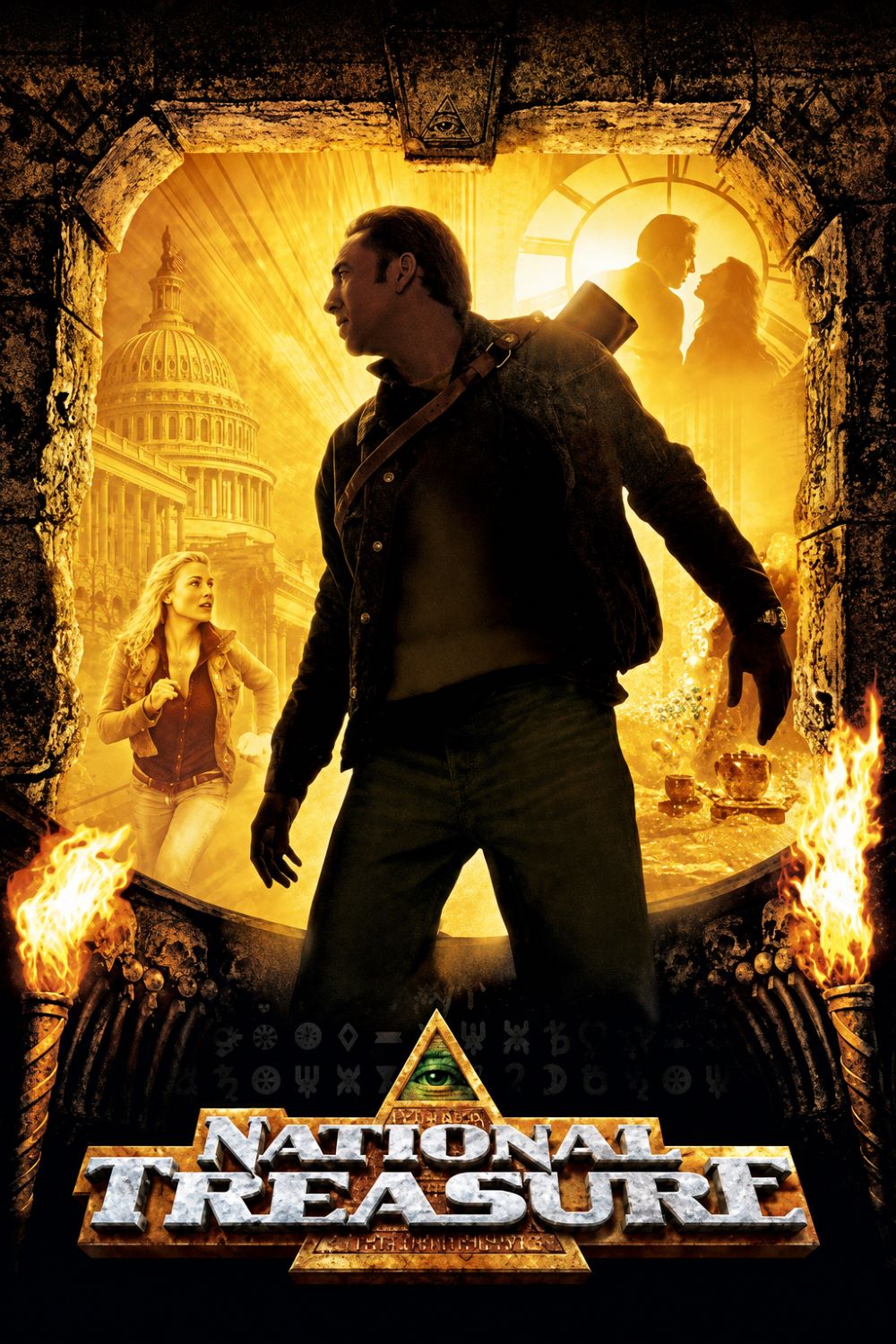
Review: National Treasure (dir. by John Turteltaub)


“If there’s something wrong, those who have the ability to take action have the responsibility to take action.” — Benjamin Gates

National Treasure directed by John Turteltaub is one of those movies that feels like a love letter to adventure, history, and a bit of old-fashioned treasure hunting. It’s the kind of film that doesn’t take itself too seriously but still manages to pull you in with its charm, puzzles, and non-stop action. At its heart, it’s a story about obsession, legacy, and the idea that history isn’t just something you read about in books—it’s something you can touch, chase, and maybe even uncover if you’re clever enough.

The movie kicks off with Benjamin Franklin Gates, played by Nicolas Cage in one of his most Nicolas Cage roles, as a historian and amateur treasure hunter convinced that a massive treasure hidden by the Freemasons and the Founding Fathers is real. The idea is wild: a secret stash of gold, artifacts, and historical riches hidden away to keep them out of the wrong hands. Most people, including his own father, think he’s nuts. But Ben’s got a lead, and when a rival treasure hunter, Ian Howe (played by Sean Bean), starts closing in on the same clues, the race is on. The stakes get higher when Ben realizes that if Howe finds the treasure first, it could mean disaster—not just for Ben’s reputation, but for history itself.

What makes National Treasure so much fun is how it blends history with a modern-day adventure. The film takes real historical figures and events—like the Declaration of Independence, the Liberty Bell, and the National Archives—and weaves them into a fictional but plausible treasure hunt. It’s the kind of movie that makes you want to dust off your old history textbooks or visit a museum the next day. The puzzles and clues are clever, even if they’re a little far-fetched. From invisible ink on the back of the Declaration to a series of riddles leading to the next location, the film keeps you guessing and engaged. And let’s be honest, who hasn’t daydreamed about finding a hidden message in a famous document or stumbling upon a secret that changes everything?

You really cannot talk about National Treasure without talking about Nicolas Cage. By 2004, Cage had already firmly established his reputation as an actor who brings a very specific, slightly unhinged energy to every role, and Benjamin Franklin Gates might be the perfect vessel for that energy. Ben is a nerd, but he is a nerd who somehow knows how to do parkour and execute complex heists. Cage plays him with this weird, endearing earnestness that anchors the movie. He delivers ridiculous lines about the Illuminati and secret tunnels with the gravity of a Shakespearean monologue, and it is hilarious, but it also makes you genuinely root for him. He never winks at the audience; he truly believes in the treasure, and that conviction pulls the whole thing together.

Of course, Cage cannot carry the entire movie on his own, and the supporting cast is surprisingly well-calibrated for this kind of ridiculous adventure. Justin Bartha plays Riley Poole, Ben’s tech-savvy sidekick who provides a running commentary of sarcastic quips. Bartha is essentially the audience surrogate, constantly pointing out how insane everything is, but he never gets annoying, which is a tough balancing act for a comic relief character in an action movie. Then there is Diane Kruger as Abigail Chase, an archivist at the National Archives who gets dragged into the chaos. Kruger does a great job of playing the exasperated straight woman to Cage’s eccentric history buff, and their chemistry is surprisingly charming, even if her character arc basically boils down to realizing that stealing national monuments is actually kind of fun.

On the villain side of things, we have Sean Bean as Ian Howe, and honestly, casting Sean Bean as a treasure-hunting bad guy is just a cheat code for making your movie better. Howe is a classic blockbuster villain—polished, ruthless, and driven entirely by greed—but Bean gives him just enough suave charm that he feels like a genuine threat rather than a cartoonish punching bag. Rounding out the main cast is Jon Voight as Ben’s estranged father, Patrick, and Christopher Plummer as his grandfather, John. Their inclusion adds a nice generational family drama to the story. The Gates family has been mocked for centuries for chasing this mythical treasure, and seeing Ben finally prove his father wrong adds a surprising amount of emotional weight to a movie that is otherwise about stealing the Declaration of Independence with a bunch of plastic ciphers.

John Turteltaub’s direction keeps the movie moving at a brisk pace. There’s never a dull moment, and the film balances its action sequences with quieter moments of discovery and problem-solving. The chase scenes, whether it’s through the streets of Washington D.C. or the tunnels beneath Philadelphia, are exciting without being over-the-top. The film also does a great job of making the historical elements feel tangible. When Ben and his team are examining a clue or piecing together a puzzle, you feel like you’re right there with them, trying to figure it out alongside them. It’s a testament to Turteltaub’s ability to make the implausible feel plausible, at least for the two hours you’re watching the movie.

Of course, National Treasure isn’t without its flaws. The plot does require a fair amount of suspension of disbelief. The idea that a treasure of this magnitude could stay hidden for centuries, or that Ben could outsmart everyone from the FBI to a team of professional thieves, is a stretch. And some of the historical liberties the film takes might make purists cringe. But that’s part of the fun. This isn’t a documentary—it’s a popcorn movie, and it embraces that wholeheartedly. The film also leans heavily on its twists and turns, some of which you might see coming a mile away. But even when you can predict what’s going to happen next, it’s still entertaining to watch it unfold.

What really stands out about National Treasure is its sense of wonder. It’s a movie that reminds you of the joy of discovery, whether it’s uncovering a hidden clue or simply learning something new about the world. The film’s climax, set in a secret underground chamber, is a perfect example of this. Without giving too much away, it’s a moment that feels both epic and intimate, a payoff for all the hard work and dedication Ben has put into his quest. And while the treasure itself might not be what you expect, the journey to find it is what makes the movie so satisfying.

In the end, National Treasure is a film that’s easy to enjoy. It’s got action, humor, history, and heart, all wrapped up in a package that’s as entertaining as it is lighthearted. It’s the kind of movie you can watch on a lazy Sunday afternoon and come away from feeling like you’ve been on an adventure yourself. Sure, it might not be high art, but it doesn’t need to be. Sometimes, a great story, a little bit of mystery, and a lot of fun are all you need. And National Treasure delivers on all three. If you’re a fan of adventure films, history buffs, or just love a good treasure hunt, this one’s for you. Just don’t be surprised if you find yourself Googling Freemason symbols or the history of the Declaration of Independence afterward.
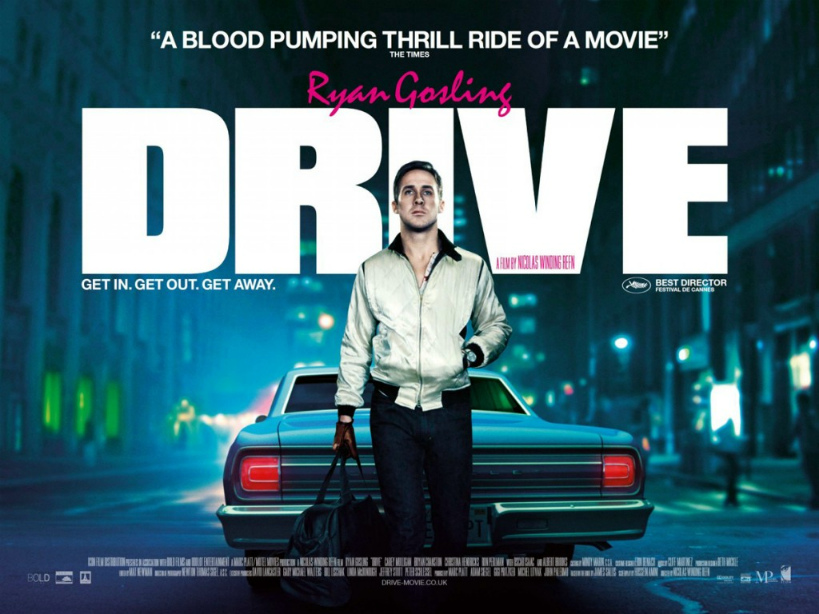
Review: Drive (dir. by Nicolas Winding Refn)


Danish filmmaker Nicolas Winding Refn has made just a handful of films with most staying under the radar of most of the general film-going public. He first caught the attention of indie film fans with his Pusher Trilogy over in Denmark, but he really caught the attention of these fans with his explosive collaboration with Tom Hardy on the Bronson biopic. He would follow that film with the violent existentialist Viking film Valhalla Rising. It would take another major collaboration with another rising star in Ryan Gosling for Winding Refn to finally have his major breakout film which has caught the attention of not just the indie film fans and cineaste crowd, but the general public at-large.

Drive was first screened over at this year’s 2011 Cannes Film Festival where it premiered “in competition” for the Palme d’Or. While the film didn’t win the top prize for best film at Cannes it didn’t garner Nicolas Winding Refn “Best Director” award and his work on this film more than merits such an accolade. The film would begin to screen at other major film festivals before landing at the Toronto International Film Festival before making it’s major public release in North America. Everywhere the film went the consensus reaction to the film has ranged from positive to calls for the film as one of 2011’s best.

So, it would seem most everyone has been quite positive with their reaction to Refn’s Drive. Is this film just another indie arthouse title which the elitist film fans have begun to hype up to levels that would border on cosmic? Or is this film actually as good as it has been talked up to be by such film fans and those of the general public who have seen it? I think the answer lies somewhere in-between.

Drive has been called an action-drama to crime-thriller to film noir and even an existentialist meditation of the film variety. Some have even called it a modern urban fairy tale from the many traditional tropes and themes inherent in fairy tales. The film actually seems to defy genre labels as it’s all those and even more. Nicolas Winding Refn has made a film with so much variety in its cinematic DNA from other classic films and storytelling styles that watching the film once is not enough to find them all.

The film makes a strong statement with it’s introduction of the character who remains nameless but could be called “The Driver” or “The Kid”. Ryan Gosling’s performance in this opening sequence will set the foundation for his character from beginning to end. His driver role is not much for chit-chat and unnecessary talking with those who have hired him to be their expert getaway driver. He’s meticulous with his equipment and intractable when it comes to the rules he has set down for his clients. He would be theirs for the five minutes they need him to drive them away from their criminal acts. Whatever they do before or after those five minutes doesn’t matter to him and he sticks to this rule explicitly. Another rule which he lays down is that he will not be carrying a firearm. These rules have had some audiences bring to mind Jason Statham’s Transporter character and they would not be totally wrong to say so. What Gosling’s driver has over Statham’s is the air of realism to the role. It’s a realism that borders on hyper-reality as the film moves on to it’s climactic conclusion, but real nonetheless. Gosling’s “driver” will not do extensive and elaborate fighting skills the way Statham’s would.

The film would move from it’s powerful introduction and into a much more calm and somewhat serene section as the nameless driver gradually gets to know his next door neighbor in the form of Irene as played by Carey Mulligan. Their relationship will form the core of the film’s narrative and it’s the driver’s growing affection not just for Irene but her young son that would dictate some of the decisions he would make right up to the end of the film. It’s a relationship built not on extensive dialogue banter but mostly on meaningful glances and silent understanding between two characters who seem to have found a kindred kinship between them. It’s this growing relationship between the two and Irene’s son which almost look like a familial unit forming until the return of Irene’s incarcerated and newly-released husband Standard. This is a character played by Oscar Isaac as a man desperate to take full advantage of his last chance at normalcy and redemption, but ultimately doomed to fail.

Standard doesn’t just become the only wrench in the happy life Gosling’s character seems to want to have with Irene and her son. Into the picture also happens to come in is his mentor and business partner Shannon (Bryan Cranston doing a great job as the good-natured, but opportunistic fool character many Shakespearean tragedies always seem to have) and Shannon’s even seedier acquaintances in Hollywood mogul-turned-mob boss Bernie Rose (Albert Brooks in a chilling performance) and his more boisterous, but not as smart partner in Nino (Ron Perlman).

The film seems to settle on the low gears for the first hour of the film, but it’s during a botched robbery attempt where the driver becomes embroiled in that Drive finally moves into the high gears and stays there until the very end. Refn’s decision to use the first hour to round out and build the characters in this film definitely pays off in the end. The audience becomes quite clear as to who the players are and what motivates them to do what they do the rest of the film. Even the most secondary and tertiary roles in this film has a part to play. Even Christina Hendricks in the role of a low-level moll to a gang of criminals gets to have her time to shine if just briefly.

Once the narrative shifts from character study to an almost Cronenbergian exercise in violence and brutality does the film finally able to hook in the last few audiences who may have still been iffy about Drive. Not to say that the final 45-minutes of the film was a non-stop action film, but it does move at a consistently higher gear pace than the first hour. We see the driver having to show to the audience that he’s not just an expert wheelman for Hollywood (stunt driver by day) and the criminal underground (getaway driver by night). It serves the film well that Gosling’s character has the barest minimum of lines of dialogue. We see all we need to know about this character through his behavior that brings to mind roles played by such past luminaries as Steve McQueen and Clint Eastwood.

Most likely it would be in the second half of the film that should satisfy the action junkies. While the action scenes are not of the Michael Bay-type they do show that Refn has a fine grasp of what makes an action scene thrilling. Whether the scene calls for some of the most well-done car chase on film since Frankenheimer showed everyone how to properly do it in Ronin or scenes of sudden brutal violence which calls to mind similar scenes from Cronenberg’s last two films (A History of Violence and Eastern Promises). Both types of action were done efficiently with little to no glamour to gloss over things. The burst of violence actually adds to the mystique of Gosling’s “Man With No Name” role. One particular scene in the apartment elevator where Gosling, Mulligan and a goon sent by the mob makes for one of the best scenes in the film and of 2011.

As much as these scenes of action and violence will be the ones to get the most attention from the general film-going public in the end it’s the excellent screenplay by Hossein Amini of the James Sallis’ novel of the same name which really holds everything together in conjunction with some top-notch performances from everyone involved. The film makes or breaks itself on Gosling’s performance as the driver and he delivers on all cylinders. His performance was quite reminiscent of past performances such as James Caan as Frank in Michael Mann’s Thief, Steve McQueen also as Frank in Bullitt, but in my opinion Gosling’s work in this film brings to mind young Clint Eastwood as “The Man With No Name” in Sergio Leone’s spaghetti western trilogy. Both characters were the type to let their actions speak for them and were both full of quiet confidence not to mention restrained violence which would erupt when needed.

Much has been said about Albert Brooks’ turn as the mob boss Bernie Rose. how the role was quite the 180-degrees from people’s perception of the actor who usually did comedic roles. I say that Albert Brooks always had a dark side to his comedic talent. I mean he was and is megamaniacal villain Hank Scorpio from The Simpsons. In all seriousness, Brooks’ as the mob boss was the other pillar which held all the other performances focused. In fact, Gosling’s character and Brook’s Bernie Rose could almost be considered mirror-images of each other. They were characters who had found their place in the world and the role they would play and didn’t struggle against it. Everyone else in the film struggled against their lot in life. It was also these characters who had the bulk of the film’s dialogue.

Drive has been hyped (for some overhyped) since it first premiered at this year’s Cannes Film Festival, but it’s one of those rare films which has more than earned and surpassed the hype which has preceded it’s general release to the general public. It’s a film which bucks traditional genre labels by combining the themes, ideas and foundations from many different film and storytelling genres. For fans of action there’s enough thrilling action to sate them. For those who are fans of film noir this film definitely carries within it the DNA set down by the film noir of the 40’s, 50’s and 60’s. For some who wish to watch a film which explore existential themes then Refn’s film has that too. In the end, Drive manages to be a film which caters to so many different audiences without ever pandering to them or dumbing the story down. It’s a film made by a filmmaker who continues to impress and who has made his best film to date.

Drive is a film that is not for everyone, but it’s also a film that everyone should see and experience at least once. It is also one of the year’s best films and, so far, my top film of 2011.