“If there’s something wrong, those who have the ability to take action have the responsibility to take action.” — Benjamin Gates
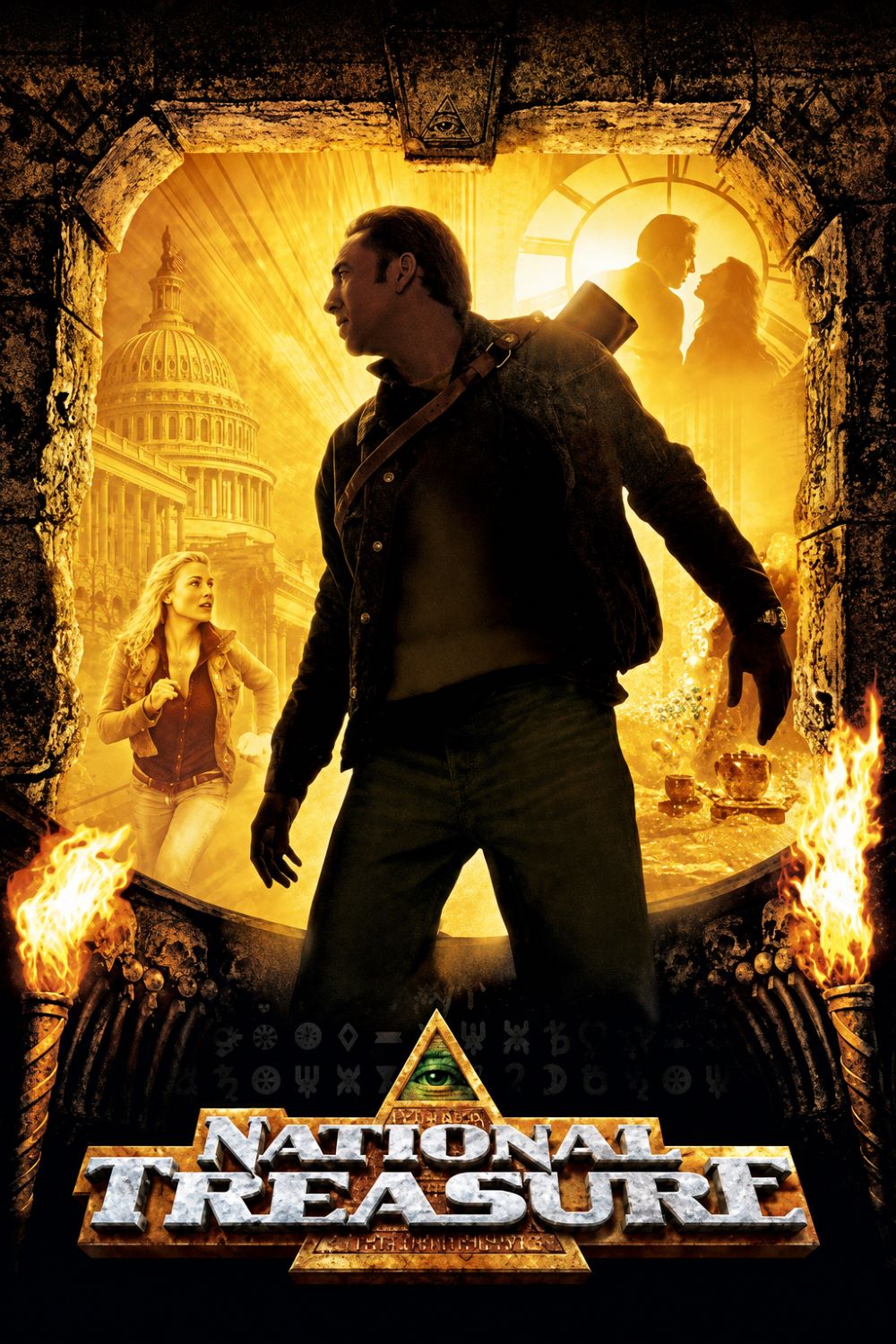
National Treasure directed by John Turteltaub is one of those movies that feels like a love letter to adventure, history, and a bit of old-fashioned treasure hunting. It’s the kind of film that doesn’t take itself too seriously but still manages to pull you in with its charm, puzzles, and non-stop action. At its heart, it’s a story about obsession, legacy, and the idea that history isn’t just something you read about in books—it’s something you can touch, chase, and maybe even uncover if you’re clever enough.
The movie kicks off with Benjamin Franklin Gates, played by Nicolas Cage in one of his most Nicolas Cage roles, as a historian and amateur treasure hunter convinced that a massive treasure hidden by the Freemasons and the Founding Fathers is real. The idea is wild: a secret stash of gold, artifacts, and historical riches hidden away to keep them out of the wrong hands. Most people, including his own father, think he’s nuts. But Ben’s got a lead, and when a rival treasure hunter, Ian Howe (played by Sean Bean), starts closing in on the same clues, the race is on. The stakes get higher when Ben realizes that if Howe finds the treasure first, it could mean disaster—not just for Ben’s reputation, but for history itself.
What makes National Treasure so much fun is how it blends history with a modern-day adventure. The film takes real historical figures and events—like the Declaration of Independence, the Liberty Bell, and the National Archives—and weaves them into a fictional but plausible treasure hunt. It’s the kind of movie that makes you want to dust off your old history textbooks or visit a museum the next day. The puzzles and clues are clever, even if they’re a little far-fetched. From invisible ink on the back of the Declaration to a series of riddles leading to the next location, the film keeps you guessing and engaged. And let’s be honest, who hasn’t daydreamed about finding a hidden message in a famous document or stumbling upon a secret that changes everything?
You really cannot talk about National Treasure without talking about Nicolas Cage. By 2004, Cage had already firmly established his reputation as an actor who brings a very specific, slightly unhinged energy to every role, and Benjamin Franklin Gates might be the perfect vessel for that energy. Ben is a nerd, but he is a nerd who somehow knows how to do parkour and execute complex heists. Cage plays him with this weird, endearing earnestness that anchors the movie. He delivers ridiculous lines about the Illuminati and secret tunnels with the gravity of a Shakespearean monologue, and it is hilarious, but it also makes you genuinely root for him. He never winks at the audience; he truly believes in the treasure, and that conviction pulls the whole thing together.
Of course, Cage cannot carry the entire movie on his own, and the supporting cast is surprisingly well-calibrated for this kind of ridiculous adventure. Justin Bartha plays Riley Poole, Ben’s tech-savvy sidekick who provides a running commentary of sarcastic quips. Bartha is essentially the audience surrogate, constantly pointing out how insane everything is, but he never gets annoying, which is a tough balancing act for a comic relief character in an action movie. Then there is Diane Kruger as Abigail Chase, an archivist at the National Archives who gets dragged into the chaos. Kruger does a great job of playing the exasperated straight woman to Cage’s eccentric history buff, and their chemistry is surprisingly charming, even if her character arc basically boils down to realizing that stealing national monuments is actually kind of fun.
On the villain side of things, we have Sean Bean as Ian Howe, and honestly, casting Sean Bean as a treasure-hunting bad guy is just a cheat code for making your movie better. Howe is a classic blockbuster villain—polished, ruthless, and driven entirely by greed—but Bean gives him just enough suave charm that he feels like a genuine threat rather than a cartoonish punching bag. Rounding out the main cast is Jon Voight as Ben’s estranged father, Patrick, and Christopher Plummer as his grandfather, John. Their inclusion adds a nice generational family drama to the story. The Gates family has been mocked for centuries for chasing this mythical treasure, and seeing Ben finally prove his father wrong adds a surprising amount of emotional weight to a movie that is otherwise about stealing the Declaration of Independence with a bunch of plastic ciphers.
John Turteltaub’s direction keeps the movie moving at a brisk pace. There’s never a dull moment, and the film balances its action sequences with quieter moments of discovery and problem-solving. The chase scenes, whether it’s through the streets of Washington D.C. or the tunnels beneath Philadelphia, are exciting without being over-the-top. The film also does a great job of making the historical elements feel tangible. When Ben and his team are examining a clue or piecing together a puzzle, you feel like you’re right there with them, trying to figure it out alongside them. It’s a testament to Turteltaub’s ability to make the implausible feel plausible, at least for the two hours you’re watching the movie.
Of course, National Treasure isn’t without its flaws. The plot does require a fair amount of suspension of disbelief. The idea that a treasure of this magnitude could stay hidden for centuries, or that Ben could outsmart everyone from the FBI to a team of professional thieves, is a stretch. And some of the historical liberties the film takes might make purists cringe. But that’s part of the fun. This isn’t a documentary—it’s a popcorn movie, and it embraces that wholeheartedly. The film also leans heavily on its twists and turns, some of which you might see coming a mile away. But even when you can predict what’s going to happen next, it’s still entertaining to watch it unfold.
What really stands out about National Treasure is its sense of wonder. It’s a movie that reminds you of the joy of discovery, whether it’s uncovering a hidden clue or simply learning something new about the world. The film’s climax, set in a secret underground chamber, is a perfect example of this. Without giving too much away, it’s a moment that feels both epic and intimate, a payoff for all the hard work and dedication Ben has put into his quest. And while the treasure itself might not be what you expect, the journey to find it is what makes the movie so satisfying.
In the end, National Treasure is a film that’s easy to enjoy. It’s got action, humor, history, and heart, all wrapped up in a package that’s as entertaining as it is lighthearted. It’s the kind of movie you can watch on a lazy Sunday afternoon and come away from feeling like you’ve been on an adventure yourself. Sure, it might not be high art, but it doesn’t need to be. Sometimes, a great story, a little bit of mystery, and a lot of fun are all you need. And National Treasure delivers on all three. If you’re a fan of adventure films, history buffs, or just love a good treasure hunt, this one’s for you. Just don’t be surprised if you find yourself Googling Freemason symbols or the history of the Declaration of Independence afterward.