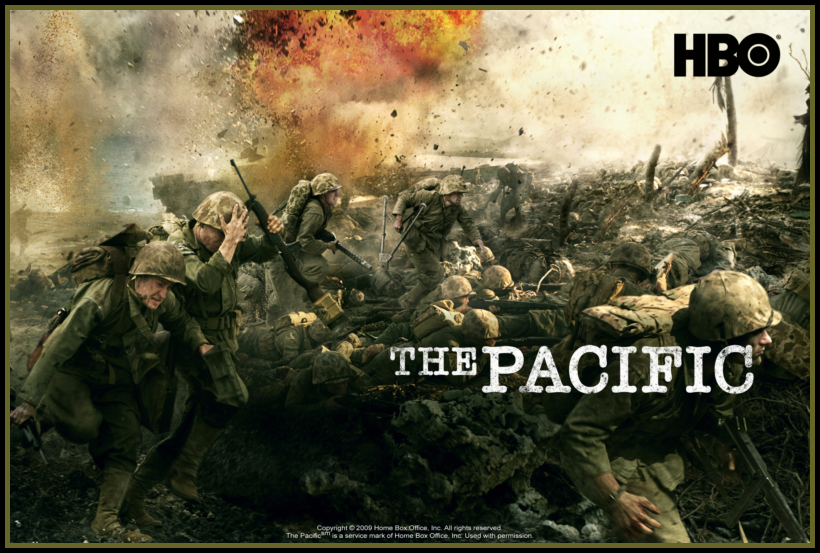
Song of the Day: Gotham’s Reckoning from The Dark Knight Rises (by Hans Zimmer)


This weekend sees the conclusion of Christopher Nolan’s deconstruction of the superhero myth, especially that of the Batman/Bruce Wayne duo. I’ve never been a big fan of Hans Zimmer’s work as a film composer though he does have some very good work in his body of work down the years. When I found out that his co-composer from the first two Nolan Batman films, James Newton Howard, wasn’t going to be involved in the third film, The Dark Knight Rises, I was very worried at how the score for that film would turn out.

Fortunately, there was one new piece of music from this Zimmer-composed soundtrack that I found to be great and my latest”Song of the Day”.

“Gotham’s Reckoning” is the leitmotif for the main antagonist of The Dark Knight Rise come in the form of the physically imposing but still devious and cunning Bane. Zimmer uses the now-recognizable ritualistic chanting that has been used over and over in the trailers and tv spots for the film. It’s only in “Gotham’s Reckoning” that we hear the chanting, but the tempo and tone created by the chants become the basis for Bane’s theme and could be heard throughout the film whenever the character enters the scene to do something important.

It doesn’t have the discordant sound that Joker’s theme had in the second film. Bane’s theme has a much more linear and organized quality to it while still retaining the primal qualities that describes Bane as a villain who wasn’t just more than a match for Batman physically actually surpasses him) but also a match for the Dark Knight in intelligence albeit with a huge streak of malice and ruthlessness. For those who have seen the film they might have noticed how Bane’s theme soon becomes a variant on the main theme for the whole trilogy. Will not spoil it for those who haven’t seen, but it’s very hard not to miss.


Trailer: The Dark Knight Rises (Nokia Exclusive)


Marvel Studios’ The Avengers has been the runaway, blockbuster hit of 2012’s summer film season. The film has also become the film which detractors of Christopher Nolan’s third and final entry in his Dark Knight trilogy put up as the film to beat this summer. I like the fanboy enthusiasm that always comes out of the shadows whenever comic book films battle it out during the summer blockbuster season year in and year out, but I will say that instead of pitting the two mega-hits against each other fans of the comic book genre should embrace both because just around the corner will be the average to awful comic book films.

With just a month to go before the film’s release we get a new trailer (this one a Nokia Exclusive) for The Dark Knight Rises which looks to emphasis the action of the film where the previous trailers and teasers concentrated more on keeping the film’s story a secret. I’ve looked at these series’ of trailers and ads for the film like another of Nolan’s previous films with The Prestige. The first trailers and ads I see as the “The Pledge” from the film’s creators that hints at the grandiose event we’re going to be witness to. This latest trailer acts like “The Turn” as we see the magician performing the trick of this latest film giving the audience a bit more flash and pizzazz (maybe some misdirection as well to keep the story secret until the film’s release). For The Dark Knight Rises it will be on opening weekend when we finally see “The Prestige” that closes out (hopefully with critical-acclaim) Nolan’s turn as the caretaker of the Batman film franchise.

The Dark Knight Rises is set for a July 20, 2012 release date.

Trailer: The Dark Knight Rises (3rd Official)


With the North American release of Marvel Studios’ The Avengers just days away it looks like DC Films’ parent company, Warner Brothers Pictures, is playing a little bit of gamesmanship by releasing a brand new trailer for their own superhero blockbuster offering this summer in The Dark Knight Rises .

The third film in Christopher Nolan’s Dark Knight trilogy and one that has much to live up to with the financial and critical success of the previous film, The Dark Knight. With no Heath Ledger to help anchor this third film it looks like the final leg in this trilogy will have to rely on the addition of Bane as Batman’s main antagonist. The film will also see the return of one Selina Kyle aka Catwoman who may or may not be a character Batman has to treat as an enemy as well.

From the previous teasers and trailers released for this film fans of the franchise will have a story that’s much more epic in scope than the previous two, but also one that seem to have the hit-or-miss of the three. Film trilogies rarely finish off as well as it starts with a few exceptions and hopefully Nolan’s final entry in his gritty take on the Dark Knight will be one of those exceptions.

The Dark Knight Rises is set for a July 20, 2012 release.

Source: The Dark Knight Rises Official Website

Trailer: The Dark Knight Rises


There’s nothing much else to say other than 2012 looks to be the year of The Dark Knight Rises.

2005 saw the reboot of the Batman film franchise. This first film in the new trilogy put Christopher Nolan on the map as an action filmmaker. 2008’s The Dark Knight with it being such a huge critical and, more importantly, a mega-blockbuster made Christopher Nolan a filmmaker who could do anything he wants and with whatever budget he asks for. Nolan was able to cash in some of that cred to make 2010’s Inception which was also a runaway success.

2012 is just around the corner and we have the third and final leg to Nolan’s Dark Knight trilogy. With the success and popularity of the two previous films to say that the hype and anticipation for this third film has reached stratospheric levels would be an understatement. This is not to say the film can’t flop, but with Nolan’s track record I am in the camp of highly doubt it.

The Dark Knight Rises is set for a July 20, 2012 release in both regular and IMAX (though not in 3D).

Trailer: The Dark Knight Rises (Official Teaser)


The first official teaser trailer for the third and final installment of Christopher Nolan’s Dark Knight Saga has finally arrived in it’s official form. The teaser had leaked in bootleg form last week. People who went to watch Harry Potter and The Deathly Hallows, Part 2 were able to see the teaser in all it’s glory on the big-screen and from my own experience it was one of the major highlight’s even before the main attraction began.

The teaser trailer plays exactly as it sounds. It teases just enough to begin the buzz and hype which should run a full year before the film’s release. We see glimpses of Tom Hardy in the role of Bane. Most of the teaser has Police Commissioner Jim Gordon in a hospital bed looking like he may have just gone a round or two with Bane. It also brings back the lesson first given to Bruce Wayne by Ra’s al Ghul from the first film about how a man could become a legend. There’s even some Inception-like imagery of crumbling high-rises that could only mean Gotham City itself now under siege.

It’s going to be a long wait til The Dark Knight Rises premieres in the theaters on July 20, 2012.

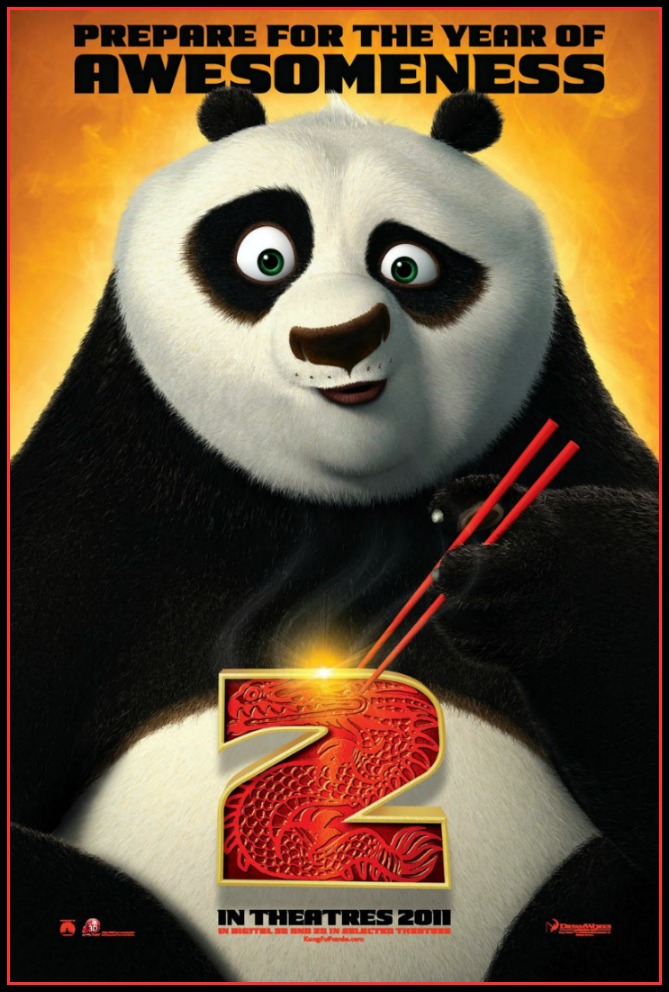
Review: Kung Fu Panda 2 (dir. by Jennifer Yuh Nelson)


In 2008, Dreamworks Animation released what many had thought was one of their animated films. Some even went so far as to consider it on the same level as many of the Pixar animated offerings. This was high praise indeed and the praises from critics was awarded by public acclaim as Kung Fu Panda became an instant classic for Dreamworks Animation. It wasn’t a huge surprise that a sequel was quickly greenlit by the studio and now three years has passed and that sequel has finally come out. Kung Fu Panda 2 does one of those rare feats in film-making where it surpasses it’s original predecessor in all things. This was a sequel that was able to take what made the first one so fun and thrilling and build on it without losing the charm that made it so beloved in the first place.

Kung Fu Panda 2 brings back the Dragon Warrior Po (Jack Black returning in the role of the big fat panda) as he continues to live his dream of having become the Dragon Warrior and fighting evil, bandits and criminals with his fellow kung fu masters, the Furious Five. Instead of the film highlighting Po’s size as a detriment and keeping him a buffoonish character like in the beginning of the first film this sequel actually makes him an equal of his heroes, if not, surpassing them. This is a refreshing change since the writers could’ve easily banked on Po as a character who bungled and stumbled his way through most of the film.

This film was a continuation of Po’s journey as a hero which the first film was just the first step. Despite being a kung fu master in his own right his culture becomes threatened by a villain even more devious than the first film’s Tai Lung. Lord Shen (voiced by Gary Oldman) is the mad peacock heir to Gongmen City who has found an ultimate weapon through fireworks that he plans to defeat kung fu and conquer all of China. Kung fu is everything to Po and he journeys with the Furious Five to confront Lord Shen and stop his plans before it’s too late.

It’s during this journey that Po learns more about his true past and where he truly comes from. The sequences where Po’s adopted goose father tells of Po’s past was some of the best animations Dreamworks has done and I’d say surpasses some of Pixar’s own work. After seeing this film I’m sure many kids and some adults would want themselves their very own baby panda. Who would’ve thought that baby pandas sounded like human babies when they cried. It’s knowing his past that Po must now learn to find his inner peace if he’s to ever go beyond just being a kung fu master.

Kung Fu Panda 2 was actually quite a dark film in places as themes of genocide, destructive march of technology against nature, difficulties of adopted children finding their true origins and many others. That’s not to say that this sequel wasn’t fun to watch. The action took the kung fu fight scenes from the first film to a whole new level, but without turning it into all flash and no substance. It’s during some of the thrilling fight sequences that we see Po truly become part of the Furious Five and even affection from some of it’s members. It would be interesting to see how a third film would explore the growing relationship between Po and certain striped-feline.

The story gets a much needed infusion of creative help from one Guillermo Del Toro who served as creative producer. His inclusion in the film’s development was probably why the film had a much darker and serious tone in addition to the charm it continued from the first film. If there was anyone in Hollywood who knows how to further develop a character through a Campbellian hero’s journey then it’s Del Toro. If Dreamworks Animation is able to keep Del Toro on hand to further treat their other projects then it will be quite a coup for the studio.

The animation in this film is a step above the first film and anything Dreamworks Animation has ever done. With each passing year and release it looks like Dreamworks Animation has been able to come to the same level of animated work Pixar has set with their own projects. While I’m sure there’s no animosity between animators fo the two houses there probably is some sort of friendly rivalry which helps push both studios to improve on their animation work. All this means is that the public wins out in the end as we’re treated to better animated features from both Dreamworks and Pixar. It’s a good thing that Dreamworks Animation has also improved their storytelling with each new film that they’re not being called the weaker films when compared to Pixar’s latest.

In the end, Kung Fu Panda 2 more than lives up to it’s predecessor and actually surpasses it in every way. This sequel’s animation and use of stereoscopic 3D was some of the best in CG animation to date. It had a story that continued to explore and build the characters from the first film that they’ve gone beyond simple, basic animated characters but fully realized and complex individuals. Even the ending scene in the film which definitely sets-up a third film doesn’t seem tacked on but looks like something that would further continue Po’s hero’s journey. Sequels and milking of a franchise usually don’t sit well with serious film fans, but this franchise seems to be doing it correctly and using each new film to further an epic tale. Here’s to hoping we see Po and his Furious Five friends back for more in the coming years.

Film Review: Pirates of the Caribbean – On Stranger Tides


This post is going to end with some spoilers, which will have warnings behind it. Just so you know.

Confession: I fell asleep during Pirates of the Carribean: On Stranger Tides. It was only for a few minutes during the jungle sequences, but nothing special was happening, so I figured I could get away with it. I can see, though why Gore Verbinski saddled up with Rango instead of this one. As Lisa Marie mentioned via Twitter, she zoned out about 10 minutes in and really only followed it for the awesomeness that is Johnny Depp. He, Penelope Cruz and Ian McShane are the only real reasons to see this, but know that the film is muddled with a bit of lazy writing covered in explosions and chases. This is one Jack Sparrow story you can really wait for on DVD. It’s literally the Pirates of the Caribbean Edition of Indiana Jones and the Crystal Skull.

Every writer goes though a bad time now and then. Even though Paul Haggis won an Oscar for Crash, he was also responsible for Quantum of Solace, which could have been a tighter story than what it was. I have to remind myself that even though Terry Rossio and Ted Elliot gave us a cool character in Captain Jack Sparrow (which was made more concrete through Johnny Depp’s performance), they were also responsible for Roland Emmerich’s Godzilla some years back. It happens. Of course, they could both write me under the table while blindfolded, this I get, and they have my respect.

That said, I didn’t outright hate Pirates of the Caribbean: On Stranger Tides. It was a fun popcorn ride in some areas, with as much flair as the Disney / Bruckheimer collaborations can offer, but it also felt like it was a production just made for the money, like The Wolfman. The only ones who seemed to really enjoy themselves here were Penelope Cruz and Ian McShane, and to both their credits they carried the film for me. Johnny Depp was great as always (he has moment where he clearly shines), but I get the feeling like he’s almost tired of the character. Again, that’s just my viewpoint here.

What about the Kids?

Well, being a film under the Disney banner, the easiest rule of thumb to use here is this: If you’ve taken your kids to any of the other Pirates movies, this is pretty much more of the same. Granted, people die and there may be a nearly naked mermaid, but it’s done well.  It should be okay for teens and pre-teens, but that’s up to families to decide.

Previously on Pirates, we found Captain Jack Sparrow (Johnny Depp, great as always) in the possession of the map from At World’s End, who is in search of the fabled Fountain of Youth. Jack finds that there is someone impersonating him who also happens to be looking for the same thing, and seeks out the imposter. This eventually leads him to the dreaded pirate Blackbeard (Ian McShane) who also seeks the Fountain to block a prophecy that will lead to his death. So, it’s something of a race to see who will get there first. Even his old friend/enemy Barbossa (Geoffrey Rush) is part of the adventure, but doesn’t quite have the same presence here as he did the other films.

Depp on his own does justice to Sparrow and he still manages to bring some fun to the character.  That’s really not a surprise, but after 3 of these films, I had the feeling that part of his performance was just repetition of what he did before. I imagine him wishing for Verbinski or sighing after every take. Well, every take that didn’t involve Penelope Cruz, I guess.

I felt Penelope’s Angelica really matched well against Depp’s Sparrow, and it opened up a lot of doors for characterization between the two. Depp and Cruz’s scenes together really worked for me and were definitely a highlight as their chemistry is amazing. Between she and McShane – who quite frankly hasn’t had a bad role since Deadwood – really help to carry the movie. Blackbeard’s ruthlessness is clearly conveyed through McShane’s acting and  if there’s one thing he knows how to do, it’s to play the villain well. There are also some notable cameos near the start of the film, which was nice to see.

One other major plus is the music. Even though Hans Zimmer uses some of the themes from the other films, he’s had some great help in guitar duo Rodrigo y Gabriela. If you’ve never heard these two before, open up another tab on your browser and look them up online. This post will be waiting for you when you get back.

Done? Good. Didn’t I say they were cool? The duo adds a lot of flavor to the music of the movie, which really does help things (as much as they can).

Rob Marshall’s direction of the film isn’t terrible as some might say. It actually feels a lot like Gore Verbinski’s (to me, anyway), and if you weren’t told who was making the film, there’s a slight possibility you wouldn’t recognize it wasn’t Verbinski. He does capture the action scenes well and truthfully, there was something cool with the lighting in the Sparrow sword fights that occurs early on. I’m under the impression that this is due to the Bruckheimer touch on things.

The writing on this film felt lazy. Here’s what I mean, and the following might be spoilers:

*** Here lie Spoilers, Ladies and Gents, be warned! ***

*** Here lie Spoilers, Ladies and Gents, be warned! ***

*** Here lie Spoilers, Ladies and Gents, be warned! ***

There is a part in the film where Barbossa explains his stake in the chase for the Fountain of Youth. In a few lines, Geoffrey Rush nails it like an old man telling stories by a campfire. The only problem is that you’ve been told what happened in a visual medium. One of the first rules of writing is to show, and not tell. With a budget of over $400 million, I find it shocking that they couldn’t have just taken a few minutes to visually give us that explanation. It’s possible that Rossio and Elliot wanted to avoid reusing some of the same Pirates elements from the earlier films, but sometimes Pirate life does have a few struggles on the water. Why not show how he lost the Black Pearl?

Another example of the writing problem is the quasi-love story between the ship’s cleric (who’s name I can’t even recall) and the mermaid they encounter. It felt forced to me, and I’m convinced that when the Cleric finally tells the Mermaid he wants her to save his life, she pulled him down into deep waters only to feed upon him like those other poor pirate souls. And you know why? Because Marshall and the writers never bothered to show the audience a hint of what became of them. I doubt they cared about them any more than the audience could have. I even stayed after the credits, figuring that the final shot would maybe show me something of their fate, but no. Nothing of the sort.

*** Spoilers are done, you can keep reading now. ***

*** Spoilers are done, you can keep reading now. ***

*** Spoilers are done, you can keep reading now. ***

Oh, and there’s nothing to read after this, because I’m writing like Rossio and Elliot. Feel that sense of emptiness? That gap, like there should be something here? That’s what this Pirates may do to you.

Film Review: Rango (dir. by Gore Verbinski)


Rango is something of an anomaly.

It’s an animated feature that isn’t in 3D. It caters as much to adults as it does to kids, and doesn’t seem to try toMovie Poster for the Film "Rango" lower itself to be “shiny” in that way. There are a number of scary images that I think would frighten younger kids, but overall, the film is very well done. It’s a fantastic homage to the Wild West, though it does get a little weird at times. I’ll admit that I walked in expecting something like Tangled. It reminds me more of George Miller’s Happy Feet, in how serious at times the story gets. And it does all this under the Nickelodeon banner. Wow, this is a big jump from Spongebob and Rugrats.

It ironic and feels right that Gore Verbinski – who gave us the Budweiser Frogs commercial so long ago and The Mexican – takes on an animated tale. He teams up with his Pirates of the Caribbean stars Johnny Depp and Bill Nighy again, and the results are worth it. Depp brings a spark of funny weirdness to the character of Rango, and the film has a number of pop culture references (including one for Fear and Loathing in Las Vegas). The supporting cast is okay, Isla Fisher (Confessions of a Shopaholic) makes for a quirky female lead trying to hold on to her land and Abigail Breslin (Zombieland) didn’t seem like she was used enough. Ned Beatty and Nighy in particular are the other vocal standouts here, along with Harry Dean Stanton (Big Love) as the the head of a mole family of outlaws. Timothy Olyphant (Justified) has a great cameo as well.

Rango is a chameleon who wishes to be the star of his own story. After an accident leaves him stranded in the desert, he finds is way through the blistering sun to the tiny town of Dirt. The townspeople of Dirt are a diverse lot, and it all has a real Mos Eisley in Star Wars to it. The currency of the town is water, which is pretty hard to come by these days. When he’s asked who he is, Rango takes the moment to be the character he envisioned. After he amazes the town with a display that adds fuel to the fire, the townsfolk end up making him the Sheriff of Dirt and charge him with finding a solution to their money/water issues.

Visually, Rango is a feast for the eyes despite how ugly the main character is. Fur moves, whiskers twitch and the open desert looks wonderful (especially when riding). Sunsets are colorful and Industrial Light and Magic really did some interesting work here. Honestly, I wouldn’t mind seeing this in 3D, but it’s actually nice that it isn’t in that format. Musically speaking, Hans Zimmer’s score adds a nice touch to the film, especially during one key scene involving a chase. I ended up getting the score shortly after seeing the movie.

If Rango suffers from any problems, it would be that it slows down a little in the middle, as if it’s not entirely sure of where it wants to go at one point. It quickly picks up, but the lull may be a little much for younger viewers looking for cartoon action throughout the film. I don’t believe adults will mind this, though.

But what about the Kid Factor?

It’s a Nickelodeon film. It’s designed for kids, and my audience (made up of parents and kids) appeared to really love it. The lessons to learn are that you truly are the center of your own story and growth comes through dealing with struggles. You can’t have a Protagonist without an Antagonist, and a story has to have conflict for it to go anywhere. You can take your kids to see Rango, but Parental Guidance is suggested. There’s a nude top half of a Barbie doll, no biggie there. Nighy’s Rattlesnake Jack brought up a lot of murmurs and gasps from the kids in my audience, so that might be something to be concerned about. There’s also shooting – it is the Wild West, after all – so there are characters that will die. If that doesn’t bother you, then you’ll have tons of fun with Rango. It’s definitely worth seeing.

Lisa And The Academy Agree To Disagree


The Oscar nominations were announced today and, for the most part, it’s pretty much what you would expect.  Below is the list of nominees.  If a nominee listed in bold print, that means they also appeared on my own personal list of nominations.

Best motion picture of the year

Black Swan
The Fighter
Inception
The Kids Are All Right
The King’s Speech
127 Hours
The Social Network
Toy Story 3
True Grit
Winter’s Bone

(The Academy and I agree on five of the ten nominees.  That’s actually more than I was expecting.)

Performance by an actor in a leading role

Javier Bardem (Biutiful)
Jeff Bridges (True Grit)
Jesse Eisenberg (The Social Network)
Colin Firth (The King’s Speech)
James Franco (127 Hours)

(The only real surprise here is Bardem.  I haven’t seen Biutiful but I’ve heard amazing things about it.)

Performance by an actor in a supporting role

Christian Bale (The Fighter)
John Hawkes (Winter’s Bone)
Jeremy Renner (The Town)
Mark Ruffalo (The Kids Are All Right)
Geoffrey Rush (The King’s Speech)

(Yay for John Hawkes!  Some people are surprised that Andrew Garfield wasn’t nominated for The Social Network.  I’m disappointed he wasn’t nominated for Never Let Me Go.)

Performance by an actress in a leading role

Annette Bening (The Kids Are All Right)
Nicole Kidman (Rabbit Hole)
Jennifer Lawrence (Winter’s Bone)
Natalie Portman (Black Swan)
Michelle Williams (Blue Valentine)

(I’m happy to see Lawrence and Portman recognized but I still so wish that the Academy had recongized Noomi Rapace and Katie Jarvis as well.  I knew it wouldn’t happen but still…)

Performance by an actress in a supporting role

Amy Adams (The Fighter)
Helena Bonham Carter (The King’s Speech)
Melissa Leo (The Fighter)
Hailee Steinfeld (True Grit)
Jacki Weaver (Animal Kingdom)

(Weaver — Yay!) 

Achievement in directing

Darren Aronofsky (Black Swan)
David O Russell (The Fighter)
Tom Hooper (The King’s Speech)
David Fincher (The Social Network)
Joel Coen and Ethan Coen (True Grit)

(The snubbing of Christopher Nolan for Inception is probably the closest thing to an outrage that the Oscars will produce this year.)

Adapted screenplay

127 Hours – Danny Boyle & Simon Beaufoy
The Social Network – Aaron Sorkin
Toy Story 3 – Michael Arndt (screenplay); John Lasseter, Andrew Stanton and Lee Unkrich (story)
True Grit – Joel Coen and Ethan Coen
Winter’s Bone – Debra Granik & Anne Rosellini

Original screenplay

Another Year – Mike Leigh
The Fighter – Scott Silver, Paul Tamasy and Eric Johnson (screenplay); Keith Dorrington, Paul Tamasy and Eric Johnson (story)
Inception – Christopher Nolan
The Kids Are All Right – Lisa Cholodenko and Stuart Blumberg
The King’s Speech – David Seidler

Best animated feature film of the year

How to Train Your Dragon
The Illusionist
Toy Story 3

 (I haven’t seen The Illusionist yet but I’m looking forward to it because the previews look great, it’s based on a script by Jacques Tati, and I love all things French.  Still, I kinda wish that Despicable Me had been nominated just so Arleigh could see the minions at the Academy Awards.)

Best foreign language film of the year

Biutiful (Mexico)
Dogtooth (Greece)
In a Better World (Denmark)
Incendies (Canada)
Outside the Law (Hors-la-loi) (Algeria)

Art direction

Alice in Wonderland – Robert Stromberg (production design), Karen O’Hara (set decoration)
Harry Potter and the Deathly Hallows Part 1 – Stuart Craig (production design), Stephenie McMillan (set decoration)
Inception – Guy Hendrix Dyas (production design), Larry Dias and Doug Mowat (set decoration)
The King’s Speech – Eve Stewart (production design), Judy Farr (set decoration)
True Grit – Jess Gonchor (production design), Nancy Haigh (set decoration) 

Achievement in cinematography

Matthew Libatique (Black Swan)
Wally Pfister (Inception)
Danny Cohen (The King’s Speech)
Jeff Cronenweth (The Social Network)
Roger Deakins (True Grit) 

Achievement in costume design

Colleen Atwood (Alice in Wonderland)
Antonella Cannarozzi (I Am Love)
Jenny Beavan (The King’s Speech)
Sandy Powell (The Tempest)
Mary Zophres (True Grit)

(That’s right, I ended up going 0 for 5 as far as Costume Design is concerned.  Which I guess goes to prove that I have better taste than the Academy.)

Best documentary feature

Exit Through the Gift Shop (Banksy and Jaimie D’Cruz)
Gasland (Josh Fox and Trish Adlesic)
Inside Job (Charles Ferguson and Audrey Marrs)
Restrepo (Tim Hetherington and Sebastian Junger)
Waste Land (Lucy Walker and Angus Aynsley)

 (If Banksy wins, I’ll be happy.  I have a feeling the award will go to Inside Job, however.  As a documentary, Inside Job reminded me a lot of Capt. Hindsight from the South Park Coon Vs. Coon And Friends trilogy.  Also, I’m a little bit surprised that Waiting for Superman wasn’t nominated.  I’m even more surprised that I actually saw enough feature documentaries last year to even have an opinion.  Also, interesting to note that Restrepo — a very nonpolitical look at military in the mid-east — was nominated while The Tillman Story, a much more heavy-handed and stridently political documentary was not.)

Best documentary short subject

Killing in the Name (Nominees to be determined)
Poster Girl (Nominees to be determined)
Strangers No More (Karen Goodman and Kirk Simon)
Sun Come Up (Jennifer Redfearn and Tim Metzger)
The Warriors of Qiugang (Ruby Yang and Thomas Lennon)

(It’s always interesting that nobody knows what these movies are about yet their producers always end up giving the longest speeches at the Oscars.  I’m hoping that Poster Girl wins because the actual producers have yet to be determined.  I imagine that means there might be some sort of legal action going on which means that, if it wins on Oscar night, there might be a big fight at the podium.  Plus, I like the title.  It makes me want to walk up to people I barely know, lean forward, and go, “Can I be your poster girl?”)

Achievement in film editing

Andrew Weisblum (Black Swan)
Pamela Martin (The Fighter)
Tariq Anwar (The King’s Speech)
Jon Harris (127 Hours)
Angus Wall and Kirk Baxter (The Social Network) 

Achievement in makeup

Adrien Morot (Barney’s Version)
Edouard F Henriques, Gregory Funk and Yolanda Toussieng (The Way Back)
Rick Baker and Dave Elsey (The Wolfman)

Achievement in music written for motion pictures (original score)

John Powell (How to Train Your Dragon)
Hans Zimmer (Inception)
Alexandre Desplat (The King’s Speech)
AR Rahman (127 Hours)
Trent Reznor and Atticus Ross (The Social Network)

Achievement in music written for motion pictures (original song)

Coming Home (from Country Strong, music and lyrics by Tom Douglas, Troy Verges and Hillary Lindsey)
I See the Light (from Tangled, music by Alan Menken, lyrics by Glenn Slater)
If I Rise (from 127 Hours, music by AR Rahman, lyrics by Dido and Rollo Armstrong)
We Belong Together (from Toy Story 3, music and lyrics by Randy Newman)

(I’ll just say it now — 4 nominations and I didn’t agree with a single one of them.  Seriously, they could have nominated up to 5 songs but instead of giving at least one nomination to Burlesque, they just nominated 4 songs.  What a load of crap.)

Best animated short film

Day & Night (Teddy Newton)
The Gruffalo (Jakob Schuh and Max Lang)
Let’s Pollute (Geefwee Boedoe)
The Lost Thing (Nick Batzias, Shaun Tan and Andrew Ruhemann)
Madagascar, carnet de voyage (Madagascar, a Journey Diary) (Bastien Dubois)

(I’ve actually seen Day & Night since it was shown before Toy Story 3.  I thought it went on a little bit too long, to be honest.)

Best live action short film

The Confession (Tanel Toom)
The Crush (Michael Creagh)
God of Love (Luke Matheny)
Na Wewe (Ivan Goldschmidt)
Wish 143 (Ian Barnes and Samantha Waite) 

Achievement in sound editing

Inception (Richard King)
Toy Story 3 (Tom Myers and Michael Silvers)
Tron: Legacy (Gwendolyn Yates Whittle and Addison Teague)
True Grit (Skip Lievsay and Craig Berkey)
Unstoppable (Mark P Stoeckinger)

Achievement in sound mixing

Inception (Lora Hirschberg, Gary A Rizzo and Ed Novick)
The King’s Speech (Paul Hamblin, Martin Jensen and John Midgley)
Salt (Jeffrey J Haboush, Greg P Russell, Scott Millan and William Sarokin)
The Social Network (Ren Klyce, David Parker, Michael Semanick and Mark Weingarten)
True Grit (Skip Lievsay, Craig Berkey, Greg Orloff and Peter F Kurland)

 (I would have probably had more matches in the sound category if I actually knew the difference between sound editing and sound mixing.)

Achievement in visual effects

Alice in Wonderland (Ken Ralston, David Schaub, Carey Villegas and Sean Phillips)
Harry Potter and the Deathly Hallows Part 1 (Tim Burke, John Richardson, Christian Manz and Nicolas Aithadi)
Hereafter (Michael Owens, Bryan Grill, Stephan Trojanski and Joe Farrell)
Inception (Paul Franklin, Chris Corbould, Andrew Lockley and Peter Bebb)
Iron Man 2 (Janek Sirrs, Ben Snow, Ged Wright and Daniel Sudick)

So there you go.  I went 50/50 on the Best Picture nominations and — well, it all pretty much went downhill from there, didn’t it?  Oh well.
Review: The Pacific Mini-Series (HBO)


“I may have dropped into Normandy on D-Day, but I still had Liberty in Paris or London. You Gyrenes had jungle rot and malaria.”

In 2001, HBO came out with a mini-series that detailed the experiences of the men of Easy Company, 506th Parachute Regiment of the 101st Airborne. This series was produced with loving care by Tom Hanks and Steven Spielberg. Two men who were instrumental in the success of an earlier World War 2 project called Saving Private Ryan. This series was called Band of Brothers and became one of the most critically-acclaimed mini-series of its time and has become part of the staple of military-themed shows and films that gets shown on Memorial and Veterans Day in the United States.

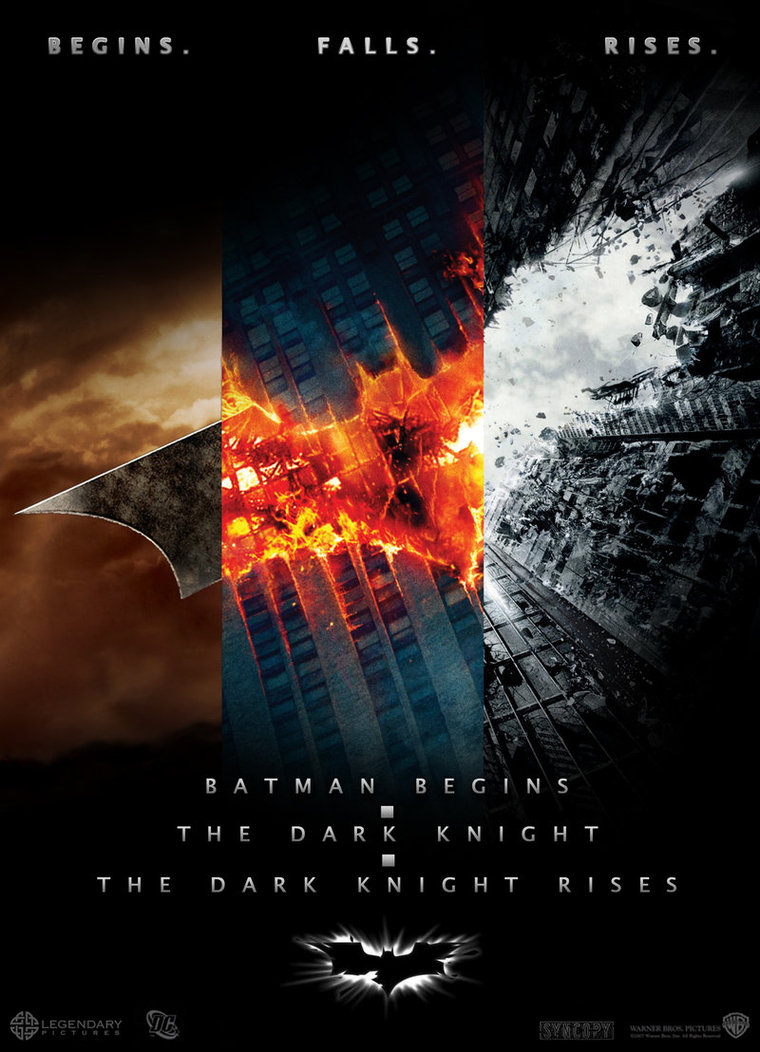
Even as this series was only a year old there was talk from some of its admirers about whether HBO and the team of Hanks and Spielberg would re-visit this era Tom Brokaw called “The Greatest Generation”. To re-visit and tell the stories of the men who fought on the other side of the European Theater in what was an even more hellish battlezone in the Pacific. It took almost 9 years, but the ending result is the mini-series called simply The Pacific.

The Pacific tells the story of three Marines of the 1st Marine Corps Division from their time before their unit ships out to the Pacific Theater of Operations and through some of the bloodiest and most savage battlefields of World War 2. There’s Gunnery Sgt. John Basilone (played by Jon Seda) who would show the sort of stoic heroism people nowadays would dismiss as a figment of Hollywood writers, but who actually did all the things only seen in action films. Bookending Basilone would be two newcomers to the art of war in PFC Robert Leckie (James Badge Dale of AMC’s recently cancelled series, Rubicon) and Cpl. Eugene “Sledgehammer” Sledge (Joseph Mazzelo from Jurassic Park). These two Marines are our guide through the unending hell that were the battles in Gen. MacArthur’s island-hopping campaign to beat back the Army and Naval forces of Imperial Japan.

It’s also these two men and their memoirs which detail their experiences during the war in the Pacific which make up the bulk of the narrative for the series. One would be Sledge’s With the Old Breed: At Peleliu and Okinawa which many consider as one of the best first-hand accounts of combat in the Pacific. The other one is Helmet for My Pillow by Leckie which was a more personal account of his time from Marine boot camp and experiencing a type of warfare in the Pacific which was new to a young man from the States. A type of warfare where the enemy didn’t surrender and would sacrifice his life in the service of one’s Emperor.

Basilone, Sledge and Leckie’s stories never come together but were told in concurrent fashion to show the audience the differing views of each. All three would go through the same meat-grinder that were the battles in immortalized places named Guadalcanal, Cape Gloucester, Peleliu, Iwo Jima and Okinawa.

We see Basilone’s heroism on Guadalcanal make him into a Stateside hero and taken away from those he fought beside to help push war bonds for the government. This change in environment for him doesn’t sit well with Basilone as we see the survivor’s guilt in him. Why does he get all the celebrity attentions when others like him were still fighting and dying the same battles he was just in months before. His story is the most poignant of the three as he finds happiness while training new Marines for the war only for his need to get back into the fight win out. The fact that all this happened for real makes his story even more memorable. Hollywood writers have tried to capture such moments and often-times fail. It was great to see Basilone’s story told for everyone to see that the world past, present and future has real-life heroes that Hollywood could never replicate but only imitate.

Jon Seda’s performance was in-line with what one thinks a gung-ho Marine should be but he brought a sense of realism to the role. He didn’t try to make Basilone more a hero than he already was. I like to compare his performance to that of Tom Hanks’ Capt. Miller in Saving Private Ryan and Damian Lewis’ Maj. Dick Winters in Band of Brothers. He was a man who did acts of bravery as seen by others on the battlefield and one which made him a celebrity to the civilians Stateside. But in the end he just saw it as him doing his job as he was trained and trying to keep his men alive. He didn’t see himself as a hero and while his Stateside role of war hero pushing war bonds did bring some perks he never fit in. Seda’s work in Part Eight where he meets his future wife was some of the best work in this series.

In Leckie’s story we see a man swept up in the great enlistment drive which happened right after the Japanese attack on Pearl Harbor. His story sees a cocky and smart young man wanting to do his part for the war effort yet not knowing the sort of sacrifices he’ll have to make or the horrors he will witness and inflict to survive day-to-day. We see Leckie quick to make friends in his unit during their training and then through their baptism of fire in the Battle of Tenaru before seeing the real horror of the war in the Pacific as his unit and the rest of the 1st Marine Division land of the island of Guadalcanal.

His time on Guadalcanal would soon erase any romanticized notion of honor and glory in battle Leckie may have had when he decided to enlist. As a writer in his civilian life prior to the war’s start he would continue to write his experiences in-between battles and skirmishes with the Japanese. Even when friends in his unit would die each and every day it seems Leckie seemed to want to keep that savagery at bay with his writing which would become a basis for his wartime memoirs. His story ends midway through the series and we won’t see him again until the final denouement as we see Leckie’s life as a civilian once again after the war. His final time in the warzone would be on the Battle of Peleliu (one of the bloodiest battles in USMC history and one that would be steeped in tragedy afterwards) where a severe concussive blast would render him unable to fight. It’s scenes on one of the hospital ships off the coast of Peleliu where Leckie’s own survivor’s guilt is temepered by the realization that any more time out in the battlefield would surely strip him of his humanity and turn him into the growing examples of battle-scarred and psychologically damaged Marines who have seen and done too many horrible things to ever return back to their civilian life intact.

The final episode shows Leckie (with James Badge Dale in a confident and cocky turn) the one who seem to adjust to the life back to civilian life with a modicum of ease. While he still carries the scars of battle in his psyche its that time in the Pacific which has also given Leckie the confidence to get his old job back at the local paper he used to work for and woo the pretty girl next door he had been shy and awkward with in the very first episode. While his performance wasn’t as good as Seda it was still a noteworthy one which brought the person of PFC Robert Leckie to the masses watching this series.

Lastly, we come to the third of the three whose story the series revolves around. The story of one Cpl. Eugene Sledge who, like Leckie, wanted to do his part for the war effort. While his young age at the start of the war prohibited him from enlisting without his parents’ consent he finally gets a chance a year later when he is of age and just in time for him to join the Corps, train and see his first taste of combat in the Pacific on the killing grounds of Peleliu then the hellish nightmare battlefields of Okinawa.

Sledge’s story is the most complex and runs the gamut of dark emotions a young man should never have to take. His young idealism in helping his country in its time of need will get some tempering even before he ships out to become a Marine. His father tells him of having to treat young men from an earlier era from another major war which had engulfed the world. His father spoke about how some of these young men who came back whole physically didn’t do so psychologically. He spoke about how the horrors of war seemed to have “ripped the souls” from these returning young men and how he didn’t want his son to go through the same thing. But as young, headstrong men who think they’re invincible are wont to do he enlists anyway.

The performance by Joseph Mazzello (hard to believe this young man is the same young boy who ran and escaped from CGI raptors and T-Rex on Spielberg’s Jurassic Park) tops all other performances in this cast full of noteworthy and great acting work. We don’t just see his Sledge go through each horrific scene after scene of battle and its aftermath with is emotional and psyche gradually sliding down into the abyss, but we could actually see Mazzello’s body, mannerisms and the look in his eyes make the same changes. I fully bought into his performance as the young idealistic young man from Mobile, Alabama slowly turned into the same uncaring, savage Marine one had to become to survive the war in the Pacific. He had seen enough bodies of Marines and enemy Japanese torn apart and strewn about everywhere one looked that one became inured to them.

One of the most powerful scenes in the series has Sledge confronted by the aftermath of what he and his mortar-team might have been responsible for. It was deep into the campaign to take the island of Okinawa and Sledge and his fellow Marines have been brought to the edge of insanity by all the fighting. A fight which has some of them questioning why the enemy just doesn’t surrender. An enemy willing to suicide charge into heavily armed Marines and also willing to herd Okinawan civilians into the line of fire. It’s this brutality by the enemy and mirrored by his fellow Marines which brings Sledge to a darker side of his nature which we as an audience don’t see a way out for him. But in the scene close to the very end of Part Nine brings Sledge back from the abyss and reminds him that there’s still humanity in him and the very Marines he has been with since the beginning. His reaction afterwards to a group of new Marines killing a young Japanese soldier for sport sickens him. We see Sledge realizing how just days and months before he was spouting the very same savage hate for the enemy as these newly arrived Marines looking for their first kill.

Of the three it’s Sledge who will carry the deepest scars of the Pacific for the rest of his life. We see the extreme difficulty he has in adjusting back to civilian life. Nightmares haunt his nights and flashbacks of the battlefields hound his steps in the daytime. His mental and emotional breakdown as he tries to go back to hunting with his father encapsulates this series at its most basic core. This series doesn’t have the camaraderie and brotherhood established between fellow soldiers that its predecessor had. While Band of Brothers also showed the horrors of war in Europe it was balanced by the hope that everyone in Easy Company had their brothers in arms to back them up when the bullets flew and shells exploded. This wasn’t the case in the Pacific.

Sure the were the same camaraderie and brotherhood, but the type of enemy fought in abject conditions which made downtime from battle almost as bad as the battle themselves didn’t bring hope. It only brought misery and a fatalistic view of the world Sledge and his fellow Marines existed right there and then. His breakdown in the final episode shows how those who fought in the Pacific definitely bore deeper scars and returned more damaged than their European brothers. Scars not just inflicted by the enemy but those they’ve inflicted on themselves by fighting savagery with their own form of savagery. It was a kill or be killed world and returning back from that brink didn’t happen to everyone and those who were able to return did so not whole.

I understand that some were disappointed by how The Pacific turned out. How it didn’t live up to the standards created by Band of Brothers. Some have said that there was no main focus to the narrative the way its predecessor strictly followed the men of Easy Company through the battles in Europe. They’ve pointed out how some episodes took too much time to get to the battle scenes. I think trying to compare The Pacific to Band of Brothers is foolish and a doesn’t give this follow-up mini-series the proper due it deserves.

The Pacific wasn’t trying to tell Band of Brother in the Pacific. While the two series do take place in the same world war the circumstances surrounding the storylines in both series diverge to take different paths. The first series almost seem like men fighting for a common cause and the good fight against tyranny. The Pacific is all about revenge. Revenge and payback for Pearl Harbor at first then as the series moves forward it becomes revenge and brutality for seeing their buddies die. This series showed nothing noble about the fighting in the Pacific. It was just a struggle to survive from one day to the next.

So, while this series may not be the second coming of Band of Brothers it does stand on its own merits and I think was the more powerful of the two. It didn’t flinch away or dismiss the darker side of the “good guys” and showed that war truly is hell and that those who fight and live through it were truly never the same. I say watch The Pacific and stop trying to compare it to Band of Brothers or any of the several shows dealing with the current wars. The Pacific should be watched as seen as the bookend to Band of Brothers. A darker journey to seeing the war of the “Greatest Generation” from the eyes of those who fought and died on the islands and jungles of the Pacific.