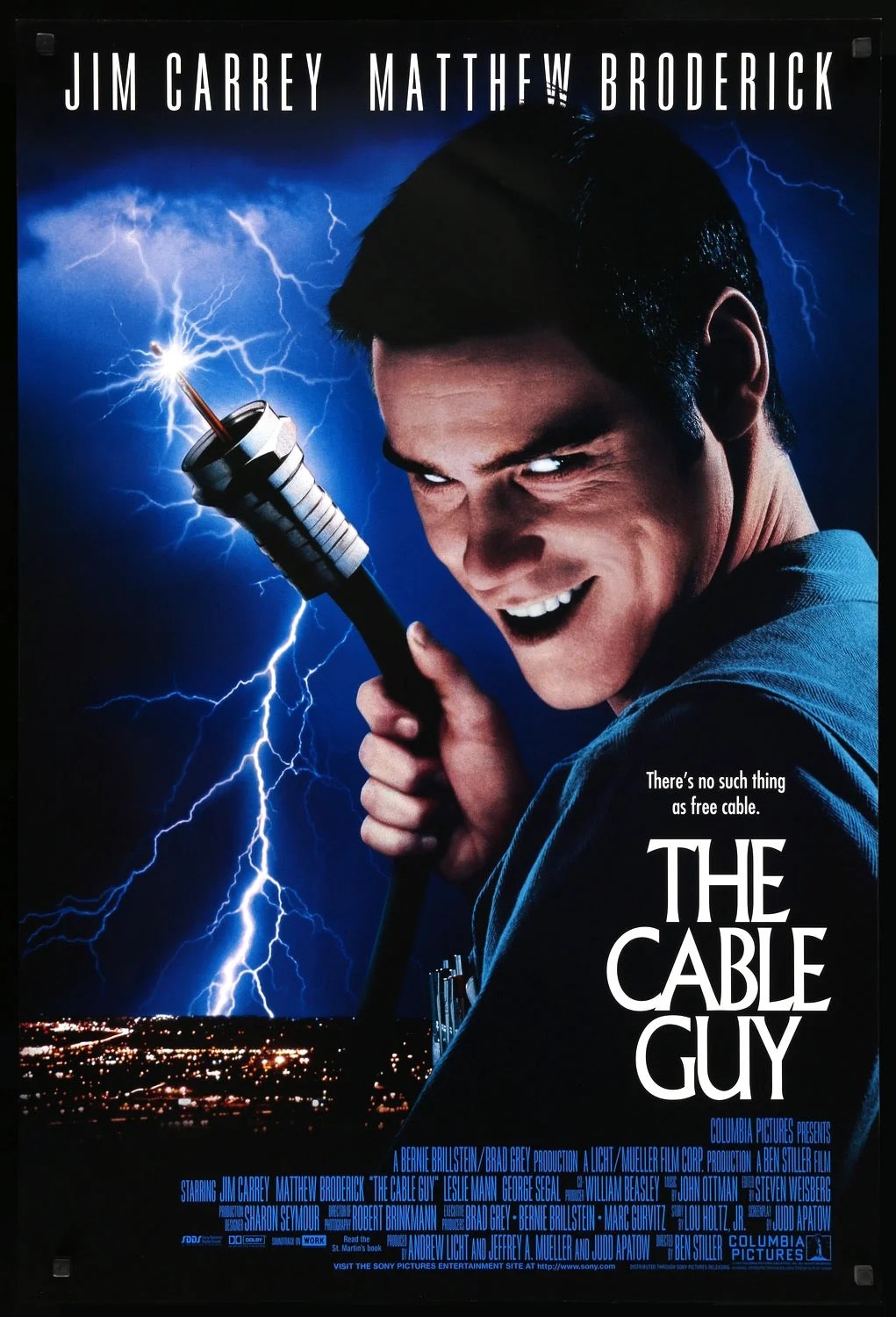
Icarus File No. 32: The Cable Guy (dir. by Ben Stiller)


“You were never there for me, were you, Mother? You expected Mike and Carol Brady to raise me! I’m the bastard son of Claire Huxtable! I am a lost Cunningham! I learned the facts of life from watching The Facts of Life!” — Chip

Few 1990s studio comedies are as awkwardly fascinating—or as misunderstood on arrival—as The Cable Guy. Directed by Ben Stiller and built around one of Jim Carrey’s most deliberately uncomfortable performances, it arrived at a strange point in Carrey’s career: he had become a massive box-office draw through films such as Ace Ventura: Pet Detective, The Mask, Dumb and Dumber, Batman Forever, and Ace Ventura: When Nature Calls. Audiences associated him with rubber-faced chaos, exuberant catchphrases, and a kind of manic but fundamentally likable comic energy. The Cable Guy offers something much colder. Carrey is still loud, physical, and wildly committed, but the movie twists those familiar traits into a portrait of loneliness, obsession, and emotional menace. It is a dark comedy about a man who has absorbed television culture so completely that he cannot form a normal human relationship without treating it like an episode of a sitcom.

That basic idea remains clever and surprisingly ahead of its time. Carrey plays Chip Douglas, a cable installer who enters the life of Steven Kovacs, played by Matthew Broderick, after Steven moves into a new apartment following a breakup with his girlfriend Robin, played by Leslie Mann. Steven wants cable television installed; Chip wants a best friend. What begins as awkward friendliness becomes invasive dependence, as Chip worms his way into Steven’s social circle, his professional life, and eventually his relationship with Robin. Chip is not simply a pest or an eccentric service worker. He is a lonely, emotionally stunted man whose references to television, movies, commercials, and game shows have become his entire vocabulary for intimacy.

The most interesting thing about The Cable Guy is that it understands television as both comfort and damage. Chip’s childhood was clearly shaped by neglect, with television functioning as his guardian, teacher, and surrogate parent. The movie makes this point broadly, sometimes too broadly, but it also gives the character a sad logic. Chip does not understand friendship as mutual connection; he understands it as a package deal. You meet someone, quote the same shows, hang out constantly, become inseparable, and live out the happy ending promised by popular entertainment. When Steven resists that fantasy, Chip does not know how to process rejection. His behavior turns increasingly controlling and vindictive because, in his mind, Steven has violated the rules of the relationship genre they are supposed to be playing.

In that respect, the film was well ahead of its time. In 1996, the idea of television becoming an all-encompassing babysitter for a generation of children was recognizable, but it still played largely as exaggerated satire. Chip represents the extreme result of a childhood where adults failed to provide stability, affection, supervision, and basic emotional guidance, leaving television to fill every role instead. He learned how to talk, how to joke, how to flirt, how to fight, and how to imagine friendship from whatever appeared on the screen. The tragedy is that media gave him endless information and endless imitation, but no real understanding of boundaries, empathy, or reciprocity.

That concern feels much less hypothetical today. Television did not disappear; it expanded into streaming libraries, on-demand movies, YouTube, social media feeds, online games, short-form video, and the constantly available internet. More children now grow up surrounded by screens that are not confined to a living-room television set or a few scheduled hours of programming. The old guardrails of limited channels, parental supervision around a shared TV, and the simple fact that a show ended at a certain time have weakened or, in many homes, disappeared altogether. The Cable Guy obviously does not predict every aspect of the internet age, but it does anticipate the emotional danger of allowing media to become a substitute for parenting, companionship, and healthy social development.

The film is careful enough to suggest that media alone did not create Chip. He is the product of abandonment first and television second. That distinction matters, because the movie is not arguing that children who watch too much television will inevitably become unstable stalkers. Rather, it suggests that screens can become especially powerful when they are used to fill an emotional void that should be addressed by family, community, and genuine relationships. Chip’s many references are funny at first because they are recognizable, but they become sadder as the movie reveals that he is not simply quoting pop culture for fun. He is quoting it because he has little else to draw from.

That makes the film more ambitious than its reputation as “the weird Jim Carrey movie” might suggest. The screenplay, by Lou Holtz Jr., has fun with media saturation, consumer culture, male insecurity, and the way people use technology to avoid direct emotional communication. The title itself now feels almost quaint, because cable installation hardly seems threatening in an age of smartphones, streaming services, social media surveillance, and algorithmic recommendation systems. Yet Chip’s obsession has only become more recognizable. He is essentially a proto-internet stalker, a man who treats access as entitlement. Because he can enter Steven’s home to connect his television service, he assumes he deserves access to Steven’s private life. The film exaggerates that premise for comic effect, but the underlying discomfort has aged well.

At the same time, The Cable Guy has a major problem, and it is inseparable from the reason the film exists: Jim Carrey. Casting Carrey was a commercial gamble meant to make a very dark premise accessible to a mainstream audience. In theory, it is an inspired decision. His brand of elastic, outsized comedy gives Chip a strange unpredictability; you never know whether he is going to make a ridiculous movie reference, belt out a sentimental song, physically humiliate himself, or suddenly become frightening. Carrey’s comic instincts make Chip memorable in a way that a more restrained actor likely would not have been. His version of the character is like an abandoned cartoon character who has somehow wandered into a real person’s life.

But the same performance often works against the movie. Carrey’s penchant for excessive facial expressions, exaggerated voices, and physical escalation overwhelms the subtler and more unsettling possibilities in the script. The film wants to be a satirical dark comedy, but it repeatedly gives itself over to big Jim Carrey bits. Some are undeniably funny, especially because Carrey commits to them with fearless energy, but they can make Chip feel less like a damaged human being and more like a delivery system for gags. The movie keeps shifting between “this man is dangerously unstable” and “look at Jim Carrey doing something weird,” and that unevenness prevents it from fully landing as either a truly disturbing character piece or a consistently hilarious farce.

The medieval-themed restaurant sequence is probably the clearest example of both the movie’s strengths and weaknesses. When Chip and Steven engage in an extended jousting and sword-fighting routine at Medieval Times, it is funny because it transforms a casual social outing into a ridiculous, testosterone-heavy spectacle. It also exposes the warped nature of their friendship: Chip is trying to force Steven into a grand, cinematic bonding ritual. Yet the scene is so broad and so committed to the escalating stunt comedy that it can feel detached from the film’s more interesting emotional undercurrents. It is memorable, certainly, but it is also the kind of scene that makes it easy to see why contemporary audiences may have expected another straightforward Carrey comedy rather than a satire with genuine bitterness beneath the jokes.

Broderick is important here because he provides the film’s necessary straight-man perspective. Steven is not a particularly dynamic protagonist, and that is partly the point. He is an ordinary, mildly selfish guy trying to rebuild his life after a breakup, which makes Chip’s intrusion feel even more invasive. Still, Broderick’s deliberately subdued performance can make Steven seem passive compared with the hurricane of Carrey’s performance. The movie needs Steven to be bland enough for Chip to project his fantasies onto him, but that choice also leaves the film with an imbalance: Chip is by far the most vivid person on screen, even when the story is asking us to see him as a nightmare.

Leslie Mann brings warmth and patience to Robin, while Jack Black, in an early supporting role as Steven’s friend Rick, adds a welcome jolt of weird energy without taking over the movie. The supporting cast understands the heightened tone, but Stiller’s direction occasionally pushes the material toward sketch-comedy exaggeration. That is not always a flaw; The Cable Guy is frequently inventive in its visual jokes, its television parodies, and its depictions of Chip turning every situation into a warped pop-culture performance. Still, the film is at its best when Stiller lets the strangeness breathe rather than constantly underlining it.

The movie’s lackluster initial reception makes sense in context. Audiences had been trained to see Carrey as a wildly energetic hero of broad studio comedies, not as a creepy, needy antagonist whose jokes often curdle into discomfort. The promotional challenge was enormous: sell The Cable Guy as a Jim Carrey movie, and viewers might expect another crowd-pleasing laugh machine; sell it honestly as a dark satire about loneliness and media dependency, and it becomes a much harder commercial proposition. Many viewers at the time seemed to reject it not because it lacked ideas, but because it did not give them the version of Jim Carrey they thought they were buying a ticket to see.

In the years since, however, the film has developed a deservedly large cult following. Distance has helped. Modern audiences are more accustomed to comedians making darker career turns, and the themes of mediated identity, parasocial attachment, isolation, and invasive access now feel much more relevant than they did in the mid-1990s. Carrey’s performance, once seen by many as abrasive or miscalculated, can now be appreciated as a risky attempt to weaponize his own comic persona. Chip is funny precisely because he is desperate to be liked, but he is also disturbing because his idea of being liked involves total possession.

The Cable Guy is not a perfect dark comedy. Its tone wobbles, its protagonist can feel underwritten, and Carrey’s larger-than-life antics sometimes obscure the sharper satire hiding underneath. Yet those flaws are also part of what makes it fascinating. It is a studio movie willing to be unpleasant, odd, and commercially confusing at the height of a superstar’s popularity. Rather than simply giving Jim Carrey another vehicle for his most familiar tricks, it turns those tricks into symptoms of a damaged man’s inability to connect. The result is uneven, but it is far more interesting than a safer 1996 Jim Carrey comedy would have been—and its cult status feels earned.

Previous Icarus Files:

  1. Cloud Atlas
  2. Maximum Overdrive
  3. Glass
  4. Captive State
  5. Mother!
  6. The Man Who Killed Don Quixote
  7. Last Days
  8. Plan 9 From Outer Space
  9. The Last Movie
  10. 88
  11. The Bonfire of the Vanities
  12. Birdemic
  13. Birdemic 2: The Resurrection 
  14. Last Exit To Brooklyn
  15. Glen or Glenda
  16. The Assassination of Trotsky
  17. Che!
  18. Brewster McCloud
  19. American Traitor: The Trial of Axis Sally
  20. Tough Guys Don’t Dance
  21. Reach Me
  22. Revolution
  23. The Last Tycoon
  24. Express to Terror 
  25. 1941
  26. The Teheran Incident
  27. Con Man
  28. Looker
  29. 1776
  30. Here
  31. The Adventures of Brisco County, Jr.

Horror Film Review: The Creation of the Humanoids (dir by Wesley Barry)


Oh, how I love this oddity from 1962.

The Creation of the Humanoids takes place in the 23rd Century.  A nuclear war has wiped out 92% of the human population.  The radiation has caused many of the survivors to become sterile.  The birth rate has plummeted to 1.4% and humanity is at risk of slowly dying out.  The majority of the remaining humans have dealt with this news by becoming lazy and decadent.  They live in luxurious apartments and they basically refuse to do anything themselves.  Instead, all of the work is done by blue-skinned androids, the Humanoids that some dismissively refer to as being “clickers.”  The Humanoids were not designed to have human emotions or thoughts but some appear to be developing them.  The Order of Flesh and Blood want to destroy the Humanoids, especially when they hear rumors that a Humanoid has been created who is indistinguishable from an actual human.  The Order of Flesh and Blood fears that the Humanoids are plotting to take over the world and replace humanity and …. they’re right!

Of course, the film suggests that might not be such a bad thing.  The majority of the humans that we meet in The Creation of the Humanoids don’t seem to have much interest in continuing on with their lives.  Having destroyed most of their civilization with a pointless nuclear war and now being unable to conceive, they seem to be content to laze about and wait for the end to come.  Ironically, the only humans that seem to care about the future of their race are a bunch of fanatics.  The Humanoids may move and speak stiffly but at least they’re making plans for the future and seem to actually care about the world in which they exist.

The Creation of the Humanoids was made for a very low-budget and with only the most rudimentary of sets.  The luxury apartments all look very similar and very simple and yet that adds to the sense of ennui that runs through the entire film.  The same can be said of the costumes, which are largely made up of jumpsuits and Confederate army caps that were reportedly rented from a local costume store.  The drab costumes capture the feel of a society where being creative or imaginative is no longer rewarded and any sign of free thought is considered to be a threat.  It’s the type of society that always seems to follow as a result of the empty promises of Marx and Coca-Cola.  Fortunately, the film’s producers did pay extra so that the film could be shot in color, the better to highlight the blue tint of the Humanoids and the darkness outside of the city. They also wisely hired veteran cinematography Hal Mohr, who brings some visual flair to the project.  Realizing that the film was extremely talky and that it featured characters who didn’t move around a lot, Mohr used creative camera angles and old-fashioned “glamour” lighting to give the film an interesting look.  The film ultimately becomes a work of pop art and it’s not a surprise that Andy Warhol described Creation of the Humanoids as being his favorite film.

I like the film too.  The stilted but philosophical dialogue, the atmosphere of ennui, the casting of Plane Nine From Outer Space’s Dudley Manlove as a Humanoid, and the moment when Dr. Raven (Don Doolittle) breaks the fourth wall to speak directly the audience, it all adds up to something that is wonderfully bizarre and thoroughly unforgettable.

The Creation of the Humanoids (1962, dir by Wesley Barry)

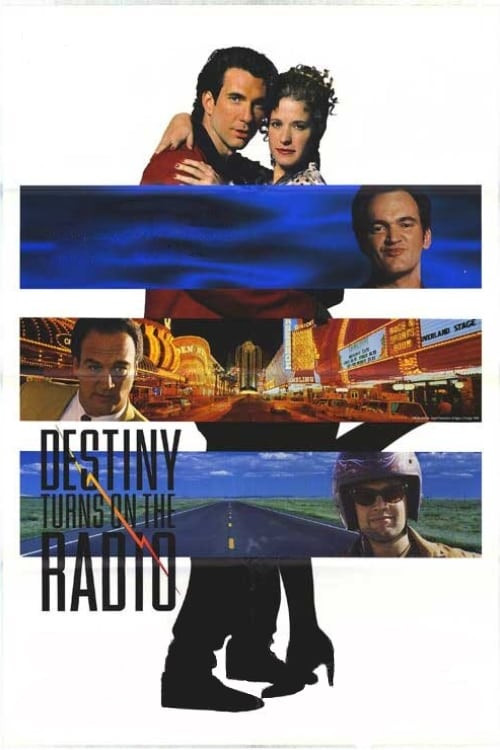
Destiny Turns On The Radio (1995, directed by Jack Baran)


Today, it can be easy to forget what an impact Quentin Tarantino had on pop culture in the 90s.  The one-two punch of Reservoir Dogs and Pulp Fiction inspired a generation of young and aspiring filmmakers to believe that anyone could make their own film.  Suddenly, you didn’t have to be a film school graduate to call yourself a filmmaker.  You could just be someone who loved movies and who was willing to keep hustling until you had something you could slip into Sundance.  That was the feeling, anyway.  The 90s were full of films about eccentric criminals who talked a lot and who loved pop culture, only three of which were directed by Quentin Tarantino.  Some of them were good.  Most of them were not.

Destiny Turns On The Radio was one of the first films to rip-off Pulp Fiction and it felt more cynical than most because it was directed by Jack Baran, who wasn’t even a video store clerk.  He was a producer of films like The Big Easy and Barfly, an industry veteran ripping off two films directed by someone who was, at that time, still an outsider.  The film tells a story that had plenty of Tarantino elements, including Quentin Tarantino himself.  Tarantino signed to play Johnny Destiny right after Pulp Fiction won the Palme d’Or at Cannes.

Johnny Destiny is a gambler who is apparently also a God.  He emerges from a lightning-filled pool and his dialogue is full of pseudo-philosophy.  He is driving through the desert when he picks up Julian (Dylan McDermott) and gives Julian a lift to Las Vegas.  Johnny Destiny is taking prison escapee Julian on a ride so that Julian can face his destiny.  Julian wants to recover some money from a bank job that he pulled off with Thoreau (James Le Gros) but it turns out that, when Johnny Destiny emerged from that pool, he also stole all the money.  (There’s no specific reason for Thoreau to be named after the famous philosopher, beyond the film trying to make itself seem deep by drawing in everyone who read Walden in AP English.)  Julian wants to get back together with Lucille (Nancy Travis), a singer who performs songs more appropriate for a 20s speakeasy than a Las Vegas lounge.  Lucille is involved with a gangster (Jim Belushi).  Belushi sings Vivia Las Vegas but otherwise, this is one of his more boring performances.

Like so many of the Pulp Fiction rip-offs of the 90s, Destiny Turns On The Radio is all self-conscious attitude and cool style, full of references to pop culture that fall flat because there’s no real thought behind them.  Reservoir Dogs and Pulp Fiction were full of style but they also told compelling stories.  Destiny Turns On The Radio is all style and little else and the cast never comes together the way that the actors in Tarantino’s first two movies did.  Watching this film, I realized why Dylan McDermott and Nancy Travis both found more success on television than in feature films.  The film posits Tarantino (as Johnny Destiny) as the epitome of cool but it then burdens him with the type of dialogue that he would have cut by the time he started a second draft.

Coming hot on the heels of the success of Pulp Fiction, Destiny Turns On The Radio actually led to a few years where many critics assumed Tarantino would be a two-trick wonder.  It was thought lightning struck twice but it would never strike a third time and Tarantino would spend the rest of his career as almost a parody of his earlier success.  Luckily, Tarantino proved them wrong and Destiny Turned On The Radio turned out to be not his career’s destination but instead just a detour.

Horror On the Lens: Creation of the Humanoids (dir by Wesley E. Barry)


The Creation of the Humanoids (1962, dir by Wesley Barry)

What makes us human?  What does it mean to have free will?  What is love?  What is freedom?  The questions and more are asked in the low-budget (and rather odd) science fiction epic The Creation of the Humanoids, which you can view below!

Now, I should warn that Creation of the Humanoids is an extremely talky film.  And the plot is occasionally difficult to follow. There’s a lot of ennui to be found in this particular film, both from the humans and those who have been built to serve them  However, I find it impossible not to love this one because it’s just such a strange movie.  I love it for the colorful set design, the contrast between the resentful robots and the paranoid humans, and the fact that the film — despite being made for next to nothing — actually has more ambition than anything ever made by several of the more successful directors working today. And, while it may not really be a horror film in the way that some of our other October films are, it still feels appropriate for the Halloween season. It just has the perfect holiday atmosphere.

First released in 1962, Creation of the Humanoids was reportedly one of Andy Warhol’s favorite films.  Keep an eye out for Plan 9 From Outer Space‘s Dudley Manlove.

Horror On the Lens: Creation of the Humanoids (dir by Wesley E. Barry)


The Creation of the Humanoids (1962, dir by Wesley Barry)

What makes us human?  What does it mean to have free will?  What is love?  What is freedom?  The questions and more are asked in the low-budget (and rather odd) science fiction epic The Creation of the Humanoids, which you can view below!

Now, I should warn that Creation of the Humanoids is an extremely talky film.  And the plot is occasionally difficult to follow. There’s a lot of ennui to be found in this particular film, both from the humans and those who have been built to serve them  However, I find it impossible not to love this one because it’s just such a strange movie.  I love it for the colorful set design, the contrast between the resentful robots and the paranoid humans, and the fact that the film — despite being made for next to nothing — actually has more ambition than anything ever made by several of the more successful directors working today. And, while it may not really be a horror film in the way that some of our other October films are, it still feels appropriate for the Halloween season. It just has the perfect holiday atmosphere.

First released in 1962, Creation of the Humanoids was reportedly one of Andy Warhol’s favorite films.  Keep an eye out for Plan 9 From Outer Space‘s Dudley Manlove.

Lisa Reviews An Oscar Nominee: The Post (dir by Steven Spielberg)


So, I finally sat down and watched the 2017 film, The Post.

The Post is something of an odd film.  Imagine if someone made a film about the production of a movie.  And imagine if, instead of focusing on the actors or the members of the crew or even the director, the film was instead about the studio executives sitting back in Hollywood and debating whether or not they should agree to give the director another million dollars to complete the film.  Imagine dramatic scenes of the execs meeting with their accountants to determine whether they can spare an extra million dollars.  Imagine triumphant music swelling in the background as one of the execs announces that they’ll raise the budget but only in return for getting to pick the title of the director’s next film.  The Post is kind of like that.  It’s a film about journalism that’s more concerned with publishers and editors than with actual journalists.

To be honest, The Post‘s deification of the bosses shouldn’t really be that much of a shock.  This is a Steven Spielberg film and a part of Spielberg’s legend has always been that, of all the young, maverick directors who emerged in the 70s, he was always the one who was the most comfortable dealing with the studio execs.  As opposed to directors like Martin Scorsese, Brian DePalma, and Francis Ford Coppola, Spielberg got along with the bosses and they loved him.  While his contemporaries were talking about burning Hollywood down and transforming the culture, Spielberg was happily joining the establishment and reshaping American cinema.  No one can deny that Spielberg is a talented filmmaker.  It’s just that, if anyone was going to make a movie celebrating management, you just know it would be Steven Spielberg.

Taking place in the early 70s, The Post deals with the decision to publish The Pentagon Papers, which were thirty years worth of classified documents dealing with America’s involvement in the Vietnam War.  Since the Pentagon Papers revealed that the government spent several decades lying to the American people about the situation in Vietnam, there’s naturally a lot of pushback from the government.  It all leads to one of those monumental supreme court decisions, the type that usually ends a movie like this.  And while the film does acknowledge that there were journalists involved in breaking the story, it devotes most of its attention to editor Ben Bradlee (Tom Hanks) and publisher Katharine Graham (Meryl Streep).

Gasp as Ben and Katharine debate whether to publish the story!

Shudder as Katharine tries to figure out how to keep the Post from going bankrupt.

Watch as Ben Bradlee talks to the legal department!

Thrill as Katharine Graham learns that her family friends, John F. Kennedy and Lyndon B. Johnson, weren’t always honest with her!

And listen, I get it.  The Post isn’t as much about Nixon and the Vietnam War as it’s about Trump and the modern-day war on the media.  And yes, we get plenty of scenes of Tom Hanks explaining why freedom of the press is important and the movie ends in typical Spielberg fashion, with triumphant music and all the rest.  But watching The Post, it’s hard not to think about other films that celebrated journalism, films like All The President’s Men and Spotlight.  Both of those films featured scenes of editors supporting their reporters.  In fact, All The President’s Men featured Jason Robards playing the same editor that Tom Hanks plays in The Post.  But Spotlight and All The President’s Men focused on the journalists and the hard work that goes into breaking an important story.  Robards and Spotlight‘s Michael Keaton played editors who were willing to stand up and defend their reporters but, at the same time, those films emphasized that it was the underpaid and underappreciated reporters who were often putting their careers (and sometimes, their lives) on the line to break a story.  Whereas Spotlight and All The President’s Men showed us why journalism is important, The Post is content to merely tell us.

The Post was a famously rushed production.  Shooting started in May of 2017 and was completed in November, all so it could be released in December and receive Oscar consideration.  Production was rushed because Spielberg, Streep, and Hanks all felt that it was important to make a statement about Trump’s treatment of the press.  While I can see their point and I don’t deny that they had noble intentions, a rushed production is still going to lead to a rushed film.  The Post is a sloppy film, full of way too much on-the-nose dialogue and scenes that just seem to be missing Spielberg’s usual visual spark.  It feels less like a feature film and more like a well-made HBO production.  Tom Hanks and Meryl Streep give performances that are all surface.  Streep’s performance is all mannered technique while Hanks occasionally puts his feet up on his desk and furrows his brow.

It gets frustrating because, watching the film, you get the feeling that there’s a great movie to be made about the Pentagon Papers and the struggle to publish them.  I’d love to know what the actual reporters went through to get their hands on the papers.  But The Post is more interested in management than the workers.

All through 2017, The Post was touted as being a sure Oscar front-runner.  When it was released, it received respectful but hardly enthusiastic reviews.  In the end, it only received two nominations — one for best picture and one for Streep.  In a year dominated by Lady Bird, Shape of Water, Get Out, and Three Billboards Outside Ebbing, Missouri, The Post turned to be a nonfactor.  For all the hype and expectations, it’s the film that you usually forget whenever you’re trying to remember everything that was nominated last year.

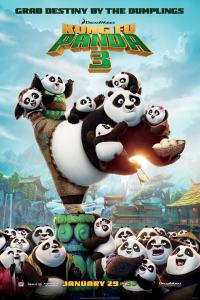
Quick Review: Kung Fu Panda 3 (dir. by Jennifer Yuh & Alessandro Carloni)


imagesHaving become the Dragon Warrior and the Champion of the Valley of Peace on many occasions, Po (Jack Black) has reached a point where its time for him to train others. All of this becomes complicated when Kai (J.K. Simmons), a former enemy of Master Oogway (Randall Duk Kim) returns to the Valley to capture the Chi of the new Dragon Warrior and anyone else that stands in his way.
The Legend of Korra geek in me hears the character of Tenzin whenever Simmons speaks in this film, only it’s Evil Tenzin vs. The Dragon Warrior. That alone was awesome.

Picking right up from Kung Fu Panda 2, Po is reunited with his birth father (Bryan Cranston), and discovers there are also other Pandas in the world. This, of course, causes a bit of tension for Po’s Goose Dad (James Hong) who raised him up until now. Can Po find a way to stop Kai? The theme of this film seems to be dealing with self discovery (as did the other films), but this focuses more on what we consider our Identity. Are we the role we take on from day to day at work or the role we have at home, or even a little of both? There’s also a nice family element to it as Po discovers what Panda life is like and deals with his Dads. Really young audiences may not exactly catch on to the theme, but there’s enough action and playful moments to keep them occupied.

On a visual level, the animation is beautiful. If you get a chance to see it in 3D, the Spirit Realm is a treat, with rocks and buildings floating around. The action scenes also move in a comic strip format, with the screen split in different ways to catch different elements. If you’re quick enough, you can catch it all. It can be jarring to anyone not used to it, I’d imagine. The Furious Five don’t have too much screen time in this one, save for Angelina Jolie’s Tigress, though it’s cute when you realize that some of the panda children in the village are played by the Jolie-Pitt kids. That was a nice discovery in the credits.

Musically, just like The Dark Knight Rises, Hans Zimmer takes what was a dual scoring effort (at least in the 2nd film) and makes it his. Though he’s assisted by Lorne Balfe (13 Hours: The Secret Soldiers of Benghazi), and drummer Sheila E. (Who worked with him on the Man of Steel score), it’s all Zimmer, really. Kai is given a nice theme to work with, one I can only describe as “Jazz Badass with Kung-Fu Swagger” and I enjoyed the music for the Panda village.

The only problem I had with Kung Fu Panda 3 was that it didn’t feel particularly epic in scope for me. In the first film, Tai Lung wanted to harness the power of the Dragon Scroll. In the second, the Peacock Shen brought cannons to decimate the Valley. This one was more personal and I enjoyed that, but it also felt like it could have been one of the Legends of Awesomeness episodes on Nickelodeon. It moved that quickly. Though it clocks in at an hour and 35 minutes — the same as the other films — it really whizzed by. It’s not a terrible thing at all, really, but I think I wanted something a little more.

Overall, Kung Fu Panda is a fun treat for the kids. While I didn’t go blind out of exposure to sheer awesomeness this time around, it gave me some inner peace and smiles.

Playing Catch-Up With 6 Mini-Reviews: Amy, Gloria, Pitch Perfect 2, Sisters, Spy, Trainwreck


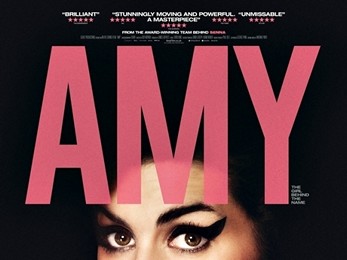
Amy_Movie_Poster

Amy (dir by Asif Kapadia)

Amy opens with brilliant and, in its way, heartbreaking footage of a 14 year-old Amy Winehouse and a friend singing Happy Birthday at a party.  Even though she’s singing deliberately off-key and going over-the-top (as we all tend to do when we sing Happy Birthday), you can tell that Amy was a star from the beginning.  She’s obviously enjoying performing and being the center of attention and, try as you might, it’s impossible not to contrast the joy of her Happy Birthday with the sadness of her later life.

A star whose music touched millions (including me), Amy Winehouse was ultimately betrayed by a world that both wanted to take advantage of her talent and to revel in her subsequent notoriety.  It’s often said the Amy was self-destructive but, if anything, the world conspired to destroy her.  By focusing on footage of Amy both in public and private and eschewing the usual “talking head” format of most documentaries, Amy pays tribute to both Amy Winehouse and reminds us of what a great talent we all lost in 2011.

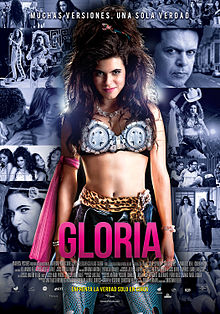
Gloria_(2014_Film_Poster)

Gloria (dir by Christian Keller)

The Mexican film Gloria is a musical biopic of Gloria Trevi (played by Sofia Espinosa), a singer whose subversive songs and sexual image made her a superstar in Latin America and challenged the conventional morality of Catholic-dominated establishment.  Her manager and lover was the controversial Sergio Andrade (Marco Perez).  The movie follows Gloria from her first audition for the manipulative Sergio to her arrest (along with Sergio) on charges of corrupting minors.  It’s an interesting and still controversial story and Gloria tells it well, with Espinosa and Perez both giving excellent performances.

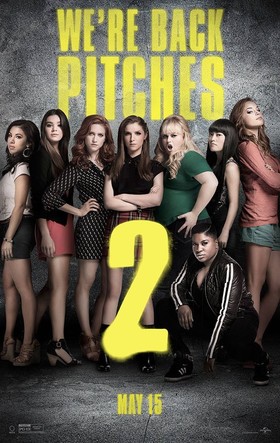
Pitch_Perfect_2_poster

Pitch Perfect 2 (dir by Elizabeth Banks)

The Bellas are back!  As I think I’ve mentioned a few times on this site, I really loved the first Pitch Perfect.  In fact, I loved it so much that I was a bit concerned about the sequel.  After all, sequels are never as good as the original and I was dreading the idea of the legacy of the first film being tarnished.

But the sequel actually works pretty well.  It’s a bit more cartoonish than the first film.  After three years at reigning ICCA champions, the Bellas are expelled from competition after Fat Amy (Rebel Wilson) accidentally flashes the President.  The only way for the Bellas to get the suspension lifted is to win the World Championship of A Capella.  The plot, to be honest, really isn’t that important.  You’re watching the film for the music and the interplay of the Bellas and, on those two counts, the film totally delivers.

It should be noted that Elizabeth Banks had a great 2015.  Not only did she give a great performance in Love & Mercy but she also made a respectable feature directing debut with Pitch Perfect 2.

Sisters_movie_poster

Sisters (dir by Jason Moore)

It’s interesting how opinions can change.  For the longest time, I really liked Tina Fey and I thought that Amy Poehler was kind of overrated.  But, over the past two years, I’ve changed my opinion.  Now, I like Amy Poehler and Tina Fey kind of gets on my nerves.  The best way that I can explain it is to say that Tina Fey just seems like the type who would judge me for wearing a short skirt and that would get old quickly, seeing as how I happen to like showing off my legs.

Anyway, in Sisters, Tina and Amy play sisters!  (Shocking, I know.)  Amy is the responsible one who has just gotten a divorce and who wants to make everyone’s life better.  Tina is the irresponsible one who refuses to accept that she’s no longer a teenager.  When their parents announce that they’re selling the house where they grew up, Amy and Tina decide to throw one last party.  Complications ensue.

I actually had two very different reactions to Sisters.  On the one hand, as a self-declared film critic, it was easy for me to spot the obvious flaw with Sisters.  Tina and Amy should have switched roles because Tina Fey is simply not believable as someone who lives to have fun.  Sometimes, it’s smart to cast against type but it really doesn’t work here.

However, as the youngest of four sisters, there was a lot of Sisters that I related to.  I saw Sisters with my sister, the Dazzling Erin, and even if the film did not work overall, there were still a lot of little scenes that made us smile and go, “That’s just like us.”  In fact, I think they should remake Sisters and they should let me and Erin star in it.

Spy2015_TeaserPoster

Spy (dir by Paul Feig)

There were a lot of very good spy films released in 2015 and SPECTRE was not one of them.  In fact, the more I think about it, the more disappointed I am with the latest Bond film.  It’s not so much that SPECTRE was terrible as there just wasn’t anything particular memorable about it.  When we watch a film about secret agents saving the world, we expect at least a few memorable lines and performances.

Now, if you want to see a memorable spy movie, I suggest seeing Spy.  Not only is Spy one of the funniest movies of the year, it’s also a pretty good espionage film.  Director Paul Feig manages to strike the perfect balance between humor and action.  One of the joys of seeing CIA employee Susan Cooper (Melissa McCarthy) finally get to enter the field and do spy stuff is the fact that there are real stakes involved.  Susan is not only saving the world but, in the film’s best scenes, she’s having a lot of fun doing it and, for that matter, McCarthy is obviously having a lot of fun playing Susan and those of us in the audience are having a lot of fun watching as well.

Spy also features Jason Statham as a more traditional action hero.  Statham is hilarious as he sends up his own macho image.  Seriously, who would have guessed that he could such a funny actor?  Here’s hoping that he, McCarthy, and Feig will all return for the inevitable sequel.

Trainwreck_poster

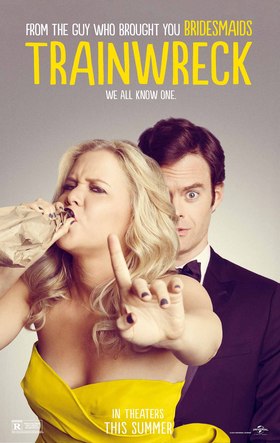
Trainwreck (dir by Judd Apatow)

There’s a lot of great things that can be said about Trainwreck.  Not only was it the funniest film of 2015 but it also announced to the world that Amy Schumer’s a star.  It was a romantic comedy for the 21st Century, one that defied all of the conventional BS about what has to happen in a romcom.  This a film for all of us because, let’s just be honest here, we’ve all been a trainwreck at some point in our life.

But for me, the heart of the film was truly to be found in the relationship between Amy and her younger sister, Kim (Brie Larson).  Whether fighting over what to do with their irresponsible father (Colin Quinn) or insulting each other’s life choices, their relationship is the strongest part of the film.  If Brie Larson wasn’t already guaranteed an Oscar nomination for Room, I’d demand that she get one for Trainwreck.  For that matter, Amy Schumer deserves one as well.

Seriously, it’s about time the trainwrecks of the world had a film that we could truly call our own.

Horror On The Lens: Creation of the Humanoids (dir by Wesley E. Barry)


What makes us human?  What does it mean to have free will?  What is love?  What is freedom?  The questions and more are asked in the low-budget (and rather odd) science fiction epic The Creation of the Humanoids, which you can view below!

Now, I should warn that Creation of the Humanoids is an extremely talky film.  And the plot really doesn’t make much sense.  However, I still like it because it’s just such a strange movie.  I love it for the colorful set design, the contrast between the resentful robots and the paranoid humans, and the fact that the film — despite being made for next to nothing — actually has more ambition than anything ever made by Michael Bay.

First released in 1962, Creation of the Humanoids was reportedly one of Andy Warhol’s favorite films.  Keep an eye out for Plan 9 From Outer Space‘s Dudley Manlove.


6 Obscure Films Of 2013: The Call, Copperhead, It’s A Disaster, See Girl Run, UnHung Hero, Would You Rather


Well, it’s that time of year when I look at the list of the films that I’ve seen over the past 12 months and I realize that there’s quite a few that I haven’t gotten around to reviewing yet.  Here are my thoughts on six of them.

The Call (dir by Brad Anderson)

Abigail Breslin is kidnapped by a serial killer.  While trapped in the trunk of the killer’s car, Breslin manages to call 911.  Breslin’s call is answered by Halle Berry, a veteran operator who is recovering from a trauma that — by an amazing and totally implausible coincidence — was caused by the same guy who has just kidnapped Breslin.

Before it became a feature film, The Call was originally developed as a weekly TV series and, as I watched, it was easy to imagine weekly episodes that would all feature a different guest star calling 911 and needing help.  For the first hour or so, The Call is well-made and acted but undistinguished.  However, during the final 30 minutes, the entire film suddenly goes crazy with Breslin running around in her bra, Berry turning into a blood thirsty vigilante, and the killer suddenly getting very verbose.  However, those 30 minutes of pure insanity were just what The Call needed to be memorable.  There are some films that definitely benefit from going over-the-top and The Call is one of them.

Copperhead (dir by Ronald Maxwell)

Copperhead is a historical drama that takes place during the Civil War.  In upstate New York, farmer Abner Breech (Billy Campbell) is ardently opposed to both the Civil War and the union cause.  In most movies, this would make Abner the villain but, in Copperhead, he’s portrayed as being a man of principle who, by refusing to compromise on his views, is ostracized and ultimately persecuted by the rest of his village.  Abner’s views also bring him into conflict with his own son, who is pro-Union.

Copperhead is a slow-moving film that features some rather good performances along with some fairly bad ones.  However, I’m a history nerd so I enjoyed it.  It certainly tells a different story from what we’ve come to expect from American films about the Civil War.

It’s A Disaster (dir by Todd Berger)

Of the six films reviewed in this post, It’s A Disaster is the one to see.  In this darker than dark comedy, Julia Stiles brings her new boyfriend (David Cross) to Sunday brunch with 6 of her closest friends.  During the brunch, terrorists explode a dirty bomb in the city.  With everyone trapped inside the house and waiting for the world to either end or somehow revert back to normal, long-simmering resentments come to the forefront.

To say anything else about It’s a Disaster would be unfair so I’ll just say that it’s a very funny film, featuring excellent work from both Stiles and Cross.  If Jean-Paul Sartre was alive and writing today, he would probably end up writing something very similar to It’s a Disaster.

See Girl Run (dir by Nate Meyer)

Bleh!  That’s probably the best description I can give you of this film.  It’s just a whole lot of bleh.

Emmie (Robin Tunney) is unhappy with her boring marriage so she runs back to her Maine hometown, stops wearing makeup and washing her hair, and pines for her high school boyfriend, Jason (Adam Scott), who works at a sea food restaurant.  Jason also happens to be friends with Emmie’s depressed brother, Brandon (Jeremy Strong).  It’s the same basic plot as Young Adult, just with no humor and a lot more talking.  In Young Adult, it was hard not to admire Charlize Theron’s wonderfully misguided character.  In See Girl Run, you just want to tell Robin Tunny to take a shower, put on some clothes that don’t look like they were stolen from a hospital storage closet, and stop whining all the time.

It’s difficult to put into words just how much I hated this movie.  This is one of those films that critics tend to describe as being “a film for adults.”  I have to agree — this is a movie for really boring, depressing adults who like to talk and talk about how their lives haven’t worked out.  If See Girl Run is what being an adult is like, I’ll just continue to be an immature brat, thank you very much.

UnHung Hero (dir by Brian Spitz)

So, this is not only the worst documentary of 2013 but it’s also quite probably one of the worst documentaries ever made.  The film opens with footage of Patrick Moote (who claims to be a comedian) asking his girlfriend to marry him.  As Moote goes on (and on) to tell us, she turns down his proposal and then dumps him because, according to her, his penis is too small.  Moote spends the rest of the film talking to various people and asking them whether size really matters.

Well, he could have just asked me and saved a lot of time.  I’m sorry if this endangers any fragile male egos but yes, size does matter.  If Moote’s penis really is as tiny as he claims it is, I probably would have turned down his proposal as well.  Then again, Moote could be hung like Jamie Foxx and I’d probably still refuse to marry him because, quite frankly, he’s the whiniest and most annoying person that I’ve ever seen.  He’s like an even less charming version of Morgan Spurlock.  What Patrick Moote never seems to understand is that size matters but personality matters even more.

Would You Rather (dir by David Guy Levy)

Would you rather have a root canal or sit through this piece of crap?  Having seen Would You Rather, I can tell you that it’s not an easy question to answer.

Jeffrey Combs plays a sadistic millionaire who invited a bunch of strangers (including Brittany Snow, John Heard, June Squibb, and Sasha Grey) to his mansion and forces them to play an elaborate and deadly game of Would You Rather.  Unfortunately, none of the characters are interesting, the film’s sadism is more boring than shocking, and talented actor Combs is totally wasted as the one-note villain.