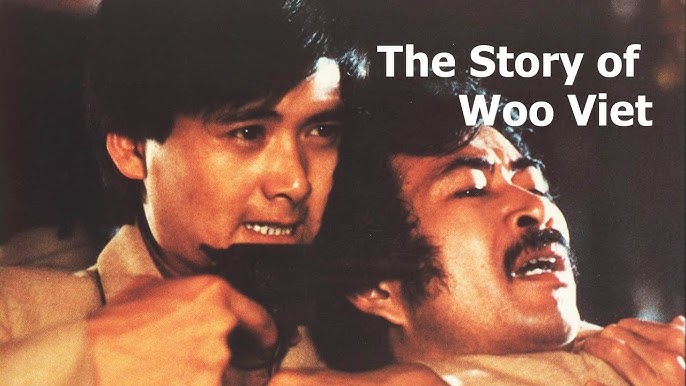
When I became obsessed with Chow Yun-Fat in the latter half of the 1990’s, I would constantly search for his movies at the Suncoast Video Store in the Park Plaza Mall whenever we’d go to Little Rock. Unfortunately, I’d run into cheap looking DVDs with titles like “God of Killers,” but I’d buy them anyway. That’s the title under which I first attempted to watch THE STORY OF WOO VIET, starring a young Chow-Yun-Fat and directed by Hong Kong legend Ann Hui. Whoever distributed the film was making a blatant cash grab on Chow Yun-Fat’s worldwide popularity at the time, and the DVD was terrible. I turned it off after a little while because the print was so dark you could barely see it, and the subtitles were illegible, constantly falling off the screen. I had not attempted to watch the film again until very recently. My friends on “Podcast on Fire” devoted an episode to THE STORY OF WOO VIET, which piqued my interest again. Lo and behold, I found a fine print with English subtitles streaming on Tubi!
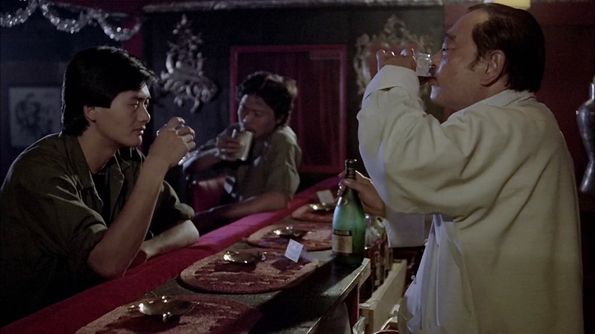
As the story starts, we meet Woo Viet (Chow Yun-Fat) on a boat full of starving refugees. We learn that he’s a former Vietnamese soldier escaping to Hong Kong in hopes of making his way to the United States. It’s a tough start as we see a baby die of malnourishment and an old man murdered by Vietnamese special agents, which leads to Woo Viet fighting off and killing those same agents, all within the first 15 minutes. On the run for murder, he’s lucky that his Hong Kong pen pal, social worker Lap-Quan (Cora Miao), can help him get fake papers for his escape to the United States. As he’s getting ready to leave, he meets the beautiful Shum Ching (Cherie Chung), who’s also using fake documents to get to the U.S. Unfortunately, the Hong Kong trafficker who’s supposed to be helping them, has sold Shum Ching to a powerful gangster in the Philippines with plans to turn her into a prostitute. When she’s taken away from the Manila airport, Woo Viet goes after her. Unable to kick enough ass to save her, he ends up working as a hired gun for her kidnapper in hopes of buying her freedom. Throw in Shaw Brothers legend Lo Lieh as Sarm, Woo Viet’s partner in crime in Manila, and the stage is set for an escape to a better tomorrow or loneliness and a quick death.
After viewing the film, it’s probably best that I couldn’t watch THE STORY OF WOO VIET back in the late 1990’s. At that time, I wanted Chow Yun-Fat as the honorable gangster of films like A BETTER TOMORROW and THE KILLER, or the badass cop of HARD-BOILED. I could not have appreciated director Ann Hui’s work here, the second film in her “Viet Nam trilogy.” Gritty and downbeat, it’s about as far away from John Woo’s stylish films as you can get. When the violence comes, it lands with a painful thud as nails enter heads, knives slash bodies, and even toothbrushes are shoved through cheeks. This is Ann Hui working within a genre film plotline while infusing it with something akin to bleak realism. She would go on to develop her legendary career with the next year’s BOAT PEOPLE, and she would use Chow a couple of more times in films like LOVE IN A FALLEN CITY and THE POSTMODERN LIFE OF MY AUNT. This is not peak Ann Hui, but she still brings something interesting to this early effort.
As far as the performances go, Chow may have been 5 years away from the superstardom of A BETTER TOMORROW, but he already had what it took to be a film lead. Even in a film like this, without his heroic bloodshed honor, he has a way of making it look easy. Cherie Chung is appealing as Shum Ching, and she was soon on her way to film stardom in Hong Kong hits like PEKING OPERA BLUES, AN AUTUMN’S TALE (with Chow), and John Woo’s ONCE A THIEF (also with Chow). Like many Hong Kong actresses before her, after a string of successful films she would get married and retire in 1991. I like Cora Miao early in the film as the kind social worker, but she fades as the film progresses. Miao would work with Chow and Ann Hui frequently throughout the 80’s. Like Chung, she retired in 1991 and married director Wayne Wang (THE JOY LUCK CLUB). Finally, I wanted to give a shoutout to Lo Lieh as Woo Viet’s one friend, Sarm. While he may be known best for his classic work with Shaw Brothers in films like the FIVE FINGERS OF DEATH and THE 36TH CHAMBER OF SHAOLIN, he gives a solid character performance here and would go on to work in Hong Kong for another two decades.
THE STORY OF WOO VIET is not at the top of the list of films that Hong Kong legends Chow Yun-Fat and Ann Hui would work on, but it’s still an important watch to see their obvious talent at this point in their careers. I’m glad I finally watched the film in 2026. After all the life I’ve lived since those days digging through the DVDs at the Park Plaza Mall, there’s no way it could have hit me the same way then that it does now.
“Hi, I’m Cindy. I’m the perfect female type: 18 to 25. I’m here to sell for you.” — Cindy Fairmont
Looker is one of those 1981 films that, when it first came out, probably felt more like a goofy, slightly overwrought tech‑paranoia thriller than a serious prediction about the future. On paper, the premise—plastic‑surgery‑obsessed models being turned into digital clones for hyper‑tuned TV ads—sounds like a pulpy B‑movie gimmick. But viewed through the lens of right now, with Instagram influencers, AI‑generated content, and algorithm‑driven aesthetics shaping how we think about beauty and success, Looker starts to feel like a strangely accurate, almost eerie forecast. For a movie that was easy to write off as a minor, tonally wobbly Michael Crichton artifact, it does a surprisingly sharp job of outlining the emotional and cultural landscape we’re living in four decades later.
At the center of that landscape is Digital Matrix, the film’s antagonist in the form of a sleek, forward‑looking tech company that positions itself as a clean, rational, and indispensable partner to the advertising world. The company promises to revolutionize marketing by replacing messy, unreliable human models with perfectly calibrated digital avatars optimized to trigger maximum viewer response. That framing—as a neutral, even benevolent innovator—makes it all the more unsettling when its plans take on a distinctly murderous slant. To protect its “LOOKER” system and its vision of a world where perception can be mathematically controlled, Digital Matrix is willing to silence anyone who gets too close to the truth, from test‑subject models to inquisitive doctors. The bodies start piling up just off‑screen, treated as collateral damage in the pursuit of a more efficient, more profitable media ecosystem.
Seen from today’s vantage, Digital Matrix feels like a rough, bluntly drawn prototype of the big tech giants we now live with: polished, data‑driven, media‑centric, and profoundly invested in shaping what we see, buy, and believe. The difference, of course, is that modern tech behemoths are a lot better at hiding the bodies. In the real world, the “harm” is rarely as literal as Looker portrays it; instead, it shows up as algorithm‑driven addictions, mental health erosion, privacy carve‑ups, and the quiet erosion of trust in shared reality. People don’t get zapped by a sinister beam of light in a corporate lab; they get nudged into polarization, over‑consumption, or self‑images so warped that they resemble the film’s surgically obsessed models. The film exaggerates the physical violence, but its broader point—that when a tech company decides it can engineer human behavior at scale, ethical lines start to blur—still rings uncomfortably true.
Crichton’s version of this is less about organic social‑media culture and more about a centralized, corporate‑run system, but the emotional texture is similar. The models in Looker are under pressure to conform to a narrow, algorithmically derived standard of beauty, and the film doesn’t shy away from the toll that takes. They’re not just selling products; they’re being sold as products, their bodies and faces reduced to data points that can be adjusted, duplicated, and replaced. The idea that a person can be scanned, stored, and then endlessly repurposed as a digital avatar also anticipates contemporary debates about deepfakes, AI‑generated influencers, and the fear that real actors, musicians, and creators might be replaced by synthetic versions once their likeness and behavior are sufficiently “trained.” In that sense, Looker reads like an early, slightly clunky draft of the same anxieties we’re only now starting to grapple with at scale.
Where Looker falls short, at least in its day, is in fully articulating what all of this means for the idea of truth. The technology of 1981—not just the film’s budget and effects, but the broader cultural imagination—still assumed that truth was something largely fixed, something you could point to and defend if you had the right facts on your side. The movie flirts with the idea that perception can be manufactured, but it doesn’t really have the tools yet to show how completely that can destabilize the very concept of objective reality. The “LOOKER” system is treated as a kind of brainwashing gadget, a one‑off sci‑fi device rather than the logical endpoint of an entire infrastructure built to measure, model, and manipulate human behavior. The film wants to ask who controls the image, but in the early ’80s that question still felt contained, almost theatrical.
Now, in a world where truth is less about who has the facts in their corner and more about who controls the data, it’s clear how undercooked that idea really was in Looker. Today, truth is less a question of evidence and more a question of access: who has the biggest data centers, who owns the most comprehensive behavioral datasets, who runs the most sophisticated algorithmic matrices for shaping what people see, hear, and believe. Social‑media platforms, search engines, and ad networks don’t just reflect reality; they actively construct it by deciding which voices get amplified, which images get pushed, and which narratives get repeated until they feel like consensus. The company with the most money to build and refine those systems doesn’t just sell products; it sells versions of reality, packaged as personalized feeds, auto‑generated content, and AI‑driven narratives that feel increasingly indistinguishable from the “real” world.
Looker doesn’t fail because the ideas themselves are weak; in fact, the film actually does a fairly solid job of letting those ideas breathe and collide with each other. The problem is that those ideas sounded quite ludicrous within the context of 1981. A company digitally scanning and cloning models to engineer perfect ads, then using a device to subtly manipulate viewers’ minds, felt closer to paranoid pulp fantasy than plausible near‑future speculation. That gap between the film’s ambition and its audience’s willingness to buy into it gives the movie a slightly awkward tone, as if the world around it hasn’t yet caught up to the reality Crichton is trying to describe. The concepts are ahead of their time, which is exactly what makes them feel so prescient now, but back then, that same forward‑thinking quality made them easier to dismiss as silly or overreaching.
That disconnect is compounded by a cast that never quite seems to have fully bought into the film’s themes and narrative, even though several of them are game within the limits of the material. Albert Finney brings his usual grounded, slightly skeptical energy to Dr. Larry Roberts, lending the story a believable human center as the reluctant investigator pulled into Digital Matrix’s orbit. There’s a lived‑in quality to his performance that makes the ethical unease feel real, even when the plot veers into goofy sci‑fi mechanics. James Coburn, meanwhile, chews the scenery with a smarmy, charming conviction that suits Reston perfectly; he plays the corporate tech visionary as someone who genuinely believes in his own rhetoric, which makes his moral bankruptcy feel all the more unsettling. But around them, the rest of the ensemble often feels like it’s treating the premise more as a glossy thriller window dressing than a full‑blown social‑tech critique. The models and executives sometimes land their lines with a kind of detached professionalism that undercuts the deeper anxieties the film is trying to tap into.
As a piece of cultural legacy, Looker works less as a perfectly executed prediction and more as an early, slightly wobbly harbinger of the digital age we’re now fully immersed in. The film’s version of Digital Matrix may look clunky by our standards, but its logic—optimize attention, manufacture desire, and treat people as data to be extracted and reused—has become the default operating system of much of the digital world. The anxiety about who controls the image, who owns the algorithm, and who ultimately shapes what we see as “real” is no longer a speculative sci‑fi concern; it’s baked into the daily experience of social media, deepfake content, and AI‑driven feeds. Looker doesn’t need to be taken as a perfectly accurate prediction; it’s more powerful as a mood piece about the anxieties Crichton saw simmering beneath the surface of media, technology, and consumer culture. And in the way it casts a cutting‑edge tech company as the film’s real antagonist—a corporation whose “progressive” vision of the future quietly slides into murder and control—it feels uncomfortably close to the darker side of today’s Silicon Valley logic, minus the obvious body count but packed with a different kind of damage—one that’s less about visible corpses and more about the quiet erosion of what we can trust to be true.
Looker doesn’t so much fly too high to the sun and then crash‑burn under the weight of its ambition as it does peer through a cracked, slightly distorted future‑looking glass and just keeps staring in the wrong direction until the future finally catches up to it. It’s a film that doesn’t quite hold together as a flawless sci‑fi masterpiece, but it also never fully collapses under its own loftiness the way so many overly serious ’80s tech‑paranoia pictures do. Instead, it lurches forward with a rough, uneven energy that somehow makes its prescience feel more honest than polished. The movie doesn’t provide clean answers or tidy resolutions; it just lays out a set of ideas—about media, authenticity, beauty standards, and corporate control over perception—and then lets them sit in the air long after the credits roll.
Since today is Orson Welles’s birthday, I wanted to share at least one scene that I love from his films. The famous tracking shot from 1958’s TouchofEvil, which begins in America and ends in Mexico, truly shows Orson Welles at his visionary best.
It’s also Welles at his most clever. Knowing that he wouldn’t be given control over the editing of the footage he shot, Welles included as many long shots as possible to make it more difficult for an editor to chop up or alter his vision.
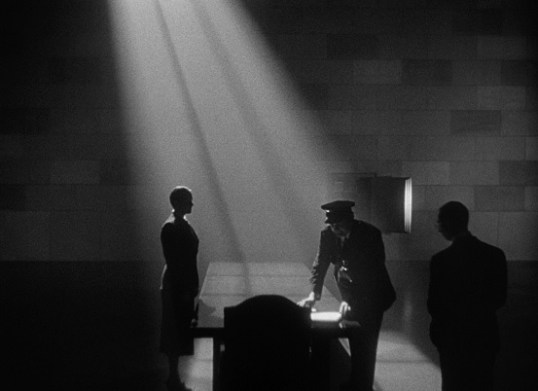
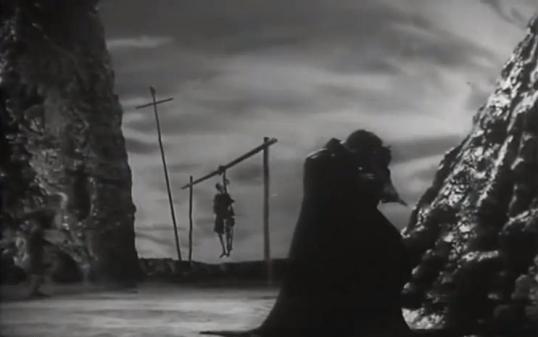
4 Or More Shots From 4 Or More Films is just what it says it is, 4 shots from 4 of our favorite films. As opposed to the reviews and recaps that we usually post, 4 Shots From 4 Films lets the visuals do the talking!
Today we celebrate what would have been the 111th birthday of the great Orson Welles! It’s time for….
4 Shots from 4 Orson Welles Films
Citizen Kane (1941, dir by Orson Welles, DP: Gregg Toland)
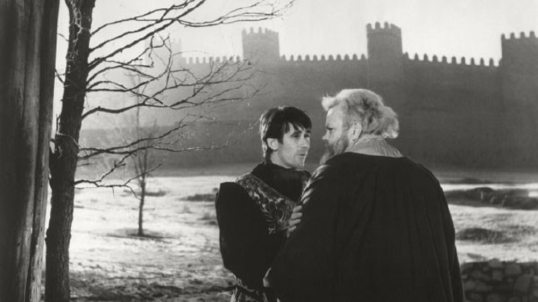
MacBeth (1948, dir by Orson Welles, DP: John L. Russell)
The Trial (1962, dir by Orson Welles, DP: Edmond Richard)
Chimes at Midnight (1965, dir by Orson Welles, DP: Edmond Richard)
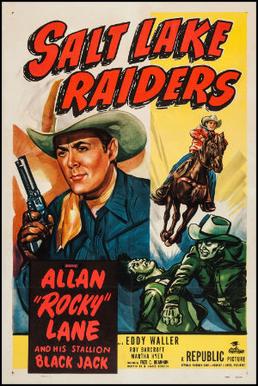
When convicted murderer Fred Mason (Myron Healey) escapes during a prison transfer, frontier Marshal Rocky Lane (Allan Lane) is brought in to re-capture him. It’s believed that Fred has returned to the ghost town of Silver City so that he can retrieve a buried treasure of $100,000. But when Rocky tracks Fred down, Fred insists that he was set up and that he didn’t kill anyone. Rocky, Fred, and Nugget Clark (Eddy Waller) are soon captured by outlaw Brit Carson (Roy Barcroft), who is also searching for the money.
I wasn’t planning on watching Salt Lake Raiders today. I’ve long wanted to review a Whip Wilson western and I was hoping I would be able to find one of his films, Silver Raiders, on YouTube. However, every search that I did for Silver Raiders just returned Salt Lake Raiders. Instead of watching a Whip Wilson western, I ened up just watching another Allan Lane western.
Salt Lake Raiders is a competently-made but not very memorable western. The person who set up Fred is no big surprise. The ghost town is a good location and, as always, Allan Lane is a believable hero. Eddy Waller, as usual, plays sidekick Nugget Clark and lovely Martha Hyer plays the daughter of the man who Fred was accused of killing, The movie holds your interest but it’s also so predictable that it is easy to understand why the studios abandoned B-western movies once television started giving them to people for free.
Unless I missed it, there is no mention of Salt Lake City or any other salt lakes in this movie.
When fans of Hong Kong cinema think of high-quality film craftsmanship, the name Wong Jing doesn’t immediately come to mind. Sure, he directed one of my all-time favorite films, GOD OF GAMBLERS (1989), and he’s had his share of box office success over the years, but he’s also churned out a lot of crap. His name is not often the stamp of quality on a film production, but there’s something about working with Chow Yun-Fat that will sometimes bring out his best.
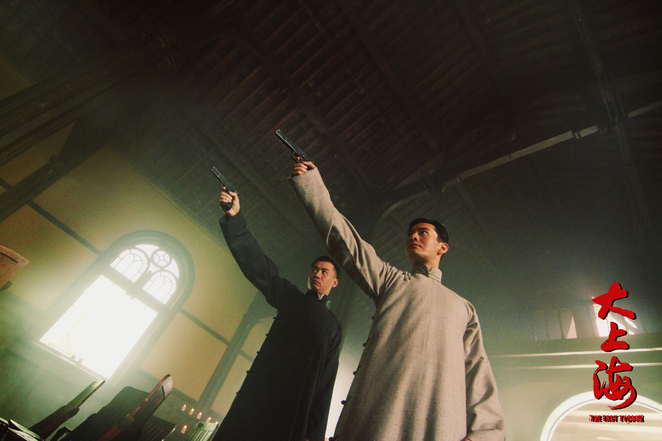
THE LAST TYCOON tells the story of Shanghai crime boss Cheng Daqi, portrayed here in two separate timelines by actor Huang Xiaoming in his younger years, and by the legendary Chow Yun-Fat in his older years. When we meet young Cheng, he seems like an awfully nice guy and then fate places him in a jail cell with the shady Mao Zai (Francis Ng). To escape and save his own life, and with a little help from Mao, Cheng commits his first murder. Forced to flee, Cheng aligns himself with a gang led by Hong Shouting (Sammo Hung). A natural leader, and as badass as it gets, Cheng rises rapidly in the ranks. The narrative isn’t as straight forward as this sounds so far, because it leaps frequently back and forth between younger Cheng and older Cheng. When the film finally settles in with Chow Yun-Fat for its latter half, we have seen how Cheng rose to become one of the most powerful men in Shanghai. We also understand how he has found himself in an extremely difficult wartime position with the Japanese that will test his loyalty to his country, as well as to the people he loves.
Right out of the gate, I want to give kudos to Wong Jing for putting together a highly entertaining film, set against an incredible 30-year backdrop of historical Shanghai! I don’t mention it in the summary above, but THE LAST TYCOON finds time to feature an abundance of romance between Cheng and the two loves of his life. We’re talking about grand melodrama done right, offset periodically with awesome action sequences, whether they be hand-to-blade street brawls, heroic bloodshed shoot-outs, or explosive wartime bombing raids. The emotions and the blood flow very strongly in this one!
The role of Cheng Daqi fits Chow Yun-Fat like a glove. He emotes early and often, and when he takes a break from that, it’s usually to pick up a pistol that he’s able to wield with maximum precision and efficiency. For a long-time fan like me, it’s high-quality fan service that fits seamlessly into the pulpiness of the story. As the younger version of Cheng, Huang Xiaoming does a fine job with the romance and the action. It seems perfectly natural that he’d eventually turn into the legend. Huang gets a lot of screentime, and without his solid portrayal, I don’t think the film would have worked nearly as well.
I did want to mention some of the notable supporting performances in THE LAST TYCOON. Veteran Francis Ng is as reliable as ever as we see his character go from a mystery lifesaver at the beginning to an evil villain by the end. The role may be underdeveloped, but Ng makes it work. I’m going to be looking for more from actor Gao Hu, who’s a total badass in his role as Cheng’s loyal soldier Lin Huai. Present over the entire 30-year timeline of the film, the man’s expert switchblade skills and gun-handling abilities are crucial to Cheng’s safety! Yolanda Yuan and Monica Mok are very good as the two women in Cheng’s life. They are very different, but it’s easy to see why he loves them both, and I think the movie ultimately gets the ending right where the romance is concerned. Finally, I did want to mention that I was somewhat disappointed in the character of Hong Shouting, played by the legendary Sammo Hung. Even though he was a powerful boss, I don’t think he comes across very strongly in the film. For someone of his stature, I see this as one of the few missteps from writer / director Wong Jing.
Small quibbles aside, I recommend THE LAST TYCOON without any reservations. Fans of Chow Yun-Fat and Hong Kong cinema can’t go wrong!
THE LAST TYCOON is currently available for streaming on Amazon Prime, Tubi, PlutoTV, and Plex.
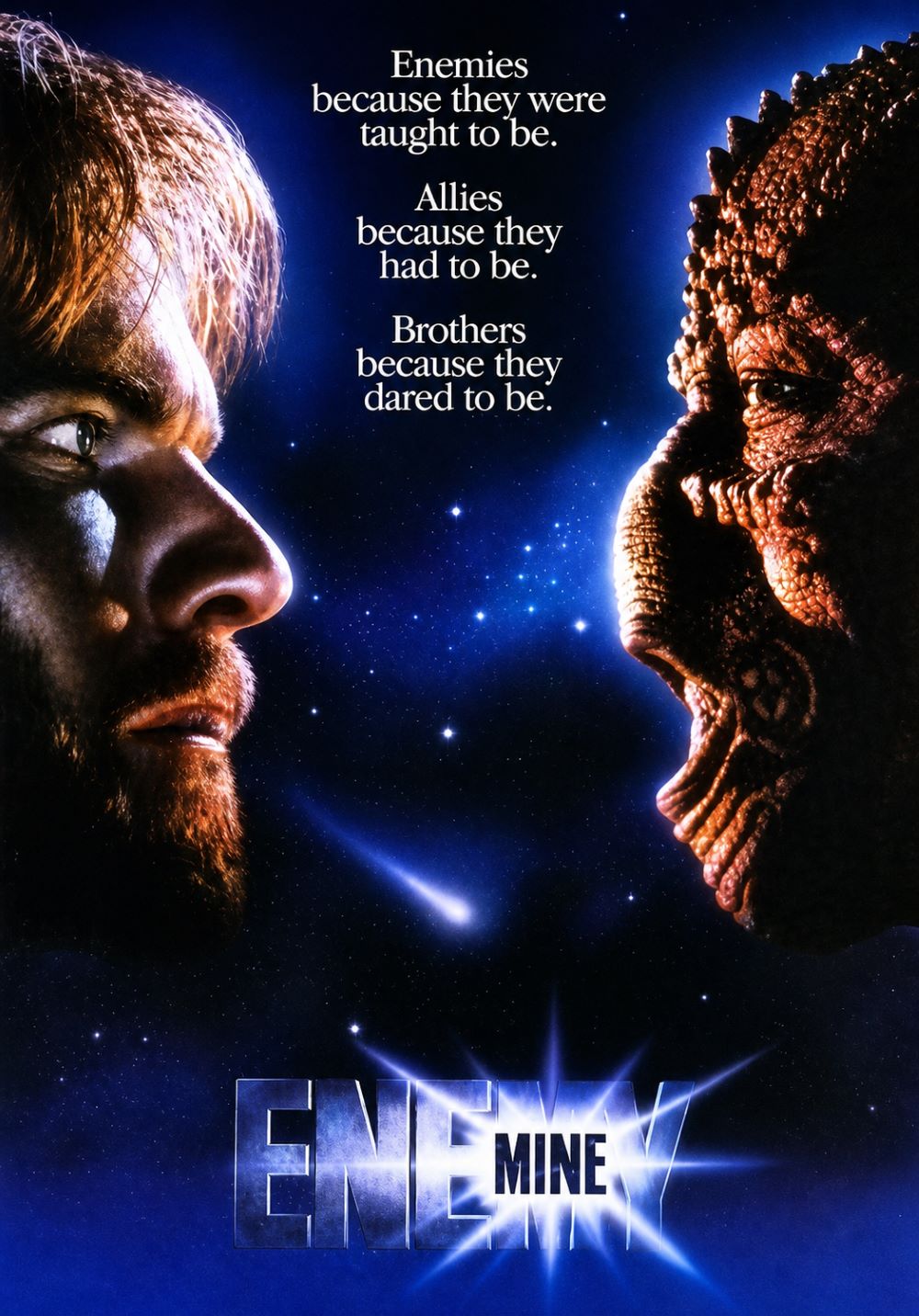
One of those 1980s sci-fi movies that sneaks up on you with more heart than flash, Enemy Mine turns a pulpy premise into something genuinely moving under Wolfgang Petersen’s steady hand. What starts as a straightforward tale of enemies forced together ends up digging deep into survival, prejudice, and the unlikely bonds that form when everything else falls away.
The storyline kicks off in the middle of an interstellar war between humans and the Drac, a reptilian alien species. Human pilot Willis Davidge, played by Dennis Quaid, crash-lands on a harsh, storm-battered planet after a dogfight with Drac warrior Jeriba Shigan. At first, it’s pure hate: they clash, scheme, and barely survive the planet’s brutal environment—freezing winds, toxic air, and hungry scavengers. But necessity breeds uneasy teamwork, and from there, the film charts a slow thaw into mutual respect and friendship. The plot builds to bigger stakes when Jeriba faces a pregnancy unique to their species, leading to themes of parenthood, loss, and legacy that give the story real emotional weight.
Interestingly, Enemy Mine‘s basic premise echoes John Boorman’s 1968 war drama Hell in the Pacific, where an American airman (Lee Marvin) and a stranded Japanese soldier (Toshiro Mifune) wash up on the same deserted island and must cooperate to survive after initial violent antagonism. Both films hinge on that classic setup of mortal enemies isolated together, grappling with a language barrier that heightens the tension—grunts, gestures, and improvised signals become their only bridge. But where Boorman leans into raw cynicism, ending on an ambiguous and bleak note that questions if reconciliation is even possible, Enemy Mine flips the script toward optimism, letting understanding bloom into a full-fledged familial bond.
What elevates Enemy Mine beyond typical space opera is its focus on themes that feel timeless, even if the delivery is pure ’80s cheese. The human-Drac conflict is a clear stand-in for racism and xenophobia, showing how propaganda and fear turn “others” into monsters in our minds. Davidge starts spouting all the usual human supremacist lines, while Jeriba embodies alien pride, but isolation strips away those defenses. The movie argues that empathy isn’t innate—it’s forged through shared hardship, language lessons (Davidge memorably recites Drac poetry), and vulnerability. There’s a queer undercurrent too, in the intense, almost parental intimacy that develops, challenging binary ideas of enemy and ally.
Dennis Quaid nails Davidge as a cocky everyman with a hidden soft side. He brings brash energy to the early fights—grinning through gritted teeth, improvising weapons from junk—but lets cracks show as grief and responsibility hit. His arc from hothead to devoted guardian feels earned, especially in quieter moments like teaching the Drac child human songs. Louis Gossett Jr. is even more impressive under layers of prosthetics as Jeriba, giving the alien a dignified, wry voice that cuts through the makeup. He conveys wisdom and humor without preaching, making Jeriba’s final lessons about tolerance land with quiet power. Their chemistry carries the film; you buy the shift from foes to family because these two sell every beat.
Thematically, Enemy Mine shines brightest in its exploration of fatherhood across species lines. After tragedy strikes, Davidge steps up for Jeriba’s child, Zammis, turning the story into a tale of nurture over nature. It’s about breaking cycles—passing on culture, rituals, and values not to perpetuate war, but to build peace. The film critiques blind loyalty to one’s side, showing how the real enemy might be the systems that demand it. Petersen, fresh off Das Boot, keeps the tone earnest, balancing tense survival scenes with tender rituals like Jeriba’s egg-laying or Davidge’s makeshift cradle. Sure, the effects age unevenly—those Drac faces look rubbery now—but the emotional core holds up.
Revisiting it today, Enemy Mine feels like a forgotten gem in the era of Aliens and Star Wars sequels. It dares to be intimate amid the spectacle, prioritizing character over conquest. The climax, with its courtroom-like showdown back in human space, hammers home the anti-war message without feeling forced. Quaid and Gossett elevate the script’s earnestness, making the bromance-turned-familial bond resonate. It’s not flawless—the pacing drags in spots, and some twists feel convenient—but its sincerity wins out. In a genre often about blowing stuff up, this one’s about building something human (or Drac) from the wreckage.
Enemy Mine reminds us that enemies are just strangers we haven’t met yet. Through Davidge and Jeriba’s journey, it champions understanding over ideology, legacy over vengeance. Quaid’s charisma and Gossett’s gravitas make it stick, turning a B-movie setup into a heartfelt plea for connection. If you’re into thoughtful sci-fi with soul, it’s worth a rewatch—imperfect, but profoundly kind.
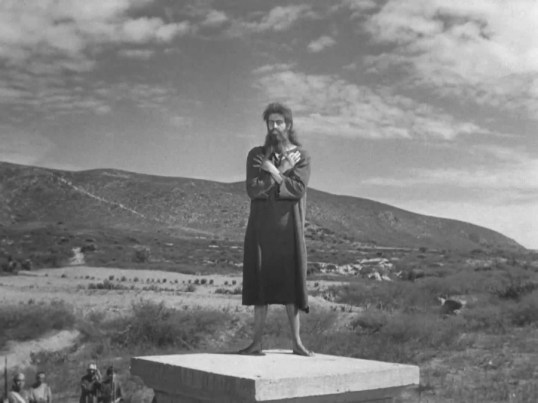
From Luis Bunuel’s 1965 short film, Simon of the Desert, the faithful Simon (Claudio Brook) finds himself transported from 6th Century Syria to the 1960s by the Devil (Silvia Pinal). The song playing at the club is called RadioactiveFlesh. Simon wants to go home. The Devil wants to dance.
4 Or More Shots From 4 Or More Films is just what it says it is, 4 shots from 4 of our favorite films. As opposed to the reviews and recaps that we usually post, 4 Shots From 4 Films lets the visuals do the talking!
Happy Cinco De Mayo to all of our readers! It’s time for….
4 Shots From 4 Mexican Films
Simon of the Desert (1965, dir by Luis Bunuel, DP: Gabriel Figueroa)
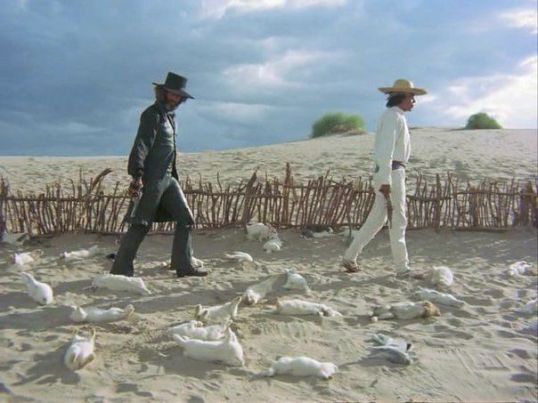
El Topo (1970, dir by Alejandro Jodorowsky, DP: Rafael Corkidi)
Like Water For Chocolate (1992, dir by Alfonso Arau, DP: Emmanuel Luzbeki)
Pan’s Labyrinth (2006, dir. by Guillermo Del Toro, DP: Guillermo Nava)
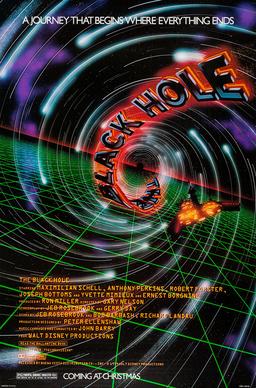
It’s the Future! The USS Palamino is on a mission to explore deep space. On the Palamino are Captain Dan Holland (Robert Forster), Dr. Alex Durant (Anthony Perkins), Lt. Charlie Pizer (Joseph Bottoms), Dr. Ellen McRae (Yvette Mimieux), a trash can-looking robot named Vincent (voiced by Roddy McDowall), and a hard-drinking, out-of-place journalist named Harry Booth (Ernest Borgnine).
The Palamino has nearly completed its mission when it comes across a black hole. They also come across the USS Cygnus, a ship that disappeared 20 years ago. Boarding the Cygnus, they discover that it is ruled over by Dr. Hans Reinhardt (Maximilian Schell) and that the crew appeared to be made up of robots. Dr. Reinhardt plans to direct his ship to fly through the Black Hole. Dr. Durant is inspired by Reinahrdt’s determination to discover what lies on the other side. The rest of the crew is suspicious of Reinhardt, especially after they meet Maximillian, the hulking red robot that serves as his bodyguard.
One of the studio’s first attempts to make a film for grown-ups, The Black Hole was also the first Disney film to receive a PG rating. The Black Hole has a lot going for it. The cast is stacked with talent. (I haven’t even mentioned Slim Pickens as the voice of a beat-up robot.) The plot is interesting and I think anyone watching will be able to relate to Reinhardt and Durant’s desire to explore what lies inside of the Black Hole. Even when seen today, the special effects hold up fairly well. Maximillian is actually frightening at times. There are some violent moments that definitely earn that PG rating.
It’s just too bad that the movie is so damn boring.
The Black Hole is a movie that calls out for a director like Nicholas Meyer or even Douglas Trumbull. Instead, the movie was directed by Gary Nelson, a television director who lets the story plod along at a slow pace. The movie goes through the motions but it never really captures the wonder or the excitement of being in space. The journey through the Black Hole is visually impressive but it takes forever to get there and then it’s over too quickly. Disney spent so much time on the special effects that they forgot to come up with a script worthy of them.
The Black Hole is a film that should have been much better than it was. As long as Disney is remaking all of their old films, I say it’s time to remake The Black Hole. Get the right director and make it the film that it should have been.