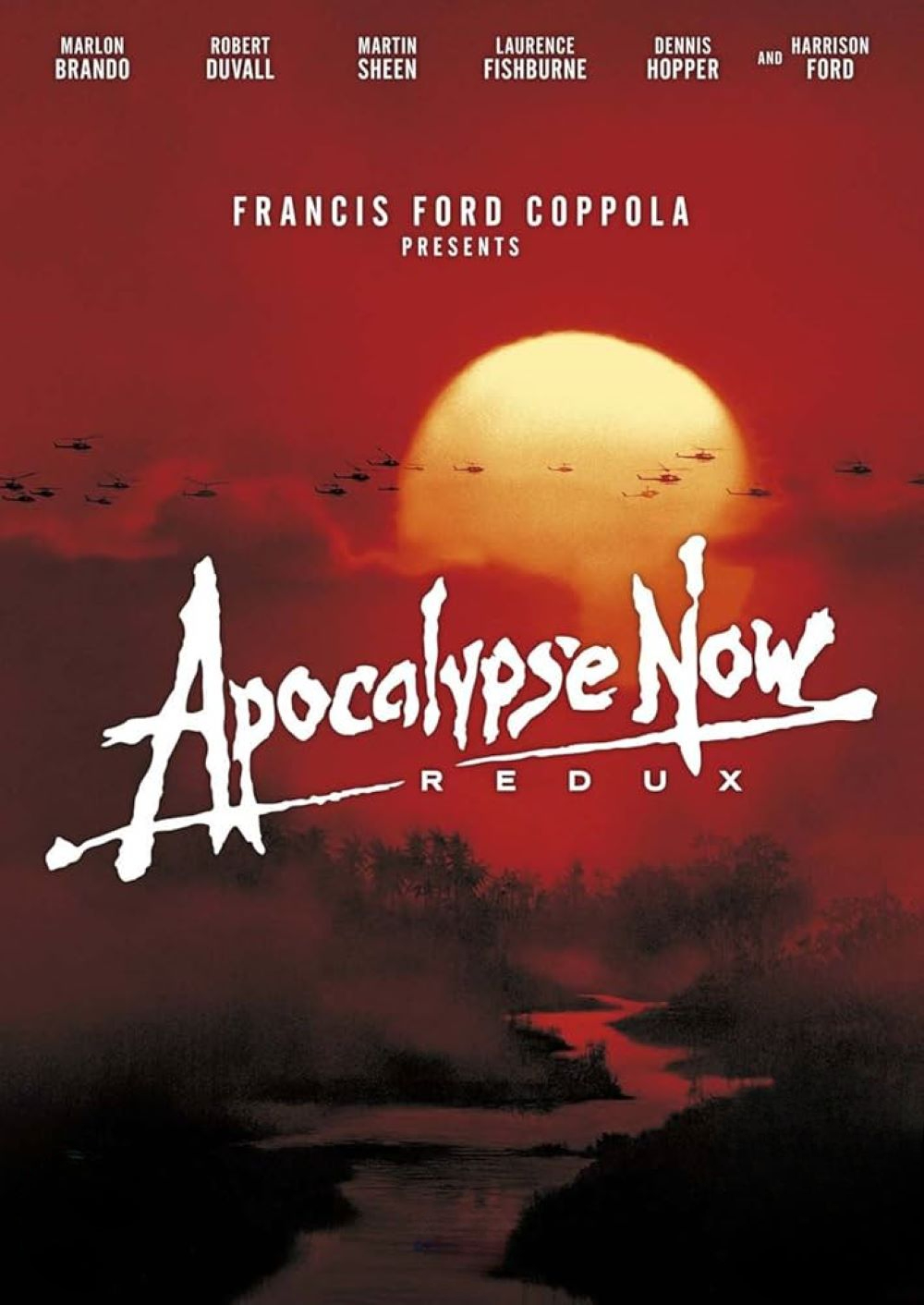
Review: Apocalypse Now Redux (dir. by Francis Ford Coppola)


“The horror… the horror…” — Col. Walter Kurtz

There is a specific kind of cinematic fever dream that only war, isolation, and a touch of madness can produce, and Francis Ford Coppola’s Apocalypse Now remains its gold standard. Co-written by Coppola and John Milius (the latter a colorful, larger-than-life figure in 1970s Hollywood), the film’s screenplay originally leaned harder into Milius’s romantic vision of martial will before Coppola reshaped it into something more hallucinatory and morally ambiguous. When we talk about the Redux version, released in 2001, twenty-two years after the original, we are not just revisiting that fever dream; we are plunging back into an even more hallucinatory, bloated, and revealing cut of the material.

At over three hours and twenty minutes, Apocalypse Now Redux is both a gift and a test of endurance. For those who only know the theatrical cut, this version feels less like a director’s tweak and more like unearthing a lost, more indulgent diary entry from Coppola’s own heart of darkness. The core remains the same: Captain Benjamin Willard (Martin Sheen), a morally hollowed-out assassin, is sent upriver during the Vietnam War to terminate Colonel Walter Kurtz (Marlon Brando), a once-brilliant Green Beret who has gone rogue and set himself up as a demi-god in the Cambodian jungle. The structure is a loose but unmistakable adaptation of Joseph Conrad’s classic 1899 novella Heart of Darkness, transposing Conrad’s grim critique of Belgian colonialism onto America’s own imperial overreach in Southeast Asia. Conrad’s journey up the Congo River becomes the Navy patrol boat’s crawl up the Nùng River, with each stop revealing a new layer of absurdity, violence, and spiritual decay.

The most immediate thing to address is what Redux adds, because those additions fundamentally alter the rhythm of the film. The theatrical cut is a lean, relentless descent. Redux is a meandering, hypnotic, and sometimes frustratingly pensive journey. Several major extended sequences distinguish this cut from the original. The first involves the Playboy Playmates. In the theatrical cut, we see them briefly at a chaotic USO show. In Redux, we get an extended sequence where Willard’s crew trades a canister of fuel for two hours with the stranded bunnies after their helicopter runs low on fuel. Later comes the brutal, psychedelic chaos of the Do Lung Bridge, which is extended in Redux to emphasize the utter breakdown of command and reality. And finally, deep in the journey, after surviving a tiger attack, Willard and the crew stumble upon the French rubber plantation, where a family of colonial planters refuses to leave their dying world. Each of these sequences grinds the forward momentum in different ways—the bunnies through desperate transaction, the bridge through absurd chaos, the plantation through nostalgic rot.

But to truly appreciate what Coppola is doing in Redux, you have to stop thinking of the Nùng River as a simple journey and start seeing it as a vertical descent—a layered, infernal funnel where each stop corresponds to a different circle of moral decay, much like the structure of Dante Alighieri’s Inferno, the first part of his epic narrative poem The Divine Comedy. The patrol boat is not just transport; it is a cramped, filthy ferry crossing the River Styx, and the further Willard and his crew go, the thinner the veil between civilization and savagery becomes. The Redux version, with its extended sequences, actually sharpens this Dantesque geometry rather than diluting it, because each added stop becomes another hellish layer, another specific flavor of corruption rotting under the jungle canopy. And importantly, the order of these stops tells a specific story of descent. Willard first encounters raw, commodified desire at the USO show, then plunges into the absurd mechanical chaos of the Do Lung Bridge, and finally drifts into the refined, decaying nostalgia of the French plantation—each circle deeper, stranger, and more spiritually corrosive than the last.

Consider the first major stop after leaving the relative order of the Delta: the extended Playboy Playmate sequence. In Dante’s Inferno, the early circles punish the lustful and the gluttonous—sins of appetite and passion that still acknowledge desire, however distorted. This stop is the hell of commodified desire, and it functions as the upper circle of Redux’s inferno. The bunnies are not seductresses; they are air-dropped promises of home, stranded and forced to barter their presence for fuel. The crew’s transaction—a canister of gas for two hours of the bunnies’ company—is transactional depravity laid bare. There is nothing refined here. The soldiers who swarm the boat are not conquering heroes; they are starving ghosts pawing at a mirage of femininity. The corruption is the commodification of intimacy, the way the war machine grinds up even fantasy into a trade good. In Dante’s Inferno, the lustful are eternally swept by winds, never at rest. Here, the winds are helicopter rotors, and no one finds peace. This stop still has energy, still has motion—it is desperate, ugly, and pathetic, but not yet defeated. It is the first circle: sin as transaction.

Further upriver, deeper into the jungle, you hit the second major stop in Redux’s order: the Do Lung Bridge. In Dante’s structure, the middle and lower circles punish the violent, the fraudulent, and the sowers of discord—those whose sins actively tear apart the fabric of order. The bridge is a sustained vision of the eighth circle—the Malebolge, the evil ditches of the fraudulent. This is the hell of absurd, endless combat, and it sits far below the bunnies’ desperate lust because it has abandoned desire altogether. The bridge is supposed to be a strategic point, but no one in command knows who is fighting whom or even which side holds which trench. Soldiers fire blindly into the dark; engineers build and rebuild sections of bridge that are destroyed every night by an invisible enemy. The wounded groan, a psychedelic light show of flares and tracers turns the sky into a flickering carnival of death, and a dazed soldier informs Willard that this place has been “crazy” for days. There is no front line, no objective, only endless, repetitive, pointless construction and destruction. The corruption here is systemic: the war has become an autopilot nightmare where violence generates nothing but more violence. Unlike the bunnies, who still want something, the soldiers at the bridge don’t even know what they are doing anymore. They simply perform the same broken task for eternity. Willard’s only reaction is a numb observation that he should inform his superiors, but he never will. The bridge is the point where any remaining belief in order or purpose dissolves into white noise. It is the second circle: sin as automation.

Then, after the bridge’s chaos, the crew drifts into the third major stop: the French rubber plantation. In Dante’s Inferno, the deepest circles before the frozen center punish heresy and treachery—sins of the intellect and will, where belief becomes a cage. The plantation functions exactly like this. It is the hell of nostalgia and colonial rot, a step deeper than the bridge’s chaos because it has calcified into ideology. After the raw transaction of the bunnies and the absurd violence of the bridge, the crew stumbles upon a walled pocket of denial. Here, the French family sips wine, argues geopolitics, and pretends the war is a tragic inconvenience rather than a total collapse. This is the hell of the static dead—people who refuse to acknowledge that their world has already ended. The rubber trees themselves, planted in neat, tyrannical rows, symbolize extractive cruelty made mundane. Willard sleeps with a widowed French woman, a moment of hollow lust that feels more like a funeral rite than passion. The corruption here is polite, intellectual, and almost seductive—but it is still decay wearing a starched shirt. Unlike the bunnies’ squalid desperation, the plantation has manners. Unlike the bridge’s chaotic noise, the plantation has quiet arguments. That makes it more insidious, and therefore deeper in the infernal funnel. This is the third circle: sin as denial.

By the time Willard finally reaches Kurtz’s compound, he has descended past all these preparatory circles into the ninth and final circle of Dante’s Inferno—Cocytus, the frozen lake of treachery, where Satan himself is trapped in ice. Kurtz is no longer a man but a fixed point of absolute darkness. His compound is a Cambodian nightmare of severed heads, pagan rituals, and whispered monologues. Unlike the bunnies’ desperate transaction, the bridge’s absurd chaos, or the plantation’s nostalgic denial, Kurtz’s hell is complete stillness. He has murdered and been worshipped for it. He has rejected every prior layer—commerce, command, colonialism—and arrived at a nihilistic truth: that horror is the only moral absolute. Willard’s task is not to understand Kurtz but to kill him, and in doing so, to become him. That is the final descent: not into fire, but into the ice of total moral withdrawal. The Redux version emphasizes this by making Kurtz more verbose but also more inert. He is trapped not by chains, but by his own unbearable clarity. The three stops before him—the bunnies, the bridge, the plantation—are all failed attempts to build meaning in the jungle. Kurtz is the place where meaning dies entirely.

What remains unchanged, across both cuts, is the technical majesty. Vittorio Storaro’s cinematography still haunts the soul. The opening shot—a napalm-blasted jungle dissolving into the slow rotation of a ceiling fan in a Saigon hotel room, with The Doors’ “The End” whispering over the soundtrack—is one of the great tone-setters in cinema history. The Redux cut luxuriates in these images even longer, letting the heat and humidity seep through the screen. The attack on a Vietnamese sampan, where an innocent family is slaughtered in a burst of trigger-happy panic, remains devastating. Laurence Fishburne’s young, wide-eyed Clean, Dennis Hopper’s jittery, sycophantic photojournalist (a role that feels like pure id), and Robert Duvall’s iconic Lieutenant Colonel Kilgore, who loves the smell of napalm in the morning, all deliver performances that feel less like acting and more like channeling. Duvall’s surf-obsessed madman is even more absurdly perfect in Redux because the added length makes his brief screentime feel like a welcome blast of cold air before the suffocating final act.

Which brings us back to Marlon Brando as Kurtz. Here is where Redux both helps and hurts. The theatrical cut gives Kurtz a mythic, almost abstract presence—shadowy, whispering, half-sculpted. Brando showed up overweight and unprepared, so Coppola shot him mostly in shadow. In Redux, those shadows remain, but the added material includes a longer, more discursive monologue where Kurtz reads from a Time magazine article about the war and rambles about the horror of administering lethal injections to polio-stricken villagers. It is more Brando, which is never nothing, but it also demystifies the monster. The terror of Kurtz in the original cut is that he is an idea, a reflection of Willard’s own potential. In Redux, he becomes a sweaty, slightly boring philosopher. The famous “the horror, the horror” death scene still lands, but getting there feels like you have already been swimming in his rhetoric for too long. The added footage makes Kurtz more human but less terrifying, which may or may not be an improvement depending on your tolerance for Brando’s mumbling.

The casual viewer might find Redux interminable. Let’s be honest: three and a half hours of madness, helicopters, and nihilism is a lot. There are stretches in the plantation sequence where you might check your phone. The pacing is deliberately, almost arrogantly slow. Coppola is not trying to entertain you; he is trying to drown you. And in those moments of slog—when the French family drones on about geopolitics, when the bunnies’ desperation overstays its welcome, when the bridge’s chaos becomes repetitive rather than shocking—you might be tempted to declare the whole Redux experiment a failure. But here is the uncomfortable truth that separates Apocalypse Now Redux from mere indulgent director’s cuts: the film’s occasional sluggishness, its bloated digressions, its refusal to maintain a clean narrative spine, are not flaws so much as they are the correct representation of the very thing the film’s themes and narrative ideas were trying to explore. This is a movie about a journey into moral rot, about the collapse of linear purpose into circular nightmare, about men who have stared too long into the abyss and lost the ability to tell a clean story. Why should the film itself be clean? The theatrical cut is a masterpiece of compression, yes—but compression is an act of control, and Apocalypse Now is ultimately about the loss of control. The Redux version, for all its unevenness, is the more honest artifact because it refuses to polish the madness into neat dramatic beats. The original film is a nightmare you cannot wake from; Redux is the insomnia that precedes it, the sweaty, bored, terrifying awareness that there is no ending, only more jungle.

This is why, despite its longer running time and the areas where the pacing sometimes slogs through, the film overall succeeds as not just a fever dream of the filmmaker, writers, and actors who survived its legendary production—the typhoons, the heart attacks, Brando’s chaos, Sheen’s breakdown—but as the correct representation of the very thing the film’s themes and narrative ideas were trying to explore. Apocalypse Now is about the impossibility of remaining sane in an insane environment. The Redux cut, by refusing to be efficiently sane, becomes a more immersive simulation of that condition. The theatrical cut tells you about the horror; the Redux cut makes you live inside its tedious, exhausting, occasionally boring reality. And boredom is part of horror, too—the long stretches between atrocities, the waiting, the pointless arguments, the nights that won’t end. Coppola, Milius, Sheen, Brando, and everyone else who survived the Philippines shoot did not emerge with a clean story. They emerged with scars, footage, and a kind of shell-shocked awe. The Redux version honors that survival by refusing to pretend the experience was anything other than a mess. It is the director’s cut as wound, not as polish.

For the obsessive, for those who want to see the entire messy, unfinished vision behind one of the great artistic catastrophes (the documentary Hearts of Darkness is essential companion viewing), Redux is invaluable. It reveals that the original 1979 cut was a miracle of editing—a salvage job that turned a troubled production into a masterpiece. Redux is the rough draft of that miracle. It has a bloated, novelistic quality, more concerned with atmosphere than narrative efficiency. As a loose adaptation of Heart of Darkness, it is oddly more faithful than the original cut—because Conrad’s novella is also meandering, digressive, and filled with colonial asides that do not advance the plot. But faithfulness is not the same as greatness.

The Redux version is a flawed, overstuffed, hypnotic masterpiece that sometimes trips over its own ambition. It earns its runtime not through tight storytelling, but through sheer, oppressive mood. And in the end, that is the point. You are not supposed to leave Apocalypse Now feeling satisfied. You are supposed to leave feeling like you have stared into something ancient and ugly. The Redux version just makes you stare longer, dragging you down through each Dantesque circle—from the desperate, transactional depravity of the Playboy bunnies, through the absurd, autopilot chaos of the Do Lung Bridge, past the polite, rotting nostalgia of the French plantation, and finally into the frozen stillness of Kurtz’s compound—until there is nothing left but the ice and the horror. And in those moments when the film slows to a crawl, when you check your watch and wonder why we are still at the plantation, that is not a failure of art. That is the art itself, reminding you that hell is not a nonstop carnival of screams. Hell is also a long, boring dinner with people who refuse to die. Whether that is luxury or punishment is for you to decide. But Apocalypse Now Redux succeeds precisely because it trusts you to sit with that discomfort and recognize it for what it is: the truth.

Live Tweet Alert: Join #ScarySocial For Kill, Baby, Kill!


As some of our regular readers undoubtedly know, I am involved in a few weekly live tweets on Twitter and Mastodon.  I host #FridayNightFlix every Friday, I co-host #ScarySocial on Saturday, and I am one of the five hosts of #MondayActionMovie!  Every week, we get together.  We watch a movie.  We tweet our way through it.

Tonight, at 10 pm et, #ScarySocial presents 1966’s Kill, Baby, Kill,, directed by Mario Bava!

If you want to join us this Saturday, just hop onto twitter, start the movie at 10 pm et, and use the #ScarySocial hashtag!  It’s a friendly group and welcoming of newcomers so don’t be shy.

Kill, Baby, Kill is available on Prime!  See you there!

Scenes That I Love: Henry Fonda in The Ox-Bow Incident


Today, we celebrate the birthday of Henry Fonda!

Fonda was born 121 years ago today and, over the course of his long career, he was often cast in role the epitomized everything great about America.  It’s rare to find a Henry Fonda film in which he played an out-and-out villain, though he did just that in Sergio Leone’s Once Upon A Time In The West.  (Leone, in fact, cast Fonda as the evil Frank because he knew audiences would be shocked to see Fonda coldly gunning down settlers and their families.)

One of Fonda’s finest films was 1943’s The Ox-Bow Incident, in which he played a cowboy who finds himself drafted into joining a posse that ends up hanging three men for the crime of murder and cattle rustling.  The members of the posse (including seven of whom voted against hanging the men) later learn that the men were innocent.  In today’s scene that I love, Henry Fonda reads aloud the letter that one of the men wrote to his wife shortly before he was hung.  This was one of Fonda’s most heartfelt and powerful performances.

4 Shots From 4 Films: Special Danny Trejo Edition


4 Shots From 4 Films is just what it says it is, 4 shots from 4 of our favorite films. As opposed to the reviews and recaps that we usually post, 4 Shots From 4 Films lets the visuals do the talking!

Today, the Shattered Len wishes a happy 82nd birthday to the man and the legend, Danny Trejo!  Trejo’s journey from being a gang member to an ex-con to a drug counselor to a pop cultural institution is an inspiring one, all the more so because Danny Trejo is so candid about both his past struggles and his present successes.  

It’s time for….

4 Shots From 4 Danny Trejo Films

Runaway Train (1985, dir by Andrei Konchalovsky, DP: Alan Hume)


Death Wish 4: The Crackdown (1987, dir by J. Lee Thompson, DP: Gideon Porath)


Heat (1995, dir by Michael Mann, DP: Dante Spinotti)


Machete Kills (2013, dir by Robert Rodriguez, DP: Robert Rodriguez)

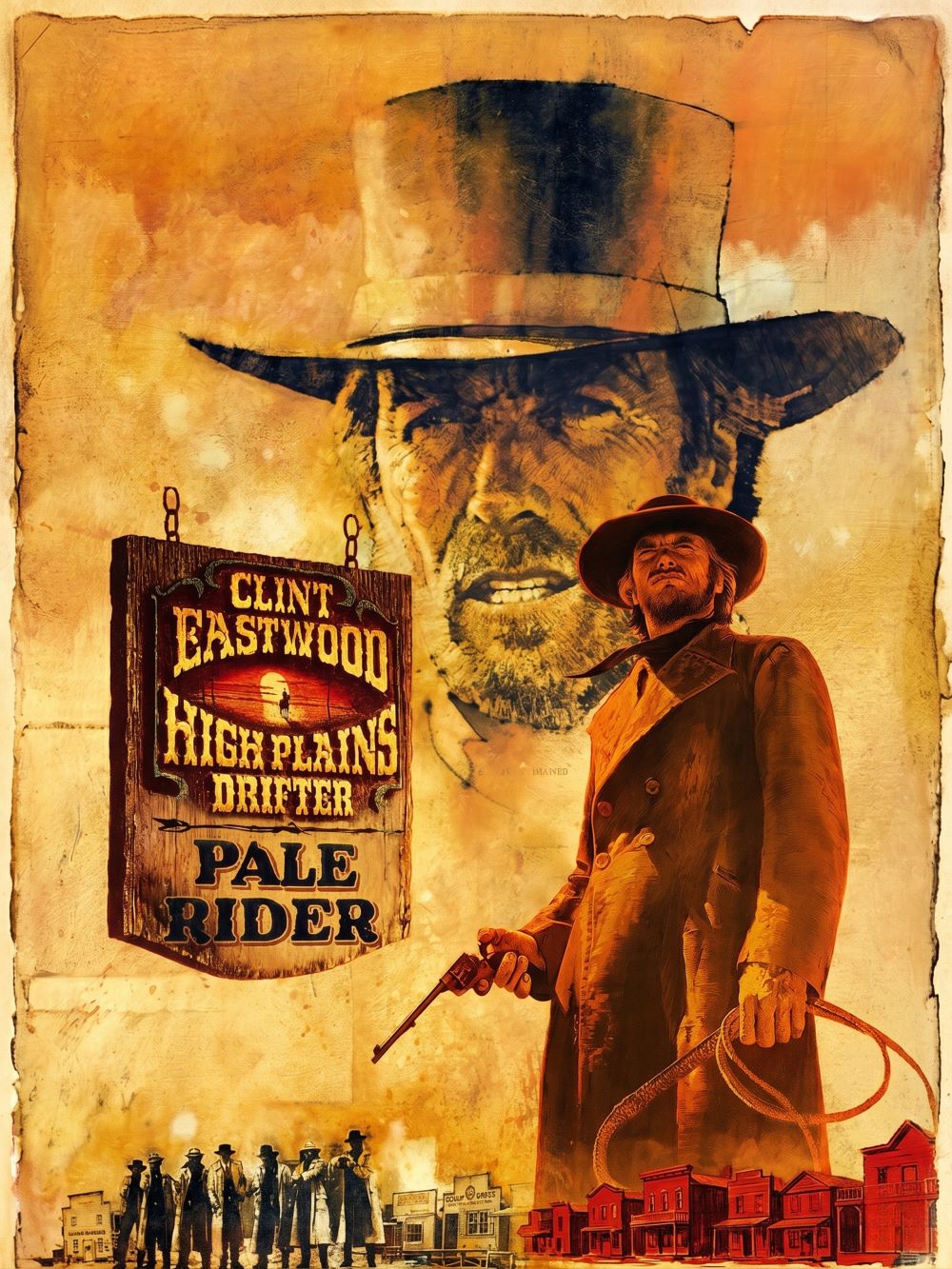
Ghosts of the Frontier: Vengeance and Redemption in Eastwood’s Twin Westerns


“It’s what people know about themselves inside that makes ’em afraid.” — The Stranger

Mythic Outsiders and the Shape of the Stranger

Clint Eastwood’s High Plains Drifter and Pale Rider both revolve around the arrival of a mysterious outsider whose presence destabilizes and reconfigures a frontier community already burdened by moral pressure, economic vulnerability, or buried violence. In High Plains Drifter, the Stranger arrives with the weight of something closer to metaphysical judgment than human intention. He is introduced not as a conventional protagonist but as an unsettling disruption of reality itself, a figure who seems to exist slightly outside the normal rules governing cause and consequence. His relationship to the town of Lago is immediately adversarial, but not in a personal sense—it is structural, almost cosmic, as though he is less reacting to the town than fulfilling a prewritten moral outcome.

By contrast, Pale Rider preserves the same narrative skeleton but shifts the emotional and moral emphasis toward intervention rather than judgment. The Preacher still carries ambiguity—his scars, his sudden appearance, and his almost supernatural timing all suggest something beyond ordinary human agency—but his role is fundamentally protective. He enters a world defined by industrial pressure and economic coercion rather than buried collective sin, and his presence functions as a counterweight to imbalance rather than an execution of moral sentence. The result is that both films feel like variations of the same mythic story, but one is written as condemnation while the other reads as reluctant guardianship.

Old Testament Retribution vs. Folkloric Myth

One of the most revealing ways to distinguish the two films is through their mythic grammar. High Plains Drifter reads like an Old Testament narrative of retribution, where morality is absolute, guilt is inherited collectively, and punishment is not only justified but structurally inevitable. The Stranger operates like a figure of divine wrath, not because he explicitly claims divine authority, but because the world of the film behaves as though such authority is implicit. Lago is not a community undergoing moral testing; it is a community already judged. Every act the Stranger commits feels like the unfolding of a sentence that predates his arrival. Violence in this framework is not expressive or emotional—it is procedural, almost liturgical, as though the town is being dismantled according to a moral code that does not permit negotiation.

The Old Testament quality of High Plains Drifter is also evident in its treatment of time and consequence. The past is not past—it is active, invasive, and inescapable. The town’s buried crime against its former marshal is not simply a backstory element; it functions as a theological stain that structures everything that follows. The Stranger does not introduce justice into the world; he reveals that justice was already waiting, dormant and inevitable.

Pale Rider, by contrast, operates within a folkloric mode that feels less doctrinal and more narrative in the oral-tradition sense. The Preacher is not a judge delivering sentence but a figure who appears within a story because the story requires balance. Folklore does not insist on moral finality in the same way scripture does; instead, it preserves ambiguity, repetition, and interpretive openness. The Preacher’s identity remains unresolved not because the film withholds information, but because resolution itself is not the point. He resembles figures from frontier legend—wandering spirits, unnamed avengers, or protective ghosts whose purpose is understood only through their effects on a community rather than through explicit explanation.

Where High Plains Drifter insists on inevitability, Pale Rider allows for contingency. The Preacher arrives in response to suffering rather than in fulfillment of punishment. His presence suggests that moral intervention is episodic rather than absolute, something that occurs when imbalance becomes intolerable rather than something decreed in advance. The result is a world that feels open-ended rather than sealed.

Moral Worlds: Guilt Versus Vulnerability

The moral architecture of each film is constructed through the condition of its community. In High Plains Drifter, Lago is defined by collective guilt so pervasive that it erases meaningful individuality. The townspeople are not simply flawed characters; they are components of a shared moral collapse. Their original crime—the betrayal and murder of their marshal—functions as the foundation of their identity. The Stranger’s arrival does not introduce new moral tension; it activates an existing one that has been suppressed but never resolved. The town’s psychology is therefore circular: guilt produces fear, fear produces complicity, and complicity guarantees punishment.

This circularity is what gives High Plains Drifter its claustrophobic quality. There is no outside moral perspective capable of altering the town’s fate. Even resistance or survival strategies feel complicit in the same moral structure. The town is effectively trapped inside its own ethical architecture.

In Pale Rider, however, the mining community is framed through vulnerability rather than guilt. These characters are not haunted by a collective sin but threatened by external forces—specifically Coy LaHood’s industrial expansion, which seeks to displace them through economic pressure and intimidation. The moral stakes are therefore asymmetrical: a powerful industrial entity versus a fragile group of independent miners. This reframing is crucial because it transforms the Preacher’s role from agent of punishment to agent of protection. He does not expose corruption within the miners; he resists corruption directed toward them.

Tone and Philosophical Direction

The tonal difference between the films reflects Eastwood’s evolving relationship with the Western mythos. High Plains Drifter is austere, surreal, and deliberately disorienting. The town of Lago feels less like a historical location than a moral construct, a space designed to contain judgment. The visual and narrative isolation of the town reinforces its status as a closed system, one in which moral consequence operates without interference from broader social or geographic context. The result is a film that feels almost metaphysical in its severity, as though it is staging a moral experiment rather than telling a grounded story.

Violence in this context becomes an instrument of revelation. Each act performed by the Stranger peels back layers of denial and self-deception, leaving only the raw structure of guilt beneath. The tone is not merely dark—it is stripping, reductive, and final.

Pale Rider, while still restrained and often somber, introduces a more grounded emotional texture. The mining settlement feels materially real, shaped by labor, scarcity, and interpersonal bonds. This grounding prevents the film from collapsing into abstraction. Even when supernatural ambiguity is present, it is embedded within a world that feels historically and physically tangible. This creates a tonal tension between myth and realism that softens the absolutism found in High Plains Drifter. Instead of moral vacuum, Pale Rider offers moral friction.

The Outsider as Moral Force

Eastwood’s performances in both films embody the evolution of the outsider archetype. In High Plains Drifter, the Stranger is almost entirely detached from human relatability. His silence is not contemplative but destabilizing, creating unease in every interaction. He functions like a moral solvent, dissolving social bonds and exposing hidden structures of guilt. There is no suggestion that he belongs to the world he enters; instead, he appears to impose a structure upon it.

In Pale Rider, the Preacher retains the same controlled economy of expression, but his presence is tempered by moments of relational meaning. His connection to the miners, particularly the young girl whose prayer summons him, introduces a reciprocal dimension absent from High Plains Drifter. He is not simply an external force acting upon the world; he is a figure whose arrival is framed as response. This responsiveness is what aligns him more closely with folkloric tradition, where characters are defined not by origin but by function within a narrative ecosystem.

Violence as Judgment vs. Necessity

Violence in High Plains Drifter operates as moral inevitability. It is structured, ritualized, and unavoidably recursive. Each act feels like the continuation of a moral sequence already underway, as though the Stranger is simply advancing toward a predetermined conclusion. The emotional effect is one of inevitability without catharsis.

In Pale Rider, violence is repositioned as necessity rather than inevitability. It emerges only when economic exploitation and coercion leave no viable alternatives. This reframing is subtle but significant: violence becomes situational rather than cosmic. The Preacher does not embody judgment; he responds to imbalance. As a result, even the film’s climactic confrontations carry a different emotional charge—they feel like interruptions in injustice rather than fulfillments of destiny.

Supporting Communities and Narrative Focus

Both films maintain a strong central focus on Eastwood’s outsider, which inevitably limits the depth of supporting character development. However, the implications of this limitation differ between them. In High Plains Drifter, the flattening of the townspeople reinforces the idea of collective moral identity. Individual psychology is irrelevant because the town functions as a single ethical organism. The lack of distinction between characters serves the film’s allegorical purpose.

In Pale Rider, the miners are more individualized in performance even if not fully developed in script. Actors such as Michael Moriarty and Carrie Snodgress bring emotional specificity that suggests lives extending beyond the frame. This helps ground the film’s mythic structure in human stakes, preventing it from becoming purely symbolic. Even if the characters are archetypal, they are not abstract.

Visual Mythmaking

Cinematographically, the two films articulate their mythic identities through environment. High Plains Drifter constructs a space that feels artificially isolated, as though removed from ordinary geography and placed into a moral void. The town becomes a sealed chamber in which ethical consequences unfold without external interference. This abstraction reinforces its Old Testament quality: a world governed by decree.

Pale Rider, shot by Bruce Surtees, leans into environmental tactility. The forests, mountains, and mining encampments feel embedded in a larger natural system. This grounding creates a sense of narrative openness. Rather than existing as a moral stage, the landscape feels like a lived world in which myth temporarily emerges before receding again into ordinary life. This is essential to its folkloric tone.

Conclusion: Two Mythic Languages of the Western

Ultimately, High Plains Drifter and Pale Rider function as two distinct mythic languages within Clint Eastwood’s evolving critique of the Western. One articulates itself through Old Testament logic—absolute judgment, collective guilt, and irreversible consequence. The other speaks in folkloric terms—episodic intervention, narrative ambiguity, and moral imbalance temporarily corrected rather than permanently resolved. Together, they form a sustained meditation on the Western outsider as both executioner and legend: one who arrives to complete a sentence already written, and another who arrives like a story that briefly becomes real before fading back into myth.

Live Tweet Alert: Join #FridayNightFlix for Dolemite!


As some of our regular readers undoubtedly know, I am involved in a few weekly watch parties.  On Twitter, I host #FridayNightFlix every Friday and I co-host #ScarySocial on Saturday.  On Mastodon, I am one of the five hosts of #MondayActionMovie!  Every week, we get together.  We watch a movie.  We tweet our way through it.

Tonight, at 10 pm et, I will be hosting #FridayNightFlix!  The movie?  1975’s Dolemite!

If you want to join us this Friday, just hop onto twitter, find Dolemite on Prime, start the movie at 10 pm et, and use the #FridayNightFlix hashtag!  I’ll be there happily tweeting.  It’s a friendly group and welcoming of newcomers so don’t be shy.

See you there!


Scenes That I Love: Joseph Cotten and Teresa Wright in Shadow of a Doubt


On this date in 1905, the great actor Joseph Cotten was born in Petersburg, Virginia.  A longtime friend and collaborator of Orson Welles, Cotten was one of the most dependable leading men of the 40s and 50s, an actor with the charisma of star and the talent of an artist.

Today’s scene that I love comes from Alfred Hitchcock’s 1943 masterpiece, Shadow of a Doubt, and it features Teresa Wright and Joseph Cotten.  Wright plays Charlie.  Cotten plays her beloved uncle, who is also named Charlie and who might very well be a serial killer.  In this scene, Uncle Charlie drags his niece to a seedy bar, where he confesses that, as she earlier deduced, he is a suspect in a murder investigation.  With a mixture of charm and intimidating, Charlie tries to convince his niece to keep his secret to herself.

4 Shots From 4 Films: Special John Glen Edition


4 Shots From 4 Films is just what it says it is, 4 shots from 4 of our favorite films. As opposed to the reviews and recaps that we usually post, 4 Shots From 4 Films lets the visuals do the talking!

Today, the Shattered Lens wishes a happy birthday to English director and editor, John Glen!  It’s time for….

4 Shots From 4 John Glen Films

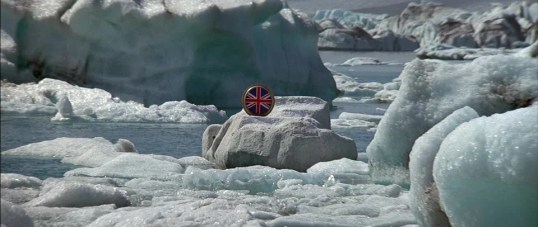
For Your Eyes Only (1981, dir by John Glen, DP: Alan Hume)

Octopussy (1983, dir by John Glen, DP: Alan Hume)

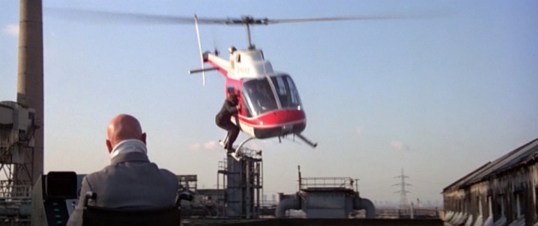
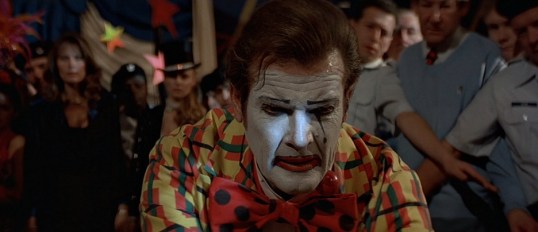
A View To A Kill (1985, dir by John Glen, DP: Alan Hume)

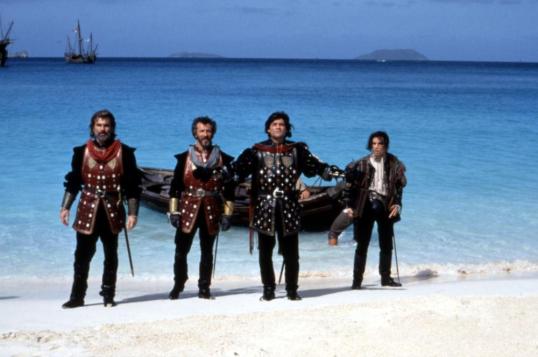
Christopher Columbus: The Discovery (1992, dir by John Glen, DP: Alec Mills)

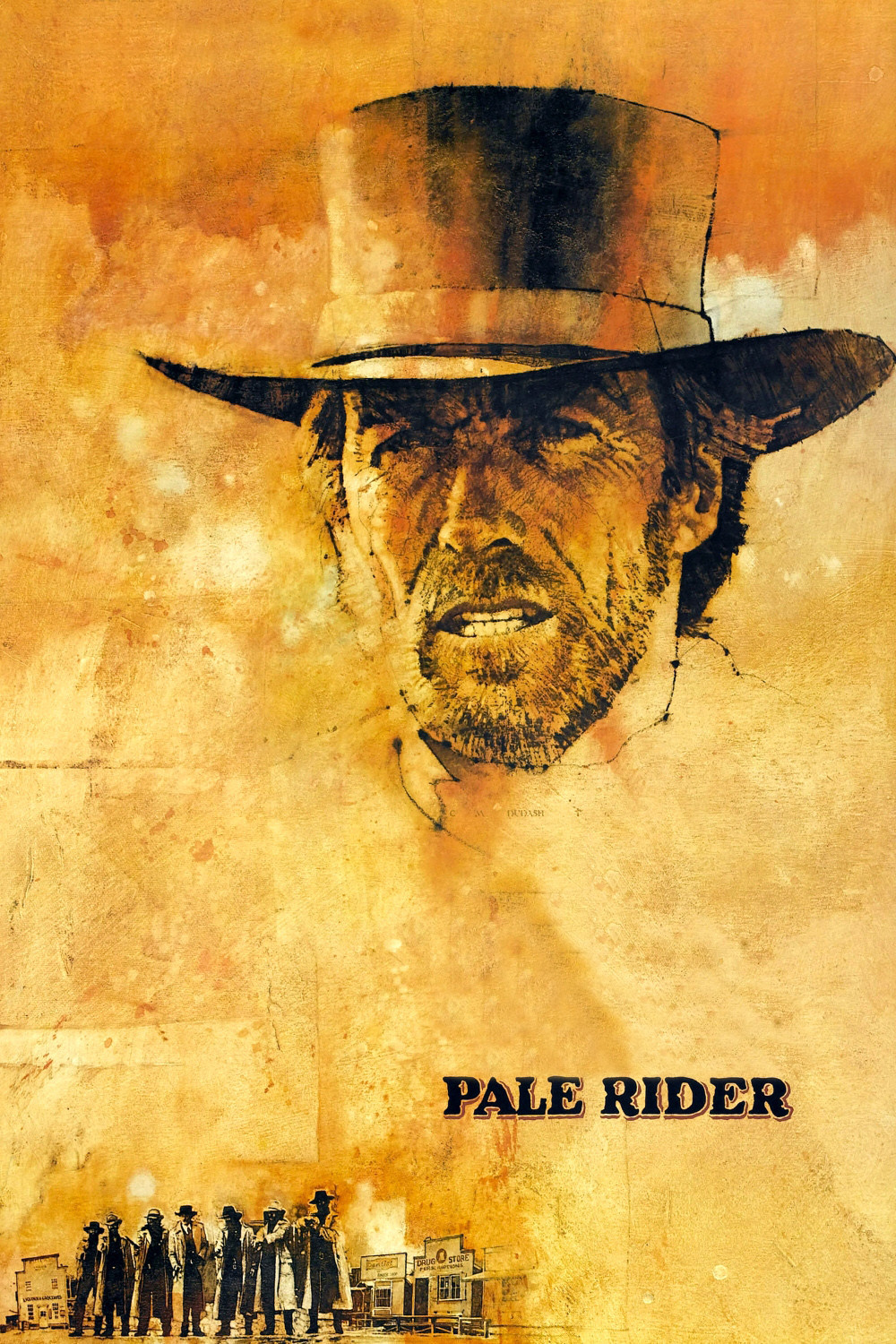
Review: Pale Rider (dir. by Clint Eastwood)


“And I looked, and behold a pale horse. And his name that sat on him was Death. And Hell followed with him.” — Megan Wheeler

Clint Eastwood’s Pale Rider occupies a fascinating space within the Western genre—both a reverent homage to the traditions that shaped classic frontier storytelling and a quiet dismantling of the myths those stories often upheld. Released in 1985, the film arrived during a period when the Western had largely faded from mainstream prominence, regarded by many as a relic of an earlier cinematic era. Yet Eastwood, by then already firmly associated with the genre through his work in Sergio Leone’s Dollar Trilogy and films like High Plains Drifter and The Outlaw Josey Wales, proved that the Western still had room for reinvention. With Pale Rider, he crafted something that feels both deeply familiar and subtly haunting: a film that embraces the iconography of the Old West while draping it in an almost supernatural atmosphere, creating one of the most enigmatic and compelling entries in his directorial career.

In many ways, Pale Rider also feels like a spiritual successor—or even an unofficial companion piece—to High Plains Drifter. Both films center around a mysterious outsider who seemingly emerges from nowhere to confront a corrupt and morally rotten community. In both stories, Eastwood plays a figure who feels less like an ordinary man and more like an embodiment of vengeance itself, a ghostly gunslinger whose true nature is never fully explained. The similarities in narrative structure are impossible to ignore: isolated frontier settlements under siege, powerful men abusing authority, and Eastwood’s near-mythic drifter arriving as a reckoning for buried sins. But where High Plains Drifter leans into bitterness and outright surrealism, portraying the Old West as a place consumed by cruelty and hypocrisy, Pale Rider takes a more restrained and spiritual approach. The Preacher is still intimidating and otherworldly, but he possesses a moral center that the Stranger in High Plains Drifter deliberately lacked. It feels almost as if Eastwood revisited the earlier film’s core ideas over a decade later with greater maturity and reflection, transforming the wrathful ghost story of High Plains Drifter into something more meditative about redemption and justice.

On its surface, Pale Rider follows a relatively straightforward Western premise. A group of struggling gold prospectors in the mountains of California are being terrorized and pressured by a wealthy mining magnate, Coy LaHood, who seeks to drive them off their land so he can exploit the area’s resources for himself. Into this conflict rides a mysterious preacher, played by Eastwood, whose sudden appearance seems almost divinely summoned after a young girl prays for deliverance. This unnamed “Preacher” becomes the reluctant protector of the miners, standing against LaHood and the corrupt marshal Stockburn and his deputies. The bones of the story echo classic Western structures—outsiders defending vulnerable settlers from ruthless power—but Pale Rider imbues this framework with a somber, spiritual weight that elevates it beyond genre familiarity.

One of the film’s most striking strengths is Eastwood’s central performance. By this point in his career, Eastwood had perfected a specific screen persona: laconic, observant, physically economical, and quietly threatening. Yet the Preacher in Pale Rider may be one of his most mysterious variations on that archetype. Unlike the swaggering Man with No Name or even the wounded determination of Josey Wales, the Preacher seems almost detached from ordinary human concerns. His calm demeanor and sparse dialogue give him an ethereal quality, and Eastwood plays him with just enough warmth to avoid complete abstraction. There is kindness in his interactions with the miners, especially the young Megan Wheeler, but it always feels measured, as if the character is passing through rather than fully participating in the world around him. The film deliberately hints at something supernatural—his sudden arrival after prayer, his unexplained scars, his near spectral presence—and Eastwood wisely resists any definitive explanation. The ambiguity is what gives the character his power.

This supernatural undercurrent is central to what makes Pale Rider unique. The title itself references the Four Horsemen of the Apocalypse, specifically Death riding a pale horse, and the biblical symbolism permeates the film without overwhelming it. Eastwood uses religious imagery sparingly but effectively, allowing viewers to wonder whether the Preacher is simply a man with a violent past or something more symbolic: an agent of justice, vengeance, or divine reckoning. The film never commits fully to fantasy, but it constantly suggests that the Preacher exists somewhere between myth and mortal reality. This ambiguity transforms ordinary Western confrontations into something more unsettling and poetic.

Visually, Pale Rider is one of Eastwood’s most beautiful films. Shot by cinematographer Bruce Surtees, whose work with Eastwood had already become legendary, the film makes remarkable use of natural landscapes. The mountainous terrain, dense forests, and rugged mining camps provide a setting that feels less romanticized than the sweeping deserts often associated with traditional Westerns. There is a chill to the environment, both literal and emotional. The forests seem shadowed and secretive, and the mining settlements feel fragile, temporary, vulnerable to destruction. Surtees’ lighting contributes significantly to the film’s tone, bathing many scenes in muted, earthy colors and allowing darkness to linger at the edges of the frame. The result is a Western that often feels ghostly, as though the past itself is haunting every image.

Eastwood’s direction demonstrates his confidence and restraint. He avoids excessive spectacle, choosing instead to let tension build gradually through atmosphere, silence, and careful pacing. Action scenes are brief but impactful, and the violence carries genuine consequence. Unlike many earlier Westerns that glorified gunfights as heroic climaxes, Pale Rider treats violence as something grim and almost inevitable. When the Preacher finally unleashes his skills, it feels less like triumphant empowerment and more like a dark necessity. Eastwood understands that his character’s power is amplified by how sparingly he uses it.

Still, despite how effective the film is overall, Pale Rider is not without flaws. Some viewers may find the pacing overly deliberate, particularly in the middle section where the story spends considerable time with the miners and their daily struggles before major plot developments occur. Eastwood prioritizes mood and atmosphere over narrative momentum, which works artistically but can occasionally make the film feel slower than necessary. The supporting characters, while likable, are also somewhat thinly sketched compared to the larger thematic ideas surrounding them. Hull Barret, Sarah Wheeler, and several of the miners are defined more by their place within the story’s moral framework than by deeply layered characterization. They are ordinary people standing against corruption, but the script does not always give them enough individuality or complexity outside of that central conflict.

What ultimately compensates for this is the strength and sincerity of the performances themselves. Michael Moriarty gives Hull Barret a gentle awkwardness and vulnerability that make him feel genuinely human rather than simply “the good-hearted miner.” There is an understated sadness in the way Moriarty carries himself, as if Hull already expects to lose against forces larger than himself, which makes his gradual courage more affecting. Carrie Snodgress similarly brings warmth and grounded realism to Sarah Wheeler, helping the character feel emotionally authentic even when the screenplay does not explore her inner life in great detail. The miners as a collective also benefit from Eastwood’s direction, which emphasizes camaraderie and shared hardship through small interactions and visual storytelling rather than extensive dialogue or backstory.

In many respects, the relative simplicity of the supporting characters may even be intentional. Pale Rider operates less like a conventional ensemble drama and more like a mythic folk tale or ghost story, where ordinary people encounter a figure who seems larger than life. The miners are not meant to overshadow the Preacher’s mystery; they function as representatives of vulnerable frontier communities trapped between survival and exploitation. Their emotional straightforwardness creates a contrast with Eastwood’s enigmatic presence. Because the supporting cast plays these roles with sincerity and restraint rather than melodrama, the film avoids feeling emotionally hollow even when some characters are not deeply developed on the page. The performances ground the story just enough to keep the supernatural and allegorical elements emotionally believable.

The film’s thematic concerns are nevertheless surprisingly rich. At its heart, Pale Rider is a story about greed and resistance. Coy LaHood represents industrial expansion and unchecked capitalism, using wealth and intimidation to crush smaller, independent prospectors. The miners symbolize ordinary people fighting to preserve their livelihoods and dignity. This conflict gives the film a subtle populist edge, framing the Western frontier not merely as a site of adventure but as a battleground between concentrated power and communal perseverance. Eastwood does not overstate these themes, but they lend the story a resonance that extends beyond genre convention.

There is also an interesting undercurrent of moral ambiguity. The Preacher protects the innocent, but he is hardly a traditional moral hero. His past appears stained by violence, and the scars on his back suggest suffering, punishment, or perhaps sins that remain unresolved. The film implies that redemption may be possible, but only through confrontation with one’s own darkness. This is where Pale Rider aligns with Eastwood’s broader body of work, which often interrogates the mythology of masculine heroism. His protagonists are rarely clean symbols of virtue; they are damaged, haunted men whose capacity for violence complicates their acts of justice.

Richard Dysart makes Coy LaHood more than a simple villain, imbuing him with entitlement and cold pragmatism rather than cartoonish cruelty. But perhaps most memorable among the antagonists is John Russell as Marshal Stockburn, whose quiet menace and personal history with the Preacher add another layer of mystery and inevitability to the film’s final act. Stockburn in particular feels almost like a mirror image of the Preacher himself—another ghost from a violent past returning for unfinished business.

What makes Pale Rider endure is its ability to function on multiple levels simultaneously. It works perfectly well as a classic Western, complete with horseback arrivals, frontier justice, and dramatic showdowns. It also succeeds as a meditation on mortality, redemption, and the fading mythology of the American frontier. Eastwood understands the genre deeply enough to honor its traditions while gently questioning them. The Preacher is both an embodiment of the old Western hero and a ghostly reminder that such heroes may never have truly existed outside of legend.

In many ways, Pale Rider feels like a bridge between Eastwood’s earlier Westerns and the more explicit deconstruction he would later achieve with Unforgiven. Where Unforgiven strips away nearly all romanticism, Pale Rider still allows for mystery and myth, but it tempers them with melancholy and introspection. It recognizes the allure of the gunslinger while quietly suggesting that such figures are often defined by pain and isolation.

Nearly four decades after its release, Pale Rider remains one of Clint Eastwood’s most compelling achievements, both as actor and director. It is a Western that understands the power of silence, shadow, and suggestion. It trusts its audience to sit with uncertainty and to appreciate heroism that comes wrapped in ambiguity. More than just a revival of a fading genre, it is a thoughtful and atmospheric meditation on justice, violence, and the strange figures we summon when ordinary courage is no longer enough. In the vast landscape of Eastwood’s Western legacy, Pale Rider stands as one of his most haunting and quietly profound works.

Join #TubiThursday For Side Out!


Hi, everyone!  Tonight, on Mastodon, I will be hosting the #TubiThursday watch party!  Join us for 1990’s Side Out!

You can find the movie on Tubi and you can join us on Mastodon at 9 pm central time!  (That’s 10 pm for you folks on the East Coast.)  We will be using #TubiThursday hashtag!  See you then!