 The year is 2036 and the world is at war. Col. Flemming (Troy Donahue) assigns his protégé, Major Agatha Doyle (Terry Farrell), to infiltrate a facility with a group of specially selected soldiers. All of the soldiers were previously on death row and will be given a full pardon if they complete their mission. Siegal (Corey Feldman) is the neurotic hacker who was convicted of desertion. Cutter (Trevor Goddard) is a straight-up psycho. Ryan (Rick Springfield) wishes he had Jessie’s Girl… no wait, he’s a demolitions expert. Sorry, my mistake. Dr. Jones (Audie England) is a doctor who is also a religious fanatic. Koosman (Richmond Arquette) is probably on death row for having an embarrassing name. Captain Aldrich (Parker Stevenson) is the most competent officer on death row and also the only one of the soldiers who isn’t a complete lunatic. Poe (Elston Ridgle) is the soldier who initially gets blamed when members of the team start dying inside the facility. It’s actually not Poe’s fault. There’s something in the facility and it’s not human.
Though the movie starts out as a rip-off of Aliens, with its collection of cocky soldiers coming up against an enemy that’s greater than all of them, it soon settles into being an Alien rip-off, with plenty of scenes of people being stalked while walking down dark, pipe-lined hallways. Not surprisingly, it fails to capture both the kinetic energy of Aliens and the heart-pounding suspense of Alien. The entire film feels very familiar, and the decision not to show the monster until the final few minutes feels cheap.
The cast is probably the most interesting thing about the movie, with Audie England, Rick Springfield, and Trevor Goddard actually committing to their roles. Parker Stevenson looks embarrassed, and Terry Farrell is one of the least convincing military officers that I’ve ever seen. (Her dialogue largely consists of shouting “MOVE!” whenever one of the convicts tries to get out of being sent to their death.) Corey Feldman overacts as Siegal, making him so nervous that you wonder why he was selected for the mission.
Legion steals the plots of Alien and Aliens but not the quality.

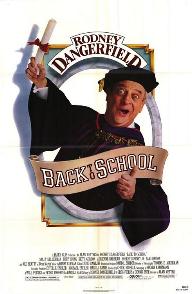 Thornton Melon (Rodney Dangerfield) started with nothing but through a combination of hard work and chutzpah, he started a chain of “Tall and Fat” clothing stores and made a fortune. Everyone has seen his commercials, the one where he asks his potential customers, “Do you look at the menu and say, ‘Okay?'” He has a new trophy wife named Vanessa (Adrienne Barbeau) and a chauffeur named Lou (Burt Young). Thornton never even graduated from high school but he gets respect.
