Retro Television Review: Homicide: Life On The Street 6.3 “Blood Ties, Part 3”


Welcome to Retro Television Reviews, a feature where we review some of our favorite and least favorite shows of the past!  On Sundays, I will be reviewing Homicide: Life On The Street, which aired from 1993 to 1999, on NBC!  It  can be viewed on Peacock.
This week, the Wilson case is finally resolved.

Episode 6.3 “Blood Ties, Part 3”

(Dir by Mark Pellington, originally aired on October 31st, 1997)

“Yo, Frank!” Detective Ballard yells at Pembleton at the start of this episode and I have to admit that I immediately cringed at the sound of it.  The man’s name is “Detective Pembleton.”  Ballard has done nothing so far to give her the right to address Homicide’s best character as “Yo, Frank!”

Of course, the main theme of this episode seemed to be all the detective who have been with the show since the beginning suck and that the new arrivals can do no wrong.

Take Falsone, for instance!  After a drug dealer is murdered, Falsone proves himself to be the only one who can talk to the dealer’s traumatized child.  Lewis is a buffoon in this episode, gloating over the dead dealer and traumatizing the kid while trying to lead him through the police station.  But Falsone?  He knows exactly what to say and, with his gentle prodding, the kid identifies the murderer of his parent as being a narcotics detective who is on the Mahoney payroll.   When Lewis asks Falsone why he’s so awesome, Falsone explains that he’s divorced and he misses his own kids….

OH MY GOD!  He’s a young detective who gets results and he’s divorced!  For a show that previously avoided stereotypes, Homicide is going out of his way to promote a big one in the form of Detective Falsone.

Meanwhile, the Wilson case is resolved.  It turns out that Ballard was totally correct and Pembleton was totally wrong.  Melia was killed by a member of the Wilson family and, to the surprise of absolutely no, the murderer turns out to be Hal Wilson (Jeffrey Wright, giving perhaps the worst performance of his distinguished career), the twitchy son of Felix.  Hal was obsessed with Melia and flew into a rage when he found out she was sleeping with his father.  Pembleton even gets Hal to admit it but –– Law & Order plot twist time! — Felix and Hal were only willing to talk to Pembleton on the condition that they weren’t Mirandized so the confession is inadmissible.  (That doesn’t seem like something that the normally meticulous Pembleton would agree to but whatever.)  Felix, Hal, and the entire family leave Baltimore for San Diego.

Afterwards, Ballard track Pembleton down and tells him that she’s going to be a Baltimore homicide detective whether he likes it or not.  Pembleton admits that he was wrong.  Watching the scene, one gets the feeling that the show is telling us, “Who needs Pembleton and Bayliss and all those boring cops when we’ve got new cop who are young and sexy and infallible?”

And here’s the thing.  There’s nothing wrong with bringing in new characters.  There’s nothing wrong casting attractive actors in those roles.  There is something wrong with pushing the characters to whom we’ve grown attached aside and insisting that we instead embrace new characters that we barely know.

This was a disappointing ending for the first three-parter of the series.  The season has just started and I’m already sick of Falsone trying to prove that the Luther Mahoney shooting wasn’t justified.  I’m sick of everyone talking about George Rae Mahoney as if she’s some total badass as opposed to a plot device.  And I’m tired of my favorites being pushed to the side.

We are not off to a good start.
Retro Television Review: Homicide: Life On The Street 6.2 “Blood Ties, Part Two”


Welcome to Retro Television Reviews, a feature where we review some of our favorite and least favorite shows of the past!  On Sundays, I will be reviewing Homicide: Life On The Street, which aired from 1993 to 1999, on NBC!  It  can be viewed on Peacock.

This week, the investigation into Melia’s murder continues.

Episode 6.2 “Blood Ties: Part 2”

(Dir by Nick Gomez, originally aired on October 24th, 1997)

Detectives Munch and Kellerman investigate a murder at Camden Yards, where the Orioles are playing the A’s and also where someone beat a loudmouth New Yorker to death in the stairwell.  Munch and Kellerman’s investigation is hindered by the fact that there’s a baseball game going on and every single witness would rather watch the action on the field then discuss the murder.  In fact, most of them don’t even consider it a crime to kill a Yankees fan.  Eventually, even Kellerman decides that he’d rather just watch the game.

In the end, though, Kellerman and Munch do make an arrest.  The murderer turns out to be another Yankees fan who was upset because he thought the Yankees were going to be playing the Orioles.  He’s even willing to sign a confession as long as he’s allowed to watch the end of the game.

Meanwhile, Pembleton and Bayliss continue to investigate the murder of Felix Wilson’s maid, Melia.  While Ballard and Gharty think that Pembleton should be looking at the Wilsons (and Gharty specifically feels that Pembleton is biased because the Wilsons are black and rich), Pembleton theorizes that the maid was killed by her abusive ex-boyfriend.  However, when it turns out that the boyfriend is still in prison in Haiti, Pembleton finally calls in Felix Wilson.

In the Box, Pembleton tells Felix that Melia had sex before she was murdered and that he needs a blood and hair sample so that both Felix and his son Hal (Jeffrey Wright) can be  eliminated as suspects.  “I had sex with her,” Felix says.  Felix goes on to say that he didn’t kill her.  Later, Felix’s attorney shows up at the station and announces that Felix has not only exercised his right to legal counsel but he will also not be submitting either his blood or his hair without a court order.  Both Pembleton and Giardello are left shaken.  Could Felix Wilson, a man admired by both of them, be a murderer?

This episode was an improvement on last week’s episode.  Munch and Kellerman got a decent, non-Luther Mahoney storyline.  The Wilson storyline is bringing out the best in both Yaphet Kotto and Andre Braugher and the great James Earl Jones is perfectly cast as Felix Wilson.  Ballard and Gharty held their own against Pembleton and Bayliss and, as opposed to last week, both of them seemed like they actually belonged in the Homicide Unit.  There was a great breakroom confrontation between the four detectives.  Even better, there was a genuinely funny scene in which Bayless called in his junior high French teacher to talk to the police in Haiti.

And yet, we still had to sit through a bunch of nonsense with Detective Falsone.  Falsone is still investigating the Luther Mahoney shooting, even though no one has asked him to do and all of the detectives involved were cleared of any wrongdoing.  Why, Falsone, why?  Why is Falsone so determined to prove that Lewis and Kellerman did something wrong in the shooting?  Why are we expected to sympathize with a character like Falsone?  This episode even features Falsone having a chance meeting with Dr. Cox and flirting with her.  Hey, Falsone — that’s Kellerman’s routine!  What the Hell!?

This would be a fine episode if not for Falsone and his vendetta against his fellow cops.  The show is really determined to try to make me like Falsone but …. I don’t think it’s going to happen.

Retro Television Review: Homicide: Life On The Street 6.1 “Blood Ties, Part One”


Welcome to Retro Television Reviews, a feature where we review some of our favorite and least favorite shows of the past!  On Sundays, I will be reviewing Homicide: Life On The Street, which aired from 1993 to 1999, on NBC!  It  can be viewed on Peacock.

This week, we start season 6.

Episode 6.1 “Blood Ties: Part 1”

(Dir by Alan Taylor, originally aired on October 17th, 1997)

It’s a new season of Homicide and, while Pembleton and Bayliss have been off working in the robbery division, some changes have occurred.  Sgt. Howard has left Homicide to work in another division.  Brodie’s documentary won an Emmy and he’s moved to Los Angeles.  Melissa Leo and Max Perlich are no longer a part of the cast.

Instead, we have three new detectives.  Gharty and Falsone (ugh!) are now full-time members of the squad.  Joining them is Laura Ballard (Callie Thorne), a recent transfer from Seattle.  When Pembleton and Bayliss return to Homicide, the first that they see is Ballard and Gharty being given a commendation for solving “the Rico case.”  Meanwhile, Falsone is walking around the squad room like he owns the place.  Giardello praises the new detectives and basically acts as if Pembelton and Bayliss are useless.

And listen, as much as I dislike Falsone and Jon Seda’s mumbling performance in the role, I do think that Peter Gerety is well-cast as Gharty.  And Callie Thorne seems like she’ll do a good job as Ballard, even if this episode does spend a bit too much time trying to convince us that she’s the greatest detective since Frank Pembleton.  But, when it comes to Homicide, I want to follow detectives like Munch, Lewis, Pembleton, and Bayliss.  I want to watch as Kellerman battles his demons and Giardello battles his superiors.  My point is that I don’t care about these new people.  I don’t care that Ballard is a hotshot detective.  I don’t care that Gharty is a blue-collar guy who is looking to prove himself.  I can’t stand Falsone.  I don’t want any of these people to be the new lead characters on the show.  I want Melissa Leo with her weird accent.  What are we even doing here, Homicide?

This episode, however, seemed to be determined to force the new characters on me.  For instance, Georgia Mahoney (Hazel Goodman) is in town, looking to get revenge for the death of her brother Luther.  She’s got people shooting at Lewis, Kellerman, and Terri Stivers.  Needless to see, Lewis and Kellerman get involved in tracking down and arresting not only Georgia but also Junior Bunk (Mekhi Phifer), Luther’s incompetent nephew.  However, Falsone gets involved too.  This means that we have to sit through an entire scene of Falsone attempting to interrogate Kellerman about the Mahoney shooting and the inconsistencies in the statements given by Lewis, Stivers, and Kellerman..  Hey, Falsone — YOU’RE THE NEW GUY!  WE LIKE KELLERMAN!  LEAVE HIM ALONE, YOU MUMBLING DOUCHEBAG!

Meanwhile, at a banquet honoring distinguished businessman and civil right activist Felix Wilson (James Earl Jones), a young Haitian woman is found beaten to death in the men’s room.  Her name is Melia and she worked for the Wilsons.  Now, in this case, Pembleton and Bayliss are the primaries but Ballard and Gharty still come along to provide support and soon, Ballard and Pembleton are arguing about the best way to handle the investigation.  Ballard thinks that Pembleton is going easy on Felix Wilson because of Wilson’s standing in the black community.  Pembleton thinks that Ballard should remember who the primary investigator is.  And myself, I’m wondering why Pembleton and Ballard are having the type of conversations that Pembleton used to have with Bayliss.  Whenever Pembleton and Bayliss debate prejudice, it works because we know who Pembleton is and we know how Bayliss is.  We don’t know enough about Ballard for her debate with Pembleton to really mean anything.

Apparently, Homicide was nearly cancelled after the end of season 5.  When it was renewed, it was done on the condition that had to improve its rating and win its time slot.  This episode feature a lot of action.  A man on a motorcycle fires at Falsone and Lewis.  A sniper hits Kellerman in the arm.  The cops stop Georgia’s private plane from taking off and arrest her.  Visually, this episode is brightly lit and there’s none of the odd camera angles that dominated the previous few seasons.  Comparing this episode to the episodes that came before it creates a tonal whiplash that can only be compared to going from the Steve Carell-led Office to the Ed Helms version.  It’s not necessarily bad but it just doesn’t feel right.

This episode ends with Georgia in jail and Pembleton still investigating the death of Melia.  Season 6 is off to a start and I’m not really happy about how it’s going so far but we’ll see what happens.

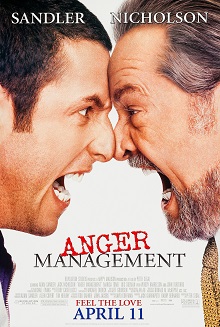
Anger Management (2003, directed by Peter Segal)


Dave (Adam Sandler), a timid man who has never gotten over being humiliated when he was a teenager, is sentenced to anger management after a slight argument on a plane is blown out of proportion by a taser-wielding shy marshal.  His therapist is Dr. Buddy Rydell (Jack Nicholson), whose techniques only seem to exacerbate Dave’s growing anger.  Among Dr. Rydell’s methods are giving Dave an unstable “anger buddy” named Chuck (John Turturro), ordering Dave to get revenge on the guy (John C. Reilly) who humiliated on his as a teenager, and also encouraging Dave to cheat on his girlfriend Linda (Maria Tomei) with a woman (Heather Graham) that they meet at bar.  Dave goes from timid to angry, Dr. Rydell starts dating Linda, and the whole thing is wrapped up with a totally implausible ending.

The idea of the star of Chinatown and Five Easy Pieces co-starring in an Adam Sandler comedy sounds like it should be exhibit #1 when it comes to talking about the decline of American cinema but I’ve always liked Anger Management.  Casting Jack Nicholson as the seemingly insane Dr. Rydell was an inspired choice and Nicholson gives a real performance in the film as opposed to just coasting on his already-established persona.  Anger Management came out a year after Adam Sandler’s first dramatic film, Punch-Drunk Love, and, even though Anger Management is a raunchy comedy from the start to finish, Sandler’s performance actually finds the reality in Dave’s situation.  Sandler plays Dave as being someone who is sincerely trying his best to get through his court-mandated anger management without losing control.  Nicholson and Sandler make for a surprisingly good team.

Of course, it’s an Adam Sandler comedy so it’s not for everyone.  The humor is often crude and the film’s final twist is so ridiculous that it can actually leave you feeling like you might need anger management.  But Anger Management does show how Jack Nicholson improves anything that he’s involved with and it also shows that Adam Sandler can act when he feels like it.  Anger Management also gave us the meme of Jack Nicholson nodding his approval, meaning the film and the performance will live forever.