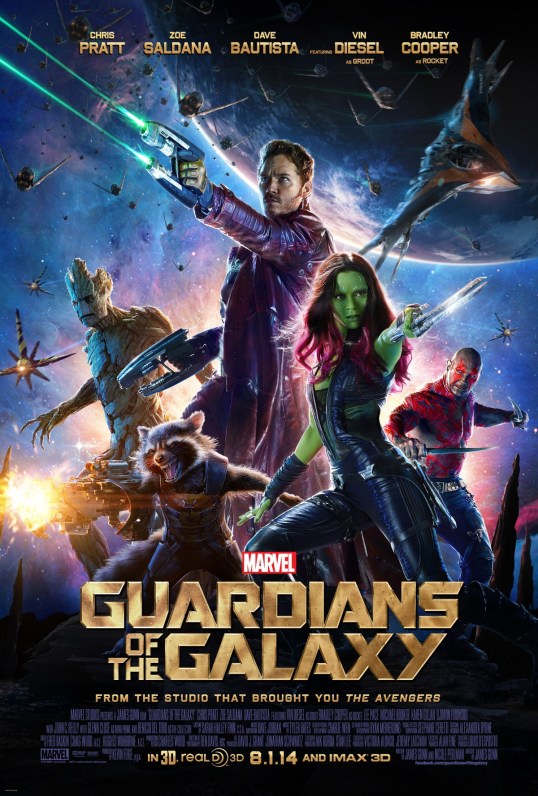
Marvel Entertainment just released the extended “Cherry Bomb” trailer for it’s upcoming Guardians of the Galaxy.
It’s been known coming straight from the film’s director, James Gunn, that Guardians of the Galaxy will feature a very eclectic selection of 70’s and 80’s tunes. These are songs that’s become part of Peter Quill’s hold on his Earth-heritage. It’s all he has left of his time as a child on Earth before leaving for a galaxy far, far away. We’ve already heard two songs that have been confirmed for the film with “Hooked On a Feeling” and “Spirit In the Sky”.
Now we have another song featured on this trailer that Gunn himself has confirmed as part of the film’s soundtrack with The Runaways’ “Cherry Bomb”.
Oh yeah, the extended trailer also includes some new scenes that doesn’t spoil the film, but just extends the smaller sequences we’ve already seen.
Guardians of the Galaxy is set for an August 1, 2014 release date.
As promised by James Gunn over three days of teasing this trailer over the weekend we finally have the latest trailer from his upcoming addition to the Marvel Cinematic Universe: Guardians of the Galaxy.
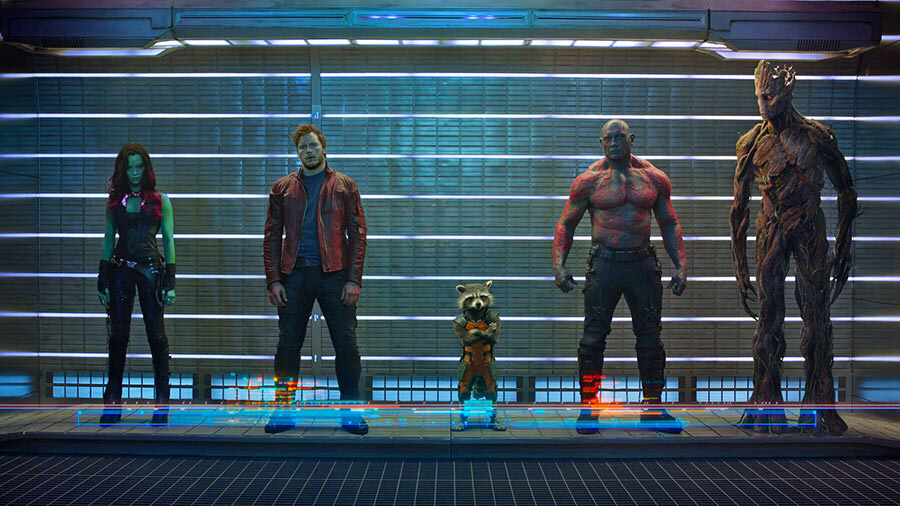
The trailer seems to expand more on some of the scenes shown in the firs trailer and still keeping most of the plot outside of the “losers team-up against Ultimate Evil” being introduced with this trailer. We do get something that people have been wondering about since the first trailer and that was how would Rocket Raccoon and Groot would sound. It’s still weird hearing Bradley Cooper’s voice come out of a suited-up raccoon, but Vin Diesel definitely nailed it as Groot. Though that’s not saying much.
We get a few more brief glimpses of Ronan the Accuser and, what should make hardcore comic book fans smile from ear-to-ear, the severed and floating head of a Celestial (2100 foot Godlike cosmic beings) that either will serve as the home base for the Guardians or for the Collector (Benicio Del Toro’s character).
It’s still a couple months away, but Guardians of the Galaxy seems to be getting the tone of Marvel’s cosmic side just right. We still haven’t even seen Michael Rooker’s Yondu character.
Guardians of the Galaxy is set for an August 1, 2014 release date.
“Hell, I’m just trying to keep this thing interesting. You can’t write me off like that. You’re just a voice, pal! You don’t know a damn thing about racing!” — Sweet JP
Anime has long distinguished itself from Western animation through its embrace of hyperkinetic imagery—an intensity of motion and visual energy that often prioritizes sensation over realism. While Western animation traditionally leans toward fluidity and physical believability, anime frequently pushes beyond those constraints, opting instead for exaggerated speed, explosive movement, and stylized impact. This difference isn’t just aesthetic; it reflects a broader philosophical divide in how motion itself is perceived. In anime, movement isn’t always about replicating reality—it’s about amplifying it.
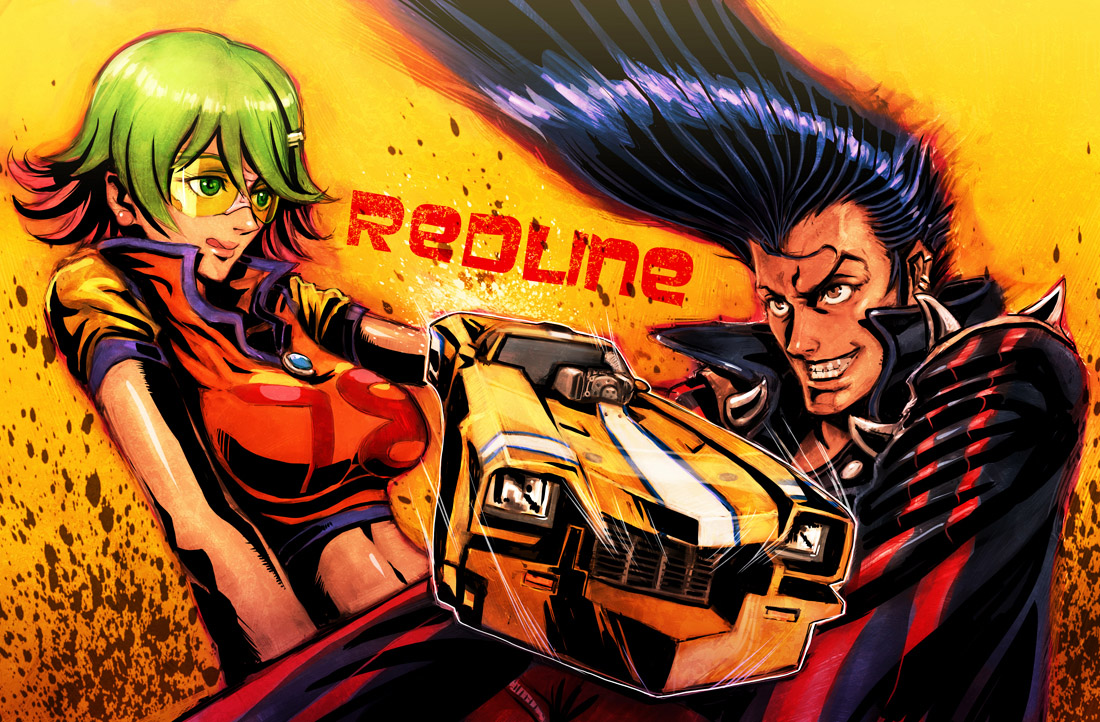
Few films embody this ethos as completely as Madhouse’s 2009 OVA Redline, a project that takes anime’s penchant for excess and turns it into a full-blown artistic manifesto. Directed by Takeshi Koike, Redline is less a conventional narrative film and more a sustained audiovisual adrenaline rush—a sci-fi racing spectacle that fuses breakneck pacing with meticulous hand-drawn craftsmanship. The production history of Redline is almost as legendary as the film itself: Koike and his team spent seven years bringing the project to life, pouring millions of dollars and an extraordinary amount of labor into its creation, with over 100,000 hand-drawn frames used in the final product. The result is a visual texture that feels both raw and impossibly refined—so detailed and fluid at times that it borders on looking computer-generated, despite being entirely handcrafted.
Koike’s influences are unmistakable throughout. There’s a clear lineage connecting Redline to the work of his mentor, Yoshiaki Kawajiri, particularly in the sharp character designs and kinetic action choreography reminiscent of Ninja Scroll and Vampire Hunter D. At the same time, the film borrows heavily from Western graphic aesthetics, most notably the thick linework and heavy shadowing associated with Frank Miller. This fusion creates a visual identity that feels globally informed yet uniquely its own—an anime that doesn’t just borrow from other traditions but aggressively remixes them.
Narratively, Redline is deceptively simple, and for some viewers, that simplicity borders on a flaw. The film centers on a futuristic intergalactic race—one that deliberately rejects advanced hover technology in favor of visceral, ground-based machines, giving the world a gritty, almost rebellious edge. At its core, the story follows Sweet JP, a daredevil racer with a towering pompadour and retro greaser aesthetic, as he competes in the titular race—the most dangerous and prestigious competition in the galaxy. His journey is framed through familiar tropes: the underdog striving for victory, the thrill of competition, and a romantic subplot involving his rival Sonoshee, who is both a love interest and a formidable racer in her own right. JP and Sonoshee are given just enough backstory and personality to be engaging, but they never evolve beyond archetypes, and the film never pretends otherwise.
And yet, this simplicity isn’t necessarily a weakness—it’s a deliberate trade-off. Redline understands exactly where its strengths lie, investing nearly all its creative energy into delivering a sensory experience rather than a deeply layered narrative. The characters function less as psychological studies and more as conduits for momentum, existing primarily to carry the viewer from one explosive set piece to the next. What truly sets Redline apart is the sheer density of its animation: every frame feels alive with motion, detail, and intent. Backgrounds pulse with activity, vehicles tear through space with exaggerated force, and the action sequences are so relentless and visually packed that they almost demand multiple viewings, as it’s nearly impossible to absorb everything in a single pass.
This overwhelming kinetic energy is where Redline transcends its narrative limitations. It creates a kind of visual immersion that few animated films—Western or otherwise—have managed to achieve. Watching it feels less like observing a story and more like being strapped into the driver’s seat of a machine hurtling toward collapse. Some critics have compared Redline to the Fast & Furious franchise, particularly its later, more exaggerated entries. On the surface, the comparison makes sense: both celebrate speed, spectacle, and a kind of reckless bravado encapsulated by the mantra “ride or die.” But the relationship feels less like equivalence and more like inversion—if anything, Fast & Furious comes across as a live-action attempt to capture the kind of unrestrained energy that Redline achieves effortlessly through animation. Where Fast & Furious is still tethered, however loosely, to physics, Redline operates in a space where those limits don’t exist and doesn’t need to justify its excess—it revels in it.
Despite its relatively modest reputation compared to more narratively complex anime films, Redline has earned a cult status among fans who appreciate animation as an art form. It prioritizes craft, motion, and sensory impact above all else, achieving something rare: a pure expression of animation’s potential. That’s why Redline remains such an essential watch. It may not offer the emotional depth of a Studio Ghibli film or the intricate plotting of a Satoshi Kon work, but it delivers something equally valuable—a reminder of what animation can do when pushed to its absolute limits.
For the best experience, Redline deserves to be seen on the largest, highest-quality screen possible. Its dense visuals and explosive color palette benefit immensely from high-resolution displays, particularly modern 4K screens that can fully capture the detail of its hand-drawn artistry. While it’s accessible through streaming platforms like YouTube, watching it on a premium setup transforms it from a great film into a full sensory event. In the end, Redline isn’t just a movie—it’s a showcase, a flex, and a love letter to animation itself, proving that sometimes style isn’t just substance—it is the substance.
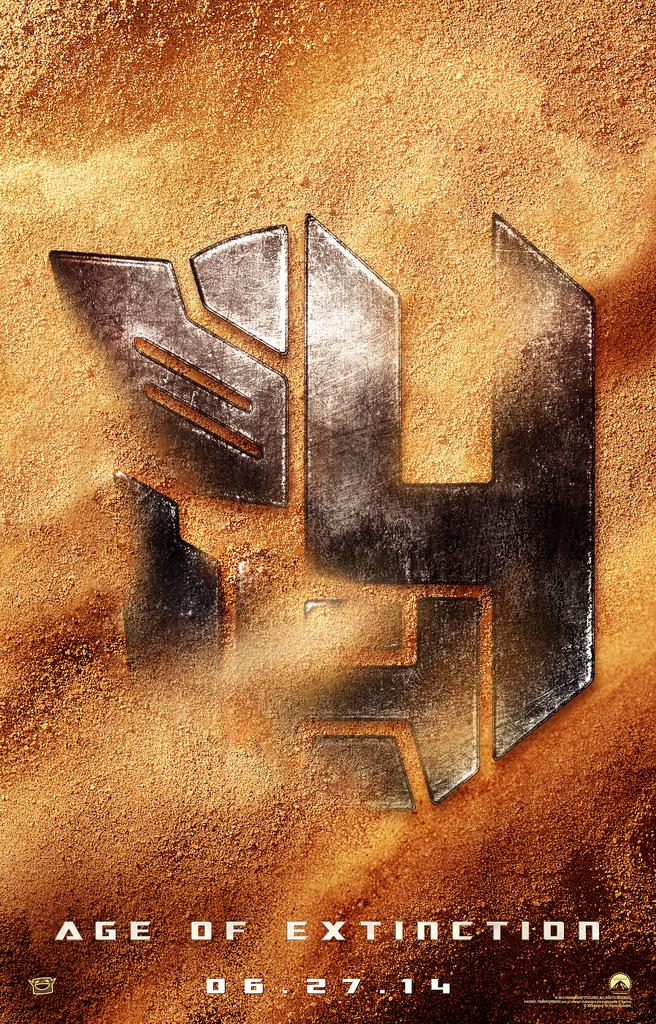
I know, I know, another Transformers extravaganza coming this summer. As if the last two wasn’t enough to swear me off the franchise. Well, guess what this one doesn’t have any of the actors from the first three and drops in a whole bunch of new ones to play war with the aforementioned robots who are more than meets the eye.
Instead of Shia LaBeouf in the lead role screaming like the most unheroic lead ever we get the manly man Mark Walhberg himself playing a Texas dad out to protect his daughter from the men in black while jump starting a rusted Optimus Prime on his spare time.
This fourth film looks to be a new start for the franchise that we all thought ended with a bang and a whimper with Transformers: Dark of the Moon, but there were still more Transformers that never made it to the bigscreen and what better way to do that than make a fourth. So, it looks like fans finally get Grimlock and the Dinobots plus a Decepticon that looks to be Galvatron.
Again, I will be seeing this (it’s like the scifi blockbuster version of Saw) just for the fact that it doesn’t have Shia LaBeouf for people to listen to scream shrilly every two or three minutes. Plus, it has Optimus Prime wrestling and then riding Grimlock.
Transformers: Age of Extinction is ready to make our eyes explode on June 27, 2014.
Yes, it is another Transformers film about to descend on the population this coming summer.
Could we finally get a quality one after the last two which got worse and worse with each new entry? I can’t say for sure, but this fourth entry does have one thing going for it and that is the lack of Shia LaBeouf. Instead we get Mark Walhberg in the lead human role. Optimus Prime and Bumblebee return with new robots filling in the rest.
If there’s one thing about Transformers: Age of Extinction that will get me to see it once it comes out is the fact that it has Grimlock and his merry band of Dinobots finally making their appearance. Yes, Grimlock and that’s all I need.
Transformers: Age of Extinction is set for a July 27, 2014 release date.
I’ll just say it outright and get it out of the way and say that Guillermo Del Toro is one of the few filmmakers whose body of work has earned him my admiration. The Mexican-born filmmaker has made some of the most fully-realized and visually-beautiful films of the last twenty years. It doesn’t matter whether its genre staples like Blade II and the two Hellboy films or arthouse fares like The Devil’s Backbone and Pan’s Labyrinth, Del Toro has a unique talent for making one believe in the world his films inhabit. This is probably the reason why Peter Jackson had tapped him to direct the film adaptation of J.R.R. Tolkien’s The Hobbit. The man just has an eye for every detail, no matter how big or small, that he believes will add to the overall experience of watching his films.
When delays and behind-the-scenes studio bickerings kept the production of The Hobbit from moving forward Del Toro was already two years into pre-production of the long-awaited new trilogy, but finally backed out. He would try to make one of his dream projects his next move with the film adaptation of H.P. Lovecraft’s classic At the Mountain of Madness. This was a film that looked to set the horror and genre scene by storm. It was a story that was right in Del Toro’s wheelhouse. The film would require him to create a believable world where cosmic Elder Gods and Old Ones existed and still make it terrifying and awe-inspiring. But once again his ideas would require a huge budget from the studios and his stance on making the film an R-rated one finally shelved it (though hopefully not for good).
With two major productions either cancelled or dropped out of, Guillermo Del Toro was now without a film to direct and it’s been years since his last (Hellboy II: The Golden Army). Maybe it was providence or just plain ol’ dumb luck, but in comes a screenplay from Travis Beacham which included such terms as “Jaegers” and “Kaiju” and Del Toro finally got a film that wasn’t an adaptation of someone elses work, but something he could build from the ground up and make his own. That film was and is Pacific Rim.
Pacific Rim finally arrives in cinemas around the world and it couldn’t come at a better time. The last couple years have seen summer blockbusters get bigger and bigger. Each new blockbuster tried to outdo the next with something more extravagant, louder and, to their detriment, more complex and convoluted in their storytelling. This is not the case for Pacific Rim which comes in with a simple premise that managed to stay together from start to finish: giant robots fighting giant monsters.
From that idea was born a film that lends itself well into Guillermo Del Toro’s visual and world-building talent. He had to find a way to make this film, that harkens back to the old kaiju films from Japan’s Toho studio and its mecha/giant robot anime genre, a believable world where adventure and spectacle ruled and not post-modern deconstruction and cynical characters and storytelling. It’s an endeavor that succeeds, though not perfectly, to do more than just entertain but also show that sometimes the old ways of telling a story does belong in this new world of hi-tech filmmaking.
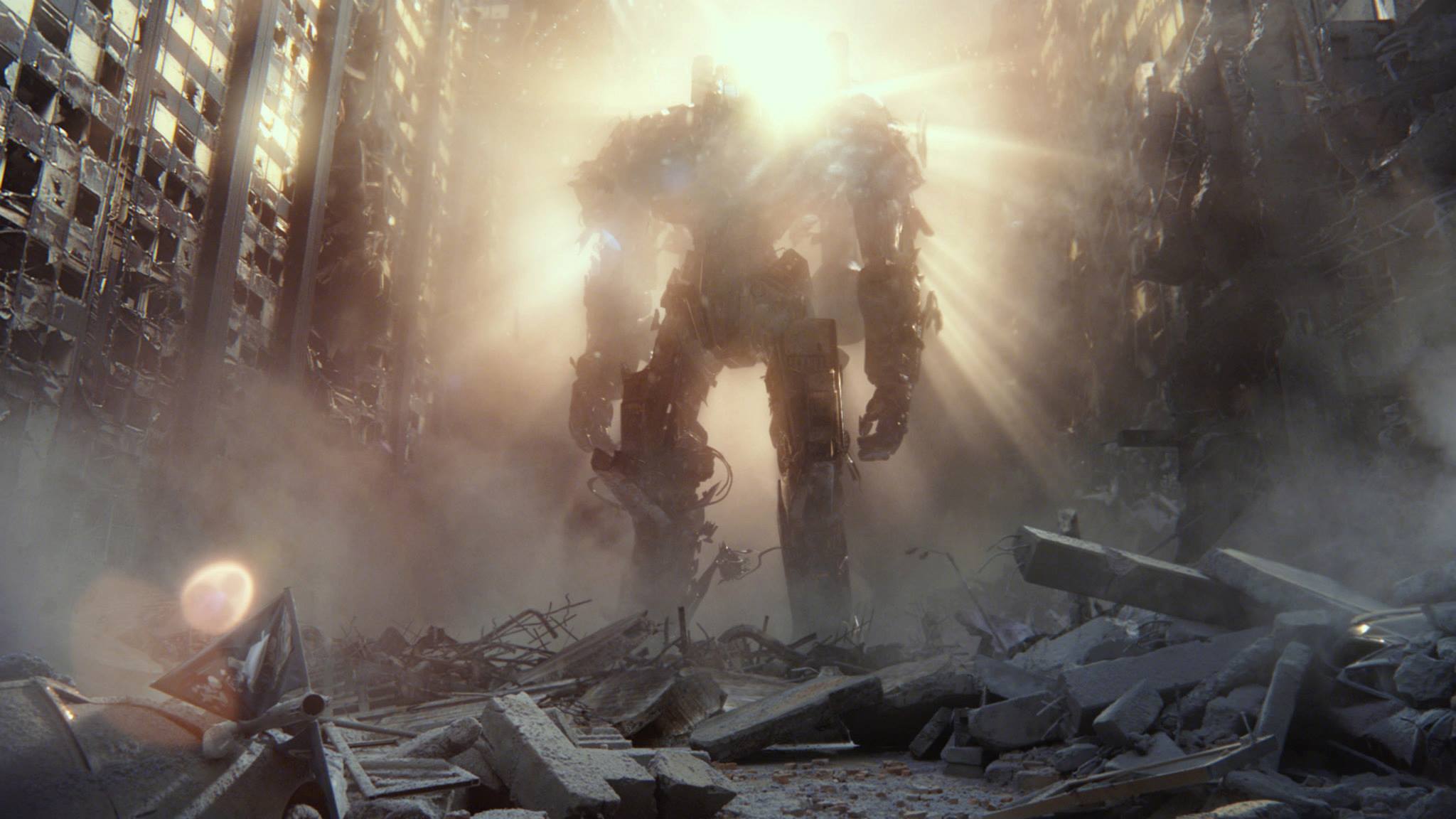
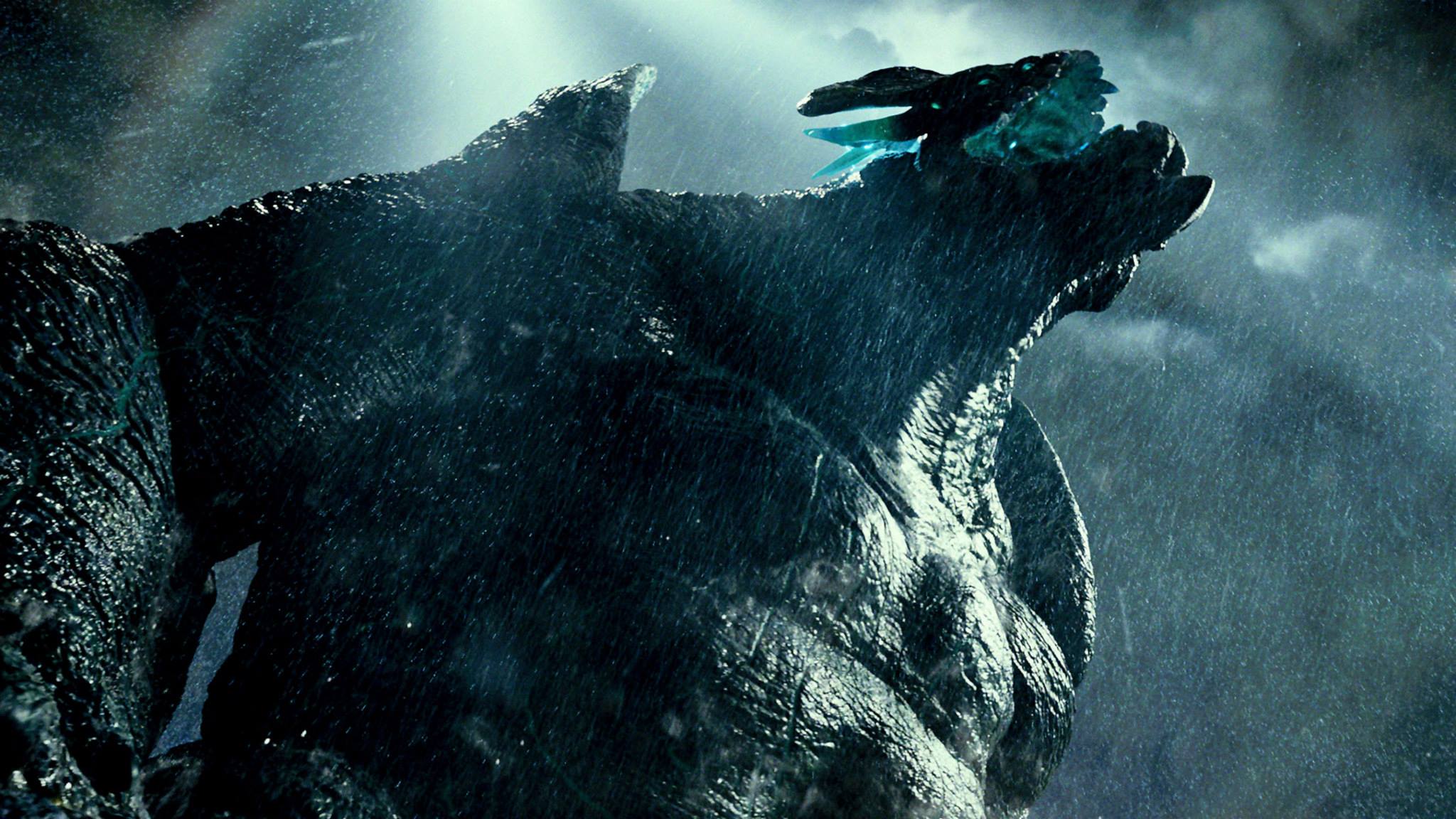
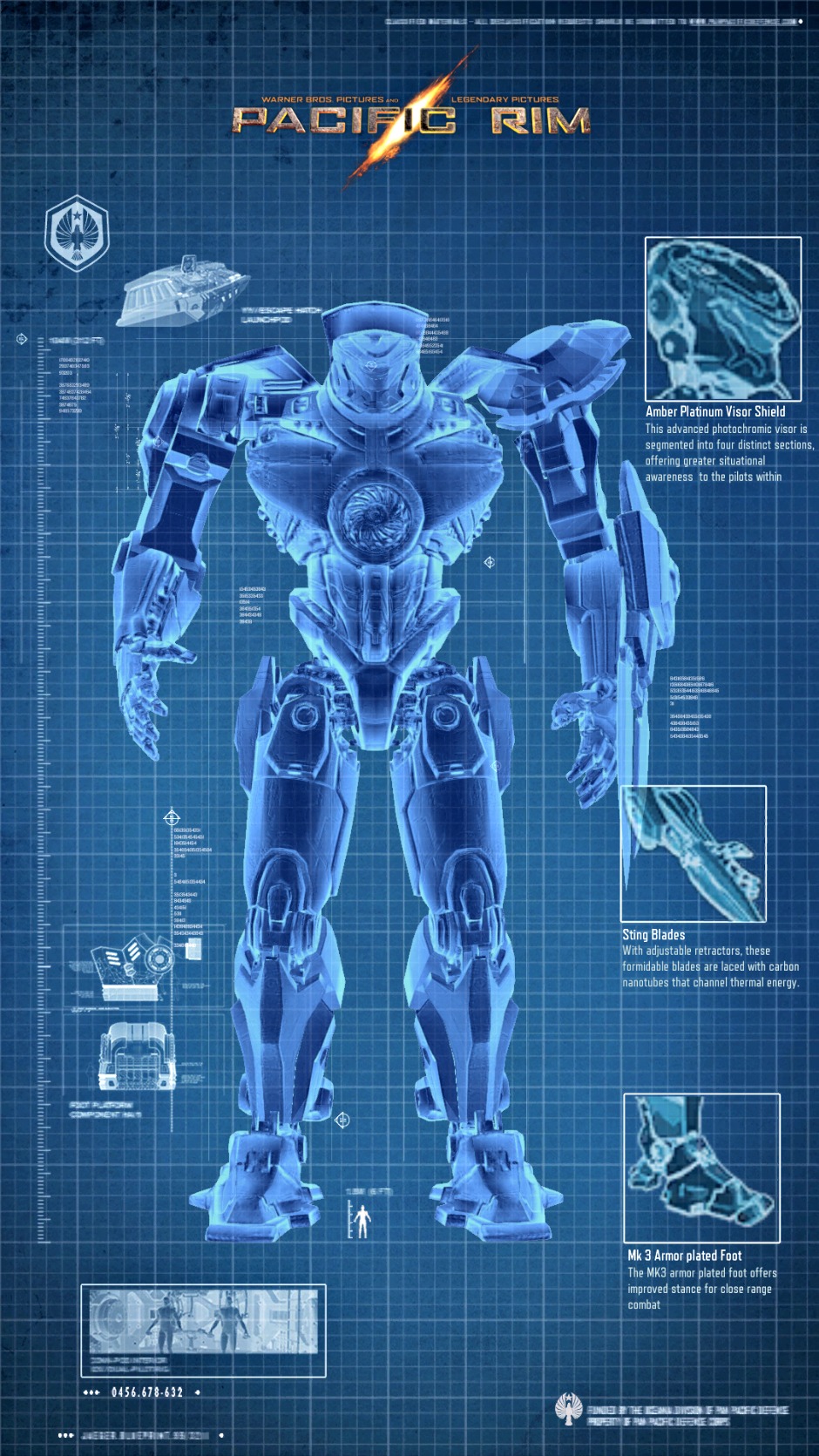
The plot to Pacific Rim is simple enough and an extended opening prologue narrated by one of it’s lead character (Charlie Hunnam of Sons of Anarchy fame playing the role of Jaeger pilot Raleigh Becket). Sometime in the very near future an interdimensional rift (called The Breach) in the Pacific Ocean where two tectonic plates meet open up to allow gigantic creatures dubbed by people as “kaiju”. These kaiju wreak destruction and havoc on a massive scale to the world’s Pacific coastline cities like San Francisco, Manila, Cabo and Tokyo. When conventional military means take too long and and only nuclear options remain on the table the world’s governments band their resources and technical know-how to find a new weapon to combat these kaiju. In comes the “Jaeger Program” where two pilots control 25-story tall giant robots through a “dark science” called “The Drift” to finally fight the kaiju on even terms.
We see through this prologue how the “Jaegers” and their pilots have become rock stars in the eyes of the public as their successes stems and stops the tide that’s been destroying cities in the Pacific Rim for years. It’s also in this prologue that we get to the point of the film where this success has led to overconfidence and the beginning of the end of not just the “Jaeger Program” but that gradual slope that leads to humanity’s inevitable extinction.
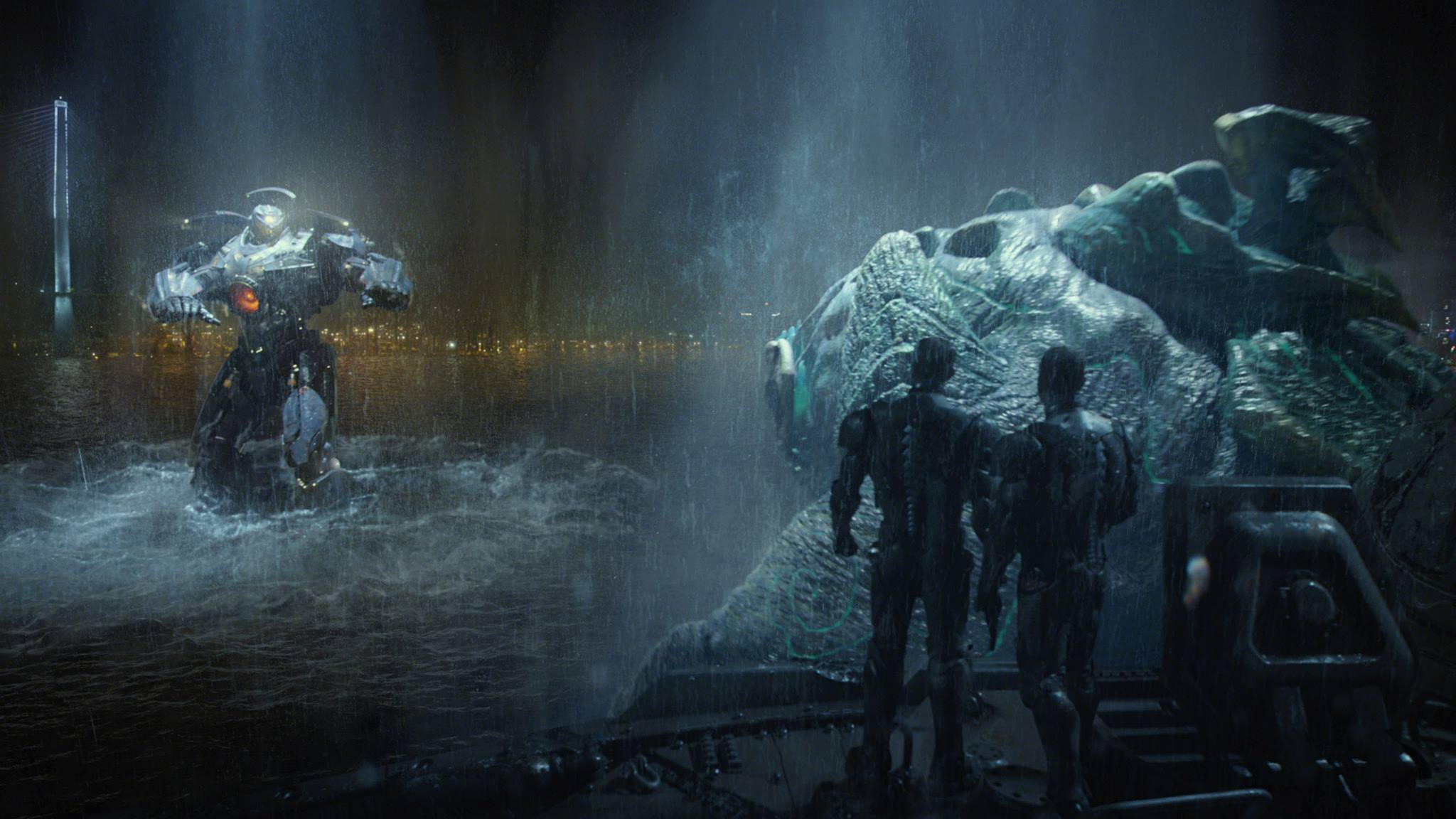
The bulk of the film deals with the last few days of the war when the world’s government have stopped funding the Jaeger Program and instead have pooled all resources and manpower towards building massive anti-kaiju walls along city coastlines as a measure of defense. The Jaeger Programs leader, Marshal Stacker Pentecost (played by the ever-present Idris Elba who seem to live the role), believes that his Jaegers and the Rangers piloting them still can finish the war once and for all with a final strike on The Breach with the remaining four Jaegers left in his arsenal. When the politicians tell him no he resorts to dealing with the less than legitimate sector to fund this final strike. But for this last mission to succeed he needs one of his best pilots back from the brink of remorse and mourning to pilot an older, refurbished Jaeger by the name of Gipsy Danger.
From then on the film takes on the premise that Del Toro promised when he first took on the project. We finally get to see giant robots fighting giant monsters.
Pacific Rim lives on it’s simplicity. Whether the simplicity of it’s story, dialogue, characters and themes. The film works within those parameters and does it well. One never feels lost with in the film’s narrative. There’s nothing convoluted with this film’s story. Some have said this need to be simple is an inherent flaw. I would agree with this if someone with less talent took on the job. Del Toro understands that keeping the story simple doesn’t mean dumbing it down, but keeping the promise of what the audience expects from a genre film of giant robots fighting giant monsters needs to deliver. The film’s simplicity allows for the story to flow from it’s hi-octane action sequences to it’s more personal moments without having it seemed forced.
Even the characters themselves come off as the archetypes of past adventure films. Whether it’s the stern father figure leading the pack to the hot-shot hero looking to redeem himself for a past failure to the cocky rival whose hothead personality acts as a counter-balance to the hero’s. Even the mysterious newcomer whose past acts as one of the film’s central emotional anchors harkens back to an earlier era of storytelling that preceded the more realistic and gritty era of film narrative born during the late 60’s and 70’s.
These characters some would call one-dimensional or plain cardboard cutouts, but in the context of the film being seen they work. We get enough of what motivates each character to fully understand why their characters do what they do in the film. The motivations range from honor-bound duty to accomplishing the mission, to revenge, redemption and just plain old-school heroism. Yes, this film brings back heroism minus the recent trend to downplay such an archaic notion. The film treats heroism as something noble born out of the shared sacrifice and the need to do what’s right and to protect not just the person next to them but everyone else who cannot fight the monsters that are at their doors.
The characters of Raleigh Becket, Stacker Pentecost, Mako Mori (played by Oscar-nominatedted actress Rinko Kikuchi who channels her inner anime not just in her attitude but even her appearance) and even the dueling scientists Newton Geizler and Gottlieb (played with manic and eccentric enthusiasm by Charlie Day and Burn Gorman respectively) all come off as heroes who accepts the challenge and nobility inherent in the term. They don’t balk at the duty put on their shoulders, but go full-bore in making sure what they do doesn’t have any moments of self-doubt or cynicism. These are characters who don’t become heroes because they were forced into it. They’ve made their choice and thus have to realize that taking on the mantle of heroism would mean making the ultimate sacrifice.
Yet, for all the talk of themes and narrative styles the film will ultimately live or die on the film’s promise. Does the giant robot fighting giant monsters hold up?
I can honestly say that it does and goes beyond what the studios have been hyping it up to be.
The action sequences between the Jaegers and the kaiju have to be some of the best action sequences of the past decade if not even farther back. It’s a loving homage to the classic daikaiju and mecha of old from Japan that Westerners grew up watching on Saturday mornings on the local UHF channels. It’s mecha anime like Mazinger Z, Macross, Gundam, Neon Genesis Evangelion, Tetsujin-28, Tengen Toppa Gurren Lagann and many others seamlessly melded with the old-school monsters flicks from the Toho Studios with kaiju bearing the iconic names of Godzilla, Gamera, Rodan, Mothra, King Ghidorah and many more. Pacific Rim is a film aimed at the inner-child of men and women who grew up watching these films and shows, but also one that seeks to fire up the imagination of the current generation of children who have been fed on the latest trend of snarky and self-doubting heroes.
The fights between the the jaegers and kaiju also does one thing that most Hollywood filmmakers who make action films have been unable to pull off. I’m talking about action sequences that remains as kinetic and explosive as any we’ve seen in the past but also aware of it’s space and environment. Pacific Rim’s action sequences never come off as being confusing. There’s no hand-held, cinema verite stylistic choices when it came to filming these sequences. We know exactly which jaeger is doing to fighting and which kaiju is fighting back. Even while set mostly at night and in the rain (or in some cases in the water and underneath in ocean), these fights and the digital effects created by ILM (with some practical ones from Legacy Effects) come off just as clear as if they were done for daytime. In fact, having them set at night with the many differing kinds of light sources available in the scene sometimes gave the fight scenes an almost psychedelic look with Hong Kong’s neon-lit streets and cityscape to the reflected bio-luminescence of the kaiju to the utilitarian lights on the jaegers themselves.
Yet, it still all comes down on whether the promised throwndown delivers and yes it does. We’ve come to learn that even ILM can make the most awesome looking digital effect visuals but still having them end up being confusing because of the filmmaker involved. Some have called this the Michael Bay Effect. Even some of today’s most visually talented filmmakers have fallen prey to it, but not Del Toro who eschews rapid-fire editing and shaky-cam moves. He instead goes from strady shots both close-up and wide to show the battle progress from one move to the next as we see each counter-move develop into more counter-moves. These jaeger-kaiju fight scenes have an almost balletic grace to them despite the massive amount of destruction heaped not just on each other but their surrounding environment as well. They also have a sense of weight to both jaeger and kaiju. With each step, punch, crash and bodyslam there’s a sense of real actual weight being protrayed on the screen unlike films like the Transformers trilogy and, more recently, Man of Steel during some of it’s major action sequences.
Once again this boils down to the simplicity of the scenes and how this choice makes the fights more exciting and thrilling than anything we’ve seen this summer. Up-and-coming filmmakers looking to find out how to set, block and choreograph action scenes could find no better filmmaker than Guillermo Del Toro to learn from.
So, does this mean that Pacific Rim is a perfect film which has no flaws and can do no wrong. It’s a question that probably splits critics and those who talk endlessly about film, but the simple answer is that Pacific Rim is not a perfect film. It does have it’s faults that’s born out of it’s simple narrative and simple-drawn characters. Yet, these flaws also comes across as strengths depending on who ones asks. But as a piece of action-adventure filmmaking that promised the simple idea of giant robots fighting giant monsters the film was perfect.
Pacific Rim reminds us that Guillermo Del Toro is one of the few filmmakers who definitely earns the label of genius. It’s not hyperbole. It’s just fact. It takes a genius filmmaker to do the sort of varied films as he has done throughout his career both as director and producer and still have each and everyone of them feel original (whether they are or not), thought-provoking and just plain old fun. Pacific Rim may be Del Toro’s love letter to his childhood loves of mecha anime and daikaiju films from Toho and other such studios, but it’s really a rallying cry to audiences both young and old that blockbuster filmmaking doesn’t have to be gritty, journeys through psychological darkness to be successful. He’s brought the fun back in epic, grandiose filmmaking that hopefully becomes a trend and not a one-shot.
P.S.: Also, make sure to stay to watch the end title sequence that was created by Imaginary Forces to make a sequence similar to the awesome end titles for The Avengers last year. Plus, there’s a small scene mid-credits at the end that ends the film on the proper note.
Ok, this is the final and most awesome trailer of Guillermo Del Toro’s upcoming giant mechs vs. kaiju (giant monster) blockbuster spectacle, Pacific Rim.
While it might look like so many trailers and teasers about this film will spoil the film for those still to see it I must say that it doesn’t. This latest and last trailer from Warner Bros. still uses scenes from previous teasers and trailers, but just extends each sequences a second or two longer. We get some new images of the jaegers and kaiju fighting, but just extended versions of what we’ve already seen. In the end, this latest trailer still doesn’t give a chronology of how these scenes fit in the film.
I know people probably have their pitchforks and hater-hats on to tear Pacific Rim apart for being too CG, all-action and no brains despite not having seen it. Or worst yet…Looks like Transformers.
I say to these people they should just stay home and go watch their indie, arthouse film that only ten other people have seen and let those of us who enjoy spectacle of this magnitude to enjoy (or not) what Del Toro seem to have cooked up in his mad scientist brain of his.
I don’t go into this film thinking it’ll be a new standard in high art in cinema. I just want to see a giant rocket punch smash into some interdimensional giant monster face.
Pacific Rim will punch fans and detractors a like in the face this July 12, 2013.
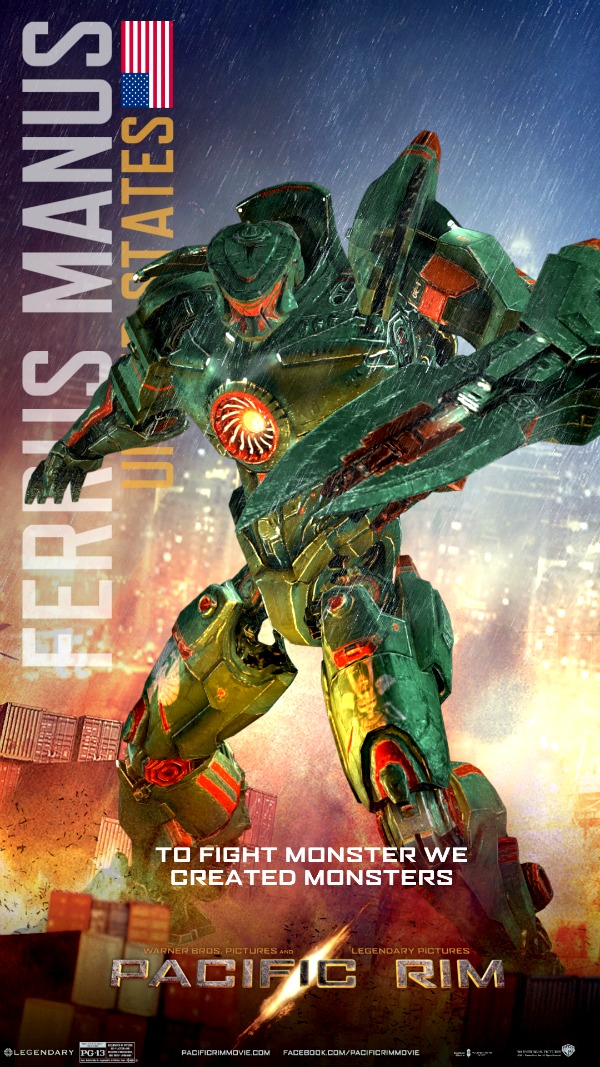
Behold, Through the Shattered Lens’ own Jaeger contribution to the fight: Ferrus Mannus.
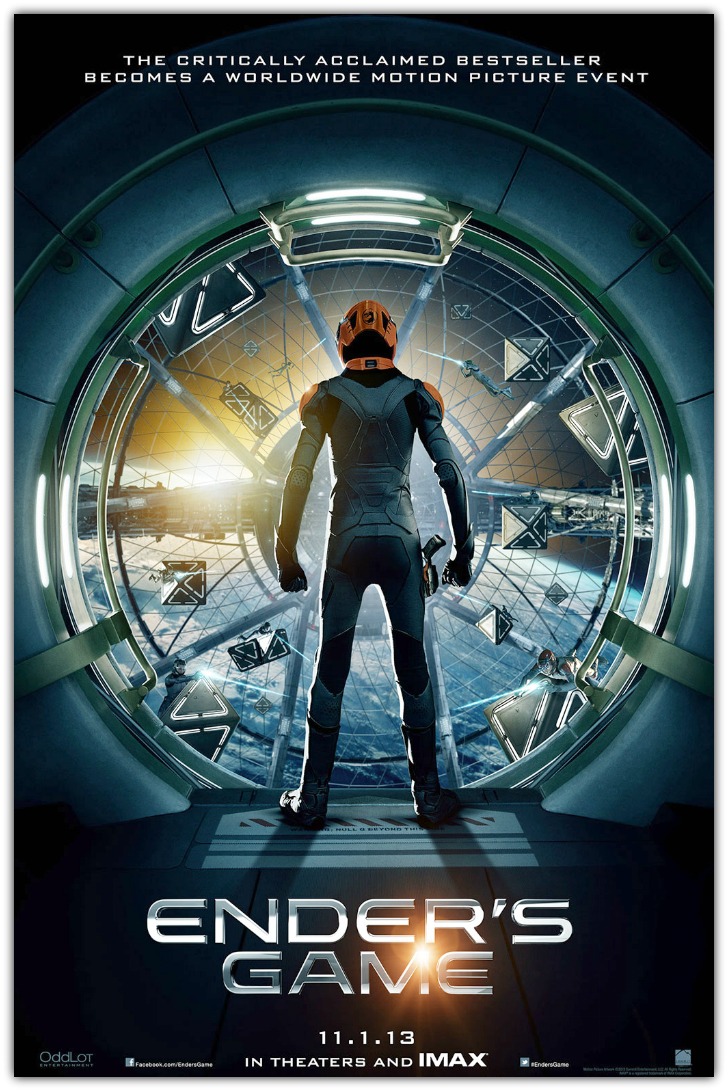
It’s finally going to happen. A film adaptation of Orson Scott Card’s sci-fi novel Ender’s Game is going to be on the bigscreen. This was a property that was often talked about becoming a film, but years upon years of talk never amounted to much other than fan casting and never getting past the concept stage.
I knew that the film adaptation had gotten the greenlight over a year ago, but I just assumed that something will derail it once again and leave Ender’s Game as another case of film vaporware. The fact that there’s now a trailer released by Summit Entertainment means that the film will come out. Now whether the film adaptation satisfies the book’s legion of fans and still entertain those who never read a word of Card’s novels still to be determined.
Ender’s Game is set for a November 1, 2013 release date.
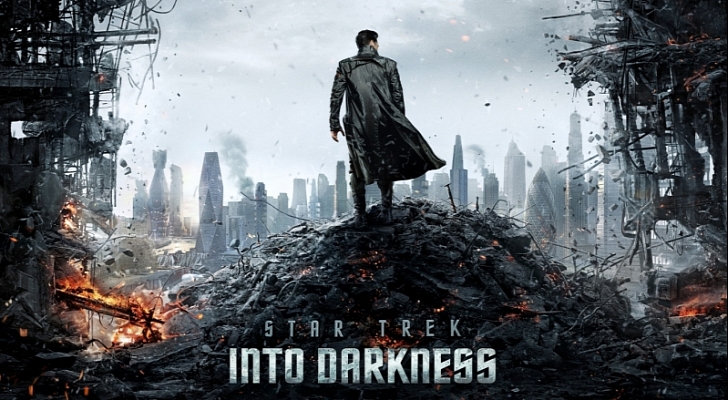
Less than two months remain before the sequel to J.J. Abrams surprise reboot hit of Star Trek arrives in the theaters this summer. It’s set to be one of this summer’s tentpole event films and this later trailer looks to set to prove that to be true.
While the first two trailers went light on the main narrative of the sequel this international trailer looks to really focus on Benedict Cumberbatch’s character who is either going to be this Star Trek alternate timeline’s Khan or Gary Mitchell or an amalgam of the two. Either way the trailer is all about action and Sherlock-Smaug looking, talking and acting all superior evil towards Kirk and the rest of the Enterprise crew.
Star Trek Into Darkness is set for a May 17, 2013 release date.