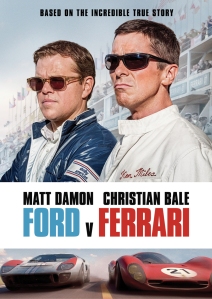
Ford v Ferrari (dir. by James Mangold)


fordvferrari posterIt’s rare for me to say that I enjoyed a film so much that I didn’t want it to end, but James Mangold’s Ford v. Ferrari hits all the right notes. A fantastic cast, impressive visuals on the races, scenes that flow without any time wasted and sound that begs to be heard on a surround system. It’s no surprise that the film earned Four Oscar Nominations – Best Sound Editing, Best Sound Mixing, Best Film Editing and Best Picture, all of which are well deserved. If the lineup this year wasn’t so stacked, I’d say that Ford v Ferrari would score quite a bit. It can go any way, but It may end up like The Shawshank Redemption – A great film that could be eclipsed by giants.

Based on a true story, Ford v. Ferrari focuses on the Ford Motor Company in the mid 60’s, down on its luck and looking for a way to stay ahead of the game. Henry Ford II, played by a scene stealing Tracy Letts (August: Osage County), asks his workers to come up with an idea. A young Lee Iacoccoa  (Jon Bernthal, The Punisher) feels the best way to do so is to attempt to win the famed 24 hour race at Le Mans in France. The LeMans is dominated by Ferrari, who hand manufactures their machines to be legends in the racing circuit. If Ford could win, it would put them in a better light to consumers, but winning requires more than just a fast car.

Ford enlists the help of Carroll Shelby (Matt Damon, The Martian), along with his brash and skillful driver, Ken Miles (Christian Bale, 3:10 to Yuma), Ken has a few issues getting along with others, but his knowledge of cars is brilliant. Shelby continuously goes to bat for Miles, who isn’t exactly poster boy material in the eyes of Ford.  Together, they work on building a competitive vehicle. The poster may suggest the story is about the cars, but at its heart, I felt that Ford v. Ferrari was more about the friendship between Shelby and Miles than anything else. Their mutual love of cars and racing is what ties it all together.

When it comes to the technical points of racing, Ford v Ferrari’s script doesn’t ask you to know much about cars going in. Just about everything you need to about the LeMans and the abilities of the cars is explained through the characters over time. Car gurus may find areas where liberties are taken, but casual watchers should find themselves entertained.

Kudos goes out to the casting for Ford v. Ferrari. Josh Lucas (Poseidon) plays the heavy in the film as a Ford businessman who would love to see Miles out of the spotlight. Caitriona Balfe (Starz’ Outlander) has some good moments with Bale as Miles’ wife, Mollie, though she happens to be the only woman in the film with many lines. Given that the story takes place in the 1960s and its guys building cars, it made sense. Playing Miles son, Peter, Noah Jupe (Honey Boy, A Quiet Place) is that character that helps the audience understand the nuances of racing. I kind of wish Bernthal had more to do here, but he’s cool when he’s on screen and carries his weight easily.

The film belongs to Damon and Bale, though. Damon’s Shelby is full of attitude. He knows what he wants to get done, what needs to happen and just does it. Damon carries this with ease, and it’s easy to forget that the actor is there at times (for me, anyway). Bale does the same, but is on a different level, with his Ken Miles being both focused and a little wild, perhaps even cynical. There’s a great mix of comedy and drama between the two actors.

The sound quality of Ford v. Ferrari is amazing. If you had the chance to see it in the cinema, consider yourself lucky. The rev of the engines are crisp, the shifting the of gears sublime. I’d be somewhat shocked if the film doesn’t walk away with the Sound Mixing / Sound Editing Oscars. From a visual standpoint, the races themselves offer some nice tracking shots, though there may be one or two scenes that particularly stand out.

Mangold and Phedon Papamichael (his Director of Photography for Walk the Line) perform some interesting tricks with the camera. With the races themselves, the cuts are smooth. You have dynamic tracking shots of cars  in some cases while others are lit enough to be comfortable. One of my favorite scenes involves a play on shadows that makes it appear like you’re watching a race, complete with the sound of the cars in the background. It’s subtle touches like that make me wonder why it wasn’t nominated for Best Cinematography. I should also note that for a 2:30 minute film, it flies by. I found very few (if any) moments where I felt a scene wasn’t particularly needed to push the narrative along. You can thank Jez and John-Henry Butterworth (Edge of Tomorrow) for that screenplay.

I can’t say I have any real problems with Ford v Ferrari. Overall, it’s an entertaining film right from the start that gets you into the story and behind the wheel.
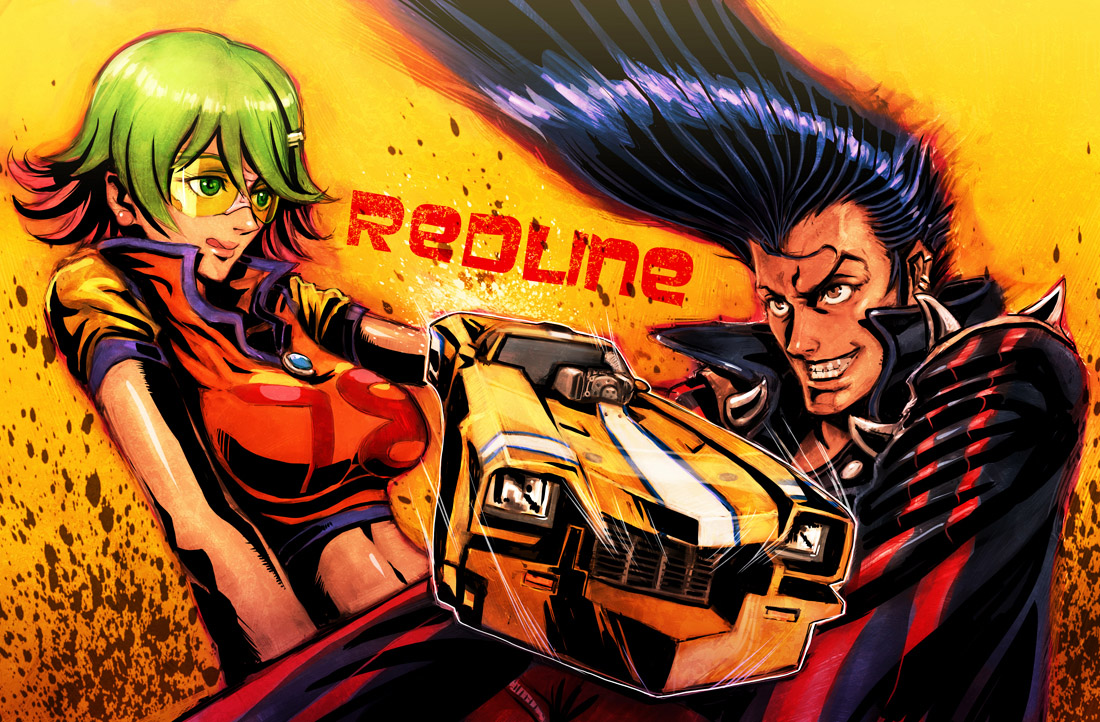
Anime You Should Be Watching: Redline


314090-redline

“Hell, I’m just trying to keep this thing interesting. You can’t write me off like that. You’re just a voice, pal! You don’t know a damn thing about racing!” — Sweet JP

Anime has long distinguished itself from Western animation through its embrace of hyperkinetic imagery—an intensity of motion and visual energy that often prioritizes sensation over realism. While Western animation traditionally leans toward fluidity and physical believability, anime frequently pushes beyond those constraints, opting instead for exaggerated speed, explosive movement, and stylized impact. This difference isn’t just aesthetic; it reflects a broader philosophical divide in how motion itself is perceived. In anime, movement isn’t always about replicating reality—it’s about amplifying it.

Few films embody this ethos as completely as Madhouse’s 2009 OVA Redline, a project that takes anime’s penchant for excess and turns it into a full-blown artistic manifesto. Directed by Takeshi Koike, Redline is less a conventional narrative film and more a sustained audiovisual adrenaline rush—a sci-fi racing spectacle that fuses breakneck pacing with meticulous hand-drawn craftsmanship. The production history of Redline is almost as legendary as the film itself: Koike and his team spent seven years bringing the project to life, pouring millions of dollars and an extraordinary amount of labor into its creation, with over 100,000 hand-drawn frames used in the final product. The result is a visual texture that feels both raw and impossibly refined—so detailed and fluid at times that it borders on looking computer-generated, despite being entirely handcrafted.

Koike’s influences are unmistakable throughout. There’s a clear lineage connecting Redline to the work of his mentor, Yoshiaki Kawajiri, particularly in the sharp character designs and kinetic action choreography reminiscent of Ninja Scroll and Vampire Hunter D. At the same time, the film borrows heavily from Western graphic aesthetics, most notably the thick linework and heavy shadowing associated with Frank Miller. This fusion creates a visual identity that feels globally informed yet uniquely its own—an anime that doesn’t just borrow from other traditions but aggressively remixes them.

Narratively, Redline is deceptively simple, and for some viewers, that simplicity borders on a flaw. The film centers on a futuristic intergalactic race—one that deliberately rejects advanced hover technology in favor of visceral, ground-based machines, giving the world a gritty, almost rebellious edge. At its core, the story follows Sweet JP, a daredevil racer with a towering pompadour and retro greaser aesthetic, as he competes in the titular race—the most dangerous and prestigious competition in the galaxy. His journey is framed through familiar tropes: the underdog striving for victory, the thrill of competition, and a romantic subplot involving his rival Sonoshee, who is both a love interest and a formidable racer in her own right. JP and Sonoshee are given just enough backstory and personality to be engaging, but they never evolve beyond archetypes, and the film never pretends otherwise.

And yet, this simplicity isn’t necessarily a weakness—it’s a deliberate trade-off. Redline understands exactly where its strengths lie, investing nearly all its creative energy into delivering a sensory experience rather than a deeply layered narrative. The characters function less as psychological studies and more as conduits for momentum, existing primarily to carry the viewer from one explosive set piece to the next. What truly sets Redline apart is the sheer density of its animation: every frame feels alive with motion, detail, and intent. Backgrounds pulse with activity, vehicles tear through space with exaggerated force, and the action sequences are so relentless and visually packed that they almost demand multiple viewings, as it’s nearly impossible to absorb everything in a single pass.

This overwhelming kinetic energy is where Redline transcends its narrative limitations. It creates a kind of visual immersion that few animated films—Western or otherwise—have managed to achieve. Watching it feels less like observing a story and more like being strapped into the driver’s seat of a machine hurtling toward collapse. Some critics have compared Redline to the Fast & Furious franchise, particularly its later, more exaggerated entries. On the surface, the comparison makes sense: both celebrate speed, spectacle, and a kind of reckless bravado encapsulated by the mantra “ride or die.” But the relationship feels less like equivalence and more like inversion—if anything, Fast & Furious comes across as a live-action attempt to capture the kind of unrestrained energy that Redline achieves effortlessly through animation. Where Fast & Furious is still tethered, however loosely, to physics, Redline operates in a space where those limits don’t exist and doesn’t need to justify its excess—it revels in it.

Despite its relatively modest reputation compared to more narratively complex anime films, Redline has earned a cult status among fans who appreciate animation as an art form. It prioritizes craft, motion, and sensory impact above all else, achieving something rare: a pure expression of animation’s potential. That’s why Redline remains such an essential watch. It may not offer the emotional depth of a Studio Ghibli film or the intricate plotting of a Satoshi Kon work, but it delivers something equally valuable—a reminder of what animation can do when pushed to its absolute limits.

For the best experience, Redline deserves to be seen on the largest, highest-quality screen possible. Its dense visuals and explosive color palette benefit immensely from high-resolution displays, particularly modern 4K screens that can fully capture the detail of its hand-drawn artistry. While it’s accessible through streaming platforms like YouTube, watching it on a premium setup transforms it from a great film into a full sensory event. In the end, Redline isn’t just a movie—it’s a showcase, a flex, and a love letter to animation itself, proving that sometimes style isn’t just substance—it is the substance.


Quick Review: Need for Speed (dir. by Scott Waugh)


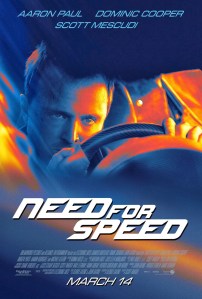
Need_For_Speed_New_Oficial_Poster_JPostersMy Short Take on Need for Speed –

Reasons to see it:

+ Fast cars doing interesting stunts that don’t feel like a CGI stunt reel. Take the Mustang chase from Drive and stretch it out.

+ It’s a tightly shot film. The chances of saying “Come on, go somewhere.” Are small and the driving camera work does its best to invoke a sense of being in the scene.

+ Imogen Poots steals practically every scene she’s in, and the cast overall seemed to enjoy themselves. Michael Keaton may be the most animated he’s been since Beetlejuice. Aaron Paul sounds like a mix between Charlie Hunnam and Solid Snake.

Reasons to hold off for now:

– It’s not the tightest story in the world. You’ll probably be able to easily call out plot angles as the movie progresses. There is also one scene in the film that never connects to anything after it, leaving something of a hole there. Overall, the film gives you just enough to understand why everyone’s doing what they’re doing, but don’t search for a whole lot of character growth here.

– The Air support moments seem a little implausible, given air traffic rules and what not.

The Long Take: 

Ever since The Fast and The Furious hit the big screen in 2001, you’ve had a number of race related movies. I think the worst I can recall was 2007’s Redline, which tried to throw some wild extortion theme into the mix. The movie adaptation for Need for Speed may actually be a better movie than some of Electronic Arts’ games. It may not be Hamlet, but it handles itself just fine.

The premise for Need for Speed is very simple. A young racer (Aaron Paul, whose voice sounds he’s channelling Sons of Anarchy’s Jax Teller) seeks vengeance against a former business partner (Dominic Cooper, Howard Stark from the Marvel Cinematic Universe) by way of a dangerous high speed race known as the Deleon. He assembles a team of friends, and goes about trying to reach his goal. There you go, all you need. It might sound as bad as this year’s Robocop, but at least the audience laughed along with this one.

Although many know Aaron Paul from his Emmy winning run on Breaking Bad, but he isn’t new to movies. He’s had a great turn in Smashed with Mary Elizabeth Winstead and worked previously with co-star Imogen Poots on The Long Way Down. Here in Need for Speed, I felt he did really well with what was given as racer Tobey Marshall, granted that it wasn’t a whole lot. Still, he sells it as best he can. Poots, on the other hand is as much the bright light in the film as Hayley Atwell was in Captain America: The First Avenger. Overall, the casting was okay here. Dominic Cooper plays the rival role well, though doesn’t come off as sinister in any way and Michael Keaton seems to enjoy himself in this as the host of the Deleon, a high stakes private race. He channels his inner Beetlejuice and is one of the high points of the film. Between he and Scott Mescudi (Kid Cudi to those who know him musically), they have the best scenes apart from the main cast.

The car scenes themselves are okay. You may find yourself leaning back in your seat in some instances, but they don’t quite have the tight feel of say Ronin. Still, you won’t see anything happen in these cars that go beyond the extreme. Truth be told, it’s almost similar to the first Fast and the Furious, save for all the wavy speed lines in the high speed chases. One of the remarkable things about Need for Speed is that it tries its best to avoid throwing too many CGI driving moments. It has a feel that’s similar to Tarantino’s Death Proof or, as the film highlights in the beginning of the movie, Bullitt. This being only his second major film (Act of Valor being the first), Director Scott Waugh gets away with making the racing moments as intense as they can be without getting too crazy…well, almost. It’s cut quick, and there are very few lag scenes as far as I could notice.

If the movie has any bad points, it’s that almost everything happens in a bubble. The plot has someone who is effectively on the run, and yet I would have imagined there’d be more of a police presence, especially given the exposure. Then again, this is Need for Speed, where you only need to avoid the cops or 2 minutes before being given the chance to hide in a cooldown zone (in NFS: Most Wanted, anyway). Fans of the games will see some of those elements in play during the film and they are functional here, if not realistic.

Additionally, there’s one other scene that involves the recruiting of a reluctant team member that goes almost no where. The reason for bringing the person along (having to do with a car issue) never appears to be addressed either visually or verbally. This left me asking, “Well, was it fixed?” and then shaking my head later on. It’s not a terrible mistake to have while munching on popcorn ( you won’t choke for not getting an answer), but someone really could have taken the time to dot that particular “i” on George Gatins’ script.

Overall, Need for Speed is a fun ride. It’s predictable in a lot of ways, and you’ll see some of it coming, but you may also find yourself smiling and swerving in your seats with the traffic.

Quick Review: Fast & Furious 6 (dir. by Justin Lin)


url-6Thinking back on the original Fast & Furious film, I still find it hard to believe it’s done so well over the years. The longevity of the films owe a lot to the Saw series, which seems fitting considering that the original director of that film will take over the reigns for the next installment. Both series have managed to take events from all of their films and weave this strange tapestry with it. Once you think one story is over, the writers somehow jump back to an earlier scene and pull out a new thread for everyone to follow. Gimmicky? Perhaps, but it works, at least for this tale.

To sum up Furious 6 in a nutshell, Dominic Toretto’s team has to help Hobbs (the lawman who was after them in Furious 5) stop a former SAS agent who is using cars to facilitate his acts of terror. Why get involved, one asks? Hobbs sweetens the deal by showing Dom that his formerly believed dead girlfriend Letty (Michelle Rodriguez) is…wait for it….not dead, and is working with these bad guys.

It’s like General Hospital with Cars. I’m such a sucker for this franchise.

If you’re new to the Furious films, the opening credits sum up the last 5 movies in a Spider-Man 2 like montage. You have your main heroes, Dominic Toretto (Vin Diesel) and Brian O’Connor (Paul Walker), who are kind of like criminals only they take down bad guys to better others (or themselves). Along with them is Dom’s sister Mia (Jordana Brewster), who is the mother of Brian’s baby boy, Jack (not to be confused with Jack Jack from The Incredibles). Then there’s the crew, made up of most of the characters from all of the Furious films leading up to 6:

From 2 Fast 2 Furious, Chris “Ludacris” Bridges and Tyrese Gibson return as two friends of Brian’s. Tej (Bridges) is the team hacker (wouldn’t be complete without one) and Roman (Tyrese) is the comic relief.

From Tokyo Drift (the 3rd and my personal favorite) comes Sung Kang, who plays Han. While he met his end in that film, every movie after the 3rd takes place somewhere before this film, believe it or not. This makes the ending of Tokyo Drift a little baffling when you see Toretto at the end of it. No matter what the writers decide to do with future installments, they’ll eventually have to circle back to how Dom got there.

From Fast & Furious. (No. 4) – We have Gal Gadot as Gisele, a former IDF member who was an accomplice to a drug cartel leader. Ironically, Gadot actually did some work with the Israeli forces, which I found interesting. She is the only member of that film to come back to the series as Don Omar and Tego Calderon sat this one out.

And finally from Fast Five, you have Hobbs (The Rock) and his former partner from Brazil, Elena (Elsa Pataky).

So, you have the setup. One of the things to understand about this (and some of the earlier ones) is that you’re working in a “Popcorn Reality”. The action’s all well and good, but in the course of all the driving, you’ll almost expect to see at least one or two action scenes or stunts that just don’t make any kind of practical sense. These GTFO moments are in great supply in Furious 6 – A runway chase that lasts a good 15 minutes, yet seems impossibly long for any plane to actually use for a take off. A “flip” car with the ability to send other cars launching into the air. In any other movie, most people would scoff and walk out. For this, it’s almost the norm and if you don’t care, it’s actually fun. Lin has been able to take the chase scenes about as far as they can possibly go, and I can’t really imagine what else they could try to push things, really.

Of particular note is Luke Evans, who plays the villain, Shaw. I didn’t really care for him in Tarsem’s Immortals, but  was good here, trying to be as much a Bond baddie as he can. Another addition is Gina Carano, who takes the place as Hobbs partner this time around. She’s a bit more light hearted here than she was in Haywire, and gets to showcase her fight skills. However, in a movie that’s already packed with stars performing particular roles, she doesn’t really have much to truly do other than to be Michelle Rodriguez’s sparring partner. Not a terrible thing, just something I noticed.

Is it worth it? Well, considering that most of the movies that came out since Fast & Furious 6 was released haven’t fared too well (Yes, I’m looking right at you, After Earth), it’s a safe bet if you also understand that this all revolves around cars driving very smooth and fast with near unlimited shift points. If you don’t like cars or racing, this might not be your cup of tea. There’s a lot of shooting at some points, which might  round things out for action fans. It’s a quick way to burn 2 hours. If you also managed to see at least the last film in the cinema, then this is a given – though you’ll probably be able to put 2 and 2 together before the story’s half done.

Also, do stick around once the credits start, as there’s a scene that will come up to help lay the groundwork for the next installment.

Fast Five (Official Trailer)


Like the Pirates of the Caribbean franchise this Vin Diesel racing franchise has been milked liked it has never been milked before. While it hasn’t reached the level of the Saw series this action-racing film series is definitely getting up there.

What started as Hollywood’s look and attempt to show underground street racing has become a joke amongst those who actually race for real. There’s a term for people who began to trick out their rides with elaborate color schemes, flames shooting out of exhaust pipes, body kits that changed the looks of the car right down to computerized control panels. Those people were going “fast and furious” and that wasn’t a compliment.

Real racers try to lighten a car and add horsepower instead of adding so much crap the way the people in the films do. They got the right cars to use whether it’s the so called “ricers” like Nissan Skyline to Subara Imprezas to Honda Civics or American classic muscle cars like the Dodge Charger R/T to Plymouth GTO’s. Everything else in terms of racing in this series are laughable, but entertaining and to Hollywood that is all that matters.

The last film in the series, Fast and Furious, has begun to move the franchise away from underground racing and into the realm of an action-thriller except with people racing cars. I’m fine with that and this latest entry in the franchise looks to move it even further from it’s roots. Plus, it has Dwayne “The Rock” Johnson playing another role to move him away from his Disney-fied roles of the past five years.

From the look of the trailer I think I will enjoy this flick. It’s not trying to reinvent anything plus it has Gal Gadot in it and that to me spells win.