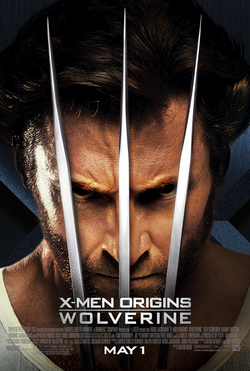
X-Men Origins: Wolverine (2009, directed by Gavin Hood)


Decades before he joins the X-Men, James “Logan” Howlett (Hugh Jackman) is just another mutant with retractable claws and a super-healing ability that essentially makes him immortal. With his half-brother Victor Creed (Liev Schreiber), Logan fights in wars throughout the centuries. When both Logan and Creed (who share Logan’s healing abilities) survive being executed by a firing squad, they are recruited by William Stryker (Danny Huston) to serve as members of Team X. Eventually, Logan tires of being an assassin and goes off on his own. However, both Stryker and Creed have plans for him and all the other mutants that they’ve captured or killed over the years. Several familiar characters appear—Scott Summers (Tim Pocock), Gambit (Taylor Kitsch), and the Blob (Kevin Durand) amongst others—but none of them have much of the personality that made them popular to comic book readers. (Just imagine including Gambit in an X-Men film but not Rogue.) Those who made it to the end of the film were given a Patrick Stewart cameo, albeit one that used CGI to de-age Stewart and make him look like an automaton.

With the majority of the X-Men either dead or cured at the end of X-Men: The Last Stand, it only made sense to spin Hugh Jackman’s Wolverine off into his own series of films. Unfortunately, 20th Century Fox didn’t understand that the thing that made Wolverine so interesting as a character was that his past was shrouded in mystery. Their first Wolverine film revealed his origin and it turned out to be not that interesting. X2 had been filled with so many hints about Wolverine’s past that the origin story didn’t feel as if it was telling us anything that we hadn’t already figured out. Even the many fight scenes between Sabretooth and Wolverine felt dull because it was established that both of them were essentially immortal and impervious to pain.

Today, this movie is mostly remembered for featuring the first appearance of Wade Wilson, the mercenary who will eventually become Deadpool. There’s very little of Deadpool to be found in this film’s version of Wilson. He tells a few jokes before getting his lips sewn shut. Imagine introducing a character who is affectionately known as “the merc with a mouth” and then rendering him silent for the majority of the movie. In Deadpool 2, there’s a scene where Deadpool goes back in time and kills this earlier version of Wade Wilson (or Weapon XI as he’s called here). The audience I saw the film with cheered.
Playing Catch-Up With The Films of 2016: Eye In The Sky (dir by Gavin Hood)


Eye in the Sky is many things.  It’s a tense and involving drama.  At times, it’s a satire of the bland and often cowardly bureaucracy that controls so much of the world.  Occasionally, it’s an angry polemic and a sad-eyed look at the state of the world today.  It’s a film about drone warfare, one that is remarkably honest about both the costs and the benefits of being able to randomly blow people up on the other side of the world.  It’s a film that will make you think and it will make you cry and it will even make you laugh in a resigned sort of way.

But, at heart, it’s ultimately the story of two houses in Nairobi, Kenya.

In the first house, terrorists are plotting their next attack.  The film leaves little doubt as to what they are planning.  Thanks to a miniature drone controlled by Jama Farah (played by Barkhad Abdi and it’s good to see him giving as good a performance here as he did in Captain Phillips), both American and British intelligence are aware of what’s happening in that house.  A British jihadist is planning her next attack.  Guns are being loaded.  Suicide vests are being prepared.  If nothings done to stop their plans, hundreds of people are going to die.

Sitting nearby is the other house.  And, in this other house, an apolitical Kenyan family is going about their day with zero knowledge of what’s happening just a few doors down.  11 year-old Alia Mo’Allim (Aisha Takow) twirls a hula hoop while her father watches.  Later, in the day, she’ll go out in her village and, while the local militia harasses anyone who doesn’t look right to them, Alia will attempt to sell bread.  She’ll set up her table directly outside of the first house.

And what no one in that village realizes is that an armed drone is hovering above them.  As they go about their day, they have no idea that there are men and women in America and Britain who are debating whether or not to blow them up.

Colonel Katherine Powell (a steely and totally convincing Helen Mirren) is determined to blow up that house and the terrorists within, even if it means blowing up Alia in the process.  However, before Powell can give the order, she has to get permission from Lt. Gen. Frank Benson (Alan Rickman, at his weary best) and Benson has to get permission from the government.  And the government is full of people who are eager to take credit for killing terrorists but who don’t want to be blamed for any of the inevitable collateral damage.  Everyone passes responsibility to someone else.

Powell may be the most determined of everyone to blow up that house but she is not the one who will actually be firing the missiles.  That responsibility falls on two Americans, Lt. Steve Watts (Aaron Paul) and Carrie Gershon (Phoebe Fox).  As the teorrists prepare and Alia tries to sell bread and the bureaucrats debate, Watts and Gershon are the only ones who seem to truly understand what’s about to happen.  If they fire the missiles, Alia will probably die.  If they don’t, hundreds of other definitely will.

It all makes for incredibly tense and thought-provoking film, one that is all the more effective because it actually allows both sides to make their case.  In Eye in the Sky, no one is presented as being perfect.  On the one hand, Powell may be willing to manipulate the data to get permission to fire that missile.  But, on the other, the film doesn’t deny that Powell is right when she says that if they don’t blow up the terrorists when they have a chance, hundreds of innocent people are going to die.  Towards the end of the film, Alan Rickman says, “Never tell a soldier that he doesn’t understand the cost of war,” and Eye in the Sky appears to understand that cost as well.  Nobody escapes this film untouched.

Well-acted and intelligently written and directed, Eye in the Sky was one of the most thought-provoking films of the previous year.  See it if you haven’t.

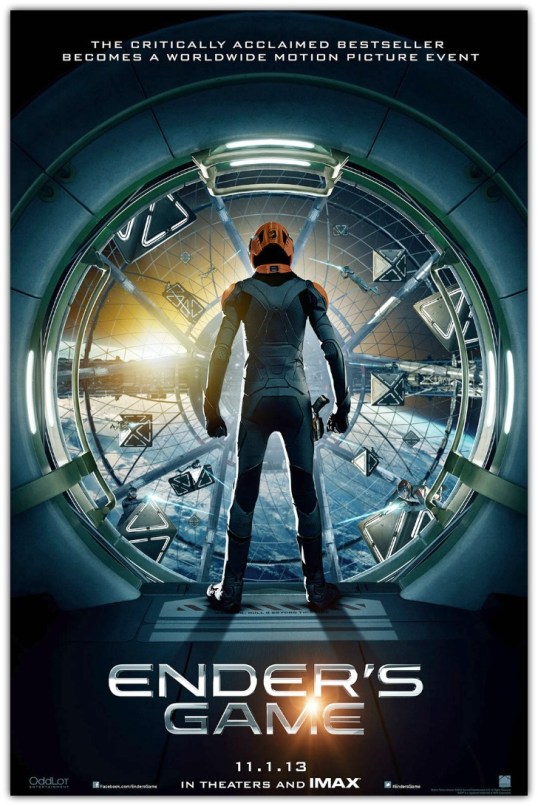
Trailer: Ender’s Game


EndersGame

It’s finally going to happen. A film adaptation of Orson Scott Card’s sci-fi novel Ender’s Game is going to be on the bigscreen. This was a property that was often talked about becoming a film, but years upon years of talk never amounted to much other than fan casting and never getting past the concept stage.

I knew that the film adaptation had gotten the greenlight over a year ago, but I just assumed that something will derail it once again and leave Ender’s Game as another case of film vaporware. The fact that there’s now a trailer released by Summit Entertainment means that the film will come out. Now whether the film adaptation satisfies the book’s legion of fans and still entertain those who never read a word of Card’s novels still to be determined.

Ender’s Game is set for a November 1, 2013 release date.