Typically, site anime expert pantsukudasai56 would be the one to recommend anything and everything anime. Anime in its series form, OVA (original video animation) and/or straight up film. I like to think my knowledge of anime is second only to his.
While I’ve had an off and on love affair with anime throughout the years I have seen my fair share of anime film. From pantsukudasai56’s viewpoint, only those anime that were produced from beginning to end with the intent of having a film release qualifies as anime film. OVA productions he sees as a sort of straight-to-video releases and shouldn’t qualify. his own initial 4 Shots From 4 Films entry were all anime films.
With his example as a guide I have chosen four anime films that veteran and burgeoning fans of the art form should check out. Two come from the heir apparent to the great Satoshi Kon. Another is a hyperkinetic (even for an anime) traditional hand-drawn anime which has had a major influence on the more recent Fast and Furious films. The fourth is a film from the late 80’s which rekindled my love for anime during my high school years.
“Hell, I’m just trying to keep this thing interesting. You can’t write me off like that. You’re just a voice, pal! You don’t know a damn thing about racing!” — Sweet JP
Anime has long distinguished itself from Western animation through its embrace of hyperkinetic imagery—an intensity of motion and visual energy that often prioritizes sensation over realism. While Western animation traditionally leans toward fluidity and physical believability, anime frequently pushes beyond those constraints, opting instead for exaggerated speed, explosive movement, and stylized impact. This difference isn’t just aesthetic; it reflects a broader philosophical divide in how motion itself is perceived. In anime, movement isn’t always about replicating reality—it’s about amplifying it.
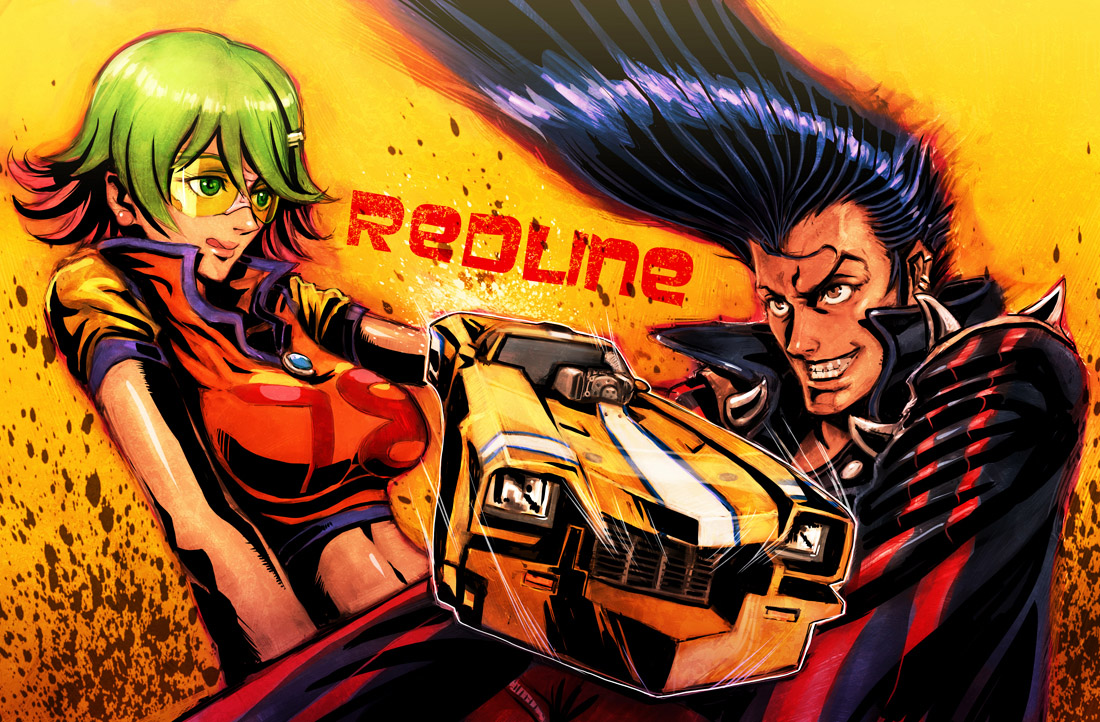
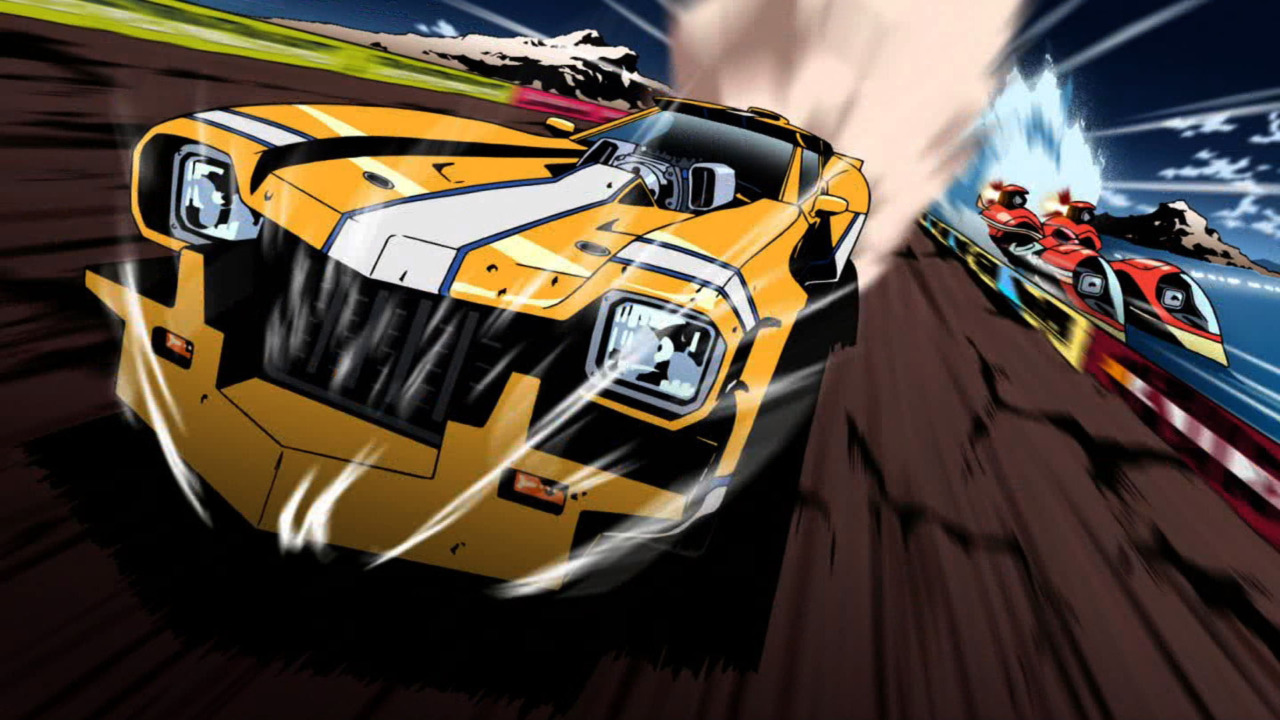
Few films embody this ethos as completely as Madhouse’s 2009 OVA Redline, a project that takes anime’s penchant for excess and turns it into a full-blown artistic manifesto. Directed by Takeshi Koike, Redline is less a conventional narrative film and more a sustained audiovisual adrenaline rush—a sci-fi racing spectacle that fuses breakneck pacing with meticulous hand-drawn craftsmanship. The production history of Redline is almost as legendary as the film itself: Koike and his team spent seven years bringing the project to life, pouring millions of dollars and an extraordinary amount of labor into its creation, with over 100,000 hand-drawn frames used in the final product. The result is a visual texture that feels both raw and impossibly refined—so detailed and fluid at times that it borders on looking computer-generated, despite being entirely handcrafted.
Koike’s influences are unmistakable throughout. There’s a clear lineage connecting Redline to the work of his mentor, Yoshiaki Kawajiri, particularly in the sharp character designs and kinetic action choreography reminiscent of Ninja Scroll and Vampire Hunter D. At the same time, the film borrows heavily from Western graphic aesthetics, most notably the thick linework and heavy shadowing associated with Frank Miller. This fusion creates a visual identity that feels globally informed yet uniquely its own—an anime that doesn’t just borrow from other traditions but aggressively remixes them.
Narratively, Redline is deceptively simple, and for some viewers, that simplicity borders on a flaw. The film centers on a futuristic intergalactic race—one that deliberately rejects advanced hover technology in favor of visceral, ground-based machines, giving the world a gritty, almost rebellious edge. At its core, the story follows Sweet JP, a daredevil racer with a towering pompadour and retro greaser aesthetic, as he competes in the titular race—the most dangerous and prestigious competition in the galaxy. His journey is framed through familiar tropes: the underdog striving for victory, the thrill of competition, and a romantic subplot involving his rival Sonoshee, who is both a love interest and a formidable racer in her own right. JP and Sonoshee are given just enough backstory and personality to be engaging, but they never evolve beyond archetypes, and the film never pretends otherwise.
And yet, this simplicity isn’t necessarily a weakness—it’s a deliberate trade-off. Redline understands exactly where its strengths lie, investing nearly all its creative energy into delivering a sensory experience rather than a deeply layered narrative. The characters function less as psychological studies and more as conduits for momentum, existing primarily to carry the viewer from one explosive set piece to the next. What truly sets Redline apart is the sheer density of its animation: every frame feels alive with motion, detail, and intent. Backgrounds pulse with activity, vehicles tear through space with exaggerated force, and the action sequences are so relentless and visually packed that they almost demand multiple viewings, as it’s nearly impossible to absorb everything in a single pass.
This overwhelming kinetic energy is where Redline transcends its narrative limitations. It creates a kind of visual immersion that few animated films—Western or otherwise—have managed to achieve. Watching it feels less like observing a story and more like being strapped into the driver’s seat of a machine hurtling toward collapse. Some critics have compared Redline to the Fast & Furious franchise, particularly its later, more exaggerated entries. On the surface, the comparison makes sense: both celebrate speed, spectacle, and a kind of reckless bravado encapsulated by the mantra “ride or die.” But the relationship feels less like equivalence and more like inversion—if anything, Fast & Furious comes across as a live-action attempt to capture the kind of unrestrained energy that Redline achieves effortlessly through animation. Where Fast & Furious is still tethered, however loosely, to physics, Redline operates in a space where those limits don’t exist and doesn’t need to justify its excess—it revels in it.
Despite its relatively modest reputation compared to more narratively complex anime films, Redline has earned a cult status among fans who appreciate animation as an art form. It prioritizes craft, motion, and sensory impact above all else, achieving something rare: a pure expression of animation’s potential. That’s why Redline remains such an essential watch. It may not offer the emotional depth of a Studio Ghibli film or the intricate plotting of a Satoshi Kon work, but it delivers something equally valuable—a reminder of what animation can do when pushed to its absolute limits.
For the best experience, Redline deserves to be seen on the largest, highest-quality screen possible. Its dense visuals and explosive color palette benefit immensely from high-resolution displays, particularly modern 4K screens that can fully capture the detail of its hand-drawn artistry. While it’s accessible through streaming platforms like YouTube, watching it on a premium setup transforms it from a great film into a full sensory event. In the end, Redline isn’t just a movie—it’s a showcase, a flex, and a love letter to animation itself, proving that sometimes style isn’t just substance—it is the substance.
So, another month of all things horror and dark has passed. Time to detox from that month by putting up a new AMV that’s all about fun and extreme action.
The latest “AMV of the Day” is simply called “Ride or Die” and I must say that it’s probably one of the best anime music video’s I’ve ever seen. I have to say that it’s on par with another AMV profiled earlier this summer with “RadioAkshun” in terms of editing and syncing up the lyrics of the chosen music with scenes from the anime.
The anime itself is breathtaking to watch and I’ll be profiling it soon. Redline works almost perfectly with the theme song from this past summer’s Fast & Furious 6. One rarely finds AMVs that uses hip-hop songs to great effect but this video’s producer and creator, Kyssifur, choosing 2 Chainz and Wiz Khalifa’s “We Own It” was quite a genius move.
Ok, less talking and back to watching this video on loop. It’s just that much fun and awesome.
Anime:Redline
Song:“We Own It (Fast & Furious)” by 2 Chainz and Wiz Khalifa
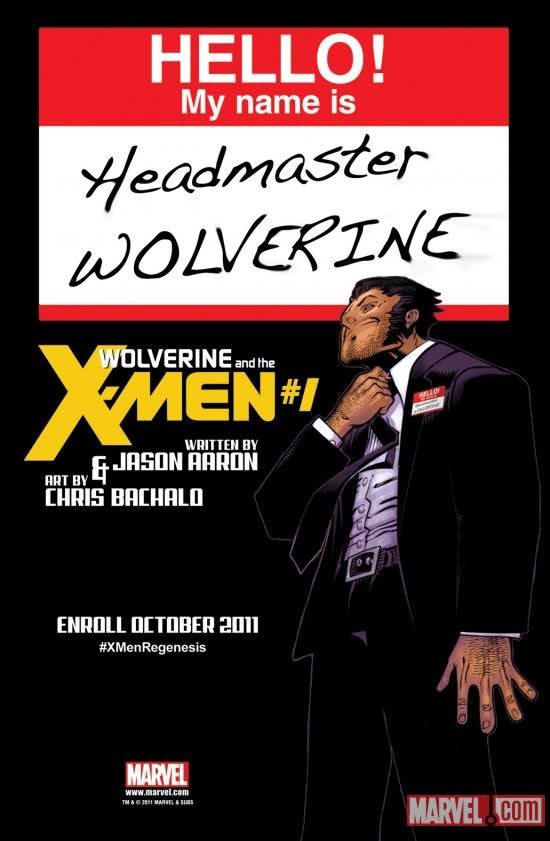
Wolverine & The X-Men: Aaron’s run is like putting all the quirky ideas & characters from X-History through a blender and bombarding the result with cosmic rays & gamma radiation. It’s the most entertaining X-Book out right now IMO (I dig X-Force but this book has an Allred purity to it.
Dan Hipp’s fanart: Mr. Hipp has cranking out cartoon, movie, and videogame inspired zombie fan art throughout 2011. You can check them out here: http://mrhipp.blogspot.com/
Miles Morales aka the Current Ultimate Spider-Man: Bendis and Sara Pichelli have crafted an interesting and endearing character. This is only of the few books where I purchase the single issues and trade because it’s so darn good!