Lisa Cleans Out Her DVR: Boston Strangler: The Untold Story (dir by Michael Fiefer)


(Lisa is currently in the process of cleaning out her DVR. It’s going to take a while.  She recorded this true crime thriller off of Showtime on June 1st.)

I have to admit that the main reason that I recorded Boston Strangler: The Untold Story off of Showtime was because I thought it was going to be one of Ulli Lommel’s infamously terrible true crime movies.  I had so much fun reviewing Curse of the Zodiac a few years ago that I always keep an eye out for anything that could possibly have been directed by the infamous Mr. Lommel.

Well, it turns out I was wrong.  This is not one of Lommel’s films.  Instead, Boston Strangler: The Untold Story is a fairly serious-minded examination of the enduring mystery of the Boston Strangler.

Now, the Boston Strangler isn’t exactly a household name anymore.  He committed his murders in the 60s, before the term serial killer had even been invented.  He is thought to have strangled at least 13 women in the Boston area, ranging in age from 85 to 19.  Eventually, a man named Albert DeSalvo was arrested for committing a series of rapes.  While he was awaiting trial on those charges, DeSalvo announced that he was also the Boston Strangler.

For the most part, it was assumed that DeSalvo was telling the truth when he confessed.  In 1967, a movie, perhaps the first ever made about serial murder, was released.  It was called The Boston Strangler and it starred Tony Curtis in the title role.  It still shows up on TCM and, from the start, it assumes that DeSalvo was guilty of the murders to which he confessed.

However, what was often overlooked was that DeSalvo was never actually put on trial for any of the murders.  (In fact, before he confessed, DeSalvo wasn’t even considered to be a suspect.)  In those days, before the discovery of DNA, there was no concrete physical evidence linking DeSalvo to the crime and his confessions were often so inconsistent that many detectives continued to have their doubts about whether or not DeSalvo was telling the truth.  He received a life sentence for a series of rapes and robberies that he had committed but he was never charged with a single murder.  DeSalvo later retracted his confession and then, a few years after the Tony Curtis film came out, DeSalvo was murdered in his cell.

(I should note that, in 2013, Boston authorities announced that DNA evidence had linked DeSalvo to the final murder, that of 19 year-old Mary Sullivan.  However, there are some who argue that the Mary Sullivan murder had so little in common with the other murders that she was probably not a victim of the original Boston Strangler.  Who knows?)

Making this story even more intriguing is that, while DeSalvo was being held for trial, his cellmate was George Nasser who, unlike DeSalvo, actually was considered to be a suspect in the murders.  There is a popular theory that DeSalvo, already facing a life sentence, agreed to confess to Nasser’s murders so that his family would be financially taken care of.

That’s certainly the theory that’s presented in Boston Strangler: The Untold Story.  In this film, DeSalvo (played by David Faustino) is just a loser who ends up being manipulated by his cellmate (Kostas Sommer).  The lead detective (Andrew Divoff) doubts DeSalvo’s confessions but everyone else just wants to be able to close the book on the murders that have gripped Boston in fear.  Boston Strangler: The Untold Story is a strange mismash of styles, veering from docudrama to horror.  It makes for a somewhat jarring viewing experience but the film does create and maintain a properly ominous atmosphere.  Though the film argues that DeSalvo was not a murderer, it still portrays him as being an empty man with no conscience and, even if he wasn’t a murderer, his very existence still left me feeling unsettled.  David Faustino is odd casting as DeSalvo and it takes a while to get used to him.  However, Kostas Sommer is chilling in the Nasser role and SyFy fans will be interested to know that Corin Nemec plays F. Lee Bailey.  If you’re into true crime, I’d say give the film a chance.

Lisa Cleans Out Her DVR: Monsignor (dir by Frank Perry)


(Lisa is currently in the process of cleaning out her DVR!  It’s taking her longer than it took Saint Malachy to transcribe The Prophecy of the Popes!  She recorded the 1982 film, Monsignor, off of Retroplex on March 8th!)

Maybe it’s because I’m a fourth Italian and I was raised Catholic but Monsignor amused the Hell out of me.

See, Monsignor is a big, sprawling epic about the Church and the Mafia.  I don’t know much about the production of this film but, having watched it, I’m going to guess that it was made by people who were neither Catholic nor Italian.  This is one of those films that is so full of clichés and inaccuracies and yet so self-important that it becomes oddly fascinating to watch.

It tells the story of Father John Flaherty (Christopher Reeve, an Episcopalian who gives a performance so wooden that one worries about getting splinters just from watching it).  When we first meet Father Flaherty, he’s just taken his orders.  He’s a good Irish kid from Brooklyn.  The neighborhood’s proud of him, because he has volunteered to serve as a chaplain in the army.  (The film opens during World War II.)  The neighborhood is even prouder when he performs a Mafia wedding.  Don Appolini (Jason Miller), who may be a mobster but who still loves the Church, is especially impressed.  He expects big things from Father Flaherty.

(The father of the bride, incidentally, is played by Joe Spinell, who played Willy Chicci in Godfathers One and Two and who achieved a certain infamy when he starred in Maniac.)

Father Flaherty goes to war and discovers that it’s not easy to be a man of God in a war zone.  Everywhere around him, soldiers are either dying or losing their faith.  (Perhaps it would help if Father Flaherty knew how to properly conduct a Requiem Mass but the movie screws that up, with Flaherty saying, “”Requiescat in pace” when he clearly should have said, “Requiescant in pace.”)   After trying, in vain, to comfort a mortally wounded man, Flaherty snaps, picks up a machine gun, and starts blowing away Germans.

Having broken the Thou Shalt Not Kill Commandment and indulged in one of the seven deadly sins, Father Flaherty apparently decides to commit every other sin as well.  Or, at least, it seems like that’s his plan.  The thing is, Christopher Reeve’s performance is bland that it’s difficult to guess what could possibly be going on inside of Flaherty’s head.  Is he disillusioned with the church or does he still have faith?  When he says that he feels guilty over his transgressions, is he being sincere or is he lying?  It’s impossible to tell because, when it comes to Father Flaherty, there’s no there there.  He’s literally an empty vessel.

That, of course, doesn’t stop him from becoming a powerful man in the Church.  Through his Mafia connections, he makes a fortune on the black market and launders money for the church.  He also has sex with a cynical, nymphomaniac postulant nun, who is something of a stock figure in films like this.  In this case, the role is played by Genevieve Bujold.  Despite the stereotypical nature of her character, Bujold comes the closest of anyone in the cast to giving a nuanced performance but her character abruptly vanishes from the film.  One can literally hear the producers in the background saying, “Okay, we’ve indulged in the sexy nun thing.  Send her home now.”

Towards the end of the film, there’s a flash forward that is so abrupt that I didn’t even realize it had happened until I noticed that Christopher Reeve and Jason Miller now had a little gray in their hair.  The flash forward doesn’t really accomplish much.  Father Flaherty has lost a lot of the Mafia’s family and the Mafia’s not happy about it.  It’s kinda like the Vatican subplot in The Godfather Part III, just with less interesting actors.

Anyway, Monsignor obviously thinks that it has something to say about both the Church and the Mafia but it’s actually remarkably empty-headed.  Strangely enough, for an epic film that cost 10 million dollars to make (that’s in 1982 money), the whole film looks remarkably cheap.  If a community theater decided to put on a production of Otto Preminger’s The Cardinal, the end result would probably end up looking a lot like Monsignor.

And yet, I really can’t hate Monsignor.  It’s so bad that, as I said earlier, it’s also oddly fascinating.  You watch and you ask yourself, How many details can one film about Catholicism get wrong?  How many Italian stereotypes can be forced into a movie with a Mafia subplot?  Now, I should point out that, at no point, does Don Appolini say, “Mama mia!” but, if he had, I wouldn’t have been surprised.  It’s just that type of film.

Anyway, Monsignor is so sordid and stupid that it becomes entertaining for all the wrong reasons.  If you’re into that, you’ll enjoy Monsignor.

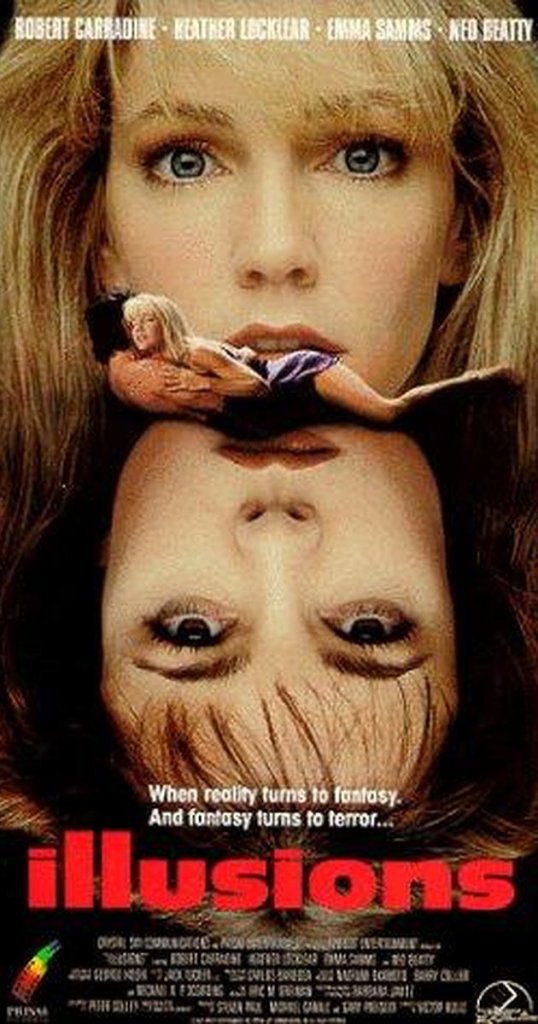
Lisa Cleans Out Her DVR: Illusions (dir by Victor Kulle)


(Lisa is currently cleaning out her DVR.  It’s taking forever and she’s loving every minute of it.  This is almost as fun as a Degrassi marathon.  Lisa recorded the 1992 psychological thriller, Illusions, off of Indieplex on March 1st.)

Illusions gets off to a pretty good start.  In a blue-tinted room, a man and a woman make out, with the whispered dialogue suggesting that they’re doing something that they’ve specifically been told not to do.  The woman is worried when an older woman opens the door but the man assures her that the older woman can’t see.  Soon, the film is switching back and forth, from the forbidden lovers to the old woman chopping up a huge chunk of meat.  The opening reminded me of the classic Italian horror film, Beyond The Darkness.

It’s an enjoyably surreal scene, one of many to be found in Illusions.  When we first meet Jan Sanderson (Heather Locklear), she’s waking up from a nightmare.  She’s in a hospital, recovering from some sort of earlier breakdown.  Her doctor (Susannah York) doesn’t think that Jan is ready to leave the hospital but Jan disagrees.  Jan can’t wait to rejoin her husband.

Her husband is Greg Sanderson (Robert Carradine), an archeologist who is currently working at a dig and who doesn’t appear to have much in common with Indiana Jones.  When Jan leaves the hospital, she moves into a house near the dig, one that Greg is renting.  As soon as Jan moves into the house, strange things start to happen.

For instance, she meets the caretaker, George (Ned Beatty).  George is an alcoholic, one who has recently been abandoned by his wife and his children.  According to Greg, George has a skill for telling scary stories.  For instance, there’s the one that he tells Jan about a murder that occurred in the house years ago.  Maybe George isn’t exactly the guy you want to have talking to someone who is recovering from a nervous breakdown?

However, before Jan can spend too much time getting freaked out about George, something else happens.  Greg’s sister arrives.  From the minute that Laura (Emma Samms) arrives, it’s obvious that she and Jan don’t like each other.  That Jan is nervous around her sister-in-law is understandable.  I love my future sister-in-law and I still spend hours worrying about whether or not she thinks I’m as cool as I think I am.  What’s strange is that Laura seems to view Jan as almost being a romantic rival.  From the minute that Laura arrives, she and Greg are whispering to each other and sharing flirtatious jokes.

(The fact that Greg and Laura were the couple in the film’s opening scene certainly doesn’t do anything to make them any less creepy.)

Jan finds herself suspecting that Laura may be conspiring against her.  When she orders Greg to tell his sister to go home, Greg says that he will.  When Jan wakes up the next morning, Laura’s gone.  Greg says that he kicked her out.  But Jan is haunted by a nightmare in which she murdered her sister-in-law and Greg helped to cover it up…

WHAT’S GOING ON!?

Well, you probably already know.  You’ve seen Gaslight, right?  You’ve seen Diabolique.  Maybe you’ve even seen a few Lifetime films.  You know how this stuff works.  Illusions is not exactly a surprising film and the movie itself occasionally feels disjointed.  The use of body doubles during the nude scenes is jarringly obvious and Jan’s narration was supplied by an actress who clearly wasn’t Heather Locklear.  Locklear, Beatty, and Samms all gave good performances but Robert Carradine was oddly cast.  His presence in the film made me think of Illusions as being Sam McGuire: The Early Years.

And yet, I still kinda liked Illusions.  It’s got just enough weird dream sequences for me to enjoy it.  You know me.  There’s nothing I love more than a weird dream sequence.  Many a mediocre film has been saved by blue mood lighting.


Lisa Cleans Out Her DVR: Madame Curie (dir by Mervyn LeRoy)


(Lisa is currently in the process of cleaning out her DVR!  How long is it going to take her?  Probably about as long as it took scientists to discover radiation.  Still, she’s not giving up!  She recorded the 1943 best picture nominee, Madame Curie, off of TCM on February 16th.)

It would appear that if you wanted to produce a best picture nominee in the early 40s, the easiest way to do it was to cast Walter Pidgeon and Greer Garson as husband and wife.

Consider the evidence: In 1941, Blossoms in The Dust was nominated for best picture.  Greer Garson and Walter Pidgeon played wife and husband.

In 1942, Mrs. Miniver won best picture.  Greer Garson and Walter Pidgeon played husband and wife.  Interestingly enough, Garson actually starred in another best picture nominee that year, Random Harvest.  Random Harvest is a far better picture than Mrs. Miniver and actually featured a better performance from Garson but it did not include Walter Pidgeon.  Make of that what you will.

Then, in 1943, Greer Garson and Walter Pidgeon starred in Madame Curie.  Again, they played husband and wife and, again, their film was nominated for best picture.

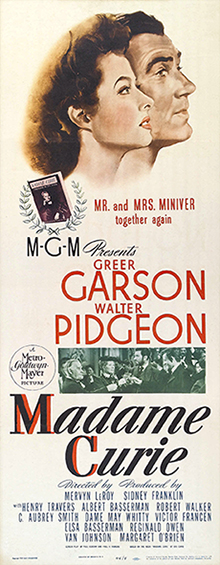
As you can tell from the poster above, Madame Curie was advertised as being “Mr. and Mrs. Miniver together again.”  Actually, Garson and Pidgeon are playing characters far different from the stalwart and very British heroes of their previous film.  Instead, they are playing the Curies, Marie and Pierre.  The film opens with Pierre meeting Marie at a party and it juggles scenes of their romance with scenes of them discovering and playing with radiation.  Of course, it’s a struggle at times.  Their colleagues are dismissive of their efforts.  Both Pierre and Marie tend to get so caught up in their research that they close themselves off from the outside world.  Their efforts pay off when they isolate radium and win the 1903 Nobel Prize.  Of course, then Pierre gets run over by a horse while out buying his wife a pair of earrings.  Can Marie continue to do their research without him?

The unfortunate thing is that the movie pretty much ends with Marie winning her first Nobel Prize, which means that it leaves out some of the most interesting aspects of her life.  For instance, during World War I, she developed mobile X-ray units and worked in field hospitals.  She was also active in the struggle for Polish independence, even naming the first element that she ever discover polonium after her native country.  She spent almost her entire career working with radioactive material, often carrying radioactive isotopes in her pockets.  In 1934, Marie died of radiation poisoning.  Her research notes and other papers are so highly radioactive that they’re kept in a lead box and I assume that they probably glow whenever the lid is shut.  If you want to study Marie Curie’s notes, you have to put on a radiation suit.  Unfortunately, none of this is discussed in the resolutely positive movie.

Judging from what I’ve seen on TCM, Greer Garson appears to have been the Meryl Streep of her day, undeniably talented but a bit too obvious in her technique and just a little boring.  The same can be said of Madame Curie, which is a very well-made but not extremely memorable movie.  It’s like a lot of the films that were nominated for best picture in the 30s and the 40s — a big, prestige picture that never exactly comes to life.  The film is probably at its strongest in the beginning, when Walter Pidgeon does a pretty good job of playing Pierre as a brilliant introvert who is almost too shy to talk to Marie.  But, as the film progresses, it just becomes another slow-moving MGM biopic.

What movie beat Madame Curie for Best Picture?

None other than Casablanca.

Lisa Cleans Out Her DVR: Wimbledon (dir by Richard Loncraine)


(Lisa is currently in the process of cleaning out her DVR!  It is probably going to take her forever.  She recorded the 2004 romantic comedy, Wimbledon, off of Cinemax on February 15th.)

I wish I could play tennis.

Actually, I guess it would be more correct for me to say that I wish I could play tennis well.  I mean, I can hold the racket and I can run around the court and I can hit the ball and sometimes, it goes over the net.  I can do all the yelling and the grunting and the jumping.  I’m pretty good at slamming my racket down on the court whenever I miss a shot.  I can play the game but I just can’t win.  I’m way too easily distracted and that’s a shame because I’ve been told that I look cute in a tennis skirt.

It’s not for lack of trying either!  There’s a tennis court a few blocks away from my house and I’ve challenged both my sister and my BFF to several matches.  And, every time, they have totally kicked my ass.  In fact, now that I think about it, the only time I’ve ever won a set was because my opponent was feeling sorry for me and they had such confidence in their own abilities that they didn’t mind throwing a game or two.

(For the record, I’ve been told that, if not for my boobs getting in the way, I would have a pretty good golf swing.  But I don’t play golf so there you go…)

Anyway, I may not be able to play tennis but that doesn’t mean that I can’t enjoy a movie about people I can.  I really like Wimbledon.  I mean — yes, it’s a totally predictable sports movie.  You know, as soon as you see the opening credits, that Kirsten Dunst and Paul Bettany are going to fall in love.  They’re the prettiest people in the movie so, of course they’re meant to be together!  And, as soon as you see Sam Neill’s name, you know that he’s going to be playing the well-intentioned but clueless authority figure who tries to keep them apart.  When James McAvoy’s name appears, you yell, “He’ll be Paul Bettany’s best mate!”  (Actually, he plays Paul’s eccentric younger brother.)  And as soon as Jon Favreau’s name appears, you’re like, “Comic relief!”

Of course, since the movie is called Wimbledon, you know that the movie is going to be about tennis and you know that Paul Bettany and Kirsten Dunst are going to be competing at Wimbledon while falling in love.  You know that one of them will make it to the finals while the other sits in the stands and provides emotional support.  It’s just a question of which one.

As I said, it’s all totally predictable and yet, that’s actually a part of the film’s appeal.  With the plot being so obvious, you’re freed up to just appreciate the film as a vehicle of movie star charisma.  Paul Bettany and Kirsten Dunst are two of my favorite actors and I think they’re both criminally underrated.  In Wimbledon, Bettany is playing the older, veteran tennis player, the one who is playing at his final Wimbledon before retiring.  When he falls in love with Kirsten, it gives him a renewed sense of focus and, for the first time, he finds that he actually has a chance to win it all.  Kirsten, meanwhile, is the up-and-coming star.  Her father (Sam Neill) worries that Kirsten’s relationship with Paul will distract her and keep her from playing her best and it turns out that he’s absolutely right.

Even if you haven’t seen the film, you know everything that is going to happen but that’s okay.  Kirsten Dunst and Paul Bettany have got a really likable chemistry.  You want things to work out for them.  You want both of them to win championships and eventually get married and have a pretty family.  Bettany, in particular, proves that he can make even the most clichéd of lines sound fresh and spontaneous.  Add to that, both Paul and Kirsten look adorable in tennis white and that’s really all that most people ask for when it comes to a film like this.

Wimbledon is an enjoyable and predictable movie, one that won’t leave you feeling depressed or questioning the meaning of existence.  It may not be perfect but it’s certainly likable and sometimes, that’s all you need.

Lisa Cleans Out Her DVR: Scorpio (dir by Michael Winner)


(Lisa is currently in the process of cleaning out her DVR!  Having recorded over 150 movies since last January, she understands that this might be an impossible task but she’s going to try anyway!  She recorded the 1973 spy thriller, Scorpio, off of Retroplex way back on January 24th!)

On the surface, Jean Laurier (Alain Delon) would appear to be the perfect man.

He’s handsome.  He looks really good in a suit.  He’s wealthy.  He’s French.  And — get this — he loves cats!  He’s the type of guy who, when he discovers a stray cat in his hotel room, immediately starts to pet it and then gives it a saucer of warm milk.  He and his girlfriend (Gayle Hunnicutt) spend their spare time looking at cats and talking about how cute they are.  At one point, even though he’s just killed a man, Jean pauses when he sees a stray cat watching…

Oh, did I mention that Jean kills people for a living?  Well, he does but I’m sure they’re all bad guys.  Seriously, he’s just so charming (and he really, really loves cats) that you really can’t hold it against him that he’s an independent contract killer.  Add to that, his code name is Scorpio.

I have to admit that the film’s title — Scorpio — is the main reason that I chose to record this movie.  I’m a scorpio myself.  In fact, I’m such a scorpio that if I believed in astrology, I would point to my existence as proof that the stars actually do determine our fate.  Seriously, you don’t want to mess with us scorpios.  We’re scorpions.  We sting.

But anyway, back to the movie.

When Scorpio is busted on a trumped-up narcotics charge (or maybe it was a legitimate narcotics charge, it was kind of hard to keep track), the CIA gives him a choice.  He can either go to prison or he can do a job for them.  Apparently, the CIA believes that Scorpio’s friend and mentor, Cross (Burt Lancaster), is a double agent who has been selling information to the Russians.  They want Cross eliminated.

Scorpio takes the job but it’s not going to be easy.  Cross is a veteran spy.  He has connections all across the world and he’s a ruthless killer, the type who forces a man to swallow a cyanide pill and then says, “You’ve got 30 seconds to live.”  In fact, the only person that Cross seems to care about is his wife (Joanne Linville) but he still doesn’t hesitate to abandon her when he realizes that their house is being watched

Cross taught Scorpio everything that he knows but there’s one lesson that Scorpio is still learning and that is to trust no one.  Is Cross actually a spy or is he being set up?  And, if Cross is being set up, what’s to prevent the same thing from happening to Scorpio?

Scorpio is probably one of the most cynical films that I’ve ever seen.  If Scorpio was a political protest, it would be full of people carrying cardboard signs reading, “Nothing Matters” and “All Is Darkness.”  Remember that annoying as Hell scene in SPECTRE where James Bond got drunk and demanded to know who a rodent was working for?  Well, imagine the disillusionment of that scene stretched out for two hours.

Fortunately, no one in Scorpio is as whiny as Daniel Craig was in SPECTRE.  In many ways, Scorpio is a triumph of old-fashioned movie star charisma.  Burt Lancaster is perfectly cast as the world-weary Cross while Alain Delon makes for a compelling Scorpio.  Both of them are believable killers and the film becomes as much about the competition between Lancaster’s old school Hollywood style of acting and Delon’s more refined (and very French) style of cool as it is about the competition between Scorpio and Cross.

Scorpio‘s a good little spy thriller, more than worth keeping an eye out for.


Lisa Cleans Out Her DVR: Hemingway’s Adventures Of A Young Man (dir by Martin Ritt)


(Lisa is currently in the process of cleaning out her DVR!  It’s going to take a while.  She recorded this 1962 literary adaptation off of FXM on January 30th!)

Hemingway’s Adventures Of A Young Man is one of those films that you just know was made specifically to win Oscars.  It’s a big prestige production, complete with a historical setting, an epic scope and big, all-star cast.  That most of those stars appear in relatively small roles was undoubtedly meant to evidence of the film’s importance.

“Look!” the film seems to shout at times, “This is such an important film that even Paul Newman was willing to stop by for a day’s work!”

The film is based on ten short stories by Ernest Hemingway and, loosely, A Farewell to Arms.  The stories all dealt with the early life of Nick Adams, who was a literary stand-in for Hemingway.  Since the Nick Adams stories were autobiographical (and, for that matter, so was A Farewell to Arms), the film can also be viewed as biopic.  Richard Beymer (who, a year earlier, had starred in West Side Story and who is currently playing Ben Horne on Twin Peaks) may be playing Nick Adams but the film leaves little doubt that he was actually meant to be playing Ernest Hemingway.

The film opens with Nick hunting with his father, Dr. Harold Adams (Arthur Kennedy).  He is present when his father travels to an Indian camp and helps to deliver a baby.  He respects his father but Nick wants to see the world and the film follows him as he explores America, working odd jobs and meeting colorful characters along the way.  Paul Newman shows up as a punch-drunk boxer and proceeds to overact to such an extent that he reminded me of Eric Roberts appearing in a Lifetime film.  Nick meets rich men, poor men, and everything in between.  He works as a journalist.  He works as a porter.  Eventually, when World War I breaks out, Nick enlists in the Italian army and the film turns into the 100th adaptation of A Farewell to Arms.

And really, I think it would have been an enjoyable film if it had been directed by someone like Otto Preminger, George Stevens, or maybe even Elia Kazan.  These are directors who would have embraced both the pulpy potential of the Nick Adams stories and the soapy melodrama of the war scenes.  A showman like Preminger would have had no fear of going totally and completely over the top and that’s the approach that this material needed.  Instead, Hemingway’s Adventures Of A Young Man was directed, in a painfully earnest style, by Martin Ritt.  Ritt tries to imitate Hemingway’s famously understated style with his understated direction but, cinematically, it’s just not very interesting.  Ritt portrays everything very seriously and very literally and, in the end, his direction is more than a little dull.

Sadly, the same can be said for Richard Beymer’s performance in the lead role.  Beymer comes across as being the nice guy who everyone says you should marry because he’ll be able to get a good and stable job and he’ll probably never go to jail.  Two months ago, when I watched and reviewed Twin Peaks, I really loved Beymer’s performance as Ben Horne.  He just seemed to be having so much fun being bad.  Unfortunately, in Hemingway’s Adventures Of A Young Man, he never seemed to be having any fun at all.  No wonder he temporarily put his film career on hold so that he could fully devote himself to working as a civil rights activist.

In the end, this is a movie that’s a lot more fun to look at than to actually watch.  Visually, the film is frequently quite pretty in an early 1960s prestige movie so sort of way.  And there are some good performances.  Eli Wallach, Ricardo Montalban, Susan Strasberg, Arthur Kennedy — there’s a whole host of performers doing memorable supporting work.  Unfortunately, even with all that in mind, this well-intentioned film largely falls flat.

TV Review: Twin Peaks: The Return “Part 6” (dir by David Lynch) (SPOILERS)


It’s time to take another trip into the world Twin Peaks!  Below is my recap of the latest episode.  Along with reading my thoughts, be sure to check out Ryan’s review of the episode as well!  And, if you want to see where my mind was immediately after the end of Part 6, check out my initial thoughts here!

I have to admit that I cringed a little when Part 6 opened with Cooper/Dougie (Kyle MacLachlan, of course) still staring at that statue.  It was an image that was somehow both touching and annoying.  There’s an innocence to Cooper/Dougie that makes you want to protect him and, at the same time, it’s hard not to want the old Cooper back.  No matter what, I do have to admire David Lynch for having the courage to take the risk of maintaining such a leisurely pace when it comes to telling this story.  It goes against all conventional wisdom.

After coming across Dougie/Cooper still staring at the statue, a friendly police officer takes him home.  (Dougie/Cooper is obsessed with the officer’s badge and can still only identify his house by using the red door.)  Janey-E (Naomi Watts) has finally reached the point where she’s willing to accept that Cooper/Dougie needs to see a doctor but she still seems to be in denial about just how strange her “husband” is acting.  If anything, the Cooper/Dougie storyline demonstrates the lengths that some people will go to in order to pretend that everything’s normal.

Dougie/Cooper is sent upstairs, by Janey-E, to say goodnight to Sonny Jim (Pierce Gagnon).  This leads to a genuinely sweet scene, in which Sonny Jim and Dougie/Cooper take turns clapping their hands and making the lights go out and come back on.

However, that fun is interrupted by Janey-E.  While going through the file that Dougie/Cooper brought home from work, she comes across an unmarked brown envelope.  Inside is a picture of Dougie with Jade (Nafessa Williams).  Janey-E realizes that not only has Dougie/Cooper not paid the money that he owed the loan sharks but that he’s also been seeing a prostitute.  “You are in the dog house, mister!” she shouts.  Dougie/Cooper, on the other hand, is just happy to see a picture of Jade.

“Jade,” he smiles, remembering that she once gave him a ride to a casino.  (“Jade gave two rides,” Dougie/Cooper says, blankly.)

Suddenly, the phone (a landline!) rings.  “Maybe it’s Jade calling!” Janey-E snaps.

“Jade,” Dougie/Cooper smiles.

Janey-E answers and discovers that it’s the loan sharks calling.  They want their money.  Janey-E tells them that there’s no way that Dougie/Cooper is going to be able to pay, especially if they do the typical loan shark thing and break his legs.  (Naomi Watts, incidentally, totally kicks ass in the role of Janey-E.)  Janey-E agrees to meet with Dougie/Cooper’s “friends” the next afternoon.

“Tomorrow’s a big day!” Janey-E snaps at him.

“Big day,” Dougie/Cooper agrees.

“Yes, sweetheart,” Janey-E agrees.

Meanwhile, somewhere — perhaps in Twin Peaks — a green light turns red and there is the sound of electricity.  In the Black Lodge, One-Armed MIKE (Al Strobel) walks with his one arm raised to the air.

Suddenly, MIKE appears in Dougie/Cooper’s living room.  “You have to wake up!  Wake up!  Don’t die.  Don’t die!  Don’t die!” he tells Dougie/Cooper before vanishing.  Dougie/Cooper responds by drawing what appears to be a ladder and steps on his work files.  It’s hella creepy.

Cut to Albert Rosengfield (Miguel Ferrer) driving through the rain.  (Is he in New York?  That’s what I assumed, mostly because I assume all big, unnamed cities are meant to be New York.)  After parking his car and getting out in the rain, Albert struggles with umbrella and then shouts, “Fuck Gene Kelly!  You motherfucker!”  It’s a funny line but also a sad one, as it reminds us of the great actor we lot when we lost Miguel Ferrer.

Albert steps into a trendy bar.  He approaches a blonde woman at the bar.  “Diane?” he says.  She turns around.  OH MY GOD, IT’S LAURA DERN!

(Yes, after 25 years, we’ve finally met the Diane that Cooper always spoke of.  Even better, she’s played by the one living performer — Jack Nance, sadly, is no longer with us — who is as closely linked to David Lynch as Kyle MacLachlan.)

Laura Dern as Diane

Cut to Twin Peaks.  At a lumber yard, psycho Richard Horne (Eamon Farren) has apparently just snorted the greatest cocaine ever.  He’s at a meeting with Red (Balthazar Getty) and several heavily armed men.  Apparently, Red is the new Twin Peaks drug lord.  (I guess the Renault family has gotten out of the game.)  Red says that he’s been in town for a few weeks and he likes it.  (During Part One, we briefly saw Red at the Roadhouse, making eyes at Shelley.)

Red is a typically talkative David Lynch drug dealer.  He says that he has problems with his liver.  He wants to know if Richard has ever really studied his hand.  Red talks about how much he likes The King and I.  In between all the random comments, he worries that Richard doesn’t have his drug use under his control and then says, “I’m going to be watching you, kid.”

“Don’t call me kid,” Richard says.

Red thinks that’s the funniest thing he ever heard.  Red also explains that, if Richard screws up, he’ll saw open Richard’s head and eat his brains.  Red does an elaborate magic trick with a dime, flipping it into the air where it apparently hangs in suspended animation before briefly appearing in Richard’s mouth.  Richard pulls the dime from his mouth, just to have it disappear from his hand.  Suddenly, the dime falls into Red’s hand.  Red explains that the dime represents the two of them.  “Heads, I win,” Red explains, “tails you lose.”

(Balthazar Getty is totally and completely chilling as Red.  He’s certainly a better actor now than he was when he made Lost Highway.)

Anyway, Richard doesn’t take this well because, in the very next scene, he’s driving his pickup truck, crying, and screaming, “Fuck you, man!”

Meanwhile, at a nearby trailer park, Carl (Harry Dean Stanton) is starting his day.  (You may remember Carl as the trailer park manager from Twin Peaks: Fire Walk With Me.  Apparently, he’s moved to Twin Peaks.)  Carl, who says he’s mostly just waiting for die, is driven into town by a friend.  Accompanying them is a man (Jeremy Lindholm) who talks about his wife, Linda.  She’s in a wheel chair and the man says that it’s taken forever for the government to send them their money.

“Fucking war,” Carl says, “Fucking government.”

(Damn straight, Carl!  Also, remember in Part One, the Giant told Cooper that he needed to find Richard and Linda.  Well, we’ve already met Richard Horne and, in this episode, we learned about Linda.  But are the same Richard and Linda that Cooper needs to find?)
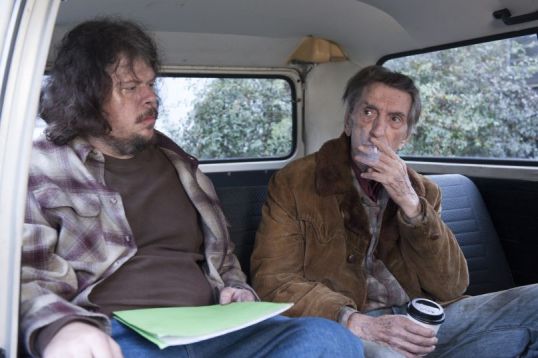
At the Double R, we discover that apparently there hasn’t been any staff turnover in 25 years.  Shelley (Madchen Amick) is ringing up customers.  The German waitress is still taking orders.  A customer named Miriam (Sarah Jean Long) says that she loves Double R coffee.  She’s a teacher.  “The kids this year are so cute!” she says.  There’s much giggling.  Surely, nothing bad could possibly be about to happen with all of this happiness going on…

Uh-oh, Richard’s still driving and yelling.  “I’ll show you a kid!” he shouts, slamming down on the accelerator.  Damn, Richard — is that any way for a Horne to behave!?

Carl sits in a park and stares up at the trees.  He watches a mother playing with her young son.  He smiles at them.  Carl appears to have calmed down considerably over the past 25 years.

Richard, being the worst human being ever, runs a stop sign.  Well, what could go wrong on such a beautiful day, right?  I mean it’s not safe but — OH SHIT, RICHARD JUST RAN OVER THE KID!  And then he keeps on driving, all the while screaming that it’s not his fault!  While he’s yelling, he suddenly realizes that Miriam — who is standing outside of the Double R — has seen his truck and his face.

Meanwhile, the mom is left cradling her dead son, while a group of onlookers stare at them.  Carl runs out to the street and sees a yellow flame (the boy’s soul, maybe?) floating into the atmosphere.  Of all the witnesses, only grizzled old Carl attempts to provide any comfort to the sobbing mother.

As the scene ends, the camera zooms in on the power lines.  We hear the crackling of electricity.  Remember how Killer BOB was always connected to electricity during the show’s initial run?

In Las Vegas, Duncan Todd (Patrick Fischler) sees a large red square on his laptop.  He gets an envelope out of a cabinet and puts it on his desk.  The envelope has a black dot on it.  (In case you’ve forgotten, Todd appeared briefly during Part 2.  He’s a Vegas business executive who apparently is in some sort of debt to some powerful and frightening people.)

At Rancho Rosa, the cops are looking over the remains of Dougie’s car, which exploded last episode.  One cops find the license plate on the roof of the house.  Meanwhile, across the street, Druggie Mom (Hailey Gates) chants, “One one nine!  One one nine!”

At a motel, a little person named Ike “The Spike” Stadtler (Christophe Zajac-Denek) sits at desk and plays with some dice.  Why is he called The Spike?  Well, we’re about to find out.  Someone slips an envelope under his door.  (It looks like the same envelope that was on Duncan’s desk.)  Inside the envelope are pictures of Dougie and Lorraine (Tammy Baird), the woman who was previously hired to kill Dougie.
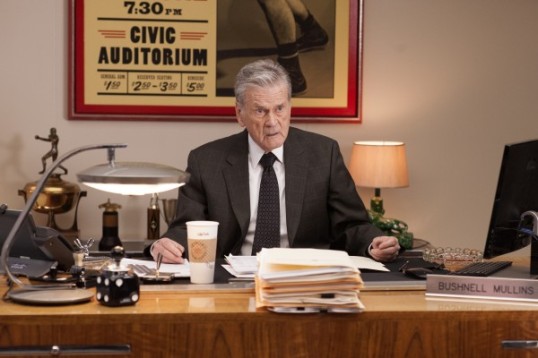
Meanwhile, Dougie/Cooper is back at work.  He’s got his big case file with him.  Unfortunately, his boss, Bushnell Mullins (Don Murray) is not impressed with Dougie/Cooper’s ladder drawing.  “Look at all of these childish scribbles,” he says, “how am I going to make any sense of this?”

“Make sense of it,” Dougie replies.

(Judging from the poster in his office, Bushnell was once a professional boxer.)

Suddenly, after looking at a few more of Dougie/Cooper’s drawings, Bushnell says, “Dougie, thank you.  I want you to keep this information to yourself.  I’ll take it from here but I may need your help again.”  Bushnell smiles.  “You’ve certainly given me a lot to think about.”

“Think about,” Dougie/Cooper replies.

“You’re an interesting fellow,” Bushnell says.

Meanwhile, Janey-E meets with the two men who claim that Dougie owes them money.  They explain that Dougie put a bet on a football game and lost.  They try to be intimidating but they don’t know who they’re dealing with.  Janey-E doesn’t have any time for their crap and she’s not afraid to let them know it.  She’s especially not impressed with their claim that Dougie owes them $52,000 when the bet was only for $20,000.

Nope, Janey-E’s not having it.

“We are not wealthy people!” Janey-E snaps, “We drive terrible cars!  We are the 99 per centers and we are shit on enough and we are certainly not going to be shit on by the likes of you!”  (If this seems surprisingly political for the normally apolitical David Lynch, it’s worth remembering that the script was co-written by Mark Frost, who is far more outspoken politically.  As a general rule, overly political stuff bores me to tears but Naomi Watts really kicks ass in his scene, totally selling every line.)  Janey-E gives them $25,000 and tells them to go away.

“What kind of a world are we living in where people can treat each other like this!?”  Janey-E says, before driving away.  “We are living in a dark, dark age.”

Meanwhile, Ike attacks Lorraine in her office and, in a disturbingly graphic scene, stabs her and at least two other women to death with a spike.  (Hence, his nickname.)

Back in Twin Peaks, Richard parks his truck in a field and tries to clean off the boy’s blood.

In the Sheriff’s Department, Deputy Hawk (Michael Horse) is in the men’s room when he sees a dime roll across the floor.  He follows the dime into a stall and, after picking it up, sees a metal sign proclaiming that the stall was built by Nez Perce Manufacturing.  And apparently, Nez Perce’s logo is a Native American chief.  Hawks sees that the top of the door is split open.  Hawk splits the door open further and finds several pieces of paper.
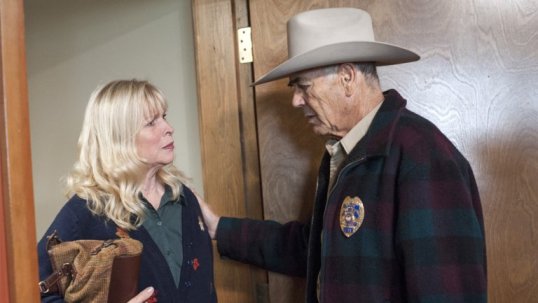
Meanwhile, Doris Truman (Candy Clark) comes by and yells at Frank (Robert Forster).  Doris is upset because her father’s car is not running right.  “Why are you always against me!?” Doris demands.  The other deputies say they wouldn’t put up with Doris but Maggie (Jodi Thelen) tells them that they don’t know what they’re talking about.  Doris, Maggie explains, changed after their son committed suicide.

“I know that,” one of the deputies says, mockingly, “he couldn’t take the pressure of being a soldier.”

(Is it possible that the death of Truman’s son — who it sounds like may have had PTSD — could be related to Linda, who — judging by Carl’s comments about the “fucking war” — may have been wounded while serving in the Army?)

And we close out with another haunting musical performance at the Roadhouse, the week courtesy of Sharon Van Etten.

Twin Peaks on TSL:

  1. Twin Peaks: In the Beginning by Jedadiah Leland
  2. TV Review: Twin Peaks 1.1 — The Pilot (dir by David Lynch) by Lisa Marie Bowman
  3. TV Review: Twin Peaks 1.2 — Traces To Nowhere (directed by Duwayne Dunham) by Jedadiah Leland
  4. TV Review: Twin Peaks 1.3 — Zen, or the Skill To Catch A Killer (dir by David Lynch) by Lisa Marie Bowman
  5. TV Review: Twin Peaks 1.4 “Rest in Pain” (dir by Tina Rathbone) by Leonard Wilson
  6. TV Review: Twin Peaks 1.5 “The One-Armed Man” (directed by Tim Hunter) by Jedadiah Leland
  7. TV Review: Twin Peaks 1.6 “Cooper’s Dreams” (directed by Lesli Linka Glatter) by Lisa Marie Bowman
  8. TV Review: Twin Peaks 1.7 “Realization Time” (directed by Caleb Deschanel) by Lisa Marie Bowman
  9. TV Review: Twin Peaks 1.8 “The Last Evening” (directed by Mark Frost) by Leonard Wilson
  10. TV Review: Twin Peaks 2.1 “May the Giant Be With You” (dir by David Lynch) by Leonard Wilson
  11. TV Review: Twin Peaks 2.2 “Coma” (directed by David Lynch) by Jedadiah Leland
  12. TV Review: Twin Peaks 2.3 “The Man Behind The Glass” (directed by Lesli Linka Glatter) by Jedadiah Leland
  13. TV Review: Twin Peaks 2.4 “Laura’s Secret Diary” (dir by Todd Holland) by Lisa Marie Bowman
  14. TV Review: Twin Peaks 2.5 “The Orchid’s Curse” (dir by Graeme Clifford) by Lisa Marie Bowman
  15. TV Review: Twin Peaks 2.6 “Demons” (dir by Lesli Linka Glatter) by Leonard Wilson
  16. TV Review: Twin Peaks 2.7 “Lonely Souls” (directed by David Lynch) by Jedadiah Leland
  17. TV Review: Twin Peaks 2.8 “Drive With A Dead Girl” (dir by Caleb Deschanel) by Lisa Marie Bowman
  18. TV Review: Twin Peaks 2.9 “Arbitrary Law” (dir by Tim Hunter) by Lisa Marie Bowman
  19. TV Review: Twin Peaks 2.10 “Dispute Between Brothers” (directed by Tina Rathbone) by Jedadiah Leland
  20. TV Review: Twin Peaks 2.11 “Masked Ball” (directed by Duwayne Dunham) by Leonard Wilson
  21. TV Review: Twin Peaks 2.12 “The Black Widow” (directed by Caleb Deschanel) by Leonard Wilson
  22. TV Review: Twin Peaks 2.13 “Checkmate” (directed by Todd Holland) by Jedadiah Leland
  23. TV Review: Twin Peaks 2.14 “Double Play” (directed by Uli Edel) by Jedadiah Leland
  24. TV Review: Twin Peaks 2.15 “Slaves and Masters” (directed by Diane Keaton) by Lisa Marie Bowman
  25. TV Review: Twin Peaks 2.16 “The Condemned Woman” (directed by Lesli Linka Glatter) by Leonard Wilson
  26. TV Review: Twin Peaks 2.17 “Wounds and Scars” (directed by James Foley) by Lisa Marie Bowman
  27. TV Review: Twin Peaks 2.18 “On The Wings of Love” (directed by Duwayne Dunham) by Jedadiah Leland
  28. TV Review: Twin Peaks 2.19 “Variations on Relations” (directed by Jonathan Sanger) by Lisa Marie Bowman
  29. TV Review: Twin Peaks 2.20 “The Path to the Black Lodge” (directed by Stephen Gyllenhaal) by Lisa Marie Bowman
  30. TV Review: Twin Peaks 2.21 “Miss Twin Peaks” (directed by Tim Hunter) by Leonard Wilson
  31. TV Review: Twin Peaks 22.2 “Beyond Life and Death” (directed by David Lynch) by Lisa Marie Bowman
  32. Film Review: Twin Peaks: Fire Walk With Me (dir by David Lynch) by Lisa Marie Bowman
  33. Here’s The Latest Teaser for Showtime’s Twin Peaks by Lisa Marie Bowman
  34. Here’s The Newest Teaser for Showtime’s Twin Peaks by Lisa Marie Bowman
  35. 12 Initial Thoughts About Twin Peaks: The Return Parts One and Two by Lisa Marie Bowman
  36. This Week’s Peaks: Parts One and Two by Ryan C. (trashfilm guru)
  37. TV Review: Twin Peaks: The Return Parts One and Two (dir by David Lynch) by Lisa Marie Bowman
  38. 4 Shots From 4 Films: Special Twin Peaks Edition by Lisa Marie Bowman
  39. This Week’s Peaks: Parts Three and Four by Ryan C. (trashfilm guru)
  40. 14 Initial Thoughts About Twin Peaks: The Return Part Three by Lisa Marie Bowman (dir by David Lynch)
  41. 10 Initial Thoughts About Twin Peaks: The Return Part Four by Lisa Marie Bowman (dir by David Lynch)
  42. TV Review: Twin Peaks: The Return Parts Three and Four (dir by David Lynch) by Lisa Marie Bowman 
  43. 18 Initial Thoughts About Twin Peaks: The Return Part 5 (dir by David Lynch) by Lisa Marie Bowman
  44. This Week’s Peaks: Part Five by Ryan C. (trashfilm guru)
  45. TV Review: Twin Peaks: The Return: Part 5 (dir by David Lynch) by Lisa Marie Bowman
  46. 14 Initial Thoughts On Twin Peaks Part 6 (dir by David Lynch) by Lisa Marie Bowman
  47. This Week’s Peaks: Part Six by Ryan C. (trashfilm guru)

14 Initial Thoughts About Twin Peaks: The Return Part 6 (dir by David Lynch)


As always, a full-scale recap will be posted either later tonight or at some point tomorrow.  These are just some initial thoughts that I had while watching the sixth part of Twin Peaks: The Return!

1. The opening theme music by Angelo Badalamenti is just as haunting as ever.  That may seem like an obvious thought but one should never underestimate just how important that music is to this show.  It sets the mood for everything that follows.  No matter what’s happened in your life in between episodes, hearing that music immediately puts you back into the world of Twin Peaks.

2. I have to admit that I kind of hope Tom Sizemore will show up in tonight’s episode, if just because of this twitter exchange that I came across yesterday.

3. As strange as Dougie/Cooper may be acting, the strangest part of his storyline is how everyone in his life refuses to accept that he’s acting strangely.  If nothing else, the Dougie/Cooper scenes have served to illustrate just how far people will go to avoid having to admit that anything out of the ordinary is happening.

4. Once again, Twin Peaks has reminded us of how much we’re gong to miss Miguel Ferrer.

5, Diane!  We finally met Diane but, just in case you haven’t seen the episode yet, I’m not going to spoil things by revealing who played her.

6. Admittedly, if you follow me on twitter, you may have seen me recently saying that I though Balthazar Getty’s performance was very detrimental to Lost Highway.  Well, while I’m not going back on that opinion, Getty gave a pretty good performance tonight.

7. It’s Harry Dean Stanton, recreating his role from Twin Peaks: Fire Walk With Me!

8. So, basically, in 25 years, there has been zero staff turnover at the diner.

9. I am going to be so careful driving tomorrow.  I’m not going a mile over the speed limit.

10. The little boy’s soul, if that’s what it was, flying into the air reminded me of a post my sister did about spirit photography.  Check it out here.

11. Hey, Patrick Fischler’s back!  I was wondering if we’d get to see him again.  You may remember him as the guy in Mulholland Drive who had the nightmares about an evil creature living behind a dumpster.

12.  “One one nine!”  The druggie mother is played by an actress named Hailey Gates and the character freaks me out every time she shows up.  Gates also hosts a show on Viceland.  (Yes, Viceland still exists.)

13. I loved Don Murray’s exasperation at seeing Dougie/Cooper’s “work.”

14. Naomi Watts needs her own spin-off series.

Twin Peaks on TSL:

  1. Twin Peaks: In the Beginning by Jedadiah Leland
  2. TV Review: Twin Peaks 1.1 — The Pilot (dir by David Lynch) by Lisa Marie Bowman
  3. TV Review: Twin Peaks 1.2 — Traces To Nowhere (directed by Duwayne Dunham) by Jedadiah Leland
  4. TV Review: Twin Peaks 1.3 — Zen, or the Skill To Catch A Killer (dir by David Lynch) by Lisa Marie Bowman
  5. TV Review: Twin Peaks 1.4 “Rest in Pain” (dir by Tina Rathbone) by Leonard Wilson
  6. TV Review: Twin Peaks 1.5 “The One-Armed Man” (directed by Tim Hunter) by Jedadiah Leland
  7. TV Review: Twin Peaks 1.6 “Cooper’s Dreams” (directed by Lesli Linka Glatter) by Lisa Marie Bowman
  8. TV Review: Twin Peaks 1.7 “Realization Time” (directed by Caleb Deschanel) by Lisa Marie Bowman
  9. TV Review: Twin Peaks 1.8 “The Last Evening” (directed by Mark Frost) by Leonard Wilson
  10. TV Review: Twin Peaks 2.1 “May the Giant Be With You” (dir by David Lynch) by Leonard Wilson
  11. TV Review: Twin Peaks 2.2 “Coma” (directed by David Lynch) by Jedadiah Leland
  12. TV Review: Twin Peaks 2.3 “The Man Behind The Glass” (directed by Lesli Linka Glatter) by Jedadiah Leland
  13. TV Review: Twin Peaks 2.4 “Laura’s Secret Diary” (dir by Todd Holland) by Lisa Marie Bowman
  14. TV Review: Twin Peaks 2.5 “The Orchid’s Curse” (dir by Graeme Clifford) by Lisa Marie Bowman
  15. TV Review: Twin Peaks 2.6 “Demons” (dir by Lesli Linka Glatter) by Leonard Wilson
  16. TV Review: Twin Peaks 2.7 “Lonely Souls” (directed by David Lynch) by Jedadiah Leland
  17. TV Review: Twin Peaks 2.8 “Drive With A Dead Girl” (dir by Caleb Deschanel) by Lisa Marie Bowman
  18. TV Review: Twin Peaks 2.9 “Arbitrary Law” (dir by Tim Hunter) by Lisa Marie Bowman
  19. TV Review: Twin Peaks 2.10 “Dispute Between Brothers” (directed by Tina Rathbone) by Jedadiah Leland
  20. TV Review: Twin Peaks 2.11 “Masked Ball” (directed by Duwayne Dunham) by Leonard Wilson
  21. TV Review: Twin Peaks 2.12 “The Black Widow” (directed by Caleb Deschanel) by Leonard Wilson
  22. TV Review: Twin Peaks 2.13 “Checkmate” (directed by Todd Holland) by Jedadiah Leland
  23. TV Review: Twin Peaks 2.14 “Double Play” (directed by Uli Edel) by Jedadiah Leland
  24. TV Review: Twin Peaks 2.15 “Slaves and Masters” (directed by Diane Keaton) by Lisa Marie Bowman
  25. TV Review: Twin Peaks 2.16 “The Condemned Woman” (directed by Lesli Linka Glatter) by Leonard Wilson
  26. TV Review: Twin Peaks 2.17 “Wounds and Scars” (directed by James Foley) by Lisa Marie Bowman
  27. TV Review: Twin Peaks 2.18 “On The Wings of Love” (directed by Duwayne Dunham) by Jedadiah Leland
  28. TV Review: Twin Peaks 2.19 “Variations on Relations” (directed by Jonathan Sanger) by Lisa Marie Bowman
  29. TV Review: Twin Peaks 2.20 “The Path to the Black Lodge” (directed by Stephen Gyllenhaal) by Lisa Marie Bowman
  30. TV Review: Twin Peaks 2.21 “Miss Twin Peaks” (directed by Tim Hunter) by Leonard Wilson
  31. TV Review: Twin Peaks 22.2 “Beyond Life and Death” (directed by David Lynch) by Lisa Marie Bowman
  32. Film Review: Twin Peaks: Fire Walk With Me (dir by David Lynch) by Lisa Marie Bowman
  33. Here’s The Latest Teaser for Showtime’s Twin Peaks by Lisa Marie Bowman
  34. Here’s The Newest Teaser for Showtime’s Twin Peaks by Lisa Marie Bowman
  35. 12 Initial Thoughts About Twin Peaks: The Return Parts One and Two by Lisa Marie Bowman
  36. This Week’s Peaks: Parts One and Two by Ryan C. (trashfilm guru)
  37. TV Review: Twin Peaks: The Return Parts One and Two (dir by David Lynch) by Lisa Marie Bowman
  38. 4 Shots From 4 Films: Special Twin Peaks Edition by Lisa Marie Bowman
  39. This Week’s Peaks: Parts Three and Four by Ryan C. (trashfilm guru)
  40. 14 Initial Thoughts About Twin Peaks: The Return Part Three by Lisa Marie Bowman (dir by David Lynch)
  41. 10 Initial Thoughts About Twin Peaks: The Return Part Four by Lisa Marie Bowman (dir by David Lynch)
  42. TV Review: Twin Peaks: The Return Parts Three and Four (dir by David Lynch) by Lisa Marie Bowman 
  43. 18 Initial Thoughts About Twin Peaks: The Return Part 5 (dir by David Lynch) by Lisa Marie Bowman
  44. This Week’s Peaks: Part Five by Ryan C. (trashfilm guru)
  45. TV Review: Twin Peaks: The Return: Part 5 (dir by David Lynch) by Lisa Marie Bowman

Lisa Reviews An Oscar Nominee: The Longest Day (dir by Ken Annakin, Andrew Marton, Bernhard Wicki, Gerd Oswald, and Darryl F. Zanuck)


As my sister has already pointed out, today is the 73rd anniversary of D-Day.  With that in mind, and as a part of my ongoing mission to see and review every single film ever nominated for best picture, I decided to watch the 1962 film, The Longest Day!

The Longest Day is a pain-staking and meticulous recreation of invasion of Normandy, much of it filmed on location.  It was reportedly something of a dream project for the head of the 20th Century Fox, Darryl F. Zanuck.  Zanuck set out to make both the ultimate tribute to the Allied forces and the greatest war movie ever.  Based on a best seller, The Longest Day has five credited screenwriters and three credited directors.  (Ken Annakin was credited with “British and French exteriors,” Andrew Marton did “American exteriors,” and the German scenes were credited to Bernhard Wicki.  Oddly, Gerd Oswald was not credited for his work on the parachuting scenes, even though those were some of the strongest scenes in the film.)  Even though he was not credited as either a screenwriter or a director, it is generally agreed that the film ultimately reflected the vision of Darryl F. Zanuck.  Zanuck not only rewrote the script but he also directed a few scenes as well.  The film had a budget of 7.75 million dollars, which was a huge amount in 1962.  (Until Steven Spielberg’s Schindler’s List, The Longest Day was the most expensive black-and-white film ever made.)  Not only did the film tell an epic story, but it also had an epic length.  Clocking in at 3 hours, The Longest Day was also one of the longest movies to ever be nominated for best picture.

The Longest Day also had an epic cast.  Zanuck assembled an all-star cast for his recreation of D-Day.  If you’re like me and you love watching old movies on TCM, you’ll see a lot of familiar faces go rushing by during the course of The Longest Day.  American generals were played by actors like Robert Mitchum, Robert Ryan, Henry Fonda, and John Wayne.  Peter Lawford, then the brother-in-law of the President of the United States, had a memorable role as the Scottish Lord Lovat, who marched through D-Day to the sounds of bagpipes.  When the Allied troops storm the beach, everyone from Roddy McDowall to Sal Mineo to Robert Wagner to singer Paul Anka can be seen dodging bullets.  Sean Connery pops up, speaking in his Scottish accent and providing comic relief.  When a group of paratroopers parachute into an occupied village, comedian Red Buttons ends up hanging from the steeple of a church.  When Richard Beymer (who is currently playing Ben Horne on Twin Peaks) gets separated from his squad, he stumbles across Richard Burton.  Among those representing the French are Arletty and Christian Marquand.  (Ironically, after World War II, Arletty was convicted of collaborating with the Germans and spent 18 months under house arrest.  Her crime was having a romantic relationship with a German soldier.  It is said that, in response to the charges, Arletty said, “My heart is French but my ass is international.”)  Meanwhile, among the Germans, one can find three future Bond villains: Gert Frobe, Curt Jurgens, and Walter Gotell.

It’s a big film and, to be honest, it’s too big.  It’s hard to keep track of everyone and, even though the battle scenes are probably about an intense as one could get away with in 1962 (though it’s nowhere near as effective as the famous opening of Saving Private Ryan, I still felt bad when Jeffrey Hunter and Eddie Albert were gunned down), their effectiveness is compromised by the film’s all-star approach.  Often times, the action threatens to come to a halt so that everyone can get their close-up.  Unfortunately, most of those famous faces don’t really get much of a chance to make an impression.  Even as the battle rages, you keep getting distracted by questions like, “Was that guy famous or was he just an extra?”

Among the big stars, most of them play to their personas.  John Wayne, for instance, may have been cast as General Benjamin Vandervoort but there’s never any doubt that he’s playing John Wayne.  When he tells his troops to “send them to Hell,” it’s not Vandervoort giving orders.  It’s John Wayne representing America.  Henry Fonda may be identified as being General Theodore Roosevelt II but, ultimately, you react to him because he’s Henry Fonda, a symbol of middle-American decency.  Neither Wayne nor Fonda gives a bad performance but you never forget that you’re watching Fonda and Wayne.

Throughout this huge film, there are bits and pieces that work so well that you wish the film had just concentrated on them as opposed to trying to tell every single story that occurred during D-Day.  I liked Robert Mitchum as a tough but caring general who, in the midst of battle, gives a speech that inspires his troops to keep fighting.  The scenes of Peter Lawford marching with a bagpiper at his side were nicely surreal.  Finally, there’s Richard Beymer, wandering around the French countryside and going through the entire day without firing his gun once.  Beymer gets the best line of the film when he says, “I wonder if we won.”  It’s such a modest line but it’s probably the most powerful line in the film.  I wish The Longest Day had more scenes like that.

The Longest Day was nominated for best picture of 1962 but it lost to an even longer film, Lawrence of Arabia.