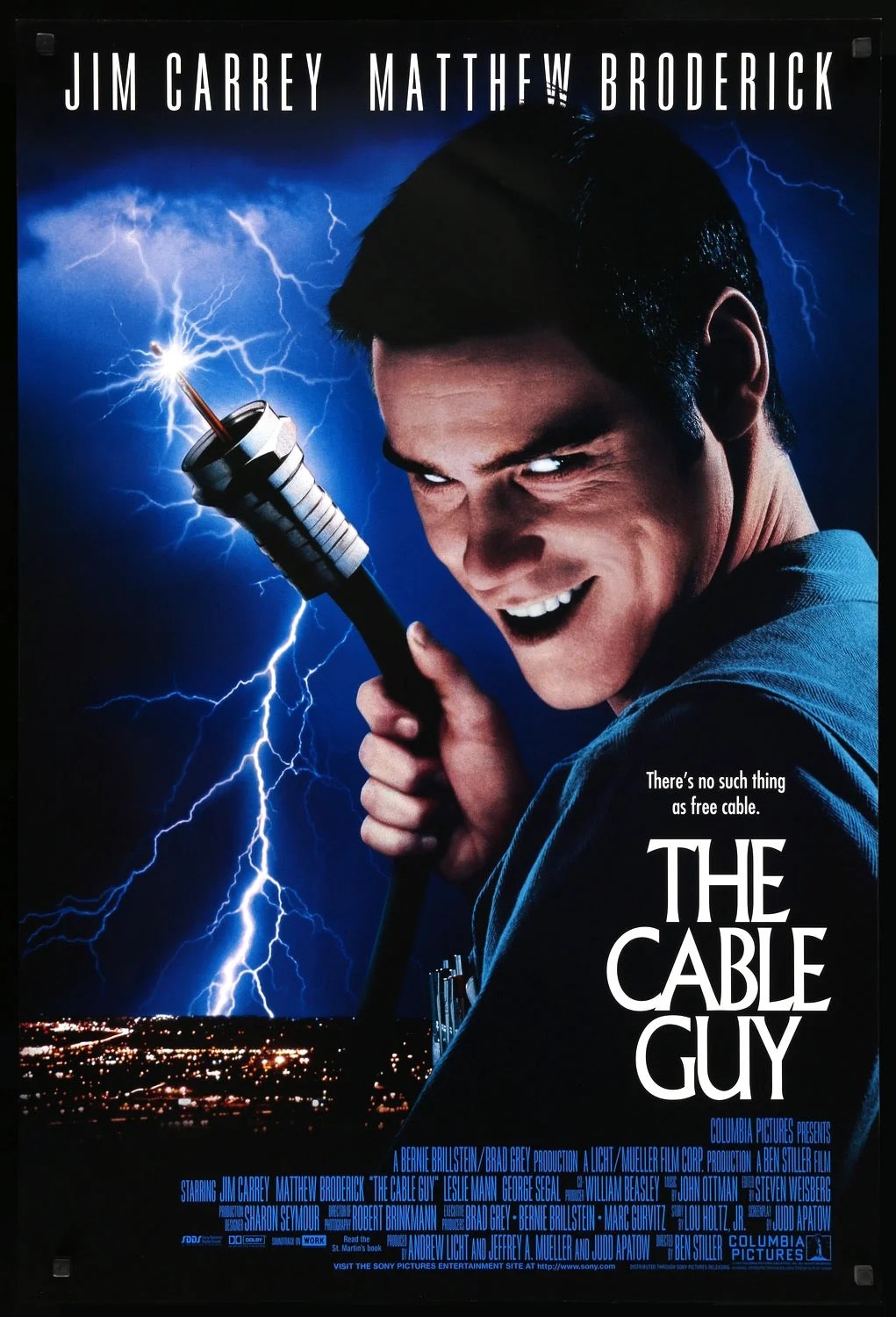
Icarus File No. 32: The Cable Guy (dir. by Ben Stiller)


“You were never there for me, were you, Mother? You expected Mike and Carol Brady to raise me! I’m the bastard son of Claire Huxtable! I am a lost Cunningham! I learned the facts of life from watching The Facts of Life!” — Chip

Few 1990s studio comedies are as awkwardly fascinating—or as misunderstood on arrival—as The Cable Guy. Directed by Ben Stiller and built around one of Jim Carrey’s most deliberately uncomfortable performances, it arrived at a strange point in Carrey’s career: he had become a massive box-office draw through films such as Ace Ventura: Pet Detective, The Mask, Dumb and Dumber, Batman Forever, and Ace Ventura: When Nature Calls. Audiences associated him with rubber-faced chaos, exuberant catchphrases, and a kind of manic but fundamentally likable comic energy. The Cable Guy offers something much colder. Carrey is still loud, physical, and wildly committed, but the movie twists those familiar traits into a portrait of loneliness, obsession, and emotional menace. It is a dark comedy about a man who has absorbed television culture so completely that he cannot form a normal human relationship without treating it like an episode of a sitcom.

That basic idea remains clever and surprisingly ahead of its time. Carrey plays Chip Douglas, a cable installer who enters the life of Steven Kovacs, played by Matthew Broderick, after Steven moves into a new apartment following a breakup with his girlfriend Robin, played by Leslie Mann. Steven wants cable television installed; Chip wants a best friend. What begins as awkward friendliness becomes invasive dependence, as Chip worms his way into Steven’s social circle, his professional life, and eventually his relationship with Robin. Chip is not simply a pest or an eccentric service worker. He is a lonely, emotionally stunted man whose references to television, movies, commercials, and game shows have become his entire vocabulary for intimacy.

The most interesting thing about The Cable Guy is that it understands television as both comfort and damage. Chip’s childhood was clearly shaped by neglect, with television functioning as his guardian, teacher, and surrogate parent. The movie makes this point broadly, sometimes too broadly, but it also gives the character a sad logic. Chip does not understand friendship as mutual connection; he understands it as a package deal. You meet someone, quote the same shows, hang out constantly, become inseparable, and live out the happy ending promised by popular entertainment. When Steven resists that fantasy, Chip does not know how to process rejection. His behavior turns increasingly controlling and vindictive because, in his mind, Steven has violated the rules of the relationship genre they are supposed to be playing.

In that respect, the film was well ahead of its time. In 1996, the idea of television becoming an all-encompassing babysitter for a generation of children was recognizable, but it still played largely as exaggerated satire. Chip represents the extreme result of a childhood where adults failed to provide stability, affection, supervision, and basic emotional guidance, leaving television to fill every role instead. He learned how to talk, how to joke, how to flirt, how to fight, and how to imagine friendship from whatever appeared on the screen. The tragedy is that media gave him endless information and endless imitation, but no real understanding of boundaries, empathy, or reciprocity.

That concern feels much less hypothetical today. Television did not disappear; it expanded into streaming libraries, on-demand movies, YouTube, social media feeds, online games, short-form video, and the constantly available internet. More children now grow up surrounded by screens that are not confined to a living-room television set or a few scheduled hours of programming. The old guardrails of limited channels, parental supervision around a shared TV, and the simple fact that a show ended at a certain time have weakened or, in many homes, disappeared altogether. The Cable Guy obviously does not predict every aspect of the internet age, but it does anticipate the emotional danger of allowing media to become a substitute for parenting, companionship, and healthy social development.

The film is careful enough to suggest that media alone did not create Chip. He is the product of abandonment first and television second. That distinction matters, because the movie is not arguing that children who watch too much television will inevitably become unstable stalkers. Rather, it suggests that screens can become especially powerful when they are used to fill an emotional void that should be addressed by family, community, and genuine relationships. Chip’s many references are funny at first because they are recognizable, but they become sadder as the movie reveals that he is not simply quoting pop culture for fun. He is quoting it because he has little else to draw from.

That makes the film more ambitious than its reputation as “the weird Jim Carrey movie” might suggest. The screenplay, by Lou Holtz Jr., has fun with media saturation, consumer culture, male insecurity, and the way people use technology to avoid direct emotional communication. The title itself now feels almost quaint, because cable installation hardly seems threatening in an age of smartphones, streaming services, social media surveillance, and algorithmic recommendation systems. Yet Chip’s obsession has only become more recognizable. He is essentially a proto-internet stalker, a man who treats access as entitlement. Because he can enter Steven’s home to connect his television service, he assumes he deserves access to Steven’s private life. The film exaggerates that premise for comic effect, but the underlying discomfort has aged well.

At the same time, The Cable Guy has a major problem, and it is inseparable from the reason the film exists: Jim Carrey. Casting Carrey was a commercial gamble meant to make a very dark premise accessible to a mainstream audience. In theory, it is an inspired decision. His brand of elastic, outsized comedy gives Chip a strange unpredictability; you never know whether he is going to make a ridiculous movie reference, belt out a sentimental song, physically humiliate himself, or suddenly become frightening. Carrey’s comic instincts make Chip memorable in a way that a more restrained actor likely would not have been. His version of the character is like an abandoned cartoon character who has somehow wandered into a real person’s life.

But the same performance often works against the movie. Carrey’s penchant for excessive facial expressions, exaggerated voices, and physical escalation overwhelms the subtler and more unsettling possibilities in the script. The film wants to be a satirical dark comedy, but it repeatedly gives itself over to big Jim Carrey bits. Some are undeniably funny, especially because Carrey commits to them with fearless energy, but they can make Chip feel less like a damaged human being and more like a delivery system for gags. The movie keeps shifting between “this man is dangerously unstable” and “look at Jim Carrey doing something weird,” and that unevenness prevents it from fully landing as either a truly disturbing character piece or a consistently hilarious farce.

The medieval-themed restaurant sequence is probably the clearest example of both the movie’s strengths and weaknesses. When Chip and Steven engage in an extended jousting and sword-fighting routine at Medieval Times, it is funny because it transforms a casual social outing into a ridiculous, testosterone-heavy spectacle. It also exposes the warped nature of their friendship: Chip is trying to force Steven into a grand, cinematic bonding ritual. Yet the scene is so broad and so committed to the escalating stunt comedy that it can feel detached from the film’s more interesting emotional undercurrents. It is memorable, certainly, but it is also the kind of scene that makes it easy to see why contemporary audiences may have expected another straightforward Carrey comedy rather than a satire with genuine bitterness beneath the jokes.

Broderick is important here because he provides the film’s necessary straight-man perspective. Steven is not a particularly dynamic protagonist, and that is partly the point. He is an ordinary, mildly selfish guy trying to rebuild his life after a breakup, which makes Chip’s intrusion feel even more invasive. Still, Broderick’s deliberately subdued performance can make Steven seem passive compared with the hurricane of Carrey’s performance. The movie needs Steven to be bland enough for Chip to project his fantasies onto him, but that choice also leaves the film with an imbalance: Chip is by far the most vivid person on screen, even when the story is asking us to see him as a nightmare.

Leslie Mann brings warmth and patience to Robin, while Jack Black, in an early supporting role as Steven’s friend Rick, adds a welcome jolt of weird energy without taking over the movie. The supporting cast understands the heightened tone, but Stiller’s direction occasionally pushes the material toward sketch-comedy exaggeration. That is not always a flaw; The Cable Guy is frequently inventive in its visual jokes, its television parodies, and its depictions of Chip turning every situation into a warped pop-culture performance. Still, the film is at its best when Stiller lets the strangeness breathe rather than constantly underlining it.

The movie’s lackluster initial reception makes sense in context. Audiences had been trained to see Carrey as a wildly energetic hero of broad studio comedies, not as a creepy, needy antagonist whose jokes often curdle into discomfort. The promotional challenge was enormous: sell The Cable Guy as a Jim Carrey movie, and viewers might expect another crowd-pleasing laugh machine; sell it honestly as a dark satire about loneliness and media dependency, and it becomes a much harder commercial proposition. Many viewers at the time seemed to reject it not because it lacked ideas, but because it did not give them the version of Jim Carrey they thought they were buying a ticket to see.

In the years since, however, the film has developed a deservedly large cult following. Distance has helped. Modern audiences are more accustomed to comedians making darker career turns, and the themes of mediated identity, parasocial attachment, isolation, and invasive access now feel much more relevant than they did in the mid-1990s. Carrey’s performance, once seen by many as abrasive or miscalculated, can now be appreciated as a risky attempt to weaponize his own comic persona. Chip is funny precisely because he is desperate to be liked, but he is also disturbing because his idea of being liked involves total possession.

The Cable Guy is not a perfect dark comedy. Its tone wobbles, its protagonist can feel underwritten, and Carrey’s larger-than-life antics sometimes obscure the sharper satire hiding underneath. Yet those flaws are also part of what makes it fascinating. It is a studio movie willing to be unpleasant, odd, and commercially confusing at the height of a superstar’s popularity. Rather than simply giving Jim Carrey another vehicle for his most familiar tricks, it turns those tricks into symptoms of a damaged man’s inability to connect. The result is uneven, but it is far more interesting than a safer 1996 Jim Carrey comedy would have been—and its cult status feels earned.

Previous Icarus Files:

  1. Cloud Atlas
  2. Maximum Overdrive
  3. Glass
  4. Captive State
  5. Mother!
  6. The Man Who Killed Don Quixote
  7. Last Days
  8. Plan 9 From Outer Space
  9. The Last Movie
  10. 88
  11. The Bonfire of the Vanities
  12. Birdemic
  13. Birdemic 2: The Resurrection 
  14. Last Exit To Brooklyn
  15. Glen or Glenda
  16. The Assassination of Trotsky
  17. Che!
  18. Brewster McCloud
  19. American Traitor: The Trial of Axis Sally
  20. Tough Guys Don’t Dance
  21. Reach Me
  22. Revolution
  23. The Last Tycoon
  24. Express to Terror 
  25. 1941
  26. The Teheran Incident
  27. Con Man
  28. Looker
  29. 1776
  30. Here
  31. The Adventures of Brisco County, Jr.
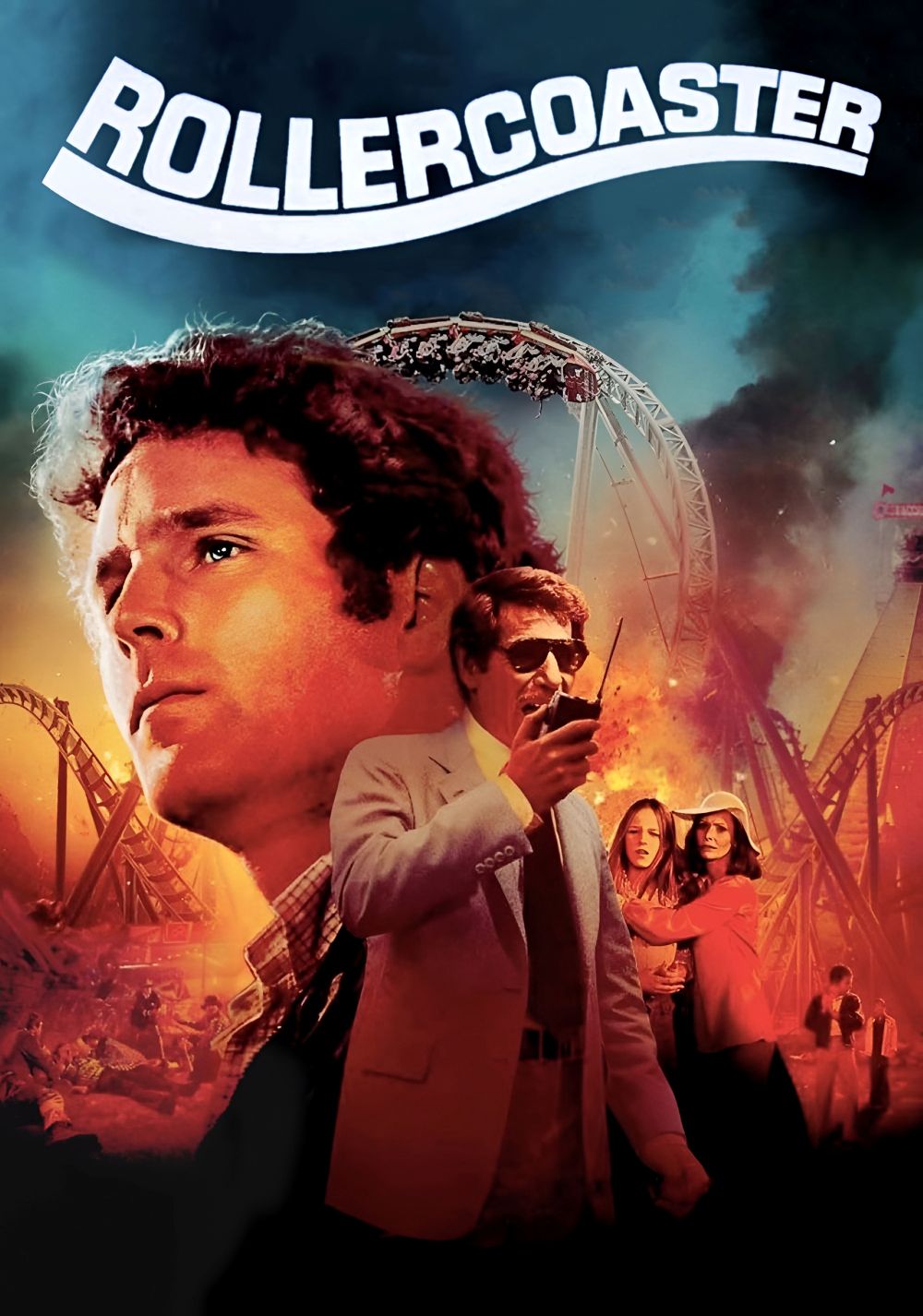
Review: Rollercoaster (dir. by James Goldstone)


“If they pay me and if they do what I say, I’ll never bother them again.” — Young Man

James Goldstone’s 1977 film Rollercoaster exists in a fascinating, albeit deeply flawed, space within the history of seventies disaster cinema. If you are a fan of retro 70s movies, specifically the whole Sensurround era where Hollywood was desperately trying to get people out of their living rooms and into theaters with seat-rumbling audio gimmicks, you have probably heard of this one. It has a genuinely neat, gritty vibe because it was actually shot on location at real amusement parks like Kings Island and Magic Mountain. You get this awesome, vintage, mid-century theme park atmosphere that you just cannot fake on a studio backlot. You can almost smell the cotton candy, the hot asphalt, and the stale beer. But once that initial wave of nostalgia wears off, you are left looking at what is actually on the screen, and honestly, Rollercoaster is not a great film. In fact, one could very easily say it is not even a good film. At its absolute best of times, it is a thoroughly average, middle-of-the-road thriller that feels more like a slightly elevated, padded-out television movie of the week than a major theatrical release.

The plot is about as standard as it gets for this era of disaster-adjacent cinema. A mysterious, young terrorist starts blowing up rollercoasters, not for any grand political manifesto, but simply to extort amusement park owners for millions of dollars. Enter our protagonist, Harry Calder, played by George Segal, who is a cynical safety inspector that just happens to survive the first derailment. Segal is basically just playing George Segal here—exasperated, a bit snarky, wearing a rumpled suit, and teaming up with an FBI agent played by Richard Widmark. The villain is played by a very young Timothy Bottoms, who is effectively creepy but given virtually zero backstory or motivation. He is just a blank-eyed psycho doing psycho things because the script needs an antagonist. The movie essentially just bounces from one park to another, with Segal walking around looking stressed while the FBI tries to figure out where the next bomb is hidden.

The pacing is arguably the film’s biggest sin. For a movie literally named Rollercoaster, it is shockingly lacking in momentum. Goldstone’s direction completely lacks the tight, pulse-pounding beats you would expect from a high-stakes thriller. There is so much filler here, so many scenes of Segal drinking coffee and staring at blueprints, and so much tedious FBI bureaucratic nonsense that it completely kills any tension. The romantic subplot feels entirely tacked on, and the climax fails to deliver the massive, explosive payoff you have been waiting for. If you judge Rollercoaster purely on its cinematic merits—the acting, the script, the direction—it is undeniably average, the kind of movie you leave on in the background while you fold laundry.

However, despite all of these glaring, undeniable flaws, Rollercoaster has a fascinating, almost prophetic legacy when you look back at the history of the thriller genre. It may not be remembered as a great movie, but it essentially built the exact template for an entire subgenre of cat-and-mouse thrillers that dominated the 90s. It practically invented the “specific-professional-against-a-psychopathic-mastermind” formula. Before Rollercoaster, thrillers were usually about spies, cops, or generic everymen. But this film introduced the idea of a highly specific, niche expert being forced into a one-on-one intellectual duel with a terrorist who targets them specifically because of their expertise. Think about how that exact template was endlessly copied and refined in the decades that followed. Look at In the Line of Fire, where Clint Eastwood plays a Secret Service agent hunted by a psycho played by John Malkovich. Or look at Blown Away, where Jeff Bridges is a bomb-defusing expert tormented by an Irish terrorist played by Tommy Lee Jones. Even The Bone Collector fits this mold perfectly, with Denzel Washington’s bedridden forensics expert being targeted by a serial killer who uses specific crime scenes just to test Washington’s intellect. All of these films drew direct DNA from Rollercoaster, using that exact same dynamic of a reluctant protagonist with a very particular set of skills being singled out by a psychopath who treats mass murder like a twisted, personalized game of chess. And if you want the absolute pinnacle of the “expert vs. bomb” trope, you have to look at Speed, which polished the cat-and-mouse dynamic perfected right here in Rollercoaster.

Because the original film was so hampered by 1970s filmmaking technology, it really makes you realize how easily this movie could be remade in this day and age. Back then, the actual destruction of the rides was limited by practical effects, clunky models, and standard camera angles that made the crashes feel somewhat static and safe. Today, technology in filmmaking has advanced to the point that the sheer scale, speed, and physical danger of the rides themselves really does become the focus of real danger. With modern CGI, drone cameras, and advanced practical rigging, you could put the audience right inside the front car of a 300-foot hyper-coaster as the tracks buckle and twist in slow motion. You could make the metal fatigue, the snapping cables, and the horrific physics of a derailment feel genuinely terrifying, turning the amusement park rides into massive, mechanical monsters rather than just static backdrop props for guys in suits to talk around.

Naturally, if Hollywood were to actually remake Rollercoaster today, you know exactly how it would look and who would star in it. It would undoubtedly star someone like Dwayne Johnson or Chris Pratt, a guy who can deliver a quip while looking concerned and holding a blueprint. They would inevitably give the safety inspector a tragic backstory, probably a dead wife or a kid they are estranged from, just to artificially raise the emotional stakes. And because it is a high-concept thriller that does not quite have the cultural weight of a massive comic book franchise, the remake would almost certainly be relegated to a streaming release. It would drop on a Friday on Netflix or Amazon Prime with a generic, algorithmically tested poster and a slick, forgettable title. It would be exactly the kind of mid-budget, mildly entertaining action flick you watch on a rainy Sunday afternoon before completely forgetting about it by Monday morning.

So, ultimately, how do you rate a movie like Rollercoaster? You just have to accept its extreme averageness and respect its ripple effect. It is clunky, the performances are uneven, and it is rarely as thrilling as its title promises. But it absolutely should not be written off entirely. It was the exact moment Hollywood realized that pitting highly specialized professionals against high-concept villains made for compelling, relatable drama. Without George Segal boredly walking around Magic Mountain, we probably do not get the overly dramatic, incredibly ridiculous, yet thoroughly entertaining 90s thriller boom, nor the slick, CGI-heavy streaming thrillers of today. Rollercoaster might just be a mediocre hill, but it is undeniably the hill that started the entire ride.

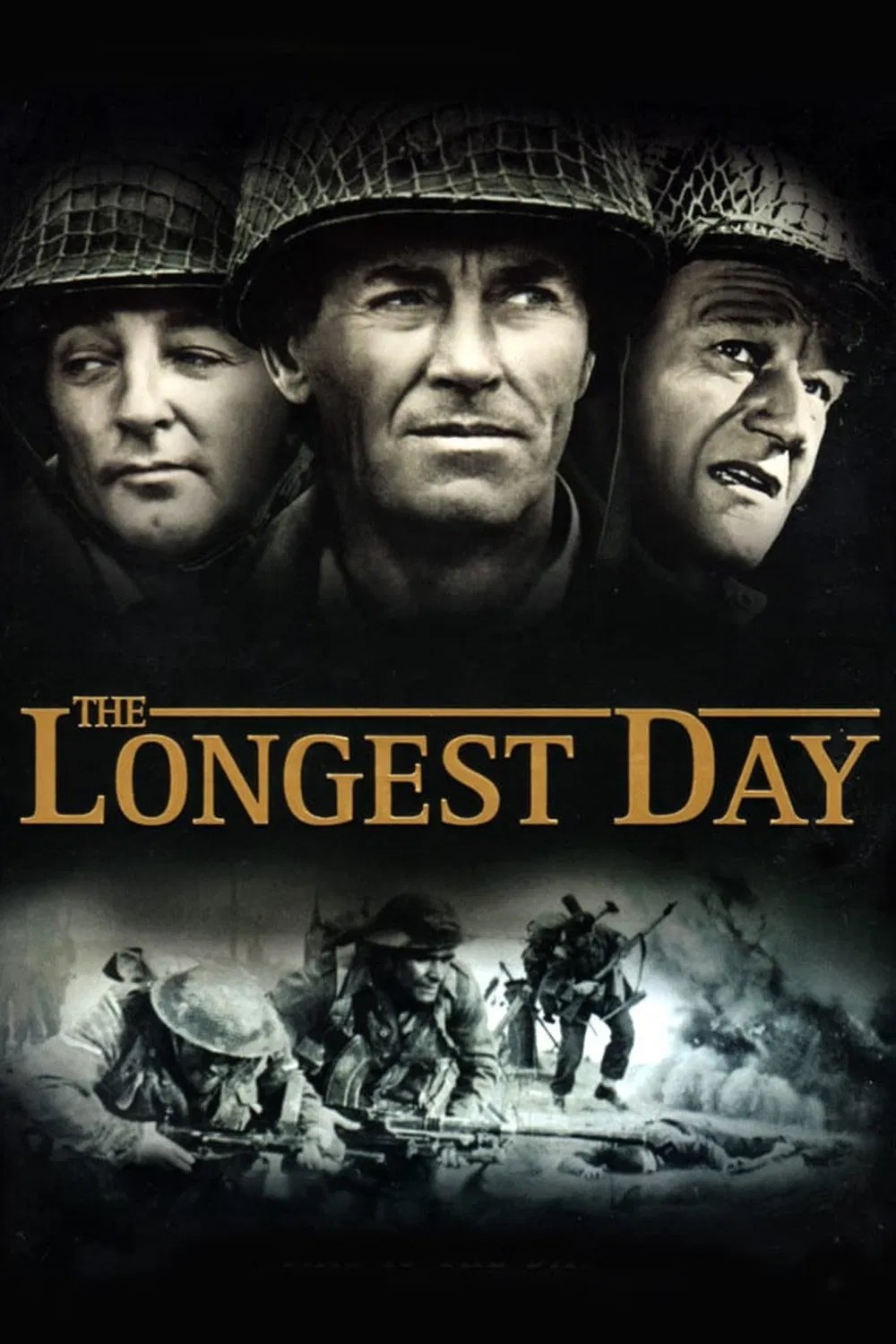
Review: The Longest Day (dir. by Ken Annakin, Andrew Barton & Bernhard Wicki)


“The thing that’s always worried me about being one of the few is the way we keep on getting fewer.” — Flight Officer David Campbell

You could be forgiven for thinking that a three-hour black-and-white war epic from 1962 about the D-Day landings might feel like homework. The Longest Day sounds exactly like the kind of movie your history buff uncle would insist you watch, and you’d brace yourself for stiff acting, dated effects, and a flag-waving tone that hasn’t aged well. But here’s the surprise: this thing still cooks. It’s massive, messy in the best way, and surprisingly modern in its storytelling. Directed by a quartet of filmmakers—Ken Annakin for the British sequences, Andrew Marton for the Americans, Bernhard Wicki for the Germans, and with uncredited help from John Wayne’s own ego (more on that later)—The Longest Day isn’t one movie. It’s five or six movies crammed into a single sprawling canvas, and somehow that chaotic energy works perfectly for a story about the chaos of June 6, 1944.

First, let’s talk about the elephant in the room: the cast. It’s absurd. John Wayne, Robert Mitchum, Henry Fonda, Sean Connery, Richard Burton, Rod Steiger, Robert Wagner, Curt Jürgens, and a young Gert Fröbe (the future Goldfinger) are just the headliners. There are about forty other recognizable faces popping up for two minutes of screen time. You half expect a narrator to say “and that guy from that thing.” But here’s the trick: The Longest Day uses star power not as distraction but as shorthand. When you see John Wayne playing Lt. Col. Benjamin Vandervoort, you don’t need a backstory. You just know he’s the tough, unkillable leader. When you see Henry Fonda as Brig. Gen. Theodore Roosevelt Jr., you read quiet dignity and grit. The movie trusts that you’ll fill in the blanks, which allows it to jump between American, British, French, and German perspectives without pausing for emotional handholding. That’s a bold gamble, and it mostly pays off, though Wayne’s scenes are a prime example of the film’s one real weakness: occasionally, it lets the star overpower the story. His Vandervoort breaks his ankle jumping into Normandy and still leads his men—cool story, historically accurate—but Wayne plays it with that trademark swagger that feels more Rio Bravo than WWII. It doesn’t ruin the film, but it does remind you you’re watching a movie star, not a soldier.

Where The Longest Day truly earns its reputation is in its structure. The film opens with a ground-level view of the German defenders—foggy, tired, complacent. Rommel (Curt Jürgens) is home for his wife’s birthday. Junior officers are skeptical of the “invasion threat.” Then we cut to the Allied side, from Eisenhower’s agonized “go” decision to the paratroopers floating down into French nightmares. The film refuses to pick a hero. It bounces between a German machine-gunner mowing down Americans on Omaha Beach and a French Resistance fighter getting captured and executed. There’s no swelling music to tell you who to root for—the score by Maurice Jarre is often tense, percussive, or eerily quiet. That evenhandedness is shocking for an early-60s war film. The Germans aren’t cackling villains. They’re professionals, some cynical, some naive, all trapped in a bad situation. One scene shows a German officer calmly reporting the invasion to higher command while another weeps because his men have no air support. You don’t sympathize with them exactly, but you understand them. That’s rare for any war movie, let alone one starring John Wayne.

The set pieces remain jaw-dropping. Because this was made before CGI, every paratrooper you see actually jumped (with stuntmen and low altitudes). Every landing craft ramp dropping on Omaha Beach is filled with real extras who had to swim ashore in cold water. The famous shot of a lone French commando running across a bridge under fire? That’s a real explosion, real bullets (blanks, but still). The production employed thousands of military advisors and actual veterans as extras. You can feel that authenticity in the grain of the film. When American soldiers fumble with wet ammunition or a British glider crash-lands through a fence, it’s not slick Hollywood heroism. It’s clumsy, loud, and terrifying. The movie’s most quoted line—“The greatest thing about the greatest generation is they didn’t know they were the greatest”—isn’t in the film, but the spirit is everywhere. These guys aren’t quoting Shakespeare. They’re vomiting from seasickness, losing their gear, and crying for their mothers. Then they get up and climb a cliff. That contrast is what makes The Longest Day so effective: it’s a blockbuster that respects the small, undignified human moments.

If the film has a flaw beyond occasional star vanity, it’s pacing. The first hour is deliberately slow—building tension through radar stations, weather reports, and a French priest’s bicycle ride. That might bore viewers raised on Saving Private Ryan’s opening twenty minutes. But hang with it, because when the invasion starts, the deliberate pace pays off. You’ve been inside the German bunkers, heard their debates, seen their confidence. So when paratroopers land behind their lines with toy clickers (the actual “cricket” device from history), every crack of a twig feels tense. The other flaw is the film’s treatment of the French Resistance and civilians. They get a few noble moments—a girl running through gunfire to deliver a message—but overall, the French are sidelined. The movie is fundamentally Anglo-American, with German scenes as the “other” perspective. That’s honest to the command structure of D-Day, but it does mean the country being liberated mostly watches from the margins.

Still, The Longest Day achieves something that most war epics don’t: it’s a genuine ensemble piece without a single protagonist, and it never loses its moral clarity. There’s a scene where a German colonel (the wonderful Werner Hinz) looks at an American prisoner and says, “We fight for a monster. You fight for your homes.” That’s the whole movie in one line. It doesn’t demonize the Germans as evil—it shows them as humans who made terrible choices and are now paying for them. And it doesn’t sanctify the Allies—it shows them as scared kids with a just cause. The final image of the film is a lingering shot of the beach, littered with bodies and wreckage, as a narrator tells you the exact number of casualties on both sides. No music. No kiss. No flag. Just the silent aftermath. For 1962, that’s audacious. For today, it’s heartbreaking.

So should you watch The Longest Day? Yes, but not as a history lesson. Watch it as a time capsule of how we used to make movies: with real explosions, real extras, and a willingness to let a story breathe across three hours without a superhero or a snappy one-liner. It’s old-fashioned, sure. Some of the acting is stagey, and the black-and-white photography might feel like a relic. But once the landing craft doors drop and the bullets start kicking up water, you’ll forget the runtime. It’s not Saving Private Ryan’s visceral nightmare, and it’s not Band of Brothers’ intimate character study. It’s a reporter’s notebook of a film—raw, sprawling, and full of names you’ll never remember but faces you won’t forget. For a movie that’s over sixty years old, The Longest Day still has legs. And for a story about the longest day, it earns every single minute.

I Liked Look Who’s Talking (1989, Dir. by Amy Heckerling)


Mollie Jensen (Kirstie Alley) is an accountant who has an affair with a married client, Albert (George Segal) and ends up getting pregnant.  At first, Albert has no interest in being a father but luckily, when Mollie goes into labor, she’s driven to the hospital by a down-on-his-luck taxi driver named James (John Travolta).  After little Mikey is born, James agrees to be Mikey’s babysitter in return for Mollie letting James use her address so he can set up nursing care for his grandfather (Abe Vigoda).  Mollie and James are falling in love but then Albert reenters the picture.  Will Mollie choose rich Albert or goofy James?

As if there’s any doubt!

The important this is not the story but that the story is narrated by Mikey and Mikey sounds just like Bruce Willis!

I will admit it.  I like Look Who’s Talking.

Hey, it’s cute!  It’s a movie that opens with a point of view shot of a herd of sperm heading for an egg.  Little sperm Mikey is so excited!  Even before Mikey is born, he’s giving us his opinions.  When he is born and they cut the umbilical cord, he says, “Hey, I need that!”  What newborn wouldn’t say that?  You’re comfortable and suddenly, you’re getting dragged into the real world.

What I really like about Look Who’s Talking is that we just hear Mikey’s narration and thoughts but Mikey himself doesn’t actually talk.  It’s not like those creepy commercials where they use cheap CGI to make it look like the babies are actually talking.  I hate those commercials.  Instead, we’re just hearing Mikey’s thoughts and his thoughts are probably the ones that most babies would have.  He just sounds like Bruce Willis.  John Travolta is adorable in this.  Kirstie Alley is neurotic and relatable.  The babies are all cute.  But the true star of the film is Bruce Willis’s voice.  Supposedly, Willis ad-libbed most of his lines.  Mikey’s crude but most babies are.

No, I haven’t seen the sequels.  I won’t ever see the sequels.  I get the feeling this is one of those movies that could only work once.  Didn’t the third movie feature talking animals and no Bruce Willis?  There’s no need for that.


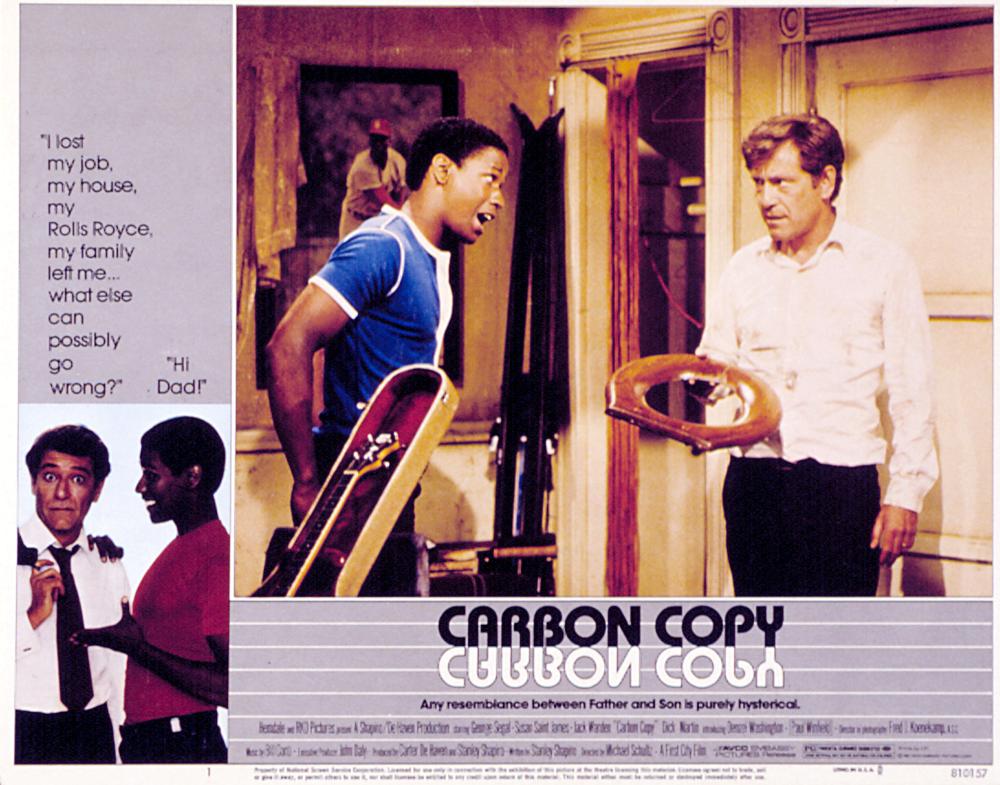
#MondayMuggers presents CARBON COPY (1981) starring George Segal and Denzel Washington!


Every Monday night at 9:00 Central Time, my wife Sierra and I host a “Live Movie Tweet” event on X using the hashtag #MondayMuggers. We rotate movie picks each week, and our tastes are quite different. Tonight, Monday March 3rd, we’re watching CARBON COPY starring George Segal, Susan Saint James, Jack Warden, Dick Martin, Paul Winfield, and “introducing” Denzel Washington.

CARBON COPY is the story about a rich, white corporate executive (George Segal) who finds out that he has an illegitimate black son (Denzel Washington). This creates a variety of issues for him at home, at work, and in his social circles.

Although CARBON COPY was chosen by Sierra, I’m looking forward to watching it for the first time for several reasons:

  1. This is the theatrical film debut of one of the all-time great actors in Denzel Washington. Everyone has to start somewhere, and it will be interesting to see Denzel at the very beginning.
  2. George Segal starred in a movie with Rod Steiger called NO WAY TO TREAT A LADY (1968). My dad used to always tell me about this movie. I bought it on DVD and added it to my collection simply because my dad loved it. I even took it to their house one year for our annual Christmas celebration so we could watch it together. That doesn’t have anything to do with CARBON COPY, but it’s always given me a reason to appreciate Segal.
  3. George Segal reportedly turned down the lead role in the film ARTHUR (1981) in order to make CARBON COPY. I enjoyed ARTHUR when I watched it growing up. It will be interesting to see how the two films compare.
  4. Director Michael Shultz also directed movies like COOLEY HIGH (1975), CAR WASH (1976), GREASED LIGHTNING (1977), WHICH WAY IS UP (1977), and BUSTIN’ LOOSE (1981) leading up to CARBON COPY. It will be interesting to see how he handles the material.

So, join us tonight for #MondayMuggers and watch CARBON COPY! It’s on Amazon Prime.

Cinemax Friday: The Babysitter (1995, directed by Guy Ferland)


Teenager Jennifer (Alicia Silverstone, shortly before she starred in Clueless) is hired to babysit Jimmy (Ryan Slater), the son of Denise (Lee Garlington) and Harry Tucker (J.T. Walsh) while the Tuckers attend a party over at the the home of Bill and Bernice Holstein (played by George Segal and Lois Chiles).  Harry spends the night drinking and fantasizing about Jennifer while Denise spends the night fantasizing about Bill.  Who does Bernice fantasize about?  The movie doesn’t say.

The adults aren’t the only ones fantasizing.  Bill’s son, Mark (Nicky Katt), is also obsessed with Jennifer and, while his parents are holding their party, he hangs out with his friend Jack (Jeremy London), who also happens to be Jennifer’s bitter ex-boyfriend.  Jack and Mark both start to discuss their own fantasies about Jennifer and they make plans to head over to the Tucker House and surprise Jennifer.  (Mark has even more in mind.)  Meanwhile, even little Jimmy is having fantasies of his own.

Today, it can be easy to forget just what a big deal Alicia Silverstone was in the early to mid-90s.  Even before she landed her star-making turn in Clueless, Silverstone achieved fame as the star of three videos from Aerosmith, all of which featured her playing roles that personified male fantasies.  Her role in The Babysitter fits right in with those Aerosmith videos as the entire film is devoted to men fantasizing about her.  Not much is revealed about who The Babysitter is and her name isn’t even revealed until the end of the movie.  Instead, the movie is about how every male in town, except for George Segal, is obsessed with her.  (What makes George Segal so special?)  Fortunately, Silverstone had the right mix of innocence and sultry beauty to be believable as everyone’s object of lust.  She does a good job playing both the normal teenage girl who just wants to make some extra money babysitting and also the exaggerated caricature who appears in everyone’s fantasies.  (Some of the fantasy scenes are ridiculous but most fantasies are.)

Especially after the release of Clueless, The Babysitter was advertised as being a softcore thriller and it used to show up frequently on late night Cinemax, playing alongside films like Body Chemistry.  Actually, it’s a satire of the suburbs that follows all of the men as they have too much to drink and make fools of themselves.  Thematically, it has more in common with movies like American Beauty, The Ice Storm, and The Virgin Suicides than it does to anything that’s ever been made by Shannon Tweed.  While many viewers were undoubtedly disappointed that Silverstone remained clothed for the majority of the film (and that even the scene where she took a bath was carefully shot to suggest more than it showed), The Babysitter was not a bad movie and it provided the great J.T. Walsh with a rare leading role.  The Babysitter is a better-than-expected mix of Nabokov and Cheever.


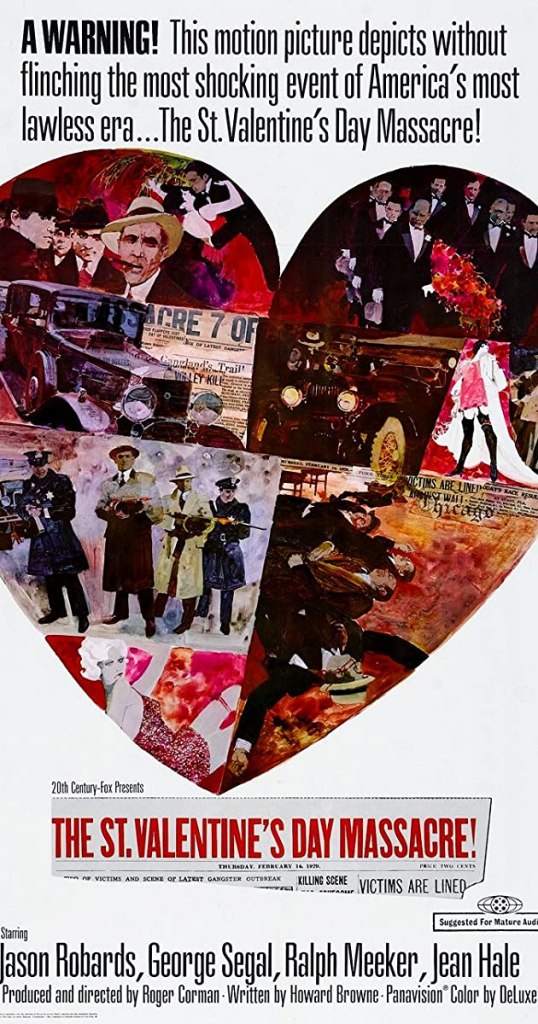
An Offer You Can’t Refuse #18: The St. Valentine’s Day Massacre (dir by Roger Corman)


On February 14th, 1929, seven men were murdered in a garage in Chicago, Illinois.  Five of the seven men were known to be associates of gangster George “Bugs” Moran.  The other two men were considered to be innocent bystanders, a mechanic and a dry cleaner who just happened to enjoy hanging out with gangsters.  Though no one was ever convicted of the crime, it was well-known that the murders were carried out on the orders of Al Capone.

In many ways, the St. Valentine’s Day Massacre was a turning point in America’s relationship with organized crime.  Before the massacre, Capone had become a bit of a folk hero.  He knew how to talk to the press and he was viewed as merely breaking a law (in this case, prohibition) that most people opposed in the first place.  However, after the murders, public opinion soured on Capone.

Some of it was the brutality of the crime.  It’s been said that over five hundred bullets were fired in that garage, all to kill seven defenseless men who were lined up against a wall.  Grisly pictures of the victims were released to the press.  Perhaps if the seven men had been carrying weapons and had been involved in a shootout with their murderers, the public’s reaction would have been different.  But this was a cold-blooded execution.

Personally, I think the fact that the killers disguised themselves as cops also played a role in the public’s outrage.  It was a very calculated move on the part of the killers and it highlighted just how much planning went into the St. Valentine’s Day Massacre.  As well, it undoubtedly made people paranoid.  If a bunch of killer could dress up like cops, who knew who else they could dress up as?

Finally, I think that Capone’s biggest mistake was carrying out the crime on Valentine’s Day.  You don’t murder people on a holiday.  Anyone should know that.  If Capone had waited until February 20th, he probably could have gotten away with it.

The 1967 film, The St. Valentine’s Day Massacre, details the rivalry between Capone and Moran, starting with them fighting for control over the Chicago rackets and ending with the title event.  Moran is played by Ralph Meeker while Jason Robards plays Capone.

Now I know what you’re probably thinking.  Perennial WASP Jason Robards as Al Capone?  That may sound like odd casting and, let’s just be honest here, it is.  However, it actually kind of works.  Robards may not be convincingly Italian but he is convincingly ruthless.  Add to that, one of the major subplots of the St. Valentine’s Day Massacre is that, even as the head of the Chicago Outfit, Capone still feels like an outsider in the world of organized crime because, while he is Italian, he isn’t Sicilian.  Capone feels as if Lucky Luciano and all of the major New York crime bosses look down on him and one reason why he’s so ruthless about taking over Chicago is that wants to show Luciano that he can be just as effective a crime lord as any Sicilian.  Capone feeling out of place in the Mafia is reflected by Robards initially seeming to be out of place in a gangster film.  By the end of the movie, of course, Capone has proven himself and so has Jason Robards.

Robards isn’t the only familiar face to be found in The St. Valentine’s Day Massacre.  Though this film was released by 20th Century Fox, it was directed by Roger Corman and Corman fills the production with members of his stock company.  Dick Miller, Jonathan Haze, and Jack Nicholson all have small roles as gunmen.  Bruce Dern plays the unlucky mechanic who enjoys hanging out with gangsters.  Buck Taylor, Leo Gordon, and Joe Turkel all have small roles.  John Agar plays Dion O’Bannon and is gunned down in his flower store.  Though not members of the Corman stock company, George Segal and David Canary plays brothers who work for Moran.  There’s a lot of characters wandering through this film but Corman makes sure that everyone gets a chance to make an impression.

It’s a good gangster film.  Though he was working with a larger budget than usual, Corman still brought his exploitation film aesthetic to the material and the end result is a violent, melodramatic gangster film that looks really impressive.  The film’s recreation of 1920s Chicago is a visual delight and looking at the well-dressed and stylish gangsters walking and driving down the vibrant city streets, you can understand why organized crime would have such a draw for some people.

The St. Valentine’s Day Massacre is a classic gangster film and a classic Corman film.  It’s an offer you can’t refuse.

Previous Offers You Can’t (or Can) Refuse:

  1. The Public Enemy
  2. Scarface
  3. The Purple Gang
  4. The Gang That Could’t Shoot Straight
  5. The Happening
  6. King of the Roaring Twenties: The Story of Arnold Rothstein 
  7. The Roaring Twenties
  8. Force of Evil
  9. Rob the Mob
  10. Gambling House
  11. Race Street
  12. Racket Girls
  13. Hoffa
  14. Contraband
  15. Bugsy Malone
  16. Love Me or Leave Me
  17. Murder, Inc.


18 Days of Paranoia #10: The Quiller Memorandum (dir by Michael Anderson)


The 1966 film, The Quiller Memorandum, is a diabolically clever little spy thriller.

The film opens with a British secret agent getting gunned down while trying to make a call from a phone booth in Berlin.  While we never learn the exact name of the agency that the man was working for, we do discover that they don’t take kindly to their agents getting gunned down in phone booths.  They send in another agent, an American named Quiller (George Segal), to take his place.

In Berlin, Quiller’s boss is a man named Pol (Alec Guinness).  Pol explains that the man in the phone booth was actually the second of his agents to be assassinated in Berlin.  All of the agents were looking for information about a Neo-Nazi group called Phoenix.  Pol tells Quiller that it is vitally important they discover just where, in Berlin, Phoenix is headquartered.  Quiller is given a few items that were found on the dead man in the phone booth: a bowling alley ticket, a swimming pool ticket, and a newspaper article about a school where it was discovered that one of the teachers had Nazi sympathies.

Though The Quiller Memorandum was undoubtedly produced with the hopes of capitalizing on the popularity of the Bond films, Quiller is no James Bond.  We know that as soon as we see him.  It’s not just that Quiller’s an American while Bond was British.  It’s also that James Bond was played by the cool and calculating Sean Connery while Quiller is played by George Segal.  Whereas Connery’s Bond never loses his confidence, Segal’s Quiller comes across as being, at first, a bit cocky and, as a result, we worry about him.  Whereas Connery’s Bond rarely gave his actions a second thought, Segal brings a slightly neurotic edge to Quiller.  You take one look at Connery’s Bond and you know that he’s going to survive no matter what.  Quiller, however, you never get that feeling.  When he’s in danger, you worry about him because it’s easy to imagine him turning up like the man in the phone booth.

And, indeed, it doesn’t take long for Quiller to get captured by the members of Phoenix.  A man bumps him with a suitcase, injecting a drug into his system that makes Quiller become drowsy.  When Quiller awakens, he’s being interrogated by an erudite man named Oktober (Max von Sydow).  Oktober’s an aristocrat.  He speaks in a very calm tone, rarely showing any hint of anger.  The only thing that betrays his evil nature are his eyes, which are cold and soulless.

Even though Quiller survives the interrogation, it’s tempting to give up on him.  After all, Quiller got captured so easily and Oktober seems so clever that you kind of find yourself wondering if maybe the agency made a mistake when they gave this mission to Quiller.  That’s where The Quiller Memorandum surprises you, though.  Quiller turns out to be a lot more clever and resourceful than anyone gave him credit for being and, for that matter, the film itself turn out to have a few more twists and turns in store for the viewer.

It’s a clever and enjoyable spy film, featuring wonderful performances from Segal, Guinness, von Sydow, and Senta Berger as the teacher who may be in love with Quiller or who may have an agenda of her own.  The film may be a spy thriller but Michael Anderson directs it as if its a film noir, full of shadowy streets and morally ambiguous characters.  The script, by Harold Pinter, encourages us to trust no one and Anderson’s direction reminds us that we made the right decision.  On the dark streets of Cold War Berlin, no one is who they seem.

The Quiller Memorandum is a must-see for fans of 60 spy films.  Watch it with someone who you think you can trust.

Other Entries In The 18 Days Of Paranoia:

  1. The Flight That Disappeared
  2. The Humanity Bureau
  3. The Private Files of J. Edgar Hoover
  4. The Falcon and the Snowman
  5. New World Order
  6. Scandal Sheet
  7. Cuban Rebel Girls
  8. The French Connection II
  9. Blunt: The Fourth Man 

Lisa Reviews An Oscar Nominee: Who’s Afraid of Virginia Woolf? (dir by Mike Nichols)


I’ve starred in a production of Edward Albee’s play, Who’s Afraid of Virginia Woolf?

That’s right.  I’ve played Martha, the heavy-drinking and dissatisfied wife of a burned-out English professor named George.  Yes, I’ve played the same role for which Uta Hagen won a Tony and Elizabeth Taylor won an Oscar.  Among the other actresses that have played Martha on stage: Colleen Dewhurst, Meg Tilly, Diana Rigg, and Kathleen Turner.  And, of course, me.

Now, I should admit that I was only 16 when I played Martha so I was perhaps a bit too young for the role.  Fortunately, my friend Erik — who played George — was only a year and a half older so he was just as miscast as I was.  (It was, at one point, suggested that I should try to put some gray in my hair but I pointed out that, as a redhead, I would never have to worry about that.)  On Broadway and film, Who’s Afraid of Virginia Woolf? runs for over two hours.  The production in which I starred only had a running time of 13 minutes.  Also, the version in which I starred did not feature the characters for Honey and Nick.  I mean, who needed them when you could just watch Erik and me yell at each other for ten minutes straight.

And that’s pretty much what we did.  When we told our drama teacher that we would be doing a scene from Who’s Afraid of Virginia Woolf? for our “Dramatic Duet,” I’m pretty sure that I saw her roll her eyes.  I imagine that’s because she knew that both of us had a tendency towards the dramatic and that the main we picked the play was so we could compete to see who could be the first to go hoarse from yelling.  She was right, of course.  There was no nuance to our performance, largely because neither one of us really understood what the play was about.  We just thought it was funny that some of our classmates covered their ears while we were loudly insulting and taunting each other.  (For the record, I went hoarse before Erik did and I spent the next two days receiving compliments about my new sexy voice.)

Now that I’ve grown up a little, I think I have a better understanding of what Who’s Afraid of Virginia Woolf? is actually about.  At the very least, I now understand that the story is about more than just two burn-outs yelling at each other while a younger couple awkwardly watches.  I now understand that the game that George and Martha play over the course of the night is not a game of hate but instead a game of a very dysfunctional but also rather deep love.  If anything, I now have more sympathy for George and Martha and far less for the play’s judgmental younger couple, Nick and Honey.

Of course, it helps that I’ve seen the 1966 film version of Who’s Afraid of Virginia Woolf?  Directed (in his directorial debut) by Mike Nichols, Who’s Afraid of Virginia Woolf? features Elizabeth Taylor and Richard Burton as George and Martha and George Segal and Sandy Dennis and Nick and Honey.  All four of them were Oscar-nominated for their roles, making Who’s Afraid of Virginia Woolf? one of the few films to see its entire cast nominated.  Elizabeth Taylor and Sandy Dennis both won in in their categories but it really is Richard Burton (who lost to Paul Scofield) who dominates the film.

Burton was a performer who could be shameless in his overacting.  (Just watch his performance in The Exorcist II if you need proof.)  And really, one would expect that the role of George would appeal to all of his worst instincts.  Instead, Burton gives a surprisingly subtle performance.  He growls when you expect him to yell and he delivers the majority of his lines not with fury but instead with a resigned and rather sardonic self-loathing.  He’s actually less showy than Elizabeth Taylor, who gives an overall good performance but still sometimes comes across like she’s trying too hard to convince the audience that she’s a 50 year-old drunk and not one of the world’s most glamorous film stars.  Throughout the film, Burton seems to be digging down deep and exposing his true self to the audience and, watching the action unfold, you can’t take your eyes off of him.  Everyone in the cast does a good job with their roles but Burton is the one who keeps the film moving.  Just as George is ultimately revealed to be stronger than he originally appears, Burton also reveals himself to be a far more compelling actor than you might think if you just knew him from his lesser roles (and performances).

Admittedly, Who’s Afraid of Virginia Woolf? is not my favorite of the many films that have been nominated for best picture over the last 90 years.  Even when the characters are inhabited by skilled performers, a little bit of George and Martha goes a long way.  That said, this is a historically important film.  The film’s language may seem tame today but it was considered to be shockingly profane in 1966.  The fact that the National Legion of Decency declined to condemn the film despite the language was considered to be a major step forward in the maturation of American cinema.  In fact, it can be argued that the MPAA rating system started as a way to tell audiences that a film like Who’s Afraid Of Virginia Woolf? was not morally objectionable but that it was still meant for adults.

Who’s Afraid of Virginia Woolf? received thirteen Academy Awards nominations.  It was nominated in every category for which it was eligible.  It won 5 awards but ultimately lost Best Picture to rather more sedate theatrical adaptation, A Man For All Seasons.


Film Review: To Die For (dir by Gus Van Sant)


The 1995 satire, To Die For, is a very clever film about some seriously stupid people.

Of course, you could debate whether or not Suzanne Stone-Maretto (Nicole Kidman) is actually dumb or not.  Suzanne may not know much about anything that isn’t on TV but she does have a natural understanding for what makes a good story.  She knows exactly the type of story that the public wants to hear and she does a good job of faking all of the right emotions.  As she proves throughout the course of the film, she’s also very good at convincing people to do stuff.  Whether it’s convincing the local television station to put her on the air as a weather person or convincing two teenagers to murder her husband, Suzanne always seems to get what she wants.

Of course, what Suzanne really wants is to be a celebrity.  She wants to be a star.  As she explains it, that’s the greatest thing about America.  Anyone can become a star if they just try hard enough and find the right angle.  If the film were made today, Suzanne would be a social media junkie.  Since the movie was made in 1995, she has to settle for talk shows and murder.

So maybe Suzanne isn’t that dumb but her husband, Larry (Matt Dillon) …. well, if we’re going to be honest, Larry’s more naive than dumb.  He’s the favored son of a big Italian family and it’s obviously never occurred to him that a woman would possibly want something more than just a husband and a lot of children.  He thinks it’s cute that Suzanne’s on TV but he’s also fully convinced that she’s going to eventually settle down and focus on starting a family.  It never occurs to him that his wife would be willing to sacrifice him on her way to stardom.

Of course, if you really want to talk about dumb, just check out the teenagers who Suzanne recruits to kill her husband.  They’ve been appearing in a documentary that Suzanne’s been shooting.  The documentary’s title is “Teens Speak Out,” which is something of an ironic title since none of the teens that Suzanne interviews really has anything to say.  Lydia (Allison Folland) is just happy that the “glamorous” Suzanne is pretending to care about her.  Russell (Casey Affleck) is the type of grinning perv who drops a pen just so he can try to get a peek up Suzanne’s skirt while he’s on the floor retrieving it.  And then there’s Jimmy (Joaquin Phoenix), with his flat voice and his blank stare.  Jimmy is briefly Suzanne’s lover before he ends up in prison for murdering her husband.  It doesn’t take much to convince Jimmy to commit murder, either.  Apparently, all you have to do is dance to Lynyrd Skynyrd while it’s raining outside.  Media interviews with Lydia, Jimmy, Suzanne, and Larry’s sister (Ileana Douglas) are sprinkled throughout the film and Jimmy continues to insist that he will always love Suzanne.

As for Suzanne, she’s got stardom to worry about….

Though the subject matter is a bit familiar and the film, made before the age of Twitter and Instagram, is a bit dated, To Die For‘s satire still carries a powerful bite.  One need only watch A&E or the Crime and Investigation network to see that Suzanne was absolutely correct when she decided that killing her husband would make her a star.  If To Die For were made today, you could easily imagine Suzanne leveraging her infamy into an appearance on Dancing With The Stars and maybe Celebrity Big Brother.  At the very least. she could get her own house hunting show on HGTV.  Delivering her often sociopathic dialogue with a perky smile and a positive attitude, Nicole Kidman is absolutely chilling as Suzanne.  Meanwhile, Joaquin Phoenix’s blank stare will continue to haunt you long after the film ends.

And speaking of endings, To Die For has a great one.  You’ll never hear Season of the Witch the same way again!